Recent work on the nature of mass polarization reveals that while ordinary citizens disagree on policy less than many tend to assume (Abramowitz and Saunders, Reference Abramowitz and Saunders2008; Fiorina and Abrams, Reference Fiorina and Abrams2008), there are large—and growing—divisions between opposing political groups in the American political context. Specifically, the prominent characteristics of polarization center on perceptions of differences between parties and candidates (Ahler, Reference Ahler2014; Westfall et al., Reference Westfall, Van Boven, Chambers and Judd2015; Levendusky and Malhotra, Reference Levendusky and Malhotra2016), between oneself and the out-party (Enders and Armaly, Reference Enders and Armaly2019), and on affective evaluations of political “others” (Iyengar et al., Reference Iyengar, Sood and Lelkes2012; Huddy et al., Reference Huddy, Mason and Aarøe2015; Iyengar and Westwood, Reference Iyengar and Westwood2015; Mason, Reference Mason2015). In other words, mass polarization is grounded most firmly in perceptions of and negative emotional orientations toward the opposing side.
Heretofore, scholars have treated these phenomena separately, developing distinct theories of perceived and affective polarization and empirically examining the processes without consideration for the other (Ahler, Reference Ahler2014; Enders and Armaly, Reference Enders and Armaly2019). However, we have good reason to believe that polarization born of affective orientations toward and perceptions of political and social groups likely stem from similar psychological processes. For example, social identity theory provides a conceptual backdrop for both processes in holding that individual orientations toward groups—positive and negative, in-groups and out-groups—guide the formation of political attitudes and choices, color political information, and generally animate the political experience (Tajfel and Turner, Reference Tajfel and Turner1979). More traditionally, ideological sophistication also plays this role, guiding the organization of political objects and providing a basis for the negotiation between what one likes and dislikes, politically (e.g., Converse, Reference Converse1964; Granberg and Brown, Reference Granberg and Brown1992). Indeed, ideological commitments have even been shown to influence affective polarization, specifically (e.g., Rogowski and Sutherland, Reference Rogowski and Sutherland2016; Webster and Abramowitz, Reference Webster and Abramowitz2017). More importantly, both theoretical traditions provide similar clues as to the nature of the causal relationship between perceived and affective polarization. If emotional orientations toward groups—whether they are based more in identity, ideology, or a combination of both—lie at the heart of political interactions, it may be the case that polarized affective reactions to political groups precede perceptions of political “distance” between such groups.
In this paper, we use several datasets to explore the relationship between affective and perceived polarization. Using the American National Election Studies (ANES) cumulative file, we observe an association between perceived and affective polarization, as well as trends suggesting that affective polarization precedes perceptions of polarization. We then test this possibility using ANES panel data from 1992 to 1996 and 2008 to 2009. Panel data provide a fairly unique opportunity to test causal relationships (see Wooldridge, Reference Wooldridge2010), and data from two different decades allows us to examine the robustness of observed patterns over time. Cross-lagged panel models estimated on both datasets provide supportive evidence that affective polarization precedes perceptions of polarization, while the opposite pattern does not find support. Consistent with previous studies (Rogowski and Sutherland, Reference Rogowski and Sutherland2016; Webster and Abramowitz, Reference Webster and Abramowitz2017), we also find that ideological extremity is related to both affective and perceived polarization, though more strongly with the latter. Finally, we consider the role of political sophistication in moderating the strength and direction of the relationship between perceived and affective polarization. Across both panel datasets, we find that as political sophistication increases, the substantive effect of past affective polarization on future perceptions of polarization increases, though past perceptions of polarization never significantly affect future affective polarization. Thus, the causal relationships we find evidence for are robust across time and level of interaction with politics.
The nature of the relationship between these variants of polarization has a number of implications for our understanding of polarization more generally. That perceptions do not appear to deepen the affective divide between groups suggests that mass polarization likely cannot be tamed with more accurate information about policy differences or attempts to emphasize moderation. Rather, perceptions of wide divergence between political groups and figures is a function of deeper, more firmly entrenched emotional commitments and orientations. This finding, itself, provides important nuance to our understanding of the individual-level psychological processes behind polarization. The more one dislikes out-groups and identifies with a given political in-group, the more psychological “distance” they perceive between those groups on a range of issues (Granberg et al., Reference Granberg, Kasmer and Nanneman1988; Granberg and Brown, Reference Granberg and Brown1992). Thus, dislike, more than a directional orientation (i.e., like versus dislike, positive versus negative), leads to a sort of detachment from political “others.” Moreover, our findings suggest that political sophistication has an emotional element to it, in addition to the ideological element, as historically conceptualized. More than ideological constraint, sophistication entails emotional constraint.
Different sources of polarization: emotion and perception
Whether the masses largely disagree on matters of policy, or are polarized on ideological grounds, is unsettled (Abramowitz and Saunders, Reference Abramowitz and Saunders2008; Fiorina and Abrams, Reference Fiorina and Abrams2008; Rogowski and Sutherland, Reference Rogowski and Sutherland2016; Enders, Reference EndersForthcoming). This is not to say, however, that the masses are not polarized. There is substantial evidence that ordinary citizens perceive a great deal of polarization (Levendusky and Malhotra, Reference Levendusky and Malhotra2016; Enders and Armaly, Reference Enders and Armaly2019) and that individuals and groups are polarized in emotional terms (Iyengar et al., Reference Iyengar, Sood and Lelkes2012; Suhay, Reference Suhay2015). The masses are perceptually and affectively polarized. Moreover, these distinct forms of polarization play important roles in politics by influencing a host of behaviors and attitudes, such as willingness to marry across party lines (Alford et al., Reference Alford, Hatemi, Hibbing, Martin and Eaves2011) and engage in the political process (Westfall et al., Reference Westfall, Van Boven, Chambers and Judd2015).
Formerly, scholars have considered these types of polarization as distinct, despite increases in both over time (e.g., Iyengar et al., Reference Iyengar, Sood and Lelkes2012; Westfall et al., Reference Westfall, Van Boven, Chambers and Judd2015) and evidence of their influence on one another (Enders and Armaly, Reference Enders and Armaly2019). However, the psychological nature of both perceptions of and affective reactions to various stimuli may suggest they are more intimately connected than implied by their separate treatment in the literature. While affective polarization may be partially grounded in ideology (at least among those that are politically sophisticated; see Rogowski and Sutherland, Reference Rogowski and Sutherland2016; Lelkes, Reference Lelkes2018; Iyengar et al., Reference Iyengar, Lelkes, Levendusky, Malhotra and Westwood2019), the very nature of categorizing individuals into groups tends to exacerbate the perceived differences between those groups (Tajfel and Turner, Reference Tajfel and Turner1979). Modern American politics is characterized by such categorizing (Huddy et al., Reference Huddy, Mason and Aarøe2015; Mason, Reference Mason2018). Once categorized, individuals tend to overestimate and exaggerate differences between groups (Pronin et al., Reference Pronin, Puccio and Lee2002; Sherman et al., Reference Sherman, Nelson and Ross2003; Boven et al., Reference Boven, CMJudd and KSherman2012). As merely identifying with a group is sufficient to produce strong emotional reactions toward both the in- and out-groups (Iyengar et al., Reference Iyengar, Sood and Lelkes2012), affective identification may precede perceptions of the political world.
But, the motivations for engaging in affectively biased behavior (such as against the out-party) are not necessarily grounded in accurate perceptions (Kenyon, Reference Kenyon2014). Americans “perceive more polarization … than actually exists” (Levendusky and Malhotra, Reference Levendusky and Malhotra2016, 378), and greater perceived polarization relates to more strongly negative affective reactions to the out-party (Enders and Armaly, Reference Enders and Armaly2019). In other words, because negative emotional reactions can be generated by skewed perceptions of a stimulus, political perceptions may precede affective polarization. So, though commonly treated independently, two forms of modern polarization for which there is a great deal of support may reinforce one another.
Despite psychological foundations that may be indicative of reciprocal causation, we have several reasons to believe that affective polarization exacerbates perceived polarization. First, identification—with a party, a candidate, or political group—generally precedes the evaluation of “downstream” political stimuli (Campbell et al., Reference Campbell, Converse, Miller and Stokes.1960; Green et al., Reference Green, Palmquist and Schickler2004; Lenz, Reference Lenz2013). Individuals perceive the political world through the lens of the group with which they identify. As such, it is sensible that affective evaluations—which are part and parcel of identification (Iyengar et al., Reference Iyengar, Sood and Lelkes2012)—are solidified before individuals make further assessments, such as a group's place in political space. This account is also consistent with evidence indicating that ideology, at least partially, underlies affective polarization (Rogowski and Sutherland, Reference Rogowski and Sutherland2016; Webster and Abramowitz, Reference Webster and Abramowitz2017); ideology, as a coherent worldview, should most certainly precede evaluations of the out-party's place relative to oneself.
More importantly for the comparison between the forms of polarization, there is some evidence that individuals consider the out-group when making sense of how various political objects (e.g., groups and individual actors) are oriented toward one another. Ahler (Reference Ahler2014), for instance, demonstrates that individuals consider the out-group's policy position when forming their own opinions. Specifically, when given factual information about the true—that is, the average, self-reported—issue positions of ideological groups, individuals moderate their own issue positions (i.e., decrease the perceived differences between themselves and the out-group). This behavior is consistent with our prediction that consideration of the out-group precedes perceived differences between groups. Indeed, individuals negotiate differences between political groups (including their own) by taking the out-group, toward whom they have established feelings, position as fixed.
Though Ahler (Reference Ahler2014) establishes that individuals consider the political opposition when forming their own opinions, the primal, foremost evaluation of that opposition—negative affect—is not considered. We aim to capitalize on existing evaluations of the out-group, rather than assess those that have been experimentally manipulated, and thereby explicitly consider the role of negative evaluations in producing perceived polarization. Do individuals who dislike the out-group perceive a greater difference between the in- and out-group as a result of that affect? And, is there heterogeneity in the degree to which individuals perceive polarization as a function of affect? We hypothesize that, because negative feelings lead to increases in the psychological distance one feels from the out-group (Granberg and Brown, Reference Granberg and Brown1992), affective polarization will similarly precede and exacerbate perceived polarization.
Ours is not the first empirical investigation of the relationship between perceived and affective polarization. Enders and Armaly (Reference Enders and Armaly2019) discuss that very relationship, finding that those who perceive greater distances between themselves and the out-party are more negative toward the out-party, out-party candidates, and out-ideological groups. The direction of that relationship, however, is not considered. Here, we build on the work of Ahler (Reference Ahler2014) and Enders and Armaly (Reference Enders and Armaly2019) by explicitly considering the temporal relationship between perceived and affective polarization.
Finally, we also suspect that political sophistication plays a role in the relationship between affective and perceived polarization. More politically sophisticated individuals have more cohesive, cogent views of the political world. This may lead to a closer connection between the two forms of polarization. But, by the nature of being knowledgeable, politically sophisticated individuals could exhibit more perceptual acuity, which should yield accurate estimates of the distances between political groups. Considering the conditional influence of sophistication allows us to shed light on the question of whether affective polarization is partially rooted in ideological foundations (Rogowski and Sutherland, Reference Rogowski and Sutherland2016; Lelkes, Reference Lelkes2018) or is largely an emotional phenomenon impacting even the politically disengaged (Mason, Reference Mason2015). We more carefully elaborate on how we believe political sophistication conditions the relationship between perceived and affective polarization below.
What causes what?
We begin our analysis by considering the aggregate relationship between perceived and affective polarization using the ANES cumulative file data from 1972 to 2016. Affective polarization is measured as an additive index composed of the absolute differences in feeling thermometer scores for opposing ideological groups, parties, and presidential candidates (Cronbach's α = 0.69).Footnote 1 Perceived polarization is a scale composed of the absolute differences in party placements on a series of issue scales (Cronbach's α = 0.86).Footnote 2 Affective and perceived polarization are moderately correlated (r = 0.41),Footnote 3 consistent with the existing research on the two phenomena (Enders and Armaly, Reference Enders and Armaly2019). We more carefully investigate this dynamic relationship in Figure 1. In light of evidence that both types of polarization are increasing over time (Iyengar et al., Reference Iyengar, Sood and Lelkes2012; Enders and Armaly, Reference Enders and Armaly2019), we split each measure of polarization into thirds, and display one type of polarization across tertiles of the other type. The upper three panels display affective polarization from 1972 to 2016 across levels of perceived polarization, and the lower three panels perceived across levels of affective. Dotted red lines represent the linear trends through the time series.
Affective polarization over time among tertiles of perceived polarization (top) and perceived polarization over time among tertiles of affective polarization (bottom), 1972–2016. Dashed line represents a linear trend.

Recall that we expect that affective polarization causes perceived polarization. If this is true, perceived polarization should be the highest, and increase the most, among those who are the most affectively polarized. While we cannot determine causality with certainty using these data (though we use appropriate data below), Figure 1 serves as preliminary evidence of our proposed causal relationship. Beginning with the lower three panels, those who are the most affectively polarized perceive the greatest amounts of polarization; the average level of perceived polarization increases when moving left to right across tertiles of affective polarization. Not only is this true in levels, but the temporal increases are the greatest among the most affectively polarized. Indeed, the slope coefficients from ordinary least squares regressions of perceived polarization onto year increase across affective polarization tertile; specifically, the standardized coefficient is 0.16 for the lower third of affective polarization, 0.19 for the middle third, and 0.27 for those highest in affective polarization. In other words, perceived polarization rises across levels of affective polarization, and the temporal increase in perceived polarization is stronger across levels of affective polarization.
We also find preliminary support for our prediction that there is no reverse causality. Though levels of affective polarization relate to perceived polarization, the over time increases—where they exist—are inconsistent with the empirical patterns we would expect if affective polarization was caused by perceived polarization. The standardized slope coefficients from a regression of affective polarization onto year are − 0.002 for the lower third of perceived polarization, 0.08 for the middle third, and 0.05 for the upper third. In sum, affective polarization relates to both the levels of, and changes in, perceived polarization. Perceived polarization only relates to the levels of, but not changes in, affective polarization.Footnote 4
While the information above reveals that the relationship between affective and perceived polarization over time hints at the former causing the latter, we utilize two panel datasets (the 1992 and 1996 waves of the 1992–1994–1996 ANES panel, and waves 6 and 9 of the 2008–2009 ANES panel) to more appropriately test this relationship.Footnote 5 More specifically, we estimate cross-lagged panel models where 1996 (wave 9) affective and perceived polarization are regressed on 1992 (wave 6) perceived and affective polarization and a host of control variables recorded in earlier panels (Finkel, Reference Finkel1995; Wooldridge, Reference Wooldridge2010). Coefficients, given in Table 1, are standardized so that the magnitudes of effects can be compared. If past affective polarization is significantly related to future perceived, but past perceived is not significantly related to future affective, we would have support for our prediction that affective polarization precedes and causes perceived polarization.Footnote 6 This is precisely what the estimates in Table 1 suggest. In both the ’90s panel and the ’00s panel, affective polarization at t − 1 predicts perceived polarization at t, but the converse is not true. The coefficients for affective polarization from the perceived polarization regressions (the first row in columns 1 and 3) are statistically significant; the coefficients for perceived polarization from the affective polarization regressions (the second row in columns 2 and 4) are not.
Cross-lagged panel models of temporal relationship between affective and perceived polarization, with controls

Standardized maximum likelihood coefficients with standard errors in parentheses.
*p ≤ 0.05 with respect to a two-tailed test.
We also note that issue extremity seems to exacerbate both forms of polarization, though more strongly and consistently with respect to perceived polarization. The relationship between issue extremity and perceived polarization is rather unsurprising; more extreme individuals project that extremity onto others (see Boven et al., Reference Boven, CMJudd and KSherman2012), resulting in large perceived differences between political groups. That issue extremity produces greater affective polarization (at least in the more modern sample) is consistent with the literature elucidating the ideological foundations of affective polarization. Increasing ideological consistency and ideological divergence between groups underlie negative affective evaluations of the out-group (Rogowski and Sutherland, Reference Rogowski and Sutherland2016; Webster and Abramowitz, Reference Webster and Abramowitz2017). Our findings lend support to the proposition that affective polarization is, at least partially, rooted in substantive ideological concerns.
Does political sophistication play a role?
Finally, we consider the role of political sophistication in the relationship between affective and perceived polarization, as sophistication tends to moderate or exacerbate a number of relationships in political science (e.g., Lelkes, Reference Lelkes2018). We expect the strength of the patterns observed in Table 1 to be positively associated with level of political sophistication. By definition, political sophisticates are those individuals who know “what goes with what” (Converse, Reference Converse1964). They possess a coherent view of the political world, owed to a belief system that tightly organizes the objects of the political world around a set of abstract political principles and values. As such, we might expect these individuals to exhibit orientations—such as emotional reactions to partisan stimuli and perceptions of group differences—that are more closely related than the same orientations among less politically sophisticated individuals. To be knowledgeable about and interested in politics is to have clearly defined views of one's feelings about the parties, and about the parties’ orientations with respect to each other.
Of course, this is not the only possibility. Sophisticated individuals are more ideological in nature than the average individual. A high reliance on ideological principles relative to emotional orientations may suppress affective polarization, just as political knowledge may promote more accurate perceptions of polarization. Some combination of these alternatives may result in a relationship between affective and perceived polarization that is weaker than that among less politically sophisticated individuals. However, Ahler and Sood (Reference Ahler and Sood2018) report a positive association between misperceptions and sophistication and Lelkes (Reference Lelkes2018) observes high levels of affective polarization among the politically knowledgeable. As such, we are skeptical of a negative effect of political sophistication, while remaining open to the possibility of observing such a pattern.
To begin our investigation, we examine the relationship between affective and perceived polarization by level of political information over time, which is shown in Figure 2. Political information is measured via interviewer ratings of respondent knowledge about politics, the most consistently fielded operationalization of political information over time. In general, the trends in affective and perceived polarization track each other reasonably closely for each level of political information. However, the rates of polarization are visually more congruent for those exhibiting high or middling levels of information. The correlation between the two variants of polarization increases fairly linearly from 0.51 among low information individuals to 0.60 and 0.70 among those possessing middling and high levels of political information, respectively.Footnote 7
Affective and perceived polarization over time by level of political information, 1972–2016.

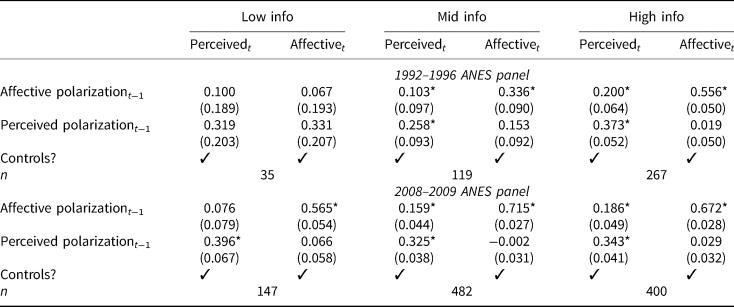
Similar to above, we now turn toward a more rigorous test of this relationship using cross-lagged panel models. The models are identical to those specified above, except that we omit political information as a control variable so that we can stratify the samples and associated models by level of information.Footnote 8 Estimates of the relevant coefficients are given in Table 2.
Cross-lagged panel models on samples stratified by level of political information

Standardized maximum likelihood coefficients with standard errors in parentheses.
*p ≤ 0.05 with respect to a two-tailed test.
Considering first the 1992–1996 panel, those low is political information exhibit no statistically significant relationships between different measurements of affective and perceived polarization; indeed, these processes are not even related to past values of the same process.Footnote 9 Among those exhibiting high or middling levels of information, the pattern is similar to that observed in Table I with respect to statistical significance: affective polarization at t − 1 (partially) explains perceived polarization at t, but past values of perceived polarization do not explain later values of affective polarization. We also find that all coefficients are larger for those with high levels of political information, compared to middling levels. For instance, the effect of past affective polarization on perceived polarization nearly doubles from 0.103 to 0.200, moving from middling to high information.
Findings are similar for the 2008–2009 data. Here, those low in political information exhibit statistically significant lagged relationships, but no crossed relationships. In other words, past affective polarization explains future affective polarization and past perceived polarization explains future perceived polarization, but the two variants of polarization are never related to each other. We suspect that this minor discrepancy in empirical patterns across panels may be due to the short period between surveys in 2008–2009 data, relative to the four year period between the 1992 and 1996 surveys—even those low in political sophistication are able to connect affective and perceived polarization from the very recent past to polarization today. Regardless, the coefficient patterns for middling and high levels of political information are nearly identical to those associated with the 1992–1996 data. Namely, past perceived polarization never explains future affective polarization, and the substantive effect of past affective polarization on future perceived polarization increases with political information.
We wish to be clear that the sources of affective polarization are, as of yet, unsettled (Iyengar et al., Reference Iyengar, Lelkes, Levendusky, Malhotra and Westwood2019). Affective polarization is connected to both ideological foundations (Rogowski and Sutherland, Reference Rogowski and Sutherland2016; Webster and Abramowitz, Reference Webster and Abramowitz2017; Lelkes, Reference Lelkes2018) and social identity (Iyengar et al., Reference Iyengar, Sood and Lelkes2012; Mason, Reference Mason2018). We believe our investigation lends additional support to the ideological account (though does not discount the prerequisite social categorization endemic to group politics). Here, the connection between affective polarization and perceived polarization is strongest among the most politically sophisticated. This is consistent with previous work that demonstrates affective polarization is stronger among the more ideologically constrained and the most ideologically extreme (Rogowski and Sutherland, Reference Rogowski and Sutherland2016; Lelkes, Reference Lelkes2018). Of course, the more politically sophisticated are more likely to possess a coherent ideological worldview, and are better able to bring that ideology to bear on other political evaluations.
If perceived polarization was merely a function of perceptual acuity among the most politically sophisticated, we would not see an increase in the strength of the relationship between the forms of polarization by level of political sophistication. Likewise, if affective polarization were exclusively driven by ideological considerations—something we doubt, given the lack of ideological constraint among the mass public (Lupton et al., Reference Lupton, Myers and Thornton2015) and the relatively few strong partisans among whom affective polarization is most concentrated (Klar et al., Reference Klar, Krupnikov and Ryan2018)—we would expect only the levels of affective polarization to increase with sophistication. In other words, levels of both affective and perceived polarization increase with sophistication; that the relationship between them also increases with sophistication suggests that ideology plays an important moderating role. Our claim, then, that affective polarization exacerbates perceived polarization is consistent with the position that affective polarization has an ideological component (e.g., Rogowski and Sutherland, Reference Rogowski and Sutherland2016; Webster and Abramowitz, Reference Webster and Abramowitz2017; Lelkes, Reference Lelkes2018). Indeed, we are implicitly accounting for ideological considerations via sophistication.
Conclusion
Our findings suggest that the greater the discord in affective orientations toward political in- and out-groups, the greater the perceived differences between those groups and their representatives when it comes to ideology and issue positions. More specifically, we find supporting evidence that the former causally promotes the latter. This dynamic provides some useful nuance to theories of mass polarization. First, it suggests that the many different manifestations of polarization that researchers have uncovered may be connected. In this case, a combination of social identity and ideological concerns nicely account for many of the major features of affective and perceived polarization, unifying our understanding of the psychological sources of mass polarization. The categorization that is natural to group politics appears to exacerbate other sources of polarization, even when considering the role of ideological extremity (Rogowski and Sutherland, Reference Rogowski and Sutherland2016).
Second, the causal dynamic has important normative implications regarding cooperation and discord. Had we found that perceptions of political divisions were culminating in negative affective orientations toward out-groups, we may have considered taming polarization through political information and cues that deemphasize partisan and ideological differences between groups and figures. However, we observed the opposite pattern. Increasingly negative affective orientations toward out-groups cause individuals to perceive greater ideological and issue-based differences between parties and candidates, irrespective of the truth. This is a powerful dynamic. Discordant emotional orientations toward in- and out-groups promote psychological distance between those groups, potentially on grounds other than one's own emotions. Thus, perceptions of polarization are, themselves, a product of motivated reasoning—further evidence that polarization is a “self-fulfilling prophecy” (Ahler, Reference Ahler2014).
We also believe our results speak to the role of sophistication in processing political information, more generally. Genuinely viewing opposing political factions as extreme would be a System 2 form of judgment, according to dual processing theory (see Kahneman, Reference Kahneman2003). That is, perceptions of the distances between political groups based on perceptual acuity would be a function of slow, analytical reasoning. However, our results indicate that a System 1 process is likely at play; individuals perceive political distances based on fast, automatic judgments that stem from affective reactions to political out-groups. We might expect the role of sophistication to promote the more measured, System 2 style of processing, but this is not what we find. In fact, those who are more politically sophisticated are more likely to rely on a heuristic (here, affective polarization) when assessing the relative divergence of groups on various issues. Our results suggest that perhaps sophistication is less about having a vast trove of political knowledge, and more related to possessing a cogent cognitive map of politics and being able to more readily access various heuristics. Simply put, the consistency and coherence defining political sophistication are not synonymous with accuracy motivations; rather they are oftentimes negatively correlated when political attitudes and predispositions are involved.
The patterns we observe also provide additional insight into an emotional component to political sophistication. More than ideological constraint, sophistication entails emotional constraint. The historic conceptualization of sophistication holds that, among the sophisticated, commitments to abstract ideological principles guide lower-order attitudes about more specific political objects, such as public policies (Converse, Reference Converse1964). The relationships we observe also suggest that abstract emotional orientations toward in- and out-groups guide perceptions of specific ideological and policy stances, among political sophisticates. Thus, to be politically sophisticated is not merely to be more ideologically consistent than others, but to be more emotionally consistent. Perhaps, then, the divisions between ideological and (supposedly) emotional processes are not as stark as we tend to treat them, as others have begun to suggest (Rogowski and Sutherland, Reference Rogowski and Sutherland2016; Webster and Abramowitz, Reference Webster and Abramowitz2017).
Our findings also build on and clarify the relationship between affective and perceived polarization revealed in previous work. Specifically, Enders and Armaly (Reference Enders and Armaly2019) use cross-sectional data to demonstrate that perceived polarization is more strongly related to affective polarization, relative to actual polarization. Here, we utilize panel data to determine whether affective polarization precedes perceived. The correlational results reported by Enders and Armaly (Reference Enders and Armaly2019) do not speak to our main question here: the relationship between affective polarization at t − 1 and perceived polarization at t. As such, we clarify the direction of the relationship between perceived and affective polarization uncovered in previous work.
We recommend that future work continue to examine the relationship between different manifestations of political division. To date, scholars have theorized about and empirically examined identity-based sorting, issue-based sorting, ideological polarization, affective polarization, perceived polarization, and many other types of geographic and sociodemographic-based sorting and polarization. These constructs productively highlight the many ways that political divisions can be sowed and have unfolded over the course of time. However, they are also surely not distinct from one another at the level of the individual, or perhaps even community. Our own investigation provides nuance to our understanding of how political perceptions are formed, and divisions exacerbated. By examining the relationships between other flavors of political discord, we may similarly uncover common threads, perhaps in the form of psychological mechanisms and orientations, that further develop our understanding of mass polarization.
Supplementary material
To view supplementary material for this article, please visit https://doi.org/10.1017/psrm.2020.24.