Children under 18 years old comprise approximately one-quarter of the United States population and are one of the country’s most vulnerable groups. Reference Dziuban, Peacock and Frogel1 The unique anatomic, physiologic, and developmental features of children cause them to be disproportionately affected by disasters. Reference Gilchrist and Simpson2 Children are at an increased risk for chemical and biological exposures due to their high skin permeability, large body surface to mass ratio, and propensity for spending time outdoors and touching dirty surfaces. Reference Bartenfeld, Peacock and Griese3,Reference Shirm, Liggin, Dick and Graham4 Children have an inherently higher respiratory rate and inhale greater quantities of toxins near ground level, where chemicals tend to collect. Reference Chung, Baum and Nyquist5 Children are also more vulnerable to disasters characterized by blasts and forceful impacts, as they have large heads and fragile organs, less fluid and blood reserves, and less protective fat and subcutaneous tissue. Reference Gilchrist and Simpson2,Reference Shirm, Liggin, Dick and Graham4 Developmentally, young children lack the mobility to escape from emergencies and often cannot comprehend and appropriately respond to threats. Reference Bartenfeld, Peacock and Griese3,Reference Shirm, Liggin, Dick and Graham4 Even when children are not physically harmed in disasters, they must often contend with short- and long-term psychological trauma. Reference Dziuban, Peacock and Frogel1 As a result of these vulnerabilities, studies of recent crises have shown that children compose up to half of all disaster victims, Reference Peek6,Reference Kousky7 whether due to a lack of mobility preventing escape during tsunamis and earthquakes, increased inhalation and exposure during chemical attacks, or mass shootings deliberately targeting schools and day care centers. Reference Dziuban, Peacock and Frogel1,Reference Bartenfeld, Peacock and Griese3,Reference Hinton, Griese and Anderson8
To prepare for and mitigate against disasters, emergency managers and hospitals routinely conduct hazard vulnerability analyses (HVAs). HVAs identify various hazards, their probability of occurrence, each hazard’s potential impact, and how prepared a given community or hospital is for a disaster. 9,10 Ideally, they should account for population-specific characteristics (ie, ages, medical needs, health conditions) and population-specific vulnerability to different disasters. Reference Campbell, Trockman and Walker11 HVAs vary based on an institution’s location, population served, and community vulnerabilities; for example, California HVAs would likely include wildfires and earthquakes, while Florida HVAs would include hurricanes.
HVAs have become standard practice across the United States due to their ability to inform disaster planning efforts. However, despite the fact that children constitute a large proportion of the total population and are a uniquely at-risk group, they are often omitted from regional, adult hospital, and community hospital HVAs. Reference Blake and Fry-Bowers12 Nationally, only 47% of all hospitals (and 67% of high-volume hospitals) have disaster plans that include pediatric needs, with the majority of hospital disaster reports not considering pediatric-specific equipment, family reunification procedures, or pediatric standards during crises. Reference Blake and Fry-Bowers12–14 Less than 50% of hospitals routinely conduct disaster drills with pediatric patients, while only 32% of hospitals have plans incorporating pediatric surge capacity. Reference Chung, Fagbuyi and Lozon15
Current State of Hazard Vulnerability Analysis (HVA) Frameworks
In the United States, the Assistant Secretary for Preparedness and Response (ASPR), through the Department of Health and Human Services (HHS), provides hospitals and regional managers with an array of HVA frameworks, resources, and examples through its Technical Resources, Assistance Center, and Information Exchange (TRACIE) website. Reference Alberts, Aronson and Barbiere16 ASPR TRACIE offers many HVA templates 17 that provide methodological approaches to classifying hazards and hazard impacts, as well as a way for organizations (or localities) to gauge preparedness and vulnerability to individual disasters. Some of the most commonly used HVA tools are the Kaiser Permanente framework, 18 the Pennsylvania Public Health Risk Assessment Tool (PHRAT), 19 and the Threat/Hazard Assessment Module (THAM). 20 These frameworks, especially the Kaiser Permanente HVA, are now widely used across the United States and internationally for regional and hospital disaster preparedness. Reference Fares, Femino and Sayah21–Reference Niu, Zhang and Jiao24
The Kaiser Permanente tool is primarily targeted at hospitals and health care organizations and provides a method to determine organizational planning priorities and establish the risk of individual hazards. 18 The template classifies hazard impact along human, property, and business dimensions, though it does not allow for additional stratification of at-risk populations or impacts within each dimension. Like the Kaiser Permanente tool, the PHRAT framework 19 helps assess hazard risk and establish planning priorities, yet it is distinct through its further distillation of hazard impact categories and incorporation of an in-depth population impact analysis alongside specific threats. The PHRAT allows an emergency manager to integrate the size of at-risk populations (eg, children age 18 and under, older adults age 65 and older, those with disabilities) as well as to care for these populations during disasters if specific procedures are in place. Finally, the Threat/Hazard Assessment Module (THAM) modality within the HHS risk identification and site criticality (RISC) toolkit 20 contains built-in data to help organizations identify hazard risk based upon geographic location and other inputs. THAM does not allow users to input specific population impacts per hazard.
Regional and hospital-based emergency managers across the world use the Kaiser Permanente, PHRAT, and THAM HVA models, along with several other templates and resources offered through ASPR TRACIE, to inform their own HVAs, with little to no modification of the original templates. However, the fact that the Kaiser Permanente and THAM models do not allow for any specific population inclusions (and even the PHRAT framework does not allow for detailed pediatric inputs) causes these templates to omit many of the pediatric considerations necessary to care for children during disasters. Even if an emergency manager wanted to modify an existing HVA template to include essential pediatric factors, the resources detailing those factors are not readily available. Instead, the majority of commonly disseminated resources available focus on helping caregivers, children, and families prepare and cope with disasters and do not provide a comprehensive framework targeted at regional or hospital emergency managers. 25–29 As a result, without a pediatric-specific hazard vulnerability and preparedness model, regional and hospital-based emergency managers across the country struggle to incorporate pediatric risks and disaster impacts into their work. 14,Reference Lyle, Milton and Fagbuyi30,Reference Ferrer, Ramirez and Sauser31
Creating a Pediatric-Specific HVA Template
In order to provide regional and hospital emergency managers with a flexible way to include children in their disaster preparedness efforts, we developed a novel pediatric HVA template to be used on its own or alongside existing frameworks. We based aspects of the template’s structure on a combination of HVA guides available from ASPR TRACIE Reference Alberts, Aronson and Barbiere16 (eg, Kaiser Permanente, PHRAT, THAM), using our pooled expertise in pediatric disaster preparedness to produce a template that offered ease of use and best reflected the unique needs of children during crises. The sub-categories within the template, which detail a given hazard’s impact and apply specifically to children, were derived from frequently studied gaps in the pediatric disaster management literature. Reference Dziuban, Peacock and Frogel1,14 Before finalizing the HVA template, we checked it for overall utility as well as compatibility with other major tools used for hospital and community vulnerability assessments.
The workbook-based template informs regional and hospital managers about their institution’s pediatric risk and resiliency as well as how prepared their regions and/or hospitals are for the pediatric consequences of those disasters (Supplemental Content, Pediatric HVA Template Workbook). It is not meant to be a thorough checklist of preparation (eg, the details, coordination, and policies of sheltering children during a displacement event) and instead spurs the inclusion of general pediatric considerations into HVAs. The template equips regional managers to think about children in disasters across multiple dimensions (eg, acute and long-term health impacts, shelter/food) and can be applied to all types of hazards. As listed hazards are intended to represent an impact to the entire region, as opposed to an individual hospital (eg, a tornado that affects a community, as opposed to damaging 1 hospital), it does not replace existing hospital-specific HVAs with intra-facility hazards (eg, water damage or power loss to a single hospital facility).
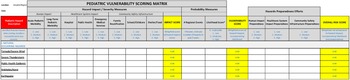
The pediatric HVA template allows managers to determine a hazard’s impact on children (impact score) and the probability of that hazard occurring, thereby establishing overall pediatric vulnerability to a given hazard (vulnerability score) (Figure 1). Managers can then input currently existing disaster preparedness efforts in order to ascertain their region’s and/or hospital’s risk to the hazard (overall risk score). The template’s construction provides managers with both the pediatric-specific impact across various categories (as in the PHRAT template) and the simplicity of a final risk score (as in the Kaiser Permanente template). Hazards included in the template were carefully chosen and based on those found in the Kaiser Permanente, PHRAT, and THAM templates.
The pediatric HVA template. The pediatric HVA template allows emergency managers to determine a hazard’s impact on children, how vulnerable the region and/or hospital is to the hazard, and the risk of each hazard based on existing preparedness efforts. For each hazard, the template produces 3 unique scores that allow for different insights. The Hazard Impact Score is a weighted score of a hazard’s impact without incorporating the likelihood of occurrence or preparedness efforts. The Vulnerability Score combines a hazard’s impact with its likelihood of occurrence. Finally, the Risk Score is a weighted score that incorporates existing preparedness efforts into a hazard’s projected impact and likelihood of occurrence.

Hazard Impact and Severity Measures and Scores
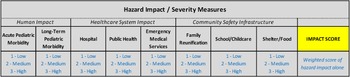
To characterize a disaster’s effect on children, the HVA template breaks a given hazard into novel impact and severity measures, one of the first instances of an HVA employing pediatric-specific categories to determine a hazard’s impact (Figure 2). These measures mirror several of the PHRAT’s classifications and are broken into “human impact,” “health care system impact,” and “community safety infrastructure.” Each of these sections is then further distilled into sub-categories that uniquely apply to children. For example, the “community safety infrastructure” category within the pediatric template is further subdivided into sections that prompt managers to consider how displaced children will be brought back to their families (“family reunification” sub-category), how school and day care closures will affect children’s safety and a hospital’s workforce (“school/childcare” sub-category), as well as how a disaster threatens the shelter and food needs of children in the community (“shelter/food” sub-category).
Impact/severity measure within the pediatric HVA template. The impact/severity measure allows emergency managers to determine how a given hazard will affect children as well as the magnitude of the impact. It is broken down into “human impact,” “health care system impact,” and “community safety infrastructure preparedness” categories.

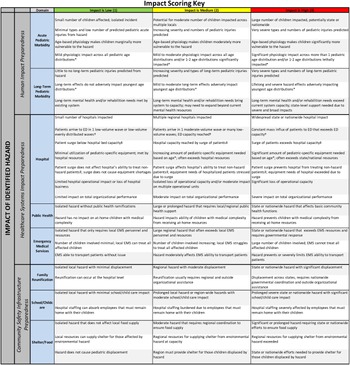
The template asks managers to assign each category an impact score of 1 (low impact) to 3 (high impact). To assist with these score determinations, the template includes an impact scoring key that assigns each category descriptions and examples across low, medium, and high impacts (Figure 3). Descriptions and examples were derived from commonly outlined pediatric needs during disasters (eg, need for pediatric-specific decontamination units during chemical and biological exposures), Reference Dziuban, Peacock and Frogel1,Reference Gilchrist and Simpson2,Reference Shirm, Liggin, Dick and Graham4,Reference Chung, Baum and Nyquist5,Reference Blake and Fry-Bowers12 existing characterizations of hazard impacts, 10,Reference Alberts, Aronson and Barbiere16 as well as descriptions within the PHRAT tool. 19
Impact scoring key. The impact scoring key provides many different considerations for each impact/severity sub-category. These considerations align across impact levels, thereby allowing managers to easily assign a score. For example, within the “acute pediatric morbidity” sub-category, the physiologic impact across age distributions is classified as mild across all ages (low impact), mild to moderate across all ages and/or severe across 1-2 age distributions (medium impact), or significant across all ages and/or lethal across 1-2 age distributions (high impact).

Although the scoring key is comprehensive, managers have wide latitude in assigning scores as each sub-category contains multiple components. For example, the “hospital” sub-category under “health care systems impact” asks managers to examine the number of hospitals a hazard affects, hospital capacity, patient flow, and the pediatric-specific equipment a given hazard necessitates. A hazard may affect these components differently, thereby allowing a manager to decide which aspects are most influential in the sub-category’s final impact score. For example, within the “hospital” category, a biologic attack on 1 community might be “low impact” in that it affects a small number of hospitals yet “high impact” in that it necessitates more pediatric-specific equipment than the region is able to provide. The manager would need to weigh these contrasting impacts within the same category in order to assign a final numerical score.
Some of the categories within the impact scoring key encourage managers to review their regional pediatric demographics and surge capabilities before assigning a score (Supplemental Content, Figure 1). While this is not a requirement to completing the HVA, it provides a means for emergency managers to identify broad areas of potential vulnerability, such as if their region lacks pediatric intensive care beds or contains a pediatric population with an uneven distribution (eg, large percentage of 0–2-year-olds). Dividing the pediatric population into separate age ranges prompts managers to appreciate how specific hazards affect pediatric physiology differently, depending on age. It also provides a more holistic assessment of a region’s pediatric capabilities, as older children can likely be cared for in adult hospitals during a surge event.
To help illustrate how an emergency manager might use the impact scoring key, the HVA template itself includes 2 examples of hazards separated into impact/severity sub-categories (Supplemental Content, Figure 2). Each sub-category is assigned a score based on the components within the impact scoring key, with a rationale for why that score was chosen.
Hazard Probability Measures and Scores
For a region or hospital to understand its actual vulnerability to a given hazard, it needs to know both the impact the hazard will have on children as well as the likelihood of the hazard realistically occurring. Building off of decades of risk management theory (where in the simplest form, risk = impact x probability) Reference Mamuji and Etkin32 and mirroring several other HVA templates, managers can assign a likelihood score to each hazard from 0 (implausible; no documented historical hazard) to 3 (high likelihood of occurring; hazard occurs every 5 years or more frequently). A weighted calculation then incorporates a hazard’s impact and likelihood of occurrence to produce a vulnerability score (ie, how susceptible a region and/or hospital is to a given hazard, without taking into account preparedness efforts).
Hazard Preparedness Measures and Scores
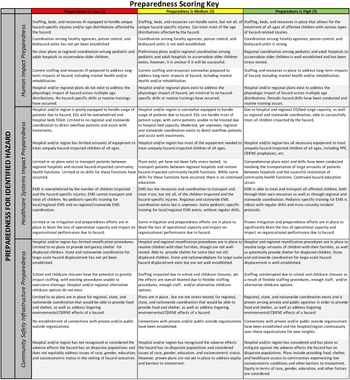
The final step in our pediatric HVA template incorporates hazard impact, hazard likelihood, and existing preparedness efforts in order to produce an overall hazard risk score. Hazard preparedness mirrors the broad hazard impact/severity categories and is separated into “human impact,” “health care system impact,” and “community safety infrastructure.” For a given hazard, emergency managers assign a preparedness score of 1 (low preparedness) to 3 (high preparedness) in each category. To assist with these score designations, the template includes a preparedness scoring key (Figure 4) that provides descriptions and examples for each category and numerical score. Similar to the impact scoring key, the preparedness scoring key is meant to serve as a guide and emergency managers are ultimately able to assign individual scores based on their own determinations.
Preparedness scoring key. The preparedness scoring key provides examples and descriptions of low, medium, and high levels of preparedness. The preparedness categories (“human impact preparedness,” “health care system preparedness,” and “community safety infrastructure preparedness”) align with the hazard impact/severity categories.

In using the preparedness scores to produce a final hazard risk score, the HVA template considers both the numerical degree of hazard impact and the score in the corresponding preparedness category. Preparedness in any 1 category (eg, “human impact preparedness”) only mitigates the impact in the corresponding hazard impact category (eg, “human impact”). For example, if a hazard is predicted to have a significant health care systems impact (by affecting hospitals, public health, and emergency medical services), and the emergency manager indicates that the region has low health care system preparedness yet high human impact preparedness, the overall risk for that hazard will be much worse than if the region had high health care system preparedness yet low human impact preparedness.
Hazard Impact and Likelihood Weights
Understanding that different regions and institutions across the world face different types and degrees of threats, the pediatric HVA template was meant to be customizable. As a result, though the framework defaults to scoring weights that reflect expert opinion and weighting systems found in other templates, Reference Alberts, Aronson and Barbiere16 emergency managers are able to assign weights to each hazard impact sub-category (eg, “family reunification”) based on which impacts they consider most consequential or relevant. Higher weighted categories have a more significant effect on final score determinations than lower weighted categories. Preparedness scores can also be weighted, so that higher preparedness has an even greater mitigating effect on the final risk score. These weighting features would be useful for emergency managers who want to customize the pediatric HVA based on prior experiences or unique characteristics of their region. For example, in a geographic region where past hurricanes have significantly impacted pediatric morbidity and mortality despite robust preparedness efforts, an emergency manager may choose to increase the acute pediatric morbidity impact weight and decrease the preparedness scoring weights, thereby more accurately reflecting hurricanes’ severe risk to the region.
Discussion
We created an HVA template that can provide emergency managers and public health and hospital leadership with essential insights into how hazards impact their pediatric populations. 33 Hazard vulnerability analyses are a powerful tool for hospital and health coalition engagement and offer a tangible approach to understanding and quantifying what would otherwise be an overwhelming proposition: predicting and mitigating against the outcomes of a devastating event. 9,10 However, as individual disasters have varied and in wide-reaching consequences on different populations, tools that aim to capture hazard impact and preparation on a granular level cannot treat an affected community as a homogeneous group. Children are one of the largest population segments that should be considered separately during disasters given their unique physiologic and developmental vulnerabilities. Reference Gilchrist and Simpson2,Reference Bartenfeld, Peacock and Griese3 Even within the broader pediatric population, it is necessary to note age-based anatomic variations and equipment needs in order to wholly assess hazard impact. Yet despite the importance of separate pediatric hazard planning, a 2018 study examining the disaster preparations of hospitals across one of the largest US states demonstrated that only 41% of hospitals had guidelines regarding pediatric surge capacity, 44% had reunification procedures for children and families, and a mere 29% of hospitals had protocols to identify and protect displaced children. Reference Vick, Wilson, Fisher and Roseamelia34 As our HVA template includes many of these pediatric-specific characteristics, emergency managers can use it to create a more comprehensive assessment of their pediatric populations and preparatory requirements.
Ultimately, being able to accurately and consistently measure hazard risk and impact is an incredibly complex process that no single tool can accomplish on its own. There is a balance between creating a hazard assessment modality that is so broad as to miss meaningful population subtleties and one that is exceedingly specific as to no longer be useful. We designed our pediatric HVA impact categories to have more detailed stratifications than the Kaiser Permanente model, 18 yet not require as many technical or numeric inputs as the PHRAT 19 or THAM 20 models. We also attempted to balance familiar and new features by combining broader impact categories that would be recognizable to emergency managers who have used existing templates (“human impact,” “health care system impact,” and “community safety infrastructure”), with novel pediatric-specific sub-categories (eg, “acute pediatric morbidity,” “family reunification”). For managers looking for even more specificity and customization, the impact, preparedness, and likelihood weights can be adjusted within the template to better reflect an individual region or hospital.
Additionally, to better capture hazard impact, an ideal HVA should instruct users on what a hazard’s potential impacts could be. The pediatric HVA template was designed for emergency managers with both comprehensive and limited pediatrics experience. The impact and preparedness scoring keys provide enough examples to guide managers who have not previously considered children in HVAs yet allow experienced managers to deviate and make their own scoring determinations. Our HVA was also designed to minimize potential bias; an examination of hospital HVA practices found that preparedness results differed based on the HVA facilitator’s background (eg, facility engineering, public health), despite facilitators using the same HVA template and working for hospitals within close geographic proximity to one another. Reference Campbell, Trockman and Walker11 Even when asked to assess identical hazards, different groups can produce disparate risk calculations, at least somewhat due to the effects of recent bias and subjective risk perceptions. Reference Campbell, Trockman and Walker11,Reference Cole35 The scoring key examples and descriptions of graded severity (ie, low impact to high impact) within our pediatric HVA template frame pediatric issues within an appropriate context to try and reduce the potential of biased scoring by individuals with different backgrounds and those less familiar with pediatric disaster management. For example, within the “public health” sub-category of the template’s “health care systems impact preparedness,” a low-impact hazard would not be expected to affect the road conditions, power grids, or transportation necessary for children with medical complexity to receive at-home resources, while a high-impact hazard would be expected to prevent these ill children from receiving necessary home care. Even when the scoring keys’ examples and descriptions do not directly apply to a manager’s region or hospital, reading through the keys can provide a frame of general pediatric issues that managers should consider when planning for children in disasters.
Reducing an HVA’s many insights into a single final score allows managers to compare the risks of different hazards to one another but also to minimize the HVA’s usefulness for those managers who want more stratification. The template provides 3 different scores: an overall risk score that lets managers analyze traditional hazard risk (incorporating preparedness), as well as impact and vulnerability scores that allow managers to compare isolated hazard impacts and pediatric population exposures. These additional scores would be important for managers wanting to isolate impact in order to reapportion existing resources or managers looking to remove probabilities and accepted consensus from their analysis in order to prepare for worst-case scenarios.
Further work is needed to determine the overall usefulness and applicability of the pediatric HVA template, its sub-categories, 3 different scores, as well as the impact and preparedness scoring keys. Next steps involve disseminating the template to regional emergency managers and managers of adult and pediatric hospitals. It will be important to observe whether and how managers integrate the template into their existing systems and how managers with limited pediatric experience handle the template’s scoring.
Limitations
There are important limitations to acknowledge regarding the pediatric HVA template. By design, all HVA templates attempt to reduce complex disaster outcomes into discrete numbers. However, there are several qualitative factors and consequences that HVAs cannot capture. Leaving these out can lead to overconfident predictions and deter preparations for rare hazards (either due to a low likelihood of occurrence or high existing preparedness). Furthermore, our HVA template is built around the idea that disasters have such a unique impact on vulnerable populations that each population needs to be analyzed separately. While this template concerns children only, there is no shortage of other important vulnerable populations such as the elderly, disabled, homeless, and impoverished communities. Using a different HVA for each vulnerable population may become too time-consuming and complicated for emergency managers to realistically undertake. The pediatric HVA template, in particular, contains above-average levels of required reading and analysis (eg, the scoring keys) that managers may not want to complete.
Finally, although the template was designed to provide emergency managers with the flexibility to apply hazards to their individual circumstance, some managers may still find it too limiting. Managers may not agree with the template’s sub-categories or the fact that in the overall risk score, preparedness only mitigates hazard impact in its corresponding category. Some managers may also find the 1 to 3 scoring criteria to be overly restrictive, instead preferring a wider range of scoring options.
Conclusion
Though children comprise a large proportion of the population and are one of the most vulnerable sub-groups, they are often overlooked within the field of disaster management. We created a pediatric-specific HVA template that includes relevant pediatric categories absent from other templates in order to allow emergency managers to better consider the needs of children during crises. Our HVA incorporates both the impacts of individual hazards on children as well as the preparedness necessary for hazard mitigation. This encourages managers to plan for pediatric-specific outcomes that they may not have previously recognized, while simultaneously strengthening existing preparedness efforts. The template is available for download and can immediately be used either on its own or as a complement to other existing HVA tools. 33 The use of our template could practically lead to improved pediatric equipment management, the creation of previously absent reunification procedures, and the incorporation of children into disaster drills. Managers can apply our template’s analysis to establish relationships with nearby hospitals, emergency medical services, and local government agencies to plan for pediatric surge events that overwhelm a single hospital’s bed capacity, require patient and resource diversions, and necessitate providing food and shelter to children. We hope that the template’s widespread dissemination can create a standardization for comparing pediatric disaster impacts and preparedness across different geographic regions and health care systems. Further work is needed to determine the overall effectiveness and usefulness of the pediatric HVA template.
Supplementary material
To view supplementary material for this article, please visit https://doi.org/10.1017/dmp.2022.90
Funding statement
Funding was provided in 2019 from the Department of Health and Human Services (HHS) Assistant Secretary for Preparedness and Response (ASPR), award number U3REP190615-01-01, in order to create a pediatric disaster care center of excellence. This paper was the result of the Hazard Vulnerability Analysis (HVA) working group within the Eastern Great Lakes Pediatric Consortium for Disaster Response, 1 of 2 centers of excellence created and funded by the HHS ASPR grant.
Conflict(s) of interest
None of the authors have any conflicts of interest to report.