On 30 October 1896 the Boston Symphony Orchestra premiered the highly anticipated “Gaelic” Symphony by Amy Beach (1867–1944).Footnote 1 Although Beach had long been known in Boston as a piano prodigy and young composer, the premiere of a symphony marked a new point in her career. It signaled that the twenty-nine-year-old had joined an elite group of composers who could successfully produce music in such a revered genre. Beach's gender added a degree of novelty to the affair. Composer George W. Chadwick summarized such sentiments when he famously wrote, “I always feel a thrill of pride myself whenever I hear a fine new work by any one of us, and as such you will have to be counted in, whether you will or not—one of the boys.”Footnote 2 In their reviews of the event, many of Boston's famous critics explored potential reasons for the work's Irish title, illuminating conceptions of the Irish among Boston's upper classes.Footnote 3 In his laudatory review, Howard Malcolm Ticknor speculated that the title originated in the general moods of the work, which he thought reflected idealized stereotypes of the Irish. He wrote that the symphony conjured the “land and life of the ideal Gael.”Footnote 4 Philip Hale, on the other hand, expressed derision for the work and the people it referenced when he dismissed the third movement as “eminently Gaelic, dull, and intolerably long-winded.”Footnote 5
Almost a century later, the Brooklyn Philharmonic presented the “Gaelic” Symphony at the Brooklyn Academy of Music on 28 January 1994. Led by conductor Dennis Russell Davies and artistic director Joseph Horowitz, the performance was part of a festival titled “From the New World” that honored the centenary of Antonín Dvořák's Symphony no. 9, “From the New World,” and the fiftieth anniversary of Beach's death. The concert included the “Gaelic” and “New World” Symphonies, as well as the “Dirge” from Edward MacDowell's “Indian” Suite. Perceptions of Beach's work had changed dramatically; it had become positioned as an explicit rebuttal to Dvořák's, delivering a message about Beach's putative ideas of musical nationalism in response to his prescriptions, illustrated in his symphony. Of this performance of the “Gaelic,” Allan Kozinn of the New York Times wrote:
Beach's work is interesting as a response to Dvořák: she countered his assertion that spirituals were the ideal basis of an American style by using English, Scottish and Irish ballads instead. But in matters of gesture, coloration and effect, the work bears an uncanny resemblance to the “New World” and is far less innovative than contemporary works by Chadwick or Ives that might have been chosen. The orchestra played it vibrantly, but programming it back to back with the “New World” did Beach no favors.Footnote 6
Peter G. Davis of New York magazine followed suit, faulting the festival organizers’ choice to program the “Gaelic” on account of supposed unoriginality:
As at most events of this sort, one encountered much that was new, fascinating, and revelatory, offset by just as much that seemed forced, unnecessary, and downright irritating. It was salutary to be reminded of Amy Beach, who was blessed with an extraordinary creative gift that remained largely imitative; one wonders what more she might have made of it had she been born later, into a less genteel, European-driven musical culture.Footnote 7
For these critics, the shadow of Dvořák loomed large over the “Gaelic” Symphony, and Beach's work was far too derivative.
The 1990s were a critical time for the reception history of the “Gaelic” Symphony, when interest in the work was revived after a long period of latency following Beach's death. This renewal happened in part because scholars discovered a relationship between Beach's symphony and the “New World” Symphony. Such connections encouraged proponents of Beach to add her name to celebrations of the centenary of Dvořák's visit to the United States, including the Brooklyn festival.Footnote 8 But the discovery was a double-edged sword. Critical understanding of the “Gaelic” has since centered so much on Dvořák that Beach and her symphony have come to be pigeonholed, opening the door for critiques like those of Kozinn and Davis. Such evaluations of the “Gaelic” as overly reliant on the “New World” stem from the assertion that American nationalism is at the heart of the work and that its Irish themes constitute Boston's “great response” to the Czech visitor's call to arms of American composers.Footnote 9
Indeed, in the past few decades, scholarship on nineteenth-century orchestral music in the United States has focused on nationalism. American symphonists are critiqued for their strategic constructions of either American exceptionalism or cosmopolitanism. Although cosmopolitanism often suggests the transcendence of national borders to tap concepts of universal experience, American cosmopolites are also frequently interpreted via the framework of nationalism.Footnote 10 Richard Crawford, H. Wiley Hitchcock, and Douglas Shadle have ably shown that, even when American composers sought to imitate Germanic or French models without sounding particularly American, they often did so in a climate in which the absence of explicitly American material actually constituted a strategic approach to American nationalism.Footnote 11 Such insights have helped us to understand more deeply the work of many American composers such as George Frederick Bristow, John Knowles Paine, and Edward MacDowell.Footnote 12
Explorations of musical and extramusical material from many nations, however, can represent encounters across national borders, particularly in the symphonic genre. Scholars of the late-century symphony in Europe suggest that some composers envisioned the genre as “a sonorous analogue of humanity.”Footnote 13 Its diverse instruments coming together to perform elaborate, lengthy musical works, the orchestra came to be seen as a communal organ for exploring ideas of universal human experience. Americanists, however, have yet to extensively examine the ways in which American composers explored material from beyond their own national borders without framing that exploration as purposefully nationalistic.
This article seeks to start that discussion by illuminating transnational encounters in Beach's “Gaelic” Symphony. I use the term “transnational” here instead of “cosmopolitan” because the international encounters in the “Gaelic” Symphony are often targeted at specific nationalities for specific reasons. Cosmopolitanism is, however, seen as one strategy for transnational encounters and thus occasionally emerges in the essay. I reposition Beach's symphony, a prominent late nineteenth-century American expression of Irishness in music, as a reflection of her connections with two significant groups: concert music composers and the Irish diaspora.Footnote 14 Regarding the former, symphonic composers of the late-nineteenth century often expressed the weight of the genre's history by alluding to preexisting work.Footnote 15 Beach borrowed material from numerous models to construct her symphony, adopting a frequent approach to symphonic writing at the time. Her roster of models includes the “New World” Symphony. Considering other sources for the Beach's work, however, contextualizes the relationship between the “Gaelic” and the “New World,” and in the process, it illuminates much about Beach's style. Beach also introduced the category of Irishness when she explicitly invoked it through her symphony's title and use of borrowed Irish melodies. Although her own heritage was not Irish, she lived in Boston, a city with unique ties to Ireland via immigration patterns. In the 1890s, a revival of Irish cultural practices that was fueled by socio-economic shifts engendered new debates about the place of the Irish in the New World. Taking the Irishness of the work on its own terms, without the intermediary framework of American nationalism, helps us to understand the role of the “Gaelic” Symphony within Boston's Gaelic revival. Taken together, the two transnational dimensions of the “Gaelic” Symphony can begin a discussion on the work of American composers’ explorations of the larger world.
Transnationalism and the “Gaelic” Symphony's Multiple Models
Beach possessed an encyclopedic knowledge of the Euro-centric canon of classical symphonic works, and her internal catalogue was put to good use in composing her symphony. Like many concert music composers of her day, Beach often consciously explored preexisting music to write new music.Footnote 16 This section explores Beach's use of models in her symphony, including the “New World” Symphony, but also other work by French and Germanic composers. Understanding the “Gaelic” Symphony as a representative of the often intertextual symphonic genre, we are also able to understand Beach's relationship with European traditions as well as Dvořák's work in the United States. After revising the relationship between the “Gaelic” and the “New World” Symphonies, analysis of the part of the “Gaelic” most often tied to the “New World”—the second movement—reveals that this part of the “Gaelic” has at least two other models that shaped significant aspects of it. Understanding Beach's intentionally intertextual process in the “Gaelic” helps to reposition the work as part of an international art-music practice that extended well beyond the border of the United States.
Some explanation for Beach's use of models can be found in her unusual childhood and musical training, which has been well documented by Adrienne Fried Block.Footnote 17 Born on 5 September 1867, Amy developed signs of prodigious talent early. Before she could say a word, Amy could hum forty tunes in the key in which she had first heard them, and she would cry if someone sang a variant of a song she had already learned.Footnote 18 She commenced piano studies and composing at four. Parents Clara and Charles Abbott Cheney supported her musical development to a degree, but gender bias and religion led them to think of her musical precociousness as potentially dangerous.Footnote 19 Middle-class childrearing beliefs of the day suggested that if a young child, particularly a girl, indulged in music too publicly or too early she stood to lose perceived female virtue and moral integrity. Rather than nurturing Amy's musical interests wholeheartedly, the family continuously balanced societal expectations and the child's passion. They decided to provide her with piano lessons, but compositional training crossed the line. Except for a year of basic theory classes with Junius Hill, professor at the Boston Conservatory, she received no formal theory or composition instruction.Footnote 20 In lieu of lessons, Beach prepared to write large-scale works by rigorous self-study of treatises and scores, largely of European origin. She perused the French Traité general d'instrumentation by François-Auguste Gevaert and Grand traité d'instrumentation et d'orchestration modernes by Hector Berlioz.Footnote 21 She also studied orchestral works assiduously in anticipation of Boston area performances. To ensure that she had absorbed them fully, Beach sometimes memorized and copied entire scores before attending concerts.Footnote 22 The process was intensive, and later in life, she advised that aspiring composers think carefully before following in her footsteps: “I do not recommend my system of study to the average student. It requires determination and intensive concentration to work alone, and those who are not equipped for it would go seriously afield.”Footnote 23 But her studies afforded Beach an internal catalogue of preexisting works from which to draw when she embarked on composing her symphony.
A surviving notebook in which she recorded analyses and thoughts on works she heard performed illuminates her musical tastes and approaches to composition. Figure 1 shows her notebook entry for her second hearing of the “New World” Symphony.Footnote 24 Often when hearing works performed, she focused on possibilities of orchestral color, reflecting her readings in orchestration. She rejected the heavy, brass-driven timbres that were characteristic of composers such as Wagner and Strauss, although she admired more delicate music by those composers immensely. For instance, of Strauss's prelude to Act 1 of Guntram she wrote, “In the middle of the Prelude the noise is sometimes overpowering but on the whole the richness of the orchestral coloring is most enjoyable.”Footnote 25 These sentiments demonstrate her approach to orchestration in her own symphonic works, which avoid the robust brass timbres of Wagner and Strauss.
Amy Beach's music reviews, vol. 2, p. 26–27, Milne Special Collections and Archives Department, Dimond Library, University of New Hampshire. Reproduced by permission.

Beach's notebook also reveals a distinct interest in preexisting material. She often connected the works she heard to others, listing possible influences and forbears. Of the Strauss prelude, she wrote, “musically the entire work is built on Wagner pure and simple; the Preludes to Parsifal and Lohengrin being so strongly suggested as to lead one to expect their themes to actually appear.” Although she criticized this work for being overly reliant on Wagner's example, she lauded others for what she perceived as more complex intertwining of numerous models. For instance, one of Beach's favorite works was Tchaikovsky's Symphony no. 6. She reviewed the work three times in her notebook, offering her plaudits on each occasion. She particularly enjoyed what she perceived as the composer's deft absorption of numerous models. In the work's first movement, for example, she heard influences of Saint-Saëns's Symphony no. 3 (the “Organ Symphony”), Charles Gounod, Anton Rubinstein (Tchaikovsky's teacher), and Wagner's Rheingold.
The notebook affirms that Beach consciously considered intertextuality in concert music, and she brought the approach to bear on the writing of her symphony. Work on the “Gaelic” Symphony began around January 1894.Footnote 26 She was twenty-six years old and had thoroughly studied numerous examples of orchestral music by composers of many nationalities, honing her craft by the examples of German, French, Russian, Italian, and Eastern European composers, in addition to learning from her local cohort in Boston. Just then, Dvořák sparked one of the greatest publicity frenzies that composers of American orchestral music have ever seen. It makes sense that the “New World” Symphony served as a model for Beach's “Gaelic” Symphony, but my research reveals that the relationship between Beach's work and Dvořák's is more nuanced than we have yet acknowledged.
The story is oft told. Dvořák had come to the United States in 1892 to lead the National Conservatory in New York with a mandate by the school's patron, Jeanette Thurber, to encourage an American national style of concert music. In May 1893, he stated that African American music should be the basis for American national style in a New York Herald interview titled “The Real Value of Negro Melodies:” “In the negro melodies of America I discover all that is needed for a great and noble school of music.”Footnote 27 The remarks were widely published and enormously controversial.Footnote 28 The premiere of his “New World” Symphony on 16 December of that year was a demonstration of those ideas, which by then included Native American music as well. Beach likely attended one of the Boston Symphony performances on the twenty-ninth and thirtieth of that month.Footnote 29
Beach became involved in the controversy as one of several Boston respondents to the May interview. Her lengthy letter published in the Boston Herald provided the opportunity to speak out in favor of nationalism, but instead, she expressed hesitation to proclaim one group of people as American at the expense of others. She suggested that the country's diversity prevented any single type of music from representing her nation, writing that “the African population . . . represents only one factor in the composition of our nation.”Footnote 30 In the course of the article, Beach mentioned a number of groups whose music might be tapped by American composers, including African Americans, Native Americans, Italians, Swedes, Russians, English, Scottish, Irish, Germans, and Chinese. Although she suggested that people from her own locality might be more prepared to use “English, Scotch, or Irish songs inherited with our literature from our ancestors,” she did not claim that these groups held cultural sovereignty over American music. Rather, she expressed resistance to limiting American composers’ palettes, adopting an inclusive approach to musical style tempered only by the composer's individual heritage and experience.
After her response to Dvořák's remarks, scant evidence supports the notion that Beach considered American national style at all. Few sources report her considering the matter, even in connection to the “New World” Symphony. In her music reviews notebook entry on Dvořák's work, Beach expressed no interest in Dvořák's strategy for American national identity.Footnote 31 Instead, after lengthy consideration of musical elements, she expressed concern for a problematic representation of slavery. She worried that Dvořák had created too lighthearted a representation of African Americans in his work:
It seems to me light in caliber . . . and to represent only the peaceful, sunny side of the negro character and life. Not for a moment does it suggest their sufferings, heartbreaks, slavery. It is all active, bright, cheery and domestic, the slow movement especially suggesting the home life to me, with the baby being sung to sleep. From this point of view it is admirable, but there is much more that might have been added, of the dark, tragic side!!”Footnote 32
Beach remained reticent on the matter of nationalism in music for some time. After her 1893 response to Dvořák's “The Real Value of Negro Melodies,” nothing was published by this high-profile public speaker on her opinions about nationalism until the advent of the First World War.Footnote 33 Neither did critics take up the issue; none mentioned the Irishness of the “Gaelic” Symphony as representative of American nationalism, nor did any review mention a connection with Dvořák during Beach's lifetime. On this issue, my reading of one particular review differs from that of Block. She describes a 1916 Kansas City critic as a “lonely voice” who recognized “nationalist implications” of the “Gaelic” Symphony. The critic wrote: “It is a grievous mistake to assume that American writers must confine themselves to ‘high-brow coon songs’ or American Indian melodies in order to preserve their nationalism.”Footnote 34 In the rest of the article, however, it becomes clear that the critic was deriding all composers who felt they needed to express their nationality in music. He advocated instead for a cosmopolitan musical style that transcended political boundaries, proclaiming Beach as a member of its vanguard: “Music is a universal language and it might be contended that the sooner American composers lose their provincialism in the artistic cosmopolitanism which embraces the whole world of inspiration, the sooner there will be more real American music.”Footnote 35 To this critic, Beach's use of Irish music did not represent her American identity so much as it signaled that she had transcended the perceived limitations of nationalism. American national identity in music was simply not a matter of discussion in the first century of the “Gaelic” Symphony's existence.
Clearly, however, the Czech composer's music guided some of Beach's choices when she composed the “Gaelic” Symphony. Rather than connecting Dvořák, the “Gaelic” Symphony, and nationalism, I propose we consider Dvořák, the “Gaelic,” and folk music within the context of the nationalism debates. The amount of attention given to the Czech composer's ideas prompted extensive reflection by Beach on folk music in concert spheres. Her musings in Dvořák's wake certainly shaped her approach to writing a symphony using folk music. They might have guided her choice of source material, particularly the music of an underprivileged minority in her locality whose struggles for inclusion in American society were a major political, social, and cultural issue at the end of the nineteenth century. That does not mean, however, that by musing on folk and concert spheres Beach engaged intellectually with ideas about American nationalism.
Significantly too, the “Gaelic” Symphony is not the first work by Beach to use folk tunes, and her use of folk material predates the May 1893 “Real Value of Negro Melodies.” An 1892 scena ed aria for orchestra and contralto, “Eilende Wolken, Segler der Lüfte,” borrows the melody of a song by Robert Burns, “Auld Rob Morris.”Footnote 36 Beach's work uses text from Friedrich Schiller's Maria Stuart, a dramatic telling of the life of Mary, Queen of Scots. The Burns song appears in the orchestra during several interludes to illustrate Mary's unspoken thoughts of Scotland as she sits imprisoned in England.Footnote 37 The work uses Scottish music, then, in the programmatic tradition of composers such as Berlioz, Liszt, Wagner, and Strauss as a narrative device, to convey Mary's internal experience.
Beach's interest in folk music prior to Dvořák's work is unsurprising, given the degree to which concert music composers looked to folk sources at the time. Indeed, in the 1890s, folk music was such a common focus of composers’ attention that we can interpret both Dvořák's and Beach's interest in folk music as part of a much larger phenomenon. A number of confluent trends—Herderian nationalism, republican uprisings, the unifications of Germany and Italy, and European colonialism—had encouraged composers to look to folk music as source material for some time. Along with Dvořák and Beach, many composers of the day, including some of Beach's American cohort and some of her European favorites—Chadwick, MacDowell, Brahms, Liszt, Robert Schumann, and Mendelssohn, to name but a few—based major works on folk music. In such an environment, we cannot reasonably credit Dvořák alone for motivating Beach to use folk music in her symphony. Rather, we can recognize her participation in the dialogue surrounding Dvořák as one of many outlets for her to explore folk music's many possibilities in concert works.
Nevertheless, the “New World” Symphony and the spectacle surrounding it clearly made an impression on the twenty-six-year-old Beach at a critical time in composition of her own symphony. A direct musical relationship between the “Gaelic” Symphony and the “New World” Symphony has been well documented by Adrienne Fried Block and Michael Beckerman, among others.Footnote 38 General dimensions of the two works have much in common. They share the key of E minor; themes in both are mostly pentatonic; they have similar instrumentation—ensembles that could be described as early-romantic orchestras; and they both last around forty minutes, although both works can vary in length depending on tempo choices. Whereas Dvořák wrote new themes based on his impressions of African- and Native American music, Beach used preexisting Irish melodies. Yet in this discrepancy scholars also see a relationship; Block and Joseph Horowitz theorize that Beach's choice was motivated by criticisms of the “New World” Symphony that claimed the work lacked any substantial influence of folk music because Dvořák did not use direct quotations.Footnote 39
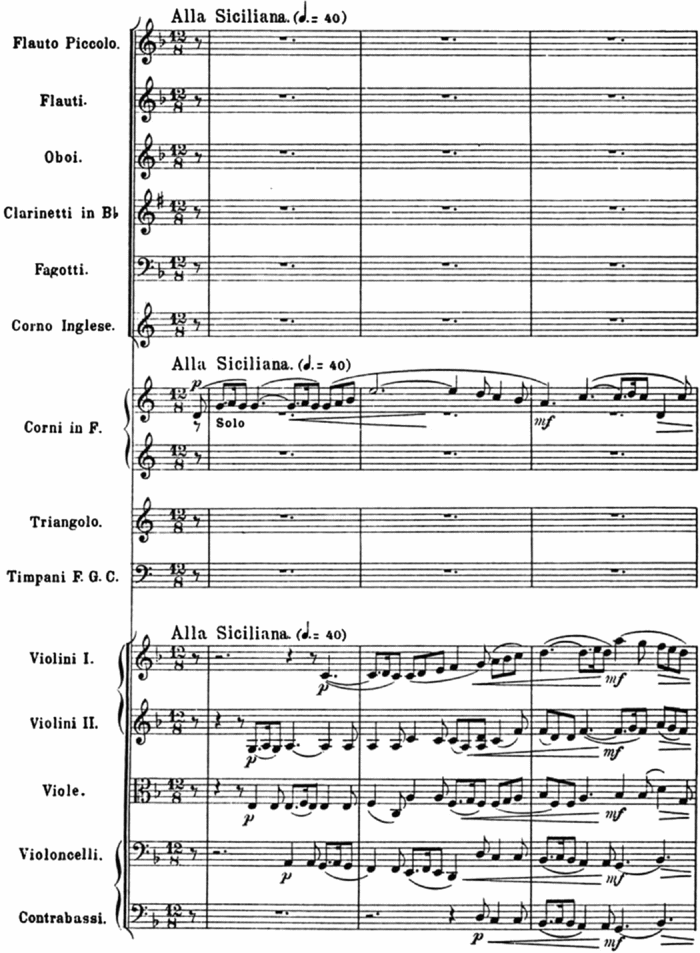
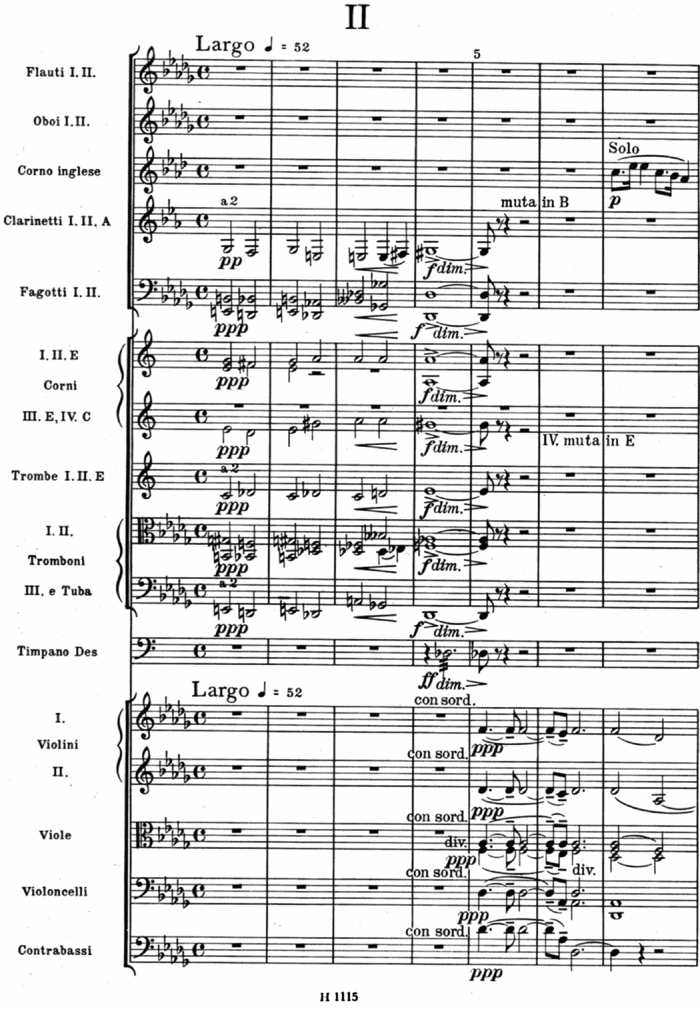
The similarity between the symphonies is most often noted in their second movements. Both movements begin with slow, brass-dominated introductions. Dvořák's introduction serves as modulation to the D-flat major tonality of the second movement from the first movement's E minor. Beach's presents the F major tonal center of the movement in a different way, by asserting the dominant of the new key. Beach might not have even noticed Dvořák's modulation when she heard the symphony, as she makes no mention of it in her listening journal.Footnote 40 After the introductions, similarities continue: both movements feature pentatonic first themes with lilting rhythms in double-reed instruments. The two movements also have quicker middle sections that eventually capitulate to a return of the first theme by the movement's end. In their larger formal designs, however, there is dissimilarity. Whereas Dvořák's second movement constitutes the slow movement of the symphony, marked “Largo,” Beach's functions as the scherzo. Beach switches the order of the scherzo section and the trio, placing the trio at the beginning and end of the movement with the scherzo in the middle. As Block describes, the form is turned “on its head.”Footnote 41
Amy Beach, “Gaelic” Symphony, op. 32, mvt. 2 opening (Boston: Arthur Schmidt, 1897).
Antonín Dvořák, Symphony No. 9, “From the New World,” op. 95, mvt. 2, opening (Berlin: N. Simrock, 1894).
Beach's movement, however, was shaped by at least two other works: Camille Saint-Saëns's Violin Concerto no. 3 and Johannes Brahms's Symphony no. 2. Understanding the combination of influences at work helps us put her work into far more nuanced perspective. The “Gaelic” Symphony, rather than being an explicit response to a single work with specific aims, instead becomes a work that interconnects streams of influences from multiple countries and, in the process, reflects universalist ideas about the symphonic enterprise. And in the case of Saint-Saëns's concerto in particular, the similarities are striking.
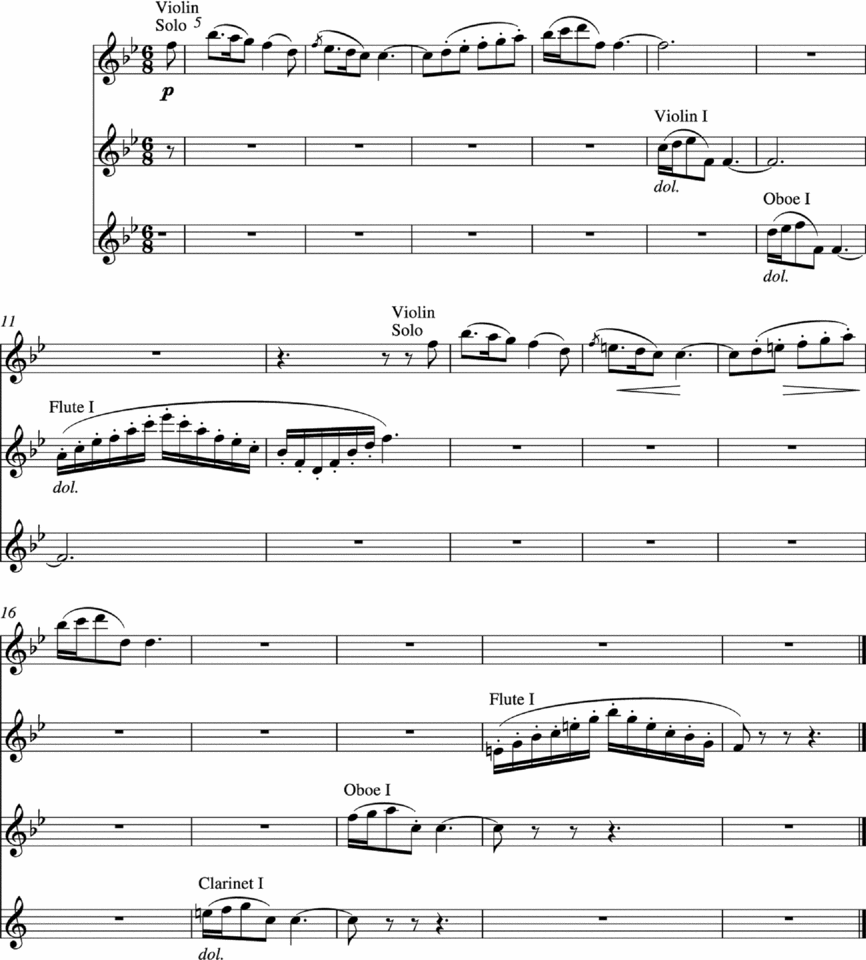
Beach left us one significant clue that the Saint-Saëns's concerto was significant to her movement when she marked it “Alla Siciliana.” The marking is a curiously Italian choice for a symphony on Irish themes by an American composer. However, we know of another Siciliana she admired greatly. In her music reviews notebook, Beach describes the second movement of Saint-Saëns's work, which she describes as a “Siciliana,” in great detail.Footnote 42 She heard at least one of the Boston Symphony's performances of the concerto on 30 November, 1 December, and 3 December 1894, while she was working on the “Gaelic” Symphony, and she may have heard it when the orchestra performed the work in 1890 as well.Footnote 43 She extolled the second movement in her notebook, writing: “the quaint old-fashioned character of the entire movement, with its ingénue sweetness, is simply fascinating.”Footnote 44 Beach admired orchestral imitations of the violin line during the soloist's rests (Figure 4) and praised the constantly varying melody that evokes earlier material without fully repeating, writing: “nothing is ever done twice exactly alike, hence the constant piquancy of effect.”Footnote 45 She also admired the tonal relationships between the concerto's movements; the second movement is in B-flat major, a half step lower than the two outer movements’ tonal centers of B minor.
Camille Saint-Saëns, Violin Concerto No. 3, mvt. 2. Violin solos and orchestral answers (Paris: A. Durand, n.d. [1881?]), mm. 41–44. Reduction by author.
Traces of all three aspects of the Saint-Saëns movement that appealed to Beach appear in the second movement of her symphony. At the end of phrases in the beginning and closing trios, she inserted short orchestral imitations, none of which exactly repeats earlier material. The theme also avoids direct repetition. Instead, a single unifying theme is transformed over the course of Beach's movement, a technique that Saint-Saëns employs in his movement as well. Additionally, in the “Gaelic” Symphony, the tonal center of Beach's movement is a half step away from that of the outer movements, although it ascends, unlike the Saint-Saëns concerto's descent to F major from the first movement's E minor.
The similarities between the “Gaelic” and the Saint-Saëns concerto are richer and more nuanced than the similarities between the second movement of the “New World” Symphony and the “Gaelic.” That makes sense on practical levels; Beach likely did not have access to a score for the “New World” Symphony because the work was so new. The analysis in her music reviews notebook seems aurally based; for instance, she wrote that the first movement's themes “do not seem to be very fully worked, or in most instances, to be combined with each other. Very little contrary motion or kindred devices are noticeable at least to the ear.”Footnote 46 By contrast, she studied the Saint-Saëns concerto rigorously and may have even memorized it, as was her habit in preparing for Boston Symphony performances. Furthermore, many of the similarities between the second movements of the “Gaelic” and the “New World,” such as folk-based, pentatonic melodies and lilting rhythms, are also similar to the Saint-Saëns work.
Additionally, the movement's unusual reversal of the scherzo and trios sections suggests that Beach used yet another model. The middle part of the movement is in an uncommon duple meter. Block names a probable model for Beach in the third movement of Johannes Brahms's Symphony no. 2, op. 73, because it reorders the scherzo and trio sections and also contains a duple-meter midsection.Footnote 47
For the second movement of the “Gaelic” Symphony alone, then, at least three probable models exist. If we only understand the relationship between the “Gaelic” and the “New World” Symphonies, without taking into account other works, we greatly misunderstand Beach's approach to symphonic writing. Drawing from multiple works, the “Gaelic” Symphony explored a mélange of preexisting material that extended well beyond the debates about nationalism and Dvořák. Interpreting the “Gaelic” Symphony solely through the “New World” grossly undervalues the many texts, contexts, and ultimately, people Beach sought to engage in writing a symphony.
Even that, however, is only part of the story of preexisting music and transnationalism in the “Gaelic” Symphony. Still another kind of musical borrowing coexists with Beach's references to Western classical music in the second movement of the “Gaelic” Symphony. Its main theme is a direct quotation of an Irish folk tune. When examining this type of musical borrowing, a different set of questions emerges: why would Beach choose an Irish theme? What did Irishness look like to her? How did she construct Irishness in the work? Was there a specific social group or political entity that shaped Beach's choices? What might her audiences think of Ireland and the Irish? Beach's thoughts about Irishness were shaped by Boston's large Irish-American community. Indeed, we know that Beach was regularly in the company of Irish Americans both in her youth and her adult life; Irish-American servants and housekeepers were listed in her childhood home as well as the Beach household in several census documents over a number of years.Footnote 48 Before examining Beach's choices in constructing Irishness in her symphony, then, we must understand more about relationships between Ireland, Irish America, and Boston in the late nineteenth century.
The Gaelic Revival and the “Gaelic” Symphony
1890s Boston was a locus for a renewal of Irish cultural practices that swept across both Ireland and its diaspora. The “Gaelic revival,” as it was known, sprang from a wave of Irish nationalism on both sides of the Atlantic. In Boston, the revival was shaped by the city's social milieu, which included an unusual concentration of Irish Americans. Some of them enjoyed rising financial and class status. Boston, however, also hosted an upper class that was notoriously antagonistic to the local Irish-American community. Understanding the social tension between Boston's Irish Americans and Boston's Brahmin upper class against the backdrop of the Gaelic revival, we gain more clarity on Beach's choices in her symphony. In this section, I briefly examine the Gaelic revival and then return attention to the “Gaelic” Symphony to consider just how Beach explored and constructed Irishness in her work, and what her approach might have meant in her world.
Connecting the late-century Gaelic revival and the “Gaelic” Symphony introduces yet another transnational dimension to Beach's work, for the revival was rooted in Ireland's troubled colonial situation. Britain had dominated Ireland for centuries.Footnote 49 Ireland's population was fractured by religious and class differences, and numerous factions advocated an array of political goals ranging from maintaining the status quo to complete independence from the United Kingdom. With political lines drawn in the sand, building a significant base of support was a challenge for any people working for change. Members of many groups, however, could lament the perceived loss of the Irish language, Gaelic sports, and traditional music over centuries of British rule. Thus, in a nationalistic effort of “de-Anglicization,” Irish political and intellectual elites promoted the restoration of Irish cultural practices.Footnote 50 They founded groups such as the Society for the Preservation of the Irish Language (1876) and Conradh na Gaelige (the Gaelic League, 1893).Footnote 51 Concomitantly, writers such as William Butler Yeats and John Millington Synge focused on pre-colonized contexts and ancient Irish folklore in their newly created literature. Literary scholar James Pethica writes that Yeats believed that folklore provided an “uncorrupted link to the Irish past.”Footnote 52 Sociologist John Hutchinson uses the Gaelic revival at the end of the nineteenth century as his example of “cultural nationalism,” in which a nation is defined by a set of shared practices.Footnote 53 Central to his model are intellectuals, most importantly historians and artists, who are “always prominent in cultural nationalist movements” because of their role in establishing cultural institutions like Conradh na Gaelige and their ability to promote “new matrices of collective identity at times of social crises.”Footnote 54 By creating new literature on old tales, writers like Yeats and Synge fostered an Irish identity that was rooted in Ireland's past, and that image circulated among the intellectual elite. In the process, they developed a space for Irish artistic output in elevated traditions like concert music.
Across the pond in the United States, analogous efforts to restore Irish practices emerged, but they were shaped by uniquely American contexts. Some Irish Americans were moving up in their world. Though there were significant numbers of Irish immigrants to the United States both before and after the famine, Irish immigration during the mid-century Irish famine years of 1845 to 1852 constituted the beginning of the great waves of immigration that indelibly altered the United States. Famine immigrants were a particularly large group, but by the 1890s, the Great Famine was a half-century in the past, and the ranks of second- and third-generation Irish Americans swelled. Some garnered increasing political, financial, social, and cultural leverage. A growing number of Irish Americans were making inroads into the middle classes, and some were even achieving elite status and financial wealth. Irish-American profiles also increased in politics and cultural life. Boston, for instance, elected its first Irish Catholic mayor, Hugh O'Brien (1827–1895), in 1884.
The Irish-American population of the United States was particularly concentrated in Boston. Earlier immigration patterns had brought enormous numbers of Irish to that city in particular. In 1855, more than 50,000 Irish immigrants lived there, while the state census that year recorded a total of 160,490 people in the city. That is, 31 percent of Boston's residents had been born in Ireland.Footnote 55 Of those Irish immigrants, some were remarkably upwardly mobile, particularly by the end of the nineteenth century. In a nuanced study of Irish-American communities, political scientist Steven P. Erie found that in the United States on the whole, between 1870 and 1900 the numbers of Irish Americans in white collar jobs rose from 10 percent of the total population of Irish Americans to 24 percent. In Boston, however, “the proportion of city workers of Irish descent rose from a paltry 5 percent in 1870 to 32 percent in 1900.”Footnote 56 The large Irish-American middle class also held particular traction in the city's social, political, and cultural life.
As some members of Boston's Irish-American community gained ground, their relationship with the conservative, financially powerful, culturally invested, and often anti-Catholic elite grew more tenuous. The term “Brahmin,” first applied to Boston's upper class by Oliver Wendell Holmes, Sr., in 1860, comes from the Indian caste system.Footnote 57 In India, Brahmins were the highest caste and were often priests and artists as well as professional tradesmen. Boston's Brahmins were often Anglo-American and devoutly Protestant. They also took active roles in Boston's artistic life, supporting such institutions as the Handel and Haydn Society, the Boston Symphony, and Harvard University.Footnote 58 Beach was also supported by such organizations. And in that community, anti-Irish sentiment ran particularly high. As historian Thomas O'Connor describes, Boston's elite resented and snubbed Irish Americans to a greater degree than did the upper classes of other American cities.Footnote 59 Historian Lawrence McCaffrey describes Brahmins’ fear that Boston's Irish Americans were harmful to their hometown, writing that they “despised [Irish Americans] for the social strain they inflicted on the city, and for their alien and subversive religion.”Footnote 60
By writing a symphony with an Irish title that was premiered at Symphony Hall, Beach was taking on the tense relationship between Boston's Irish-American and Brahmin communities. And in the symphony, she deployed numerous resources that resonate with the Gaelic revival. She used borrowed Irish melodies in three of the four movements; the first two each contain one tune, and the third movement contains two. The tunes bear Irish-language titles. Beach took them from an intellectually credible source that claimed ancient origins, consistent with cultural nationalism in Hutchinson's terms. But the borrowed tunes are only one of numerous ways in which Irishness emerges in the “Gaelic” Symphony. Specific ideas about Irishness also played a role in the shaping of other themes, including those she took from her own previously written song about a tempestuous sea voyage. Even some large-scale structural decisions, choices about mode, and other musical characteristics are consistent with the interests of Gaelic revival thinkers. The next section of this essay integrates musical analysis, primary source readings, and hermeneutical reflection to understand multiple ways in which Beach worked to establish ideas about Ireland and the Irish that are consistent with the values of the Gaelic revival.
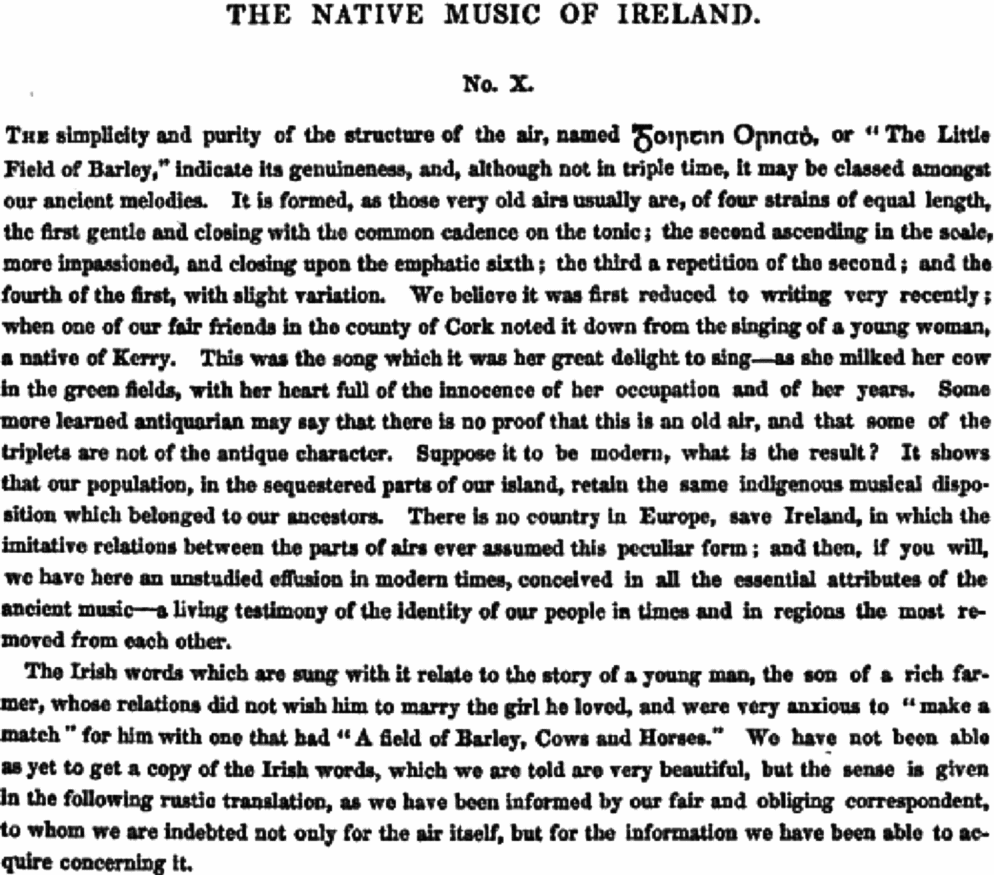
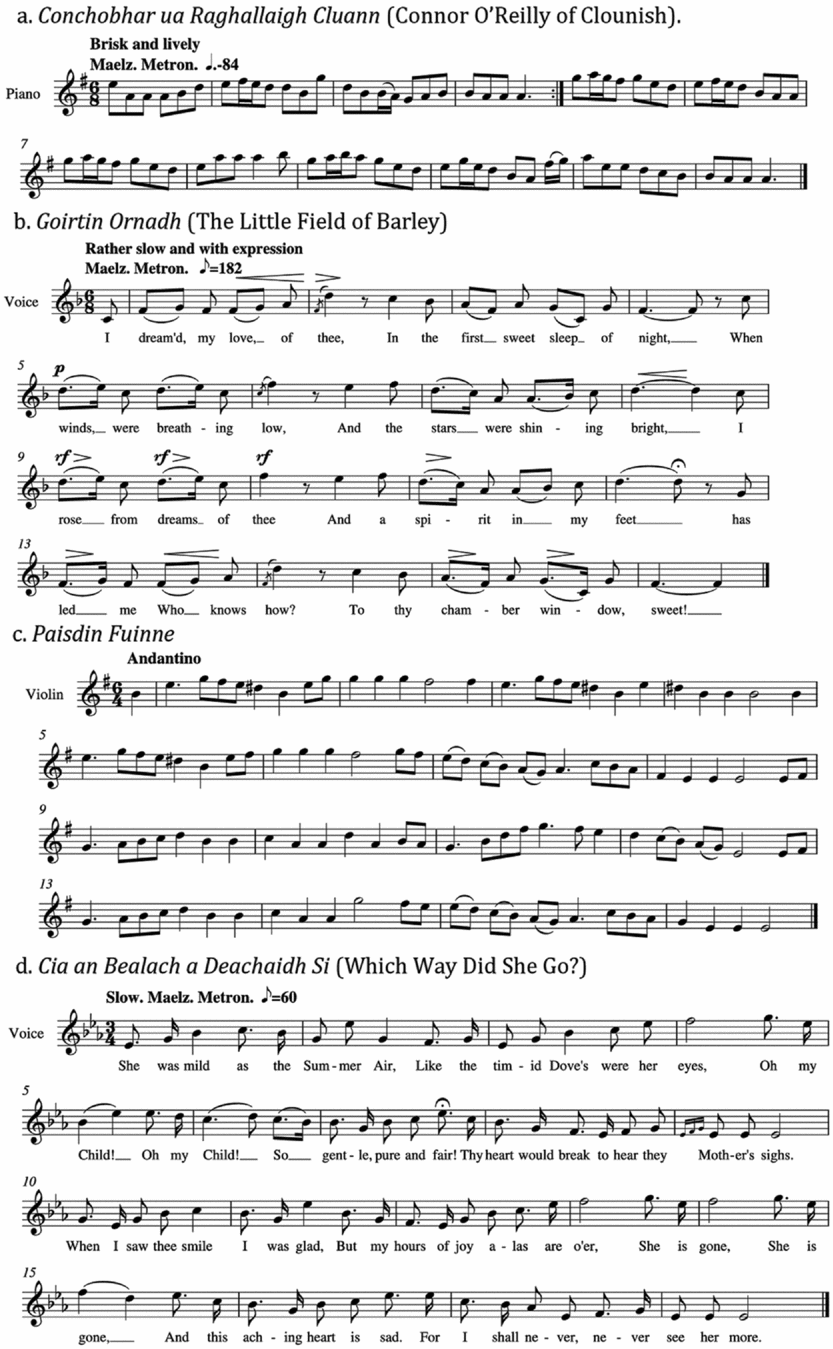
For the symphony, Beach borrowed four tunes printed in an 1841 volume of The Citizen, an Irish nationalist periodical published in Dublin, which was available to her at the Boston Public Library.Footnote 61 The image of Irishness cultivated in The Citizen was shaped by midcentury movements for independence from the British crown that culminated in an 1848 rebellion.Footnote 62 Like advocates of the later Gaelic revival, writers for The Citizen also celebrated the Irish countryside, separating ideas of the Irish from the industrialism associated with a modernizing Britain, and they propagated older, idealized, pre-colonial ideas of Irishness. Unlike proponents of the Gaelic revival, who resisted advocating specific political ideas in favor of promoting Irish cultural practices, The Citizen’s creators openly supported Irish independence. Many of them eventually become members of Young Ireland, a revolutionary group active in the later 1840s. Thomas Davis, one of Young Ireland's leaders, was involved with The Citizen before founding The Nation, the publication for which he is better known.Footnote 63 Although The Citizen was not a music magazine, music editor Henry Hudson (1798–1899) appended music supplements in every issue. Where possible, Hudson offered annotations about the tune and composer, along with musical analysis and a few words on the arrangement (Figure 2). Music was included for several reasons, all nationalistic: promote the music for which Ireland was known, explain what was exceptional about the individual examples, and encourage an idealized version of Ireland encoded within the tunes.
Description of “The Little Field of Barley,” The Citizen: Dublin Monthly Magazine 3, no. 18 (April 1841): 260. Dublin: Samuel J. Machen.
Beach's selection of The Citizen as a source seems relatively obscure, particularly given the surfeit of options at her disposal in Boston. Those options included several major collections of Irish music that were heavily circulated at the time, like the works of Edward Bunting, Thomas Moore, and William Bradbury Ryan.Footnote 64 Numerous ballads in circulation as sheet music might also have served as source material, as could abundant performances of traditional Irish music in her vicinity. But Beach's choice makes sense within the context of Gaelic revival Boston. She used a source published in Ireland, with explanations on the origins of the music used, and whose characterizations of Irish people and Irish life anticipate the Gaelic revival. Moreover, the 1841 date of this volume's publication rests on the eve of the Great Famine that commenced in 1845. Amidst a movement that celebrated distant, historical concepts of Irishness, Beach tapped a source from just before the worst disaster in Ireland's history. The famine also precipitated significant changes in Irish life, leaving a sense among the Irish that numerous indigenous practices were lost in its wake.Footnote 65 Furthermore, the famine immigrants who swelled Boston's ranks identified with pre-famine Irish life in particular, as it was the Ireland of their memory.Footnote 66
Irish tunes from The Citizen used in Amy Beach's “Gaelic” Symphony. Reductions by author.
The particular examples that Beach selected from The Citizen’s supplements are also consistent with the Gaelic revival. Song lyrics feature agrarian characters and promote an idealized image of Ireland. For instance, the magazine's discussion of “The Little Field of Barley,” the tune used in Beach's second movement, focuses on the agrarian setting of the text and its commentary argues that it was written before modern times.Footnote 67 The text, in the Irish language with an English translation, tells of a rich farmer's son whose parents did not approve his choice to marry a poor woman. He went ahead with the marriage and was happy even after disownment.
The magazine also mounts elaborate cases for the supposed ancient origins of the tunes, even though the nature of orally transmitted folk traditions can prevent accurate dating. According to The Citizen, “The Little Field of Barley” “may be classed amongst our ancient melodies.” The writer admits to scant primary evidence to support the claim, but provides evidence that the tune is very old. He or she looks to the tune itself for clues to its age, claiming that the song's a–b–b–a structure represents a very old tradition (most Irish traditional music is performed in binary structure). If it is more recent, no matter; the writer claims the old fashioned traits of “The Little Field of Barley” would then support the notion that Ireland remains unsullied by modernity. Such examples of purportedly older music still being performed show “that our population, in the sequestered parts of our island, retain the same indigenous musical disposition which belonged to our ancestors.”Footnote 68 Of the three remaining tunes borrowed from The Citizen, the magazine claimed that Conchobhar ua Raghallaigh Cluann was composed by Turlogh O'Carolan, a famous Irish harper of the seventeenth and eighteenth centuries. As an O'Carolan tune, it would be considered part of the old tradition. The one exception is the song Paisdin Fuinne, which the magazine claims was written more recently. However, its author is the Irish war hero Richard Fitzpatrick. The strength of the author's renown could have caught the attentions of Hudson, but ancient qualities were still necessary; Hudson commented: “people of old-fashioned tastes will think it a capital one.”Footnote 69 Whether or not the melodies were actually old, the matter was clearly important to The Citizen, making the tunes more attractive to proponents of the Gaelic revival as well.
The use of Irish melodic material was, however, only one way in which Beach engaged with Irishness in her symphony. A close reading of the first and third movements show that use of her own previously composed material and decisions about form express the ideals of the Gaelic revival. In several places, Beach's music reflects or explores the hardships of displacement. In others, her music supports notions of the Irish that stem from the Gaelic revival. Brought together, the various ways of considering Irish identities, Irish music, and Irish experiences show us that Beach was contributing to discussions about the place of the Irish in the New World.
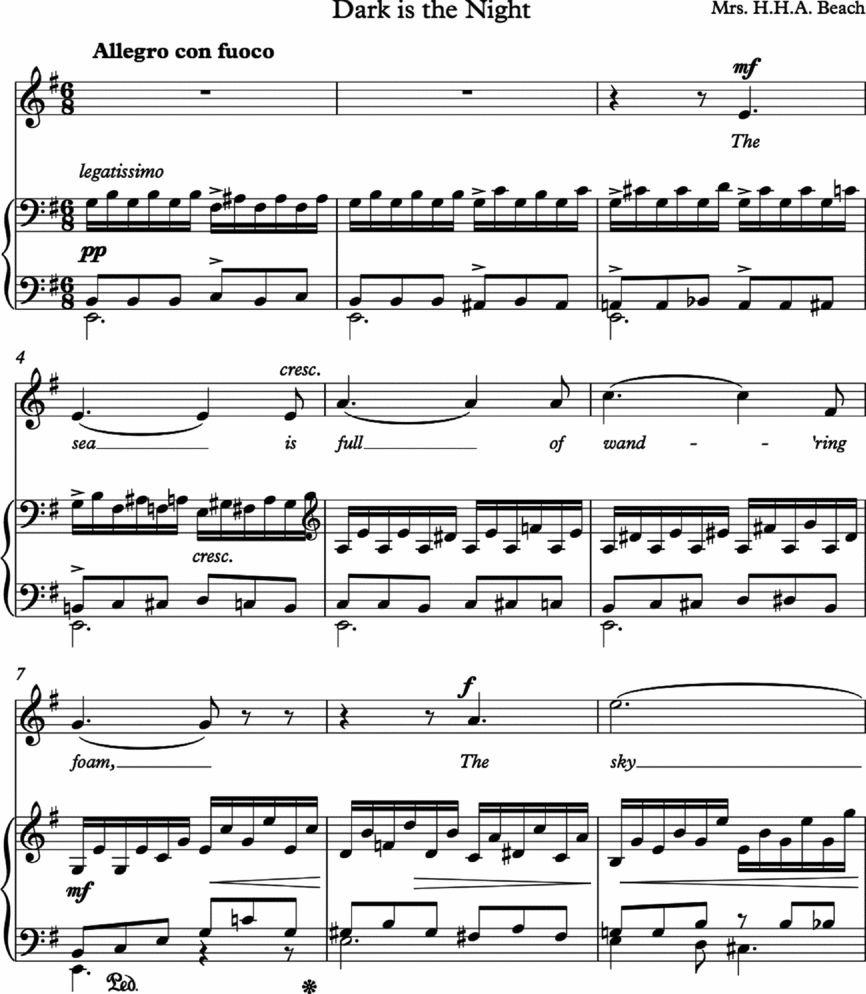
In the first movement, Beach borrowed from her own previously composed song “Dark is the Night”.Footnote 70 The song, with text by British poet William Ernest Henley, depicts a tempestuous night at sea. The lyrics describe the narrator's anxieties in the storm. The narrator is not necessarily Irish, nor do I think it was the poet's intention to signify Irishness. However, his experience has much in common with the Romantic-era Irish character types: a strong male, facing a fearful, potentially dangerous situation in the present, nostalgic for an idealized past.Footnote 71 Beach's music also possesses superficial markers of Irishness common in American song of the time, including compound meter and large, ascending leaps at the beginnings of phrases.Footnote 72
Amy Beach, “Dark is the Night,” in Three Songs, text by William Ernest Henry, op. 11 (Boston: Arthur Schmidt, ca. 1889).
Beach's music for “Dark is the Night” illustrates the confusion and tumult of stormy seas through ambiguous tonality, peppered with moments of nostalgia for the protagonist. The piano's chromatic whizzing at the beginning does not follow a clear harmonic progression, thereby confusing the modality. Thereafter, excepting a few moments of clarity, the frenetic piano part tempestuously pushes the boundaries of the E minor tonality. Series of diminished and half-diminished seventh chords (mm. 8–10 and 15–16, for instance) lack a clear progression. This tonal ambiguity in the piano part contrasts with the vocal line, which is relatively straightforward. If the dominant is noticeably downplayed in the piano, the vocal line makes up for that by emphasizing B at several key points. Indeed, at the end, the ambiguity is somewhat mitigated by a B–D#–E in the voice (supported by the quick V7–I cadence in the piano). The combination produces the effect of the piano performing the storm, or the internal confusion of the protagonist, while the vocal line depicts the person, or his more ordered attempts to make sense of the frightening situation. On the other hand, the middle part of the song's ternary form, in E major, contains a much more clear tonal center as the narrator's thoughts turn to nostalgic memory: “Where are the hours that came to me, so beautiful and bright.” That ends, however, on a series of major and minor III chords. Upon return of the A section, the key signature changes back to E minor, but the tonal center sinks from G to F-sharp diminished, resting there for several measures, then moving through several other chords. E minor finally appears (m. 49). The song finishes with an extremely quick V–I progression (m. 58), followed by an extended plagal cadence.
The symphony, particularly its first movement, takes material from several parts of “Dark is the Night.” The transfer of this song about a sea voyage into an American symphony on Irish themes can also come to represent the experience of immigration. The symphony begins with the same chaotic chromatic figures. Music intended to depict a stormy sea comes also to represent the internal tumult of liminality in an immigrant's sea voyage. E minor is eventually strongly asserted at the beginning of the first theme (rehearsal A). The first theme of the symphony adopts the first theme of the song with quite a functional and straightforward progression supporting it. The second theme of the symphony is borrowed from the song's middle section, written to support text about nostalgia for an idealized past. Three major sections of the first movement's exposition, then, employ Beach's own previously written material about a tumultuous sea voyage consonant with the boundary-crossing experience of immigration.
Other parts of the “Gaelic” Symphony display still more ways of constructing and exploring Irishness. Beach seems to have applied formal innovation in order to assign proper heft to the third movement. She employed a double ternary form whereby one theme is presented, developed, and returned, and then the process repeats itself for the second tune. As both themes are borrowed from The Citizen, virtually all of the melodic material in the movement stems from an Irish melody. Indeed, the third movement is the only one of the symphony that contains two borrowed Irish tunes. The first, titled Paisdin Fuinne, is in E minor, and the second, Cia an Bealach a Deachaidh Si, is initially in the parallel major but becomes minor at the return. Beach achieves cohesion by including quotations of the second melody in the first half and vice versa.Footnote 73 In the process, it becomes the longest and most emotionally stark movement of the work.
Critics at the 1896 premiere connected the length of the movement with the symphony's Irish title and faulted Beach for it. Philip Hale, a prominent Boston critic, deprecated the movement as “eminently Gaelic, dull, and intolerably long-winded.”Footnote 74 Louis Elson, the Boston critic who later penned one of the first histories of American music, wrote condescendingly of the movement: “the long, slow movement proved that the Gaels were a very deceptive race as regards their cadences.”Footnote 75 Their derision reveals at least as much about the biases of Boston's upper class against the Irish and Irish Americans as it does their musical taste. The movement's duration and its formal innovation, however, work together to construct a crucial image of Irishness in the work. It is by far the most morose in tone, expressing the loss that attended nineteenth-century images of the Irish. As Irish history of the past century had included political domination and a famine in which one in eight residents of Ireland starved to death and even more than that fled wretched conditions at home to face the challenges of immigrant life, grief and loss were seen as Irish national experiences at the end of the nineteenth century. Grief becomes the focus of this movement, and in its length and emotional weight, this movement becomes the centerpiece of the symphony.Footnote 76
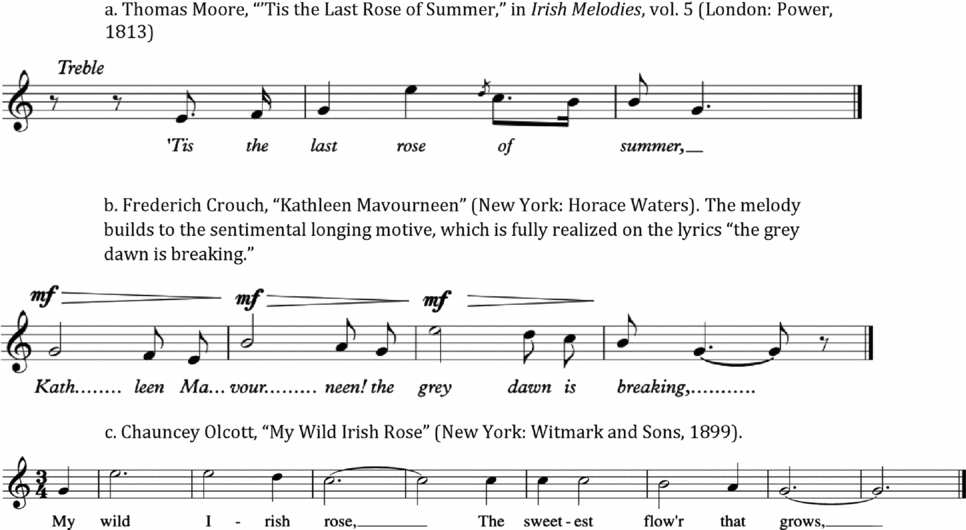
The movement employs at least one other method of communicating Irish grief. One of the most common musical devices associated in the United States with the Irish was a descending motive beginning quite high in the range of the instrument or voice. This high tessitura often causes the voice to strain, sounding a physical discomfort that can be easily translated into an expression of intense emotion. When preceded by pitches set lower, in a more comfortable range, a wide, virtuosic leap is created in which the strain of the higher notes is emphasized. This device had often been used to express loss in sentimental songs about the Irish in the United States, particularly since the widespread popularity of Thomas Moore's Irish Melodies, published serially between 1808 and 1834. By the end of the century, this motive, which I term the “sentimental longing” motive, had developed as a common and significant way to musically express Irish experiences of loss.Footnote 77Example 6 illustrates some prominent examples from across the nineteenth century.
Examples of the sentimental longing motive from across the nineteenth century.
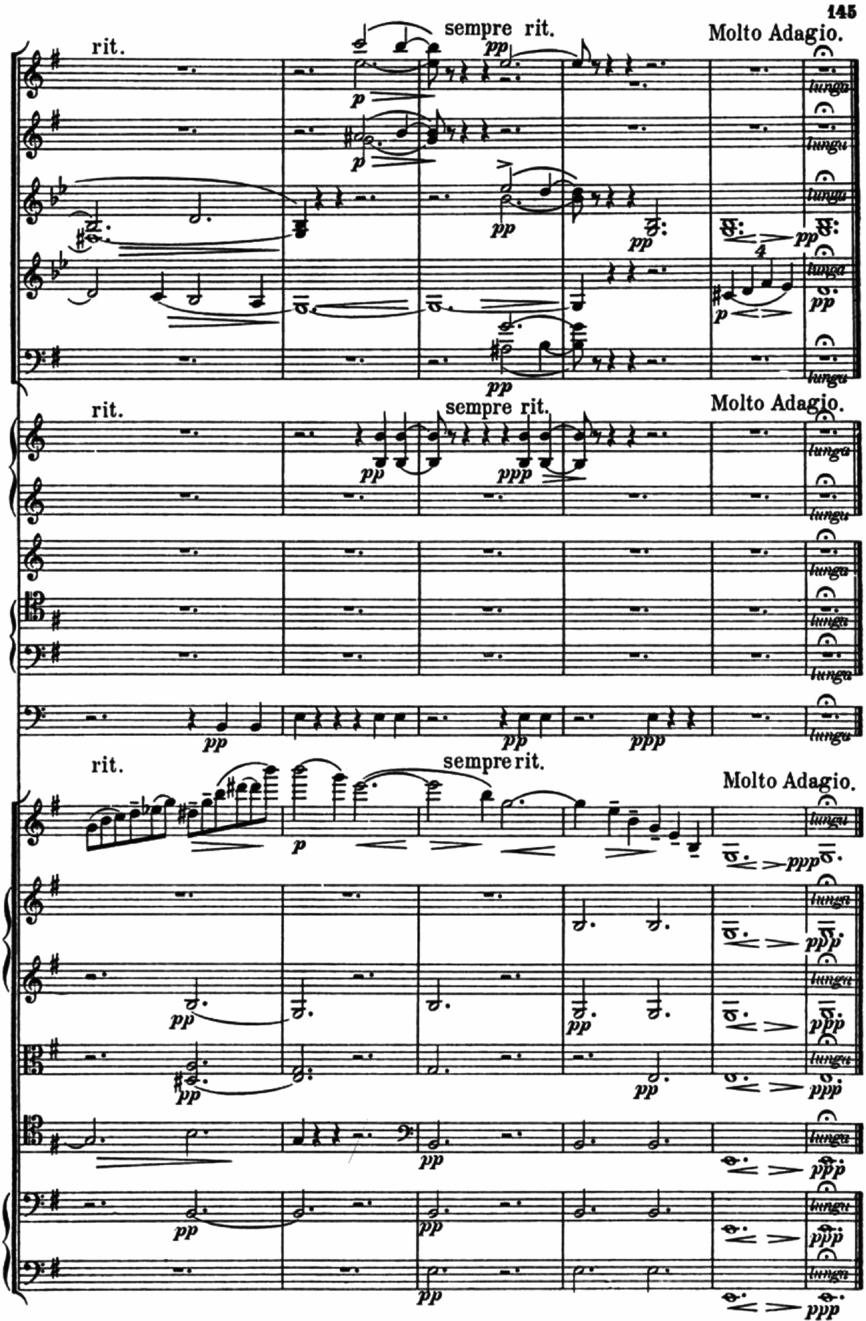
The third movement of the “Gaelic” Symphony contains many sentimental longing motives. The movement's first theme, borrowed from the tune Paisdin Fuinne, contains a sentimental longing motive at its denouement. There, an upward leap of a minor seventh is followed by a descending line that finishes with the theme's cadence (see Example 4c, measure 14). Another sentimental longing motive appears in the violin solo at the end of the movement (Example 7). Beach's use of the sentimental longing motive at the end of this movement in particular suggests that it was vital to ideas about Irishness.
Amy Beach, “Gaelic” Symphony, op. 32, end of mvt. 3 (Boston: Arthur Schmidt, 1897), 145.
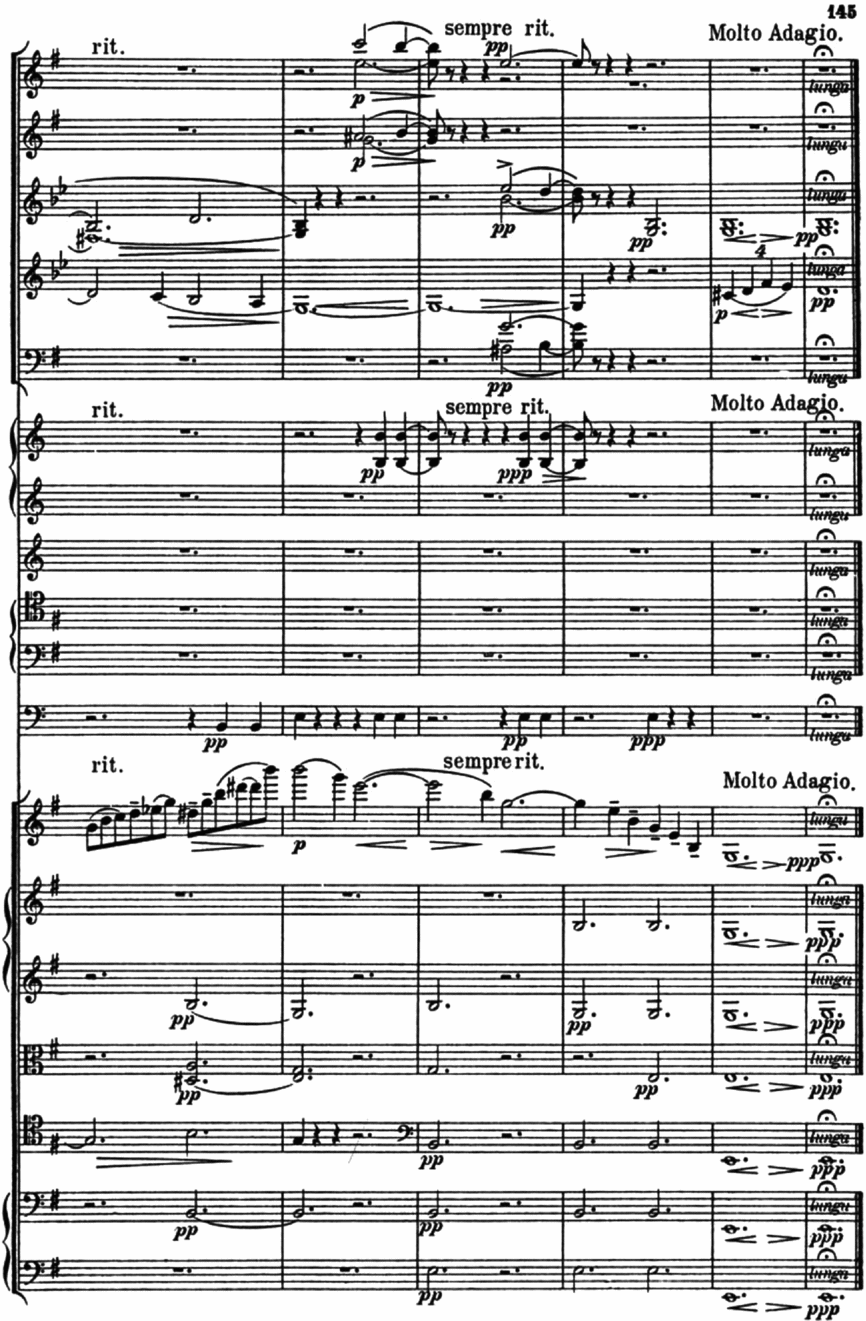
The third movement is the longest in duration of the “Gaelic” Symphony. Almost all of its melodic material derives from material Beach believed to originate in old Irish music, and it contains sentimental longing motives to establish a sense of grief or longing. In many ways, this movement most reflects the influence of the Gaelic revival. Critics also heard Irishness in this movement more than they did in others, and some of them associated with Brahmin culture, including Hale and Elson, faulted the movement as they disparaged the Irish. None of that is happenstance; Beach constructed this movement to articulate specific ideas of the Irish that were popular in the Gaelic revival. She imbued the movement with a pervasive sense of loss, using what she thought were very old melodies, to convey a bucolic, pre-colonized image of the Irish. In doing so, she expressed the kind of sympathy for the suffering of underprivileged groups that emerged in her thoughts on the “New World” Symphony when she took Dvořák to task for insensitivity to the brutality of slavery.
In 1917, before a Minneapolis performance of the “Gaelic” Symphony, a local newspaper interviewed Beach and asked about her motivations for writing the “Gaelic” Symphony. In her response, Beach mentioned finding tunes in a collection of Irish music (now known to be The Citizen) that “sprang from the common joys, sorrows, adventures, and struggles” of the Irish.Footnote 78 I believe that Beach's sympathy for Irish people—their collective joys and overwhelming sorrows—are at the heart of the “Gaelic” Symphony. Ideas about Irishness guided not only her musical borrowing but also extended to other thematic material and her choices about form. It wasn't just any image of the Irish on display, but a carefully crafted, strategically employed representation of the Irish that contributed to the discourse. The music of The Citizen and the emphasis on distant origins, loss, agrarian lifestyles, and the use of the Irish language reflect the values of the socially and financially ascendant Irish-American community. We only truly understand the “Gaelic” Symphony, then, by acknowledging the context in which it was written, not only in the United States as a whole, but also within transatlantic networks, Irish-American communities, and Amy Beach's Boston.
Most of all, however, we understand that Beach's world was larger than the United States. In order to understand her work fully, we must recognize her engagement with an international, cosmopolitan concert-music culture that sought to transcend national borders, problematic as the enterprise might have been. We must also understand the Irishness of the symphony on its own terms, without filtering it through concepts of nationalism and Dvořák's work. Approached in this way, the “Gaelic” Symphony becomes a complex example of late-century intertextuality, musical invention, and social statement that reflects the composer's nationality to some extent, but reaches far beyond it.