It is a site suited, like few others, to contemplate the past and the interlinking of the fates of human beings.
Hugo Winckler, Das Vorgebirge am Nahr el-Kelb (The Promontory of Nahr al-Kalb) (1909)Now Lebanon will have a unified memory of its past. Instead of always reflecting over a fragmented past based on the Civil War, Lebanese can now go further back and realize a far deeper and common history that unites them all.
Tarek Mitri, Lebanon's minister of culture, speaking about the heritage site of Nahr al-Kalb (2005)On 4 August 2005 the Lebanese English-language paper the Daily Star reported that Lebanon's ancient inscriptions at Nahr al-Kalb had been accepted into the United Nations Educational, Scientific and Cultural Organization's (UNESCO’s) collection of “worldwide rare documents” through its Memory of the World Programme.Footnote 1 UNESCO established the Memory of the World Programme in 1992, after realizing that its World Heritage Programme, which seeks to protect historic landscapes and architectural landmarks, did not safeguard a category of less visible, yet equally important, documents of the past: texts.Footnote 2 The Memory of the World Programme made the preservation of “documentary heritage [which] reflects the diversity of languages, peoples and cultures” its goal, hoping that its work would help prevent “collective amnesia.”Footnote 3 An eight-member Lebanese national committee made up of cultural and political elites affiliated with Lebanon's Ministry of Culture and Lebanese University, the country's largest public university, submitted a unanimous proposal to UNESCO's International Advisory Committee (IAC) to include Nahr al-Kalb in its collection of “documentary heritage.” The IAC reviewed and accepted the proposal in June 2005, placing the inscriptions along the river of Nahr al-Kalb in the company of 156 other universally memorable texts from around the world.Footnote 4
By establishing and publishing its lists of world heritage sites, both architectural and textual, UNESCO “convert[s] selected aspects of localized descent heritage into a translocal consent heritage—the heritage of humanity.”Footnote 5 UNESCO's endorsement of the stelaeFootnote 6 of Nahr al-Kalb—archaeological monuments that have been part of Lebanon's national heritage register since 1937—delocalized heritage that is firmly embedded in Lebanese history and, quite literally, in Lebanese soil and transformed it into an icon of universal historical value. In a country where history is sensitive, and where historians are very selective about its retelling, this endorsement and transformation of a national heritage site signaled an important official return to and use of the past.Footnote 7 In this article, I trace the evolution of the archaeological site of Nahr al-Kalb from its ancient beginnings to contemporary times. I argue that it is not the content of these commemorative inscriptions but the mode of repeated commemoration that made it possible to reinterpret potentially divisive markers of Lebanon's past as icons of national unity and a shared humanity. Nahr al-Kalb's deep history, the act of commemorative repetition, and UNESCO's approval provided safe temporal and spatial alternatives to the more precarious memories of Lebanon's recent past.
Heritage has been defined as a “mode of cultural production that gives the endangered or outmoded a second life as an exhibition of itself.”Footnote 8 The reinterpretation and presentation of a site of history as a site of memory revitalizes the treasured yet endangered heritage and endorses it as a past that is worth saving. Although many heritage sites around the world are endangered, not all are outmoded. In the case of Nahr al-Kalb, the archaeological heritage site has kept growing. Additional inscriptions have been recorded, repeating previous commemorative practices. Instead of a historic site turning into an exhibition, the exhibition has become the site of ongoing cultural production.
With this observation, I challenge a prevailing argument in memory scholarship that once a site of history becomes a site of memory, it loses its meaning and authenticity. Pierre Nora most famously defined a site of memory, or lieu de mémoire, as “the reconstruction, always problematic and incomplete, of what is no longer.”Footnote 9 He bemoans the proliferation of archives, monuments, and memorials as a symptom that contemporary societies preferred externalized and catalogued reflections of the past over authentic, lived, “organic” experiences of the past in their everyday lives. However, rather than dismissing records and representations of history as mere “graveyards of knowledge,” memory scholars need to pay closer attention to their commemorative forms and trajectories.Footnote 10
My inquiry into the politics of heritage in Lebanon falls within a larger body of recent scholarship that investigates the dynamic and complex relationships among history, memory, and politics in a region often stereotyped as hung up on its past, unable to change, and hostile to modernity.Footnote 11 The fact that history and memory are passionately contested in specific historical contexts by individual agents or organizations with certain goals in mind has been shown repeatedly through careful ethnographic analysis.Footnote 12 The politics of heritage has been most extensively analyzed in the Middle East in Israel and Palestine, where archaeologists and heritage preservationists work hard to produce material evidence of Jewish and Palestinian origins as a way to legitimize contemporary national claims.Footnote 13 The literature is equally strong in critiquing European colonial rulers’ interventions in the Middle East as they created and fulfilled their own visions of Arab heritage through their collection and preservation practices.Footnote 14 Less frequently analyzed have been the complicated connections among prenational, national, and global heritage production practices and the way in which agents of newly independent states write their history both within and against their predecessors’ commemorative frameworks. The Middle East is an area rich with archaeological sites and practices of heritage preservation that construct claims of cultural uniqueness through referencing an ancestor's superior achievements.Footnote 15 However, what happens if it is not the ancestor's heritage that is preserved and if it is not unique?
POST CIVIL WAR LEBANON RETURNS TO THE PAST
Lebanon's 1975–91 civil war saw successive rounds of violent conflicts that pitted Lebanese and foreign militias and armies against each other in ever-changing alliances. They fought over access to and distribution of political power and resources in Lebanon, for and against the stability of the larger Levant region, and for and against nationalist and global political ideologies; they also settled personal scores and sought personal enrichment.Footnote 16 Colloquially referred to as “the events,” Lebanon's civil war ended when Saudi Arabia sponsored a constitutional assembly in the Saudi city of Taif, resulting in the 1989 Taif Accords and the beginning of Lebanon's second republic.
After the Taif Accords, a large Syrian military force defeated the remaining Lebanese militia forces that opposed the new constitution and Syria's “special role” in postwar politics. At the same time, the Israeli Defense Forces (IDF) and the South Lebanese Army (SLA), an independent Lebanese militia force partnering with the IDF, continued to occupy a large stretch of Lebanese soil along the Israeli–Lebanese border.Footnote 17 The IDF and SLA fought against Lebanese resistance militias organized by Hizbullah in South Lebanon.Footnote 18 Trapped between the Syrian and Israeli fronts throughout the 1990s, and with a costly physical reconstruction project in front of them, the Lebanese exhibited, according to Lebanese sociologist Samir Khalaf, collective civil war amnesia.Footnote 19
Particularly in the public sphere, civil war topics were assiduously avoided in favor of a discourse that emphasized the future (al-mustaqbal) over the present or the past.Footnote 20 Instead of prosecuting militia leaders in court for crimes committed during the civil war, a 1991 amnesty law officially granted the majority of them a clean slate and included them in the newly formed government.Footnote 21 Following the formula “no victor, no vanquished,” no single party in Lebanon was able to claim victory or made to bear the burden of defeat.Footnote 22 If there was public blame, it was mostly aimed at Palestinians who lived in refugee camps in various parts of Lebanon and who had been both participants in and victims of Lebanon's civil war.Footnote 23 The profound public silence regarding “the events” prevented the building of public civil war memorials or the establishment of a national cemetery for the fallen.
After a decade of this state-sponsored forgetfulness, Lebanon's president Emile Lahoud inaugurated the newly restored national heritage site of Nahr al-Kalb on 24 November 2003, two days after Lebanon's Independence Day. The occasion marked the official return to the past. Although he made no direct reference to the civil war in his inauguration speech in front of the inscriptions of Nahr al-Kalb, he drew lessons from the country's past with bearing on its present. President Lahoud reversed the future-oriented discourse sponsored by then-prime minister Rafiq al-Hariri and turned to antiquity for a symbolic space that would heal Lebanon's civil war wounds.Footnote 24 In changing the official, indecisive formula of “no victor, no vanquished” to the more decisive “from vanquished to victorious,” Lebanon's head of state, who both modified and restored the heritage site of Nahr al-Kalb, generated an image of Lebanon as a community united by a will to resist outside force, survive it, and, ultimately, triumph. To this, the Ministry of Culture, with the help of UNESCO, added a trope of ancient Lebanon as cradle of civilizations.
PUBLIC MONUMENTS: WHERE HISTORY TURNS INTO MEMORY AND DIFFERENCES INTO RESEMBLANCES
Nahr al-Kalb, a well-known archaeological site north of the capital, Beirut, consists of a series of historic inscriptions hewn into a sheer, rocky incline. From ancient times until national independence, the region that now is Lebanon was at the crossroads of warring empires. For millennia, elites used Nahr al-Kalb to make statements about their military prowess and political power. Restored by the Ministry of Culture in 2003, with the financial backing of Lebanon's National Heritage Foundation, a nongovernmental organization (NGO) created after the civil war with the intention of restoring badly damaged or neglected heritage sites, Nahr al-Kalb is at the same time a collection of historic inscriptions, a formidable landscape, a national monument to Lebanon's independence, a tourism site, and an internationally recognized text. Recording significant changes in imperial power politics in the region, this history book written in stone is at the same time a testament to profound historical changes that took place in the region and a celebration of repetition and resemblance. Repeating the artistic language and style of their predecessors, each new ruler of the region, including the first and thirteenth presidents of Lebanon, chiseled their names and statements into the rock face. Some of Nahr al-Kalb's authors attempted to overwrite or modify existing commemorative signs, leading to symbolic battles on this strategic hill.
It has been argued that public monuments, both built and sculpted, are the most conservative form of public memorials because they are conceived and built to last forever.Footnote 25 Moreover, inscriptions are said to have an “indisputable character.”Footnote 26 Although inscriptions on a monument built or sculpted from stone are certainly conservative from the point of view of artistic genre and style, their immutable form constitutes a site of symbolic significance rather than merely an artistic limitation. Public monuments of the past may record singular events, but they do so in a repetitive fashion.
As scholars, we need to pay attention to the fact that whereas history presents a record of differences, memory is a record of resemblances. History and memory are two different languages with distinct grammar and rules. As Maurice Halbwachs argues, “History is a record of changes; it is naturally persuaded that societies change constantly . . . In contrast . . . memory is a record of resemblances and naturally is convinced that the group remains the same . . . Changes that do occur are transformed into similarities.”Footnote 27 Particularly in the context of a country with a national history that has been contested and fraught with recurring conflict, the notion of translating history—which tells us how different we are from each other and from the past—into memories that emphasize similarities and, in the case of Nahr al-Kalb, preserving such memories in “rock-solid” form has implications for the ways in which a contested past can sustain the image of a unified national community. Similarities generated in commemorative action are often a result of the commemorative process itself, such as the continuity of artistic conventions. Halbwachs, however, does not discuss this.
In this article, I investigate this important intersection of public monumentality, repetition, and the construction of community identity based on the logic of resemblance. I show that governmental elites at times of profound political transition need to make public interventions into the past to bolster their legitimacy, new commemorations are confined by rules and conventions of public memorializing, and the logic of resemblance inherent in commemorative processes can be used to convert a history of ruptures and fragmentation into a memory of unity and strength. Of course building public monuments is not the only or the most important form of commemorative activity, but it is favored by elites and states because of visibility. Building public monuments, elites harness the past in order to produce their own cultural and political legitimacy. By analyzing Nahr al-Kalb as a profoundly Lebanese space that is used to articulate a post civil war narrative of a victorious Lebanese community, I show that history can be rewritten when memory repeats itself.
SITUATING NAHR AL-KALB
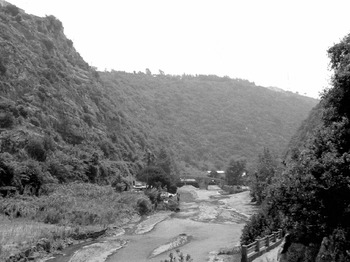
Nahr al-Kalb, which translates into “Dog River,” describes both the river and river gorge that is located about twelve kilometers north of Beirut (Fig. 1).Footnote 28 The river empties into the Mediterranean Sea at a point in Lebanon's coastline that features steep slopes rising up to the height of about twenty-four meters next to the sea, obstructing the passage along an otherwise accessible and flat coastal strip.Footnote 29 The present water level of the river is very low in the dry season and swells to the size of a modest creek only during the rainy season.
The slopes and old bridge of Nahr al-Kalb, Lebanon.

Along the banks of the river, about half a kilometer inland, several family-style restaurants are popular local tourist destinations. In the summer and the fall particularly, Lebanese families drive from Beirut and other urban centers to sit by the river on the restaurants’ large terraces, enjoying traditional food and each other's company in natural surroundings. Although the site is close to the modern highway, or autostrade as it is called locally, that links northern Lebanon to the capital and is not far from a main electricity plant and urban development, the steep slopes and narrow river valley create the impression of relative isolation and of escape from the fast-paced life of most contemporary Lebanese. As visitors pass the hillside, they sometimes stop to look at the roadside inscriptions, but then they move on to the restaurants down the road. Lebanese school or scout groups, after studying their lesson on Nahr al-Kalb as “the meeting point of civilizations” (multaqā al-ḥaḍarāt), often visit the site en route to the famous Jeïta Grottoes farther along the highway. Foreign tourists also stop briefly to take a few photographs of the inscriptions then get back into their rental cars and drive on to visit the old town of Byblos or the Harissa, a large statue of the Virgin Mary that overlooks the Mediterranean from atop the northern coastal hillside. In other words, Nahr al-Kalb is a site that people pass on their way to other destinations. This is not to imply that the site is unimportant; rather, Nahr al-Kalb is an integral part of the surrounding historical and social geography of Lebanon.
Twenty-two recorded inscriptions are carved into the rock on the promontory that protrudes into the Mediterranean at the mouth of Nahr al-Kalb. With the exception of a 14th-century Mamluk stele and the two most recent inscriptions, they signal in different foreign languages the successful defeat of the challenging geography and/or the occupation or liberation of inhabitants of the region by successive invaders. The inscriptions are not in chronological order on the sheer slopes of the river because their placement depends on different roads that were built around and across this difficult terrain throughout the ages. The older inscriptions tend to be located higher on the hill, and the more modern stelae are located closer to the current highway that passes the site.
When I saw the inscriptions for the first time, on a hot summer day in 1997, it was challenging to climb the hill through the weeds and dense bushes that concealed both the path and the inscriptions. By the summer of 2003, however, access had been dramatically improved. It was still a steep climb, but stairs and railings aided visitors in reaching their destination. The restoration team had numbered the stelae roughly in sequence of a visitor passing them from east to west, with the exception of the last two Arabic inscriptions, which carry the chronological numbers twenty-one and twenty-two.
READING THE HISTORIC INTERVENTIONS AT NAHR AL-KALB
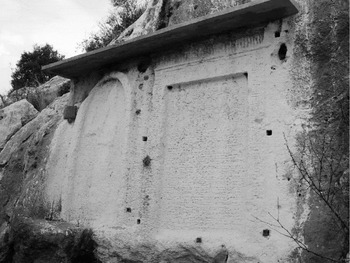
The oldest inscriptions commemorate the Egyptian pharaoh Ramses II (ca. 1270 BCE) and his military excursion to expand his kingdom to the north. The pharaoh had three separate inscriptions carved into the rock, and we can therefore give the ancient Egyptians credit for setting a trend that later rulers tried to emulate. Next are six Assyrian inscriptions that were installed when the Assyrians beat back the Egyptians and established their rule over the Mediterranean around 1000 bce. The Assyrian inscriptions were placed in proximity to, or right next to, the Egyptian stelae, hewn into the rock in the same rectangular shape with similar victory inscriptions. The Assyrians followed the Egyptian commemorative style but engraved inscriptions about themselves twice as often (Fig. 2).
Early Egyptian and Assyrian stelae under a protective ledge.

Four tablets of cuneiform inscriptions commemorate King Nebuchadnezzar's military conquest of the region in the 6th century BCE. Roman Emperor Caracalla declared in the early 3rd century that a certain battalion of his troops had constructed a road around the forbidding hill. According to archaeologists, the name of the battalion was scratched out shortly after it was inscribed, presumably for its subsequent treasonous activities. In a 4th-century Greek inscription, the Byzantine governor Proclus took credit for improving the Roman road. In the first Arabic inscription, the 14th-century Mamluk sultan Barquq announced the building of a three-arched bridge over the river, which, damaged and rebuilt several times over the course of history and presently mossy and picturesque, graces most touristic postcards of Nahr al-Kalb.Footnote 30
Entering the modern era, Napoleon III commemorated his arrival in Lebanon in 1860–61, a time of local unrest that pitted Christian and Druze communities against each other in what historians subsequently named Lebanon's first civil war.Footnote 31 Notably, Napoleon III chose to write his historical declaration in a layer of plaster that was superimposed on one of the rock stelae of Ramses II. Next, an English inscription celebrates the completion of a railroad bridge across the Dog River, connecting Haifa to Beirut and Tripoli. This feat was inscribed on a bronze plaque, yet in the same rectangular shape as the neighboring rock inscriptions with writing underneath the image of a dog. This bronze inscription was inaugurated on 20 December 1942 by preindependence president Alfred Naqqash. Meanwhile, British troops and French general Gouraud commemorated their World War I victories in three separate inscriptions, and French and British troops who occupied Damur and Damascus in 1941 added a World War II inscription in 1941. Finally, in 1946, Lebanon's president Bshara al-Khouri proclaimed in Arabic the departure of all foreign troops from Lebanese territory, and President Emile Lahoud added another Arabic inscription, declaring Lebanon's liberation in 2000. Two more inscriptions are presently illegible.
As public monuments, the stelae follow the conventions of an artistic language that was invented in order to make public declarations. They have to be large enough to be seen from a distance, and they have to be easily recognizable as pronouncements of powerful leaders. Throughout their history, the stelae at Nahr al-Kalb have remained simple and formulaic. Their power lies not in their uniqueness or their style but in the fact that they appear everywhere in exactly the same form. In the case of Egyptian and Assyrian inscriptions, images of the king accompany the texts; on Babylonian tablets and subsequent Mamluk, Ottoman, and European monuments, textual inscriptions predominate within a decorative border.
All inscriptions at Nahr al-Kalb honor men, be they generals, presidents, or soldiers, or the engineering achievements of men, as in bridges, roads, or railway connections. The names of kings, generals, and presidents have a prominent status and size within the inscriptions. If individual soldiers or battalions are mentioned, they are in smaller script, or they are on stelae that do not mention a commanding superior. Later additions followed closely the example of their predecessors, which means that the most recent invader or builder simultaneously remembered and symbolically displaced those who came before him. Therefore, the carving of inscriptions onto a rectangular rock face at Nahr al-Kalb at the same time commemorated a new historical event and repeated the memory of all the prior inscriptions.Footnote 32
However, the hillside of Nahr al-Kalb is more than a “natural history book” where “great men” left records of their accomplishments in the rock face of a sheer slope in a picturesque river valley. The texts and the accomplishments they list not only define, but also are defined by local geography: armies had to move themselves and their equipment across the river and up and down the sheer slopes; the builders of bridges and roads had to move construction materials into place and devise ways to make the area passable, presumably for other military invaders. In other words, the stelae record the repeated embodied experience of physical exertion.
Visiting and contemplating the historical markers requires climbing to their location on the hill, keeping bodily and cognitive memory closely linked. Memory scholars have been criticized for their preference for texts and textual analysis, so it is important to acknowledge that the act of commemoration at Nahr al-Kalb required (and still requires) strenuous bodily efforts: the physical feeling of accomplishment at having scaled a steep hill accompanied the reading of the victory inscription.Footnote 33 Of course, the physical part of the commemoration became easier once more sophisticated roads and bridges were constructed. After a tunnel was dynamited through the hill for the current autostrade, the most recent inscriptions were situated almost at river and sea level. However, this means that the contemporary visitor has to stand in the narrow valley, looking up at the old inscriptions overhead. Therefore, the landscape in which the historic texts are embedded plays a significant part in the creation and appreciation of the historic stelae.
The actual real estate belongs to the local monastic order of Mar Yussef al Bourj, which has owned the land since 1746.Footnote 34 The head of the order, Father Martinus Fahd, explained in a newspaper interview that the land, which covers approximately 364,000 square meters, used to be the site of an old watchtower that was turned into a house of worship. In other words, the landscape has a breathtaking quality that attracted more than one kind of monument builder.
GERMAN (RE)DISCOVERIES OF LEBANON'S ANTIQUITY
European explorers and Orientalists began documenting the site of Nahr al-Kalb in the 19th century. As Edward Said so forcefully argues in his book Orientalism, the creation of European academic knowledge about “the Orient” went hand in hand with military excursions into the area. Napoleon I landed in Egypt in 1798, and the French army of Napoleon III landed in Lebanon in 1860–61. The British Empire controlled the most extensive Middle Eastern territory (and coined the geographic term “Middle East”) and currently holds one of its largest archaeological collections. Germany did not build a colonial empire as vast as its two European neighbors’, which leads Said to proclaim that “the German Orient was almost exclusively scholarly . . . It was never actual.”Footnote 35 Although it is true that German troops did not enter the area until World War I, Germany had been building strong military and economic relations with the Ottoman Empire since the early 1880s.Footnote 36 Germany was politically more interested in the Ottoman Turkish court than its imperial Arab subjects, and its scholarship of the Orient privileged the study of ancient pre-Islamic and (pre-)Old Testament empires as a way to establish a glorious “Indo-Germanic” or “Aryan” origin for its relatively young nation.Footnote 37 In other words, it might be correct to call German Orientalism “another Orientalism,” but it was connected to actual political ambitions, both inside the Ottoman Empire and at home.Footnote 38
According to Weissbach, the most complete copies of the inscriptions of Nahr al-Kalb were made by German orientalist Max Weidenbach in 1845.Footnote 39 Most of the current research on the stelae is still based on Weidenbach's old documents because the rock surfaces continued to deteriorate after he completed his work. Weidenbach, and subsequently Winckler (1909) and Weissbach (1922), noted that Ramses II had three inscriptions made in order to honor three gods—Ptah, Re, and Ammon—as well as himself. The Assyrian monuments were more difficult to decipher than the Egytian stelae, but experts agreed that their victory inscriptions were similar although they focused on the king himself. Based on inscriptions found on Assyrian monuments elsewhere, the German Orientalists assumed that specific sacrificial ceremonies accompanied the inauguration of each monument, although they found no remaining local records of such ceremonies. As previously noted, the Greek, Roman, Mamluk, and Ottoman inscriptions did not receive the same scholarly scrutiny by German Orientalists as the ancient Egyptian, Babylonian, and Assyrian texts. As the more recent inscriptions mostly dealt with construction of bridges or roads and not with large-scale military campaigns that defined the borders of empires, they might have been outside of “History” with a capital H. It is tempting to call the bridge inscriptions of late antiquity and early modernity “engineering victories” because their authors chose to execute them right next to the stelae of ancient emperors and their military conquests. Again, no documentation of opening ceremonies for these inscriptions survived, but it is likely that some kind of celebration occurred when the plaques, roads, or bridges were completed.
In his scholarly publication, Hugo Winckler explicitly notes that the Egyptian inscriptions and Assyrian counter-inscriptions never mention “events in Phoenicia” nor were Phoenician inscriptions engraved on the rocky slopes, which means that local practices or reactions of local people remain unrecorded. Despite their claim to inventing alphabetical writing, Phoenicians did not leave a significant textual record. Instead, the ancient stelae describe the most important known power struggles in the ancient Near East from the point of view of the victor alone. As Lebanese scholar Anis Sayegh argues in his 1956 book, Jidar al-ʿAr (The Wall of Shame), this public display of foreign victors kept the Lebanese in the perpetual position of the vanquished.Footnote 40 In his book, he bemoans the fact that his was the first publication in Arabic on Nahr al-Kalb and that the site had been badly neglected by Lebanese authorities, who had designated the site “national heritage” but then failed to protect it. After a discussion of each inscription, Sayegh proclaims that conquerors had entered Lebanon through “the gates of weakness and division and indifference” (abwāb al-ḍaʿf wa-l-inqisām wa-l-tahāwun) and had occupied the land and used its resources. He issues the warning, prophetic in hindsight, that “the wall of shame will remain open for more plates if we do not protect it with a wall of hearts and minds.”Footnote 41 Actively preserving foreign invaders’ victory inscriptions so as to build up a “wall of hearts and minds” did not become a priority of the Lebanese state until after the 1975–91 civil war.
MODERN INTERVENTIONS AND FRENCH AND OTTOMAN MEMORY BATTLES
In her unpublished report on the state of the Nahr al-Kalb stelae, Lebanese archaeologist and architect Yasmine Makaroun calls the European inscriptions starting with Napoleon III “interventions.”Footnote 42 In other words, archaeologists make a clear distinction between the ancient stelae and their modern interlopers. This judgment call might be based on the fact that Napoleon III chose to memorialize himself and his army on a plaster surface that he superimposed on one of the three ancient inscriptions of Ramses II, thereby disrupting one of the ancient texts and starting the first of several modern memory battles. Napoleon III's choice of location cannot have been coincidental. It references France's imperial aspirations, which had led Napoleon I to invade Egypt in 1798. Both Winckler (1909) and Weissbach (1922) deplore the French destruction of the Egyptian Ptah relief in order to make room for their own monument because there was, after all, enough space left on the slopes to inscribe new messages. Weissbach then notes with obvious glee that the French plaster inscription was destroyed by a Turkish officer during World War I.Footnote 43 As soon as the French assumed their Mandate power over Lebanon in 1919, however, they restored the French inscription.
This example proves the link between the cultural and the political and the importance of claiming symbolic victory in addition to achieving military victory. Nahr al-Kalb was a site where foreign armies and engineers staged both kinds of battles to expand their respective influence in the region. The French sought to eradicate and overwrite previous Egyptian history, the Ottoman Turks destroyed the French, and the French restored their image of colonial power in the Levant. These acts of rewriting and overwriting happened precisely at a moment of larger political and cultural change, when the European Mandate powers took over rule of the Arab world from the Ottomans. The French erasure of the Egyptian inscription can be read as the official European declaration of the end of regional empires, a message directed at both the Egyptians and the Ottomans.
After the installation, destruction, and restoration of the French stele of Napoleon III, three more European inscriptions were added to the hillside to commemorate significant local battles of World War I. They refer to the capture of Damascus, Homs, and Aleppo in 1918; the occupation of Beirut and Tripoli in 1918; and the capture of Damascus in 1920. lt is not specified in any of these inscriptions who the local enemy was. The focus remains on the victorious agents: the “Desert Mounted Corps composed of British Australian New Zealand Indian Cavalry with a French Regiment of SpahisFootnote 44 and Chasseurs d’Afrique and the Arab Forces of King Hussein,” “The XXI British Army Corps with Le Détachement Français de Palestine et Syrie,” and “Le Général Gouraud étant commandant en chef de l’armée du Levant les troups françaises sous le commandement du Général Goybet sont entrées victorieuses à Damas,” followed by thirteen individually listed army units.Footnote 45
It requires independent historical knowledge on the part of the audience to determine that the first two military events commemorate European victory over the Ottomans with the help of Arab troops, and the 1920 French inscription commemorates the defeat of the same Arab troops after Prince Faysal had established his short-lived Arab state in Damascus and challenged French Mandate rule. If properly explained, the inscriptions of Nahr al-Kalb can teach a valuable lesson about colonial alliance making during the war (to capture Damascus from the Ottomans)—and the defeat of those same allies (in Damascus) when they interfered with European designs for a map of the Middle East after 1918. Also of note is the linguistic bricolage of English and French in both 1918 inscriptions. The British units are spelled out in English and the French units in French, but the Arab forces of King Hussein are not spelled out in Arabic, which indicates a level of cultural sensitivity among Europeans that was not accorded the local “Other.” One could also read into this text a level of wartime collusion that resulted in the two European powers dividing the conquered territory between themselves, in blatant disregard of the promises they had made to other players in the region.Footnote 46
The modern “interventions” at the site of Nahr al-Kalb express and contest European colonial aspirations during the demise and in the aftermath of the Ottoman Empire. To have “the last word” on the hillside of Nahr al-Kalb, in the case of the French superimposition, destruction, and restoration of the Napoleon III inscription, signals in no uncertain terms whose power was on the ascendant. To make and break alliances in order to obtain hegemony over the Middle East was part of the colonial project. Again, it is significant to point out that local inhabitants are not mentioned in any of the texts. Foreign troops acted in a symbolically empty space. This practice changed for the first time when an English description, mounted in 1941, declared that the “First Australian Corps captured Damur, while British, Indian, Australian and Free French Troops captured Damascus, bringing Freedom to Syria and the Lebanon.” In 1941, the local Other was mentioned, even if only in the role of liberated subject. It is not mentioned that the enemy was also French. The Lebanese were liberated from the Vichy French in order to be ruled by the Free French, who, after World War II ended, conceded independence to Syria and Lebanon by withdrawing their troops. At this particular historical juncture, Syrian and Lebanese fates were linked because were both ruled by the same French high commissioner. Therefore, it took the “liberation” of Damascus to secure the “liberation” of Lebanon. Currently, the words “Syrie” and “Syria” in the 1920 and 1941 French stelae commemorating victories in World War I and II remain barely legible due to vandalism—an anonymous, yet strong, public reflection of how some Lebanese feel about contemporary Syrian involvement in Lebanese affairs.
NATIONAL INTERVENTIONS AND CONTEMPORARY MEMORY BATTLES
On 5 March 1937 seventeen of the ancient historic stelae and the 14th-century Barquq Bridge officially became Lebanese national heritage via Resolution 506 of the Lebanese Ministry of Antiquities.Footnote 47 In other words, Nahr al-Kalb became a national heritage site before Lebanon's national independence in 1943. Similarly, the building of Lebanon's national museum, which houses most of the country's archaeological collections, was completed in 1937. The creation of Lebanon's national heritage, or the beginnings of a discourse about Lebanon's origins and ancient past, was therefore closely tied to French Mandate policy and oversight. The French Mandate ended officially on 22 November 1943, but it took another three years for French troops to withdraw from Lebanese soil. On 1 January 1947 then-president Bshara al-Khoury symbolically reclaimed Lebanon as territory free of foreign influence by unveiling an independence declaration on a marble slab the size of the other stelae on the slopes of Nahr al-Kalb.Footnote 48
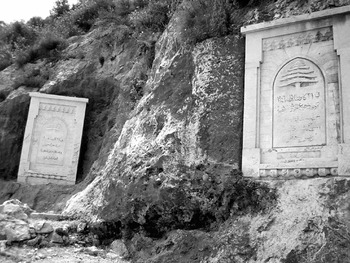
Similar to the Egyptian stelae, the Lebanese marble monument is surrounded by decorative carvings. A cedar tree replaced the pharaoh in the central position, and the writing underneath the tree spells out, “On 31 December 1946, the withdrawal of all foreign troops from Lebanon was completed [tamma jalāʾ jamīʿ al-juyūsh al-ajnabiyya] in the era of his Excellency President Bshara al-Khoury.” President al-Khoury's public declaration of independence leaves the foreign troops unnamed, but the date, 31 December 1946, makes it clear that the inscription refers to the French. Lebanon's national independence is proclaimed in the same artistic style as the inscriptions of former conquerors. By intentionally replicating the artistic genre of his predecessors, Bshara al-Khoury was able to achieve several objectives: he put himself in the same position of power as previous generals and invaders; he used the same language that declared foreign control over the region in order to assert Lebanese control; and he proclaimed the withdrawal of all foreign troops, acknowledging and cleansing Lebanon's entire historical record. The Lebanese were finally in sole control of their territory and the writing of their history.
Additional ironies emerged, however, from this alignment of a Lebanese independence declaration with victory statements of previous invaders. First, the Lebanese military was not celebrating a victory over ancient and modern foreign troops. Those troops withdrew, and they only did so three years after the official Lebanese independence declaration in November 1943. Second, it is ironic that this nationalist declaration came at the expense of official regulations regarding the conservation of Lebanon's heritage. According to the 1937 directives of the Ministry of Antiquity, the site of Nahr al-Kalb was to be preserved unaltered as national patrimony. Of course, one can argue that an event of such political significance as national independence after centuries of foreign rule deserved the breaking of a law, especially if the law was implemented under French Mandate rule.
However, it is curious that the new Lebanese government did not choose to follow the example of their French and Turkish predecessors and alter old inscriptions. Unlike Napoleon III, they did not write over existing texts, nor did they destroy any of the monuments, as happened in other parts of the postcolonial Middle East.Footnote 49 President Bshara al-Khoury's inscription can be compared to another chapter in a book, a book reissued in order to update the content of previous chapters to current realities. One might have expected a Lebanese reaction to the 1920 French proclamation about taking Damascus, which for all intents and purposes was a declaration of colonial control. However, there was none. By leaving all the old inscriptions in place, the Lebanese were able to emphasize the length and diversity of foreign influence, which gave the Lebanese all the more reason to celebrate their final independence.
To the great surprise and alarm of conservationists and caretakers of Lebanon's national heritage, bulldozers appeared again at the Nahr al-Kalb site on 21 September 2000 and carved a rectangular hole of three by four meters to the left of the Bshara al-Khoury inscription (Fig. 3).Footnote 50 According to Al-Nahar, the order for the bulldozers to go to work came directly from the Ministry of the Interior—which had not consulted the Lebanese Department of Antiquity or the Ministry of Culture. Into the newly broken rock face, President Lahoud added the following (and for the time being, final) national independence declaration: “On 24 May 2000, the dawn of liberation broke [bazagha fajr al-taḥrīr] in the era of the President of the Republic, General Emile Lahoud.”
Lebanese inscriptions by Bshara Al-Khoury (1946) and Emile Lahoud (2000).

This rather poetic statement refers to the unilateral withdrawal of Israeli troops from South Lebanon, where they had been policing a self-declared “security zone” since 1978. The inscription was mounted next to Lebanon's 1946 independence declaration, using the same kind of marble and identical monument design. The Arabic script declaring national liberation was similar to that of al-Khoury’s. Although the 2000 inscription declared liberation, its location next to al-Khoury's inscription and its inauguration on Lebanon's Independence Day blurred the boundaries between liberation and national independence. As in al-Khoury's inscription, the foreign forces remained unnamed. Only the date linked the statement to the actual event commemorated, which again required knowledge of local history on the part of the viewer. Lahoud's inscription went a step further than al-Khoury’s, however, in obfuscating the referent: it mentioned no army at all. A breaking dawn is a rather abstract rendering of the conclusion of years of fighting and much bloodshed between Lebanese guerrillas and IDF and SLA troops.Footnote 51 Similar to the withdrawal of foreign forces in 1946, the liberation of South Lebanon took place without the Lebanese army; the credit for the withdrawal of Israeli troops goes to Hizbullah.
Lahoud, like his predecessor, proclaimed his power as head of state by defying and breaking rules of state as expressed in the written code of antiquities preservation. In other words, he publicly declared that politicians in Lebanon stand above the law. In the context of Nahr al-Kalb, this lawbreaking may be the direct result of the framework of commemoration, set up by the historic legacy of rulers and generals who indeed stood above the law. While adding their pages to the history book on the rock surface of Nahr al-Kalb, Lebanese presidents copied the acts of their predecessors—even if the act violated a Lebanese legal code. Of course, it can also be argued that it is precisely the act of violating a law of historic preservation that shows presidential power. The 1937 national heritage resolution of the Lebanese government was written to protect and seal the site from future modification, tampering, or destruction. By declaring Nahr al-Kalb a national heritage site, the history book was closing. However, the story did not end. Two Lebanese presidents opened the book again, adding their own declarations in an attempt to have “the last word” on the sheer river slopes. Yet, the history of the Nahr al-Kalb makes claims for final closure precarious.
Lahoud copied stylistically what al-Khoury (and other foreign rulers) had stated before him, but he could not literally copy him and declare the completed withdrawal of all foreign troops from Lebanese soil, because Syria continued to exercise significant power in the country. Instead he chose the ephemeral metaphor of liberation as the breaking of dawn.
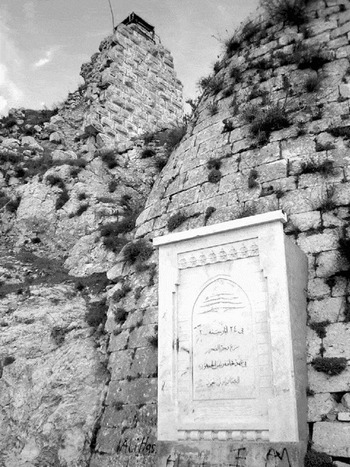
In a more significant deviation from previous conventions, Lahoud repeated his own inscription and had a second, identical marble plaque installed on the walls of Beaufort Castle in South Lebanon (Fig. 4).Footnote 52 Beaufort was built by crusaders in the 12th century as one of a series of fortifications in the holy land. Perched on a steep cliff south of the Lebanese town of Nabatiye, it is close to the Israeli–Lebanese border. It became a strategic military position for Palestinian militias attacking Israel in the late 1970s and for the Israeli military policing their “security zone” in South Lebanon after 1982. Hizbullah repeatedly attacked the IDF at Beaufort, and the castle was evacuated when Israeli forces unilaterally withdrew from South Lebanon in May 2000. Beaufort Castle flies a Hizbullah flag, and it is a potent symbol of Hizbullah's struggle against Israel.Footnote 53 By mounting his inscription at Beaufort, Lahoud not only marked the actual historical site of liberation, but also symbolically attached Beaufort (read: the south, with its largely Shiʿi population) to Nahr al-Kalb (read: the north, with its predominantly Christian population), claiming that both were, literally and metaphorically, on the same page. By using the term “liberation” (taḥrīr), President Lahoud discursively aligned himself with the popular “Lebanese resistance” of Hizbullah, whose political mission is to liberate all occupied Lebanese territory from foreign rule, thereby turning Muslim and Christian Lebanese into a community of resisters.
The repeated Emile Lahoud inscription at Beaufort Castle, South Lebanon.

TRANSFORMING NATIONAL HISTORY INTO INTERNATIONAL MEMORY
After the completion of significant restoration work on 24 November 2003, two days after Lebanon's Independence Day, President Lahoud conducted a public ceremony to reinaugurate Nahr al-Kalb. The staff of Lebanon's Directorate General of Antiquities, a branch of the Ministry of Culture, initiated and executed a restoration project with the financial support of the National Heritage Foundation.Footnote 54 The restoration efforts cleared the area of vegetation, restored inscriptions, improved access to the stelae, and added trilingual panels with short explanations right next to the inscriptions. As the oldest inscriptions are barely legible, and Napoleon III had overwritten one of the Ramses II inscriptions, the explanatory panels also present drawings of the original inscriptions from the 1845 German sources. After violating Lebanon's code of heritage preservation, Lahoud then honored and applied it.Footnote 55 The 2003 inauguration ceremony included ministers, government representatives, local politicians, and representatives of cultural and student organizations. In other words, the nation was symbolically constituted in front of its heritage. During his inauguration speech, the president said that the site bore witness to “a people who throughout history knew how to resist the logic of force.”Footnote 56 Interestingly, a detailed report about the ceremony and the individual stelae inscriptions was not only published in the local newspaper the next day but also appeared in the Middle East Airlines magazine, Cedar Wings, in the summer of 2004, targeting visitors on their way to Lebanon.Footnote 57 Nahr al-Kalb was launched both as a fiercely national and also a global tourist icon.
After the site was accepted as a global heritage site in UNESCO's Memory of the World Programme and Register in 2005, Nahr al-Kalb belonged not only in the pages of Lebanese history books but also in the history book of humanity. Salwa Seniora Baassiri, secretary general of the Lebanese National Commission for UNESCO, stated that the stelae of Nahr al-Kalb proved that “different civilizations existed in Lebanon—and that indeed Lebanon is a very old country and a cradle of civilizations that played a pivotal role in the development of humanity.”Footnote 58 She cast Lebanon as a strategic site of ancient history, a place where multiple cultures (not foreign forces, invaders, or colonial powers) met and interacted in order to contribute to the progress of humanity. Lebanon's minister of culture, Tarek Mitri, reapplied the globalized interpretation of Nahr al-Kalb to the national sphere, saying, “Now Lebanon will have a unified memory of its past. Instead of always reflecting over a fragmented past based on the Civil War, Lebanese can now go further back and realize a far deeper and common history that unites them all.”Footnote 59 By declaring the stelae “world memory,” UNESCO bestowed its own brand of universalism and humanism onto Lebanon's heritage. This global value was then transferred back to the Lebanese national stage as a unifying force that could help mend the wounds of the 1975–91 civil war.
There is, of course, nothing inherently unifying about ancient history.Footnote 60 However, what makes Nahr al-Kalb a suitable icon of national unity is that the Lebanese state is the culmination of millennia of history of “different civilizations” displaying military prowess and engineering ingenuity. The tropes of military conquest or colonialism are dropped in favor of a more abstract narrative of “progress.” In this way, the “civilizations” that left their imprint on Lebanon become the ancestors of the country's contemporary multicultural heritage.
UNOFFICIAL INTERVENTIONS AT NAHR AL-KALB
As demonstrated previously, the heritage site of Nahr al-Kalb has seen its share of tampering. Several official memory agents crossed or scratched out names or superimposed their plaques. Additional unofficial interventions are visible at Nahr al-Kalb, most notably in the form of advertisement billboards and graffiti. Just as former generals chose the site to broadcast their military victories, so do today's commercial establishments exploit the visibility afforded by the river slopes to advertise their products. Representatives of the Ministry of Culture and the Ministry of the Environment have been fighting the commercial intrusions at Nahr al-Kalb without success.Footnote 61
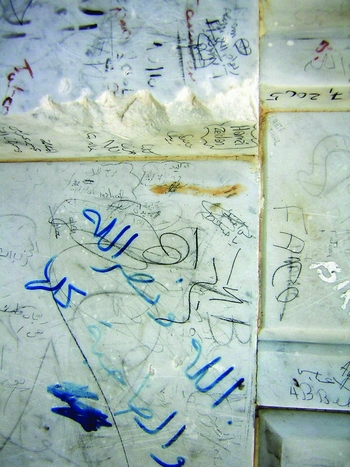
Moreover, the historic inscriptions that are located closest to the main road of today's Nahr al-Kalb heritage site have been overwritten with names and comments of present-day visitors, recording that they, too, have been here. The smooth surfaces of the two presidential marble tablets, easily accessible from the road, have been particularly popular targets for individual graffitists. The graffiti was removed from the presidential inscription at Nahr al-Kalb during the 2003 restoration, yet the layers of graffiti were thick at Beaufort when I visited in January 2007 (Fig. 5). Here, not only names of visitors but also political commentary—such as “Death to Jumblatt,” “Death to Geagea,” “The Shebʿa farms are Lebanese,” “Death to Israel,” or “Allah and Nasrallah and the Dahiye altogether”—were inscribed in Arabic on the presidential monument. The graffiti contested the Maronite president's official independence declaration, overwriting it with Hizbullah's claims that Israel still occupies the Shebʿa farms right next to the Syrian border, which justifies Hizbullah's continued resistance acitivities. Maronite Lebanese Forces leader Geagea and Druze leader Jumblatt, who are in opposition to Hizbullah, are threatened in the same terms as Israel, the freedom of expression of the graffitists guaranteed by the relative isolation of the site. Like graffiti in other conflict zones, these private commentaries sent a message of defiance, allowing ordinary citizens to think “out loud” and express their disapproval of certain Lebanese elites while expressing their support for others.Footnote 62
Graffiti on the Lahoud inscriptions at Beaufort. [A color version of this figure can be viewed online at www.journals.cambridge.org]

If the graffiti on the presidential independence declaration at Beaufort was used to express opposition to Israel and certain cabinet members in the current Lebanese government, the official inscriptions at Nahr al-Kalb were used as a backdrop for protests against Syrian involvement in Lebanon. On 25 June 2000, three months before bulldozers dug the hole for President Lahoud's inscription, 300 Lebanese-flag-waving members of Lebanon's anti-Syrian Free National Current (FNC) staged a rally in front of the independence plaques at Nahr al-Kalb. The FNC is a political movement organized by Michel Aoun, who was general of the Lebanese army during the civil war, Lebanon's contested president during its last year, and a politician in exile for fourteen years. In the summer of 2000, FNC members unsuccessfully attempted to install two marble plates at Nahr al-Kalb, one marking the Israeli withdrawal from Lebanon and a second (blank) awaiting an inscription of the Syrian withdrawal from Lebanon.Footnote 63 This public protest was interrupted and dispersed by Lebanese security forces. Subsequently, Nahr al-Kalb became the staging ground for another FNC rally, celebrating the anticipated return in 2005 of Michel Aoun from his Paris exile.Footnote 64 Since Aoun's return to political office in Lebanon and his joining forces with the Hizbullah-led opposition to the current government, the FNC has staged no more rallies at Nahr al-Kalb.
Because Nahr al-Kalb's stelae are public monuments under the state's legal protection, they can become the targets of popular dissent or commercial disruption. Without the power to enforce the law protecting Lebanese heritage, the Ministry of Culture is unable to curb the advertisement sprawl at and around Nahr al-Kalb. Without fencing in the area to keep visitors from scribbling graffiti, restoration teams will have to keep sending clean-up crews to the site to undo contemporary attempts at overwriting history. Although disruptive from the point of view of heritage preservation, these two popular practices follow the established conventions of commemorating or advertising a superior achievement.
Whereas advertisements and graffiti may signal disrespect for ancient heritage, the commercial interventions and political protests staged at Nahr al-Kalb are mindful of, and responsive to, the message of national independence and repeated commemoration of foreign powers’ interventions on Lebanese soil. Significantly, the Lebanese who oppose Israel (and by extension American influence in the Middle East) and those who oppose Syria (and the influence of surrounding Middle Eastern regimes) are also opposed to each other, yet members of both groups seek out the stelae of Nahr al-Kalb, or its Beaufort extension, to stage their protests. Mirroring the practices of rulers and presidents, the FNC tried to add a new inscription to the site, challenging Syria's presence in Lebanon.Footnote 65 In both their anonymous and organized public protests, Lebanese citizens respond to messages from political elites and engage in their own cultural politics, illustrating that Nahr al-Kalb can become more than a brief tourist stop on the way to another destination. In other words, Nahr al-Kalb has been, and probably will remain, subject to continuous unofficial interventions.
CONCLUSION
Lebanon has officially returned to the past. The recent restoration and reinauguration of the archaeological site of Nahr al-Kalb, as well as its inclusion in UNESCO's world memory list, demonstrate the desire of Lebanese elites to embrace their ancient past and to construct a narrative of a united, post civil war national identity. President Lahoud redefined the Lebanese, both in the north and the south, as a liberated community with a long history of resistance against outside forces. Members of the Ministry of Culture and National Heritage Foundation transformed Nahr al-Kalb into a site of multicultural exchange and deep human understanding.
These recent reinterpretations of a heritage site that displays foreign military and engineering victories on what Anis Sayegh called a “wall of shame” constitute a significant official step in producing post civil war narratives of Lebanon's past. UNESCO's inclusion of Nahr al-Kalb in its Memory of the World Programme turned the local history of a cultural crossroads into a history of shared humanity. It is ironic that Lebanon's heritage elites symbolically returned Lebanese soil to “foreign forces” in the guise of admittedly more benign global cultural elites. Unofficial interventions commented on and disagreed with public declarations of independence and liberation. All of this happened within the span of five years after a decade of public avoidance of the past.
That the stelae of Nahr al-Kalb could be interpreted in such different ways is mostly a result of the logic of resemblance. “Great men” engaged in the repeated practice of installing commemorative inscriptions that copy each other, declaring their military and engineering superiority and their position in a long line of foreign forces that fought to take possession of Lebanese soil. In the end, the very act of affixing an inscription became a symbolic “taking possession” that did not even require military actions. Throughout history, foreign rulers and elites have come to Nahr al-Kalb to add their commemorative plaques. Lebanese political elites ushered in the country's independence and liberation from foreign influence using the very language of previous invaders. Contemporary popular dissent with the government did not result in a destruction of the stelae but in an attempt to add more inscriptions.
The commemorative focus on foreign invaders illustrates the precariousness of the Lebanese state, unable (or unwilling) to erase foreign influences. Foreign forces continue to have a say in Lebanese affairs, the country's independence compromised most immediately by continuing Syrian involvement—even after the withdrawal of Syrian troops—and the ever-present Israeli military surveillance and threat of future Israeli attacks. In light of these current political conditions, and in the aftermath of an inconclusive civil war, the staging of national unity messages at a well-known heritage site is a small yet significant step in the very difficult road of post civil war national-identity building.
The stelae of Nahr al-Kalb are neither the most physically impressive nor the most widely known ancient monuments in Lebanon. It therefore needs explaining why Lebanon's National Heritage Foundation made Nahr al-Kalb one of its main restoration priorities and bankrolled the work project with $200,000 to date.Footnote 66 I haves suggested that its logic of repetition of memories of accomplishments, its deep history that predates Christian and Muslim historical narratives, and its role in staging the national independence declaration of 1946 made it a perfect site to produce a post civil war image of a united community. As Humphreys has evocatively argued, memory and desire constitute two sides of the same coin: “Memory creates the desire to regain the old and seize hold of the new, in the hope that they will be the same thing.”Footnote 67 A desire to turn a long list of foreign victory declarations into a narrative of Lebanese victory, and to celebrate repeated foreign interventions as evidence that Lebanon is at the crossroads of important world cultures, created a postwar memory that highlighted resemblances at the expense of cultural differences.
The heritage site of Nahr al-Kalb is a challenging site for analysis, but here I have demonstrated the significance of national heritage in a post civil war society and the role that commemorative rules and conventions play in creating narratives of the past. By studying the politics of heritage in postconflict zones in the Middle East, we may shed light not only on contemporary struggles for power but also on the complex historical and cultural dynamics that can create authentic sites of memory.