At the New York Legal Aid Society's twenty-fifth anniversary banquet in 1901, Arthur von Briesen, the Society's longtime president, ended the evening with the following acknowledgement: “Before we separate I beg to be permitted to say a few words on … the valuable aid which the Society has received from the women of New York. I want you to understand that without them we could not have prospered, without their assistance we could not have done the work… . Their energetic efforts in our behalf, their clear understanding of the duties … has enabled us to increase not only the forte and our power for good, but enabled us to create a special branch in which the cases of women can be specially considered by an able lawyer who is also a woman.”Footnote 1 Here Briesen publicly recognized women's efforts on behalf of legal aid as benefactors, supporters, volunteers, and lawyers. The audience that evening would not have been surprised to learn that a woman lawyer now would be providing legal services to women clients, for this was not a new phenomenon. The Society already employed a number of women lawyers. Furthermore women formally untrained in law, but nonetheless acting as lawyers, had prior to the turn of the century provided legal services to poor women through New York City's Working Women's Protective Union (WWPU). As I demonstrate, the origins of legal aid lay in the provision of legal services to poor women—often by other women.
Legal scholars who address the history of legal aid suggest that the first legal aid organization in the United States was the New York Legal Aid Society (the Society).Footnote 2 They further paint a portrait of legal aid in which women as legal providers are primarily absent and in which gender plays little role. Rather, according to the literature, legal aid developed in response to mass immigration to the United States and the fear that without access to law immigrants, primarily imagined as men, would become seduced by socialism. Not only is this picture incomplete but the WWPU, founded in 1863, had by 1888 already conducted over 10,000 prosecutions and mediated 25,000 disputes on behalf of women.Footnote 3
This article provides a case study and an in-depth analysis of the WWPU. It then discusses how by the turn of the century, when the Society became the dominant provider of legal aid in New York City, women's roles as legal providers and recipients of legal aid was even further expanded. By doing so, I demonstrate that gender was foundational to the development of legal aid and that women played crucial roles as lawyers, benefactors, and clients. Although this article focuses on New York, legal aid organizations in cities such as Chicago and Philadelphia also first arose to provide free legal services to women and such aid often was provided by other women.Footnote 4
Significantly, however, the article is not just about women but also the central role that gender ideologies played in the creation of legal aid. Gender dictated who would be the beneficiaries of legal aid, how lawyers constructed legal claims, what claims would be taken, who provided legal aid, and how legal aid reflected back upon the image of the legal profession. The story of the development and work of the WWPU is multicausal and demonstrates how legal aid was shaped by shifting gender ideologies and their intersection with the nascent labor movement, understandings of wage labor, new ideas about philanthropy, and the changing nature and composition of the legal profession.
In the first part, I discuss the founding of the WWPU, situating its origins in a failed attempt by women to establish a labor union for women workers. Then I analyze how gender shaped the WWPU's work, the portrayal of its clients, adversaries, and practice, and the interactions between elite male attorneys and the WWPU. Also explored is how women without formal legal training, and at a time when women could not be admitted to the New York Bar, vote, or even sit on juries, provided much of the legal advice and conducted the majority of the work of the WWPU. With this background, the final part of the article examines the New York Legal Aid Society, where I argue that the Society consciously sought to differentiate itself from the WWPU and present a more professional and masculine image. At the same time, however, and due to material conditions, including perpetual financial problems, the needs of poor women, and a new cadre of professionally trained women lawyers, the provision of legal aid continued to be deeply feminized.
Labor Activism and the Founding of the Working Women's Protective Union
In 1863, in the midst of the chaos and disorder of the Civil War, New York City's economy experienced significant inflation. This was particularly devastating for the poor and working class, who in many cases could no longer afford necessities as wages stagnated and prices rose.Footnote 5 In response, workers began organizing, striking, and making demands for higher wages and shorter hours. As employers refused to bargain, thousands of New York City workers went out on strike.Footnote 6 Although men, led by the machinists (an industry crucial to the war effort), began the strikes, women workers soon joined them.Footnote 7 Women workers, concentrated in the sewing trades, were some of the worst-paid workers, and their wages had actually decreased during the course of the war. Where machinists and other skilled male workers earned approximately $2 a day and complained that they could not live on such wages, many women in the sewing trades earned $2.50 a week.Footnote 8 As one newspaper reported, “[women's wages] have been so depreciated that it is scarcely possible to realize how any one could live from the proceeds of such work.”Footnote 9
Furthermore, male unionists were often hostile to women workers, believing that they drove down wages and were incapable of organizing.Footnote 10 Even so, women who worked in a variety of trades began to hold meetings in their shops and homes to contemplate collective action and additional strikes.Footnote 11 Such women became particularly visible when their letters began to appear in newspapers, complaining of the unfair practices of employers, low wages, long hours, and dehumanizing treatment.Footnote 12 This nascent movement was quite democratic as hundreds of women soon began to attend citywide meetings.Footnote 13 One newspaper reported that the ladies who attended such meetings were “plainly attired—contrasting with women's rights conventions and other kindered [sic] assemblies very favorably.”Footnote 14 At a November 18 meeting, the Working Women's Union was formed to advocate for higher wages and shorter hours.Footnote 15 A man who mysteriously did not want his name published was elected president, and five women were elected to serve on the executive committee.Footnote 16
With the creation of the Union, some newspapers that had been sympathetic to the complaints of working women suddenly turned cold. The Tribune reported that at the first large meeting of the Union, the women who crowded the hall appeared well fed and that there was no indication of “starvation” or “consumption (except for food).” It further claimed that some women “bragged” of their high wages, and that others living with parents had “free support.” Moreover, it reported that the women were ignorant of how to conduct a meeting and that they refused to elect delegates.Footnote 17 Pointing to the chaos, and potentially radical undertones of the movement, a number of articles claimed that Susan B. Anthony was in the audience in the company of a “colored girl.”Footnote 18 According to one reporter, the president asked her to leave, stating that she would “only confuse the meeting” and “lead it from the business at hand.”Footnote 19
The next days would not bode well for the women of the Union because skilled male strikers went back to work having negotiated higher wages with their employers. On November 24 at a Union meeting, the male president presented a draft constitution. The preamble stated that the Union would work “to secure legal protection from fraud,” “appeal respectfully … to employers” for higher wages and shorter hours, and create a registry for unemployed women. It also provided that “every working woman of good character other than those employed in household labor shall be entitled” to be a member.Footnote 20 Yet as one newspaper ominously wrote about the meeting, “Women have the reputation of being pretty good talkers, but it was observable that most of the speeches were made by men.”Footnote 21
Following this meeting, and in quick succession, a group of unnamed men formed a committee, drafted a new constitution for the Union, and issued a report regarding why it was necessary for men to control the Union.Footnote 22 The report, speaking to the women of the Union, stated, “The difficulties in the way of organizing and carrying on an association to be managed and controlled among yourselves, were so great as would seriously impair the usefulness of the Union.”Footnote 23 A later description of the takeover candidly explained, “The [Union's] earlier efforts were directed to the establishment of an organization among the working-women themselves for their own mutual protection. But their want of experience in the management of business affairs and some already evident machinations among the evil-disposed of their own sex, proved obstacles not easily surmounted. Thus the gentlemen … felt impelled to assume the entire control.”Footnote 24 The new committee tellingly changed the name of the Working Women's Union to the Working Women's Protective Union of the City of New York, with membership limited to those who contributed at least $25.Footnote 25 This was a sum that virtually no working-class woman could afford.
The new leaders of the Union now narrowly defined the mission of the Union to provide “working women with legal protection from the frauds and impositions of unscrupulous employers.”Footnote 26 Gone were the women's demands for collective action; and the Union made clear that it would not foster strikes, and it admonished those women that it aided to behave in a manner “worthy of respect and esteem.”Footnote 27 Clearly the women's actions and their potential, or at least imagined, association with suffrage, strikes, and democratic unionism was too threatening and radical for male labor leaders and their middle-class allies. Further, the continued agitation of working women occurring only four months after New York City's infamous draft riots may have provoked even greater fears of social unrest and chaos.Footnote 28
Within a couple of months of the founding of the WWPU, some of New York's elite members of the bar began supporting the Union, including James Brady, Charles Daly, William Roberts, and Peter Cooper.Footnote 29 Charles Daley, one of the most respected judges in New York City, quickly became an officer of and ardent advocate for the Union, and he enlisted the support of other New York judges.Footnote 30 New York lawyers also generously began funding the Union.Footnote 31
The events that transformed a nascent labor union controlled by women into a middle-class benevolent organization directed by lawyers functioned to channel working-women's potentially disruptive and radical actions into orderly legal channels.Footnote 32 At the same time, male lawyers could demonstrate their concern for the well-being of poor white women and the power that law had to redress working-class grievances. Disaffected working-class women, through the Union, could take their grievances to the courts rather than the streets, and law could mediate between workers and employers. Furthermore, by the Union asserting that the problem that working women faced was the result of fraud and unscrupulous employers, it implicitly claimed that the wage-labor system was sound. The problem was simply with those employers who engaged in fraud—something that law and lawyers could remedy.
The Work of the Union
Through the years, the WWPU provided primarily two services to working women—an employment bureau, and legal assistance to women who had claims against employers. The Union was never an organization with an active rank-and-file membership, and it was certainly not a women's labor union. Rather, it was controlled by the all-male board of directors and its officers and reached out to a wider public only when it required additional funds. Eventually the Union became the darling of New York's bench and bar, with many of New York's most renowned judges and lawyers supporting the organization.Footnote 33
The Union focused its legal services on collecting the unpaid wages of working women. A woman requiring help from the Union found her way to its offices, which through the years occupied a number of addresses in what is now Greenwich Village. There, the Union's supervisor, always a woman, and whose crucial role will be analyzed later, would listen to the woman's complaint and determine whether she had a viable legal case. If a valid claim existed, the woman returned on “complaint day” and presented her case to a male attorney. Upon accepting a case, the Union sent a demand notice to the potential defendant, signed by the supervisor. The demand stated the amount owed and gave the employer three days to respond. Surprisingly, employers often appeared as summoned, and the Union attempted to persuade them to pay the claim. If the employer did not respond or refused to pay, the Union would file a court case in the woman's name. The Union prided itself on its determination in bringing cases to trial and even pursuing them through appeal.
Over the course of its history, by far the largest number of claims that the Union brought involved women in the sewing trades. At times, employers deducted money for allegedly substandard work or simply refused to pay wages. Another common practice involved hiring women to do unpaid “trial” sewing for extended periods, and then terminating them without payment. Some employers required their workers to provide a security deposit, which they then refused to return. The Union took cases for sums as low as twenty-five cents and as high as $300.Footnote 34 In addition to women in the sewing trades, the Union at various times handled cases for bookbinders, washerwomen, tutors, saleswomen, artists, shoefitters, stenographers, secretaries, traveling book saleswomen, and even an actress.
From its inception, the Union refused to provide legal services to domestic workers, claiming they already had their board and bed provided, and thus did not face the privations of other poor working women. That exclusion, however, may have also performed a number of other functions that went to the heart of the Union's perception of its own role. First, it insulated the benefactors of the Union as employers whose own employment practices might be scrutinized. Second it excluded many Irish immigrant women and African American women who filled the ranks of domestic servants.Footnote 35 In addition, the Union located the problem of working women in the industrial sphere, outside the home. Finally, throughout the nineteenth century in New York, the middle and upper classes believed that a domestic labor crisis existed, and domestic help was generally unreliable and unruly—not the type of women worthy of Union protection.Footnote 36
The Union's Representations: Remaking Working-Class Women
The Union proved ingenious at reconstructing the image of the working woman in order to situate her as worthy of legal representation. No longer were they impertinent women who demanded unions of their own and fostered strikes. Now the Union reconstructed such working-class women into domesticated middle-class women who simply had fallen on hard times. Repeatedly the Union asked its supporters to imagine that such women were their own daughters untrained in industrial work and now required to support themselves. At the Union's first annual meeting, A. Oakey Hall, who was a former New York district attorney and who would later become mayor of New York, declared that the Union was particularly interested in the woman who had been “nurtured” and was now forced to “maintain herself by an occupation to which she was unaccustomed.”Footnote 37 Another early example described one working woman who sought the Union's assistance as being “of excellent education and address.”Footnote 38 A further description from the 1870s described two needy sisters from New Orleans as well educated and from a good family whose fortunes had reversed due to the war.Footnote 39 The Union's governing conception of working women was to see them as white, middle-class women who had fallen on difficult times as a result of the Civil War. Now in the industrial workforce, they required the aid of gentlemen lawyers. Furthermore, although the Union often iterated that it provided services to women of all races, it seldom provided counsel to African American women.Footnote 40 Rather part of what made such women worthy of Union representation was their whiteness and the fantasy that such women came from families that resembled the Union's benefactors.
By the 1880s, the ethnic composition of the city's working-class women included growing numbers of Eastern and Southern European immigrant women, and women's industrial employment could no longer be imagined as temporary and the result of war. Instead, the WWPU began to see the plight of working women as inherent in capitalism—a product of the vagaries of the market. Even with this, the Union's image of the working-class woman did not change. As one Union speaker stated, “We are subject constantly to commercial reverses. The panic comes along and the great house goes down, and the bank topples over.” In this account, the rich man became poor, and his wife and daughter, unprepared and untrained, were forced into the workplace.Footnote 41 Another story involved a woman appearing at the WWPU's office in dire need of help. A benefactor immediately recognized her as the educated daughter of a deceased friend who, when alive, was “well known,” “wealthy,” and held in great respect.Footnote 42 Clearly these stories demonstrated that downward mobility could affect anyone through no fault of her own. Instead of conceptualizing working-class women as a class apart, these accounts presented them as members of the middle-class. In doing so, the Union was at once able to portray its clients as worthy of legal representation while eliding class conflict. Through these tropes, the Union could continue to maintain that its clients were truly middle class while ignoring the reality that the “new world” of the United States had produced an old-world-like permanent poor working class.
Strikingly, however, it also recognized the women that it served as wage earners, and often family breadwinners. In 1870, the Union wrote, “Working women by the toils of their own hands, furnish the only support of aged parents, or of crippled or diseased sisters and brothers, and often times of large families of their own.”Footnote 43 This position differed significantly from that of many, including some male union organizers and working-class men, who often maintained that women's employment was limited to their years before marriage.Footnote 44 It further contrasted with mid- to late nineteenth-century gender ideology, which saw white women's roles to be in the home, and either made working women invisible or portrayed them as disordered and standing outside appropriate gender relations.Footnote 45
Rather, the Union acknowledged that working women supported themselves and their families with their wages. In 1885, the Union's superintendent testified in U.S. Senate hearings, “Nearly all [to whom the Union provided aid] … have someone dependent upon them, either an aged father, or brother, or sister. There are very few working women that have not got somebody dependent upon them besides themselves.”Footnote 46 Union reports also sought to emphasize this point to the public. For example, the Union's 1888 Annual Report described Mary, who “had a sick husband and child who depended upon her slender earnings.” Two other women, Susan and Nancy, supported themselves and their mothers, one by sewing straw and the other as a stenographer. The report described Bridget as “a pale faced little woman, the only dependence of a husband in the last stages of consumption, as well as two small children.”Footnote 47
Yet as the Union showed the extent to which women and their families depended upon women's wages, it simultaneously upheld the ideology of the male breadwinner upon whom wives and children depended for support. In no case that it described (at least for which there are extant documents) did an able-bodied male appear. Rather, the Union recounted a litany of dead and dying men. No woman had a healthy husband (where husbands existed in the Union's accounts, they were on their death beds) and only occasionally was a father mentioned—even then he was enfeebled. The ideology of the male breadwinner was reinforced, with the caveat that in situations where no healthy male existed, working women out of necessity functioned as breadwinners.
If the Union had publicized cases involving working women with laboring husbands, fathers, or brothers, it would have been forced to recognize that male laborers often did not earn enough to support their families.Footnote 48 Furthermore, as presented by the Union, the female breadwinner's independence was incomplete, for ultimately she was dependent upon the Union to collect her wages. By presenting these women as essentially standing alone, without male protection or support, the Union created a role for itself—it functioned as the familial protector that it imagined these women otherwise lacked.
Women Without Agency
Similarly crucial to the Union's ideology was its understanding of working women as embodying female passivity and helplessness. Indeed, it was this very passivity that made them worthy of legal aid. What is important in the Union's continual depiction of the poor, helpless working woman is not its innovation, but rather how old it was, appearing throughout antebellum literature.Footnote 49 Yet the Union, from its inception through the 1890s, stubbornly maintained and fortified this construction. Consistently, the Union described the women it assisted as helpless, downtrodden, defenseless, and at times starving. The Union's first report in 1868 was filled with crippled women, consumptive girls, and the widows of Union soldiers. The report, however, recognized working women's active struggles to receive their wages. Through the decades, however, even such minuscule recognition of female agency evaporated while the Union's agenda became narrower.
For example, in the 1860s, various annual reports described a Union benefit where women in the sewing trades exhibited their work. During this demonstration a female factory operative explained to her audience the amount of time that went into the creation of various garments and the piece rates employers paid. She lectured that a pair of drawers required 1,800 stitches and needed to be finished with buckles, buttonholes, and straps. She worked from 7 a.m. to 9 p.m. and could finish four garments a day. For this labor she received sixteen cents a garment. Other women told similar stories.Footnote 50 This Union exhibition gave working women the opportunity to voice their complaints and educate their elite and middle-class audience about the economy in which they labored. As Judge Charles Daly stated, these women spoke the “eloquence of facts.”Footnote 51 By the 1870s, however, any discussion of this exhibition evaporated.
Likewise, in 1868, the Union wrote of an episode in which a group of female employees of a parasol factory asked the Union to provide assistance in convincing their employer to pay living wages. Although no legal claim was involved, and the women did not allege that the employer had failed to pay them, the Union took their demands seriously. It began negotiations with the employer and claimed, that through various tactics, they convinced him to pay higher wages.Footnote 52 Such stories emphasized the women's agency and recognized that the wages women often received were inadequate.
Yet by 1888, the Union adopted the slogan, “Oh, if we could always get paid for our work, we could get along.”Footnote 53 This phrase defined narrowly the abuses and inequities that working women experienced. It asserted that if working women could collect their wages, they could adequately support themselves and their families. It thus insinuated that the wages women received were living wages and refuted the rallying cry of labor reformers and women's rights advocates that the wages that employers paid women in the sewing trades were so meager that women had to supplement their incomes by prostitution.Footnote 54 In contrast, the Union's position justified the existing system of wage labor, claiming that it was not the system that needed to be reformed, but rather only the individual behavior of certain employers who refused to be bound by their contractual obligations.
As the agenda of the Union narrowed, so did the space for women's agency. By 1879, Judge Noah Davis remarked: “In this union we see a corporation created for the noblest purposes—the protection of oppressed and helpless womanhood. Its motive was the idea of pure chivalry … Outside of infancy, there is no object so helpless as a poor girl … forced to walk upon the sharp edge of necessity, between starvation on the one hand and death in life on the other.”Footnote 55 The Union's literature repeatedly declared that the working woman standing alone was without defenses. Only with the Union behind her could she stand up to employers. What empowered the working woman, in the Union's view, was an organization of male lawyers able to use the law on her behalf. The more helpless the working woman seemed, the greater the Union's power appeared. As late as 1888, one lawyer stated at a Union benefit that women without male protection will “shrink from his cruelty without a word, and lie down and suffer.”Footnote 56
An 1888 Union report described a case involving a woman who sewed sheets for two and a half cents each. When she sought to collect her money, the company sent her from one person to another, each claiming that he was not responsible for paying such wages. The Union proclaimed, “Finally Catherine gave up in despair, and called on the Hercules of the UNION for help.”Footnote 57 In the Union's words, it, with access to law, became god-like. Elite lawyer Fredric Coudert labeled the men of the Union “knights” who used not the sword but the law to seek redress. He further claimed that with the mere command “open sesame,” the Union provided justice to working women.Footnote 58 As constructed by these men, they were magically endowed knights who rescued damsels in distress.
The Union's construction of working-class women as without individual agency was extraordinarily unstable, for their agency bursts through Union narratives. In contrast to Union descriptions, women did not stand idle when their wages went unpaid. Rather, they constantly harassed their former employers. At times traveling substantial distances, such women appeared day after day demanding to be paid. Some even camped out at their employer's home, refusing to leave until the employer paid the wages owed. In at least one situation, the woman filed suit against her employer on her own and only came to the Union later for assistance.Footnote 59 Others sought assistance from the Union when their employers sued them. Pursuant to a New York State law of 1876, an employee had the right to retain goods produced for an employer until wages were paid. Although the Union never admitted it, for working women, the Union's aid was only one tool they used when self-help had failed.
The Union's Women Workers and the Practice of Law
The ideological work of gender is always incomplete and produces complex ironies and contradictions.Footnote 60 The Union is the perfect example of this phenomenon. As the Union attempted to depict the “good” working woman as lacking agency, through the years it obscured the extraordinary legal work of its own female employees. Women always occupied the position of Union superintendent and assistant superintendent. The first superintendent, Mrs. C. Brooks, was so retiring that she did not want her name publicly announced at the Union's first annual meeting. From 1868 (when the position became salaried) to 1888, Martha W. Ferrer was the superintendent.Footnote 61 That a woman held this position was not unusual, for many nineteenth-century institutions that assisted women had a female superintendent on staff.Footnote 62 A number of elements, however, were unique about Martha Ferrer's work. First, despite her service, she remains almost invisible in the Union's writings—no mention of her is made in any newspaper article about the Union, and she did not speak at any of the Union's many benefits.Footnote 63
Ferrer, however, exercised a tremendous amount of power, as did Mrs. Creagh, who filled the position after Ferrer's death. Their work is evidence that women were practicing law, under the rubric of philanthropic work, at a time when women in New York State could not be admitted to the bar. It also highlights how legal aid from its founding employed women advocates who performed the work of lawyers. Ferrer not only managed the day-to-day activities of the Union but she, or her assistant, also met with each woman seeking aid. She listened to their stories and determined whether a colorable legal claim existed that could be prosecuted by the Union. Only after the superintendent's determination would the woman seeking assistance be permitted to return during complaint day to speak to a male attorney. Furthermore, as hinted at in Union documents, many women came to the Union office seeking advice about how to respond to the abuses of employers, and the superintendent must have provided it. If Union figures are to be believed, Ferrer would have listened to tens of thousands of complaints over the years.
Likewise, after the Union accepted a case, the superintendent sent a demand notice to the employer under her own signature. The Union's decision that the superintendent, rather than one of the Union's attorneys, would send the notice highlights the superintendent's authority.Footnote 64 Yet why would the Union choose to have the employer receive the notice from the female superintendent rather than from a male attorney? Perhaps the Union's representation by a woman emphasized the morality of the Union. That is, the question of the payment of wages (or at least the failure of the payment of wages) belonged more in the realm of morals than the market. Who better to present such claims than a white middle-class woman who, according to nineteenth-century gender ideology, embodied morality?
In addition, presentation of the claim under a woman's name might have been viewed by employers as less antagonistic and litigious than if received from a male attorney. Perhaps employers understood it as an invitation for negotiation and settlement. Even after a complaint was sent, the superintendent's role continued, and she was primarily responsible for negotiating with employers for the payment of wages and the settlement of cases. Thus the Union's male attorneys would have been involved in only a fraction of the cases upon which the superintendent worked. The superintendent also functioned, along with an attorney, as an arbitrator when employers chose to have their cases heard by the Union's arbitration service. What distinguished the supervisor's duties from those of the Union's attorneys was simply that she did not appear in court.Footnote 65
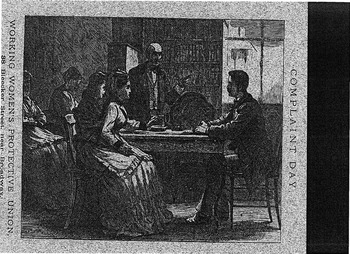
Illustration 1 below supposedly depicts complaint day at the Union, and it was widely reproduced in the Union's annual reports. The illustration is significant for a number of reasons, and it was clearly embraced by the Union as the image that it wished to project to its audience. The most active, prominent, and authoritative figure in the illustration is the Union's male attorney, who is standing and lecturing an errant employer. Next to the attorney is a working woman and next to her is the Union's superintendent. The superintendent is differentiated from the Union's client by the more elaborate dress that she wears. Although only the male attorney is portrayed as speaking, the superintendent is not entirely passive as she actively sits forward in her chair and glares at the errant employer who returns her gaze. Yet as portrayed, it is the male attorney who commands the viewer's attention and who appears to be in control. The superintendent and her role is more ambiguous and less active. She is as much an audience to the attorney's performance as an active participant.
This illustration appeared in each of the WWPU's annual reports beginning in 1878.

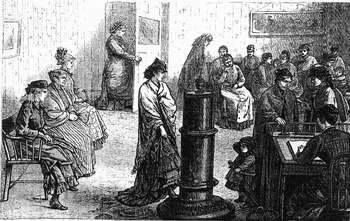
A later illustration created by Georgina Davis (Illustration 2), a pioneering woman illustrator, which appeared in Frank Leslie's Illustrated, presents a much less ambiguous image of the superintendent and its women employees.Footnote 66 In this portrayal, the assistant superintendent sits at a desk, surrounded by women in need of the Union's services. She appears actively engaged with a working woman seeking assistance. The Union's supervisor appears at the door ready to summon the next client. Here the Union's women employees are all active and firmly in charge of the work of the Union. Even more striking is that the Union is depicted as a space entirely inhabited by women. Yet this is an illustration that the Union never embraced. If it had, the superintendent's legal work would have been highlighted and the work that the Union performed feminized. The Union's carefully constructed image that male attorneys controlled the work of the Union would have been undermined.
G.A. Davis, “New York City — The Waiting Room in the Building of Working Women's Protective Union,” Frank Leslie's Illustrated (Feb. 5, 1881).

As the work of the superintendent was ignored, other women's contributions to the Union were also slighted, and only the occasional hint of them can be detected. Middle-class and elite women volunteers organized the Union's public fundraising events. Furthermore, wealthy women and women's organizations were some of the Union's largest benefactors. For instance, the women's organization Sorosis was a frequent contributor to the Union. In addition, in 1880, five of the seven largest monetary donations to the Union came from women or women's organizations.Footnote 67 Thus what must be recognized is that this organization supposedly run by male attorneys was in fact a feminized space in which women ran and participated in its most crucial functions, including engaging in legal work.
Domesticity, Sentimentalism, and the Union
One of the few times that Martha Ferrer's work was publicly discussed was when she died. The year of her death, 1888, also marked the Union's twenty-fifth anniversary. During the celebration, she was briefly eulogized, described as a mother and grandmother. The speaker further praised her dedication to the Union in a position requiring her “to look out for all the details of the society” and provide “tender care,” and “love” to the working women who came to the Union's offices.Footnote 68 Such a description not only discounted Ferrer's legal work but also drew upon images of the ideal late nineteenth-century white woman in her home caring for family and managing the household.
Domestic imagery was crucial in how the Union portrayed itself, its attorneys, its workers, and the women who received legal aid. Such imagery functioned to resituate the Union's working women from the industrial sphere into a domestic sphere—a place, according to mid- to late nineteenth-century gender ideology, where women naturally belonged. The day after the Union's offices opened in 1864, it wrote, “Before the present year closes, we feel confident that hundreds of homeless working girls will look upon the headquarters of the Union, as a home, and upon the lady in charge, as a mother.”Footnote 69 Here the Union's female workers were not understood as professionals but rather as substitute mothers, and the Union's office was not portrayed as an impersonal professional space but rather as a home. Further playing upon domestic imagery, in 1870, the Union described itself as “a home where the story of fraud could be told.”Footnote 70 Again, the Union did not situate itself as a law office where legal services were rendered but rather as a domestic institution where care and love was provided.
Returning to Illustration 1 above, it is striking that if it were viewed out of context, it could represent a middle-class family at home. The male lawyer is depicted as a kind and protective father, and the superintendent is portrayed as a concerned mother. Both are challenging the man who threatens their daughter protectively seated between them. A later illustration that appeared in Harpers Monthly went so far as depicting the Union's attorney and a working woman seated in front of a large, ornate, and blazing fireplace.Footnote 71 Such imagery highlighted the Union's understanding that it provided a place that, like home, was built upon benevolence, altruism, and morality and that provided a refuge and an antidote from the harsh world of the market—a place where fraud occurred.
As such depictions re-created the working woman as a middle-class daughter, they also remade the image of male lawyers. The illustration, as well as the Union's writings, embraced what Michael Grossberg calls “responsible manhood.” As he wrote of lawyers during the antebellum period, “The ideal lawyer carefully reasoned through problems, soberly addressed difficulties, courageously defended the dependent, and acted as an independent crusader.”Footnote 72 Grossberg surmises, however, that the post–Civil War period marked the demise of lawyers embracing responsible manhood. Yet the Union maintained this position throughout its existence, and it attempted to integrate it with the new idea of the business lawyer as specialist and aggressive adversary. As the older image of the lawyer increasingly conflicted with the everyday practice of law (which for elite New York City lawyers often meant representing corporations and raising corporate capital), it may have become even more important for the men of the Union to be able to imagine the practice of law as embodying such older conceptions of the work of the urban lawyer. Robert Gordon has also astutely pointed out that elite New York City lawyers in the late nineteenth century longed for a higher calling that could reconfirm the legitimacy of law and legal practice.Footnote 73 In the Union they found such a place.
If the public sphere of the market (and by extension the lawyer's role in it) was marked by often callous and arm's-length commercial transactions, and the home viewed as a redemptive refuge that stood outside market transactions, the Union united these two worlds. Here, the Union fought for what was morally correct without regard to whether litigation made commercial sense or was cost effective. The Union, through the image of the downtrodden working woman, allowed lawyers to view themselves and the profession as gallant, paternal, and deeply moral.
Also, many historians recognize the paradigm shift surrounding philanthropy that occurred during the Civil War. Where antebellum charity was based upon the sentiments of giving, humanity, and sympathy, postwar charity rested upon scientific efficiency and a “tough-minded dollar-and-cents approach.”Footnote 74 George Fredrickson writes, “The charity worker, like the military commander … was never to give way to ‘sentimental’ humanitarian impulses, but was to consider the army as a whole and the ‘cause’ rather than the immediate comfort of individuals.”Footnote 75 The Union never adopted this approach. Instead it emphasized that it joyfully and freely gave money to needy women, and at other times actually purchased their legal claims at par value. Here was a realm, like the home, were the ordinary rules of business did not govern. Throughout its history, the WWPU refused to adopt the business model of philanthropy, and frequently celebrated its conscious rejection of the values of the market. Judge Daly remarked at an early meeting that the WWPU was prepared to spend $100 to procure twenty-five cents.Footnote 76
Such a statement was not an anomaly—the Union often boasted that it spent more on the prosecution of a case than the legal claim was worth. By doing so, it attempted to exempt its own activities from the laws of the market that governed lawyers' everyday legal practice. For example, in 1880, its treasurer told the following story of a woman collecting the money from a judgment won by the Union:
“Here is your money—seven dollars and sixty-one cents,” was the Matron's greeting to the next comer. [The woman] was expressing her thanks hesitantly when she suddenly asked, “How much am I to give you out of this?”… . The reply came instantly and cheerfully, “not one cent, my good woman; it is all yours.” “But you spent some money to get it; You had Jane come all the way from New Hampshire to be a witness for me. I ought to pay you for that.” “Yes, I know, we paid over nine dollars for Jane's fare and nearly fifteen dollars for other expenses, but that is part of our duty.”Footnote 77
Here the lawyer's duty to pursue justice and what was morally correct trumped market logic.
Another case concerned the claims of a woman named Catherine whose employer owed her five dollars for sewing sheets. The Union wrote, “Meanwhile ‘the company’ had dissolved and another company had bought out the concern. The UNION had great difficulty in tracing back and fixing the responsibility on anyone; but energy and perseverance—and much more money than Catherine's claim amounted to were successful at last.”Footnote 78 As Henry Day, one of New York's elite attorneys, observed of the Union, “There is something besides the money here … I do not believe there is any lawyer in the city of New York that will bring six thousand suits, and carry them through to judgment for the $22,000 that have been obtained.Footnote 79 Another Union officer remarked regarding the cost of employers appealing cases to higher courts, “The cost grows from five dollars to ten; and from ten dollars to a hundred. Would you back down, or would you pursue justice.”Footnote 80 In the Union's realm of women, more associated with the domestic sphere than the industrial sphere, the rationality and rules of the marketplace were replaced by an ethics of benevolence.
The Union also refused to lose sight of the suffering of the individual. It constantly reminded its audience that what appeared to be the small sums of money that women sought, constituted significant amounts for them. It implicitly argued that the value of a dollar differed for working women compared to those who were financially secure. Thus, they never tired of pointing to cases where a dollar represented the difference between a working woman and her children eating or starving. In doing so, the Union emphasized that the benefits that it provided could not be objectively measured in dollars and cents, for the subjective benefit that it provided to individual women far outweighed the actual amount of damages.Footnote 81
By the Union celebrating its market inefficiency, it attempted to rehabilitate the image of lawyers and the practice of law as ensconced within market relationships. One Union speaker told his audience, “Lawyers are not a class … which are supposed by the community to do much for nothing, and yet they do more than any other.”Footnote 82 The documents of the Union are replete with the nineteenth-century version of the lawyer joke, which often focused on the high fees charged by attorneys.Footnote 83 Such comments reflected a concern that the lawyer and his work had been entirely commodified. By contrast, the men of the Union viewed their work as a visible refutation of this connection between law and the marketplace. As the Union wrote, its legal advice was “without price.”Footnote 84 Thus, the Union represented a context in which lawyers could fantasize that their own services were literally priceless, and the ordinary rules governing the efficiency of litigation and the practice of law did not apply. There is an irony here—as working women sold their labor, male attorneys claimed that they refused to sell their own, when attempting to win wages owed to such women.
Yet at moments, the Union exhibited a certain discomfort with the image that it created and how it exempted itself from market and efficiency standards. At times, it claimed that the Union's true importance lay not in the prosecution of individual cases, but rather in how it deterred employers from engaging in fraud. For instance, it asserted that the Union's true value should be measured by the (inherently incalculable) number of employers who, due to its existence, did not engage in fraudulent behavior. At these times, the Union described itself as a policeman who patrolled industry, preventing the worst abuses of employers. As the Union wrote, “Their polluting waters are restrained only by constant vigilance.”Footnote 85 Again, here the Union found a role for law in mediating the relationship between employers and employees while reinforcing the importance of contracts. The threat of litigation by the Union supposedly deterred employers from breaching their own bargains. Moreover, as early as 1871, the Union lobbied for and won a law that allowed judges to award fees and costs against a male employer who failed to pay a woman's wage.Footnote 86 This law was gender specific and the Union boasted that costs, which could triple the amount of damages, acted as a strong deterrent to employers. It appears that such sums went into the Union's coffers and not to the plaintiff. Thus, the Union quickly began funding itself through court victories, shifting its costs to the defendant, indirectly placing a price tag on the services that it rendered, and reasserting its place in the market economy.
Although the Union's conceptualization of its work as standing outside market forces was incomplete and conflicted, unlike other organizations and throughout its existence, the Union was not primarily concerned with justifying its activities as appropriately businesslike, efficient, and unsentimental. Rather, at a time when lawyers were seen as increasingly immersed in market relationships and neglecting broader issues of justice, the Union sought to remove law (at least momentarily or episodically) from the world of the business corporation, placing it in the domain of pure benevolence, a location that was feminized and more akin to the domestic sphere than the market. In other words, if benevolent organizations needed to prove their professional status in a world increasingly dominated by the corporation, lawyers faced the opposite problem— they needed to demonstrate that they were not captured by the corporation and that they possessed hearts and souls.
Contracting Women
As the Union sought to remove itself from a world driven by the market and arm's-length bargaining, it also sought to remove the claims that it brought from a contractual paradigm. Throughout the Union's writings, it portrayed women's claims for unpaid wages as involving fraud rather than a contractual breach. Yet such women's actual legal claims would have been for breach of contract. This question of fraud versus contract begs for examination, especially given that in the 1890s the Legal Aid Society began bringing similar cases for men and women, and consistently described them as arising from a contractual breach. Just as the Union imagined that its legal services stood outside a market relationship, ultimately the Union's description of working women's legal claims depicted them as victims of fraud rather than free contractual agents who functioned in the realm of the market. As explored below, the Union's use of the model of fraud rather than contract points to the continuing cultural and legal residue of coverture.
In 1860, after intense lobbying by the woman's movement, the New York legislature dealt a significant blow to coverture—a common-law doctrine that held that a married woman's legal identity merged into her husbands and that she could not own property or enter into contracts in her individual capacity.Footnote 87 As legal scholars have emphasized, coverture, though technically applying solely to married women, actually cast its net wide, branding even unmarried women noncontractual actors.Footnote 88 The New York Earnings Act provided that the wages earned by a married woman constituted her property rather than her husband's. It also gave women enhanced contractual power over their separate property. For the first time in New York, the Earnings Act, at least theoretically, recognized married women as full contractual beings. Thus, in 1860, in New York, the legislature laid the groundwork for the emergence of women to enter and participate fully in the liberal political economy. Yet coverture, in practice, lingered past the end of the century as decisions from the New York courts frustrated the intent and purpose of the Earnings Act.Footnote 89 Defendants continued to attempt to have cases dismissed on the ground that a suit for a married woman's wages needed to be brought by her husband. Furthermore, New York courts were sympathetic to husband's suits brought for the collection of a wife's wages.Footnote 90 As Reva Siegel writes, “Notwithstanding enactment of the 1860 earning statute, a wife's wages still presumptively belonged, as at common law, to her husband.”Footnote 91 The Union's use of the paradigm of fraud may have been in part strategic. By constantly describing such claims as arising from fraud it was able to ignore, at least rhetorically, the raging controversy over the status of a married woman's contract.
More importantly, the independent, emancipated contracting woman of the Earnings Act stood in sharp contrast to the poor agentless victim of the Union's discourse. To the extent that nineteenth-century contract was built on the underlying assumption of equal bargaining power, and an expression of the will of both parties, fraud stood outside the contractual paradigm. Just as courts continued to recognize a husband's claims for his wife's wages, the Union masked the emerging image of the contracting woman. In doing so, it took these women outside the contractual world of the market (coded as male) into the sphere of morality, more closely associated with the nineteenth-century woman.Footnote 92
By classifying the employer's failure to pay wages as fraud, the Union positioned the women to whom it provided legal aid as something other than free and abstracted contractual agents. To a certain extent, such women could not be imagined as the abstracted individual who stood at the heart of contract precisely because the Union could not see past their sex, their femaleness—the very thing that made them worthy of legal aid. As such, they were always grounded in the particular.Footnote 93 Such imagery elided the new reality of the increased agency of working women and counteracted the popular image of the new factory girl, a visible figure in urban life. The factory girl—unmarried, perhaps a suffragist, interested in popular amusements, fashion, money, and courtship—stood as the antithesis of the passive woman worthy of Union protection.Footnote 94
Where the Union labeled the wronged working woman a victim of fraud, it recognized another group of women it endowed with a great deal of agency, and labeled them thieves, unworthy of Union protection. For example, in 1868, the Union wrote, “All working-women, and especially all working-girls, are not saints. Some are impetuous, some are willful and obstinate, some are dishonest … while nearly all are ignorant of the ordinary rules which govern the conduct of men in the management of business.”Footnote 95 Statements like these insinuated that working women, even ones who were not thieves, could never fully fit into the contractual paradigm. Yet there was a paradox in this. For a woman truly to be worthy of Union protection, she needed to be imagined as standing outside the contractual paradigm. Yet to the extent that she stood outside the contractual regime, she would never be able to equally participate in the market.
The Union was also willing to point fingers at its own clients. Union reports are replete with descriptions of “fraudulent” claims made by working women. Unlike the good women victims of fraud, the working women perpetrators of fraud stood out for their brazenness, foreignness, and agency. The Union described Bridgette, who complained to the Union that she had made a dozen vests and her employer failed to pay her. Upon investigation, the Union learned that she had completed only two vests but demanded that her employer pay for all twelve. Confronted by the Union, Bridgette responded, “Why shouldn't I make sure of me money. Hasen't he plinty of it … Ye're chaits yourself, that's what ye are.” The Union immediately obtained a warrant allowing it to seize the vests and materials that Bridgette refused to relinquish.Footnote 96 In this story, the Union made certain that its readers recognized the Irishness of the dishonest Bridgette. It also illustrates how the Union at times turned against its own clients.
By highlighting stories such as these, the Union assured its audience that it was not just an advocate for working women but rather for a general contractual regime in which both sides abided by their commitments. Such cases also stressed the manner in which the Union taught women the importance of contract. In other words, it disciplined women into the contractual regime.Footnote 97 Yet in doing so, it set up a series of contradictions and paradoxes. On the one hand, these working women needed to learn the value of contract to become disciplined workers. On the other hand, their very assertion of the contractual self required a degree of agency that negated the quality that made them worthy of Union protection, and in extreme cases, made them (as practitioners of “fraud”) targets of the Union's wrath. Furthermore, the Union at times inferred that even the most disciplined female worker could not fit into a contractual regime due to her very femaleness. In doing so, the Union highlighted the social, cultural, and legal anxieties that swirled around women's role in the market economy.
The Legal Aid Society and the Feminization of Legal Aid
Dramatic shifts occurred in the 1890s regarding how legal aid was provided to the poor, and a multitude of organizations in New York City, some composed primarily of women, now competed with the Union. For example, Fanny Weber, a philanthropist, and Emily Kempin-Spyri, a Swiss lawyer, created the Arbitration Society, which was primarily run and staffed by women who provided legal advice to the poor.Footnote 98 Furthermore, as more women began graduating from law schools, they became involved in providing legal services to the poor, while women who were not trained as lawyers continued the tradition of providing legal aid now under the rubric of social work.Footnote 99 For instance, the settlement houses that sprouted up across New York City provided one significant location for such informal legal aid.Footnote 100
By the late nineteenth century, however, the New York Legal Aid Society became the dominant provider of legal aid services. The Society was originally created in 1876 to provide legal services to German immigrants, and it was only in 1890 that the Society eliminated the requirement that those who sought aid be German.Footnote 101 Under the leadership of Arthur v. Briesen, the Society significantly expanded, eventually opening multiple offices in New York City. Although the Society attempted to de-emphasize the WWPU's tropes of domesticity and sentimentalism and instead highlight that it was conducted with modern businesslike efficiency, the Society, like the WWPU, was significantly connected to women. This manifested itself in at least three ways. First, the Society was particularly concerned with issues that affected women and the home, and poor women frequently used the Society's services. Second, the Society hired a number of women lawyers who held important positions. And third, the Society used female images to represent legal aid. One of the Legal Aid Society's three New York City branches was even called the Women's Branch. In multiple ways, the Legal Aid Society also built upon what the WWPU had already created, and the work of the superintendent at the WWPU must have carved a path for women lawyers who would work at the Society.
I, however, am not arguing that the Society ever intended to be so closely associated with women. Rather it may have been just the opposite, for the Society in the 1890s sought to distance itself from a feminized world of domesticity, sentimentalism, and philanthropy and position itself in a professional male world of law and market relations. The Society referred somewhat condescendingly to the WWPU as its “one lovely sister” and claimed that the WWPU was a charity that functioned without a full-time paid lawyer.Footnote 102 In contrast, the Society pointed to the fact that it employed a lawyer to whom it paid a salary. Likewise, where the WWPU constantly situated itself in a domestic-like realm, the Society situated itself in a professional world and claimed that it was the equivalent of a medical dispensary where experts administered life and death services.
As we have seen, the WWPU constantly refused to adopt an ideology of efficiency. The Society, however, embraced a capitalist efficiency claiming that it refused to take cases where the damages would be less than the time and energy expended by the lawyer. As the Society's attorney wrote, “This office continually dings into the ears of its clients the principle, that suits are brought, not for the sake of inconveniencing the defendant but to gain something substantial for the plaintiff. Your Attorney also always brings home the fact that time is money.”Footnote 103 Moreover, the Society adopted a policy where its clients were required to pay a small fee for representation and a percentage of any monetary award.Footnote 104 Clearly unlike the WWPU, which touted that its services were priceless, and described its work as purely altruistic, the Society's services came with a price. This fee symbolized the professional nature of its services and disassociated legal aid from the feminized realm of charity, philanthropy, and sentimentalism. As the president of the Society wrote, such a fee “removes the sting of charity and makes the client feel that the assistance rendered is in the nature of a regular business transaction.”Footnote 105 The WWPU yearned to create an image of its work as altruistic and a picture of lawyers as sympathetic. The Society wanted to demonstrate that its work was akin to any other legal practice and ensconced in a rationalized, efficient, and professionalized world.
One of the greatest contrasts between the WWPU and the Society was how they described their clients. The WWPU consistently and somewhat disingenuously portrayed its clients as middle-class women. The Society, especially in its early years, presented its clients as foreign and ignorant. At times, it emphasized how difficult and unpleasant it was for the lawyer who had to work with such clients. The Society's lawyer, in 1893, wrote that “Russian and kindred immigrants are less in sympathy with the views of life and justice that prevail in the United States … Being frequently ignorant, suspicious and over charged with prejudices, the poor people are more apt to get into disputes of a legal or quasi-legal character.”Footnote 106 Where the WWPU emphasized the helplessness of those women who sought aid, the Society consistently perceived its Eastern European Jewish clients as too aggressive, and it viewed its role as educating and disciplining such immigrants.
Furthermore, and quite transparently, in its early years, the Society wanted to provide the types of services to men that the WWPU provided to women, and at times it sought to situate itself in a deeply male world. For example, the Society created and often celebrated its Seaman's Branch, which provided legal services to sailors from around the world who docked in New York. Seamen would of course be male and encompass many traits traditionally associated with working-class masculinity. Likewise, the lawyer in charge of the branch engaged in his own manly behavior as he used a small launch, often at night, to prevent “pirates” and “crimps” from kidnapping or otherwise abusing sailors.Footnote 107 In spite of these attempts and the tropes that the Society employed, women in need of legal services, and issues associated with women, increasingly became a significant part of the Society's work.
Women as Clients of the Legal Aid Society
During each year in the 1890s, the number of women seeking legal services from the Society increased, as did cases involving domestic relations. As this occurred, the Society, which originally eschewed the use of vignettes infused with sentimentalism, soon began to fill its literature with stories of poor sewing women and abandoned wives.Footnote 108 In a 1901 speech that Lyman Abbott gave at the Society's twenty-fifth anniversary celebration, he beseeched the audience to “consider for one moment your daughter, your sister, your friend to be alone in this great city … without father or brother or husband or friend to be a protector … if she is suffering injustice or wrong, if wages are not paid to her, if protection is not given to her, if the door of the house of vice swings wide open to her … Think what you owe to that daughter, that sister … And then, through this Society reach out the hand of help to her.”Footnote 109 Such sentiments and imagery echoed those that the WWPU had employed for almost forty years, and they were in considerable tension with how the Society sought, at other times, to portray itself.
Although the Society attempted to create a professional, businesslike, and more male image for itself, in reality it was in competition with the WWPU and it needed to distinguish its work and the types of cases that it took from those conducted by the WWPU. Simultaneously, it had to respond to demands for various types of legal aid required by those who came to its offices. From its inception, the WWPU had refused to represent domestic workers, and quickly the Legal Aid Society made the representation of women domestic workers, such as housekeepers, one of its specialties. The Society was fond of stating that it took such cases even when they infuriated supporters of the Society, who found themselves the subject of complaints.Footnote 110 The Society's interest went beyond merely taking such cases as it also sought to educate domestic employers and employees who were, of course, primarily women. One of the Society's first major publications, Domestic Employment, authored by lawyers Helen Arthur and George Engelhardt, set forth the law governing maids, cooks, and other employees who worked in homes. Since there was no predefined category of law governing “domestic employment,” the lawyers had to borrow from contract law and the law of master and servant. By doing so, they, at least partially, defined the work that occurred in a home as based upon a series of contractual relationships. Thus they situated the home as simply another location in which the market, law, and arm's-length contractual relations functioned. This contrasted dramatically with the WWPU's idealization of the home as a place outside of the market—a refuge where the “story of fraud could be told.”Footnote 111
As the pamphlet made clear, it was primarily directed at “mistresses” and those workers employed in homes. Unable to entirely desentimentalize the home or recognize it as a place of class conflict, the pamphlet's introductory paragraph stressed that “a good mistress, circumspect and kindly in disposition, will never give cause for complaint as to the manner in which servants are treated, or as to food, lodging or physical comfort.” To the servant, the pamphlet advised that there was “no better calling … than the privilege of assisting in the affairs of the home of cultured men and women. In such a home she finds every means of development.”Footnote 112 To the extent that the WWPU portrayed the women it represented as middle-class women who had fallen upon hard times, the Society operated with a different set of constructs. The Society saw its primarily immigrant clients as only potentially learning how to become both Americanized and dignified working-class women. Yet for mistresses who failed to be role models and servants whose appreciation fell short of what the pamphlet deemed the norm, the law would have to mediate.
Where the Society was willing to take cases involving women domestic workers, in 1890, it decided not to take domestic relations cases. In part, this was based on an understanding that divorce was immoral and that domestic relations cases were unsavory. By the mid-1890s, in large part due to demand, the Society decided to represent women in matrimonial cases, especially cases involving nonsupport by husbands.Footnote 113 This decision was based on the gendered understanding that it was often women who were the victims and suffered most when marriages ended. Furthermore, without a husband's financial support, poor women, with limited employment options, were often unable to provide for their families. A husband's support might be the only thing that prevented these women from having to rely on charity or the limited public support available. A women's claim for support was thus not that far removed from a claim for wages. Both involved a failure to abide by one's obligations and a breach of contract—in one the wage contract and in the other the marriage contract.Footnote 114
One type of story the Society often repeated, to the point of it almost becoming a trope, involved immigrant wives who traveled to the United States to join husbands. Upon arriving, they discovered that their husbands had remarried or were living with other women. Penniless and often with nowhere to go, they would find their way to the Society. The Society would help these women by seeking support payments from husbands and at times filing for divorce.Footnote 115 Likewise the Society sought divorces and support for women whose husbands had abandoned them. Plus, in an enormous clash of cultural and religious norms, the Society investigated and campaigned against rabbis who provided what it labeled “fraudulent divorces” to immigrant Jewish men, whose wives had no knowledge of their husbands' actions.Footnote 116 At other times, the Society would informally become involved when women sought its aid in controlling drunk and abusive husbands. Two sets of ideas drove the Society's actions in regard to matrimonial cases. First was an understanding that men were breadwinners and, whether divorced or not, were financially responsible for their families. Second, immigrants had to learn that American civil law trumped both immigrant custom and religion. Yet the Society's involvement in these cases was not a dramatic and intentional policy shift but rather, at least in part, a response to the needs of women who sought its assistance.
In 1899, the Society created a women's committee. The committee then founded the Society's Women's Branch, which was entirely managed, run, and staffed by women, including women lawyers who volunteered their services. In part, the creation of the women's branch was intended to reduce the number of women who sought aid, especially in matrimonial cases, from the Society's other offices. The Women's Branch was located in the Charity Building, where multiple philanthropic and reform-based organizations had offices. The location of the branch was intended to integrate the provision of legal advice and representation with other social services. The Society, reflecting a much larger ideology of differences between men and women, believed that women lawyers were better suited than male lawyers to represent women clients.Footnote 117
But the women lawyers who staffed the office were often at a loss regarding how to advise women with marital problems whose husbands continued to be present and provide support. Lawyers, at times, blamed the women themselves for failure to adequately perform as wives and maintain appropriate homes. As Josephine Stary, the head of the Women's Branch wrote, “In dealing with these cases we must never disregard the fact that the woman who cannot manage her own affairs, who cannot maintain her dignity at the head of her home, though it be a lowly one, ought to have been taken in hand years ago, while she was in her teens, and then taught something of the responsibilities and duties of married life—of the virtues a woman must cultivate to maintain the respect of her husband.” Although Stary admitted that many of these women suffered “indignities,” her only advice was to “pray.”Footnote 118 The Women's Branch was not particularly successful because the Women's Committee was unable to raise sufficient funds to maintain the branch, and women clients found its location inconvenient and continued to use the Society's other offices and it was soon closed.
As the Society pursued domestic employment and domestic relations cases, newspaper and journal articles on the Society often featured and emphasized the Society's female clients and were directed to an audience of women readers. This functioned to further the association between women and legal aid. For instance, one of the first articles on the Society to appear in the national press was a 1906 Ladies Home Journal article. The article implored its readers, primarily women, to organize legal aid societies in their home cities and spoke of the Society's “crusade against the abandonment and non-support of women and children.”Footnote 119
In a 1903 Green Bag article describing the work of the Society, women and women's issues featured prominently. Like the WWPU, a large number of the Society's cases involved collecting workers' wages from employers who had failed to pay them. The article mentioned one case in which a Coney Island show had refused to pay one of its “houtchie coutchie dancers,” another where a woman of “social prominence” did not pay her maid's wages, and a third involving a male lawyer who neglected to pay his female stenographer.Footnote 120 It also discussed the Society's use of a law, for which the WWPU had originally lobbied, allowing for the arrest of a male employer who refused to pay a woman worker. Finally, the article highlighted how a large portion of the Society's work was devoted to securing support from the husbands of deserted wives.Footnote 121 Clearly, poor and working-class women used the Legal Aid Society, as they had used the WWPU, as a significant resource that could help them in their daily struggles.
Women as Legal Aid Society Lawyers
As so many of the Society's clients were women, the Society was also one of the few legal institutions that hired and promoted women lawyers. These women lawyers, at times, made the issues facing poor women more visible and a Society priority. Again, this was not necessarily the intent of the directors of the Society (who were most often men) but rather reflected material conditions. For example, the Society was perpetually in need of money, and hiring women lawyers who had few professional opportunities was undoubtedly economically efficient.Footnote 122 At times, women lawyers hired by the Society were even expected to work without pay.Footnote 123 In other cases, socially prominent women who were Society supporters would agree to pay the salary for women lawyers.Footnote 124
Even more remarkably, in 1901, Rosalie Loew, who had worked at the Society since 1897, was appointed as the Society's chief attorney.Footnote 125 In her annual report she wrote, “Your attorney believes that the interest of women has been of great assistance to the Legal Aid Society by spreading the knowledge of its benefits and its needs. It is perhaps gratifying … that a woman is in charge of the whole work, and another of one of its branches.”Footnote 126 At various times at the turn of the century, Mary Quakenbos, Annette Fisk, Josephine Stary, Sadie Frances Rothschild, and Bertha Rembaugh all worked as lawyers at the Legal Aid Society.Footnote 127 By 1905, Rembaugh was the head attorney of the Society's uptown branch.Footnote 128 In part, we might see this path for women lawyers as already carved out by the work of the WWPU's female superintendents.
The Society also may have been considered a particularly appropriate place for women lawyers. As the Legal Aid Society readily admitted, it tried not to bring cases to trial but preferred negotiation and settlement, or what the society called “conciliation” and “adjustment.”Footnote 129 The Society proclaimed, “Litigation is always unsatisfactory and should be resorted to only in extremity.”Footnote 130 Such a position skirted the contentious issue of whether it was appropriate for women lawyers to appear in court. Moreover the Society made it clear that, unlike private lawyers required to zealously represent their clients, the Society as a “quasi-public corporation” did not take cases that were “morally wrong.”Footnote 131 A morally upright legal practice that was not based upon courtroom appearances, and that bridged philanthropy and law, was precisely the type of work that was considered appropriate for women lawyers. As demonstrated, women who were not formally trained in law had been doing such work at the WWPU, the Arbitration Society, and in the settlement houses.Footnote 132 Mary Quakenbos, one of the first women Legal Aid Society lawyers, commented regarding women representing poor people that there is “plenty of work for women lawyers who are womanly and do not let their brains dominate their hearts.”Footnote 133 Such language implied that women instinctively were sympathetic and charitable and that legal aid work was naturally appropriate for women lawyers.
In addition to women clients and lawyers, the Society also received a great deal of financial support from women benefactors. In 1897, Mrs. Lucy Schroeder established a Society fund used to prevent certain types of foreclosures and to provide bonds necessary in civil cases; she also became the Society's first life member.Footnote 134 Moreover, the invitation card used to invite people to the Society's twenty-fifth anniversary celebration, which also functioned as a fundraising event, went out under the names of three women and two men. It specifically stated, “You are invited by the ladies and gentlemen of the Legal Aid Society.Footnote 135 Another letter enticing patrons to the celebration explained, “The banquet is expected to be of more than usual interest because ladies as well as gentlemen will be seated at [the head] table.Footnote 136 Such an unusual seating arrangement was a visible and progressive marker of the important role that women played in the Society as patrons and lawyers.
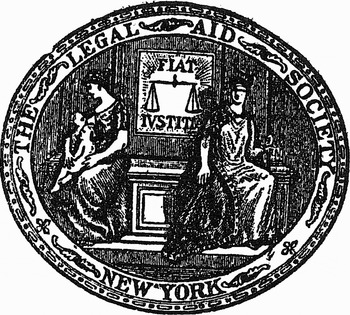
By 1905, legal aid had become so associated with women and the feminine sphere that Briesen penned a poem that used the phrase “Miss Legal Aid.”Footnote 137 In a perhaps tongue-in-cheek manner such language emphasized how legal aid had become deeply associated with women. The insignia the Society used (Illustration 3 above) also located legal aid within a feminized sphere. This illustration not only portrayed a figure of a blindfolded woman as a symbol of justice but another more unusual image of a woman also appears. This other woman is seated with her back to Justice and dressed in what appears to be a somewhat modern gown. She nurses an infant while holding another infant, perhaps a twin on her lap. Even though it is unclear who or what this figure represents, it is deeply feminine, nurturing, and maternal. Perhaps this woman nurses Justice herself; perhaps she is the goddess Tellus, whom ancients worshipped as Mother Earth, and a symbol of fertility and stability. Even without knowing her identity, this figure gestures towards how, by the turn of the century, the provision of legal aid, in a multitude of ways, was deeply associated with women.
Legal Aid Society Letterhead.

Conclusion
Although we might expect that legal aid continued to be closely linked with women throughout the twentieth century, this is not the case. Rather, by the second decade of the twentieth century, legal aid organizations embarked upon a project of professionalization in their effort to gain and solidify the support of bar associations. As this occurred, they began to sharply distinguish legal work from what they designated as “social work.”Footnote 138 Embedded in the ideology of professionalism was an implicit understanding that the legal profession was male and that social work was female.Footnote 139 Much of women's legal work for legal aid organizations now came under the heading of social work. For example, the Working Women's Protective Union continued to provide advice to working women well into the twentieth century. A 1928 report of the New York City Bar Association, however, condescendingly viewed the WWPU as not quite a real legal aid organization because it was “thoroughly socialized,” maintained relationships with other “social agencies,” rather than legal aid organizations, and was staffed and run by a female social worker rather than a trained lawyer.Footnote 140 Some women lawyers as well as social workers responded to this professionalization and legalization project by seriously criticizing how legal aid societies provided legal services.Footnote 141 During this period, Reginald Heber Smith wrote his deeply influential Justice and the Poor (1919), which provided the first serious account of the history of legal aid.Footnote 142 Smith's work was part of legal aid's larger project of professionalization, and it overlooked much of women's long history of involvement in legal aid.
I have attempted to restore women and gender's role in the development of legal aid. As demonstrated, legal aid from its beginning was shaped by complex gender and class configurations. With this richer and gendered history of legal aid, we can now further contextualize figures such as lawyer Clara Foltz, who from the 1890s on advocated for a public defender's service.Footnote 143 That such a call came from a woman can be understood as part of a larger pattern of women's work in legal aid.
Although it is tempting to celebrate this newly reconstructed vision of legal aid and the role that women played, its gendered origins and development is too multivariate for easy categorization. The birth of organized legal aid occurred with the Working Women's Protective Union, which arose out of specific historical circumstances and functioned as one means through which male labor activists working along side male professionals, primarily lawyers, usurped the power of women working in the garment trades. Instead of empowerment through collective action, working women received narrowly construed legal help in collecting wages that were owed to them. At the same time, the WWPU allowed elite New York lawyers to congratulate themselves and the profession for their generosity and the power that law possessed while affirming that the wage labor system was sound. The Union also allowed such lawyers to imagine that, for at least a moment, the practice of law could stand outside of the market and escape commoditization. Indeed, the WWPU represents an extraordinary venue where elite lawyers interpolated themselves through working women.
The daily reality of the work of the WWPU, however, was quite different than its elite supporters imagined. In large part, the WWPU was managed by a female supervisor, and she and her female assistants provided much of the day-to-day legal advice to working women, acted as gatekeepers, interacted with defendants, and arbitrated disputes. When the New York Legal Aid Society began competing with the WWPU in the 1890s, it was already accepted that legal aid was an appropriate field for now formally trained women lawyers.
The Legal Aid Society at first may have sought to de-emphasize its association with women, but material conditions did not allow for this. Poor women and their legal problems, primarily with employers and husbands, propelled the Society to handle these cases. The small cadre of women who began graduating from law schools provided an inexpensive means to staff the Society. Simultaneously such lawyers, the female benefactors of the Society, and the attention of journalists that the Society attracted, served to solidify the connection between legal aid and women. It is fair to say that by the first decade of the twentieth century, legal aid was, although would not remain, feminized.