INTRODUCTION
This contribution examines the relationship between violent conflict and the crisis of representation in an African country by focusing on political parties and rebel movements. It deals with the ‘chicken or the egg’ question of whether inadequate representation leads to violent conflict, or whether violent conflict damages representative democracy. In the general literature on political parties, these are assumed to represent social interests; in the context of the plural society of the Central African Republic (CAR) these social interests are mainly ethnoregional. As will be shown, political parties have not performed well in their representative role, for a number of reasons (from obstacles such as organisational shortcomings and lack of means of communication to rent-seeking behaviour). Numerous rebel movements also claim to put local and national grievances on the agenda; these are heard and therefore seem to address the issues better than parties. Parties and rebel movements therefore compete to a certain extent, but political parties lose out in the course of war and in peace processes, not least because they are no longer regarded as the main actors by international mediators. However, only some, and not all, party leaders become rebel leaders and vice versa, thus blurring the distinction to (only) a certain degree.
The relationship between political parties and violence can be complex, particularly when violence has become an established mode of competition, as is the case in many African states. More importantly, civilian political parties may fall prey to armed insurgencies in an indirect but significant way: they are simply no longer the most important actors in the political game when peace negotiations involve the government on the one hand and rebel movements on the other. Political parties also have to position themselves between alignment and critique with respect to violent actors – a potentially risky business. They may ultimately lose out as a result of power-sharing arrangements enacted in peace agreements. In such processes they usually receive substantially less attention from the media and the donor community present in the country than do most armed movements (Mehler Reference Mehler2009). Moreover, the difficulties of political parties in representing supposedly ethnoregional interests are aggravated by rebel movements which appeal to the same clientele. Formerly violent actors, the warlords and rebel movements may turn their organisations into political parties and compete in future elections, when they are often more successful than their peaceful competitors at the polls.Footnote 1 In the end, political parties become marginalised. Violence pays; democracy is harmed. By focusing differently on civilian political parties – that is, on their role in conflict and their (in)capacity to represent ethnoregional interests, contrary to general assumptions; and on rebel movements – that is, on their ability to sideline civilian competitors rather than attempt the difficult task of transforming themselves into political parties (‘from bullets to ballots’) – this paper seeks to address questions that escape the attention of well-intentioned policy makers and mainstream research alike.
Methodologically, the paper addresses its hypotheses in the following way: the main (north/south) ethnoregional cleavages, together with further types, are described and analysed in relation to the changing election results from 1993 to 2005. The limited responsiveness of the political system to ethnoregional grievances is demonstrated through the limited amount of public goods provided in the periphery. The supposed social and political basis of rebel movements is contrasted with their clearly opportunistic rent-seeking behaviour. Behavioural patterns of opposition parties towards the use of violence are also analysed. By analysing the composition and dramaturgy of peace processes (international negotiations including power-sharing devices plus internal dialogue processes), the paper demonstrates the declining importance of parties in the political game. Finally, selected biographical data shows that some of the key stakeholders in CAR politics are straddling roles as violent entrepreneurs and as civilian politicians, and thereby setting problematic standards for political careers. As a result both peace and democracy have suffered enormously over the last two decades.
There is a growing body of literature on the transition from rebel movements to political parties (e.g. De Zeeuw Reference De Zeeuw2008; Deonandan et al. Reference Deonandan, Close and Prevost2007; Dudouet Reference Dudouet2009; Söderberg Kovacs Reference Söderberg Kovacs, Jarstad and Sisk2008), but relatively little about the fate or strategies of ‘ordinary’, ‘civilian’ parties in that context. Some works specifically focus on the challenges of post-conflict elections (Lyons Reference Lyons2005) or of power sharing (Jarstad Reference Jarstad, Jarstad and Sisk2008; Mehler Reference Mehler2009; Sriram Reference Sriram2008), but most focus on the general transition to peace. The focus of the Jarstad & Sisk (Reference Jarstad and Sisk2008) volume is fortunately about ‘war to democracy transitions’. Its contributions show that policy makers' expectations that such transitions result more or less automatically in both peace and democracy are highly problematic and naive. Manning (Reference Manning2004, Reference Manning2007) is interested in the description of challenges that parties themselves face in moving from battlefield to political arena. She finds (2007: 268) that intense competition forces parties to adapt but does not necessarily make them more moderate, more institutionalised internally, or more committed to democratic competition. The following pages are concerned not so much with the organisational problems of parties – particularly violent ones – during transition, but rather with their representational function and their changing attitudes towards violent conflict.
Political parties ideally represent social interests. The latter may be in conflict, and sometimes this conflict degenerates into violence. Sartori (Reference Sartori1976: 27) posits that parties are or should be ‘an instrument … for representing the people by expressing their demands’. Different forms or degrees of representation may be distinguished, and the symbolic/descriptive and responsive/substantive ends of a continuum may be juxtaposed. In the African context, mainstream authors assume that the predominant division of social interests is frequently ethnoregional in nature, although doubts are permitted, particularly with regard to the assumed link between ethnicity and party politics (Basedau & Stroh Reference Basedau and Stroh2009). Ethnoregional groups certainly do not exist ‘objectively’ and with a clear consciousness on their own. ‘Rather both groups and their interests are to an extent constituted through the political process itself’ (Randall Reference Randall, Basedau, Erdmann and Mehler2007: 84). Randall (Reference Randall, Basedau, Erdmann and Mehler2007: 101), in an initial sketch of the representational function of political parties in Africa, comes to the conclusion
that African political parties in general may offer some degree of descriptive representation … for ethnic groups … but that evidence of more substantive, responsive representation of these social groups … is much harder to find. Whilst (some) ethnic groups may appear to enjoy a form of substantive or interest representation, through the processes of clientelism, in reality it may be closer to symbolic collective representation.
The question, then, is whether armed insurgencies can represent ethnoregional interests better than political parties. One supportive argument may be deducted from the classification of guerilla movements by Clapham (Reference Clapham1998: 6) into ‘liberation’, ‘separatist’, ‘reform’, and ‘warlord’ organisations – separatist and reform movements may have the ambition to represent ethnoregional interests.
This contribution addresses these more general points by focusing on the case of the CAR since the mid 1990s. The country experienced a fairly successful democratic transition in the early 1990s, but a mixture of basic state fragility and mismanagement led to widespread violence only a few years later (similar to Burundi and Congo-Brazzaville, where the democratic experience was even more short-lived). The case is also an example, as will be shown, of a ‘democracy to warlord politics transition’. It may also be useful to point to some features of representation in the CAR context: widespread poverty, lack of infrastructure, neopatrimonial ethos. This mixture should influence not only popular expectations in terms of representation, but also what role models are available for politicians, and these politicians' capacity to resolve problems effectively.
PARTIES AND CLEAVAGES, CONFLICT AND VIOLENCE IN THE CAR
Conflicts are often first and foremost non-violent. Societal cleavages are seen as essential for the shaping of a party system, and this is generally believed to hold true for African countries. However, the classical European cleavages along the axes of church versus state, labour versus capital, urban versus rural areas, centre versus periphery are only partially relevant (Erdmann Reference Erdmann2007).
Ethnoregional cleavages in the CAR's political system
For a long time, up to the end of the 1980s, the most relevant cleavage in the CAR was more or less an ethnoregional one, with a clear north–south divide (or savaniers versus riverains). The main political personalities of the country – Barthélémy Boganda, Jean-Bédel Bokassa and David Dacko – were south-western (from the comparatively small Ngbaka ethnic group); Abel Goumba (Banziri) and André Kolingba (Yakoma) were south-central elites. The densely populated north-west (Gbaya, Sara, and also Mandja) felt neglected, and Ange-Félix Patassé, an ambitious up-and-coming politician and prime minister under Bokassa from 1976 to 1978, built on this grievance, though he made his career in Bangui. The capital, with the bulk of formal educational institutions, health centres, etc., was located in the south.
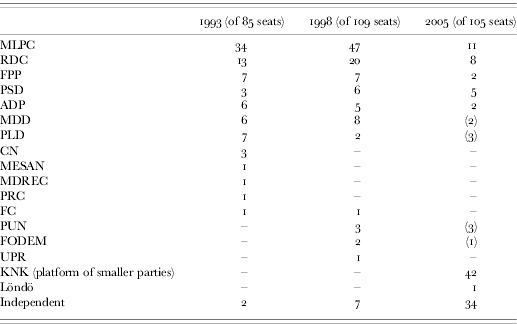
Change did occur in the 1990s, but initially not in terms of the general north-south divide. In fact, election results from the 1990s (1993 and 1998/9) show a remarkable similarity concerning the outcome for the ruling party, Mouvement pour la Libération du Peuple Centrafricain (MLPC; founded in 1982 and for a long time dominated by Patassé). It received 40–50% of the votes each time, which could be explained by the existence of a fairly stable ethnoregional alliance (mainly Sara and Gbaya) in the north-west and the north (Table 1). Both Patassé and Goumba, Patassé's challenger in the second round of the 1993 presidential elections, had clear regional strongholds, with Patassé winning more than 85% in three out of seventeen prefectures (north-west: Ouham, Ouham-Pendé and Nana-Gribizi) and Goumba equally 85% in four, less densely populated ones (south-east: Ouaka, Basse-Kotto, Mbomou and Haut-Mbomou).Footnote 2 This ethnoregional voting pattern should not be taken as evidence of an inability on the part of citizens to change the regime by electoral means (and therefore a pretext for violence), as Patassé always needed smaller alliance partners to get a majority. The former single party, created by Kolingba in 1986, the Rassemblement Démocratique Centrafricain (RDC), was too weak to win multiparty elections, but strong enough to persist as the major opposition party. It won its seats mostly in the southern and south-eastern parts of the country. Kolingba's own ethnic group, the Yakoma, provided the party's main support, but the Yakoma vote alone would not have been enough to win the number of seats that the RDC actually won. There were other notable dynamics in the political geography during the 1990s, for example, the declining popularity of the ‘fourth’ candidate Goumba and his Front Patriotique pour le Progrès (FPP), a party with deep political roots but without a continued organisational existence.Footnote 3 The RDC clearly profited from the declining popularity of the Goumba camp after the 1993 elections. Other shifting alliances in the southern block were also observed (Mehler Reference Mehler, Villalón and VonDoepp2005). Thus, only the MLPC and the RDC can be termed stable political parties.
Legislative elections since 1993: seats per party
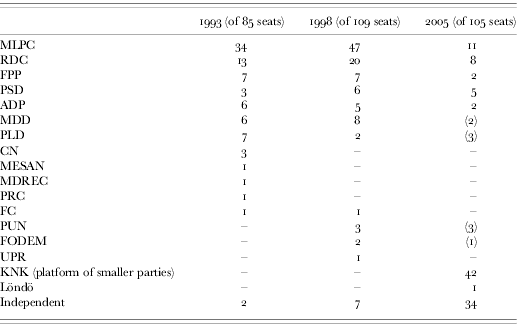
Sources: African Elections Database (2009); other sources provide partly differing information. The results for established parties that joined the KNK platform (MDD, PLD, PUN, FODEM) are detailed in the table (in brackets).
It initially appears to have been unnecessary to compete for the votes of ethnic parties' ‘core’ voters. Nevertheless, at the margins of each party's electorate there was intense non-violent competition. The parties or their leaders held some clientelist appeal among their followers, although Goumba in particular never wanted to appear as the typical African ‘big man’. In Randall's terms (Reference Randall, Basedau, Erdmann and Mehler2007: 90) even the bigger parties MLPC and RDC could be seen as representing ethnoregional interests ‘to the extent that parties are identified by their leaders and/or in the public mind with one or more ethnic groups’, while it was also appropriate to ask ‘in what sense are they representing those groups?’ (emphasis in the original). The FPP and, arguably, three other parties (ADP, PSD, MDD), with their long-lasting existence and ability to win mandates, may be seen as additional parties of significant importance that merit attention for the sake of the argument of this contribution.
The ‘Northern Alliance’ was probably terminally ended by Bozizé's (of Gbaya origin) revolt against his former mentor Patassé (from the Suma minority, but usually identified with Sara),Footnote 4 and the subsequent armed takeover of state power in 2002/3; this split may prove important for coalition-building in the future. Gbaya and Sara are major ethnic groups in the north/north-west of the country, which believed that they had been neglected since the beginning of French colonisation.Footnote 5 Patassé's military defeat by Bozizé meant that the old ethnoregional cleavage (north versus south) lost relevance, as will be demonstrated in a later section.
The relative neglect of the north was evidently not remedied when northern politicians started to rule the country (beginning with Patassé in 1993). This becomes clear from the provision of public goods since the 1990s. In terms of both critical infrastructure (roads, hospitals, schools) and security, no significant progress was recorded in the periphery.Footnote 6 A certain ‘Patassé effect’ may be seen by comparing the net school enrolment rates in 1988, 2000 and 2003 by region: Ouham and Ouham-Pendé, the major Patassé strongholds, witnessed an increase from 29·4 and 31·5%, respectively, to 37·4 and 36·0% between 1988 and 2000, with falling figures in 2003 (UNDP 2008: 146). However, Patassé's home prefecture of Ouham-Pendé still ranked sixteenth out of seventeen in 2006 with regard to respondents claiming to have no education, and was only in thirteenth place for respondents claiming to have secondary education or higher (UNFPA & Macro International 2008: 4, 5). Vakaga prefecture, the main site of the Union des Forces Démocratiques pour le Rassemblement (UFDR) rebellion starting in 2005, had the worst, and still declining, figures for school enrolment rates (1988: 26·8%, 2000: 22·4%, 2003: 22·0%) (UNDP 2008: 146). The record was no better with regard to security as a public good in northern CAR. Insecurity indeed even spread under both Patassé and Bozizé in large parts of the periphery, and not only in Bangui, which had been the main theatre of violence in 1996/7. With few exceptions, mostly in the elite, northern populations did not profit from northern government.
Growing fragmentation
The MLPC thus did not ‘deliver’ to its main constituencies, but it was not the only party to experience setbacks. The degree of fragmentation of the party system has been increasing since 1993 (see Table 1). This serves as an initial indicator of a loss of influence on the part of the main political parties. Whereas the RDC and the MLPC together controlled forty-seven out of eighty-five seats after the 1993 elections (55·3%), and the six most important parties controlled fifty-nine seats (69·4%), this ratio changed with the 1998 elections: 67 out of 109 for MLPC and RDC combined (61·4%) and eighty-eight seats for the six main parties (80·7%). Thus, the first sign of the loss of importance of formal political parties appeared with this election. Seven independent candidates were elected, compared with two in the previous election. A big change in the legislative composition occurred only after the successful Bozizé rebellion in 2003. After the 2005 elections, the MLPC and the RDC together held only 19 out of 105 seats (18·1%) and the six main parties together held twenty-nine seats (27·6%). This result reflects a dramatic political change, though there was admittedly no level playing field during these elections. Can this development be termed a crisis of ethnoregional representation? Or was it just a matter of unfair elections? Probably not the latter: the elections were not openly manipulated, at least not on a country-wide level. Even more significant than the loss of seats for major parties was the increase in the number of candidates, thirty-four, elected as independents. These figures could be taken as clear evidence of the declining importance of political parties in an era of growing violence. However, political parties have themselves been part of this evolution.Footnote 7
Party-related violence
The CAR's transitional context is obviously important for understanding party-related violence. The CAR is an example of a transition that was perverted by the undemocratic behaviour of democratically elected rulers (similar to Congo-Brazzaville). President Patassé's governance style included widespread mismanagement, self-enrichment, the buying of MPs and the exclusion of formerly privileged groups. These activities formed the background for mutinies (1996/7), coup attempts (2001/2), and the successful rebellion (2003). Patassé created his own personal armed groups (Karako militia and others), but these were not formally related to the MLPC. This party, founded in the 1980s, was solidly anchored in society and different currents existed within it, some of which were critical of Patassé. It would be wrong to assume that the MLPC was an instrument in the grip of its chairman Patassé (2009: 108). There is no doubt that at least Patassé himself showed a propensity to use violence when it suited his personal interests, while the MLPC may not have been directly associated.
Long-standing relationships between elites in the party and in the security apparatus are not simply cut off when ruling parties lose elections.Footnote 8 In the CAR the former ruling party, RDC – Kolingba's party – retained considerable influence in the security apparatus, particularly the army, throughout the 1990s. Nor did the RDC play in accordance with the rules of democracy. Like other parties, it became a secondary actor in the course of the growing militarisation of politics, which occurred from the mid 1990s on. The mutinies in the late 1990s and the attempted violent coup in 2001 evoked more than mere sympathy from the RDC, although – and this is important – the party never endorsed Kolingba's personal decision to back the coup. Ethnic loyalty also played a role in mutinies and the coup attempt, as former president Kolingba had predominantly recruited troops from his Yakoma ethnic group. The resulting backlash on the RDC was evident when the coup attempt failed.Footnote 9 Electoral competition itself was not exempt from violence in the CAR's multiparty era, but compared with other African cases, this violence resulted in limited damage. However, neither of the major parties completely rejected violence as a means of politics, at least not clearly enough.
PEACE NEGOTIATIONS AND DIALOGUE PROCESSES
The first peace process
International actors also exerted an influence in the interplay between civilian and armed actors in the CAR. Pushed by France, four African presidents flew in directly from the Franco-African summit in Ouagadougou in early December 1996, and some of them again in January 1997, to mediate between the mutineers and the government (Ngoupandé Reference Ngoupandé1997: 78–81). The efforts by Konaré, Bongo, Déby and Compaoré led to the signing of the Bangui Peace Accord on 25 January 1997. On 7 April, Mali's ex-president and chief mediator Amadou Toumani Touré brokered the entry of two of the mutineers into an enlarged government. In contrast to their sidelining in peace talks from 2006 onwards, twenty-five political parties, the five main trade unions and twelve civil society organisations signed a declaration that was then made part of the peace accord. The first post-agreement government installed in February comprised approximately 50% opposition and 50% pro-president forces. Reconciliation talks were held in Bangui in February and March 1998 with approximately 400 participants; the opposition alliance G-11 took part, and although it suspended its participation for some days for procedural reasons, a national reconciliation pact was still signed at the end of the meeting. This was the last time that political parties played such an important role in the peace process.
The armed conflicts in 1996/7 – and equally importantly, the character of their resolution – had highly negative effects on the political climate in the country, which undermined the prospects for both democracy and the preservation of civil peace. Furthermore, the activities of international actors – despite good intentions – effectively contributed to the poisoning of the political environment.
In the first place, the character of the conflict-settlement process, as promoted by international actors, amplified the tension between the principle of accommodation and the practice of exclusionary and privatised politics. International actors continuously sought broader representation of the radical and partly violent opposition, and later rebels, in government. And something close to this objective was achieved: the mutinies of 1996/7 led to the inclusion of some rebel leaders in roles entailing governmental responsibility, as we have seen. Patassé also felt compelled to include a substantial number of opposition members in his government, but he was able to handpick which members would be included and which portfolios they obtained. In parallel he appointed more and more advisors, who formed a kind of a shadow cabinet where the real decisions were taken.
Thus, this first conflict-settlement episode appears to have provided a temporary and cosmetic acceptance of inclusive politics, largely as a result of international pressure. The practice of inclusion did not, however, lead to any real participation in decision-making by former counter-elites. Even less was it perceived to have led to an equal representation of ethnoregional interests. In practice, the agreement involved an extension of rents to those elites who had power to disrupt civil peace. That the National Assembly later (30 October 1997) decided to attribute substantial pensions to former presidents Dacko and Kolingba testifies to this. Such pensions were clearly a bonus for the renunciation of violence.
A dangerous precedent was established in the resolution of these conflicts. A lesson apparently learnt by local actors was that the threat of violence could be instrumentalised to receive material rewards. For instance, the mutineers were immediately accepted as negotiating partners and concessions were made quickly – much more quickly than to the civilian opposition. Exerting violence proved the means to garner international attention, which, at least at first glance, proved rewarding. One message emanating from this situation was that those losing out in the redistribution of sinecures should retain their capacity to sustain conflict (and thus their arms). This would preserve their capacity to return to the ‘dining room’.Footnote 10 One excuse for the international actors' behaviour was that government and rebel forces rarely fought each other and instead targeted the civilian population, sometimes with serious humanitarian consequences – a reason why a quick peace was sought by the international community.
Additionally, electoral violence in the CAR was constantly comparatively low. Campaigns resulted only in a very limited number of casualties in 1993, 1998/9 and 2005. When the situation in the CAR is compared to, for instance, Kenya or Côte d'Ivoire, it becomes obvious that the CAR's political parties were not deeply involved in acts of violence. A qualified exception is the avowed involvement of former president Kolingba in the bloody coup attempt in May 2001, but again it is doubtful whether his RDC was involved: the party never formally endorsed its leader's decision.
From Patassé to Bozizé
In the aftermath of the May 2001 uprising, parallel investigations created an atmosphere of general suspicion. The dismissal and later accusation of the chief of staff, General François Bozizé, of being implicated in a new coup plan was a surprising turn of events. Bozizé refused to accept an arrest warrant. On 3 November 2001, the UN Secretary General's special representative in the CAR, General Lamine Cissé, undertook a good offices mission to bring the two parties together. On the basis of unwritten concessions by both parties, President Patassé promised to appoint Bozizé to another post and to consider granting a pardon once the judicial procedure was completed. For his part, Bozizé seemed to be willing to be questioned by the Commission of Inquiry. However, four days later government troops attacked Bozizé's positions.Footnote 11 Bozizé then defected with about a hundred troops and moved to the north of the country; after taking weapons from several gendarmerie barracks and following a number of skirmishes, he went into exile in Chad. His troops returned to Bangui in a surprise attack on 25 October 2002, and were repulsed after heavy fighting with Patassé's forces, which included Libyan troops and up to 1,000 fighters from the Congolese rebel organisation Mouvement de Libération du Congo (MLC) (Marchal Reference Marchal2009).
In this context, Patassé offered a ‘national dialogue without exclusion’ on New Year's Eve, but only gradually received support for the idea. Political parties had a difficult choice to make: siding with the republic and accepting dialogue meant siding with a president who showed no respect for democracy (or the constitution); siding with Bozizé – which many parties ultimately did – meant siding with a violent actor of doubtful democratic credentials. Getting rid of Patassé at any price was apparently the order of the day.
Patassé seemed completely isolated, the country devastated, and democracy in shambles when another surprise attack by Bozizé's troops (helped by Chad) led to the conquest of Bangui on 15 March 2003. Patassé was at a regional summit in Niger. Upon his return he could not land, was forced to fly to Cameroon, and finally took exile in Togo. Bozizé suspended the constitution and named a new cabinet including most opposition parties and with Goumba as vice-president. A National Transitional Council (CNT) was introduced as an all-party body to serve as the interim legislative organisation. The postponed ‘national dialogue’, originally planned by Patassé for December 2002, was held from 15 September to 27 October 2003 and resulted in a sober assessment of the country's situation. Despite numerous statements of forgiveness and reconciliation, the climate of distrust remained.
The ‘national dialogue’ in September/October 2003 – which included many of the major civilian protagonists but not Patassé or his former defence minister Jean-Jacques Démafouth – can still be termed fairly successful, as it led to a set of consensus decisions regarding major fields of public life (particularly on the electoral process).Footnote 12 At the beginning of the proceedings a resolution had been tabled to bar all members of the transitional government, including the head of state, from standing for election. This was quickly foiled by the president's camp, showing that Bozizé had long-term ambitions. Bozizé was eventually elected president in 2005. He included some heavyweights of the political class in his subsequent government, including one of Kolingba's sons, but excluded the Patassé camp. Patassé himself had been excluded from standing in the presidential elections.
The accession to power of yet another military leader exposed a major pattern in the CAR's political life, with the political careers of some main figures demonstrating the straddling of two spheres of power, one civilian, one military:
• Ange-Félix Patassé (MLPC): putschist, 1982; president, 1993–2003; afterwards at least vaguely associated with some northern rebel movements (Armée Populaire pour la Restauration de la Démocratie (APRD),Footnote 13Front Démocratique du Peuple Centrafricain (FDPC)).
• François Bozizé (KNK): putschist, 1982 and 2003; very disappointing election results in 1993 (1·5%); chief of staff, 2001; president of the republic, 2003.
• André Kolingba (RDC): chief of staff, 1979; putschist, 1981; president of the republic, 1981–93; at least indirectly involved in mutinies, 1996/7; claimed to be the mastermind of the coup attempt in 2001; died on 7 February 2010 in a Paris hospital.
• Charles Massi (FODEM): retired army colonel; former mines minister under Patassé; minister of rural development under Bozizé; political coordinator of the UFDC rebel movement in 2008 (later expelled); founder of the armed Convention des Patriotes pour la Justice et la Paix (CPJP); allegedly killed in army custody in January 2010.
• Jean-Jacques Démafouth (NAP): defence minister under Patassé; interrogated for involvement in a coup attempt, 2001; political brain behind the APRD rebellion; in 2009 vice-president of a UNDP-sponsored demobilisation programme.
Rebellion and a new peace process
The exclusion of Patassé from the elections in 2005 triggered a rebellion in his home region. Additionally, so-called ‘liberators’, partly Chadian mercenaries and partly CAR nationals who had helped Bozizé take power (Debos Reference Debos2008), increasingly posed a security threat in the capital Bangui and extorted money from inhabitants. They were later transported to the border with the help of the Chadian government, and a good number of them became rebel fighters. This variation in the origin of the different new rebel groups may already indicate whether they could be expected to represent larger group interests.
The various rebel movements in the northern part of the countryFootnote 14 from 2005 onwards were also dealt with diplomatically when they could not be defeated by the regime. While the UFDR rebels asked for negotiations under international mediation, Bozizé was more than reluctant. The only noteworthy signal was when the head of state held a one-day forum in the National Assembly as a limited form of dialogue with all ‘vibrant parts of the society’, during which he at least did not rule out direct talks with rebels. Several opposition leaders snubbed the meeting. While France intervened with massive military support for the Bozizé government, most international donors continued to exert pressure on Bozizé to start negotiations with the rebels. Bozizé gave in by announcing a direct dialogue in his New Year's speech in 2006, and thereafter started talks under the aegis of Libya and Gabon, leading to agreements with FDPC and UFDR.
The APRD and the government finally signed a ceasefire agreement on 9 May 2008, thus preparing the ground for a more inclusive peace settlement. Some well-known politicians jumped on the bandwagon rather late in the process, or revealed their intimate connection with various rebel movements. On 29 March 2008, former defence minister Démafouth, who had for a long time been believed to have close links with ‘the’ rebellion, was declared coordinator of the APRD. He had once been one of ex-president Patassé's closest confidants, but had then been dismissed and arrested in 2001 in the context of the failed coup. The move to make Charles Massi political coordinator of the UFDR came as a surprise. Massi, a retired army colonel, had been among the most active political entrepreneurs during the previous decade,Footnote 15 and headed a small political party (Forum Démocratique pour la Modernité, FODEM). He had supported, then opposed, both the Patassé and Bozizé regimes and had held several ministerial positions, most recently as minister of rural development until mid January 2008. Both Massi and Démafouth had stood for president in the past and received only 3·2 and 1·3% of the votes respectively in the 2005 presidential election. The conclusion they seemed to draw from this experience was that they could never win elections without taking up arms first. This was exactly the lesson demonstrated by Bozizé, who had received a meagre result in the 1993 election.Footnote 16
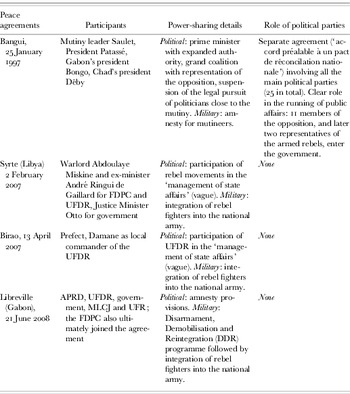
After many steps back and forth, a so-called ‘global’ peace agreement was signed in Libreville on 21 June by the government, the APRD (Démafouth), and the UFDR (local military commander Damane). It was rejected by parts of the exiled UFDR leadership, however, and was not signed by the third most important group, the FDPC, even though it had attended the meeting. Fighting erupted anew in August after all three groups withdrew from the peace process over the thorny issue of an amnesty law.Footnote 17 With every major episode of violence, political parties gradually lost their significance in the peace process (see Table 2).
Power-sharing elements of peace agreements in the CAR

Source: Author's compilation.
Dialogue again, but differently
One of the original UFDR factions, Abakar Sabone's Mouvement des Libérateurs Centrafricains pour la Justice (MLCJ), which had left the UFDR, joined the Libreville peace agreement only on 7 December 2008. This was certainly not the most important rebel movement militarily, but was probably the most outspoken one programmatically. The beginning of the so-called ‘inclusive political dialogue’ followed this signature. The preparatory committee had presented its final report to Bozizé in April after two months of negotiations between government representatives and the three main rebel movements. The recommendations had detailed the composition of delegates and the venue, but it took several more months for concrete preparations to begin. In late October 2008 the APRD, the UFDR and the government had held talks in Libreville which resulted in a new composition of the preparatory committee, with the opposition coalition Union des Forces Vives de la Nation (UFVN),Footnote 18 civil society organisations and the rebel groups receiving more seats. This at last paved the way for the holding of this important gathering of approximately 200 participants from 8 to 20 December in Bangui.
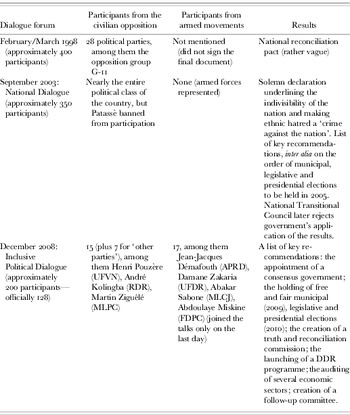
The meeting was chaired by former Burundian president (and coup leader) Pierre Buyoya. Patassé flew in from his exile in Togo. His rival inside the MLPC, Martin Ziguélé, attended as well, as did Démafouth, who had formed a political party in the meantime (Nouvelle Alliance pour le Progrès (NAP)). During the opening ceremony, the civilian opposition were not allowed to take the floor. On 10 December, UFVN coordinator Henri Pouzère asked Bozizé to step down for multiple violations of the constitution,Footnote 19 but the tide turned when Ziguélé, whose MLPC was part of the UFVN, explicitly recognised Bozizé as president four days later. Towards the end of the gathering Patassé joined this position. Warlord Miskine, absent at the beginning, participated at least for the last day. In the end, the participants and most importantly Bozizé agreed to form an inclusive consensus government, hold free and transparent elections, install a follow-up committee, and create a truth and reconciliation commission. The follow-up committee was composed of former presidents Patassé and Kolingba, plus Bozizé. There were no seats for the civilian or the armed opposition.Footnote 20 Not only in formal peace agreements but also in dialogue processes, the civilian opposition had lost out (Table 3).
Political dialogue forums in the CAR

Source: Author's compilation, based on various sources (Sangonet, Marchés Tropicaux et Méditerranéens and others).
The consensus government was eventually formed on 19 January 2009, but offered only limited opportunities for participation to civilian opposition and rebel movements. Three opposition members, Moïse Kotaye, André Nalke Dorogo (MLPC) and Raymond Adouma, were appointed to the junior ministries of small and medium-sized enterprises, public health and international cooperation, respectively. Françoise Naoyama of the APRD became the environment minister, and Djomo Didou of the UFDR the housing minister. New rebel alliances were subsequently formed, and new skirmishes took place in the first half of 2009. Still in October 2010, it would be premature to accept the success of the peace process.
REPRESENTATION OF SOCIAL INTERESTS VIA REBEL MOVEMENTS?
Rebel movements have far more obvious direct links to the use of violence than their civilian opponents; but what can be said about their representational side? All in all, there have been few clear statements of what the various rebels stand for. The most political stated aim of rebel representatives has been ‘to sit down and to discuss’ national problems. They have also accused the current government of corruption, mismanagement and the pursuit of narrow ethnic interests (of Bozizé's Gbaya group). The professed readiness to join a power-sharing government might be seen as nothing more than rent-seeking behaviour and not an acknowledgement of the need for more consensual decision-making.Footnote 21 A few NGO reports consider the UFDR rebellion to have been an expression of the grievances of the Gula (HRW 2007: 78–9). UFDR president Djotodia repeatedly criticised the ‘exclusionist’ policies of the regime and was quoted as follows: ‘Many people from other ethnic groups and different political parties are ostracised and banned from participating in the management of the country.’Footnote 22 The best-known UFDR commander, Zaccharia Damane, cited additional grievances: the impassability of the roads in the region (Vakaga), the lack of health care, the lack of education, and insufficient access to potable water. The most outstanding statements have come, however, from Abakar Sabone, a co-founder of the UFDR and the head of the breakaway MLCJ. In an interview in November 2006 with the local newspaper Le Confident, he declared that one of the reasons for starting a rebellion was Bozizé's broken promise to appoint a Muslim prime minister.Footnote 23 He also alluded to the dominance of Christians in the management of state affairs,Footnote 24 saying that the aim of his rebel movement was to force Bozizé, through the use of arms, to accept dialogue and take ‘the geopolitics of our country’ seriously. When the MLCJ decided to break away from the UFDR in summer 2008, it claimed to be working for an overhaul of the political class – another bold statement.Footnote 25 During the inclusive political dialogue, Sabone succeeded in inscribing a recommendation in the official document that the two Muslim holidays of Aïd el-Fitr and Aïd el-Kébir should become national holidays (AFP 18.11.2008).
Political claims from the APRD are much more difficult to find. The group complained – apparently from its inception in 2005 – that Bozizé had toppled a legitimate government in March 2003, mismanaged public funds, and divided the nation (IRIN News 2.8.2007). Such statements underscored the dominant impression that the APRD was fighting for Patassé's return. The exclusion of Patassé from running for the presidency in 2005 was another argument advanced by APRD officials (HRW 2007: 38, 42), putting it firmly in one political camp. However, local commanders of the APRD occasionally said quite the contrary, that they had no contact at all with the former president, who they claimed was a man of the past (IRIN News 19.12.2006).
An occasional commentator on the private internet platform Sangonet clearly exposed the ideological and programmatic poverty of all rebel movements and declared that their activities were nothing but criminal.Footnote 26 It is difficult to come to a different conclusion. It may therefore be of greater interest to determine what the social background of rebel movements is. However, we lack clear information on recruitment practices and the ethnoregional affiliation of individual fighters. Findings from Debos (Reference Debos2008) corroborate the impression that many formerly pro-Bozizé fighters, some of Chadian origin, joined the anti-Bozizé rebel movements. Their main motivation thus appears to be material gain rather than political conviction. Regional autonomy is not a declared political goal of CAR's armed movements. None could be classified as Clapham's ‘separatist’ type. Equally, reformist credentials are hard to attest; the ideological and programmatic production is far from impressive. They seem closest to the ‘warlord’ type, though ‘the creation of a personal political fiefdom separate from existing state structures and boundaries’ was at best transitionally achieved by APRD and UFDR.Footnote 27
Armed rebellion in the CAR has, however, had an unintended political consequence. Rebel movements, their repression, and the collateral damage in terms of human rights violations, have attracted the attention of the ‘international community’ – humanitarian NGOs, the UN organisations, and the European Union. The number of recent reports on the most remote areas of the CAR – particularly in the north-east, but also in the north – is unprecedented. Who would have talked (or even known) about the Gula before the UFDR conquest of Birao? And it cannot be ignored that ‘demobilisation rents’ served part of the local population, thereby fulfilling material requests – a kind of perverse effect of a neopatrimonial form of representation in the context of violence, and one that included neglected segments of the population (‘youth’). But at what price? Randall (Reference Randall, Basedau, Erdmann and Mehler2007: 85) speculates about the possibility that political parties themselves create the ethnoregional groups they pretend to represent; why should this not also be true of rebellions? Ethnic grievances are put on the national and international agendas through rebellion, despite serious doubts about the sincerity of their promoters. And it should also be immediately added that those grievances have significantly increased in the process of rebellion and repression.
It may also be significant that the three elected members of parliament from Vakaga prefecture – with the provincial capital Birao, the scene of major destruction in 2006/7 – changed 100% with each election (in 1993, 1998 and 2005) and that the weight of the major parties steadily declined over the same period (1993: 2 RDC, 1 MLPC; 1998: 1 MLPC, 1 PSD,Footnote 28 1 independent; 2005: 2 KNK, 1 independent). This may have to do generally with the viability of democracy in a country without the most basic roads, which makes accountability on the part of elected MPs objectively difficult, as they probably would not report back, even on a yearly basis. This is certainly a key impediment to the functioning of representational democracy.
It may also, however, be a sign of the failure of political parties to organise themselves efficiently in the periphery of such a country. Can rebel movements do better? The tendency of the CAR's rebel movements to transform themselves into political parties suggests rather the contrary. However, the negative outcomes of rebel activities for the population do not mean that these groups have not brought about change, particularly with regard to political space. Over decades political life was centred on Bangui and the south, and the negative consequences of the mutinies in the 1990s were concentrated there. The traditional political parties cared little about citizens in the remote periphery, even though the Zaraguina phenomenon (roving highway robbers, the abduction of children for ransom, and assaults on buses and small villages) is an old one and had a direct impact on the lives of northerners for a long time. As a result of rebel activities, national and international awareness of the plight of people living in the periphery of the CAR has grown considerably over the last decade.
* * *
Political parties have lost out both in the CAR's recurrent violent crisis and in the peace process. Established parties' loss of representational weight in parliament and their sidelining in both peace negotiations and dialogue processes are major indicators of this. The amount of attention given to the main political parties, and their room to manoeuvre, has declined rapidly since 1997. The parties themselves may bear part of the responsibility, as their relation to violence and violent actors has not always been clear, and they have offered few services to the population. Compared with other countries where peace agreements have led to sophisticated post-conflict power-sharing agreements favouring rebel movements (for example Burundi, DR Congo), however, it may be claimed that the comparative political loss in the CAR has been limited. At the same time it has to be noted that rewarding the use of violence by admitting the perpetrators to the negotiating table after a show of force is very dangerous (Tull & Mehler Reference Mehler, Villalón and VonDoepp2005). This could prompt even more peaceful political parties to change their strategy, and there are convincing signs that this will indeed be the case in the CAR.
On closer inspection, it becomes clear that the relationship between political parties and violent conflicts in the CAR is highly complex, as some of the most active political entrepreneurs create or use political parties and military organisations (including rebel forces and the official army) more or less interchangeably for their purposes. This process has clearly accelerated since 1996. The few classical parties (and civil society) have suffered a political setback; they have not been able to make their voice heard. The donor community – interested principally in a quick, superficial peace – has largely disregarded them. Civilian political parties were invited to the two dialogue forums organised in 2003 and 2008 and contributed to their content; however, they were absent from the peace negotiations proper. Finally, there have been very few attempts by the rebel organisations themselves to occupy political space by proposing to represent ethnic or other collective interests. Only a few, hardly convincing, claims have been voiced in this regard. With the exception of allusions to a Muslim agenda by Abakar Sabone and the vague sympathies of the UFDR for the Gula, the groups offer little in ideological terms. Claims from rebel groups which are heard much more frequently are that their organisers will block the official security forces' attacks on civilians. The security grievances of the population are cited as a justification for armed rebellion, while rebels themselves provide the context, or at least the pretext, for the very same brutality by armed forces.
Political parties and rebel movements in the CAR may ‘stand for’ the interests or grievances of ethnoregional groups, yet it is hard to identify many activities undertaken by these organisations which one could easily classify as ‘acting for’ those same groups. This latter, more substantive, form of representation has until now been rare – maybe because of the specific contextual conditions of the CAR. The example of Côte d'Ivoire, where rebel leaders have tried hard to create their own local legitimacy (while not standing in national elections, at least so far), and where political parties have remained the prime political actors, suggests that there may be important variations at play in post-conflict societies. Can representatives know what the interests of the represented are without consultation? This is difficult to believe. The low level of re-elections to parliament in the CAR, portrayed in the case of Vakaga prefecture, suggests that voters do not consider their deputies to be responsive to their concerns. Only at the local level is it possible that traditional forms of consultation between the population and the (local) elite may play a role; the other form of consultation is intra-elite dialogue of dubious value. It is doubtful whether rebel movements do any better than parties at representing group interests. They may get more or less voluntary popular support at times, but they cannot be held accountable by the local population they claim to defend; elected members of parliament at least face the destiny of not being re-elected. The CAR thus faces a continued crisis of representation, and both peace and democracy have suffered from the recent devaluation of political parties and the militarisation of politics. Security concerns are also among the main reasons cited for a repeated delay in organising elections due in 2009 and not fixed yet by October 2010. The CAR seems on a path towards complete informality in representing social interests.