[W]e have really everything in common with America nowadays, except, of course, language.
Oscar Wilde, The Canterville Ghost
1. Introduction
Over the last twenty years, political science has been transformed by a revolution in the way we measure political actors' positions. Advances in computing power, methodological innovations, and greater accessibility to relevant data have all pushed the sub-field of ideal point estimationFootnote 1 “from almost nowhere to establishing itself as a true scientific sub-discipline” (Poole, Reference Poole2017). Empirical studies of electoral competition, legislative procedure, judicial decisionmaking, policy representation, and voting behavior all now routinely incorporate sophisticated estimates of actors' locations in ideological space (their “ideal points”). Over this period, scholars have made steady progress in developing methods that account for data limitations and allow for the estimation of more complex, realistic models of political choice behavior. These methods accommodate dynamic elements (Martin and Quinn, Reference Martin and Quinn2002), sparse datasets (Caughey and Warshaw, Reference Caughey and Warshaw2015), and unconventional data sources such as campaign contributions (Bonica, Reference Bonica2013).
Recent political tumult in Western democracies has made one set of innovations—those involving what are known as “bridging” methods—especially relevant. Bridging is motivated by a desire to provide truly comparable ideological measures across multiple sets of political actors (such as voters and legislators), political or cultural boundaries (such as between countries), time points (such as legislators whose terms do not overlap), or any combination of the three. In other words, bridging methods attempt to place otherwise incomparable actors in an identical or common policy “space.” For instance, we can compare the ideological positions of two legislators who have never served together by triangulating through a third legislator who has served with both.
In most applications, bridges are actual policy proposals or political figures that are common to the non-overlapping groups. When such common stimuli (e.g., parties, elected officials) are unavailable, scholars have created them using short profiles of fictional candidates, parties, or situations. These “anchoring vignettes” offer a flexible way to perform bridging between disjoint sets of political actors. For example, anchoring vignettes have been combined with expert placements to estimate comparable policy scores for all major European parties (Bakker et al., Reference Bakker, Jolly, Polk and Poole2014). In this application, all experts place a set of fictitious parties alongside the parties from their country of expertise. The intuition is that if the anchoring vignettes are understood identically across contexts, then systematic differences that arise in vignette placements are due to different interpretations of the underlying scale itself. The Aldrich and McKelvey (Reference Aldrich and McKelvey1977) model, a variation of which we employ in this paper, uses these differences to estimate individual distortion parameters and correct for such distortions in raw scale placements.
The recent rise of populist authoritarian political forces in Western democracies has made clear the need for comparable cross-national ideological measures (Inglehart and Norris, Reference Inglehart and Norris2017). Though bridging opens up an array of exciting research opportunities to analyze such phenomena, it does not come without perils. Not all bridges are created equal, and the number and quality of the bridges can have a major influence on the results produced by joint scalings (Jessee, Reference Jessee2016). In this paper, we use an original dataset to evaluate the use of both anchoring vignettes and an alternative approach to jointly scale American and European stimuli. Specifically, we exploit the fact that many experts on European party positions are Americans themselves and/or teach at American institutions. That is, there is a large pool of experts who are familiar with both American and at least one European country's political systems.
Accordingly, we ask these transatlantic (TA) experts to place three anchoring vignettes, American stimuli, and European stimuli on a series of left–right issue scales. We compare their responses to those of Americanists, who are asked only to place American stimuli and the anchoring vignettes on the same scales. We then evaluate the performance of different approaches by permuting which responses are included in the scaling (only the anchoring vignettes, only the TA placements, and the full set of responses).
The results indicate that American and TA experts interpret and use nearly all anchors (both vignettes and American stimuli) in statistically indistinguishable ways. A key exception concerns one of the vignette parties, suggesting the need for more cross-comparable language in the vignettes used to bridge between Europe and the US. As such, we present combined estimates of party and candidate positions on six policy issues using just the American stimuli as bridges, discuss potential applications, and the need for additional research.
2. Measuring policy positions across contexts
Scholars primarily rely on four data sources to measure party positions in ideological space. One set of data sources infers ideology from what parties say and do, for example, aggregating roll-call data to infer parties' left–right preferences (Hix et al., Reference Hix, Noury and Roland2006) or extracting content from electoral manifestos to estimate parties' policy positions (e.g., the Comparative Manifestos Project) (Budge, Reference Budge2001). A second set of data sources infers ideological placement from voter and expert surveys. Surveys such as the European Election Survey (EES) and the American National Elections Survey (ANES) asks voters to place stimuli within their country on left–right scales. Expert surveys, such as the Chapel Hill Expert Survey (CHES), ask scholars with country expertise to place parties on general ideological as well as specific policy issue scales. The Comparative Study of Electoral Systems (CSES) combines information from both voters and experts to place parties across the left–right ideological scale.
All four sources have been widely used in political science literature. Scholars have used these sources to study whether voters respond to changes in parties' actual or perceived policy statements during elections (Adams et al., Reference Adams, Ezrow and Somer-Topcu2011), the degree of ideological voting in the electorate (Jessee, Reference Jessee2009; Saiegh, Reference Saiegh2015), and voter support for EU integration (De Vries and Edwards, Reference De Vries and Edwards2009; Tillman, Reference Tillman2013) and populist parties (Bakker et al., Reference Bakker, Rooduijn and Schumacher2016). A large portion of this literature concerns dimensionality, or the “number of issue dimensions” in a party system (Lijphart, Reference Lijphart1999, p. 87). Although scholars have found that the US party system reduces to a single left–right dimension (Poole and Rosenthal, Reference Poole and Rosenthal1997), there are ongoing debates on whether this dimension is sufficient as issues evolve temporally (Albright, Reference Albright2010; Stoll, Reference Stoll2010) and whether other party systems are also unidimensional. Most (but not all; see Marks et al., Reference Marks, Hooghe, Steenbergen and Bakker2007) have found that European party systems have three dimensions (which include economic left–right, social left–right, and EU integration) but that the salience of these dimensions vary across countries and elections (Hooghe et al., Reference Hooghe, Marks and Wilson2002; Marks et al., Reference Marks, Hooghe, Nelson and Edwards2006; Benoit and Laver, Reference Benoit and Laver2007; Bakker et al., Reference Bakker, Jolly and Polk2012). Importantly, studies have also shown that the four sources of data provide valid, reliable, and comparable estimates over time (Ray, Reference Ray1999; Steenbergen and Marks, Reference Steenbergen and Marks2007; Whitefield et al., Reference Whitefield, Vachudova, Steenbergen, Rohrschneider, Marks, Loveless and Hooghe2007; Hooghe et al., Reference Hooghe, Bakker, Brigevich, De Vries, Edwards, Marks, Rovny, Steenbergen and Vachudova2010; Bakker et al., Reference Bakker, Jolly and Polk2012).
Given the extensive use of ideological scaling and related measures in comparative literature, scholars have also investigated the sources' strengths and weaknesses. Expert surveys have a number of advantages relative to other measures. They offer relatively more validity since experts are presumably knowledgeable (Saiegh, Reference Saiegh2009). Moreover, they are relatively easy to collect and compare across countries relative to other measures(Mair, Reference Mair and Laver2003; Marks et al., Reference Marks, Hooghe, Steenbergen and Bakker2007). Making cross-national comparisons using roll-call data and public opinion surveys is particularly challenging because it requires assuming that subtle (or not so subtle) differences in policy proposals, party families, and/or survey questions are comparable (Lo et al., Reference Lo, Proksch and Gschwend2014). Other benefits of expert surveys include that they do not need to be administered following electoral cycles, and are inexpensive in both time and funding. They do not involve the intensive data collection efforts that election manifestos and roll-call data do, nor do they require individual researchers to interpret minute details in party platforms or decipher parties' own strategic image (Benoit and Laver, Reference Benoit and Laver2007; Mikhaylov et al., Reference Mikhaylov, Laver and Benoit2012). Expert surveys also provide robust measures. Across several Latin American countries, roll-call data, elite surveys, and expert surveys recover similar party positions (Saiegh, Reference Saiegh2009), and the standard deviations of party placements between experts are relatively small (Steenbergen and Marks, Reference Steenbergen and Marks2007; Hooghe et al., Reference Hooghe, Bakker, Brigevich, De Vries, Edwards, Marks, Rovny, Steenbergen and Vachudova2010). Finally, unlike some national election surveys that ask voters to place parties on only the left–right dimension, expert surveys measure parties' positions across multiple issue spaces.
One of the key insufficiencies in the survey approach, however, is that respondents are presumed to perceive concepts like left–right equally even though they make judgments based on unobserved personal criteria. Research shows that respondents are prone to moderating their own position and the position of parties they favor (Hare et al., Reference Hare, Armstrong, Bakker, Carroll and Poole2015). Respondents with strong ideological preferences might distance themselves from the stimuli they view unfavorably or move all stimuli toward one end of the scale (Carroll et al., Reference Carroll, Lewis, Lo, Poole and Rosenthal2013). While experts are plausibly more attune to correcting for personal bias, one expert might place parties according to preferences of party leaders and another according to preferences of the electorate (McDonald et al., Reference McDonald, Mendes and Kim2007) or evaluate the behavior at different points in time (Budge, Reference Budge2001). These are the examples of “differential item functioning” (DIF), or distortion that occurs when survey respondents interpret ideological and/or issue scales differently (King et al., Reference King, Murray, Salomon and Tandon2004). Consequently, two respondents might place the same stimuli in the same party system at distinct numeric positions even if their underlying perceptions of the stimuli's “true” positions are equivalent (Lo et al., Reference Lo, Proksch and Gschwend2014), leading to systematic error in scaling estimates.
DIF is even more problematic in studies that place stimuli from different party systems in a common ideological space (Bakker et al., Reference Bakker, Jolly, Polk and Poole2014). Comparative work, including many of the studies cited earlier, implicitly assume that parties across country contexts can be situated on a common scale. Yet research shows the substantive meaning of left and right varies from country to country (Benoit and Laver, Reference Benoit and Laver2007), and that experts asked to place stimuli in a single country tend to orient their placements around what they perceive to be their own country's political center (McDonald and Budge, Reference McDonald and Budge2005). This is called “response-category differential item functioning,” which emerges when groups of respondents use ordinal response categories differently (King and Wand, Reference King and Wand2007). Scholars relying on expert surveys to compare party positions across party systems therefore need to account and correct for both within-country (i.e., “personal bias”) as well as cross-country (i.e., “response-category”) DIF.
2.1. Solutions to DIF
There are several approaches for correcting within- and cross-country DIF. The most basic approach to resolving both types involves the construction of the survey itself. Being precise in data collection processes reduces the likelihood that respondents place parties based on different criteria. CHES accomplishes this by asking respondents to evaluate parties according to the positions of party leaders and in the year the survey is administered (Whitefield et al., Reference Whitefield, Vachudova, Steenbergen, Rohrschneider, Marks, Loveless and Hooghe2007).
Other approaches occur during the estimation process, when “anchors” are used to identify and correct for distortion. Aldrich–McKelvey (A-M) scaling is the original method for correcting for within-country DIF (Aldrich and McKelvey, Reference Aldrich and McKelvey1977). The critical intuition in A-M scaling is that even if distortion exists across respondents' placements, respondents typically order stimuli accurately. In other words, a respondent may not recognize nuanced ideological differences between moderate and extreme candidates of the same party, but they do recognize the ideological differences between parties themselves. A-M scaling thus “assumes that the individual reports a noisy linear transformation of the true location of the stimulus” (Armstrong et al., Reference Armstrong, Bakker, Carroll, Hare, Poole and Rosenthal2014). It relies on the maximum likelihood framework to model respondents' raw placements as a linear function of the stimuli's “true” positions plus two respondent-specific parameters (usually the respondent's self placement on the ideological scale, i.e., the anchor). These parameters correct for individual distortions in order to recover a latent common ideological scale across respondents. The first summarizes shifts to the left or right of the scale, and the second expands or contracts placements along the scale (Aldrich and McKelvey, Reference Aldrich and McKelvey1977).
A-M scaling, however, requires complete data, thus limiting its efficacy in answering many research questions (Bakker et al., Reference Bakker, Jolly, Polk and Poole2014). In particular, A-M scaling cannot be used in applications that estimate ideal points for stimuli across respondents from different countries. In these surveys, a French expert does not place German parties, leading to an abundance of missingness. A-M scaling is thus suited for handling within-country DIF but not cross-country DIF.
Poole, (Reference Poole1998) developed the Blackbox technique, a generalizable extension of the A-M model, to address missing data limitations. The Blackbox technique estimates a set of weights and constant terms that allow the scaling of stimuli in a latent common space, and is particularly useful for applications that bridge across time and geographic units where missing data are embedded in the data structure. In these contexts, “common” stimuli can be then used as anchors to bridge across non-common stimuli. A survey that asks voters to place federal legislators in their own state, for instance, might also ask them to place the president. Blackbox techniques can then be used to quantify and correct for DIF using respondents' presidential placements as the anchor to bridge across states.
In cross-country applications, however, there is no “naturally occurring” equivalent anchor. Anchoring vignettes, or fictional parties and figures, have been one solution to this problem (King et al., Reference King, Murray, Salomon and Tandon2004). Like A-M scaling, the vignette approach assumes that any DIF present in stimuli placements is also present in vignette placements. Having all respondents place the same fictitious stimuli thus allows researchers to bridge across countries by quantifying and then correcting for underlying within-country and cross-country bias (Bakker et al., Reference Bakker, Jolly, Polk and Poole2014).
CHES first experimented with vignettes in expert surveys in its 2010 panel: alongside a country's parties, respondents were asked to place three fictional party platforms on a left–right scale based on a summary of their economic policy preferences. To correct for DIF, Bakker et al., (Reference Bakker, Jolly, Polk and Poole2014) combine Blackbox scaling and anchoring vignettes to estimate party positions across European countries using CHES data. King and Wand, (Reference King and Wand2007) develop a method comparable to a non-parametric version of the A-M model that accommodates both missing data as well as anchoring vignettes. In addition to vignettes, studies have experimented with other types of anchors. König et al., (Reference König, Marbach and Osnabrügge2013) bridge across party systems in Europe by using European Party Manifestos, common among all countries in their study.
While these approaches help resolve both types of DIF in cross-country applications, an insufficiency in the techniques (and in traditional A-M scaling) is the inability to directly estimate uncertainty bounds around point estimates. To account for both missing data and estimate uncertainty, Hare et al., (Reference Hare, Armstrong, Bakker, Carroll and Poole2015) develop a Bayesian implementation of the A-M scaling model. Like Blackbox methods, they preserve the A-M model but automatically produce measures of uncertainty (credible intervals) for the stimuli and individual distortion parameters.
Specifically, the Bayesian Aldrich–McKelvey (BAM) model treats the observed stimuli placements (y ij) as linear transformations of the “true” stimuli positions on some latent policy dimension.Footnote 2 The linear transformations are modeled using two expert-specific distortion parameters: an intercept or “shift” parameter α i that captures leftward and rightward biases in scale usage and a weight or “stretch” parameter β i that captures the level of dispersion in stimuli placements.Footnote 3 The BAM model estimates and corrects for these distortions to produce a cross-comparable estimate of stimulus j's position ζ j. Adding a heteroskedastic error term, the BAM model is then:

In essence, the BAM model partitions the observed variation in experts' placements of stimuli along issue scales into its systematic component (i.e., the distortion parameters) and its stochastic component. BAM automatically models and corrects for biases present in experts' ratings, and information about the extent and direction of these biases is provided by the expert-specific distortion parameters α i and β i. These parameters provide information about the magnitude and direction of the biases in experts' placements—information the model uses to transform the raw issue scale placements into DIF-corrected estimates of the stimuli locations (ζ j). Moreover, the distortion parameters also allow for an additional check on the quality of the vignettes. Specifically, a positive value of β i indicates that expert i perceives the intended left–right ordering of the stimuli and the size of β i indicates the extent to which the expert stretches or compresses the distances between the stimuli.
Our study contributes to the rich methodological literature on DIF-correction in two ways. We (1) test the validity of vignettes as anchors to bridge across European and American party systems, and (2) use the BAM method to estimate policy positions on specific issue scales in the CHES data, with American stimuli as anchors.
3. Testing the validity of bridging strategies between the US and Europe
Despite their theoretical appeal, virtually no work has been done to validate the use of anchoring vignettes to bridge across party systems. In this application, we take advantage of the unique opportunity afforded by experts who are familiar with both American and European party systems. Specifically, this group is composed of comparativist academics who study European party politics and are employed at US institutions. In most cases, these experts were born in the US, are US citizens, and would vote in American elections. We therefore assume that in addition to their academic expertise in European politics, they are also familiar enough with American politics to competently place both American and European stimuli (e.g., the Democratic Party and Die Linke) on general policy scales. This unique group of experts allows us to compare model estimates that use traditional anchoring vignettes to those that employ an alternative anchor—American stimuli.
Accordingly, we recruited 25 European country experts (the UK, France, and Germany) from a pool of academics at US universities.Footnote 4 We refer to these participants as TA experts. In addition to asking TA experts about party positions in their country of expertise and six anchoring vignettes (three fictional parties on the general economic scale and three on the general social scale), we also asked them to place four American stimuli on the same policy scales. We then recruited 13 experts on American political parties (Americanists), who were asked to place American stimuli and anchoring vignettes only. The four American stimuli on the survey include President Donald Trump, Senator Bernie Sanders, and the Democratic and Republican parties. Both American figures and parties are included to better capture the distribution of ideological preferences in the US system.
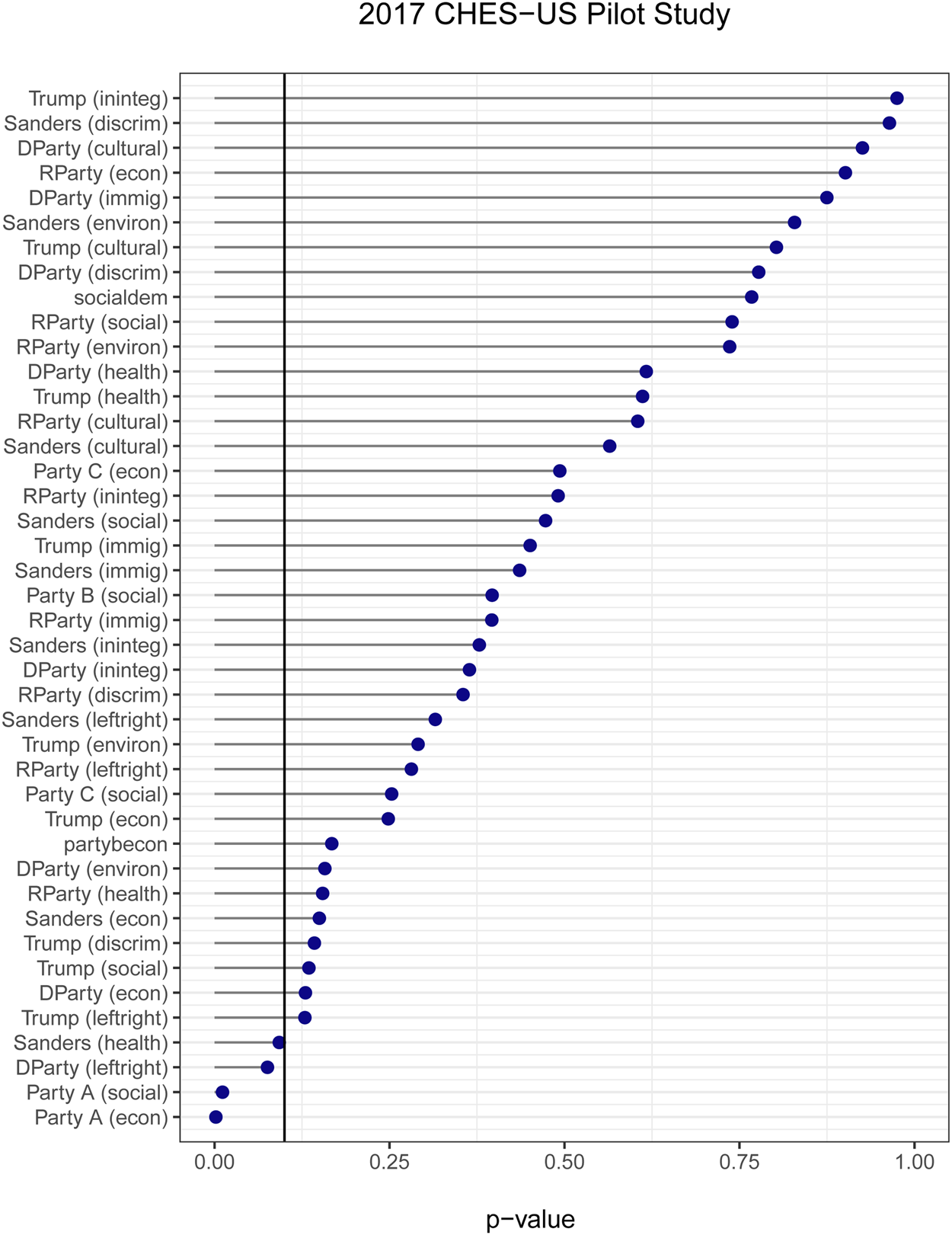
To assess vignette validity, we first check for whether Americanists and TA experts interpret common stimuli differently. Figure 1 compares the Americanist and TA experts' placements of the American stimuli and anchoring vignettes (Party A, Party B, and Party C) across policy scales using p-values from difference of means tests. In only four cases do the p-values indicate a statistically significant difference at p < 0.1 (two-tailed).
Difference of means tests between US and European expert placements of stimuli. Note: Vertical line denotes p = 0.1.

These results indicate that both types of experts view the ideological space in similar (in many cases, nearly identical) ways. Still, it is notable that Americanists and the TA experts differ in their placements of Party A on both the general economic and social scales. The Americanists view Party A as somewhat more economically left-wing, but slightly more socially right-wing, than the TA experts.Footnote 5 We suspect the phrases “social justice” and “welfare state” in Party A's vignettes have a stronger leftward connotation in the US than in Europe, while the presence of centrist parties like the Christian Democrats make Party A look relatively extreme in the European context.
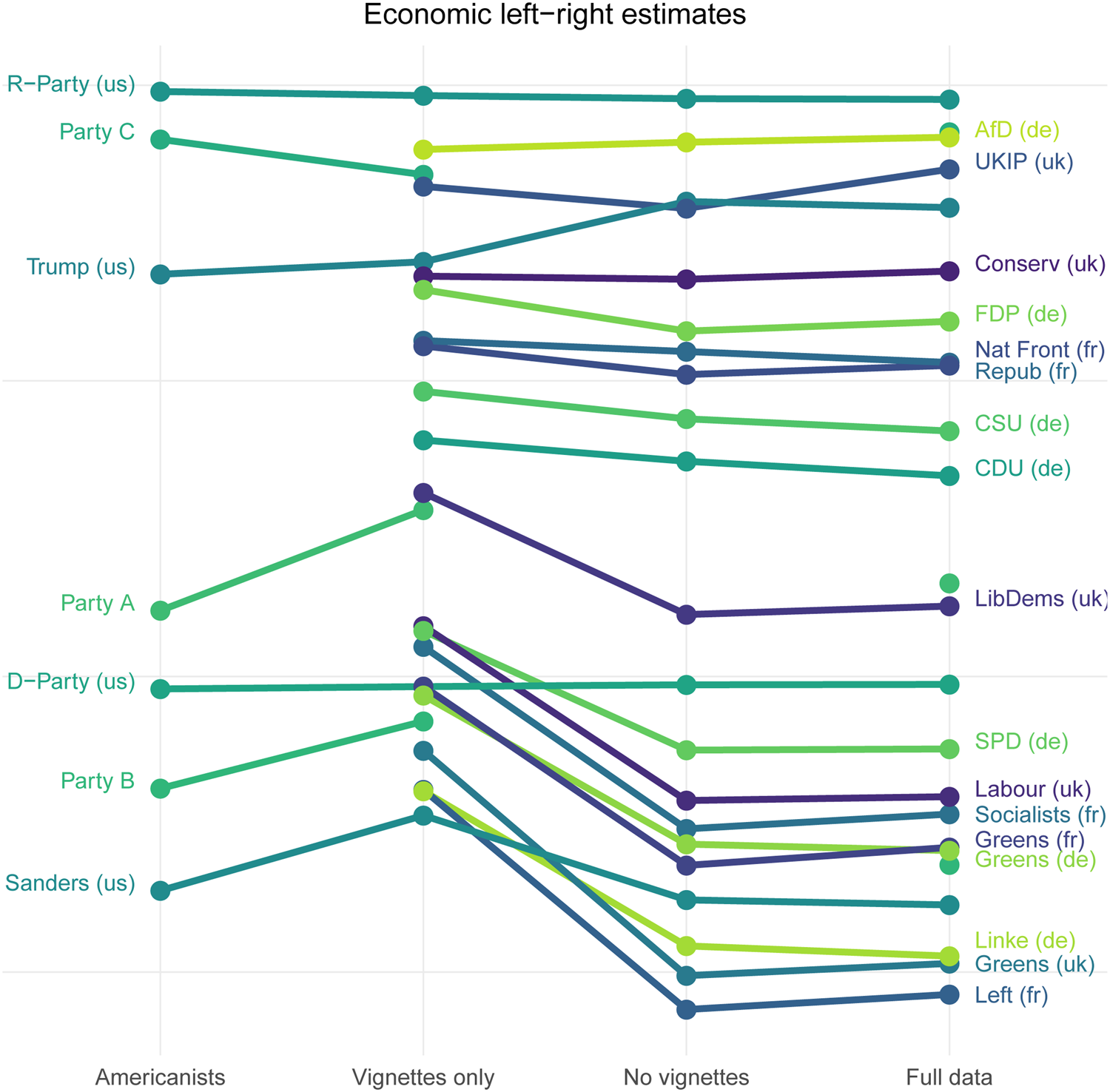
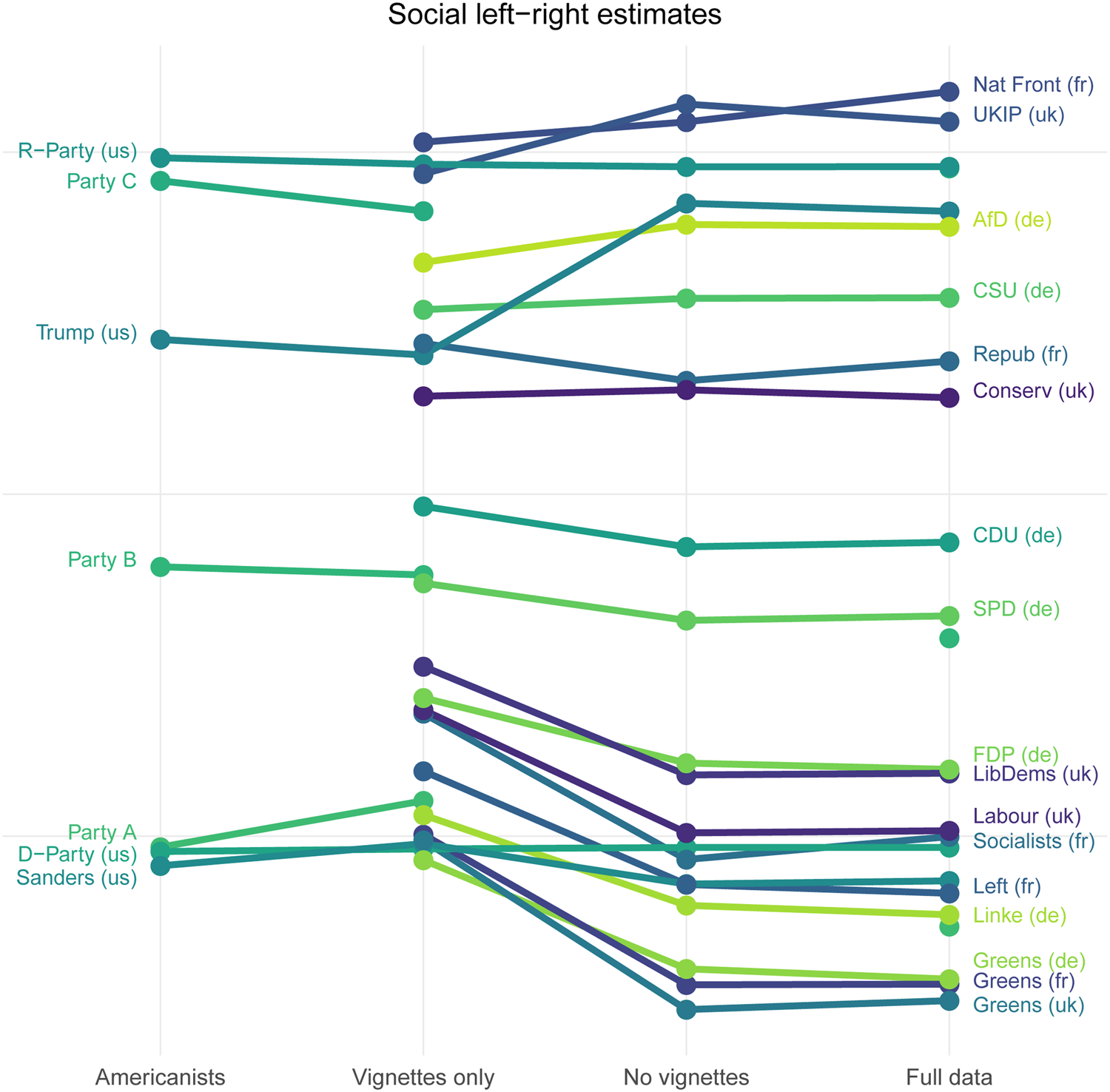
We next evaluate how both types of anchors—the conventional vignettes and the American stimuli—function when used separately and together to jointly scale, or bridge, the stimuli in a common space. For this task, we turn to the BAM scaling method described in the previous section. Figures 2–3 show the BAM estimates of party positions on the general economic and social scales under four different specifications:
Bayesian Aldrich–McKelvey ideal point estimates of general economic positions under alternative data specifications

Bayesian Aldrich–McKelvey ideal point estimates of general social/cultural positions under alternative data specifications

(1) Americanists: Including only Americanists' placements of the American stimuli and the vignette parties (i.e., no bridging).
(2) Vignettes only: Including only the vignette placements to bridge between the American and European stimuli (i.e., dropping the TA placements of American stimuli).
(3) No vignettes (American stimuli): Including only the TA placements of American stimuli to bridge between the American and European stimuli (i.e., dropping the vignette placements).
(4) Full data: Including both the vignette and TA placements to bridge between the American and European stimuli.
The estimated stimuli positions are presented in Figures 2–3.Footnote 6 The model is identified by constraining the Democratic Party at −1 and the Republican Party at +1 across specifications.
Even with significant differences between American and TA experts' interpretation of the Party A, the use of the anchoring vignettes alone produces a joint configuration with a high degree of face validity. Particularly on economic issues (see second column of Figure 2), the anchoring vignettes help to account for the tendency of Americanists to place Party B and Bernie Sanders too far to the left. The Labour Party in the UK, the Socialist Party in France, and the SDP in Germany are placed to the right of the Democratic Party on the economic dimension, which is consistent with other ideological measures. For example, according to data from the Comparative Manifesto Project (CMP), these European parties put more emphasis on the free market economy relative to the Democratic Party in recent elections. On the social dimension, President Trump is placed to the left of the CSU and AfD in Germany. These placements seem to accurately reflect President Trump's past inconsistencies social issues such as abortion and gay marriage as compared to two parties whose social agendas are better established.
Yet there is also evidence that vignettes fall short. While vignettes move Senator Sanders toward the center on the economic scale relative to the Americanist-only placements, he continues to outflank all extreme left parties in Europe. This result is odd, however, given the state-centric positions of left-wing parties in Europe. Perhaps more problematically, both far-left and center-left parties are clustered around the Democratic Party on the social dimension. Although the Democratic Party had a fairly robust liberal social agenda in 2016, European parties on the extreme left tend to put high premiums on liberal social policies. In general, the lack of differentiation among ideal points at the left end of the social scale makes it difficult to discern meaningful differences in party positions.Footnote 7
Stimuli producing significant differences in mean ratings of Americanist and Transatlantic experts.

μ US are the mean ratings of Americanist experts, μ TA are the mean ratings of Transatlantic experts.
Using American stimuli as anchors to bridge across party systems increases the face validity of both the social and economic scales in certain respects. American left-wing stimuli are closer to the economic center and American right-wing stimuli further right on both economic and social issues relative to the European stimuli. Specifically, we see in the third column of Figure 2 that Senator Sanders is placed to the right of Die Linke in Germany, the UK Greens, and the Left Party in France, moderating his economic position relative to extreme left parties in Europe, while Trump is placed further to the right of the UK Conservatives. On social issues, the National Front and UKIP—parties that are best known for hardline views on immigration, abortion, and gay rights—outflank the Republican Party and President Trump on the right, while all three Green parties, the Left Party in France, and Die Linke are to the left of the Democratic Party and Senator Sanders. These results remain mostly unchanged when anchoring vignettes are added back as bridges (i.e., the full dataset).
Overall, the results suggest that vignettes might perform well in the European context but not necessarily in the cross-Atlantic context. The degree that stimuli positions shift between the two models (i.e., vignettes as anchors versus American stimuli as anchors) suggest that anchors' ideological dispersion influences the spacing between estimates along the common scale. To this end, the American anchors seem to provide more spatially valid estimates. The presence of intransitivity, or switches in the ordering of candidates and parties between models with different anchors, provides additional evidence that cross-continental comparisons require alternative or updated bridging approaches. Namely, there is greater intransitivity between US and European stimuli than between European stimuli alone, the latter of which trend together across model specifications. In the economic models (Figure 2), American stimuli switch positions with European stimuli in seven instances—and do so dramatically—while European stimuli make marginal switches with one another four times. In the social models (Figure 3), intransitivity occurs twice as often between cross-continental stimuli than it does between French, German, and UK stimuli.
To further explore the possibility that anchors' ideological dispersion influences the arrangement of ideal points, we apply BAM to a fifth model that uses only Democratic and Republican parties to anchor estimates (i.e., excluding extreme stimuli, Sanders, and Trump) on the economic and social dimensions. Figure 1 in the online appendix shows the results of the “DR” models as compared to the “No vignette” models. In each case, the results are highly correlated. Yet there is a noticeable centering effect, where stimuli in the “DR” model move slightly inward, away from extreme ends. Even slight changes suggest that ideological dispersion among anchors influence point estimates. These results also dramatize the differences between the vignette and American stimuli models, highlighting the potential insufficiency of current vignette profiles for capturing the spread of ideological space in cross-continental applications.
3.1. Comparing party positions on specific issues
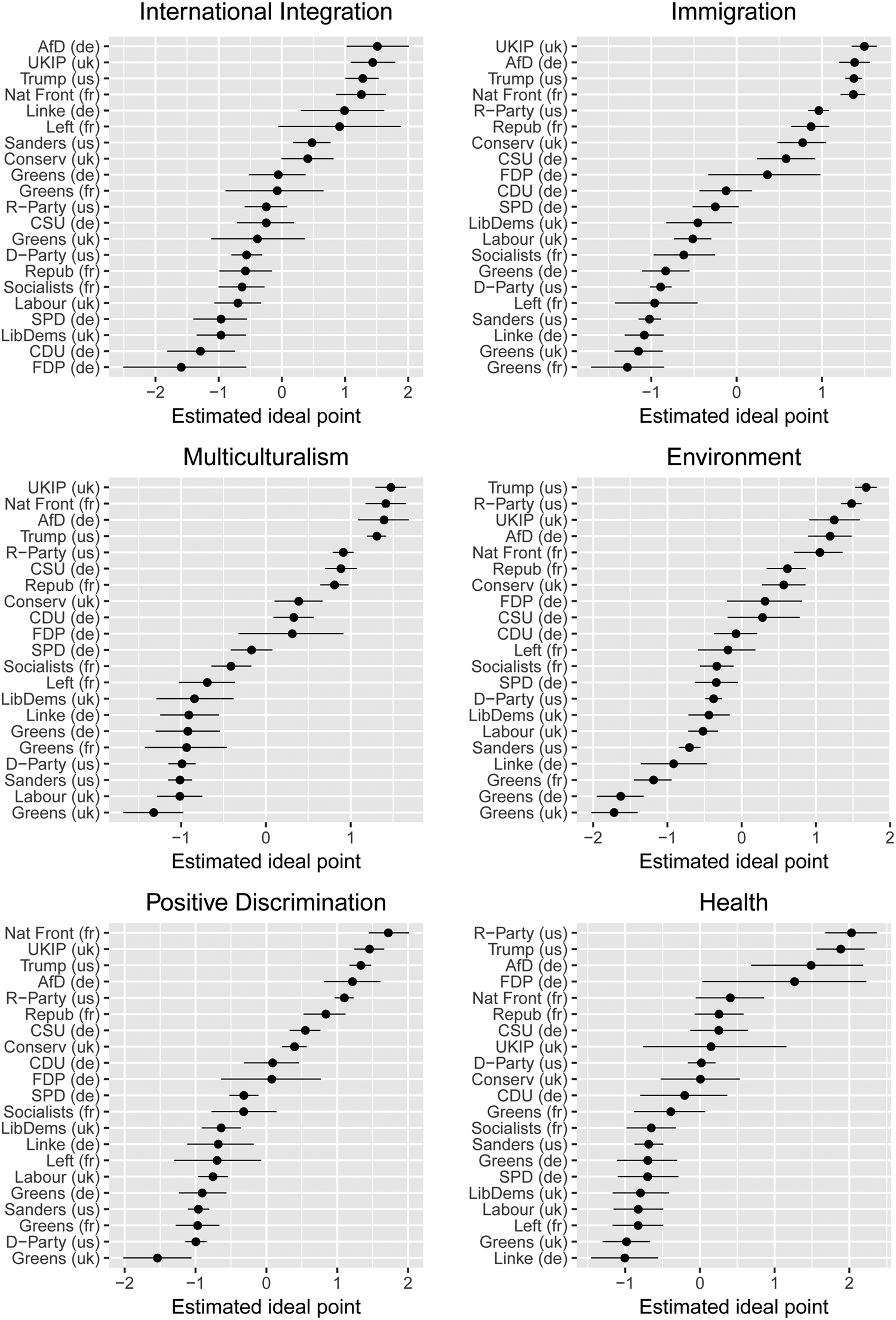
Based on the success of the TA placements to bridge between the American and European stimuli, we close by estimating BAM scaling on an array of policy scales without anchoring vignettes. That is, we exclusively use the TA placements to bridge stimuli placements on the six specific issues shown in Figure 4. The use of BAM controls for any remaining differential item functioning at the expert level.Footnote 8
Policy-specific stimuli estimates. Note: Bayesian Aldrich–McKelvey scaling estimated separately for each of the six issues. 90% credible intervals shown.

Figure 4 provides examples of both convergence and divergence between American and European political actors on specific policies. On economic issues such as health care and environmental regulation, the Republican Party and President Trump stand apart from all other stimuli, occupying the far-right end of the policy space. On the issue of health care, the Democratic Party is closest to the UK Conservative Party, while Senator Sanders is closest to the French Socialists. On environment regulation, the Democratic Party is most in line with the German FDP and the UK Liberal Democrats, with Senators Sanders located somewhat further left than the Labour Party.
The health care issue, in particular, provides an important test of our joint scaling approach. On this issue, a valid scaling should identify the Republican Party and President Trump from other right-wing stimuli as unique in their support of a private health insurance system without universal coverage. This is precisely what we see in Figure 4: the closest stimuli to the Republican Party and President Trump on the issue of health care are two German parties—Alternative for Germany (AfD) and the FDP—whose ambiguity on the issue is reflected in their wide uncertainty intervals.
It is on social/cultural issues such as immigration, multiculturalism, and positive discrimination (often referred to as affirmative action in the US) where we find greater overlap between left- and right-wing political actors in the US and Europe. On these matters, the Democratic Party and Senator Sanders are clustered among the most left-wing parties in Europe. On the other end of the spectrum, we find that President Trump, the UKIP, the National Front, and the German AfD comprise a distinct right-wing nationalist cluster, while the Republican Party is nestled between this cluster and mainstream right-wing European parties (i.e., the UK Conservatives, the French Republicans, and the German CSU/CDU). This pattern differs somewhat from the results for the general social policy scale (Figure 3), where the Republican Party is estimated to be further to the right (likely due to a greater influence of religious traditionalism).
International economic integration is an especially fascinating issue that reveals strange bedfellows on both sides of the Atlantic. Here, we find that left- and right-wing populists such as the Euroskeptic French Left Party, the UKIP, Senator Sanders, and President Trump are interspersed on one end of the international integration continuum, while the German Christian Democrats, the FDP, and the UK Liberal Democrats anchor the opposite end. Both American parties are nestled in the middle of the scale at nearly identical positions, reflecting the extent of intra-party divides in American politics over the issues of trade and international involvement.
4. Discussion
Estimates of political actors' positions in ideological space are very much the mother's milk of political science. They are essential tools to gain deeper insight into virtually every aspect of political competition: factions, cleavages, realignments, vote choice, party systems, and polarization (Brady, Reference Brady2011). As events continue to pull the American and European continents closer together, the need to estimate a common TA ideological space has never been clearer. This paper is but a first step in that endeavor, focusing on extending an approach that researchers have shown to be more efficient, cheaper, and suitable for cross-country comparisons relative to alternative scaling measures. While we advance the use of expert surveys, we note that researchers using such data should be extremely cautious about DIF and that future work should incorporate the strengths of other sources—public opinion surveys and text data, for instance—to further refine ideological estimates.
We find that European party experts who reside in the US place the American stimuli (parties and candidates) on issue scales in a manner that is statistically indistinguishable from American party experts. In only two of 36 cases (9 scales × 4 American stimuli) do difference-of-means test indicate significant differences between the Americanists and the TA experts at p < 0.1 (two-tailed). Thus, TA experts appear to be effective bridges, a claim strengthened by the face validity of the results in Figures 2–4. Future work should explore the extent to which characteristics of the TA experts, such as whether they are an embedded citizen or professional observer (e.g., a European expert living in the US), affect the quality of the bridges. If professional observers can act as effective bridges, the pool of experts who can place parties from two countries is not only larger, but inclusive of cases that are more difficult to obtain party placements from within-country experts, such as in fragile democracies.
While the three fictional anchoring vignettes seem to provide consistent estimates with TA placements, they also show a tendency to compress scaling estimates—particularly the left-wing stimuli ideal points. Differences between model specifications hint that this compression has two separate but related sources. One source is the ideological dispersion of anchors used. Our results suggest that the most valid estimates are generated when anchors mirror the ideological variation of the party systems being scaled. Specifically, the anchoring vignettes we use in this survey seem to lack the full ideological dispersion needed to place US and EU systems in a common space. Adding vignettes whose profiles occupy additional space within the common scale, or tweaking the language in the vignette profiles, may improve estimates.
Moreover, the wording of vignettes (particularly concerning Party A) appears to introduce DIF between American and TA experts. Because the vignettes are designed to “anchor” the raw placements of real stimuli, the introduction of DIF limits the ability of BAM scaling to produce a valid common space of the American and European stimuli. Producing a valid common space is critical for many studies, but especially those that use the spatial composition of party systems to explain election outcomes. Future work on TA bridging should test and refine the language used in these anchoring vignettes. That said, we note that this is a unique situation in which experts familiar with both political contexts (Europe and the US) are available, and in this case the anchoring vignettes continue to work, if imperfectly, as intended.
Anchoring vignettes are also limited in their coverage of specific issues, while American stimuli allow us to easily anchor estimates across full policy scales. Our results show that American political actors are most distinct on economic matters, with a distinctive right-wing skew relative to their European counterparts on general economic ideology and specific issues such as health care. This is of course is hardly surprising, given the voluminous literature on why America stands apart from other developed nations in its resistance to socialism (Hartz, Reference Hartz1955; Lipset, Reference Lipset, Bialar and Sluzar1977). At the same time, the results call into question the conventional wisdom that European political parties compete in a wider ideological space than American parties.Footnote 9 Future research should consider how these cross-national ideological gaps have waxed and waned over time, but these findings suggest that contemporary polarization in the American party system has placed the scope of ideological conflict on par with its Western European counterparts.
Indeed, the American stimuli especially track European left-right cleavages on general and specific social/cultural issues. This result provides further evidence that the Democratic and Republican parties in the US—particularly at the elite level—have locked into the competing orthodox-progressive poles of the culture war debate (Layman, Reference Layman2001; Gibson and Hare, Reference Gibson and Hare2016). The topic of international economic integration—an issue driving much of the tumultuous political events of 2016—also reveal similar cleavages across party systems. Here, conventional left–right divisions are insufficient to capture party and candidate positioning in both the US and Europe.
Needless to say, this is a research program ripe with future opportunities. For one, these estimates could be integrated into American/European multilevel models of voting behavior to examine how political context and personal characteristics interact with party positioning to influence vote choice (cf. Singh, Reference Singh2010). These data can also be used to better understand variation in the dimensional complexity of political systems—for example, the extent to which electoral rules and other contextual factors serve to collapse or expand the number of ideological dimensions by which political competition is organized (Bakker et al., Reference Bakker, Jolly and Polk2012). Our results demonstrate the promise of survey-based approaches in extending such cross-national analyses.
Supplementary Material
The supplementary material for this article can be found at https://doi.org/10.1017/psrm.2019.22
Acknowledgments
Paper prepared for presentation at the 2017 American Political Science Association. We thank Jim Adams, Diogo Ferrari, Will Lowe, Bob Lupton, Matthew Shugart, and the anonymous reviewers for their helpful comments and suggestions for revision.