I. INTRODUCTION
Magnetic sorbents are very promising materials for wastewater purification or oil spill removal applications because they make it possible to use electromagnetic collection of the sorbents after sorption.Reference Chen, Lam, Zhang, Pan, Arruebo and Yeung1–Reference Wang, Sun, Zhang, Fan and Ma3 Expanded graphite (EG) decorated with magnetic iron compounds is considered as one of the most advanced magnetic sorbent, which demonstrates the high sorption capacity of liquid hydrocarbonsReference Wang, Sun, Zhang, Fan and Ma3–Reference Lutfullin, Shornikova, Vasiliev, Pokholok, Osadchaya, Saidaminov, Sorokina and Avdeev5 and can be produced from inexpensive components. The higher the magnetic saturation of the sorbents, the lower the power of electromagnets that is required, reducing the energy consumption. Among the various iron compounds, metallic iron possesses the highest saturation magnetization value (M s = 220 emu/g),Reference Huber6 making the expanded graphite decorated with metallic iron (EG/Fe) of particular interest.
One of the possible ways to produce the EG/Fe materials is to reduce the precursor materials of EG with iron oxides. The reduction can be carried out either by solid chemical reducers, viz., KBH4, etc., or by gaseous reducers, i.e., hydrogen.Reference Wang, Sun, Zhang, Fan and Ma3,Reference Lutfullin, Shornikova, Vasiliev, Pokholok, Osadchaya, Saidaminov, Sorokina and Avdeev5,Reference Beguin and Frackowiak7–Reference Huan, Zhao-hui, Lu and Cheng-hu10 The main drawbacks of solid reducers are the necessity of using solvents and decreasing the bulk density of EGs,Reference Shornikova, Sorokina and Avdeev11 which results in the sorption capacity decrease.Reference Toyoda and Inagaki4 The reduction of EG/Fe2O3 by gaseous reducers, on the other hand, preserves the EG morphology responsible for the high sorption capacity of resulting materials. Thus, the study of the reduction of Fe2O3 deposited on expanded graphite supports hydrogen flow that is of interest. Herein, we report the role of the nature of expanded graphite matrix and its properties in the reduction of Fe2O3 by hydrogen as well as peculiarities of the investigated process.
II. EXPERIMENTAL
A. Samples
Iron (III) oxide particles were deposited on expanded graphite (EG) of three types and on an inert ceramic support with a density of 0.4 g/cm3. The EG/Fe2O3 samples, designated as EL-350 and EL-900, were prepared as described in Ref. Reference Lutfullin, Shornikova, Pokholok, Sorokina and Avdeev9 by graphite anodic oxidation in saturated Fe(NO3)3 solution until the specific charge of 1200 C/g was reached, followed by exfoliation in air at temperatures of 350 and 900 °C, respectively. The PRO-900 sample was prepared by graphite intercalation in 98% nitric acid according to Ref. Reference Avdeev, Sorokina and Tverezovskaya12, followed by hydrolysis and impregnation of the residual compound by aqueous solution of iron (III) nitrate at a room temperature for 30 min. Then, it was dried at 60 °C for 5 h and exfoliated at a temperature of 900 °C in air. Ceram-350 and Ceram-900 samples were obtained by impregnation of ceramic supports with the excess of saturated aqueous solution of iron (III) nitrate at a room temperature for 30 min followed by drying at 60 °C for 5 h and then were put into a furnace preheated to 350 or 900 °C, respectively, for 3–60 s.
The Expanded graphite samples without iron oxides marked as EL-350-pure and EL-900-pure were synthesized by graphite polarization in 36% nitric acid [the concentration of  ${\rm{NO}}_{\rm{3}}^ -$ ions in this solution is equal to that in the saturated solution of Fe(NO3)3], followed by exfoliation at temperatures of 350 and 900 °C, respectively. The PRO-pure sample was obtained by exfoliation of the graphite residual compound at 900 °C.
B. Investigation techniques
The total amount of iron in EG/Fe2O3 samples was determined gravimetrically. The EG/Fe2O3 powder compressed into a pellet was placed in a quartz crucible and burned in air at 1000 °C for 4 h until the full burnout of carbon was reached. According to the x-ray diffraction (XRD) data, the incombustible rest was α-Fe2O3 and, consequently, the iron content [ω(Fe), %] was calculated with a relative error of 5%.
The phase composition of the samples was studied by XRD on a thermo ARL X'TRA powder diffractometer (Waltham, MA; Cu Kα radiation, λ = 1.5418 Å, 2θ = 20–90°, 2°/min). 57Fe Mossbauer spectroscopy was carried out using a constant acceleration spectrometer using a 57Co/Ru gamma source. The isomer shifts (ISs) were determined relative to α-Fe. The qualitative composition of functional groups on EG/Fe2O3 surface was studied using Fourier transform IR (FTIR)-spectroscopy. FTIR spectra were performed using a Tensor 27 Bruker spectrometer (Billerica, MA) in a 4000–800 cm−1 range. The content of functional groups was determined with an elemental CHNO analyzer PerkinElmer 2400 (Waltham, MA). The measurement error was 3%. The scanning electron microscopy (SEM) images were captured using a JEOL JSM-6480 LV/EDS microscope (Tokyo, Japan).
The reduction processes of EG/Fe2O3, Ceram/Fe2O3, and EG samples in hydrogen flow were studied using a differential scanning calorimeter (DSC) NETZSCH DSC 204HP (Selb, Germany). The DSC samples were compressed in pellets of 10–11 mg weight with a density of 0.2 g/cm3. The measurements were taken in the 30–600 °C temperature range in dynamic hydrogen atmosphere (60 mL/min) at a heating rate of 5 °C/min. The measurement error was 5%. The reduction of EG/Fe2O3 to EG/Fe at constant temperatures (300–600 °C) was performed in a quartz reactor placed in a shaft furnace under hydrogen flow of 60 mL/min for 2 h. The analysis of gases evolving during the heating of EG/Fe2O3 and Ceram/Fe2O3 samples, in an inert atmosphere, at the heating rate of 5°/min, was performed using an MRU Vario + analyzer (Obereiseheim, Germany). The measurement error was 5%.
The magnetic measurement of EG/Fe samples was performed using a Faraday balance at room temperature. The pore structure of EG/Fe samples was investigated by the standard contact porosimetry technique.Reference Volfkovich, Bagotzky, Sosenkin and Blinov13 The specific Brunauer–Emmett–Teller surface of EG/Fe samples was determined with low-temperature nitrogen adsorption method using a Qsurf analyzer. The measurement of EG/Fe sorption capacities of crude oil was carried out according to the ASTM F 726-99 international standard.
III. RESULTS AND DISCUSSION
A. EG/Fe2O3 samples composition
According to Ref. Reference Lutfullin, Shornikova, Pokholok, Sorokina and Avdeev9, iron oxide particles are randomly distributed on the EG surface and mostly concentrated on defects of worm-like particles. The size of iron oxide particles varies within a wide range from tens of nanometers to units of micrometers. According to XRD patterns, the phase composition of all samples is represented by graphite phase padding, and in the case of EL-900 and PRO-900 samples, by peaks corresponding to the α-Fe2O3 phase. The iron content in the samples depends on the preparation routs: ω(Fe) = 12.0% for EL-350, ω(Fe) = 14.0% for EL-900, and ω(Fe) = 9.7% for PRO-900.
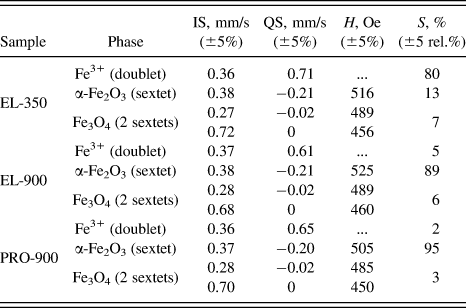
To determine the valent state and localization of iron in EG/Fe2O3 samples, Mossbauer spectroscopy was applied (Fig. 1). The corresponding hyperfine parameters are listed in Table I. The Mossbauer spectrum of EL-350 sample is composed of the major doublet with spectral contribution S = 80% and sets of minor sextets. According to its IS of 0.36 mm/s and quadrupole splitting of 0.71 mm/s, the former is to be attributed to ferrihydrite.Reference Long14 Ferrihydrite is an amorphous hydrated iron oxide Fe2O3·nH2O, the chemical formula of which can be written as Fe5HO8·4H2O or FeOOH·2H2O.Reference Long14 The minor sextets (with the spectral contributions of about 20%), according to their hyperfine parameters, correspond to α-Fe2O3 and Fe3O4.Reference Long14
Mossbauer spectra of EG/Fe2O3 samples: (a) before reduction and (b) after reduction by hydrogen.

The parameters of Mossbauer spectra of EG/Fe2O3 samples.
IS—Isomer shift related to α-Fe, QS—quadrupole splitting, H—magnetic field, S—spectral contribution.
By contrast, the major components in the Mossbauer spectra of the other samples (EL-900 and PRO-900) were α-Fe2O3 sextets. There were also minor sextets and doublets corresponding to Fe3O4 and Fe3+, respectively. Unlike the above samples, the Fe3+ doublets are presumably related to superparamagnetic Fe2O3 particles with a particle size <10 nm,Reference Zboril15,Reference Kundu, Mukherjee and Chakravorty16 because these samples were obtained at high temperatures.
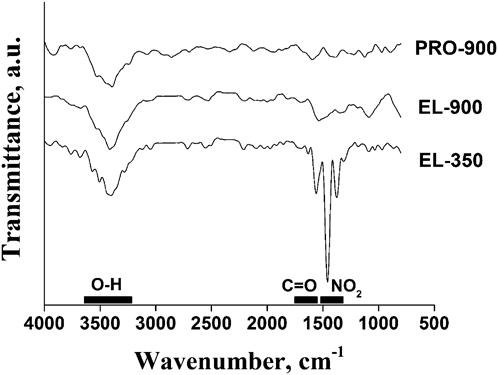
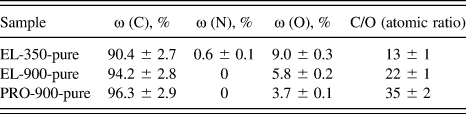
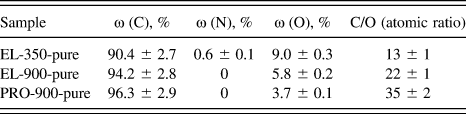
Besides iron-containing particles, the EG/Fe2O3 samples contain oxygen functional groups. According to FTIR analysis, carbonyl, hydroxyl, and nitro groups were observed in the EL-350 sample, whereas the EL-900 sample bears carbonyl and hydroxyl groups and the PRO-900 sample, only hydroxyl groups (Fig. 2). As long as expanded graphite is a black solid, the quantitative determination of amounts of each group is impossible, although the total content of oxygen functional groups could be described as C/O atomic ratio. Herein, the C/O atomic ratio was determined for pure EG samples on the assumption that iron compounds do not influence the determined parameter. According to elemental analysis, the total amount of oxygen-containing functional groups decreases in the sequence of EL-350-pure > EL-900-pure > PRO-900-pure (Table II). Finally, the combination of gravimetry, elemental and Mossbauer analyses allows to estimate the compositions of EG/Fe2O3 samples shown in Table III.
FTIR spectra of EG/Fe2O3 samples.
The elemental compositions of EG samples.
The compositions of EG/Fe2O3 samples.
B. Reduction of EG/Fe2O3 samples in the dynamic regime
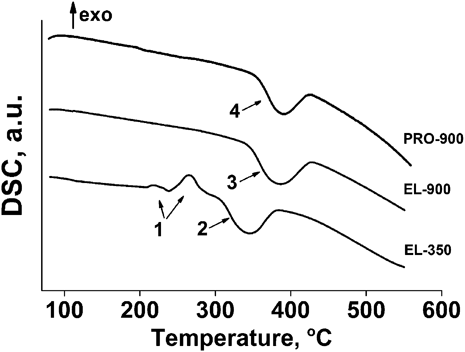
DSC investigations of the reduction of EG/Fe2O3 samples in hydrogen atmosphere were performed at temperatures up to 600 °C. Reduction of EL-350 sample was found to be a two-step process, which included an exothermic reaction (Fig. 3, peak 1) in the temperature range of 200–278 °C, with a thermal effect of ∆H 1 = −27 J/g, and an endothermic reaction (Fig. 3, peak 2) in the temperature range of 310–378 °C with a thermal effect of ∆H 2 = 66 J/g. Reduction of the samples EL-900 and PRO-900 was a one-step process, occurring in the temperature range of 350–420 °C (Fig. 3, peaks 3 and 4), with thermal effects of ∆H 3 = 76 and ∆H 4 = 63 J/g, respectively.
The DSC curves of the reduction of EG/Fe2O3 samples.
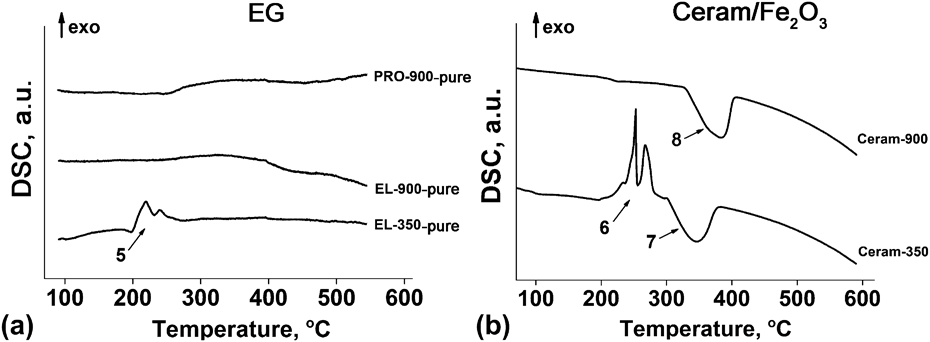
As long as the investigated EG/Fe2O3 materials consist of EG matrix and iron-containing particles, the reduction of EG and Ceram/Fe2O3 samples were carried out in identical conditions. The reduction of EG samples did not exhibit any thermal effects, except a small exothermic effect for the EL-350-pure sample in the range of 200–220 °C (∆H 5 = −12 J/g) [Fig. 4(a)]. This effect is attributed to the decomposition of functional groups of its carbon. Presumably, the decomposition of functional groups in EG samples is similar to that in graphite oxides. The partial decomposition of functional groups, mostly hydroxyl and carboxyl groups, takes place spontaneously at temperatures >200 °C, accompanied by evolving of heat and gases (CO, CO2, and H2O). At the same time, the functional groups can be directly reduced by hydrogen. The decomposition of the majority of functional groups is observed in the 200–250 °C temperature range, accompanied by intense exothermic effects. At higher temperatures, further decomposition of residual functional groups occurred, but it was significantly less intensive without the visible exothermal effect.Reference Pei and Cheng17,Reference Jeong, Lee, Jin, Kim, Bae and Lee18 Thus, during the reduction of EG and EG/Fe2O3 samples in hydrogen, the decomposition of oxygen-containing groups took place. The thermal effect of this process was observed only for EL-350-pure [Fig. 4(a), peak 5] and EL-350 (Fig. 3, peak 1) samples with low C/O atomic ratios.
The DSC curves of (a) EG samples and (b) Ceram/Fe2O3 samples.
In parallel, the reduction of Ceram/Fe2O3 was investigated. According to XRD and Mossbauer spectroscopy, the Ceram-350 sample, similar to the EL-350 one, contains ferrihydrite and α-Fe2O3, whereas Ceram-900, like the EL-900 and PRO-900 samples, contains almost only α-Fe2O3. The following endothermic peaks are observed on DSC curves of Ceram/Fe2O3 samples: in the range of 300–372 °C, for Ceram-350 [Fig. 4(b), peak 7]; and in the range of 330–400 °C, for Cearm-900 [Fig. 4(b), peak 8]. According to literature,Reference Pei and Cheng17–Reference Baldokhina, Suzdaleva, Prusakova, Burnazyana, Korneevb, Kovalenkob and Folmanisb19 these effects are attributed to the reduction of FeOOH and Fe2O3, respectively, that supposes endothermic effects in EG/Fe2O3 samples are entirely the result of the reduction of iron-containing phases (Fig. 3). Additionally, two-humped exothermic effect is observed in the case of Ceram-350 [Fig. 4(b), peak 6]. To understand this process, the emitted gas analysis was performed during the heating of Ceram-350 in inert atmosphere. In the 130–300 °C range, the emission of NO2 was prevailing [Fig. 5(a)]. The peak 6 on the DSC curve [Fig. 4(b)] corresponds to further reduction of evolved gas by hydrogen. Nitrogen dioxide can be formed from the decomposition of nitric acid adsorbed in the ceramic matrix, which, in turn, was formed during flash heating at 350 °C of the ceramic matrix impregnated with iron (III) nitrate.
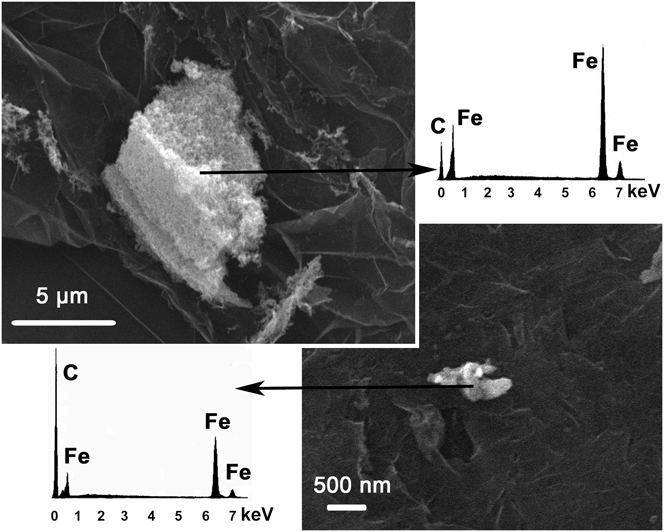
SEM images and energy dispersive x-ray spectra of EL-350 sample after reduction.
To summarize, the exothermic peak on DSC curves of the EL-350 sample represents the two processes: (i) the decomposition of oxygen containing functional groups and (ii) the reduction of gases evolved during the decomposition of nitric acid adsorbed in EG/Fe2O3 [Fig. 5(b)]:
 $${\rm{4HN}}{{\rm{O}}_{\rm{3}}} = {\rm{4N}}{{\rm{O}}_{\rm{2}}} + {{\rm{O}}_{\rm{2}}} + {\rm{2}}{{\rm{H}}_{\rm{2}}}{\rm{O, }}\,\,\Delta H\,{\rm{ > 0}}\quad {\rm{,}}$$
 $${\rm{N}}{{\rm{O}}_{\rm{2}}} + {{\rm{C}}_{{\rm{graphite}}}} = \;{\rm{NO}} + x{\rm{CO}} + {\rm{1}} - x{\rm{ }}{{\rm{C}}^{\rm{ + }}}{\rm{graphite, }}\,\,\Delta H\,\,{\rm{ \lt \,\,0}}\quad {\rm{.}}$$
At the same time, further interaction of evolved gases with hydrogen results in the following exothermal effects:
 $${\rm{2NO}} + {\rm{2}}{{\rm{H}}_{\rm{2}}} \to {{\rm{N}}_{\rm{2}}} + {\rm{2}}{{\rm{H}}_{\rm{2}}}{\rm{O, }}\,\,\Delta H\,\,{\rm{ \lt\,\, 0}}\quad {\rm{,}}$$
 $${\rm{CO}} + {\rm{3}}{{\rm{H}}_{\rm{2}}} = {\rm{C}}{{\rm{H}}_{\rm{4}}} + {{\rm{H}}_{\rm{2}}}{\rm{O, }}\,\,\Delta H\,\,{\rm{ \lt\,\, 0}}\quad {\rm{,}}$$
 $${{\rm{O}}_{\rm{2}}} + {\rm{2}}{{\rm{H}}_{\rm{2}}} \to {\rm{2}}{{\rm{H}}_{\rm{2}}}{\rm{O, }}\,\,\Delta H\,\,{\rm{ \lt\,\, 0}}\quad {\rm{.}}$$
Reactions (3)–(5) occur at significant rates even at a temperature of 200 °C because active gases, such as atomic oxygen, radicals of nitrogen, and carbon oxide, formed during the decomposition process, interact with hydrogen very intensively.
The endothermic peaks in EG/Fe2O3 samples correspond to the reduction of iron-containing phases only. According to SEM, by energy dispersive x-ray analysis, both small and large particles of iron oxides are reduced to Fe (Fig. 6). From Mossbauer spectroscopy, 76–90% of iron oxides converts to α-Fe during the reduction of EG/Fe2O3. The residual iron is in form of superparamagnetic particles of iron oxide (III) with particles size <10 nm [Fig. 1(b) and Table IV]. The estimated compositions of the EG/Fe2O3 samples after reduction are listed in Table V.
Profile of the amount of gases evolving during the heating of samples in an inert atmosphere: (a) Ceram-350, (b) EL-350.
Parameters of Mossbauer spectra of EG/Fe samples.
Calculated parameters for the best kinetic models of the reduction.
As one can see, the origin of expanded graphite matrix affects the completeness of iron reduction. The degree of iron reduction in EL-350 is about 76%, in EL-900 about 85%, and in PRO-900 about 90%. The increase of C/O atomic ratio in the EG/Fe2O3 samples from 13 to 35 (Table II) leads to increase in the degree of iron reduction from 76% to 90% (Table V). This can be explained by the interaction of iron-containing phases with EG matrix in EG/Fe2O3. Iron compounds are bound to a matrix by chemical forces through oxygen atoms of functional groups.Reference Phillips20 The high amount of functional groups can limit the process of reduction, especially the growth of nuclei. During the growth of the metallic iron phase, small particles of iron oxides could remain to be strongly connected to the matrix that lowers the degree of iron reduction.
The compositions of EG/Fe samples.
But, at the same time, EG matrix does not influence the temperature range and thermal effects of iron oxide reduction. Endothermic peak 2 on the DSC curve of the EL-350 sample (Fig. 3) corresponds to reduction of FeOOH with impurities of Fe2O3 and Fe3O4:
 $${\rm{FeOOH}} + {\rm{1}}{\rm{.5}}{{\rm{H}}_{\rm{2}}} = {\rm{Fe}} + {\rm{2}}{{\rm{H}}_{\rm{2}}}{\rm{O, }}\,\,\Delta H = {\rm{60}}\,{\rm{J/g}}\quad ,$$
 $${\rm{F}}{{\rm{e}}_{\rm{2}}}{{\rm{O}}_{\rm{3}}} + {\rm{3}}{{\rm{H}}_{\rm{2}}} = {\rm{2Fe}} + {\rm{3H2O, }}\,\,\Delta H{\rm{ = 11}}\,{\rm{J/g}}\quad ,$$
 $${\rm{F}}{{\rm{e}}_{\rm{3}}}{{\rm{O}}_{\rm{4}}} + {\rm{4}}{{\rm{H}}_{\rm{2}}} = {\rm{3Fe}} + {\rm{4}}{{\rm{H}}_{\rm{2}}}{\rm{O, }}\,\,\Delta H = {\rm{6}}\,{\rm{J/g}}\quad {\rm{.}}$$
Considering the content of iron compounds in EG samples and the degree of iron reduction, the theoretical enthalpy is to be equal to  $\Delta H_{\rm{2}}^{{\rm{theoretical}}}$ = 77 J/g (±10%), coinciding, within error, with the experimental enthalpy ∆H 2 = 66 J/g (±5%).
The endothermic effects observed on the DSC curves of the samples EL-900 and PRO-900 (Fig. 3, peaks 3 and 4) correspond to the reduction of iron oxide (III) with impurities of Fe3O4:
 $${\rm{F}}{{\rm{e}}_{\rm{2}}}{{\rm{O}}_{\rm{3}}} + {\rm{3}}{{\rm{H}}_{\rm{2}}} = {\rm{2Fe}} + {\rm{3}}{{\rm{H}}_{\rm{2}}}{\rm{O}}\quad {\rm{,}}$$
 $${\rm{F}}{{\rm{e}}_{\rm{3}}}{{\rm{O}}_{\rm{4}}} + {\rm{4}}{{\rm{H}}_{\rm{2}}} = {\rm{3Fe}} + {\rm{4}}{{\rm{H}}_{\rm{2}}}{\rm{O}}\quad {\rm{.}}$$
The experimental values enthalpy are agreed well with the calculated values:  $\Delta H_{\rm{3}}^{{\rm{theoretical}}}$ = 80 J/g (±10%) ≈ ∆H 3 = 76 J/g (±5%) and
 $\Delta H_{\rm{4}}^{{\rm{theoretical}}}$ = 60 J/g (±10%) ≈ ∆H 4 = 63 J/g (±5%).
C. Kinetics of the EG/Fe2O3 reduction
The kinetics of reduction was investigated on the example of the PRO-900 sample. DSC curves of reduction at heating rates of 3, 5, and 10°/min are given in Fig. 7. The NETZSCH Thermokinetics 3.1 software was used to evaluate kinetic models and Arrhenius parameters. Several one-stage and two-stage kinetic models were tested. There are several models, e.g., phase-boundary-controlled reaction models, n-dimensional diffusion models, n-dimensional growth of nuclei models, etc., which are widely utilized to fit the DSC data of iron compound reduction. It was found that the two-stage model, viz., the expanded Prout–Tompkins autocatalysis reaction model followed by n-dimensional Avrami–Erofeyev growth of nuclei one, fits best the experimental data (Table VI). It is to note that the suggested mathematical models for the reduction of iron oxides (III) on the EG matrix appeared to be the same as the models for their reduction without graphite matrix.Reference Lin, Chen and Li21,Reference Pineau, Kanari and Gaballah22 This is consistent with the theoretical consideration. In the beginning, the reduction process is limited by chemical reaction factors only. On formation, a new α-Fe phase adsorbs hydrogen molecules and catalyzes the reduction—this corresponds to the autocatalytic Prout–Tompkins model. During the formation of large α-Fe nuclei, the reduction becomes limited by topological factors of growth of the nuclei.
The approximation of the mathematical model to the DSC curves of the sample PRO-900.
D. The reduction of EG/Fe2O3 samples in static regime
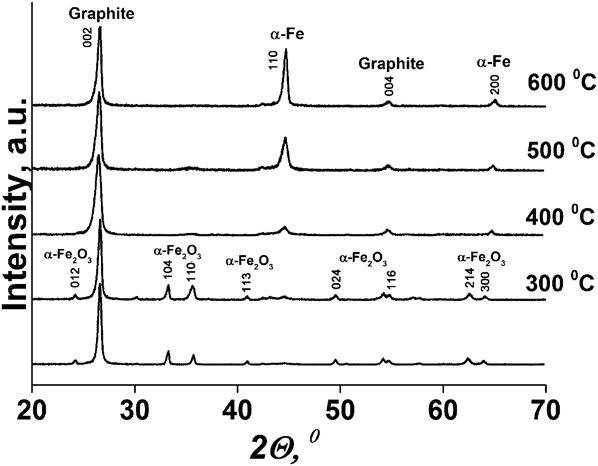
In this part, we investigated the reduction of materials at constant temperatures. Figure 8 shows the XRD patterns of PRO-900 heated in hydrogen atmosphere at temperatures of 300, 400, 500, and 600 °C for 2 h. As it follows from the figure, the reduction onset of iron oxides was at 400 °C. The increase in the reduction temperature results in the increase of XRD peak intensities of α-Fe as well as their narrowing, reflecting the enlargement of iron particle. At 600 °C, as determined by Mossbauer spectroscopy, the maximum degree of iron reduction of 98% is reached. The two other EG/Fe2O3 samples (EL-350 and EL-900), with the degree of iron reduction at 600 °C higher than 96%, demonstrate similar behavior. Thus, during the prolonged reduction of EG/Fe2O3 samples at 600 °C, the influence of expanded graphite nature had almost vanished as iron-containing phases were nearly completely transformed into α-Fe.
XRD patterns of the sample PRO-900 after the reduction at constant temperatures.
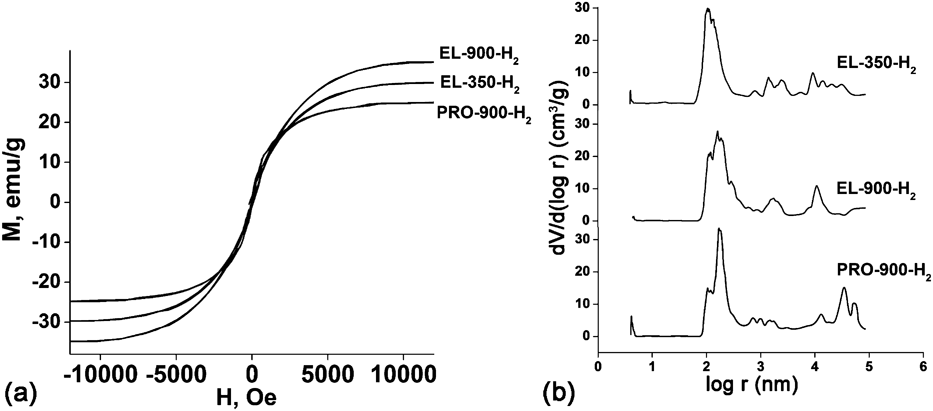
The EG/Fe samples obtained are characterized by the high values of saturation magnetization, which linearly depends on the α-Fe content [Fig. 9(a), Table VII]. The experimental magnetic saturation values are consistent with the theoretical ones calculated as  $M_{\rm{s}}^{{\rm{theoretical}}}$ = M s (bulk α-Fe)·ω(α-Fe). It implies, that α-Fe particles in EG/Fe are more than tens of nanometers in size for all samples.
(a) The magnetization of EG/Fe samples in dependence on magnetic field strength, (b) the pore structure distribution of EG/Fe samples.
Magnetic and sorption properties of EG/Fe samples.
The EG/Fe materials are considered to be very promising magnetic sorbents for liquid hydrocarbons sorption applications, e.g., for oil spill response. These materials possess very low bulk density, viz., 2.0 kg/m3 for EL-350 and EL-900 and 2.5 kg/m3 for PRO-900. It is well known that the pore structure of EG/Fe is mainly comprised of macropores. As it was impossible to investigate pore structure of EG/Fe because of their low bulk densities, we used compressed samples with densities of 40 kg/m3 to perform it by standard contact porosimetry [Fig. 9(b), Table VII].Reference Avdeev, Sorokina and Tverezovskaya12 The total pore volume V pore (40 kg/m3) did not depend on the nature of EG/Fe and was about 22–23 cm3/g. Macropores with a radius of 100 nm–10 μm contribute to approximately 70% of the total volume and corresponds to the elliptical and crevice inside pores of EG/Fe worm-like particles. Macropores with radius of 10–100 μm contribute to approximately 30% of the total volume and are spaces among worm-like particles. Average pore sizes are in the range of 110–180 nm, and the values of specific surface are in the range of 30–150 cm2/g (Table VII). In our previous work, it was shown that samples EL-350 and EL-900 possessed very high sorption capacities to liquid hydrocarbons: up to 85 g/g of octane and up to 110 g/g of motor oilReference Lutfullin, Shornikova, Vasiliev, Pokholok, Osadchaya, Saidaminov, Sorokina and Avdeev5 that did not depend on iron content. Iron phases were found not to affect the porous structure of materials. In this work, we determined the sorption capacity for crude oil with a viscosity of 1.8 mPa s. The values of sorption capacities for EG/Fe with bulk densities of 2–2.5 kg/m3 are in the range of 89–93 g/g, and they do not depend on the nature of expanded graphite or specific surface but only on total pore volume (Table VII). The EG/Fe materials with sorbed oil can be attracted by magnets with a magnetic field strength of up to 4 kOe and a gradient of field strength of up to 1 kOe/mm.
IV. CONCLUSIONS
The reduction of iron (III) oxides deposited on different EG matrixes by hydrogen has been studied at temperatures up to 600 °C. It was found that the nature of EG matrixes, viz., the content of oxygen containing functional groups in matrix describing the C/O atomic ratios, significantly affected the completeness of reduction at dynamic conditions. During heating at constant rate of 5 °C/min in hydrogen, the degree of the iron oxide to α-Fe reduction was found to be in direct proportion to the C/O ratios of the starting materials. Thus, the higher content of oxygen containing functional groups in matrix, the lower degree of reduction was observed. It was presumed that part of iron in oxide phases was chemically bonded to the oxygen containing functional groups of EG matrix, suppressing their reduction.
It was shown that the EG matrix themselves did not react with the iron oxides as reducing agents at our experimental conditions. Instead, the present oxygen containing functional groups underwent partial reduction by hydrogen.
The reduction kinetics for EG/Fe2O3 samples were found to be very similar to those for bulk iron oxides. The two-stage model was adopted, where the first stage was described by the Prout–Tompkins autocatalysis model and the second by the Avrami–Erofeyev equation (n-dimensional growth of nuclei).
The prolonged reduction of EG/Fe2O3 samples at 600 °C diminished the effect of the oxygen functional group content, as all iron oxides in all the samples were almost completely reduced to α-Fe.
The EG/Fe samples, obtained herein by reduction in hydrogen, demonstrated the high, up to 35 emu/g, values of saturation magnetization. All the samples were mainly macroporous. At 89–93 g/g, the values of sorption capacity for crude oil of the materials with bulk densities of 2–2.5 kg/m3 were independent of the nature of the EG matrixes and of specific surface. They only depended on the total pore volume. Thus, the EG/Fe materials obtained by reduction in hydrogen are shown to be the highly effective magnetic sorbents suitable for liquid hydrocarbon sorption applications, e.g., for oil spill response.
ACKNOWLEDGMENTS
This work was supported by the Russian Foundation for Basic Research (Grant No. 12-03-00939a). Also, the authors acknowledge support from M.V. Lomonosov Moscow State University Program of Development for the use of their equipment, in particular S. Chernyak and S. Savilov.