Introduction
Surgeons in the early days of adenotonsillectomy and tonsillectomy were over-enthusiastic about performing these procedures. This led to the critical revision of surgical indications for these procedures, and recurrent adenotonsillitis or tonsillitis became the first and most common indication for adenotonsillectomy and tonsillectomy.
Adenotonsillar or tonsillar hypertrophy leads to upper respiratory obstruction in children and adults. About 80 per cent of children with obstructive sleep apnoea have adenotonsillar hypertrophy.Reference Esteller 1 This upper respiratory obstruction leads to alterations in cardiopulmonary and blood parameters.Reference Çetin, Yılmaz, Özen, Bozan and Coşkun 2 – Reference Simsek, Karacayli, Ozel, Arslan, Muluk and Kilic 4 Otorhinolaryngologists disapprove of surgery in those who do not fall within the purview of current surgical indications, and hence all such cases of adenotonsillar or tonsillar hypertrophy are managed conservatively. However, this conservative approach may put these patients at risk of developing cardiopulmonary diseases.
This risk can only be eliminated through active cardiac screening of children with adenotonsillar or tonsillar hypertrophy and surgical intervention, irrespective of enumerated surgical indications. To prove this hypothesis, we conducted an interventional study on children with adenotonsillar or tonsillar hypertrophy who otherwise did not fulfil the present surgical indications.
Materials and methods
A prospective, interventional study was conducted at an academic institution after obtaining approval from the institutional review board. Twenty-five participants, aged 3–18 years (mean age, 9.0 ± 3.8 years), with grade III and IV adenotonsillar hypertrophy or tonsillar hypertrophy were enrolled in the study after informed consent was provided by parents or participants. Participants included 16 patients with adenotonsillar hypertrophy and 9 with tonsillar hypertrophy (21 boys and 4 girls; mean age, 9.0 ± 3.8 years).
Patients with confirmed recurrent adenotonsillitis or tonsillitis (for whom the number of documented adenotonsillitis or tonsillitis episodes was: seven or more in a year, five per year for three years, or three per year for two years), neuromuscular disorders, pulmonary diseases, heart disease, and any cause of upper respiratory tract obstruction (allergic rhinitis, septal deviation, skull base anomaly, nasal polyp) were excluded from the study.
All participants underwent blood oxygen saturation measurement with pulse oximetry before surgery and at three months post-operatively. The study participants also underwent a medical history evaluation, and basic haematology and biochemistry investigations.
Right ventricular hypertrophy was diagnosed on electrocardiography (ECG) based on the presence of any two of the following criteria: QRS axis of more than 90 degrees, R/S ratio of more than 1 in leads V1 and V2, ST and T wave depression in leads V1 and V2, and S wave of more than 7 mm in leads V5 and V6.
Twelve-lead ECG was performed pre-operatively and at three months after surgery (with an iE33 cardiovascular ultrasound machine; Phillips Medical Division, Andover, Massachusetts, USA), using a broadband 8–10 MHz paediatric probe, with simultaneous recording of surface ECG tracing, while the participant was in the left lateral decubitus position. Pulmonary artery functions were measured as per the standard ECG protocol.
Right ventricle functions
The right ventricle parameters recorded included: ventricular end systolic and diastolic diameters, ventricular diameter fraction shortening, and ventricular systolic ejection pressure. The myocardial performance index was calculated as the ratio of combined isovolumetric contraction and isovolumetric relaxation periods to right ventricle ejection time. Tricuspid annular plane systolic excursion, as an index of right ventricular axial shortening, was recorded with M-mode tracing at the lateral tricuspid valve annulus in a modified four-chamber view. Early and late diastolic velocity ratio was determined by recording pulse Doppler signals across the tricuspid valve.
Pulmonary artery functions
Pulmonary artery functions were measured by observation of: tricuspid regurgitation, pulmonary flow acceleration time, tricuspid regurgitation velocity, pulmonary flow velocity time index and pulmonary vascular resistance. Pulmonary artery systolic pressure was measured by recording tricuspid regurgitation flow velocity using colour flow mapping guided continuous wave spectral Doppler. Mean pulmonary artery pressure was calculated from the pulmonary flow acceleration time recorded across the right ventricular outflow track using the Mahan formula (mean pulmonary artery pressure = 79 − 0.62 × acceleration time of pulmonary flow trace).
Results
The data were recorded as means ± standard deviations, and analysed for statistical significance (p < 0.05) using the paired t-test.
Clinical evaluation revealed mouth breathing in 72 per cent and snoring in 84 per cent of participants. Sixty per cent of participants had grade III and 40 per cent had grade IV tonsillar hypertrophy, while a high arched palate was present in 68 per cent of participants in the study. None of these parameters had any significant sex predilection. Blood oxygen saturation significantly improved after surgery (p < 0.05).
Cardiopulmonary functions analysis
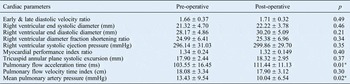
The combined effects of adenotonsillar and tonsillar hypertrophy are shown in Table I. Cardiopulmonary observations of the study group were recorded and statistically analysed using the paired t-test.
Cardiac parameters for all participants

Data represent means ± standard deviations, unless indicated otherwise. *Indicates significance (p < 0.05)
The analyses revealed significant improvements in pulmonary flow acceleration time and mean pulmonary artery pressure at post-operative observation. Eleven participants had tricuspid regurgitation pre-operatively, but only three participants continued to have tricuspid regurgitation post-operatively (p < 0.05). Forty per cent of participants had right ventricular hypertrophy pre-operatively; however, 24 per cent of cases improved post-operatively (p > 0.05). Overall, 64 per cent of participants had impaired cardiopulmonary haemodynamics pre-operatively, which decreased to 24 per cent post-operatively; this was a highly statistically significant difference (p < 0.005).
Intra-group analysis
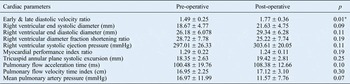
The effects of isolated tonsillar hypertrophy are shown in Table II. Nine participants had tonsillar hypertrophy. Tonsillectomy led to a significant improvement in early and late diastolic velocity ratio in all participants (p < 0.05). There was a single case of tricuspid regurgitation in this group that improved after tonsillectomy. No other parameter had significant improvement; however, right ventricular end systolic diameter and mean pulmonary artery pressure had low p values (0.09 and 0.07, respectively), indicating positive trends that might have reached statistical significance with a larger sample.
Tonsillar hypertrophy group cardiac parameters

Data represent means ± standard deviations, unless indicated otherwise. *Indicates significance (p < 0.05)
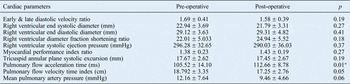
The effects of adenotonsillar hypertrophy are shown in Table III. Sixteen participants had adenotonsillar hypertrophy and underwent adenotonsillectomy. Adenotonsillar hypertrophy was significantly improved in terms of pulmonary flow acceleration time (p < 0.05). None of the other cardiopulmonary parameters showed any statistical significance (p < 0.05). In this group, surgery improved tricuspid regurgitation in 7 participants out of a total of 10 found to have tricuspid regurgitation on Doppler study (p < 0.05).
Adenotonsillar hypertrophy group cardiac parameters

Data represent means ± standard deviations, unless indicated otherwise. *Indicates significance (p < 0.05)
Discussion
Adenotonsillar hypertrophy is the most common cause of upper airway obstruction in children.Reference Martha, Moreira Jda, Martha, Velho, Eick and Goncalves 5 Hypercapnia and hypoxaemia in upper airway obstruction cause respiratory acidosis, which leads to acute or chronic vasoconstriction changes in the pulmonary artery.Reference Görür, Döven, Unal, Akkuş and Ozcan 6 , Reference Kessler, Chaouat, Weitzenblum, Oswald, Ehrhart and Apprill 7 Although the acute stage is generally reversible, when hypercapnia and hypoxaemia are chronic, this leads to hypertrophy of the tunica muscularis of small and medium respiratory vessels and the condition becomes irreversible.Reference Görür, Döven, Unal, Akkuş and Ozcan 6 Long-standing pulmonary hypertension eventually causes right ventricular hypertrophy and cardiac failure.
Brain natriuretic peptide or its precursor is a good diagnostic tool in paediatric cardiology.Reference Oran, Ozturk, Çimen, Vatansev, Bulut and Arslan 8 This hormone is released by the ventricular myocardium in response to ventricular dilatation, and is also found to be increased in adenotonsillar hypertrophy.Reference Oran, Ozturk, Çimen, Vatansev, Bulut and Arslan 8 , Reference Lee, Yoon, Lim, Ko, Choi and Kim 9 Pulmonary hypertension in hypoxia and hypercarbia is also associated with the release of a vasoactive substance (endothelin-1) and increased calcium permeability.Reference Talaat and Nahhas 10 , Reference Hay 11 Impaired cardiopulmonary function can have a marked effect on physical activity and developmental milestones in the paediatric population.
We evaluated cardiopulmonary function by investigating parameters similar to those used by Çetin et al. Reference Çetin, Yılmaz, Özen, Bozan and Coşkun 2 They studied 26 patients with adenotonsillar hypertrophy and 15 patients with adenoidal hypertrophy. Right ventricle functions were evaluated pre-operatively and six months after surgery. Their observations were analysed and compared with those of 40 healthy children. The authors found significant improvements in tricuspid annular plane systolic excursion, pulmonary flow acceleration time, mean pulmonary artery pressure, myocardial performance index and tricuspid isovolumic acceleration after surgery. They endorsed these parameters in the evaluation of adenotonsillar hypertrophy with upper airway obstruction. Our study found significant changes in pulmonary flow acceleration time and mean pulmonary artery pressure in the combined evaluation of adenotonsillar and isolated tonsillar hypertrophy, whereas intra-group evaluation of adenotonsillar and isolated tonsillar hypertrophy showed significant improvement only in pulmonary flow acceleration time and early and late diastolic velocity ratio, respectively. The present study comprised 11 patients with right ventricular hypertrophy pre-operatively, which decreased to 4 patients post-operatively.
Tatlıpınar et al.Reference Tatlıpınar, Biteker, Meriç, Bayraktar, Tekkeşin and Gökçeer 12 conducted an observational study to assess the individual effects of adenoidal, tonsillar and adenotonsillar hypertrophy on cardiopulmonary function. They found a significant difference in mean pulmonary artery pressure between the groups. Mean pulmonary artery pressure was higher in patients with adenoidal and adenotonsillar hypertrophy. A group analysis showed a non-significant difference in tricuspid annular plane systolic excursion and myocardial performance index. Koc et al.Reference Koc, Aytekin, Kalay, Ozcetin, Burucu and Ozbek 3 evaluated right ventricle function and mean pulmonary artery pressure pre-operatively and 3 months after surgery in 27 children (mean age, 8 ± 2 years) with adenotonsillar hypertrophy. They found significant differences in peak early tricuspid diastolic velocity, mean pulmonary artery pressure and myocardial performance index.
Pulmonary hypertension is quite prevalent in children with adenotonsillar hypertrophy. Marangu et al.Reference Marangu, Jowi, Aswani, Wambani and Nduati 13 reported that 20 per cent of children with adenotonsillar hypertrophy have pulmonary hypertension, and its risk increases three to five times with associated nasal obstruction or an increased adenoid-nasopharyngeal ratio. As discussed earlier, it is the first step in myocardial injury, and hence patients may remain asymptomatic for a long time.Reference Tatlıpınar, Biteker, Meriç, Bayraktar, Tekkeşin and Gökçeer 12 The present study had three patients with high mean pulmonary artery pressure pre-operatively that normalised three months after surgery. These observations are comparable to those of Martha et al.,Reference Martha, Moreira Jda, Martha, Velho, Eick and Goncalves 5 who performed ECG to evaluate pulmonary artery pressure in 33 children with adenotonsillar hypertrophy. There were 12 children with pulmonary hypertension in that study; those children showed a significant decrease in mean pulmonary artery pressure and an insignificant decrease in systolic pulmonary artery pressure after adenoidectomy or adenotonsillectomy. However, that study had a major limitation in terms of controls, because they compared results with just 10 healthy children.
Adenotonsillar hypertrophy has been implicated as a risk factor for rheumatic heart disease.Reference Pac, Karadag, Kurtaran and Aktas 14 Odemis et al.Reference Odemis, Catal, Karadag, Kurtaran, Ark and Mete 15 conducted a study on 103 children to determine the relation between rheumatic heart disease and adenotonsillar hypertrophy. They found a significant increase in the frequency of tricuspid valve, pulmonary valve and physiological mitral valve regurgitation in 53 patients with adenotonsillar hypertrophy. However, they did not find an association between adenotonsillar hypertrophy and increased rheumatic heart disease valvulitis.
As discussed, adenotonsillar hypertrophy causes pulmonary hypertension through hypoxia or hypercarbia, and eventually leads to respiratory acidosis and capillary vasoconstriction. Although pulmonary hypertension is prevalent in obstructive sleep apnoea, the milder form of adenotonsillar hypertrophy also leads to nasal obstruction and snoring. These features become augmented by deep sleep through hypotonia. Moreover, the acute inflammation of adenoids or tonsils can further worsen nasal obstruction, causing pulmonary hypertension.
van Staaij et al.Reference van Staaij, van den Akker, Rovers, Hordijk, Hoes and Schilder 16 conducted an open randomised trial to assess the rate of infection and quality of life of children undergoing surgery versus a watchful waiting strategy for mild adenotonsillar hypertrophy. They found no significant differences between groups, and advocated a ‘wait and watch’ policy for such cases. However, they did not evaluate cardiopulmonary function. Hence, this watchful waiting policy may impact on cardiopulmonary function in terms of pulmonary hypertension and cardiac complications, as discussed earlier. We therefore suggest that such children undergo cardiac evaluation and recommend that intervention is initiated early to avoid irreversible damage to the cardiopulmonary system.
Otolaryngologists recommend surgery for adenotonsillar hypertrophy according to standard indications for adenotonsillectomy or tonsillectomy. However, surgical intervention is indicated in cases of adenotonsillar or tonsillar hypertrophy causing obstructive sleep apnoea, which is the end stage of upper respiratory obstruction that could lead to irreversible cardiopulmonary damage. Hence, we advocate that surgical indications are revised to include cardiac parameters. Any changes in cardiopulmonary parameters should be made the first indication for surgical intervention to avoid irreversible cardiopulmonary damage, which may jeopardise a child's development.
-
• Adenotonsillar hypertrophy affects cardiopulmonary functions, and damage can become irreversible
-
• This study evaluated cardiopulmonary functions in 25 children with adenotonsillar or tonsillar hypertrophy pre- and post-operatively
-
• There were significant improvements in pulmonary flow acceleration time, mean pulmonary artery pressure and tricuspid regurgitation after adenotonsillectomy
-
• Changes in cardiopulmonary functions should be a priority indication for adenotonsillectomy
This level of evidence 3b study shows that chronic adenotonsillar hypertrophy causes significant cardiovascular changes in children. Early detection and treatment of these patients are necessary to prevent future cardiovascular complications from developing. This study has a few limitations in terms of the small sample size, the limited study duration, and the absence of polysomnography and continuous oxygen saturation measurement. However, observations from the present study and earlier studies validate the occurrence of cardiopulmonary damage in adenotonsillar or tonsillar hypertrophy. Therefore, a review of surgical indications is warranted.