Introduction
The bone-anchored hearing aid (BAHA) has become a well-established, versatile tool ideally suited for the management of several hearing loss scenarios. The device was initially introduced as an aid for conductive hearing loss. A recent consensus statement decreed that the BAHA should be the amplification device of choice for patients with mixed hearing loss in which the conductive component was greater than 30 dB.Reference Snik, Mylanus, Proops, Wolfaardt, Hodgetts and Somers1 However, even in situations of mixed hearing loss with a less severe conductive component, BAHA performance may exceed that of conventional hearing aids, and may prove particularly successful in cases of recurrent infection related to hearing aid use.Reference Hol, Snik, Mylanus and Cremers2 More recently, BAHA implantation has been recognised as an effective treatment for single-sided deafness.Reference Wazen, Spitzer, Ghossaini, Fayad, Niparko and Cox3
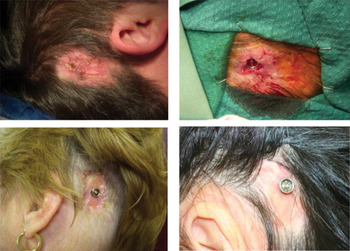
While BAHA implantation is a valuable treatment alternative, as with any surgical procedure it is not without risks or complications, the most prevalent of which are issues relating to skin reduction and inflammation. The incidence of skin reactions varies between studies and by technique and grading system used: it can range from 5 to 50 per cent.Reference Granström and Tjellström4–Reference Tamarit Conejeros, Dalmau Galofre, Murcia Puchades, Pons Rocher, Fernández Martínez and Estrems Navas7 While many of these skin reactions will respond to conservative measures, soft tissue problems may lead to revision surgery or less than satisfactory cosmetic outcomes (Figure 1).
Clinical photographs showing examples of poor cosmesis and wound healing observed following traditional bone-anchored hearing aid implantation involving raising a split thickness skin flap and removing the underlying soft tissue.

The standard surgical technique for BAHA placement involves the creation of a split thickness skin flap or graft, followed by removal of a large area of subcutaneous tissue down to the periosteum. After the BAHA is inserted, the skin is then coapted down to the periosteum. This soft tissue removal leads to alopecia and raises the risk of devascularising the overlying skin, with the potential for infection and scarring.
More recent techniques have aimed at less invasive approaches to improve cosmesis and decrease soft tissue complications.Reference de Wolf, Hol, Huygen, Mylanus and Cremers5, Reference van de Berg, Stokroos, Hof and Chenault8 These have used a linear incision, soft tissue reduction and a standard-length abutment.
In this report, we describe our experience with BAHA implantation using a single, linear incision and either no or minimal soft tissue reduction. This is accomplished by using the longer abutment that keeps the attachment to the sound processor above the level of the full-thickness scalp.
Methods
Following approval by the Royal Victorian Eye and Ear Hospital Human Research Ethics Committee, all BAHA implant candidates over the age of 18 years were offered enrolment in this prospective study, which used the modified surgical technique described below.
Surgery was performed under either general anaesthesia or monitored local anaesthesia, as indicated by patient and surgeon preference. The patient was examined in the pre-operation holding room and the planned insertion site marked with the patient sitting up.
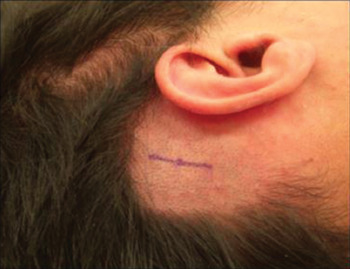
A standard placement technique was used, as follows. At a position approximately 55 mm from the top of the tragus and approximately level with the top of the pinna, a dummy device was used to ensure proper positioning with adequate clearance from the auricle. In the operating room, a limited shave was performed to expose the surgical site. A 1.5–2.0 cm, vertical incision was marked centred on the planned abutment position (Figure 2). Methylene blue was then used to mark the fixture site, introduced via a 21-gauge needle advanced into the periosteum. Of note, toward the end of the study we began to measure the depth of the scalp during the application of methylene blue. After advancing the needle tip fully until it abutted bone, the needle was grasped at the skin surface before removal. Using a ruler to measure the depth of penetration provided an excellent approximation of scalp depth, which we then used to determine whether a minimal soft tissue reduction should be performed. The aim was to achieve a final scalp thickness not greater than 6 mm at the abutment. The site was then infiltrated locally with adrenaline. The patient was then prepared and draped in the usual sterile fashion.
Pre-operative photograph showing the intended site of a 1.5–2 cm linear incision, centred at the planned insertion site.

A single, linear incision was made through to the periosteum. Sub-periosteal elevation was then carried out to expose an approximately 1 cm diameter area of calvarium at the methylene blue mark. Minimal soft tissue reduction was then performed, if necessary, by grasping the overlying periosteum and muscle and sharply removing a small volume adjacent to either side of the planned insertion site. Initially, this decision was made by the surgeon simply estimating the scalp depth. After we began to routinely measure the depth, minimal soft tissue reduction was performed when the scalp was thicker than 6 mm. This ensured that the skin edges would sit below the abutment, even in the presence of post-operative swelling and with local anaesthetic infiltrated into the region.
A standard BAHA insertion was then completed, preferentially using the 4 mm fixture when calvarial depth permitted. The long abutment was applied (8.5 mm for System 2 and 9 mm for System 3).
The wound was closed in layers using deep Vicryl sutures followed by 5-0 nylon for the skin (typically two sutures above and below the abutment). A dressing of either acraflavin wool or petroleum jelly coated gauze was then applied under the healing cap.
Patients were reviewed between 10 to 14 days post-operatively for suture removal. Patients then began to perform routine implant hygiene tasks using the supplied after-care kit. They were reviewed again four weeks after surgery, and then monthly until the speech processor was loaded (usually at three months for System 2 and six weeks for System 3). More frequent follow up was carried out if necessary for wound complications.
Management of wound issues was at the discretion of the surgeon. In general, any significant granulation was treated with silver nitrate in the clinic and then Kenacomb ointment (Aspen Pharma, St Leonards, Australia) applied to the wound three times daily with or without oral antibiotics.
Three months after speech processor loading, patients were reviewed again, and then annually or as needed for any wound healing concerns.
Results
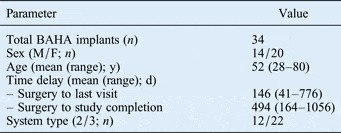
Between June 2009 and November 2011, 34 adult patients underwent single-stage BAHA insertion at our institution. Demographic information as well as surgical details are shown in Table I. The underlying indication for BAHA surgery was a mix of single-sided deafness and conductive hearing loss. The mean duration of clinical surveillance, defined as the time between surgery and the last clinic visit or sound processor fitting, was 146 days (range, 41–776 days). One patient was lost to follow up after being seen 41 days post-operatively. To gain a sense of how long the implants had been in place, we calculated the mean interval between the time of surgery and the end of the study, when the patient charts were last reviewed. The 34 implants in this study were in place for an average of 494 days (range, 164–1056 days). Twenty of the 34 (59 per cent) patients were followed for over 1 year and 29 of the 34 (85 per cent) were followed for over 6 months. The BAHA System 3 was introduced halfway through our study, and was then used for all subsequent implants.
Patients' demographic and surgical data

BAHA = bone-anchored hearing aid; M = male; F = female; y = years; d = days
Surgery was well tolerated by all patients, with no immediate operative complications. While most patients experienced excellent hearing rehabilitation, two patients (both men with single-sided deafness after acoustic neuroma treatment) had their abutment removed due to lack of subjective benefit. In both these patients, the scalp defect healed spontaneously over the screw fixture. No patient required any further surgery for soft tissue reduction. In addition, patients were universally satisfied with the cosmetic outcome.
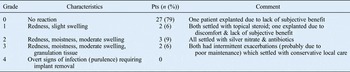
To quantify the degree of skin reaction at the abutment site, the Holgers and colleagues' 1988 quantification system was used.Reference Holgers, Tjellström, Bjursten and Erlandsson9 This system grades skin reactions from 0 to 4 and is commonly used to grade penetrating skin implants. Patient charts were reviewed to find the worst Holgers grade during the course of clinical surveillance; these data are summarised in Table II. Only 14.7 per cent of patients demonstrated a score of 2 or higher during the study. Most of these skin reactions were noted early in the post-operative healing period, and once resolved did not recur. However, the two patients who received a score of 3 continue to have some intermittent recurrences controlled by conservative local care. In both these cases, it was felt that the recurrent reaction may have been at least partly due to sub-optimal maintenance of the prosthesis.
Patients' holgers grade data

Pts = patients
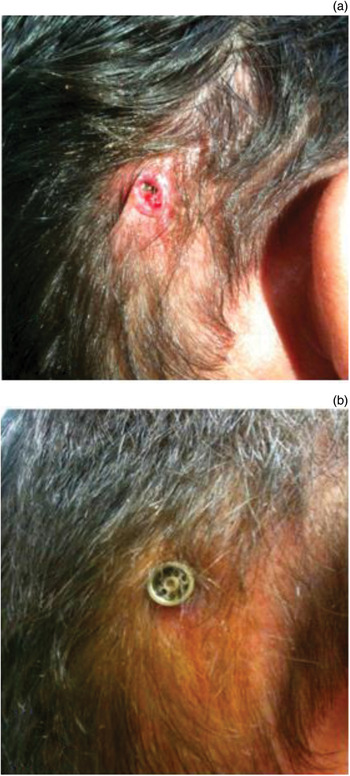
An example of the most severe case of infection and granulation, scored as Holgers classification 3, can be seen in Figure 3(a). Figure 3(b) shows the same patient just a few weeks later, and demonstrates an excellent clinical response to conservative care with silver nitrate and antibiotics in even this, most significant, reaction.
Clinical photographs showing (a) a Holgers grade 3 reaction, and (b) appearance following conservative care, including silver nitrate therapy and a topical preparation containing steroid, antibacterial and antifungal agents.

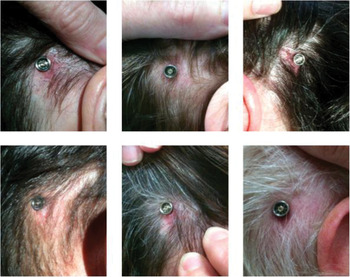
With regard to cosmetic outcome, the panel of photographs displayed in Figure 4 shows the typical, favourable results achieved with the described, modified technique using a linear incision and either no or minimal soft tissue reduction. There was no notable surgical defect and minimal, if any, alopecia. While the skin surface may have approached the top of the abutment in some patients, this did not appear to cause any interference with usage of the sound processor.
Clinical photographs showing excellent cosmetic results of the described technique in six different patients, with minimal scarring or alopecia.

Discussion
During this study, we completed 34 BAHA implantations using a minimally invasive technique involving a small, linear incision and either no or minimal soft tissue reduction. This technique was first presented in 2009 by Dr Gordon Soo and colleagues at the Second International Symposium on Bone Conduction Hearing–Craniofacial Osseointegration but has not been formally reported in the literature (GMS Soo et al., personal communication). We found this technique preferable to traditional methods using a split thickness skin flap and extensive soft tissue reduction, as it resulted in fewer post-operative wound complications. The method facilitates quicker, and thus less expensive, surgery. We also found the cosmetic result to be significantly improved, with minimal or no alopecia and less scarring, in comparison with prior techniques. The patients involved in this study were all very satisfied with their cosmetic outcome.
Most of the post-operative problems associated with BAHA implantation are related to peri-abutment soft tissue complications, including infection, skin and soft tissue overgrowth, and fixture loss.Reference Wazen, Young, Farrugia, Chandrasekhar, Ghossaini and Borik10 One might predict that the significant vascular disruption associated with extensive soft tissue reduction might lead to such sequelae. Recent studies have indeed shown that a linear incision technique produces fewer soft tissue complications than the traditional skin flap.Reference van de Berg, Stokroos, Hof and Chenault8, Reference Mudry11 Unlike the technique described here, these studies employed traditional soft tissue removal and placement of a standard BAHA abutment. Review of recent BAHA literature suggests that most surgeons now utilise a less invasive, linear incision, though significant soft tissue reduction is still undertaken.
The traditional soft tissue reduction performed during BAHA surgery serves two purposes: it increases the clearance of the abutment over the skin; and it minimises the abutment soft tissue interface where adverse reactions are thought to develop. The BAHA system provides two abutment options. In System 2, these were 5.5 and 8.5 mm in length. In System 3, their length has been increased to 6 and 9 mm; however, the distance from the bone surface is unchanged. With the classic insertion technique, the short abutment is used, and the longer abutment is reserved for cases of refractory skin overgrowth. When not performing a soft tissue reduction, we instead always used the longer abutment in order to gain clearance over the skin. In patients with a particularly thick scalp, we did remove a very slight amount of soft tissue just around the fixture insertion site, to ensure adequate clearance. While there might be some concern that the increased abutment length may create additional leverage against the fixture and impair osseointegration, we did not encounter any implant failures.
• Traditional bone-anchored hearing aid insertion methods risk alopecia and other soft tissue complications
• By utilising a longer abutment, minimal soft tissue removal is necessary
• This enables quicker, cheaper surgery
• In the current series, good outcomes were seen
We did not encounter any problems caused by the increased abutment soft tissue interface created by this technique. Our soft tissue complication rate was similar to that seen in other studies. Most of the patients included in our study were followed for over one year (at the time of writing) – longer than the typical development period expected for most skin reactions.Reference Badran, Arya, Bunstone and Mackinnon12 We also found improved healing, compared with the previous technique involving extensive soft tissue reduction. Since the use of a longer BAHA abutment permits less tissue reduction, it is plausible that leaving the underlying soft tissue in its native state and not interrupting the vascular supply promotes a healthier tissue abutment interaction, thereby generating fewer soft tissue complications.
Conclusion
The minimally invasive technique described in this report represents a simplified, and quicker, surgical method for BAHA insertion, with excellent cosmetic results. In our series, soft tissue complications were minor and well managed with conservative care, and no patient required further surgical intervention for overgrowth. Extended follow up will provide a better assessment of any long-term soft tissue complications that may develop. However, our current experience suggests that issues are most likely to develop early in the post-operative period rather than later on.
Acknowledgements
This research was supported by the Commonwealth of Australia through the Cooperative Research Centres Program. Subjects were managed through the Royal Victorian Eye and Ear Hospital, Melbourne, under ethics approval from its Human Research Ethics Committee.