Introduction
Out-of-hospital cardiac arrest (OHCA) is a lethal health problem that affects between 236,000 and 325,000 people in the United States each year. An estimated 295,000 people have OHCA assessed and treated by emergency medical services (EMS) each year; in Europe, the figure is 275,000 people.Reference Atwood, Eisenberg, Herlitz and Rea1–Reference Nichol, Aufderheide and Eigel3 If deaths due to OHCA were separated from deaths due to other cardiovascular causes, OHCA would be the third leading cause of death.Reference Nichol, Aufderheide and Eigel3 The most common cause of sudden cardiac death (SCD) is coronary artery disease.Reference Müller, Agrawal and Arntz4
Resuscitation attempts are unsuccessful in 70-98% of OHCA cases.Reference Lippert, Raffay, Georgiou, Steen and Bossaert5 The vast majority of resuscitation attempts are abandoned based on factors such as the time between cardiac arrest and start of cardiopulmonary resuscitation (CPR), the initial electrocardiogram (ECG) rhythm, the interval to defibrillation and the period of advanced life support with continuing asystole, no reversible causes, or no return of spontaneous circulation.Reference Larkin, Copes, Nathanson and Kaye6 Factors associated with an increased chance of survival are the presence of ventricular fibrillation upon admission of the rescue team, shorter time between call for and arrival of the ambulance, cardiac arrest occurring outside the home, witnessed cardiac arrest, bystanders performing (CPR) before the arrival of the ambulance, and younger age.Reference Herlitz, Engdahl, Svensson, Ängquist, Young and Holmberg7 In those cases where CPR is successful, studies have demonstrated that most survivors have a good quality of life.Reference Lippert, Raffay, Georgiou, Steen and Bossaert5
However, in all OHCA cases, EMS personnel are challenged by the question of when to start, continue, and terminate resuscitation attempts based on the difficult balance of benefits, risks, and costs.Reference Lippert, Raffay, Georgiou, Steen and Bossaert5 Any decisions taken will affect the patient’s family, and thus affect the care provided by the personnel.
Ethical Conflicts
To ensure that both patients and their families are treated with dignity, several ethical decisions are required of EMS personnel.Reference Baskett, Steen and Bossaert8 A survey of ethical conflicts in prehospital emergency care showed EMS personnel to be caught between family members making differing requests concerning the patient’s short-term and long-term interests. CPR was sometimes initiated for the sake of families, which could result in a conflict between the family’s wishes and those of the patient.Reference Sandman and Nordmark9 In a study to elicit criteria used to make decisions about withholding or terminating CPR, it was found that both prognostic and ethical criteria were used without a clear borderline. Nearly half of EMS personnel participating in the study stated that family members’ expectations influenced their decision either to abstain from or to terminate CPR,10 and it has even been argued that family members’ expectations are a valid reason for continuing with futile CPR.11,12 Heilicser et al found that some personnel faced an ethical dilemma when family members did not want resuscitation performed, and the patient had no advance directive or do not resuscitate (DNR) order.Reference Næss, Steen and Steen13 Another study found that in the absence of advance directives, or if only an unofficial document or oral report of an advance directive were available, there was considerable variability in Emergency Medical Technicians’ decisions about resuscitation. Emergency Medical Technicians (EMTs) with >10 years of experience were more likely to withhold resuscitation attempts in the presence of only an oral report of an advance directive, and were more likely to withhold resuscitation attempts in situations they considered futile.Reference Marco and Schears14
Termination of Cardiopulmonary Resuscitation
In most countries, EMS personnel make diagnoses of death but only a physician can certify death.Reference Lippert, Raffay, Georgiou, Steen and Bossaert5 In practice, making a diagnosis of death and taking the final decision to proceed with on-scene pronouncement of death in OHCA patients may be determined more by family and EMS personnel’s comfort levels and the specific on-scene environment than by following guidelines for decisions regarding termination of resuscitation.Reference Pepe, Swor and Ornato(15) The unexpected death of a patient is a source of anxiety and stress for health care professionals, and is the most common form of death confronted by EMS personnel. These unexpected deaths occur in uncontrolled environments with limited health care resources, and are marked by a lack of helpful information and by the presence of bystanders who may interfere, or criticize EMS personnel. Thus, field pronouncement of death is challenging.Reference Morrison, Cheung and Redelmeier16
An American study showed that termination-of-resuscitation protocols for traumatic and non-traumatic OHCA are not being implemented as intended in the EMS system. More than half of cardiac arrest patients received continued CPR despite meeting criteria for termination of resuscitation, when resuscitation attempts hence were futile.Reference O’Brien, Hendricks and Cone17 When hospitals provide online medical control support to determine if EMS personnel should terminate resuscitative efforts out-of-hospital, the pronouncement of death and termination of resuscitative efforts for medical cardiac arrest varied significantly depending on the particular base hospital providing online support.Reference Eckstein, Stratton and Chan18 Another study showed that when guidelines permitted them to withhold resuscitation, EMS personnel were more likely to withhold resuscitation from persons having non-traumatic OHCA if the patient had a terminal condition and if the patient, family, or caregivers indicated, in writing or orally, that no resuscitation was desired. The increased likelihood of resuscitation being withheld by EMS personnel was primarily due to honoring oral DNR requests from the family.Reference Feder, Matheny, Loveless and Rea19
Decisions by paramedics and EMTs to continue or to terminate resuscitation are influenced by factors other than patient clinical characteristics, including personnel’s knowledge and attitudes toward termination of resuscitation guidelines, beliefs regarding resuscitation, family emotional preparedness, and the location where the cardiac arrest occurs.Reference Grudzen, Timmermans and Koenig20 The very existence of guidelines on resuscitation also can influence the decision.
Caring for Families
Purves and Edwards note that although EMS personnel often face the needs of bereaved family members in cases of cardiac arrest and sudden death, caring for families is not always defined as an important activity, and is not part of EMS personnel’s training.Reference Purves and Edwards21 In a Norwegian study, however, the importance of caring for families in case of a loved one’s cardiac arrest and death was defined by the paramedics as the most important part of their work, though not recognized by the EMS organization.Reference Steen, Næss and Steen22
In a study of EMTs’ attitudes toward training, comfort, and roles when a patient dies on-scene, almost half of the EMTs did not think notifying the family of the death was their responsibility. However, 60% felt comfortable making a death notification, even though only 24% reported that they had received adequate training to do so and to help the family.Reference Smith-Cumberland and Feldman23 Most (77%) of the EMTs recognized that their actions on scene affected the grief process of the family.Reference Smith-Cumberland and Feldman24 In a survey of EMS personnel’s experiences with family members’ presence during resuscitation, the majority found it inappropriate for families to witness resuscitation attempts. Many were uncomfortable with the family presence, and felt that family had a negative impact on their ability to perform resuscitation. Almost half of the personnel felt uncomfortable providing emotional support.Reference Compton, Madgy, Goldstein, Sandhu, Dunne and Swor25
There is a need for research exploring how EMS personnel are affected by family dynamics and the emotional context, how they are able to comfort and care for family members during CPR, and how they ease bereavement or grief on-scene when the patient has died.Reference Bremer, Dahlberg and Sandman26 The aim of this study is to analyze EMS personnel’s experiences of caring for families when patients suffer cardiac arrest and sudden death.
Methods
Study Design
This qualitative study was conducted in January 2007, and was approved by the head of the EMS system in which it was conducted. The study conforms to the ethical principles for medical research involving human subjects outlined in the Declaration of Helsinki.27 According to Swedish law at the time of the study, there was no need for an ethical board review if written consent was obtained from the participants, and if the study did not involve a physical intervention.28 The study adheres to Swedish laws and regulations concerning informed consent and confidentiality. Participation was voluntary and confidential, and participants were assured that their individual comments would be impossible to trace in the published material. Oral and written informed consents were obtained from the participants. They were informed about how confidentiality would be maintained, and about the availability of support if the interview awoke unpleasant memories or emotions.
The face-to-face interviews were scheduled in coordination with the EMS agency leadership and conducted by the first author (AB). In an attempt to obtain a rich variety of data, the criteria for informant selection were determined through purposeful sampling29 for age, sex, years of working in the EMS, profession, and formal medical and nursing education. Based on the researchers’ experience and the interviewer’s skills, it was estimated that 10 informants would be an appropriate number. The personnel worked at the largest EMS agency (ambulance station) within the EMS system. The interviews were conducted with off-duty personnel on four different occasions in a private room at the ambulance station, each interview lasting 40-100 minutes. All interviews were digitally recorded and transcribed verbatim by a professional transcription service. Designations were made in the texts to indicate non-verbal information such as intonations, periods of silence, hesitations, and emotional expressions such as sighing, laughing and crying. The first author listened to each interview several times to check for potential errors in the transcriptions, and to familiarize himself with the content in a preliminary way. Together with the first author, the second and third authors read and critically examined the quotes and all interpretations in order to accomplish scientific reliability and validity.
Participants and Study Setting
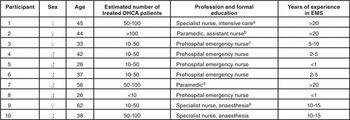
There is considerable variation across Europe in the structure and process of EMS systems. Some are almost exclusively staffed by paramedic/EMTs; others also employ prehospital physicians.Reference Nolan, Soar and Zideman30 In Sweden, the EMS system includes professions such as specialist nurses, registered nurses, EMTs and paramedics, and prehospital emergency physicians are rare. The ambulance teams include at least one registered nurse, often a specialist in emergency, intensive, or anesthesia care. In recent years, the number of registered nurses specializing in ambulance care has increased significantly, whereas the number of paramedics has decreased.Reference Bremer, Dahlberg and Sandman26 The intent in this study was to include participants representing the diversity of professions in the Swedish EMS system, as well as various experiences of providing care to family members when a loved one suffered sudden cardiac death (Table 1). The participants’ professional affiliations and formal education are generally comparable with those of prehospital EMS professionals in Sweden overall, with a slightly low paramedic representation.
Demographics of study participants

a Three years of education to RN and one year in intensive care (University College).
b Two years of education to assistant nurse and one term in prehospital emergency care (high school).
c Three years of education to RN and one year in prehospital emergency care (University College).
d One term of education in prehospital emergency care (high school).
e Three years of education to RN and one year in anesthesia (University College).
This study took place in an EMS system serving a 6,500 kmReference Nichol, Thomas and Callaway2 area in southern Sweden. The population in the EMS catchment area was 280,000 inhabitants, with 18% >65 years of age. Stationed in nine cities, the EMS system had a total of 11 ambulances in service around the clock and four additional daytime ambulances.
Qualitative Interviews and Lifeworld Hermeneutics
This research was guided by reflective lifeworld research that emphasizes individuals as living wholes, focusing on the world as it is experienced. This research approach, grounded in phenomenology and hermeneutics, holds the ontological and epistemological idea that meanings are infinite, implying that no meaning saturation can exist. This implies also that variation and richness in data (meanings) is more important than the number of informants.Reference Dahlberg, Dahlberg and Nyström31–Reference Dahlberg and Dahlberg33 The approach is based on an attitude of openness to the lifeworld, which requires openness to the whole research situation, including oneself. The researcher focuses on the phenomenon with a willingness to see all its aspects, its related events, and objects in new ways without presuppositions about meaning. In interviews, openness means an honest will to listen, to see, and understand with respect to the phenomenon in its context. Openness to the phenomenon works by way of a “bridled” process of understanding. The urge to slow down the evolving understanding includes restraining one’s personal beliefs, theories and presumptions concerning the phenomenon that might otherwise confound understanding. Bridling is a systematic and careful scrutiny of how understanding of the phenomenon and its meanings comes into being.Reference Dahlberg, Dahlberg and Nyström31
The opening question in the interviews asked about the experience: “could you tell me about your experiences of good (or bad) caring for families when their loved ones suffered cardiac arrest?” After this, open-ended questions were asked to reach a deeper understanding about the things the participant regarded as belonging to the phenomenon: “how is that…?”, “how was it for you that (when)…”, or “could you tell me more about…?” Participants were encouraged to talk openly about their experiences of the phenomenon. Aiming to elicit spontaneous and relevant descriptions, the interviewer tried to be sensitive and flexible, and at the same time to keep the phenomenon in focus. The follow-up questions were designed to prompt experiential reflection, thus increasing the richness and quality of data.
Data Analysis
An interpretative analysis inspired by the hermeneutics and scientific openness described by GadamerReference Gadamer, Weinsheimer and Marshall34 was practiced to understand the caring lifeworld of the EMS personnel. NyströmReference Nyström35 inspired the analysis process.
In the process of analyzing data for meaning, the search for meanings was carried out through a flexible dialogue with the text, seeing a particular meaning as a figure against the others as background, then taking up another one, making it a temporary figure, and so on.Reference Dahlberg, Dahlberg and Nyström31 According to Gadamer,Reference Gadamer, Weinsheimer and Marshall34 text interpretation involves finding the text’s meaning and elucidating what the text says to understand it in a different way by “seeing something new.” Hermeneutic interpretation means engaging in a thinking dialogue with the text’s message, actively questioning and interrogating data. Exploratory questions were asked of the interview texts, always with the phenomenon in focus and with a bridled, sensitive, and reflective stance. GadamerReference Gadamer, Weinsheimer and Marshall34,Reference Gadamer and Dawson36 emphasizes openness as the first and overall methodological principle. Second, an awareness of the power of tradition, understood as a personal history of effect, is an important principle of the hermeneutic approach. A third principle is a cautious use of theory to prevent pre-understanding from controlling the process of understanding. The fourth principle is the search for otherness.
The first step of the data analysis was that of a movement from whole to parts and back to whole again, with the aim of reaching a basic and preliminary understanding before the parts came into focus. The first readings of data did not include any interpretive work. However, already in the initial readings “active openness” was practiced in the search for an understanding not based on the researcher’s pre-understanding.
The second step was to identify similarities and differences in how the EMS personnel experienced how they cared for families when patients suffered cardiac arrest and sudden death. Four essential themes, described in the Results section of this paper, emerged from this reading.
The third step of the analysis sought to find preliminary and underlying meanings within each theme. Tentative interpretations were outlined. At this stage, the open reading was matched by a critical reading with the intention of finding explanations that could illuminate further the surplus of meaning. Analysis was thus complemented by a distancing, questioning and critical approach. Some theoretical tools were used to explain further meanings in the themes.
The fourth step implied that the relevance of the tentative interpretations was estimated by using some criteria of quality.Reference Dahlberg, Dahlberg and Nyström31 Validity was evaluated by making several controls against the data, repeatedly moving back and forth between the parts and the whole to estimate if they were consistent, and to determine whether there were any discrepancies between the understanding of the parts and that of the emerging interpretations. The final interpretations explain substantive data, without any findings of other interpretations that contradict or contest the explanations presented below.
At the fifth and final step, all tentative interpretations found to be valid were compared with each other for the purpose of finding a common denominator for all data of general importance. This resulted in a main interpretation (described in the Results section), which was the only interpretation found to explain all the data. The main interpretation also made possible an understanding valid outside the context of the study.
Results
Below are four tentative interpretations illuminating the EMS personnel’s experiences of caring for families when patients suffered cardiac arrest and sudden death, followed by a main interpretation to complete the analysis.
1. A Sense of Inadequacy When Responsibility is Extended to Caring for Family Members
The EMS personnel interviewed felt responsible for both patient care and family care, and were aware of the need to prioritize between the patient’s best interests and the family’s best interests, although care of family members was always the second priority. Depending on the responsibility judged most important at the time, this implied different problems for the personnel. The first priority, saving the patient’s life, implied distress and a sense of inadequacy for the personnel when family members’ suffering was experienced. The second priority, caring for bereaved family members, implied a need for the personnel to counteract their own strong driving forces to save lives, sometimes supported by family members. The internal and external demands of life-saving treatment could be considerable: “He’d given her cardiopulmonary resuscitation, he’d tried to save her himself, and so of course it feels as though he expects us to make an attempt too. The ambulance personnel have arrived, and that’s us. We have to try and save her.”
However, on the way to the patient with awareness of the first priority, the EMS personnel already had thoughts about the patient’s loved ones. In the first meeting with family members, an immediate assessment of them was made, still with the patient’s best interest as first priority. One informant put it this way: “As soon as you put your foot inside the door or as soon as you make contact with the relatives, you start taking in the mood and you’ll store it during the time you’re taking care of the patient and then start taking care of the relatives.” After a while, care was extended to family members, partly implying a change from structured behavior, rationality and reason, allowing more room for emotional involvement, feelings and empathy. When the decision was made to waive or terminate CPR, the personnel turned to a caring role with great openness to family members’ preferences, their main fear being that care would be experienced as routine.
The EMS personnel’s sense of inadequacy in meeting family members’ despair and needs sometimes prolonged the continuation of CPR. The sense of responsibility diminished when attention to care needs failed and commitment was lacking, or empathy for family members was deficient. One person described the lack of commitment: “I couldn’t cope with getting involved, or we couldn’t cope with getting involved, or else I couldn’t cope with getting involved in that particular case, just then and there, and with them in particular, with her after what had happened.” Families were abandoned at times when EMS personnel or the Emergency Dispatch Center judged the family’s needs less important than emergency situations elsewhere, based on assumptions of a distant patient’s medical needs being greater than the needs of the present family on-scene. Being forced to leave family members alone before reaching closure felt unfair, unethical and unworthy, and was experienced as a “personal-professional” failure.
Walker argues that there are many-faceted practices of responsibility.Reference Walker37 The notion of moral responsibility is most likely to be invoked in cases where stakes are high, when dependability or dereliction make it appropriate to reflect on character, or where individuals are relying entirely on the informal system of pressures of mutual recognition, with no official decision-makers or enforcers. “High stakes” must be moral stakes and performance must reflect on moral character. The notion of moral responsibility is highly applicable in cases of OHCA and SCD, as the stakes are high when the EMS personnel struggle to save lives, while family members are in distress. It also seems appropriate to reflect on the personnel’s character in caring for families, as courage and honesty are essential and risk of irresponsible behavior is present. Furthermore, more formal guidelines sometimes direct EMS personnel to ignore the needs of bereaved families if the EMS unit is needed somewhere else. At the same time, the personnel are relying on an informal system without any clear directions of where the responsibility for distressed and grieving families begins and ends, how such responsibility should be weighed against other responsibilities, or even whether they formally have this responsibility.
According to Walker, the many-faceted practices of responsibility consist of many circumstances shaped in particular ways in the context of judgments, perceptions, feelings, and reactions. The links between vulnerabilities and responsibilities suggest that the distribution of responsibilities is likely to be complex, and that much of it may be invisible to individuals because of its apparent “naturalness.” In cases of OHCA and SCD, the distribution of responsibilities among EMS personnel is “natural,” instinctive, and unreflecting. Fulfilling responsibilities is therefore more influenced by circumstances, the atmosphere on-scene, and presumptions and feelings, rather than by considered and well-founded priorities between responsibilities toward the patient on one hand and the family on the other. While trying to solve the situation without abandoning the family, personnel are caught between the patient’s best interest and family wishes, feeling disappointment when they, for various reasons, do not succeed in saving the patient’s life or in providing care for the family. The distribution of responsibilities follows an initial affective reaction to family members’ distress and despair, later evoking the personnel’s own vulnerability and desire to escape, links that are mostly hidden from EMS personnel.
Furthermore, Walker argues that there is a reproduction of supporting sensibilities, dispositions, and feelings that makes people responsive to moral pressures from within and without. More formal sanctions keep shared understandings circulating and authoritative. As moral orders are often complex networks of different positions, people first need to understand who they are, and second, where they are, to see what in particular they are responsible for, and to whom. As EMS personnel prioritize between concomitant moral responsibilities, they are put under pressure from actual or perceived family members’ expectations, and are sometimes unable to honor family wishes when obliged to follow guidelines contradictory to family preferences. However, responsiveness to moral pressures is more dependent on each person’s sensibilities, dispositions and feelings, and less on formal sanctions, because shared understanding on how to care for family members is sparse. This increases the risk of inequality in care. EMS personnel’s sense of inadequacy when responsibility is extended to caring for bereaved family members is likely to increase due to uncertainty as to what is expected from them.
2. Balancing Interpretive Reasoning and Emotional Response in Decision-Making
Moving from patient care to caring for families involves a transition from well-structured guidance to a situational response. In this situational response, personnel are forced to balance between interpretive reasoning and more direct emotional, affective response, at their own discretion. During this transition, there is a short period of ambiguity concerning how to extend focus from the patient to family members when further attempts at resuscitation are futile. This necessary but difficult extension of care was often empathetic to the family members’ reactions, and related to the personnel’s own internal, emotional response. They tried to assess the family’s state of mind, understand what knowledge family members had about the severity of the situation, and sense what openness there was to accepting: “When you see the relatives, you also realize that maybe they’ve understood that this here, my relative is dead. You can also see when you look at a relative if they’re shocked or if they understand in a way or not, a bit depending on the mood and things like that.”
EMS personnel’s decisions and actions were influenced by the family’s state of mind. Perceived expectations, demands and reactions from family members created uncertainty, and affected to some degree how long CPR was continued and if/when the treatment was terminated. Family members’ despair called for CPR, and initiation or continuation of CPR was experienced as inducing or maintaining the family’s hope. The personnel attempted to ensure that the hope they passed on to family members was realistic, so that they would come as close as possible to a well-founded assessment. At the same time it was difficult to communicate a realistic hope verbally, especially during ongoing CPR.
The treatment itself instilled hope. Sometimes, CPR is administered only with reference to family members’ needs, to show them that everything possible is being done to save the patient’s life. When CPR is futile, the aim is to give them time to realize the patient’s death. Before deciding on termination of resuscitation and making a death notification, personnel might experience guilt, failure, and betrayal. Sometimes continuing CPR was a way to deal with these feelings, and to relieve their own feelings of inadequacy in meeting family needs.
As long as EMS personnel acted on well-defined medical grounds, and CPR was justified in saving the patient’s life (i.e., the personnel were acting according to structured guidance), the intention with treatment was genuine. When medical grounds were lacking, the personnel might deem CPR as unethical and as a cynical practice that instilled false hope. However, there was uncertainty at times whether this behavior might do some good or benefit the family. “What shall we do? Or shall we play along? Shall we pretend all the way? … Shall we play along? It looks good to the relatives. So shall we play this game then or should we really tell them the truth?” Continued CPR risked going over the threshold where the family members understood that the personnel no longer believed in the patient’s survival. Hence, the EMS personnel risked being exposed with an inauthentic continuation of futile CPR, without any genuine intent to save lives.
Damasio shows how emotion and reason interact.Reference Damasio38 He argues that reason consists not only of “pure” intellectual processes but also of an irresistible urge to think sensibly. Emotions are of fundamental importance for functional common sense and are, for better or worse, part of reason. A lack of emotions would be devastating to the ability to make decisions and act properly in social situations. Emotions act as inner signposts, and make it possible to empathize with other people’s situations. However, emotional dominance can have devastating effects on the ability to think rationally, and thus undermines our judgment. An absence of emotions is equally devastating to the rational ability to make informed decisions in line with personal aspirations, social norms and moral principles. In favorable cases, emotions promote sound decisions in which individuals can constructively use logical thinking. However, there is always an element of uncertainty, for example, when it comes to moral choices.
The necessity and risk of balancing emotions and reasons in decision-making seem applicable to EMS personnel’s situation at OHCA and SCD. Medical assessment of a patient follows a fairly linear and rational process based on medical criteria and treatment guidelines; care of bereaved family members is usually performed without strict guidelines, based on personal experience and with emphasis on emotions awakened by family members. These emotions are a tortuous and difficult road for personnel to follow. Firstly, if personnel cannot understand and handle their own emotions (e.g., feeling inadequate or vulnerable), they risk hanging on to medical guidelines without any objective support for doing so. Secondly, if personnel uncritically follow their own emotions in the interpretation of family members’ signs, comments and reactions, they risk misjudging family members. Hence, emotions as inner signposts can sometimes lead to erroneous conclusions and create a care relationship with elements of dishonesty, misguided benevolence and false hopes.
Balancing emotion and reason in decision-making can also be examined by using Svensson’s “Differentiation and Consolidation Theory” to provide a framework of cognitive, evaluative and emotional processes.Reference Svensson, Schneider and Shanteau39 This theory states that a decision-maker must find an alternative sufficiently superior to its competitor(s). This is achieved through: “(1) holistic evaluation, (2) alternative and problem restructuring, and (3) the application of one or several decision rules.” The stages of a decision process include: (1) identification of alternatives; (2) attention to markers guiding the start of the decision process, elicitation of goals, screening and editing of alternatives, selection of reference and/or preliminary choice alternatives; and (3) process and structural differentiation to reach a decision. Looking at the influence of affect and emotion in decision processes, Svensson argues that affect in terms of the decision-maker’s emotional state or mood can influence the decision-making process, and have an effect on all alternatives. An aspect of a decision alternative can also trigger affects that, together with a value component, shape the attractiveness of the aspect. Finally, the decision problem and its alternatives can themselves trigger affect.
When EMS personnel face extending care to the family members in OHCA and SCD situations, affect and emotion influence the decision processes, implying a fragile balance between care being experienced as good or bad. In relation to EMS personnel’s emotional state, however, it is hard to pinpoint how it may influence decision-making. It is more evident how decisions to terminate resuscitative efforts can be unattractive when they trigger personnel’s feelings of guilt, failure and betrayal due to failure in saving a human life. Decision problems related to withholding or termination of CPR on one hand and perceived expectations and demands of family members on the other hand, can also trigger affects causing inauthentic continuation of futile treatment. Zajonc suggests that experiences of feelings and affect are faster than cognitive processes related to the same stimulus.Reference Zajonc40 If this is true, the extreme time pressure on the personnel at OHCA could explain the great influence of affect and emotion in the care of family members.
3. Identification with Families is the Basis of Existential Pliability and Escape
Good care seemed to require the courage to be affected and to be existentially pliable, i.e., to have an ability to recognize and respond to people’s existential questions and needs. In this respect, the professional role was to be empathetic, allowing oneself to be sad and to receive family members’ grief. Professionalism was also conveying a sense of calm and security, despite the personnel’s own distress, grief and feelings of inadequacy. Identification appeared to promote an empathic approach and hence the ability to recognize family members’ needs: “You get a totally different feeling of empathy when you can identify with them then in that way, and of course you feel at the same time when you’re doing it that it takes a lot more energy.” While strength was lost in compassion and recognition, the personnel got strength back from the meaningfulness and confirmation of supporting the family when failing to help the patient. By staying with bereaved families, the EMS personnel eased their feelings of inadequacy and also their own suffering in the aftermath.
However, fear of losing control and a lack of courage to meet family members’ despair prevented good care. To extinguish the family’s hope could be experienced by the personnel as betrayal with subsequent feelings of guilt for having failed to save the patient’s life. Even if the guilt in one sense was understood as unfounded, it felt liberating to escape the responsibility to meet fully the family’s despair and need, and to temporarily relieve feelings of inadequacy by the continuation of CPR. Upholding false hopes implied a way to manage feelings of guilt, failure and betrayal, or was a sign of inability to face the existential questions raised. The personnel were sometimes overwhelmed by grief, despair and the fear of being inadequate or not being able to shoulder the perceived responsibility to be existentially pliable: “I suppose I felt more uncomfortable. Kind of how are we going to get this together? A slight running-away feeling in my body but even so, kind of, wonder if we may not be needed anyway. Perhaps we should terminate this now?” The emotional struggle meant going from a feeling of control to uncertainty, or having mixed feelings about potential limits on how humanity can be expressed in the professional role.
Close identification with the family’s situation could cause distance to the patient’s objective status and also in the continuation of futile CPR, or come painfully close to making the personnel unable to confront their own emotions. If they succeeded in confronting their own emotions at a later stage, they risked doing this alone. Close identification also strained the ability to restrain oneself from showing emotions, which might affect the external calm that was felt to be important when receiving the family’s trust. A lack of identification, on the other hand, was congruent with a lack of commitment, responsibility, and empathy for the family member. Hence, if identification became too close, futile treatment of the patient was likely, making it difficult to take care of family members. If identification was remote, bereaved family members might be abandoned and not taken care of as would otherwise have been the case. The “degree” of the personnel’s identification, i.e. to what extent the family member is judged to be similar to the personnel, could contribute to unequal care.
Zaner shows the complexity in relations between helping professions and persons seeking help by illuminating healthcare professionals’ dilemmas of interdependence and distancing to damaged or distressed persons.Reference Zaner41 Being a healthcare professional means balancing seemingly conflicting characteristics. These characteristics include intimate yet distanced, open yet impervious, personal and appreciative yet impersonal and objective, and approachable yet dignified. In terms of an inner distancing, this takes quite a long time to learn and requires lengthy clinical training and experience. There are dangers implicit to inner distancing. The helper can feel the needs and suffering of the distressed person so much as to affect the helper’s medical judgment, or the helper’s inner balance can fail from the consequences of his or her own decisions or actions, making it impossible to maintain this kind of distancing.
At OHCA and SCD, EMS personnel seem to face dilemmas of interdependence and distancing. Their “choice” between existential pliability and escape is not easily made, as it requires moral sensitivity and competence, abilities that are challenged in acute and traumatic situations with the need to set priorities, take responsibility and make decisions based on reason and emotion. Existential escape is a result of EMS personnel’s inability to distance themselves and intense identification with family members, but also as a result of the personnel not being able to identify with grieving families. These tendencies manifest in the same way: as an inadequate capacity to meet the needs and suffering of distressed families.
4. Strengths and Limitations of Experience-Based Knowledge
Regardless of the EMS personnel’s experience-based knowledge, there were feelings of inadequacy in caring for family members with uncertainty about each individual situation, how the personnel would be affected and what their reactions would be. Lack of experience seemed to increase feelings of inadequacy and reduce the security of decisions to refrain from CPR, while life experience and experience in caring for bereaved family members gave some confidence and security: “It was more scary in the beginning, like, especially the bit with the relatives. Because I felt that you kind of felt so inadequate, you couldn’t do that much, like. But now I’ve seen that you don’t have to do that much either. It’s, like, enough just to be there and maybe hug them and be close and answer honestly. That goes a long way. You just have to be calm above all.” When the personnel felt secure and had good self-awareness of their own values and skills, this promoted self-confidence in caring. Experiences of caring for bereaved families and being in similar situations were perceived as increasing understanding for the family members.
The EMS personnel lacked knowledge and expressed uncertainty about the bereaved families’ experiences of the care provided. Feelings of failure, or a need to know how families managed life, were discussed rarely or not at all. Regardless of the experiences of providing care at OHCA and SCD, these events left feelings of inadequacy, emptiness and weakness that demanded recovery, reflection and confirmation: “Even if you couldn’t save the person’s life, you’ve used up quite a lot of energy. And so you feel pretty empty afterwards. And mostly I think, if you’ve been given feedback, that you feel it worked out OK.” For the processing of emotions, thoughts, and actions, it was necessary to be given feedback and opportunities to have discussions with colleagues, a sharing of experiences that also strengthened their collective solidarity. In these talks, it was liberating and useful to hear how colleagues had interpreted the situation, confirming that there were mutual feelings and experiences.
Gadamer argues that experience-based knowledge is only valid as long as it is confirmed.Reference Gadamer, Weinsheimer and Marshall34 Becoming experienced involves correcting wrong notions and expanding one’s knowledge. Although experience is something that is acquired by repetition, it is in principle not possible to live the same experience more than once. We rarely acquire entirely new experience, but our existing experience is rather confirmed or nuanced, since we are not inclined to jeopardize our prior understanding. Only when something beyond pre-understanding and the traditional appears, is there the possibility of new experience. The “experienced mind” then turns to itself and one becomes aware of one’s experience. Thus, a new horizon is acquired, which remains until a new experience again broadens one’s vision and opens up yet another new horizon of understanding. A person who is considered to be experienced has not only become experienced through experiences, but also through openness to new experiences. This transparency means being open-minded, responsive and receptive to new ideas, but also to the possibility that earlier beliefs and values were inaccurate.
The experiential knowledge that EMS personnel obtain through situations they have been involved in becomes a guide in new situations similar to those already experienced. The experiences affect the ability to assess care needs and the ability to have a critical approach to policies, values and norms. However, to rely solely on experience in the care of family members seems insufficient, and does not guarantee any success in being existentially pliable, nor is it any guarantee against feelings of inadequacy. When EMS personnel’s openness to new experiences is also hindered by lack of feedback, then there is a risk that pre-understanding will not be challenged and exposed to reflection (individual, collegial or with bereaved family members). This means increased risk for the personnel to cause additional suffering to families and to themselves, partly by limiting family participation and partly by existential escape.
Main Interpretation: Extended Ethical Competence is Necessary
The main interpretation of the study’s result is the need for extended ethical competence, primarily invoked by the presence of family members. As situations with OHCA and SCD are influenced by the healthcare professional’s identification processes and imply feelings of inadequacy, it is important to identify risks and opportunities while making moral choices under time pressure and balancing between the influence of emotion and reason. For healthcare professionals, depending only on experience-based knowledge is not enough when caring for bereaved family members. These situations also require an extended and highly developed ethical caring competence, which implies advanced knowledge in both ethics and caring.
Caring competence is essential in order to meet the needs of bereaved family members in a professional way. This competence is, according to Dahlberg and Segersten, an ability to establish a functional contact between humans, based on a caring encounter and dialogue.Reference Dahlberg and Segesten47 Caring encounters arise at the breaking point between being authentic and close on the one hand, and distant and avoiding on the other. At this breaking point, each healthcare professional has to find a personal, caring style with presence in the encounter and flexibility in various care situations. The meaning of the breaking point at OHCA and SCD is the necessity for the healthcare professional to be truly close without being totally wrapped up in the situation, authentic without letting compassion take over the family members’ despair, and honest without appearing to be insensitive. The goal of caring is to relieve family members’ suffering and promote wellbeing. These caring goals must be achieved within a framework of ethical competence.
Ethical (or moral) competence is a dimensional combination of moral perception, moral judgment, and moral behavior.Reference Jormsri, Kunaviktikul, Ketefian and Chaowalit45 Ethical competence has been described as the ability to comprehend ethical problems, to realize responsibilities, and to think and act in a way that is not constrained by moral fixations or automatic reactions when confronting a moral problem (i.e. to consider all relevant values, principles, interests, feelings, duties, needs and beliefs critically and openly).Reference Kavathatzopoulos42 Hence, ethical competence involves a cognitive process of articulating and being aware of ethical problems and how to act on them, or reviewing former actions critically.Reference Kälvemark Sporrong, Arnetz, Hansson, Westerholm and Höglund43 At work, this competence requires an ability to integrate perception, reflection and action, and to understand oneself as being responsible for one’s own actions.Reference Brytting44 Jormsri et al define moral competence as “the ability or capacity of persons to recognize their feelings as they influence what is good or bad in particular situations, and then to reflect on these feelings, to make their decision, and to act in ways that bring about the highest level of benefit for patients.”Reference Jormsri, Kunaviktikul, Ketefian and Chaowalit(45) According to Höglund, ethical competence regarded as tacit knowledge is not enough, as it is unreflected.Reference Höglund46
The healthcare professional’s ethical caring competence places great demands on flexibility in the decision-making process, the flexibility to consider both the medical care of the patient and care for family members. This also implies increased demands on attention and sensitivity with an open, reflective and conscious mind. The reverse, the lack of competence concerning flexibility in the decision-making process, increases the risk of getting stuck in behavior focused on lower priority needs, which might increase feelings of inadequacy. A lack of attention might lead to completely overlooking family members’ needs, and hence the responsibility to care for them. Inadequate attention might also imply healthcare professionals’ inability to pay attention to their own feelings and thoughts, which could disturb the balance between the influences of emotion and reason in decision-making. Lack of sensitivity creates a risk for rigid care without regard to individual needs, as well as a risk for the failure of healthcare professionals to identify themselves with grieving families, resulting in additional suffering. Lack of attention and sensitivity create the risk of care relationships with elements of dishonesty, misguided benevolence and false hopes.
Discussion
In summary, the results show that EMS personnel felt inadequate when responsibility was extended to caring for family members. This implies concomitant responsibilities, and a need for prioritization in which the personnel sometimes failed as a result of their perceptions, feelings and reactions. Shifting focus from patient care to care of family members demanded transition from well-structured guidance to situational response, forcing personnel to balance interpretive reasoning and direct emotional response at their own discretion. Using such a reaction as the basis of decision-making risked erroneous conclusions and a care relationship marked by dishonesty, misdirected benevolence and false hopes. The personnel’s choice was between existential pliability and escape. Both choices originated in identification with family members, where the ability to be existentially pliable was dependent on balance between closeness and distance and the courage to face their own vulnerability and family members’ emotional expressions. Experience reduced feelings of inadequacy and uncertainty, but was not sufficient in caring for family members and did not guarantee existential pliability.
The study results suggest two benefits of EMS personnel’s identification with bereaved families. First, identification with the families has an intrinsic value, since it promotes EMS personnel’s wellbeing. Second, it encourages personnel to take responsibility for family members (which hopefully will lead to good care for them). Identification enabling the personnel to take responsibility for family members means that the personnel have the opportunity to cope with their own distressing experiences. However, identification can also have negative consequences, since inadequate identification can lead to biased and unequal treatment (i.e., to less good care for some). Conversely, when identification is too strong, this can encourage personnel to escape from their responsibility for the family. Escape will not only lead to less good care, but also to a lost opportunity for personnel to deal with their own distressing experiences at the scene.
The EMS personnel’s identification can be understood in the light of Hare’s idea of two levels of moral thinking.Reference Hare48 Hare argues for “level-1” thinking at an immediate intuitive level in everyday practical moral thinking, and “level-2” thinking as a more critical moral thought when there is adequate knowledge of the facts. This idea is useful because EMS personnel usually lack time and adequate information in emergency situations like OHCA and SCD, and hence tend to use a level-1 approach. Hare argues that it would be better to adopt level-1 principles whose general acceptance will lead to actions in accordance with the best level-2 principles in most situations.
EMS personnel’s identification can be categorized as level-2 thinking. This means that unless the personnel have considered beforehand various alternative beliefs about how family members with their particular preferences might experience the situation, they risk using level-2 prima facie principles that are inappropriate or less well-suited at the immediate intuitive level. Consequently, it seems that while identification is a precondition for taking responsibility for family members, it is essential also to promote awareness of the role of identification at an earlier stage. Results also show that a lack of identification might lead to biased, unequal treatment and worse care for some families. Kuhse stresses the importance of impartiality and justice in ethics, together with a caring attitude.Reference Kuhse49 These fundamental values in traditional ethics theory seem reasonable to follow even in cases of OHCA and SCD, although it is perhaps impossible to eliminate fully the risk of unequal treatment.
Other characteristics found important in this study are the ability and motivation to take responsibility, and characteristics like courage and honesty. However, responsibility for grieving families sometimes can be handled suboptimally, in part because of particularly problematic conditions (e.g., when the personnel are forced to prioritize patients’ needs). EMS personnel face conflicting moral values inherent in the concomitant responsibility for the patient and the distressed family. In their response, they sometimes fail to prioritize between these different responsibilities as a result of their own perceptions, feelings, and reactions. It is a challenging task to balance the duty to save lives against what the EMS personnel feel to be right and good in caring for families, simultaneously balancing emotion and reason in the decision-making process. Hence, a capacity for flexibility in the decision-making process is vital.
Attention to family needs varies, sometimes causing inauthentic continuation of futile CPR. The reason for this may be personnel’s lack of awareness of possible consequences for the family and about whether the family experiences this conduct as right or good. It also may be that personnel are convinced their actions are correct, based on their own values. Furthermore, courage and honesty can deteriorate as a result of feeling inadequate or through ambivalence towards right and wrong, important values, and requirements that must be followed. Ongoing CPR, distance from family members, and unfinished care relations can make it difficult and sometimes impossible to have a constructive dialogue to identify central family values, their experiences, and wishes. The personnel’s consciousness of their own values and alternative beliefs about how family members can experience the situation are vital for increased attention and sensitivity, making it possible to explain clearly and honestly various options, and how these relate to family values and preferences.
In line with findings by Steen et al,Reference Steen, Næss and Steen22 this study shows that EMS personnel defined caring for bereaved families as an important task, although it was not always recognized as such by the EMS organization. Caring for families is not part of the personnel’s training, but is instead a matter of each individual’s experiences, perceptions and values. While Smith-Cumberland and Feldman’s studyReference Smith-Cumberland and Feldman23 found that the personnel believed their actions had an impact on the grief process and many felt uncomfortable making a death notification, this study shows how EMS personnel found their actions valuable and problematic, and how they experienced decision-making during resuscitation, death notification and care after the termination of CPR. The findings of Compton et alReference Compton, Madgy, Goldstein, Sandhu, Dunne and Swor25 regarding EMS personnel feeling uncomfortable with providing emotional support during resuscitation in part could be explained by the results of this study. Being uncomfortable may be related to identification leading to escape from general responsibility or to a specific existential responsibility, manifested in the form of surrender of responsibility or as inauthentic continuation of futile CPR. Compton’s findings that the personnel were most often neutral regarding whether families made them feel uncomfortable, and whether they were bothered by family presence, could be explained in this study by the ability to retain some distance without this necessarily meaning loss of closeness to the family.
Sandman’s and Nordmark’sReference Sandman and Nordmark9 findings that EMS personnel are caught between differing requests made by family members during CPR was not confirmed by this study. However, in line with Sandman and Nordmark, the results show that CPR was sometimes initiated for the sake of families without any clear and oral request from family members. This finding is closer to Næss, Steen and Steen’s10 findings that family members’ perceived expectations influenced EMS personnel in their decision either to abstain from or terminate CPR.
The results of this study can be compared with three hypothetical constructs defined by Morrison et al in the development and construct validity test of a survey instrument aimed to measure paramedic comfort with field pronouncement. The hypothetical constructs were: (1) there is a positive relationship between technical ability and psychological comfort with field pronouncement; (2) paramedics who have personally experienced loss, and constructively resolved this emotionally, might be more comfortable with field pronouncement; and (3) more experienced paramedics might be more technically capable and comfortable with the out-of-hospital pronouncement of death.Reference Morrison, Cheung and Redelmeier16 A fourth hypothetical construct, based on Norton et al’s findings,Reference Norton, Bartkus, Schmidt, Paquette, Moorhead and Hedges50 was added to these hypothetical constructs: the influence of the age and gender of the paramedic, the self-reported annual number of field pronouncements and the years of experience are correlated with the psychological comfort. The results of this study confirm in part the hypothesis that personal experiences of loss, and constructively resolving these experiences, might increase the comfort with field pronouncement, and also improve care for the bereaved family. Comparing them with the fourth construct, it could be argued that the results to some extent confirm the impact of experience and the number of deaths seen. However, the study also shows the shortcomings of the personnel’s experiences, the complexity of how experiences can lead and mislead, and their failure to guarantee good care.
Finally, facing people in despair is an acute and stressful event for EMS personnel.Reference van der Ploeg and Kleber51 Even the most experienced health care professional cannot be prepared for, or shielded from, the overpowering feelings of identification, failure, and loneliness that can occur.Reference Jonsson and Segesten52 This became obvious in this study results, as there was stress during resuscitation, while feelings of identification and failure especially were seen in the aftermath of the patient’s death. Feelings of loneliness were primarily seen at times when EMS personnel were not given support and feedback after the events.
Limitations
This study has several limitations. First, the study findings are limited to the social, religious, and cultural norms of the northern European society in which the study was conducted, as well as to the experience of the individuals who were interviewed. Second, the sample may be biased in the sense that the participants consisted of EMS personnel who perceived care for bereaved families as being important. The result might have been different if the sample had consisted of personnel who felt that care for bereaved families was of minor importance. The number of nurse informants also limits the transferability of the result in EMS systems where the ambulance professionals have a different educational background. Third, the interviewer’s pre-understanding of the phenomenon is based on several years of clinical experience in prehospital emergency care, implying a risk of unjustifiably influencing the objectivity. Finally, there is a need for increased knowledge of how different contexts affect healthcare professionals’ decisions, not least with respect to ethical conflicts in prehospital emergency care. There is a need for observational studies to explore how EMS personnel’s identification with patients and families affects the care provided. There is a need for interventional studies to identify ways of supporting emotional care and balancing between responsibilities for patients and families. There is also a need for comparative studies of EMS personnel’s individual ethics profiles and ethical decision-making approaches, as well as the ethical norms and values they represent.
Conclusions
The EMS personnel’s grief counseling and provision of support and care to bereaved family members requires advanced knowledge and ethical caring competence. The promotion of this competence requires tools so that personnel can address these emotional situations. The study findings support recommendations for:
• Continuous moral education and clinical ethics training. The aim is to challenge personal experience, attitudes, values and norms, to learn from others’ experience and to relate this to theories in caring ethics and current research on the subject.
• Advanced education and training in how to respond appropriately to families who are suddenly bereaved. The aim is to increase the understanding of bereaved families’ needs and how to care for them.
• Clinical supervision to support and help deal with EMS personnel’s discomfort after stressful events. The aim is to take care of those constantly facing families in distress, grief and suffering.
Development of clear guidelines on family support and initiation of or discontinuation of futile resuscitation could be of potential assistance for the personnel. As a result of this and other studies within an overall project on ethical aspects of OHCA, one of the authors has contributed to an article on ethical guidelines for prehospital CPR covering both aspects of initiation and discontinuation and of family support.Reference Ågård, Herlitz, Castrén, Jonsson and Sandman(53)
Acknowledgements
We are grateful to all the participants for willingly sharing their experiences. We also thank Assistant Professor Margaret Myers for her very helpful comments on the linguistic perspective of our research.
Abbreviations:
CPR = cardiopulmonary resuscitation
DNR = do not resuscitate
ECG = electrocardiogram
EMS = Emergency Medical Services
EMT = emergency medical technician
OHCA = Out-of-hospital cardiac arrest
SCD = sudden cardiac death
Conflicts of interest
The authors have no disclosures or conflicts of interest to report.