Background
A physically-active lifestyle throughout the lifecourse is more beneficial to both mental and physical wellbeing than being sedentary (Nicholl, Coleman and Brazier Reference Nicholl, Coleman and Brazier1994). Globally, 1.9 million deaths annually are attributed to physical inactivity (Ezzati et al. Reference Ezzati, Lopez, Rodgers and Murray2004). Participation in physical activity is influenced by a multitude of factors, including social, economic and cultural facets of society. Regular participation in physical activity increases quality of life and independence in older age, increases muscle strength and reduces hip fracture from falls (United States Department of Health and Human Services 1996). There is abundant evidence that physical inactivity and a sedentary lifestyle are associated with an increased incidence of chronic conditions, including diabetes, obesity, cancers, osteoporosis, ischaemic heart disease (Hohl III Reference Hohl2001) and depression (World Health Organization 2004). These disorders become more prevalent and severe with age (Donaldson Reference Donaldson2004). Yates et al. (Reference Yates, Djoussé, Kurth, Burning and Gaziano2008) found that men aged 70 years in the United States of America (USA) who took up regular exercise two to four times a week, ate well, did not smoke, and maintained healthy blood pressure and normal weight, had increased longevity. The amount of habitual physical activity accrued is also closely linked with all-cause mortality risk (Blair, Cheng and Holder Reference Blair, Cheng and Holder2001). A recent study found those who increased activity levels between 50 and 60 years of age lived as long as those who were already exercising regularly in middle age (Byberg et al. Reference Byberg, Melhus, Gedeborg, Sundström, Ahlbom, Zethelius, Berglund, Wolk and Michaëlsson2009), which suggests that encouraging greater participation in physical activity among older people confers significant health benefits. Cassel suggested that activity, including physical activity participation, may be ‘the best treatment for aging’ (2002: 2334).
Examples of such health promotion schemes that include older people in the United Kingdom are the recent free swimming scheme for the over-sixties (Department of Culture, Media and Sport 2009) and the ‘Lets Get Moving: Physical Activity Care Pathway’ programme (Department of Health 2009). The latter identifies inactive people aged 16–74 years and offers a brief, focused intervention, which begins with administration of the General Practice Physical Activity Questionnaire (GPPAQ), and the simple four-level Physical Activity Index (PAI) that categorises participants as ‘active’, ‘moderately active’, ‘moderately inactive’ and ‘inactive’. The GPPAQ and PAI tools are increasingly used to inform health practitioners when a brief intervention to increase physical activity is appropriate (Department of Health 2006).
Since 1997 in England, physical activity has increased among men and women in all age groups under 75 years (Chaudhury and Roth Reference Chaudhury, Roth, Craig and Mindell2007), but participation declines with age. In 2006, 35 per cent of men and 27 per cent of women aged 55–64 years, compared with 21 per cent of men and 16 per cent of women aged 65–74 years, met the current recommendation of the Chief Medical Officer for England of moderate intensity activity for 30 minutes on at least five days a week (Chaudhury and Roth Reference Chaudhury, Roth, Craig and Mindell2007). Several studies have shown that life course transitions, such as changes in employment status, have implications for physical activity participation (Arthur and Finch Reference Arthur and Finch1999; Coakley and White Reference Coakley and White1992; Robertson Reference Robertson2003). Life-changing experiences, such as retirement, may encourage older adults to reconsider many aspects of their life, including their health. An analysis of cross-sectional data found large reductions in physical activity among men around the time of retirement, and that those who were retired and aged 65–74 years were 23 per cent less likely to meet the physical activity target than those aged 55–64 years (Allender et al. Reference Allender, Cowburn and Foster2006). Berger et al. (Reference Berger, Der, Mutrie and Hannah2005) reported that employment involved a considerable amount of physical activity but it was not replaced by those who retired. Those not in work reported more physical activity at home or in leisure time than the employed, but insufficient to compensate for the loss of work-related activity, and a higher proportion participated in little physical activity outside the home.
This paper examines the reasons for the decline in physical activity among those aged 60–69 years. We ask what proportion of men and women in the age group take regular exercise and what are the risk factors for inactivity. The paper was inspired by the appearance as a contestant of the political commentator, John Sergeant, on the 2008 BBC television programme Strictly Come Dancing (the equivalent of Dancing with the Stars in the USA). The spectacle of an overweight man around retirement age dancing (albeit badly) on national television captured the imagination of the general public. He claimed to have lost two stone (12.7 kilograms) in weight through the regular and demanding physical activity. If he became a role model for men in their sixties, and encouraged them to increase their physical activity and reduce weight, then his departure from prime-time television was a great loss. We ask how much physical activity adults of his age group do, what types of activity they pursue, why they do not do more, and what are the perceived and actual barriers to physical activity among older adults.
Methods
The sample
The reported analysis draws on data from the cross-sectional, population-based Health Survey for England (HSfE), an annual nationwide survey of the English population living in private households. Each wave uses a Postcode Address File to recruit a stratified, two-stage, random sample that is representative of the socio-demographic profile of the English population, as more fully explained elsewhere (Craig and Mindell Reference Craig and Mindell2008a; Craig and Shelton Reference Craig and Shelton2008). For this paper, an analysis sample was drawn from the HSfE surveys in 2006 and 2007, comprising 1,550 respondents aged 60–69 years in 2006 and 561 adults aged 60–64 years in 2007 (the pertinent questions were not asked of those aged 65 or more in 2007). In both years, questionnaires were administered in the participants' homes by trained interviewers. In addition, the HSfE 2006 asked the respondents to complete self-completion questionnaires. Over 99 per cent of those aged 60–69 years in 2006 answered the questions on physical activity, and 100 per cent of those aged 60–64 years in 2007 completed the self-completion questionnaire on knowledge of, attitudes about and the practice of physical activity. The measures are described in more detail below.Footnote 1
Measurements
The HSfE 2006 collected data on participation in physical activity during the previous four weeks, including in heavy housework, manual work, gardening, ‘do-it-yourself’ (DIY) home improvements, walking, and sports and exercise. The respondents were shown a card list of common sports and physical activities, such as swimming, cycling, gym workout, aerobics, keep-fit, dancing, running/jogging, football/rugby, badminton/tennis, squash and calisthenics. The information was recorded using a computer-aided personal interview (CAPI) package. Data were also collected on smoking status, alcohol consumption and self-reported health. Height was measured with a stadiometer and weight by a scale, from which the Body Mass Index (BMI) was calculated.Footnote 2 Waist and hip circumferences, as indicators of overweight and obesity, were measured by a nurse. A wide range of own and household socio-economic and socio-demographic data were also collected during the interview. A more detailed description of the methodology is available, and the HSfE recognises that self-report measures are potentially prone to response and recall bias (Craig and Mindell Reference Craig and Mindell2008b).
The respondents were classified into ‘high’, ‘low’ and ‘medium’ levels of reported physical activity. A high level was defined as 20 or more occasions of moderate or vigorous activity of at least 30 minutes duration during the previous four weeks (on an average of at least five days each week). This level of activity is the minimum required to gain some general health benefits (e.g. reduced relative risk for cardiovascular morbidity) and corresponds to the Chief Medical Officer's target (Donaldson Reference Donaldson2004). A medium level was defined as 4–19 occasions of moderate or vigorous activity of at least 30 minutes during the last four weeks (on average on between one and four days each week). A low level was defined as up to three occasions of moderate or vigorous activity of at least 30 minutes during the last four weeks (on average on less than one day a week).
The self-completion questionnaire administered in HSfE 2007 was specifically to obtain information about the respondents' knowledge of and attitudes to four areas of lifestyle behaviour: smoking, drinking, eating and physical activity. The module on physical activity had questions on knowledge, attitudes, social influences, barriers to and factors that encouraged physical activity (Blair, Cheng and Holder Reference Blair, Cheng and Holder2001; Health Education Authority 1996; Office for Official Publications of the European Communities 1999). There were also questions about the respondent's knowledge of the current recommended physical activity target, their perception of how active they were compared to others of their age, their desire to be more physically active, the barriers that impeded more physical activity, and the factors that would encourage them to engage more in exercise or sport. The new questionnaire underwent cognitive testing prior to being piloted in autumn 2006. It was administered by interviewers to people aged 16–64 years.
Statistical analysis
A logistic regression was carried out of variations in the level of physical activity among the sample (n.b. all aged 60–69 years), with the outcome or dependent variable being whether or not the respondent's level of physical activity attained the Chief Medical Officer's target. The following covariates were included in the initial model: equivalised household income quintiles, socio-economic status using the five category National Statistics Socio-economic Classification (NS-SEC) (managerial and professional, small employers and own account workers, lower supervisory and technical and semi-routine and routine occupations) (Office of National Statistics 2002), economic-activity status (in paid employment or not), limiting long-term illness (none, non-limiting long-term illness, and limiting long-term illness), BMI (<25 kg/m2, 25–29.9 kg/m2 (overweight), ⩾30 kg/m2 (obese)), age in single years, waist circumference (raised waist circumference >102 centimetres (cm) in men and >88 cm in women), waist–hip ratio, smoking status (current smoker, ex-smoker, never smoked), alcohol consumption on heaviest drinking day (below maximum recommended units, above maximum units, more than twice recommended maximum units), National Health Service region, and the 2004 index of multiple deprivation (IMD) quintile for the respondent's residential area (which measures seven domains related to: income deprivation; employment deprivation; health deprivation and disability; education, skills and training deprivation; barriers to housing and services; living environment deprivation; and crime) (Communities and Local Government 2004).Footnote 3
The descriptive results
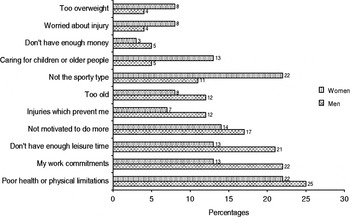
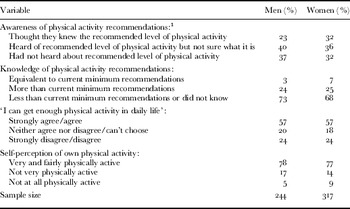
Among the respondents aged 60–64 years, 23 per cent of men and 32 per cent of women thought they knew the national physical activity targets for adults, but actually few did so (3% of men and 7% of women). Around one-quarter over-estimated the targets and the rest either did not know them or under-estimated them (see Table 1). Over one-half (57%) of the sample thought they could get enough physical activity in their daily life, and more than three-quarters (78% of men and 77% of women) thought they were physically active compared to others of their own age. The most important perceived barriers to being more physically active were work commitments (22% of men and 13% of women), lack of leisure time (21% of men and 13% of women), and poor health (25% of men and 22% of women). In addition, 22 per cent of the women said that they were not ‘the sporty type’, 4 per cent of men and 8 per cent of women said that they were too overweight, and 12 per cent of men and 8 per cent of women said that they were too old to do more (Figure 1).
Barriers of adults aged 60–64 to doing more physical activity, exercise or sport by age and sex.

Awareness and knowledge of current recommendation for physical activity and perception of own physical activity, adults aged 60–64 years, England, 2007

Note: 1. The recommendation is 30+ minutes on five or more days a week.
The regression results
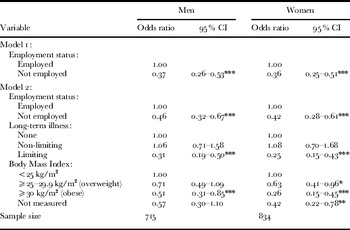
Table 2 shows the results of the logistic regression analysis of the factors that influenced physical activity participation among those aged 60–69 years. Only variables that were statistically significant at the 5 per cent level were included in the final models. An odds ratio (OR) greater than 1.0 shows an increased likelihood of physical activity participation. Being in paid work was found to be associated with physical activity for both men and women. Those who were not working had odds that were about one-third of those for working adults (OR=0.37 men, OR=0.36 women) of participation in the target level of physical activity (Model 1). After controlling for poor health and BMI, those who were not working had less than one-half the odds of working adults (OR=0.46 men, OR=0.42 women) (Model 2). Limiting long-term illness (illness that limits activities) was also associated with lower odds of meeting physical activity targets, with again similar odds for men (OR=0.31) and women (OR=0.25). Both overweight and obesity also associated with lower levels of physical activity in men and women. Obese men (OR=0.51), overweight women (OR=0.63) and obese women (OR=0.26) were less likely to participate than those who were not overweight. Equivalised household income (NS-SEC), occupational status, age (in single years), waist circumference, waist–hip ratio, smoking status, alcohol consumption, NHS region and the index of multiple deprivation quintile were excluded from the final models as not statistically significant for men or women.
Estimated odds ratios for physical activity that meets Chief Medical Officer's recommendation by associated risk factors and gender, 60–69-years-olds, England, 2006

Notes: The Chief Medical Officer's recommendation is 30+ minutes on five or more days a week. CI: confidence interval.
Significance levels: * p<0.05, ** p<0.01, *** p<0.001.
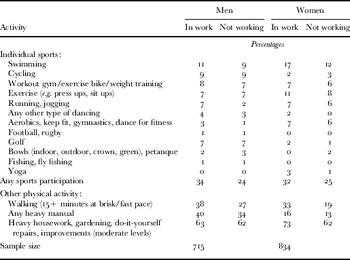
Given the importance of working status on physical activity, we examined its influence on participation in sports and exercise, walking, heavy manual work and heavy housework and gardening. There were no significant differences in sports and exercise participation for most activities for men and women in this age group (see Table 3). Swimming, doing exercises (e.g. press-ups and sit-ups) and yoga were significantly lower among non-working women, and swimming, running and jogging were significantly lower among non-working men. The level of participation in none of the specified sports was not significantly higher among the respondents not in work. Walking (15 or more minutes at a brisk fast pace) was also significantly lower in men and women who were not working. Men were much more likely than women to be engaged in non-occupational heavy manual work (e.g. DIY), but there were no differences by work status. Participation in moderate levels of heavy housework and gardening were significantly lower in women who were not working, but not among men.
Participation in activities during the last four weeks by gender and work status, 60–69-year-olds, England, 2006

Discussion
Those aged 60–69 years who responded to the Health Survey for England in 2006–07 thought that work and lack of leisure time were barriers to physical activity, but the inverse was found to be the case. There were no sports with significantly higher participation among those who were not working (who presumably had more leisure time). Physical limitations were a barrier to participation, but employment was not. Working was equally important for both men and women, even given the lower level of employment among women. Being in employment may provide income to pay for participation in various types of physical activity, such as gym, pool and club memberships or individual sports sessions.
It is likely that opportunities for occupational and non-occupational physical activity are reduced when no longer employed. There is likely to be less occupational physical activity, especially for those who were manually employed, and other influences may be less physical activity associated with walking or cycling to and from work, smaller social networks and associated activities, less participation with colleagues in team sports or, say, dancing, and less access to facilities, e.g. workplace gyms, swimming pools and sports grounds. The lower levels of walking in the non-working group were particularly marked. This suggests that schemes such as free swimming for the over-sixties, whilst removing a financial barrier, only partially compensate for work-related losses and do not make access to facilities easier. Schemes that provide transport (possibly including free bicycles given the relative popularity of cycling), team-sports' facilities and group activities with social and physical dimensions such as walking groups or conservation projects might have beneficial results.
From a public health perspective, there is a need to recognise both the lack of knowledge in the population of what constitutes sufficient physical activity and the reduction in participation in physical activity that tends to occur when people retire from work. General practitioners should provide information on and encourage continued physical activity participation in the local area and beyond, explain the Chief Medical Officer's targets, and stress the multiple health benefits. Given that after controlling for health status, obese men and women were less likely to participate in physical activity than others, they need to be targeted for health promotion education and interventions, and there is also a case for health promotion strategies that specifically focus on the population of retirement age.
This study has presented evidence for those aged 60–69 years in the general population of England, but only a small proportion of the sample were members of the country's growing minority ethnic groups. Stamatakis (Reference Stamatakis, Sproston and Mindell2005) reported from the HSfE 2004 that for men and women aged 55 or more years, physical activity participation was lower in most non-white ethnic groups compared to white groups – particularly the Indian, Pakistani, Bangladeshi and Chinese-origin populations but not Black-Caribbeans. This suggests that specific interventions tailored for these groups may be needed to boost their participation in physical activity. Studies have shown that the terms ‘activity’ and ‘exercise’ mean different things for people of different cultural backgrounds. We concur with Bird et al. (Reference Bird, Radermacher, Feldman, Sims, Kurowski, Browing and Thomas2009) that more research is needed to design and implement physical activity promotion interventions that are culturally-tailored and sensitive.
To the best of our knowledge, the reported analysis is the first in England to have examined the attitudes towards, perceptions of and knowledge about physical activity and its benefits among those aged 60–64 years using a nationally-representative sample. Large cross-sectional surveys such as the HSfE provide robust evidence of the levels of participation in physical activity and of variations by age, gender and health status, but do not allow us to specify the causal relationships, such as how adults adopt, maintain or cease to participate in sport and physical activity throughout their lives (Allender, Cowburn and Foster Reference Allender, Cowburn and Foster2006; for a Spanish study with a longitudinal dimension seeCastillo et al. Reference Castillo, Navarro, Sanz, Rodríguez, Izquierdo and Pinés2010). Those who were obese may be so through not participating in physical activity, rather than their not participating in physical activity through being obese. Obesity might be a barrier through negative perceptions of body image, especially for women. Indeed, a few respondents reported that they were too overweight to do more, and some women also reported that they were not the ‘sporty type’. Similar circular reasoning may be used by people with limiting long-term illnesses to account for their low physical activity participation.
It is evident that many more people think they know the current recommendations for adults about the level of beneficial physical activity than actually do, and that many people have unrealistic views of their own levels of activity. Being in paid work associates with higher levels of physical activity regardless of health status. More health education around physical activity targets and more health promotion interventions are needed for the over-sixties who are no longer in work. Being of retirement age does not seem to change the perception of physical activity in adults but it does impact on how physically active individuals are.
Acknowledgements
We are grateful to the participants in the Heath Survey for England (HSfE), its field staff and our colleagues at the National Centre for Social Research (NatCen). The HSfE 2006 and 2007 were funded by the National Health Service Information Centre for Health and Social Care. The funder played a substantial role in determining the content of the surveys but played no part in the design, analysis or interpretation of this study, in drafting this article or the decision to submit for publication. The authors' work is independent of the funders, and we were responsible for conception, design, analysis and interpretation. We thank Dr Aparna Shankar for her comments on earlier drafts. The views expressed in this article are those of the authors and do not necessarily reflect those of the funder.