1. Introduction
By innovation I mean what Schumpeter meant, namely the economic activity of producing and using new knowledge and ideas about sources of value that results in the disruption and restructuring of the economic order. Innovation is an evolutionary growth-of-knowledge and creation-of-value process that is coordinated by economic institutions (Dopfer and Potts Reference Dopfer and Potts2008; Nelson and Winter Reference Nelson and Winter1982). In the standard theoretical and policy model, these are the institutions of the market (including entrepreneurial agents and innovating firms) and the institutions of government that correct market failures and systems failures in the production of knowledge (Arrow Reference Arrow and Nelson1962; Nelson Reference Nelson1993).
However, a further class of economic institution of innovation is the commons, or the institutions that govern the creation and use of common pool resources. Economic analysis of commons has traditionally focused on natural resources such as forests, fisheries or watersheds (Ostrom Reference Ostrom1990). But new knowledge can also be a common pool resource – a knowledge commons (Benkler Reference Benkler2006; Hess and Ostrom Reference Hess and Ostrom2006; Madison et al. Reference Madison, Frischmann and Strandburg2010, Reference Madison, Strandburg, Frischmann, Menell and Schwartz2016) – when a relevant community can create and enforce governance rules to facilitate cooperation and avoid the traps of social dilemmas in the peer production of knowledge (Franke and Shah Reference Franke and Shah2003; Frischmann et al. Reference Frischmann, Madison and Strandburg2014; Ostrom and Hess Reference Ostrom and Hess2003). Governance institutions to create and use common pool knowledge have been studied in the context of: technology sharing and collective invention (Allen Reference Allen1983; Meyer Reference Meyer2003; Nuvolari Reference Nuvolari2004), including patent pools (Lerner and Tirole Reference Lerner and Tirole2004, Reference Lerner and Tirole2005); private collectives (Gächter et al. Reference Gächter, von Krogh and Haefliger2010); open innovation (Chesbrough Reference Chesbrough2003) and user innovation (von Hippel Reference Von Hippel1987, Reference Von Hippel2005; Von Hippel and Von Krogh Reference Von Hippel and von Krogh2003). Clusters of research on knowledge commons have developed in particular domains, including: sports (Buenstorf Reference Buenstorf, Metcalfe and Cantner2003; Lüthje et al. Reference Lüthje, Herstatt and von Hippel2005; Shah Reference Shah2005); science (David Reference David1998; Franzoni and Sauermann Reference Franzoni and Sauermann2014; Nelson Reference Nelson2004; Nielsen Reference Nielsen2012); open source software (Benkler Reference Benkler2004a; Langlois and Garzarelli Reference Langlois and Garzarelli2008; Osterloh and Rota Reference Osterloh and Rota2007); medicine (Strandburg et al. Reference Strandburg, Frischmann and Madison2017); and hackerspaces (Kostakis et al. Reference Kostakis, Nairos and Giotitsas2015; Moilanen et al. Reference Moilanen, Daly, Lobato and Allen2015; Williams and Hall Reference Williams and Hall2015), among others (e.g. Fauchart and von Hippel Reference Fauchart and von Hippel2008; Raustiala and Sprigman Reference Raustiala and Sprigman2006).
A central insight of this multidisciplinary and empirically rich literature is that, under certain conditions, peer production in the knowledge commons can be a viable and efficient institutional substitute for market-based or industrial modes of production (e.g. Benkler Reference Benkler2006; Frischmann et al. Reference Frischmann, Madison and Strandburg2014; Madison et al. Reference Madison, Strandburg, Frischmann, Menell and Schwartz2016). This efficacious view of the knowledge commons carries over to the specific context of peer-produced innovation, as when Shah and Mody (Reference Shah and Mody2014: 315) write of ‘innovation communities constructed by users’ as ‘a particular type of knowledge commons’. The idea that peer production in the commons can substitute for market institutions of innovation is striking because of the centrality of innovation to economic growth and prosperity, and because of the scale of resources allocated to innovation in firms and to innovation policy. However, without disputing the underlying facts or even theoretical models presented above, my argument is that what I call the innovation commons (Allen and Potts Reference Allen and Potts2016) is better understood as a complementary rather than a substitute innovation institution.
An innovation commons is an institution to facilitate cooperation and supply governance among a group of technology enthusiasts in order to create, under high uncertainty, a pooled resource from which the individual members of the community might seek to discover and develop entrepreneurial opportunities for innovation. The innovation commons is not the peer production of new technology per se: it is, rather, the peer production of the information necessary to discover the opportunities from which to develop markets, firms and industries. It is a market-making, firm-making (and entrepreneurship-making) institution. The institutional origin of innovation is not, as in the Schumpeterian canon, entrepreneurial action in firms and markets. Rather, innovation originates in a prior state of non-market coordination among proto-entrepreneurs and technology enthusiasts who develop governance rules to facilitate cooperation under uncertainty.
Section 2 elaborates the concept of the innovation commons, with examples. Section 3 presents the theory of innovation commons within a Hayek–Ostrom–Williamson institutional framework. Section 4 develops a model of innovation commons as institutions of higher-order entrepreneurial discovery mechanisms, which in turn implies a multilevel selection theory of evolution. I conclude that innovation commons are key institutions of economic evolution.
2. What is an innovation commons?
Innovation is an economic activity and an economic problem. An innovation commons is an efficient institutional solution to a particular form of the innovation problem that occurs in the very early stages of an innovation trajectory.
Let us elucidate terms. An innovation trajectory is a Schumpeterian concept – broadly synonymous with the industrial dynamics of a historical wave (Schumpeter Reference Schumpeter1939), technological trajectory (Dosi Reference Dosi1982), or three-phase meso trajectory (Dopfer and Potts Reference Dopfer and Potts2008). An innovation trajectory aligns with the dynamic phases of the innovation process from entrepreneurial origin to industrial and market maturity. The innovation problem is the economic problem associated with the economic organization of innovation. In the market failure formulation of the innovation problem, prices in a perfectly competitive market will fail to allocate innovation resources in a Pareto-efficient distribution owing to the public good characteristics of new knowledge (Arrow Reference Arrow and Nelson1962; Martin and Scott Reference Martin and Scott2000). The coordination failure innovation problem occurs when multiple investments by different parties are required across an innovation system (Nelson Reference Nelson1993; Teece Reference Teece1986, Reference Teece1992). A broader political-economy innovation problem is the disruptive consequences of innovation, requiring redistribution to those who are harmed by the externalities of innovation (including devaluation of extant capital) and who might otherwise seek political means to block or slow innovation (Juma Reference Juma2016; Taylor Reference Taylor2016).
Innovation problems array over the innovation trajectory, requiring institutional solutions. Firms and markets are institutional mechanisms to solve the allocation problem of private investment in innovation resources. But market failure and coordination failure problems call for government intervention to fix distorted incentives or create public goods (e.g. intellectual property rights or tax mechanisms to incentivize private investment, or direct public support or provision: Davidson and Potts Reference Davidson and Potts2016). Public support for R&D happens early in the trajectory, support for the infrastructural needs of new industries occurs through the middle phases of an innovation trajectory, and public welfare support arrives later in the trajectory to mitigate disruptive consequences. Private and public institutional orderings jointly solve the various economic problems of investment and coordination over an innovation trajectory.
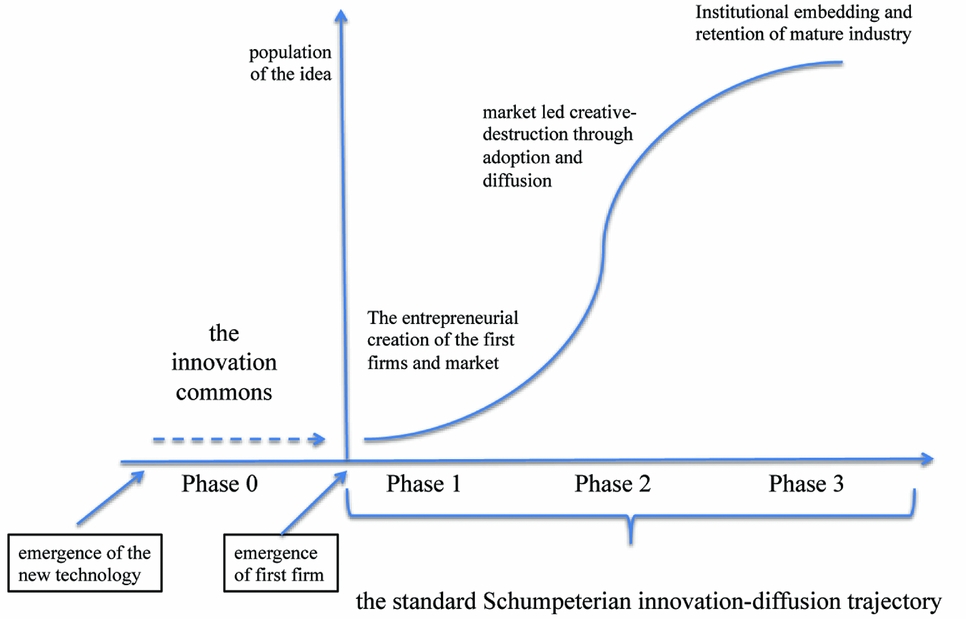
What economic problem does an innovation commons solve? Prior to the above conception of the innovation trajectory, in an earlier phase – a ‘zeroth phase’, as a prefix to the standard three-phase conception of the Schumpeterian trajectory (see Figure 1) – the economic problem of innovation is not yet an investment and coordination problem, but begins as a species of ‘knowledge problem’ or ‘discovery problem’. The problem the innovation commons solves is that of discovering the economic (or entrepreneurial) opportunity in the new idea, invention or technology. The innovation commons solves this problem by creating the institutional conditions for an effective common pool resource of inputs that supplies sufficient conditions for Phase 1 of the Schumpeterian trajectory.
The innovation trajectory, starting in the innovation commons

The full innovation trajectory therefore originates in the innovation commons, and is institutionally distinct from subsequent phases of innovation that occur in organizations and hierarchies (Aghion and Tirole Reference Aghion and Tirole1994), markets (Gans and Stern Reference Gans and Stern2010) and governments, as well as in hybrid institutional forms including networks of firms and markets (user innovation and open innovation), private collectives (Gächter et al. Reference Gächter, von Krogh and Haefliger2010), relational contracting (Pisano Reference Pisano1991) and vertical integration (Robertson and Langlois Reference Robertson and Langlois1995). An innovation commons is institutionally prior and distinct in that it requires neither the existence of entrepreneurs, firms, markets or governments or combinations thereof, nor does it need any of their institutional mechanisms, such as property rights, prices, contracts, hierarchical control or coercion, or expectations of repeated dealing. This is not to say that it does not benefit or spill over from them, for instance innovation commons notably tend to form around universities (Madison et al. Reference Madison, Frischmann and Strandburg2009).
An innovation commons is a governance mechanism to create a pool of innovation resources with respect to a new idea or technology of uncertain prospect. The participants of an innovation commons are better described as enthusiasts (i.e. hobbyists and hackers) rather than entrepreneurs,Footnote 1 and orient as members of a cooperative community. This concept overlaps with related observations of cooperation in innovation, such as collective invention (Allen Reference Allen1983; Meyer Reference Meyer2003; Nuvolari Reference Nuvolari2004), knowledge sharing networks (Gawer and Cusumano Reference Gawer and Cusumano2014; Taylor Reference Taylor2016; Von Hippel Reference Von Hippel1987, Reference Von Hippel2007), and the sharing economy (Sundararajan Reference Sundararajan2016). But it is not a covering set for non-firm or non-market cooperation in innovation. Rather, an innovation commons is a governing institution that arises in particular conditions to solve a specific problem, usually collapsing once that problem is solved in a process that then gives rise to entrepreneurial firms and new markets, which is the point conventionally (but I argue mistakenly) understood to be the origin of innovation.
Those particular conditions have the following characteristics:
• a prospective new idea, invention or technology;
• distributed resources, including information, relating to that new idea;
• fundamental uncertainty (or sheer ignorance) about the nature of the entrepreneurial opportunity associated with that new idea.
An innovation commons emerges when that group can make governance institutions for mutual cooperation to create a common pool resource of distributed innovation resources and information. The ‘commoners’ may use the common pool resource for whatever purposes are within the rules of the innovation commons, whether formal or informal, but the problem they are trying to solve is ‘how do we transform this new idea into an innovation?’
To see why a commons (à la Ostrom Reference Ostrom1990) might be a more efficient institutional form to coordinate that activity than a firm, market or government, we need to appreciate the extent of the knowledge problem involved in early-stage innovation, and the fundamental uncertainty that must be overcome for entrepreneurial action to be possible.
A new idea is not equivalent to the discovery of economic value. An invention is a technical opportunity but not yet an economic opportunity. Entrepreneurial endeavour requires identifying an opportunity for profit (or an opportunity to create ongoing value for a relevant community) and this requires gathering and making sense of fragments of information to assess and map the new idea's economic value. For any new idea or technology, entrepreneurs will rarely be in a position to act confidently, or at least will have trouble persuading financiers or owners of complementary resources to join them, until answers are furnished about the nature of the opportunity (Hausmann and Rodrik Reference Hausmann and Rodrik2004). The necessary conditions for entrepreneurial action include: what knowledge needs to combine to make this technology work? What will it be used for? Who will use this and how? What costs are involved in producing or delivering this, and how do they vary, and over what margins? What business models will work? What unintended effects will this have, on whom, and why? This will require information about costs and benefits; demand and supply; applications and risks; competitive and complementary goods and services; networks, perceptions and expectations; technological, regulatory, cultural, social, political and environmental factors in the broadest sense, among other factors. An innovation commons is an institution to pool distributed information to discover opportunities that would otherwise be, for an individual, prohibitively costly or inefficient to discover. The comparative efficiency of the innovation commons as an institution owes to the distributed nature of information and knowledge, combined with the ex-ante uncertainty about the value of individual pieces of information and the mutual value that individual community members derive from creating a high quality common pool resource among other like-minded enthusiasts. If any of these conditions did not hold, a firm, market, relational contracting situation or government would be a superior institutional solution.
Examples of phenomena that we may retrospectively recognize as innovation commons trace from the beginning of the modern economic era. Mokyr's (Reference Mokyr2016) inquiry into the ‘Republic of Letters’, a virtual community of scholars formed in 1680–1720 across Western Europe that begat the Industrial Enlightenment and the industrial revolution (Mokyr Reference Mokyr2011), was a rule-governed commons for pooling and sharing scientific information. Yet the Respublica Literaria was not just the communications of a trans-European bunch of gentlemen scholars. This was a self-governing community, a group of people who arrived at an effective institutional solution to a fundamental economic problem in the production of knowledge, namely: new knowledge benefits from the co-production of complementary other knowledge. But each bit of knowledge is costly to produce, improves when given critical, honest and disinterested feedback, and can make use of other recently produced knowledge. Societies and clubs to discuss and disseminate ‘useful knowledge’, often technical and scientific in nature, are a characteristic feature of progressive, technologically developing economies. They were common not only in mechanical engineering (Allen Reference Allen1983; Nuvolari Reference Nuvolari2004), but also in early agriculture, horticulture and viticulture (McIntyre et al. Reference McIntyre, Mitchell, Boyle and Ryan2013), among other domains. While these communities appear as proto-forms of industrial science prior to being organized into modern universities and research laboratories, that view neglects the extent to which these scientific knowledge commons were also functioning as innovation commons by pooling useful information to identify and develop entrepreneurial opportunities (see Lyons Reference Lyons2013).
Modern examples of innovation commons found at the germinal phase of any new general purpose or adaptable technology illustrate this point. The Homebrew Computer Club, formed at Stanford University in the mid-1970s by early DIY computer enthusiasts to pool resources and information, turned out to be a highly effective innovation commons (Meyer Reference Meyer2003). Similar institutional arrangements can be observed in open source software development,Footnote 2 and, particularly in the past decade or so, in so-called hackerspaces focused around new frontier technologies such as 3D printing, synthetic biology (Kera Reference Kera2014), and blockchains (Allen Reference Allen2017). Innovation commons can also be broadly observed in the context of user innovation wherever it extends to some kind of platform of governance model to facilitate sharing and development.Footnote 3
Innovation commons are innovation communities.Footnote 4 They tend to spatially organize, such as in coworking spaces (Potts and Waters-Lynch Reference Potts and Waters-Lynch2017), or emerge where effective communication networks and platforms have been built (Franzoni and Sauermann Reference Franzoni and Sauermann2014). They function well without formal intellectual property by developing ‘Mertonian’ community norms.Footnote 5 This process of community forming and information and resource sharing has been well documented around new sports such as mountain-biking and board sports.Footnote 6 Communications media, such as hobbyist magazines, websites or podcasts can augment and facilitate entrepreneurial information discovery with curated reports of these primary events (Potts and Thomas Reference Potts and Thomas2015). These sites of innovation resource pooling each build on a vital community.
Innovation commons emerge about a prospective new technology or germinal idea, but where the nature of the economic opportunity remains uncertain. The characteristic features of the innovation commons are associated with a cooperative strategy by a group of people, often with some measure of cultural affinity interlinked by shared tacit knowledge, coming together behind a veil of ignorance about what entrepreneurial positions they might subsequently stake, or with uncertainty over the value of the information and resources they currently hold. A defining feature of this group is that as economic agents they are pre-entrepreneurial, pre-firm, pre-market; they are amateurs, enthusiasts, citizens (as in ‘citizen science’, Nielsen Reference Nielsen2012), peers (as in ‘peer production’, Benkler Reference Benkler2006), or users (as in ‘user innovation’, Von Hippel Reference Von Hippel2005). In conditions of high uncertainty the discovery of economic opportunities not only requires pooling innovation resources but, more importantly, requires pooling distributed information, and this is most effective in a self-organizing rule-governed commons (Ostrom and Hess Reference Ostrom and Hess2003). An innovation commons is a species of knowledge commons (Hess Reference Hess2008; Madison et al. Reference Madison, Frischmann and Strandburg2010, Reference Madison, Strandburg, Frischmann, Menell and Schwartz2016) to minimize the transactions costs of discovering entrepreneurial opportunities about the value of particular positions, resources, information and knowledge that each individual holds.
3. Theory of the innovation commons
What is the innovation problem that society seeks to solve? In the Schumpeter–Nelson–Arrow formulation, the production of new knowledge can experience market failure (Martin and Scott Reference Martin and Scott2000) and systems failure (Dodgson et al. Reference Dodgson, Hughes, Foster and Metcalfe2011). Within this choice-theoretic analysis, innovation policy seeks to correct these mistakes (from the perspective of aggregate social welfare) in the allocation and planning of investment. The theory of the innovation commons, however, is Coasean in being contract-theoretic (à la Williamson Reference Williamson2002) rather than choice-theoretic. Elinor Ostrom's work can similarly be characterized as ‘social-contract’-theoretic rather than social-choice-theoretic (Tarko Reference Tarko2016). In the choice-theoretic approach, market and systems failure is resolved with transfers or rent creation. But in the contract-theoretic approach, the innovation problem for society begins as a collective action problem in pooling innovation resources. Under certain circumstances, this social dilemma can be resolved with effective governance institutions (i.e. rules).
In the Schumpeter–Nelson–Arrow choice-theoretic framework, innovation costs are implicitly represented as factor input costs or production costs that require public subsidy or supply to induce efficient levels of private investment. However, from the Coasean or contract-theoretic perspective, innovation costs also include transaction costs, and so the economic problem of innovation requires choosing efficient rules or institutions to minimize the total costs of coordination, cooperation and discovery of new ideas and their value.
The transaction cost approach to the innovation problem is usually framed at the boundary of firms and markets (e.g. the optimal size of the innovating firm, the efficacy of networks of innovating firms, and external contracting models such as open innovation, e.g. Aghion and Tirole Reference Aghion and Tirole1994; Teece Reference Teece1992). Innovation commons theory argues that efficient innovation requires groups of people to come together to pool resources to discover entrepreneurial opportunities. However, under certain conditions – particularly in relation to distributed partial knowledge and fundamental uncertainty, conditions widely prevalent in the early stages of any new technology – the most economically efficient organization of such groups might not be in firms or markets. This is because of transactions costs.
The transaction cost efficiency of innovation commons arises because the information and knowledge to recognize an opportunity is ‘not given to anyone in its totality’ (Hayek Reference Hayek1945). Furthermore, the value and meaning of the individual pieces of information and knowledge are not always apparent to those holding them (Lachmann Reference Lachmann and Lavoie1994; Lavoie Reference Lavoie, Birner and Garrouste2004). Innovation commons are an institutional mechanism to create a common pool of resources, information and knowledge from which entrepreneurial opportunities can be revealed. The economic character of this problem is a collective action problem (specifically, a multilateral contracting problem) rather than a choice-theoretic problem of market failure.
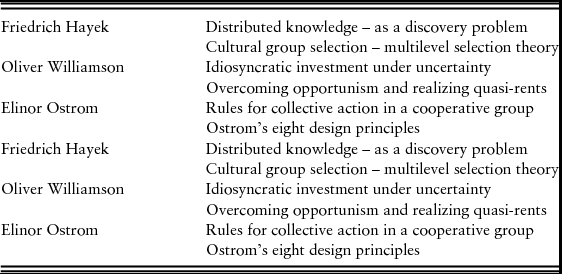
Modern innovation theory and policy are built on a Schumpeter–Nelson–Arrow formulation of the innovation problem, as a choice-theoretic diagnosis of an investment problem resolved with public ordering to correct market and systems failures. A new institutional approach to innovation theory and policy can be framed as the ‘Hayek–Williamson–Ostrom’ model of the innovation problem, in relation to knowledge, uncertainty and coordination, which offers a contract-theoretic diagnosis of a coordination problem resolved with private ordering institutions.Footnote 7
Elements of the theory of the innovation commons

The ‘Hayek’ part of the innovation commons model – both the ‘use of knowledge in society’ (Hayek Reference Hayek1945) and his later work on cultural evolution (Hayek Reference Hayek1973, Reference Hayek and Bartley1988) – establishes the centrality of both distributed knowledge and group selection to this new understanding of the innovation problem. For Hayek, ‘the economic problem of society is mainly one of rapid adaptation to the particular circumstances of time and place’. The innovation problem, however, deals with new goods and services for which markets and therefore prices do not yet exist. Markets of course do provide rich information about the need for new substitutes (rising prices), the benefit of new complements (falling prices), and prospective costs of inputs into the innovation process (R&D costs), opportunity costs (alternative returns on factors) and rents available (extant profits).
However, the Hayekian knowledge problem applies not only to how new information affects an existing economic order, but also to the problem of identifying and coordinating distributed knowledge for entrepreneurial discovery of opportunities for innovation. Yet such information is not entirely, or even generally, communicated through the price mechanism. The relevant question is not whether markets work for innovation, but whether alternative institutional mechanisms can also perform this function of coordinating innovation resources, and, if so, whether more or less efficiently? For Hayek, price signals efficiently conveyed meaning to coordinate action. But opportunity discovery for innovation requires extracting meaning from non-price information as well, in which a group of people need to construct from fragmented bits of data, information and knowledge a sense of what something means, and then to coordinate on that shared meaning (Lachmann Reference Lachmann and Lavoie1994; Lavoie Reference Lavoie, Birner and Garrouste2004; Potts and Hartley Reference Potts and Hartley2015). An innovation commons can under certain circumstances be an efficient institution for coordinating economic activity by pooling and then jointly figuring out the meaning of distributed information.
Hayek's latter work on cultural group selection (Zywicki Reference Zywicki2000), now called ‘multi-level selection theory’ (Gintis et al. Reference Gintis, Bowles, Boyd and Fehr2003; Nowak et al. Reference Nowak, Tarnita and Wilson2010; Wilson and Wilson Reference Wilson and Wilson2007) – examined how groups that can successfully cooperate and realize gains from cooperation will outcompete groups that can do neither. Turchin (Reference Turchin2015) and Bowles and Gintis (Reference Bowles and Gintis2013) call this ‘cooperation for competition’. A society that can lower the transactions costs of cooperation for innovation can potentially outcompete a rival society with higher innovation transactions costs.
The ‘Williamson’ part of the innovation commons model is the emergence of an implicit contracting problem to deal with idiosyncratic investment under uncertainty that is associated with the Hayekian problem of coordinating distributed information, knowledge and innovation resources, and the agency problems and the hazards it contains owing to these being specialized assets with quasi-rents, namely the problem of asset specificity and opportunism (Holmstrom Reference Holmstrom1989; Williamson Reference Williamson1985). In the Williamson framework, agents economize on transactions costs by choosing an efficient governance structure to minimize hazards of opportunism and maximize quasi-rents. Quasi-rents are returns to mutual cooperation in consequence of specific investments that pay off only if the counterparty also makes specific investments (Klein et al. Reference Klein, Crawford and Alchian1978). Yet such contracts expose each party to hazards of opportunism: the other party can defect and capture all rents once an irreversible investment is made.
The ‘Williamson problem’ (Williamson Reference Williamson1979, Reference Williamson1985, Reference Williamson2002) translates into an innovation problem of governance when those idiosyncratic investments are the distributed (Hayekian) components of specialized knowledge and complementary investments that need to be combined in order to reveal entrepreneurial opportunities. The economic problem is that innovation requires multilateral investment in transaction-specific assets with uncertain value. The quasi-rents correspond to identifying opportunities for value creation (conditional upon others making idiosyncratic complementary investments), observable to all involved whether or not they have contributed through specific investment. The economic problem of innovation therefore involves choosing among the set of feasible institutional arrangements those rules that protect their relationship specific-investments at least cost (Allen and Potts Reference Allen and Potts2016). Under conditions of idiosyncratic but incomplete knowledge, high uncertainty as to its value (and quasi-rents), and an expectation of a temporary relationship, a commons can be an efficient institutional mechanism.
The ‘Ostrom’ part of our model resolves Hayek's knowledge problem and Williamson's transactions cost problem with emergent institutional rules for collective action. Ostrom (Reference Ostrom1990, Reference Ostrom2007) explained how many common pool resource dilemmas were not actually instances of market failure (to be resolved with effective property rights, or regulated public ownership) but would yield to private ordering solutions when the relevant ‘community of use’ could come together and develop effective rules to resolve the social dilemma itself through governance. Ostrom's (Reference Ostrom2010: 642) framework emphasizes ‘the wide diversity of institutional arrangements that humans craft to govern, provide and manage public goods and common pool resources’, and translates into the space of the innovation problem when innovation is seen as a cooperative group activity subject to social dilemmas in which technologies are developed as a common pool resource. An innovation commons emerges when a community of innovators and potential entrepreneurs can design or discover rules to overcome social dilemmas and develop effective governance structures to solve innovation problems that can be difficult or expensive to solve with alternative organizations or institutions. Innovation commons tend to occur at the very beginning of the innovation process, when uncertainty is highest, when quasi-rents are most vulnerable, when useful knowledge is distributed, but when genuine enthusiasts can devise mechanisms to identify each other and cooperate.
Ostrom argued that self-governing communities could sometimes, when certain conditions are met with respect to the resource and the community, do a better job than firms, markets and governments in organizing and protecting important resources. While not all commons institutions succeeded, those that did tended to share eight institutional design principles associated with: clear group boundaries; matching rules to local conditions; rules being endogenously selected and externally respected; effective community monitoring with graduated sanctions and low-cost dispute resolution; and modular governance (Ostrom Reference Ostrom1990, Reference Ostrom2005; Wilson et al. Reference Wilson, Ostrom and Cox2013). Ostrom's eight design rules emphasize that effective governance of a common pool resource needs to be tightly adapted to the particular nature of the community, the situational context and the idiosyncratic resource, which in this case is the technological innovation.
These same design principles appear salient in the innovation commons. Evidence for this claim comes from detailed study of commons-based peer production in hackerspaces, which has examined their governance constitutions (Allen Reference Allen2017), the social rules relating to sharing and production (Kostakis et al. Reference Kostakis, Nairos and Giotitsas2015; Moilanen et al. Reference Moilanen, Daly, Lobato and Allen2015) and their modular economic organization (Langlois and Garzarelli Reference Langlois and Garzarelli2008). Hackerspaces are innovation commons that have clearly defined boundaries, explicit governance rules, and community decision-making; they require monitoring and make use of sanctions. In an ethnographic based economic study, Williams and Hall (Reference Williams and Hall2015: 779) use hackerspaces to illustrate ‘how technology effectively lowers the cost of implementing and sustaining three of Ostrom's design principles [clearly defined boundaries; monitoring; collective choice arrangements and communication] for common pool resource scenarios’. A further crucial aspect of an innovation commons that can be observed clearly in many hackerspaces is the role of tacit knowledge in binding together a community of genuine enthusiasts. Mutual tacit knowledge has functional value in facilitating and reinforcing communication efficiency, possibly creating a language barrier that to outsiders may seem like jargon, but that works effectively as a screening mechanism for the community, facilitating mutual recognition of who is, and is not, an inside member of the relevant community, and therefore with whom it is safe to share information and resources and to cooperate. Shared tacit knowledge also has a powerful constitutive function as only those engaging with the group and contributing to its collective resources would have a chance of understanding its potential.Footnote 8
The innovation commons emerges from civil society, is made of informal rules and leaves little historical trace. It is a temporary cooperative institution that collapses to competition, having served its purpose to reveal the shape of the entrepreneurial opportunity. Yet it can be an efficient (cost-minimizing) solution to the innovation problem in terms of the costs of cooperation and with whom to cooperate (distributed knowledge, viz. Hayek); the incentive problem (quasi-rents from idiosyncratic investments, viz. Williamson); and how to cooperate with them (rules of governance, viz. Ostrom).
Three characteristics of the innovation commons
The Hayek–Williamson–Ostrom view of the innovation problem, as a distinct body of theory (cf. Schumpeter–Nelson–Arrow), also identifies a new type of commons – along with natural resource commons (Ostrom Reference Ostrom1990), knowledge commons (Frischmann et al. Reference Frischmann, Madison and Strandburg2014; Hess and Ostrom Reference Hess and Ostrom2006), and other new commons (Hess Reference Hess2008; Madison et al. Reference Madison, Frischmann and Strandburg2010) – with three peculiar characteristics.
First, there are two distinct resources in the innovation commons – i.e. it is actually two commons. One resource is the materials and technology, such as kit, tools, samples, and other pooled and shared things; in a hackerspace this might be the CNC mill or access to biosamples. But the other distinct resource that pools in an innovation commons is information that is relevant to discovering the entrepreneurial opportunity (cf. Eckhardt and Shane Reference Eckhardt and Shane2003; Shane Reference Shane2000; Waguespack and Fleming Reference Waguespack and Fleming2009). This is information, sometimes tacit, about how the technology works in particular circumstances: what potential regulatory barriers and exceptions the new idea might encounter; how particular consumers use the new technology in specific instances; the price points that matter; the sourcing of critical resources; the prospect of potential competitive or complementary investment, and the source of such investment; the problems that arise when attempting to scale up, the specific sources of expertise in particular aspects of production and development; the possible markets that might exist. This information cannot be patented or easily protected; it is context-specific, acquired by experience and often accumulated without intention. Its value decays if unused. Moreover, it rarely has value or even legibility unless combined with other related data (i.e. the marginal quasi-rent is zero).
Yet this is the crucial information that entrepreneurs need. An innovation commons is therefore invariably two commons. This usually nested and inseparable relation, in that you generally cannot get access to one without access to the other, is plausibly an efficient mechanism when contribution to the former (the physical resources and technical information) functions as a screening mechanism for the high-value resource, which is the information that enables opportunity discovery and therefore facilitates entrepreneurial action.Footnote 9
Second, the innovation commons can function for defensive purposes to protect a technology from capture by alternative institutional forms, and thus from being controlled or monopolized by any one group.Footnote 10 This might occur in the private sector, where a firm controls a technology by copyright and refuses to license it, or extracts significant rents from that monopoly position (for example, pharmaceuticals or software), or from the public sector rendering a technology illegal or controlling it to meet the government's interests with regulation or enforcement (for example, cryptography, maps or weapons). Placing an idea in the commons, or a credible threat of doing so, can be an effective defensive gambit to foreclose alternative institutional modes of development of the new technology or idea (Benkler Reference Benkler2006).
Third, innovation commons tend to be temporary and can rapidly collapse (Allen and Potts Reference Allen and Potts2016). This distinguishes an innovation commons from sharing economy models of peer production (Benkler Reference Benkler2004a; Hamari et al. Reference Hamari, Sjöklint and Ukkonen2015; Swann Reference Swann2014). The collapse occurs when an innovation commons has completed its function by revealing the entrepreneurial opportunity, reducing uncertainty to a level tolerable for entrepreneurial action. At this point the value of the commons to those in it collapses, so they exit and subsequently enter the institutions of the Schumpeterian trajectory, namely innovating firms in competitive markets (Figure 1). The collapse of the innovation commons is not the result of a tragedy, but rather is evidence of its success in producing the common pool resource that those who contributed to the commons sought, namely reduced entrepreneurial uncertainty. An innovation commons is in this sense a form of entrepreneurial infrastructure (Frischmann Reference Frischmann2012).
4. Higher-order discovery and multilevel selection
The institutional theory of the innovation commons predicts that the geography of innovation will be, in part, determined by the effectiveness of the institutions of proto-entrepreneurial cooperation in a Kirznerian model of opportunity discovery. In other words, entrepreneurial alertness can be augmented through cooperative institutional technology and when this happens we would expect to observe a higher rate of innovation within a local cluster because of the higher rate of discovery of entrepreneurial opportunity owing to the pooling of innovation resources and information. (Note this also predicts higher ex post entrepreneurial competition.)
Two important assumptions underlie Kirzner's (Reference Kirzner1973, Reference Kirzner1996) model of entrepreneurial discovery of opportunity. The first relates to who does the discovering, namely the entrepreneur; the second relates to where and how they do it, namely being alert to opportunities read in market prices. Kirzner's approach is methodologically individualist and oriented within market institutions, with the entrepreneur alert to information in relative prices and price movements. The underlying constraint on innovation discovery works through a supply of talented entrepreneurs, or ‘upper-tail human capital’ (Meisenzahl and Mokyr, Reference Meisenzahl and Mokyr2011; Mokyr Reference Mokyr2016; also see Mokyr Reference Mokyr2017), and price information. To overcome this constraint, and increase opportunity discovery, requires more or better entrepreneurs, or more or better price data.
An innovation commons is a solution to this problem that works not by increasing the supply of or genius of entrepreneurs, but by improving their collective intelligence. An innovation commons is not a market institution (there are no prices, and much non-price information). However, like a market it is also a mechanism to facilitate the entrepreneurial discovery of opportunities in the Kirznerian sense of reading the opportunity in the messages and meanings generated by the institution. As Lachmann (Reference Lachmann and Lavoie1994) and Lavoie (Reference Lavoie, Birner and Garrouste2004) explain, ‘markets are an extension of language’, and entrepreneurial action depends upon an extraction of meaning from a context. These opportunities are not revealed by alertness to relative prices or price changes, but by alertness to the constructed meanings that emerge from the pool of information and knowledge in the innovation commons and by the meanings discerned and inferred from the community of enthusiasts.
The innovation commons augments the institutions of market discovery with a higher-order discovery mechanism to pool and create information that would otherwise not be available to any potential entrepreneur. The information and messages generated by the innovation commons have a higher order of complexity than information created or read by an individual entrepreneur (Foster Reference Foster2005). In this sense an innovation commons is an institutionally more complex form of Kirznerian pure entrepreneurial alertness over distributed knowledge – a ‘cooperative social technology of alertness’ – that requires a governance mechanism to create the common pool resource from which deeper opportunities for innovation can be revealed. Just as there is higher-order capital (Harper and Endres Reference Harper and Endres2010), there can also be higher-order institutional mechanisms of entrepreneurial discovery. The innovation commons is a cooperative social technology of alertness that under certain conditions will outcompete individual Kirznerian alertness. We can represent this evolutionary logic using a multilevel selection model.
Multilevel selection in evolutionary economics is an extension of the replicator equation (Bowles et al. Reference Bowles, Choi and Hopfensitz2003; Metcalfe Reference Metcalfe2008; Zinovyeva Reference Zinovyeva2010) in which selection operates on variety within a population and between interacting groups (i.e. Lotka–Volterra type co-evolutionary models). Multilevel (or group) selection is the idea that competition and differential selection operate not only between individuals, but also between groups.Footnote 11 Lower-order selection operates within groups and predicts that selfish individuals will outcompete altruists. Higher-order selection operates between groups and predicts that groups of altruists (or agents who have found a way to mutually cooperate) will outcompete groups of selfish agents. The evolutionary success of cooperators therefore depends on the relative strength of competitive selection operating within groups (lower-order selection) versus selection between groups (higher-order selection). When between-group selection dominates within-group selection, we will tend to observe an evolutionary transition and the emergence of a higher-level form of organization (Traulsen and Nowak Reference Traulsen and Nowak2006). Social systems usually require powerful mechanisms to supress conflict or competition within a group – e.g. docility (Simon Reference Simon and Dopfer2005), punishment (Bowles and Gintis Reference Bowles and Gintis2005), morality (Haidt Reference Haidt2007), or coordination on an external threat (Taylor Reference Taylor2016; Van Vugt Reference Van Vugt2006).
Multilevel selection theory studies how a trait will evolve in a population by decomposing the costs and benefits of the trait into two covariance terms that relate individual fitness to group fitness (Price Reference Price1972).Footnote 12 The trait of interest is cooperation, and the first covariance term in the Price equation predicts that it will be selected out in a single population – it is individually costly, and can be strategically exploited by non-cooperators. However, the second covariance term indicates that with sufficient variance in cooperation between groups, a cooperative trait will evolve in a population if the ratio of between-group variance to within-group variance is greater than the ratio of selection strength on individuals versus groups. When variation in cooperation is concentrated at the group level, selection will favour cooperative groups, and cooperation (the trait under selection) will evolve. The more cooperators can engage in assortive matching, leading to greater variation in group-level cooperation, the stronger will be selection for cooperation.
Multilevel selection illustrates the conditions under which the innovation commons, as a cooperative social technology of alertness – i.e. a group trait – can outcompete individual alertness by revealing deeper opportunities for innovation. Group selection can favour individually costly (cooperative) behaviour only when the underlying game is not the prisoner's dilemma and when groups are assortive (Bergstrom Reference Bergstrom2002). Both conditions apply in the innovation commons. This predicts that societies and cultures that can marshal this form of institutional cooperation in order to discover opportunities to compete in markets subsequently will be more evolutionarily successful economically than societies with only individual-level entrepreneurial alertness.
Multilevel selection theory explains how cooperation evolves when the selection force operating between groups is stronger than the selection force operating within groups (Wilson and Wilson Reference Wilson and Wilson2007). The absence of cooperation in both Schumpeterian and neoclassical models of innovation is a consequence of that analysis being formulated entirely as competition within groups, where the group represents the industry or market, and also in supposing that entrepreneurial discovery is in effect a free good (conditional only upon the supply of entrepreneurs). But cooperative groups can, under certain conditions, outcompete groups that cooperate less effectively, or that fail to cooperate at all. An innovation commons is a cooperative group that creates the conditions (improved opportunity discovery) for subsequent individual competition between entrepreneurs to thrive.
When task complexity exceeds individual capability, cooperation is an adaptive response. But cooperation is costly, requiring special conditions for cooperative groups to emerge. Ostrom (Reference Ostrom1990), Bowles and Gintis (Reference Bowles and Gintis2005, Reference Bowles and Gintis2013) and Wilson et al. (Reference Wilson, Ostrom and Cox2013) show how rules and institutions to monitor and punish free riding can solve social dilemmas. Evolution selects on behaviours and culture that make effective groups.Footnote 13 In evolutionary game theory, institutions are modelled as solutions to coordination problems (Aoki Reference Aoki2007), but when the coordination problem is competition through knowledge discovery, institutions will select for cooperative group-making rules. The role of institutions in innovation, then, is not simply to incentivize investment in R&D that would otherwise be undersupplied in a competitive market. Institutions for innovation also need to solve a different and prior problem, namely to facilitate cooperation in order to pool and share information and other resources to facilitate opportunity discovery. The innovation commons is in this sense the germinal institution of innovation.
5. Conclusion
I have argued that innovation commons are an important but widely overlooked institutional component of a modern market-capitalist economy. Part of the difficulty in identifying and elucidating innovation commons is that they cut obliquely across at least four distinct bodies of economic theory. One, an innovation commons is a type of knowledge commons, but an unusual type: emergent under conditions of high uncertainty and distributed knowledge, and often only temporary. Two, innovation commons are integral to Schumpeterian innovation trajectories, but they occur prior to the first entrepreneurial firms at what is usually measured as the origin of industrial dynamics. Three, innovation commons are an emergent institutional mechanism for higher-order entrepreneurial discovery. And four, innovation commons are distinct institutions of innovation beyond the standard suite of firms, markets, governments and networks.
The framework for analysis that I have proposed draws upon the economics of common pool resources, evolutionary economics, market process economics and institutional economics. Under certain conditions, an innovation commons is a comparatively efficient institution to solve the innovation problem of early phase development and opportunity discovery. The institutions of the innovation commons are in this sense the origin of the subsequent entrepreneurial action in innovating firms and of market and industrial dynamics that we associate with economic evolution. The governance institutions of the innovation commons are a missing piece of the puzzle toward a general theory of innovation-driven economic growth and evolution.
As an institutional technology of higher-order discovery, the theory of the innovation commons predicts that societies that can marshal such institutional cooperation will outcompete economic societies with only individual-level Kirznerian entrepreneurial alertness because of their higher rates of discovery of entrepreneurial opportunity. This suggests two general empirical predictions for subsequent research: first, innovation commons should exist at the origin of all innovation trajectories; and two, the quality of innovation commons institutions should be positively correlated with subsequent entrepreneurial activity.