Crusade history has been a popular and fruitful pursuit among modern historians of the Middle Ages. An unprecedented number of scholarly publications on the subject have appeared in recent years, not least because from the 1960s onwards the concept of crusade has been understood by many to include an increasing number of topics and a wider chronological and geographical scope than ever before. For centuries, crusade history was a relatively narrow field of study, which principally had at its centre one master narrative with strong roots in medieval times. The story of the momentous events of the First Crusade and the establishment of the kingdom of Jerusalem at the turn of the eleventh to the twelfth centuries was predominantly based on the chronicles of the First Crusade and William of Tyre’s history of the kingdom of Jerusalem. The chronological limits of this master narrative largely stretched between the Council of Clermont in 1095, when Pope Urban II proclaimed the First Crusade, and the fall of the kingdom of Jerusalem, which ceased to exist as a territorial entity in 1291. Its main plot was the conquest of Jerusalem by the First Crusaders, the events and subsequent crusades relating to the kingdom of Jerusalem and its neighbouring Latin principalities during the twelfth and thirteenth centuries and, to a lesser extent, attempts to reconquer the Latin East after 1291. From the fifteenth century onwards at the latest, crusade history was in essence understood as the rendering, refashioning and interpretation of this master narrative. Its basic shape was not seriously challenged until the middle decades of the twentieth century and has for much of crusade history survived into the twenty-first.
Crusade historiography has not been the subject of extensive scholarly study. There have been a number of more or less systematic surveys, some of which take in works of the nineteenth and earlier centuries,Footnote 1 while others concentrate on more recent publications.Footnote 2 This chapter traces the scholarly narratives about the crusade from the dawn of the modern era until today by focusing on the principal developments in Western historiography. Though not always in agreement with it, this chapter owes much to Christopher Tyerman’s The Debate on the Crusades, published in 2011, to date the only monograph study of crusade historiography through the ages.Footnote 3 Considering the general lack of in-depth studies, the story of crusade historiography, however, moves in largely uncharted territory and still holds as many questions as it is ready to answer.
The Fifteenth and Sixteenth Centuries
In the latter half of the fourteenth and the fifteenth centuries, the steady progress of the Ottoman Empire towards the Balkans, especially after the fall of Constantinople in 1453, led to a new flurry of writings in support of crusading. Most of these were aimed at eliciting resistance against the Ottoman advances and to a lesser extent also reawakening the centuries-old ambitions of reconquering the Holy Land. They included such diverse texts as Philippe de Mézière’s allegorising reform treatise Le songe du vieil pélérin of 1386, St Catherine of Siena’s militant letters in support of a new crusade and John Mandeville’s Travels.Footnote 4 Into the fifteenth century, public discussions about the defence against the Ottoman attacks intensified and took on an almost frantic tone after 1453. Among the most prominent voices were those of the popes, in particular Eugenius IV (1431–47) and Pius II (1458–64), who assumed a leading role in trying to raise awareness and organise military resistance against the Ottomans.Footnote 5 It is in this context that renewed interest in the history of the earlier conflicts between Christians and Muslims arose. In the 1430s, Andrea Biglia, a Milanese scholar at the University of Siena, wrote his Comentarii historici de defectu fidei in Oriente, in which he attempted to present a long-term historical perspective on the contemporary Muslim assault on Christian lands, going back as far as the times of Muhammad.Footnote 6 In a more focused fashion, historians such as Flavio Biondo or Benedetto Accolti addressed the more recent history of the crusades of the twelfth and thirteenth centuries.Footnote 7 Their stories, just as many other historical writings of the period, were directed at not only reviving the historical memory of the earlier crusades but also addressing Renaissance humanist concerns of religious and cultural renewal through historical reflexion as well as, in a more practical sense, to underscoring the necessity of organising Europe’s defence against the Turks.Footnote 8 Biondo’s impetus in writing about the crusades probably owes much to his post as secretary of the papal chancery between the papacies of Eugenius IV and Pius II, whereas Accolti’s position as chancellor of the city of Florence brought him into close contact with the overarching political concerns of the period and in particular the crusades organised against the Ottomans.Footnote 9
Both Biondo and Accolti used the stories found in the chronicles of the First Crusade and William of Tyre’s Chronicon as the narrative core of their crusade histories. It was the story of the conquest of the Holy Land by Western Christians at the end of the eleventh century, of the establishment and decline of the Latin East in the twelfth and thirteenth centuries and, by extension, of the attempts to recover the Holy Land after 1291. However, fifteenth-century reworkings of these stories were cast in a contemporary mould. They were no longer based principally on the Christian quest for the Holy Places of Jerusalem. The demands and urgencies of geopolitics led most fifteenth-century authors to add a distinctly eschatological tinge to their stories about the contests between Christians and Muslims, postulating and expounding allegedly existential contrasts between the two religions and their cultural embeddings.Footnote 10 As a corollary, this period with its technological advances also witnessed a revival in the popularity of the earlier crusade histories. Robert of Rheims’ chronicle of the First Crusade (often known as Robert the Monk in modern historiography), for example, was one of the earliest works to appear in print in 1472.Footnote 11
The sixteenth century was the final period in which crusading had any, albeit waning, impact on military conflicts. Crusade indulgences were still issued by popes and people took the cross to fight non-Christians, for example, the Turks at Lepanto in 1571, or Christians from across the confessional divide opened up by the Reformation, for example, during the Spanish Armada of 1588.Footnote 12 At the same time, the institutions of the Catholic Church came under attack not only from Protestant reformers but also from Catholics themselves. As a consequence, the discourse about crusading became more and more multifaceted during this period, with debates about whether crusading was still legitimate and, if so, how and when to employ crusades.Footnote 13 Furthermore, Renaissance Humanism continued to claim a cultural, rather than just religious, superiority of Christianity vis-à-vis Islam.Footnote 14
During the first three decades of the sixteenth century, the renewed attacks by the Ottoman Empire – resulting in the Battle of Mohács in 1526 and the siege of Vienna in 1529 – not only provoked a military response but also intensified the debate among the leading intellectuals about the justifications of such a response. Martin Luther, Thomas More and Erasmus of Rotterdam were the most prominent contributors to this debate. All three of them came to the conclusion that military action for the defence of Christendom was ultimately justified, but their attitude towards crusading differed greatly. Luther rejected crusading outright in parallel with his damnation of indulgences and his refusal to accept papal authority. Nevertheless he considered it a Christian duty to combat non-Christian enemies.Footnote 15 Thomas More ultimately backed the Catholic call for a crusade, his concern for the survival of the integrity of a united Christendom winning over his awareness of the many potential abuses which the practice of early sixteenth-century crusading entailed.Footnote 16 It was these abuses that turned Erasmus against the crusade. Like Luther, he detested the sale of indulgences and the farce this made of the idea of the miles Christianus. Erasmus also rejected the notion of war ordained by God, denying the validity of Old Testament models as a foil for modern warfare. He was a pacifist at heart, entertained visions of the Ottomans’ peaceful conversion to Christianity and only reluctantly conceded the necessity of defensive warfare as a last resort.Footnote 17
Even though religiously motivated warfare survived the sixteenth century, most poignantly in the inter-confessional conflicts between Catholics and Protestants, crusading in the medieval tradition was dying a slow death. In 1517, Emperor Maximilian I tried to launch an international crusade project against the Ottomans reminiscent of twelfth- and thirteenth-century crusades to the Holy Land.Footnote 18 In the 1580s, the Huguenot François de La Noue likewise proposed an international campaign against the Muslims following the example of medieval crusades, hoping that in the process the collaboration between Catholic and Protestant forces would lead to reconciliation between the confessional opponents.Footnote 19 But even though these projects engendered much writing about the crusade, they did not materialise, partly because they followed anachronistic concepts and went against the political realities of the time.Footnote 20
The preoccupation with the Ottoman threat nevertheless led to continued interest in the medieval Holy Wars. One of the few crusade histories written in the sixteenth century was Johannes Herold’s De bello sacro of 1549. Following the Humanist tradition established in the fifteenth century, its narrative about the wars against the Muslims was a continuation of William of Tyre’s Chronicon, published alongside the first printed edition of this twelfth-century chronicle. Herold continued William’s narrative through to his own lifetime by drawing on a plethora of medieval sources including documents about the crusade in Spain and against the Albigensian heretics in the thirteenth century.Footnote 21 Still, Herold’s text was not yet greatly affected by the confessional divide. Although he himself had joined the Protestant camp by the time he published De bello sacro, he dedicated the book to the Catholic bishop of Basel, Philipp of Gundelsheim.Footnote 22 Rather than with confessional polemic, Herold was concerned with the ad fontes ideal of Humanist historians.Footnote 23 As well as actually publishing primary source materials in the form of appendices, he also painstakingly listed the many medieval writers he had consulted when piecing together his own text.Footnote 24
This concern for providing primary source materials as a basis for studying the history of the crusades continued throughout the sixteenth century and into the next and arguably formed the most important legacy of the Early Modern period for the later historiography of the crusades. Robert of Rheims’ chronicle of the First Crusade, for example, was reprinted in Basel in 1533, as was William of Tyre’s chronicle in 1549 and again in 1564.Footnote 25 One of the most prolific editors of crusade texts in the late sixteenth century was Reiner Reineck, who published among other works Albert of Aachen’s chronicle as Chronicon Hierosolymitanum (1584–85), Hayton’s Historia Orientalis (1585) and Burchard of Mount Zion’s Descriptio Terrae Sanctae (1587).Footnote 26 In 1597, François Moschus of Armentières re-edited James of Vitry’s Historia Occidentalis.Footnote 27 Arguably the most influential editor of crusade texts in this period, however, was Jacques Bongars. Despite being a French Protestant of a decidedly anti-Catholic outlook, he was not interested in the history of the medieval crusades for its potential to stoke the confessional controversies of his own times. Bongars and his collaborators followed the Humanist impulse of studying past history as a mirror and guide for the present. For this purpose, they were keen to set the study of the history of the crusade on a firm textual basis by providing a comprehensive collection of edited sources. His Gesta Dei per Francos, published in 1611, contained a great number of crusade texts from the chronicles of the First Crusade to the treatises for the recovery of the Holy Land of the early fourteenth century.Footnote 28 Bongars’ editions are far from faultless, but his collection formed an important basis for students of the crusades well into the nineteenth century.
The Seventeenth Century
Following in the footsteps of Jacques Bongars and other editors, most seventeenth-century crusade historians projected an air of scholarly professionalism, basing their works on extensive study of the available medieval chronicle texts. At the same time, however, they wrote for a public and readership whose distinct outlook and expectations were shaped by contemporary cultural and political developments. Authors from both sides of the confessional divide continued to discuss the crusades within denominational parameters. There was a clear tendency on the part of Protestant authors to portray the medieval crusades as legitimate, and indeed admirable, episodes of Christian history that were, however, hampered by the shortcomings and corruption of the medieval church in particular and medieval culture in general. The Catholic side tended towards a more celebratory history, seeing in the crusades an example of muscular Christianity appealing to a reinvigorated post-Tridentine version of Catholicism. This was perhaps most noticeable in seventeenth-century France during the heyday of Gallicanism. The story of the medieval crusades provided a convenient stand for highlighting excesses caused by overbearing papal control and for establishing salient historical roots of contemporary French triumphalism.Footnote 29 A prominent early example was the section on the crusade in Étienne Pasquier’s Les recherches de la France written in 1590 and first published in 1607.Footnote 30 For Pasquier, the crusades were important because, in his view, they had provided an early platform for French dominance and gloire in Europe, even though he considered the crusades a failure as military and papal expeditions and an unjustified drain on the material resources and spiritual credibility of the medieval church.
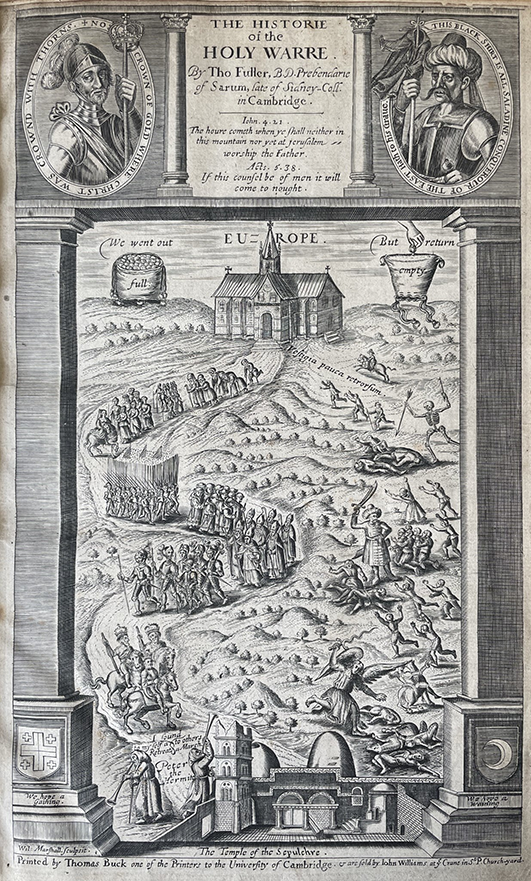
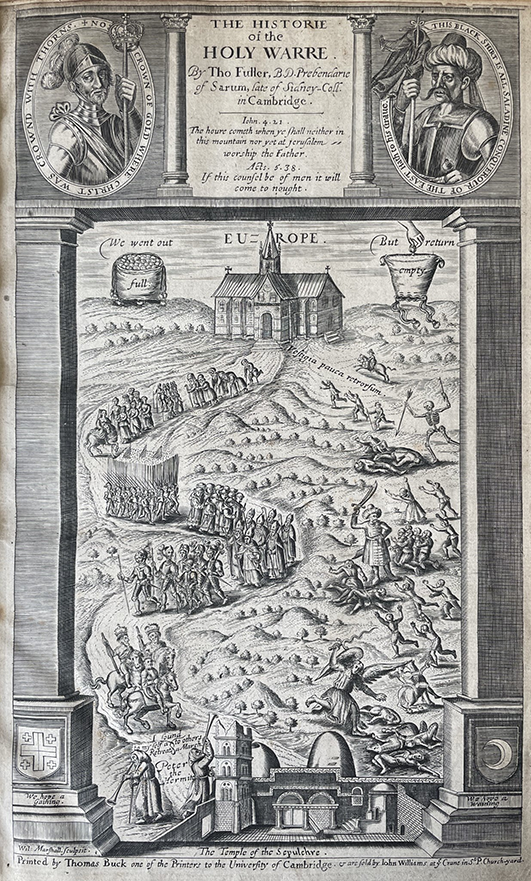
Such judgements were replicated across the English Channel. Thomas Fuller’s The Historie of the Holy Warre, first published in 1639 and re-edited three times by 1651, was a typical work of seventeenth-century Protestantism, in which the failures of the crusades were mainly blamed on the shortcomings of the medieval Catholic Church (Figure 1.1).Footnote 31 Even though Fuller clearly condemned the crusades, he tried to extend his vision beyond the confessional perspective, questioning the justification and practicality of the Christian occupation of the Holy Land. Fuller acknowledged the connections between the medieval crusades and the Ottoman threat of his own day, but the way he told the story of the crusades was not meant to emphasise the common ground between the past and the present. In a similar vein, Richard Knolles in his Generall Historie of the Turks of 1603 presented the medieval crusade from a fairly neutral perspective. Knolles tended towards dramatic delivery and was certainly less scholarly than Fuller, but he, too, saw the medieval crusades as distant history rather than a topic inviting comment on contemporary politics.Footnote 32
Frontispiece from Thomas Fuller’s The Historie of the Holy Warre (Cambridge, 1639).
France turned out to be the most fruitful terrain for crusade history in the seventeenth century. Perhaps the most influential French crusade historian of the era was the Jesuit Louis Maimbourg. His Histoire des croisades, first published in 1675, was a typical product of French Gallicanism.Footnote 33 Scholarly in its demeanour and based on a great variety of primary source materials, Maimbourg’s history went to new lengths in praising the medieval French monarchy and nobility as pillars of the crusades. He indirectly compared their achievements with those of his own patron, King Louis XIV, to whom Maimbourg was deeply devoted, dedicating all his historiographical writings to the monarch.Footnote 34 Maimbourg’s work was probably the most popular history of the crusades of the seventeenth century in all of Europe. It appeared in several French editions and was published in Italian in 1684, in English in 1685/86, in Polish in 1707 and eventually also in German in 1776.Footnote 35 Into the eighteenth century it probably served for many as the main reference for the history of the crusades.
French historiography of the seventeenth century also marked a terminological watershed for crusade history. What had for the past two centuries been the history of the wars against the Turks or the history of the Holy War now became the history of the crusades.Footnote 36 Up until the seventeenth century, the Latin term cruciata and its vernacular equivalents were used only sparingly if at all in medieval or Early Modern writings for denominating medieval wars which we are used to calling ‘crusades’.Footnote 37 Medieval and Early Modern historians did not use the term ‘crusade’ in the titles of their works or for referring to the wars they were chronicling. This changed in seventeenth-century France when academic or official crusade historiography switched from Latin to French. In 1607, Étienne Pasquier’s chapter on the crusades in his Les recherches de la France was entitled ‘Quel fruict nos apportasmes des voyages d’outre mer, que nos ancestres appeloient Croisades’ (‘What fruits we gained from the voyages across the sea which our ancestors called Crusades’).Footnote 38 Even though Pasquier used the term croisade only intermittently throughout his chapter, he felt the need to clarify the meaning of the word to his readers by explaining that such wars were called croisades because of the importance of the symbol of the cross for their participants ever since the First Crusade.Footnote 39 The first consistent use of the term croisade appears in Pierre d’Oultreman’s La vie du Venerable Pierre l’Hermite. Aucteur de la premiere Croisade … published in 1631.Footnote 40 Like Pasquier, d’Oultreman thought it necessary to explain the newly introduced term croisade, adding a whole chapter on: ‘Que c’est que Croisade, & la façon de se Croiser’ (‘What is the Crusade and the manner of signing oneself with the Cross’)Footnote 41 Like Pasquier, he indirectly defined the crusades as wars in which crusaders took part, but in contrast to Pasquier he subsequently used the term croisade consistently throughout the book. Thus, by the time Louis Maimbourg wrote his influential Histoire des croisades, French historiography had adopted a new terminological cladding, by which the history of the Holy War became the history of the crusade. The influence of Maimbourg’s work was probably responsible for the terminological switch also elsewhere. In the eighteenth century, historians in France, the United Kingdom and Germany all wrote histories of the croisades, the crusades and the Kreuzzüge.
In seventeenth-century France, the crusade enjoyed great resonance not only as history and epic romance,Footnote 42 but also as a foil for awakening imperialist ambitions. An unlikely candidate, Gottfried Leibniz, the German universal scholar, wrote a proposal addressed to King Louis XIV, in which he suggested a French conquest of Egypt.Footnote 43 Reminding the king of the crusading past of his medieval ancestors, Leibniz proposed a colonial venture aimed at extending French influence and trade, and spreading Christianity and Western culture in Africa and Asia. Even though Louis XIV did not respond to these plans, Leibniz foreshadowed a new context for the history of the medieval crusades, albeit one that would not be further developed by historians until much later. The crusades as a historical example and forerunner of imperialist expansion and colonialism only became a hallmark of crusade literature in the nineteenth century.
The Eighteenth and Nineteenth Centuries
By the early eighteenth century, the threat of an Ottoman invasion of central Europe had finally disappeared. Those who still fought the Ottomans, such as the Military Orders, were of marginal importance and their battlegrounds were peripheral. Even though some prominent historians of the eighteenth century pronounced on the crusade, their largely sceptical views did not amount to a uniform Enlightenment vision of the crusades. Scholars assigned the crusades a firm place in their encyclopaedic panorama of world history, most prominently Diderot in his Encyclopédie, but as a separate subject the crusades were temporarily of little interest and lacked context.Footnote 44
There was in fact a great variety of opinions about the medieval crusade, ranging from outward damnation and arrogant condescension to assigning the crusades a constructive role in the progress of medieval culture towards what Enlightenment thinkers considered a more civilised future. David Hume called the crusades ‘the most durable monument of human folly that has yet appeared in any age or nation’.Footnote 45 He had little sympathy for the ‘barbarity’ of the crusaders, whom he considered superstitious, caught under the spell of the medieval church and culturally inferior to the Muslims they fought. Edward Gibbon probably had more sympathy for the crusaders’ religious motivation than Hume and others, but he ultimately found little understanding for their overall endeavours. He judged the crusades to be futile, wasteful and misguided and in his view they ultimately contributed little to the progress of human civilisation.Footnote 46 It should perhaps be pointed out that neither Hume nor Gibbon were crusade historians as such and medieval crusading held generally little interest for them.
There was, however, another side to the Enlightenment view of the crusades. Voltaire, one of the few Enlightenment thinkers to write an actual history of the crusades, painted a slightly more nuanced picture. Following the footsteps of the Gallicanist historians, Voltaire took a generally dim view of the crusades as concerned their motivation, goals and results, but he was prepared to look beyond these shortcomings. For him, selected moments of crusade history pointed towards a future of greater liberty, such as Frederick II’s negotiation for the return of Jerusalem in 1229, achieved without violence and without the pope’s approval, or the alleged growth of municipal liberties bought by the communes from noblemen impoverished in the crusades.Footnote 47 In his Esprit des croisades published in 1780, Jean-Baptiste Mailly took up Voltaire’s lead, now also giving the idea of the crusade as a civilising factor a distinctly nationalist edge by emphasising the role of the French nation in this process.Footnote 48 Other prominent Enlightenment thinkers who similarly viewed the crusades as having played a role in the progress towards greater civilisation and liberty were the Scots William Robertson and Adam Smith. Robertson wrote about the crusades in the introduction to his History of Charles V.Footnote 49 His complementary narrative of the crusades included fairly positive aspects. The crusades in his view had extended the cultural borders of Christian Europe, furthered civic culture, reduced feudalism and enhanced monarchic powers. In a similar vein, Adam Smith in his Wealth of Nations of 1776 deemed the crusades partly responsible for having created the prosperity of the Italian city-states.Footnote 50 This positive connotation of the crusades continued into the nineteenth century as witnessed by the essays of Arnold Herren and Maxime de Choiseul-Daillecourt, which won prizes in a competition run by the Institut de France on the topic of the contribution of the crusades to modern civilisation.Footnote 51
The popularity of crusade history as a topic in its own right only returned in the nineteenth century. Romanticism, nationalism and the professionalising of academic history provided forceful contexts for the growing interest and appreciation of the medieval past in general and the crusades in particular.Footnote 52 In addition, Napoleon’s expedition to Egypt and Syria in 1798–99 led to a renewed political focus on the Eastern Mediterranean and allowed for new perspectives on the medieval crusades. Leibniz’s seventeenth-century treatise, postulating a link between the crusades and a proposed French military presence in the Levant, received fresh attention. Even if Napoleon did not approve of the parallel with the Middle Ages, French historians were quick to exploit the obvious connections. In his Itinéraire de Paris à Jérusalem, first published in 1811, François-René de Chateaubriand broke with Enlightenment views of the crusades. Instead of ascribing them a role in the general development of European civilisation, Chateaubriand picked up the strings of the fifteenth and sixteenth centuries by presenting crusading as a pivotal historical episode in the confrontation between Muslim East and Christian West.Footnote 53 His picture of the medieval crusades was couched in a vision of a new Western conquest of the Muslim world. This approach was closely bound up with Chateaubriand’s own experiences travelling in Greece and the Near East. For him crusaders were the messengers of a superior Christian culture and civilisation, defending the West against a tyrannical, uncivilised and morally inferior Islam.
The first substantial history of the crusades written in the nineteenth century was by Joseph-François Michaud, Chateaubriand’s contemporary and kindred spirit. His massive seven-volume Histoire des croisades was first published between 1812 and 1822 and was arguably the most widely read history of the crusades of the entire nineteenth century.Footnote 54 It went to as many as nineteen editions, six during Michaud’s own lifetime, and was translated into English, German, Italian and Russian. Like Chateaubriand, Michaud had journeyed to the Levant as a traveller and pilgrim and thus had developed a very personal and emotional relationship with the topic of the crusade. Following Chateaubriand, he cast the crusades as a Christian success story in the struggle with an inferior Muslim culture. With Michaud, however, an overtly nationalist discourse slowly set in. As his assessment of the historical role of the crusades developed through the subsequent editions of his Histoire and other writings, Michaud came to emphasise the historical crusades as projects of the French nation and to compare them with the recent French colonial adventures in North Africa, in particular the conquest of Algeria, which was widely seen as an echo of Louis IX’s Tunis crusade.Footnote 55
The early nineteenth century also produced other national strands of crusade history. In Britain, Charles Mills published his History of the Crusades for the Recovery and Possession of the Holy Land in 1820, which was also widely read and went through four editions by 1828.Footnote 56 Mills reacted sharply against Michaud’s French focus on the crusades, claiming the crusades as pan-European ventures, and he also rejected the triumphalist tone adopted by French historians of the day. For Mills, the crusades were above all outbursts of religious fanaticism and signs of medieval ignorance and superstition. Here Mills echoed Fuller’s seventeenth-century voice rather than that of the Enlightenment. Even though Mills was probably the most influential British historian of the crusades in the nineteenth century, other writers such as Frederick Oakeley, George Proctor or William Stubbs gave more room to the Enlightenment view of the crusades as contributing to the progress of European civilisation, thus also making way for a comparison of the medieval crusades with contemporary nineteenth-century imperialism and colonialism.Footnote 57
Perhaps the most groundbreaking contribution to crusade history in the nineteenth century came from Germany. Although there had been German language histories of the crusades in the eighteenth century, such as Friedrich Willhelm Heller’s Geschichte der Kreuzzüge nach dem Heiligen Lande,Footnote 58 it was Friedrich Wilken who founded a distinct German tradition of crusade history in the first half of the nineteenth century. His seven-volume Geschichte der Kreuzzüge nach morgenländischen und abendländischen Berichten was published between 1807 and 1832.Footnote 59 Wilken’s approach foreshadowed the methodological revolution in source interpretation later championed by Leopold von Ranke. However, the decisive move towards a new critical scholarship came with Heinrich von Sybel. His Geschichte des ersten Kreuzzugs of 1841 for the first time challenged the reliability of William of Tyre’s chronicle for the history of the First Crusade, demonstrating its dependence on the earlier texts by Albert of Aachen, Raymond of Aguilers and the Gesta Francorum.Footnote 60 This was a new departure in the sense that it established, also for crusade studies, the then modern paradigm which postulated Quellenkritik, that is, thorough source criticism, as the basis of all historiographical interpretation.
These methodological advances were accompanied by an upsurge in scholarly editions of medieval texts. During the second half of the nineteenth century, several large editorial projects such as the Monumenta Germaniae Historica in Germany, the Rolls Series in Britain or the Recueil des historiens des Gaules et de la France were in full swing and all included important sources for the history of the crusades.Footnote 61 In addition, the celebration of the crusades as part of national heritage in France led to the biggest editorial project for crusade texts yet, the Recueil des historiens des croisades (1841–1906), which comprised the most important Eastern and Western sources.Footnote 62 The quality of these editions was generally not comparable with other collections such as Monumenta or the Rolls Series, but the Recueil was important for providing a comprehensive collection of crusade texts. Other texts were published in the Archives de l’Orient Latin and the Revue de l’Orient latin between 1881 and 1911, both sponsored by the Société de l’Orient Latin founded by Paul Riant.Footnote 63 He belonged to a group of very productive French crusade historians working at the end of the nineteenth century, including Gustav Schlumberger, Louis de la Mas Latrie, Wilhelm Heyd, Emanuel Rey and Joseph Delaville Le Roulx.Footnote 64 An equally dedicated group of historians and editors of crusades texts were active in Germany around the same time. In his Kulturgeschichte der Kreuzzüge of 1883, Hans Prutz presented the crusades in the context of cultural history in the Enlightenment sense, while at the same time adopting a nationalist stance by stressing the importance of Germans for the alleged cultural progress brought by the crusades.Footnote 65 Heinrich Hagenmeyer followed von Sybel’s path as both a historian and an editor of sources. His editions of the First Crusade chronicles and his reinterpretation of Peter the Hermit’s role has shaped crusade studies until modern times.Footnote 66 Similarly, Reinhold Röhricht’s Geschichte des Königreichs Jerusalem and his Regesta Regni Hierosolymitani 1097–1291 established a lasting framework for the study of the history of the kingdom of Jerusalem.Footnote 67
The growing volume and professionalisation of academic history in the second half of the nineteenth century also led to first trends towards diversification in crusade history with a departure from the narrow chronological boundaries of the traditional master narrative. In 1886, Joseph Delaville le Roulx published a study of the fourteenth-century crusades of Jean Baucicaut, which was not long after followed by a book on Philippe de Mézière and the crusades of the fourteenth century by the Romanian Nicolae Iorga, who subsequently also published his massive five-volume Notes et extraits pour servir à l’histoire des croisades au XVe siècle.Footnote 68 Not much later the first systematic study of the crusades not directed at the Holy Land appeared when Otto Volk published a thesis entitled Die abendländisch-hierarchische Kreuzzugsidee, in which he presented a history of proto-crusades and crusades against Muslims in Italy, Spain and northern Africa, and against heretics and non-Christians in northern Europe and the Baltic between the eleventh and the mid thirteenth centuries.Footnote 69
If crusade studies of the nineteenth century were predominantly the domain of French and German historians, this would eventually change in the twentieth century.
The Twentieth Century and Beyond
Crusade studies in the twentieth century were both a continuation of and a reaction against the strands laid down in the nineteenth. The turbulent history of the Middle East throughout the twentieth century made sure that political interests and nationalist perspectives continued to play a role when writing the history of the crusades in the Levant. The legacy of the previous century, with its praise of imperialism and its belief in the superiority of Christian culture, was particularly strong in France. This was most evident in René Grousset’s Histoire des croisades et du royaume franc de Jérusalem of 1934–36.Footnote 70 French colonial propaganda, first in northern Africa and after the First World War in the Levant, had adopted the crusades and Crusader States of the twelfth and thirteenth centuries as historical parallels, and Grousset fashioned his history along such ideological lines. But elsewhere crusade history as imperialist history became a thing of the past as the twentieth century progressed. Changes in academic culture led to steps towards establishing medieval history as a separate subject at universities, and to new perspectives and priorities. In addition to French, German and British historians, the growing academic scene of the United States produced a very active group of crusade historians.Footnote 71 From the middle of the century onwards, Israeli historians also began writing about the crusades and Crusader States as part of their national history.Footnote 72
Arguably the most influential academic book written on the crusades in the past one hundred years is Carl Erdmann’s Die Entstehung des Kreuzzugsgedankens published in 1935.Footnote 73 Erdmann did not follow the tradition of crusade history as moulded by the master narrative established in the Middle Ages. He was not primarily interested in the history of the expeditions to the Holy Land and the Latin East. Probably influenced by Europe’s recent experience of the First World War, his interest lay in the phenomenon of Holy War in a Christian context. Rather than as an episode of confrontation between East and West, Erdmann understood the crusade to be a consequence of developments which had taken place in Western religious and political culture in the eleventh century. For him the First Crusade was the result and culmination of earlier traditions of Holy War. This was a fresh departure in crusade studies, but Erdmann was not alone in tracing new approaches, and similar studies investigating the crusades in terms of a Christian warrior culture were pursued between the 1920s and 1940s by Paul Alphandéry, Étienne Delaruelle, Paul Rousset and Michel Villey.Footnote 74 In addition, some crusade historians explored new, hitherto neglected topics and sources such as, for example, papal crusading letters, the late medieval crusades or criticism of crusading.Footnote 75
Crusade history after the Second World War began absorbing such recent impulses and developed into the vibrant and multilayered academic field of study it has become today. Reflecting on recent developments in crusade studies, and in particular the long-standing debate about the definition of the crusade, Giles Constable divided contemporary crusade historians into four major categories according to their choice of definition: traditionalists, who claim that crusades were uniquely aimed at recovering the Holy Land from the Muslims; pluralists, who take the view that crusading during the twelfth century developed into a flexible military institution, which the popes employed against a variety of enemies of the Church within and outside Christendom; generalists, who do not insist on an institutional definition of the crusade but view crusading as belonging to a tradition of religiously motivated wars; and popularists or internalists, who employ a psychological approach, viewing the crusades first and foremost as a result of widespread religious enthusiasm or a particular type of medieval religious revivalism.Footnote 76 But even if modern crusade historians like to couch their approaches with reference to Constable’s categories, the divisions postulated have never been as sharply pronounced.
It is, however, true that there has been a persistently strong strand of writing crusade history in the traditional mould of the master narrative of the crusades to the Holy Land and the history of the Latin East during the twelfth and thirteenth centuries. Steven Runciman’s widely read History of the Crusades, published in the 1950s, appealed to the general reader rather than the scholarly world but did much to cement traditional concepts about the crusade.Footnote 77 General crusade histories of a strictly scholarly nature have also continued to follow this narrow thematic path. In the German and French academic worlds, Hans Eberhard Mayer’s Geschichte der Kreuzzüge, first published in 1965, and Jean Richard’s more recent Histoire des croisades have bolstered the lasting influence of the traditional narrative with its narrow chronological and geographical boundaries.Footnote 78 Elsewhere, especially one-volume histories, some written for the general reader as much as the academic and acknowledging the pluralist stance in principle, still predominantly present the crusades in this restricted thematic mould.Footnote 79
Some elements of the traditional narrative have developed into independent fields of research in their own rights. Thus the history of the Latin East, in particular the kingdom of Jerusalem, has attracted a fair amount of attention from historians and archaeologists investigating various aspects of the principalities and their societies founded in the wake of the crusades to the Eastern Mediterranean.Footnote 80 Other particular topics derived from the traditional narrative are the role the Byzantine Empire played in the crusades to the Levant,Footnote 81 warfare on crusade and in the Crusader States,Footnote 82 commerce and shipping,Footnote 83 and in particular, the history of the Military Orders.Footnote 84 In addition, there still is a strong tradition of writing monographs on individual crusades to the Eastern Mediterranean.Footnote 85
Undoubtedly the hiatus of the Second World War delayed the impact of Carl Erdmann’s work on the general direction of crusade studies. His work and that of similar-minded historians opened up avenues for departing from the established standard narrative with its focus on the Eastern Mediterranean. By the 1960s, these influences were making themselves felt. The so-called Wisconsin or Pennsylvania history of the crusades, planned before the Second World War, was gradually published in six volumes between 1955 and 1989.Footnote 86 Although organised by US historians, its authors included American, European and Arab crusade scholars. Being a multi-author work, there was of course no single narrative, but the range of topics included in the six volumes betrayed a concept of the crusades which far exceeded traditional boundaries of crusade studies. This included crusades in various parts of Europe and crusades of the Later Middle Ages, as well as a number of peripheral topics such as mission, Arab culture and art. The story of the crusades told by the Wisconsin history was clearly and significantly different from the traditional master narrative in terms of its chronology, its geography and its wide range of topics.
The most prominent advocate of the pluralist view of the crusades was Jonathan Riley-Smith. His What Were the Crusades?, first published in 1977, incidentally coincided with the publication of a timely English translation of Erdmann’s Entstehung des Kreuzzugsgedankens.Footnote 87 Riley-Smith postulated a definition of the crusades which included the wars fought against all kinds of alleged enemies of the Church during the Middle Ages, including the Reconquista, the crusades against heretics, non-Christians in north-eastern Europe as well as political opponents of the papacy. In addition, he stretched the timeframe for the crusades into the modern era, adding among other topics the later history of the Military Orders. Riley-Smith was, however, not the first to describe the crusade in institutional terms as a specific type of warfare initiated by the papacy and regulated in Canon Law independent of its particular aim. James Brundage’s study of the legal foundations of the crusade and Helmut Roscher’s book on Pope Innocent III and the crusades, which were published eight years earlier, already pointed in a similar direction.Footnote 88 Studies of crusading which lay outside the traditional master narrative were not new in the 1970s, but Riley-Smith was the first historian to integrate crusades which fell outside the traditional geographical and chronological boundaries into one coherent narrative with the traditional Holy Land crusades. His approach did not go unchallenged and led to controversies among different camps of crusade historians which were at times conducted with great pertinacity if not outright stubbornness.Footnote 89 Still, his new approach found many supporters and encouraged a flurry of research which encompassed the new, wider scope of crusade studies. In the early 1980s, new books on the Northern Crusades, the Italian Crusades and criticism of crusading appeared, which consciously or unconsciously subscribed to the new pluralist model.Footnote 90
If studying aspects of crusading outside the traditional master narrative had earlier been the exception, it now became mainstream. One particularly important area has been the history of the post-1291 crusades as the crusades of the fourteenth and the fifteenth centuries have become an increasingly popular topic for research.Footnote 91 Other historians have begun more systematically to study crusades fought outside the Eastern Mediterranean.Footnote 92 In addition, the new definition of the crusade has produced a wealth of work investigating the institutional side of crusading: crusade propaganda, liturgy, criticism of crusading, and in more recent times gender have become integral elements of crusade studies.Footnote 93 Part of this expansion of crusade studies was the systematic integration of new source material. Charters have, for example, turned up precious prosopographical data on crusading networks and information about the motivation of crusaders.Footnote 94 Other types of sources contributing to crusade studies in recent years have been papal letters, sermons, liturgical texts, works of art, material culture and literary texts.Footnote 95 As a result of these new approaches and interpretations, many – though by no means all – recent general histories of the crusades now present the crusade movement in its wider thematic and chronological scope.Footnote 96
Many modern crusade studies are, however, conducted without clear reference to the theoretical debates about traditionalist, pluralist, generalist or popularist models. This does not mean that the debates about the definition of the crusade are no longer relevant, but recent attempts to come to grips with the question of definition have concentrated on modern contextualisations rather than theoretical underpinnings. The momentous events of 9/11 have given the study of the medieval crusades in the twenty-first century a new contemporary frame of reference both inside and outside the academic world, leading to a resurgence of general interest in and a need to rethink traditional foundations of crusade studies. Thus there is an increasing awareness that Muslim views of Christian crusading have developed their own history closely connected with Western historiography and have had a great impact on the rhetoric of contemporary political struggles in the Middle East and their global repercussions.Footnote 97 At the same time, some fundamental assumptions underlying crusade studies have been questioned. It has, for example, been asked whether or to what extent it is possible or desirable to extract definitions of the crusade from medieval sources that are themselves extremely vague about the concept of the crusade and whether, as a consequence, there is a need to address the use of anachronistic concepts in modern crusade scholarship.Footnote 98 In a different vein, accompanied by a number of recent studies on nineteenth-century crusader medievalisms and their impact on modern historiographical traditions,Footnote 99 Kristin Skottki has opened up a debate about the dependency of crusade studies on modern medievalisms and suggested a discussion of so-called postcolonial approaches to the crusades.Footnote 100 To what extent, she asks for example, is it still helpful to view the medieval crusades in a wider context of a clash of civilisations between Christians and Muslims? And what roles do received images and interpretations of the medieval crusades play within modern political debates? Behind such new approaches lie concerns about understanding the historicity of modern crusade studies as well as endeavours to develop crusade studies so as to enable crusade historians further to engage with contemporary academic and non-academic discourses.Footnote 101