Percutaneous vessel embolisation is a common and routine procedure to close congenital or acquired vessel connections.
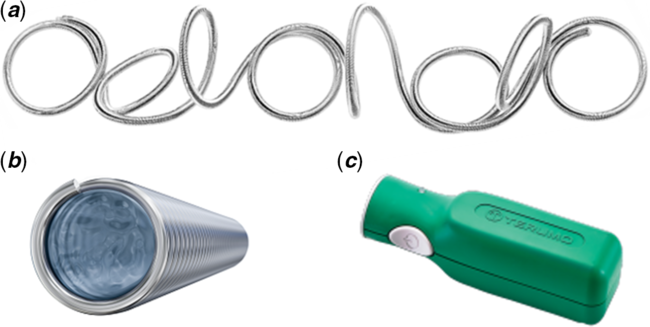
The Azur Peripheral Hydrocoil (Terumo; Somerset, NJ, USA) has been used in the treatment of intracranial aneurysmsReference White, Lewis, Nahser, Sellar, Goddard and Gholkar1,Reference Gunnarsson, Tong, Klurfan, Cawley and Dion2 and its success for vascular occlusion in CHD has also been documented.Reference Goldstein, Aiyagari, Bocks and Armstrong3 Now, a new version of the Azur Hydrocoil, the Azur CX Peripheral Coil System (Fig 1a) has been used for small vessel embolisation.Reference Ebaugh and Chew4–Reference Harmon, Kaleka and Maciolek6 The Azur CX coil is made of a platinum alloy with an inner hydrogel core and has 3D Spherical Shape. The coil is available in a detachable delivery form, in 0.018″ and 0.035″ wire diameters with variable diameter loops (2–20 mm) and lengths (2–40 cm). The first loop is smaller which facilitate the coil placement in a tortuous anatomy, and it can be repositioned up to 30 minutes after delivery. This coil has a second-generation hydrogel technology and a cross-sectional coverage on the interior, which enables expansion between the gaps with hydrogel forming a solid coil core that increases the volume fill (Fig 1b). The system is compatible with the Progreat® microcatheter (Terumo; Somerset, NJ, USA) which allows a precise coaxial placement and positioning in a peripheral vessel through a 4F catheter. These coils are detached using the Azur Detachment Controller (Fig 1c), which is activated by the user and allows placement of the coil with minimal movement.
(a) Azur CX Peripheral Coil. (b) Azur CX Coil post-expansion with a solid core. (c) Azur Detachment Controller.

We report two cases of vessel embolisation in small infants with CHD. All vessels were successfully closed with the Azur CX Coil.
Case report
Patient 1
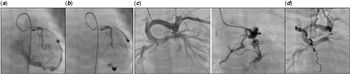
A 2-month-old male patient (63 cm, 6.73 kg) was referred to our hospital because of an asymptomatic continuous systolic–diastolic cardiac murmur. Transthoracic echocardiography showed dilation of the left coronary artery and two large coronary arterial fistulas between the left coronary artery and the right ventricle. A cardiac catheterisation was scheduled for percutaneous coronary artery fistula occlusion. Coronary angiography (Fig 2a) revealed two large coronary fistulas with 4 mm diameter that arose from the left main coronary artery and drained together into the apex of the right ventricle. The left coronary arterial ostium was entered with a 4F JL 1.5 catheter through which a Progreat® microcatheter and a 0.018-inch guide wire (Terumo; Somerset, NJ, USA) were placed. The Terumo wire was advanced through the fistula into the right ventricle, snared in the pulmonary artery, and externalised through the femoral vein. An Amplatzer Piccolo™ Occluder II 5/6 mm (St. Jude Medical; Saint Paul, Minnesota, USA) was advanced thought the regular 4F delivery into the fistula from the venous entry. However, the device was not delivered because it dislodged into the right ventricle during the intended device placement. Then an Azur CX Detachable Coil 5 mm/16 cm was implanted through the microcatheter, which had remained in the coronary fistula. Two loops of the coil were placed into the right ventricle and the rest was positioned into the fistula. Angiography demonstrated complete occlusion of the fistula (Fig 2b). The patient was discharged to the referring hospital two days after the procedure and the transthoracic echocardiography showed normal left coronary artery blood flow.
(a) Coronary angiography shows two large coronary fistulas between the left main coronary artery and the apex of the right ventricle. (b) Angiography after occlusion with Azur CX coil. (c) Angiographies shows a tortuous venovenous collateral that arise from the innominata vein and drain into the pulmonary veins. (d) Angiography after occlusion with one Azur CX coil.

Patient 2
An 8-month-old male patient (69 cm, 7 kg) born with tricuspid atresia and subpulmonary stenosis was admitted to the hospital due to low transcutaneous oxygen saturation (SpO2). The patient underwent a 3.5mm Gore-Tex central shunt in the first days of live and a partial cavopulmonary connection and atrial septostomy at 5 month of age. Angiographies showed a tortuous venovenous collateral that arose from the innominate vein and drained into the pulmonary veins (Fig 2c). Multiple approaches from the right jugular vein, using different catheters, were performed to selectively enter the venovenous collateral without success. Then though the left jugular vein, using a 4F modified right coronary super torque catheter and a Progreat® microcatheter, it was possible to enter the collateral. Four 4/2 mm Tornado® coils were implanted; however, important residual flow was present in post-implantation angiographies. Next, through the same catheters and despite the small landing zone, one 3 mm/8 cm Azur CX coil was successfully delivered with complete occlusion of the venovenous collateral (Fig 2d). After the catheterisation, the patient was discharged with a SpO2 > 80%. Total cavopulmonary connection will be performed between 18 and 24 months of age.
Discussion
We present two cases of small infants with CHD in whom we successfully closed a coronary fistula and a venovenous vessel causing right to left shunt, using Azur CX coils. There are currently several occlusion devices and their effectiveness has been reported in the field of CHD.Reference Schwartz, Glatz, Rome and Gillespie7,Reference Sathanandam, Justino, Waller, Gowda, Radtke and Qureshi8 As the Azur Hydrocoil, this coil is made of a platinum alloy that does not generate significant artefacts on MRI, which is advantageous in patients who need lifelong follow-up. Unlike the previous version, the Azur CX does not need a prehydration before the delivery to enhance the softness profile and it can be repositioned up to 30 minutes after the delivery. Compared to similar sized peripheral coils, Azur CX offers a superior volume and packing density per 1 cm of length9 as it has a cross-sectional coverage on the coil interior which enables expansion between the gaps with hydrogel and forms a solid coil core. Thus, Azur CX has the potential to use fewer coils in small vessel embolisation procedures. Additionally, hydrocoils have a lower midterm recanalisation rate compared with fibered coils.Reference Fohlen, Namur, Ghegediban, Laurent, Wassef and Pelage10 The other major advantage is the detachment controller system, activated by the user allowing a precise placement with minimal movement. Without controlled deployment, complete vessel occlusion close to the origin of a feeding artery may be difficult to achieve, since the last coil may protrude into the feeding artery.
In summary, the advantages that make this coil suitable for treating small infants with high-flow abnormal vessels and veins with difficult access are the low profile of the device and the ability to deliver them through a microcatheter. The volumetric filling allows complete vessel occlusion using fewer coils, making the procedure faster and more effective which is important in small haemodynamically instable children. Coil repositioning is possible up to 30 minutes after delivery and the detachment is highly controlled.
Acknowledgements
None.
Financial support
This research received no specific grant from any funding agency, commercial or not-for-profit sectors.
Conflicts of interest
None.
Ethical standards
The authors assert that all procedures contributing to this work comply with the ethical standards of the relevant national guidelines on human experimentation and with the Helsinki Declaration of 1975, as revised in 2008, and have been approved by the institutional committees.