INTRODUCTION
The US racial landscape is as contradictory as ever. The Black middle class has never been larger or more influential, and Americans twice elected a Black President of the United States. At the same time, there remains no shortage of racially polarizing discourse, displays, and events, including the divisive 2016 presidential election and the beginning of the Trump Era. Moreover, persistent racial inequality in the material conditions of American life cannot be denied.
One of the central intellectual projects in disentangling these contradictory circumstances is tapping key features of contemporary racial attitudes; that is, identifying the feelings, beliefs, and elements of ordinary discourse that capture Whites’ central tendency regarding race today. Once, there was broad-based support for Jim Crow racial perspectives. Surveys conducted in the 1940s show that substantial numbers of Whites endorsed segregationist, openly discriminatory statements, and saw Blacks as their natural, innate inferiors (Schuman, Steeh, Bobo and Krysan Reference Schuman, Steeh, Bobo and Krysan1997). Subsequent years witnessed a steady retreat from Jim Crow views; this disavowal of old-fashioned racism has left scholars intensely debating the tenor of current racial outlooks.
An abundance of research has focused on an attitude labeled racial resentment (or modern racism or symbolic racism). It is theorized as a subtle and politically potent anti-Black psychological orientation. Racial resentment is subtle in that it lacks Jim Crow racism’s overt belief in Blacks’ biological inferiority. Instead, it is a bitter condemnation arising from the belief that Blacks are culturally deficient, and fail to adhere to traditional moral values. From this perspective, Blacks are no longer victims of discrimination, but rather seek unearned privilege and advantage (Kinder and Sears Reference Kinder and Sears1981; Kinder and Sanders Reference Kinder and Sanders1996; Henry and Sears Reference Henry and Sears2002). Racial resentment is politically potent in that it powerfully predicts opinions about explicitly racial policies, such as affirmative action, and tacitly racial policies, such as welfare. If we wish to understand the persistence of racial tension and dispute, especially in the political arena, the answer is to be found in the emergence and potency of racial resentment (Williams et al. Reference Williams, Jackson, Brown, Forman, Torres and Brown2000; Tuch and Hughes Reference Tuch and Hughes2011).
The construct and its measurement have generated substantial debate. We focus on one key line of contention: what is the constellation of values, feelings, and beliefs measured by the racial resentment scale (RRS)? One group of scholars argues that the RRS captures something important about Whites’ racial outlooks, but disagree about the locus of its hostility. Theorists trace the emergence of racial resentment to social forces – “alterations in intellectual currents, changes in economic arrangements, and eruptions of political crisis” (Kinder and Sanders Reference Kinder and Sanders1996, p.294) – yet deemphasize the role that such factors continue to play in the replication and alteration of racial resentment across time. Influenced by Allport’s (1954) socio-cultural perspective on racial prejudice, racial resentment theorists focus on psychological forces, foregrounding values and affect that are learned through early childhood socialization and later crystalize as racial acrimony (Kinder and Sears Reference Kinder and Sears1981; Henry and Sears Reference Henry and Sears2009).
In contrast, scholars influenced by Blumer’s (1958) sociological perspective on prejudice contend that racial animus is primarily informed by socially emergent, collective, and dynamic struggles over relative group position. Despite its initial theorization, several scholars have suggested that racial resentment is fundamentally concerned with social perceptions about group status hierarchies (Hughes Reference Hughes, Tuch and Martin1997; Sidanius, Devereux, and Pratto Reference Sidanius, Devereux and Pratto1992; E. Smith Reference Smith, Mackie and Hamilton1993). Understanding the locus of the racial hostility captured by the RRS has implications for how scholars theorize the nature, causes, consequences, and amelioration of the current expression of racial animus.
Yet a third group of scholars argue that the RRS is an invalid measure of racial enmity, proposing that it primarily measures non-racial political dispositions, incorrectly characterizing them as prejudice. Some contend that the RRS merely taps opinions about the policy preferences it seeks to predict (Schuman Reference Schuman, Sears, Sidanius and Bobo2000; Carmines, Sniderman, and Easter Reference Carmines, Sniderman and Easter2011). Others propose that it primarily assesses non-racial values and political principles (Sniderman and Tetlock Reference Sniderman and Tetlock1986; Sniderman and Carmines Reference Sniderman and Carmines1997; Sniderman, Crosby, and Howell Reference Sniderman, Crosby, Howell, Sears, Sidanius and Bobo2000; Feldman and Huddy Reference Feldman and Huddy2005). In response, racial resentment theorists have argued that the RRS is distinct from non-racial politics (Henry and Sears Reference Henry and Sears2002; Sears and Henry Reference Sears, Henry and Zanna2005), instead measuring non-racial values about individualism and fairness, and beliefs about the contemporary relevance of race and the sources of racial inequality. These distinctions bear upon whether the potency of the RRS lies in its measurement of current racial outlooks – as intended – or in its erroneous indexing of non-racial political dispositions. Given these debates, we ask, to what extent does the RRS measure non-racial values and racial beliefs?
Our overarching aim is to map the meaning of RRS responses. Given the contention surrounding the measure, some might ask, “why bother,” especially since scholars have suggested alternative measures of current racial prejudice (Wilson and Davis Reference Wilson and Davis2011). Our admiration of these efforts does not negate the fact the RRS has been widely-used for over two decades, and its use shows no sign of abatingFootnote 1. Therefore, it is prudent to more fully understand the constellation of attitudes captured by one of the most prominent measure of racial hostility.
We use a multimethod approach, conducting quantitative analyses of closed-ended survey items and extensive qualitative analyses of detailed open-ended responses. We consider the sample as a whole and conduct subgroup analyses. To foreshadow what is to come, we find that the racial animus measured by the RRS is firmly grounded in social concerns about relative group position, reflecting psychological acrimony to a lesser degree. Corresponding with its theorists’ narrative, the RRS substantially measures beliefs about the continued relevance of race for Blacks’ life chances and the sources of racial inequality, and values about individualism and fairness. We find little evidence that the RRS measures non-racial political dispositions.
BACKGROUND
Theorizing Racial Resentment
Social scientists across disciplines have emphasized racial resentment (Kinder and Sears Reference Kinder and Sears1981; Sears Reference Sears, Katz and Taylor1988) as a theoretical account of contemporary racial animus. Racial resentment—and its doppelgangers symbolic racism (Kinder and Sears Reference Kinder and Sears1981; Henry and Sears Reference Henry and Sears2002) and modern racism (McConahay Reference McConahay, Dovidio and Gaertner1986)—is characterized as a subtle hostility for modern times. Kinder and Sanders (Reference Kinder and Sanders1996) explain:
a new form of prejudice has come to prominence, one that is preoccupied with matters of moral character, informed by the virtues associated with traditions of individualism. At its center are the contentions that Blacks do not try hard enough to overcome the difficulties they face and that they take what they have not earned. Today, we say, prejudice is expressed in the language of American individualism (p.105–106).
Theorists argue that racial resentment is animated by the following narrative: a) structural obstacles to Blacks’ success, such as widespread racial prejudice and discrimination, are things of the past, b) Blacks struggle to succeed because of cultural deficiencies of their own making, and c) Blacks unfairly “play the race card” to circumvent expectations about self-reliance and industriousness. Racial resentment is informed by non-racial values about individualism and fairness, hostile racial affect, and beliefs about the continued relevance of race in the US and the sources of racial inequality.
The racial resentment scale (RRS) aims to measure this racial enmity. Kinder and Sanders (Reference Kinder and Sanders1996) write that the items “focus on Blacks as a group,” are “designed to reveal “antipathy,”” and are “preoccupied with character: effort, enterprise, and determination” (p.108). To reflect the post-Jim Crow shift toward racial egalitarianism, the RRS was designed as an indirect measure of racial hostility. Kinder and Sanders (Reference Kinder and Sanders1996) propose that,
Compared to most efforts to measure racial animosity, these questions should appear rather subtle. They do not require Whites to declare in straightforward fashion that Blacks are dim-witted or lazy or promiscuous. Their approach is more roundabout. The questions distinguish between those Whites who are generally sympathetic toward Blacks and those who are generally unsympathetic (p.106).
Although this circuitous approach aligns with the theorization that racial resentment is a subtle form of racial hostility, it has contributed to ambiguity and debate about how RRS responses should rightly be interpreted.
The Locus of Contemporary Racial Animus
Among those asserting that the RRS is a valid measure of Whites’ racial outlooks, there is disagreement about the locus of its racial hostility. Influenced by Allport’s (1954) socio-cultural view of prejudice, racial resentment theorists primarily focus on psychological acrimony, arguing that non-racial values, racial affect, and racial beliefs are learned through early childhood socialization and crystalize as racial resentment by early adulthood (Henry and Sears Reference Henry and Sears2009; Sears and Kinder 1981). This model situates racial enmity as a relatively static hostility, arising when young Whites judge Blacks vis-à-vis an abstract moral standard and find them lacking.
Racial resentment theorists downplay tangible, personal self-interest motives (i.e., individual loss/gain from racial change) and collective group struggles over material or political resources (i.e., group loss/gain from racial change) as foundations of racial animus (Kinder and Sears Reference Kinder and Sears1981; Kinder and Sanders Reference Kinder and Sanders1996). Kinder and Sanders (Reference Kinder and Sanders1996) write, “as portrayed in [the RRS], the ‘problem of race’ is not the threat that Blacks might pose to Whites’ personal safety or to their material well-being, but to their sense of civic virtue. To Whites who agree with the premise of these questions, Blacks constitute a moral threat, one that challenges ‘how we are to order our lives and our life as a community’” (p.108).
This view of racial animus contrasts with the group position model proposed by Blumer (Reference Blumer1958) and subsequently elaborated by a number of scholars (Bobo Reference Bobo1983; Bobo Reference Bobo, Katz and Taylor1988; Bobo Reference Bobo1999; Bobo and Hutchings, Reference Bobo and Hutchings1996; Bobo et al., Reference Bobo, Kluegel, Smith, Tuch and Martin1997; Bobo and Tuan, Reference Bobo and Tuan2006; Smith Reference Smith1981; Wellman Reference Wellman1977).Footnote 2 These scholars propose that racial attitudes are group-level normative judgments; that is, they involve ideas about the resources, statuses, and privileges that members of different groups are rightly entitled to enjoy. These attitudes are developed and mobilized in collective struggles over the allocation of such resources. In this perspective, racial animus is a dynamic hostility arising when Whites judge Blacks’ status in society vis-à-vis their own, and see threats to their own advantageous group position.
Despite its underlying theorization, several scholars have argued that the RRS substantially captures this locus of racial animus. For example, Jim Sidanius and his colleagues (1992) stressed that the RRS items are, at their core, normative statements about support for group-based inequality. Extensive analysis of 1986 and 1992 National Election Study led sociologist Michael Hughes (Reference Hughes, Tuch and Martin1997) to conclude that: “The issue represented by symbolic racism is status and power and Whites’ fear of losing them” (p.74). Social psychologist Eliot Smith (Reference Smith, Mackie and Hamilton1993) reached a similar conclusion, arguing, “there is reason to identify symbolic racism with group-based, emotion-linked appraisals” stemming from “perceivers views of their group interests” (pp.308–309).
The RRS, Non-Racial Values, and Racial Beliefs
Another group of critics asserts that the RRS is an invalid measure of racial animus; contending that it substantially measures non-racial political dispositions, incorrectly characterizing them as racial hostility. Some suggest that it merely measures the public policy preferences that it seeks to predict (Carmines et al., Reference Carmines, Sniderman and Easter2011). For example, Howard Schuman (Reference Schuman, Sears, Sidanius and Bobo2000) cautions that individuals might provide ostensibly “resentful” responses on completely non-racial bases. He writes, “Although I personally support some types and degrees of preferential treatment at present, I also believe that it is possible for someone to oppose preferential treatment on what are genuinely equalitarian grounds and at the same time support vigorous efforts against all forms of discrimination” (p.314). Racial resentment theorists deny this charge, arguing that this critique only applies to some of the RRS items, and show that the explanatory power of the RRS is uncompromised when these questions are removed (Sears and Henry, Reference Sears, Henry and Zanna2005).
Still others propose that the RRS primarily measures non-racial political dispositions (Sniderman et al., Reference Sniderman, Crosby, Howell, Sears, Sidanius and Bobo2000). For instance, Stanley Feldman and Leonie Huddy (2005) write,
… [the RRS] may be confounded with the expression of conservative ideology because it draws heavily on the language of individualism. Consider the third item in the resentment scale that suggests that if Blacks tried harder they could be just as well off as Whites. A strong individualist would agree with this statement; they would also agree with any other statement that referred to the positive effects of hard work, regardless of the target person’s race, gender, or other characteristics (p.170).
Racial resentment theorists reject this critique, providing evidence that although the RRS is correlated with non-racial political dispositions – such as preference for limited government and political ideology—it is fundamentally distinct from them (Henry and Sears Reference Henry and Sears2002; Sears and Henry Reference Sears, Henry and Zanna2005). Based on the underlying narrative theorized to animate racial resentment, the RRS should instead measure non-racial values about individualism and fairness, and beliefs about the contemporary relevance of race and the sources of racial inequality.
Research Strategy
Our ambition is to map the meaning of RRS responses, investigating the extent to which they reflect a) racial animus grounded in psychological acrimony, b) social concerns about relative group position, and c) non-racial values and political principles. We begin by quantitatively analyzing a survey-based experiment investigating the extent to which priming respondents’ sense of group position affects patterns of RRS response and/or patterns in the magnitude, direction, or significance of its predictors. If we observe substantial differences across conditions, it would indicate that considerations about group position are distinct from, yet associated with, RRS responses. In the event that response patterns are unaffected by priming sense of group position, it might indicate that such considerations are part and parcel of RRS responses. Or, alternatively, that such considerations are wholly unrelated to RRS responses.
To adjudicate between these explanations, we examine correlations between the RRS and items measuring respondents’ sense of group position. If the sets of items are uncorrelated, it would indicate that considerations about group position are unrelated to RRS responses. If the sets of items are correlated but load onto independent factors, it would indicate that such considerations are related to RRS responses, but are substantively different from them. If the sets of items are highly correlated and load onto a single factor, it would indicate that the group position items and the RRS tap similar underlying constructs.
Then, we use what prove to be extensive open-ended data to qualitatively map the locus of the racial animus measured by the RRS, and to chart the constellation of non-racial values and racial beliefs informing RRS responses. Finally, we link the quantitative and qualitative data, exploring how respondents’ frames of reference vary across levels of resentment and political partisanship.
METHODS
We analyze data from the 2009 Race Cues, Attitudes, and Punitiveness Survey (RCAPS), which was conducted via the InternetFootnote 3 with an AAPOR response rate 1 of 27.3%Footnote 4 The non-full probability sample contained 1,500 respondents who were representative of the US population. For information about the survey’s methodology, see Simmons and Bobo (Reference Simmons and Bobo2015). The current study uses the unweighted data, focusing on 1,050 White respondents.
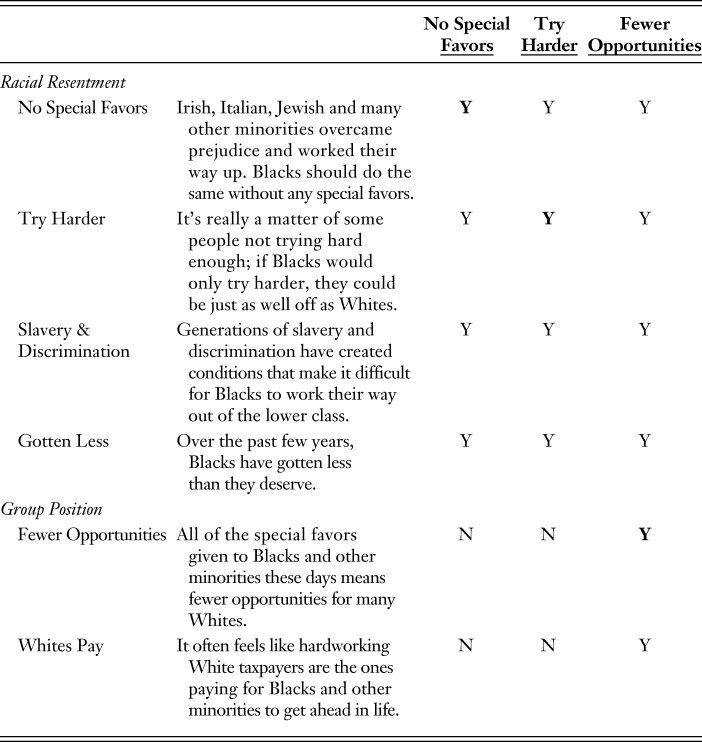
The RCAPS contained a survey-based experiment where some respondents were primed to think about group positon before addressing the RRS and others were not. The design featured three ballots: the 325 respondents randomly assigned to the No Special Favors ballot and the 377 respondents assigned to the Try Harder ballot began the racial attitudes section of the RCAPS with the corresponding RRS question. The 348 respondents assigned to the Fewer Opportunities ballot began with a question measuring their sense that Blacks threaten Whites’ status in the racial hierarchy; this question was the initial group position prime.
Then, all respondents were asked: “Would you please tell us why you feel that way,” and typed their responses in a large text-box. This question was pioneered by Bobo and Tuan (Reference Bobo and Tuan2006), and is a novel approach to eliciting respondents’ sentiments, allowing them to “vent” their feelings, ultimately revealing the frames of reference informing their views. Respondents seriously answered the open-ended question, providing complex, multiple-sentence accounts of their viewsFootnote 5. Answers were 40 words long, on average, and about half appealed to two or more frames of reference. Our approach to understanding the feelings, values, and beliefs informing RRS responses has two obvious limitations. First, it only captures respondents’ conscious schemas; therefore, we cannot study how implicit cognitions inform RRS responses. Second, it is subject to social desirability bias. However, the RCAPS is a self-administered online questionnaire, a mode that should mitigate this phenomenon (Kreuter et al., Reference Kreuter, Presser and Tourangeau2008; Krysan Reference Krysan1998).
After answering the open-ended item, respondents completed the remaining RRS questions in a randomly assigned order. To further reinforce the initial prime, respondents assigned to the Fewer Opportunities ballot also answered a second group position question randomly mixed in with the RRS items.
Quantitative Measures
The RRS is a widely used four-item index (Kinder and Sanders Reference Kinder and Sanders1996) coded on a 0-1 scale such that higher values indicate greater resentment. Respondents used a five-point agree/disagree scale to address the statements listed in table 1. The mean RRS score was 0.67, with a standard deviation of 0.26; its alpha reliability was 0.84.
Question Wording and Appearance by Experimental Ballot
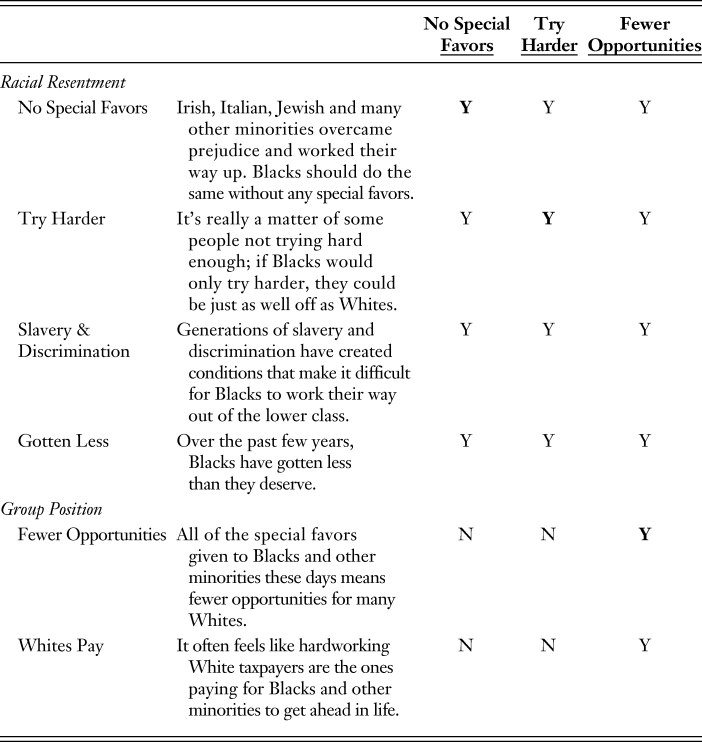
Note: Respondents used a five-point agree/disagree scale to address the statements above. Slavery and Discrimination and Gotten Less were reverse coded when creating indexes. Y indicates that the item appeared on a ballot, and N indicates that it did not; a bolded Y indicates the ballot’s lead item.
We measured subjective perceptions of threat to racial group position with two new questions that situate Whites against Blacks and other minorities in a direct zero-sum competition. Respondents assigned to the Fewer Opportunities ballot used a five-point agree/disagree scale to respond to the statements listed in table 1. The group position index was coded on a 0-1 scale such that higher scores indicate greater perceptions of threat. The mean score was 0.61, with a standard deviation of 0.33; its alpha reliability was 0.86. Because our items are explicit about race relations, respondents might read them as violating egalitarian norms, triggering a reduction in subsequent RRS scores (Mendelberg Reference Mendelberg2001). Alternatively, these considerations might be part and parcel of RRS responses, in which case, priming them will have null effects.
The RCAPS measured four groups of variables that are well-established correlates of racial resentment (Kinder and Sanders Reference Kinder and Sanders1996). All variables are standardized to a 0-1 scale; however, some are reported in their original units below for ease of interpretation. There were four demographic variables. Age is a continuous variable ranging from 19-88 years, with a mean of 49 years and a standard deviation of 16 years. Southern is a dichotomous variable coded 1 for residence in a southern US state; 33% of respondents resided therein. Education is a six-point scale indicating respondents’ highest level of attainment, ranging from “less than high school” to “post-graduate;” 27% of respondents reported a bachelor’s degree or higher. Income is a fourteen-point variable ranging from “less than $10,000” to “$150,000 or more;” respondents’ average income was $50-59,999.
Non-racial values were assessed by two variables. Political ideology is a five-point scale ranging from “very liberal” to “very conservative;” 21% of the sample identified as liberal and 41% identified as conservative. Egalitarianism is a six-item index, coded such that higher values indicate greater egalitarianism. Respondents used a five-point agree/disagree scale to evaluate statements such as “Our society should do whatever is necessary to make sure that everyone has an equal opportunity to succeed.” The mean score was 0.52 with a standard deviation of 0.25; its alpha reliability was 0.84.
Racial affect was assessed by a feeling thermometer difference score, which captures the degree to which respondents feel warmer toward Whites than Blacks. Respondents used two feeling thermometers to indicate their warmth/coolness toward both groups; these variables were coded on continuous 0-1 scales, such that higher values indicate more coolness toward the target group. Subtracting a respondent’s feelings toward Whites from their feelings toward Blacks created a difference score. This variable was recoded to a 0-1 scale, such that respondents who were as warm or warmer toward Blacks than Whites were recoded to 0, and those who rated Whites more favorably than Blacks comprise the rest of the range up to 1 (Carmines et al., Reference Carmines, Sniderman and Easter2011). The mean score was 0.13 with a standard deviation of 0.18.
Racial beliefs were measured by a racial stereotype index difference score. Respondents used two seven-point bipolar rating scales to assess Blacks and Whites on the dimension of hardworking/lazy. These variables were coded on a 0-1 scale, where values of 1 indicate the most negative ratings. A stereotype difference score was created following the procedure described above. The mean score was 0.14 with a standard deviation of 0.22.
The RCAPS also measured four objective indicators of threat to Whites’ position in the racial status hierarchy. Percent Black is Blacks’ share of the population in respondents’ census tracts; on average, respondents lived in tracts that were 6% Black. Gini indices measure the degree of economic inequality within a racial group living in the respondents’ census tracts; the White Gini index mean was 0.40, with a standard deviation of 0.13, and the Black Gini index mean was 0.40, with a standard deviation of 0.23. Black median income represents Blacks’ share of Whites’ median income in respondents’ census tract. It is a truncated measure, such that locations where Blacks earn as much or more than Whites were collapsed at the highest value. On average, respondents lived in locations where Blacks earned 70% of Whites’ income.
Qualitative Measures
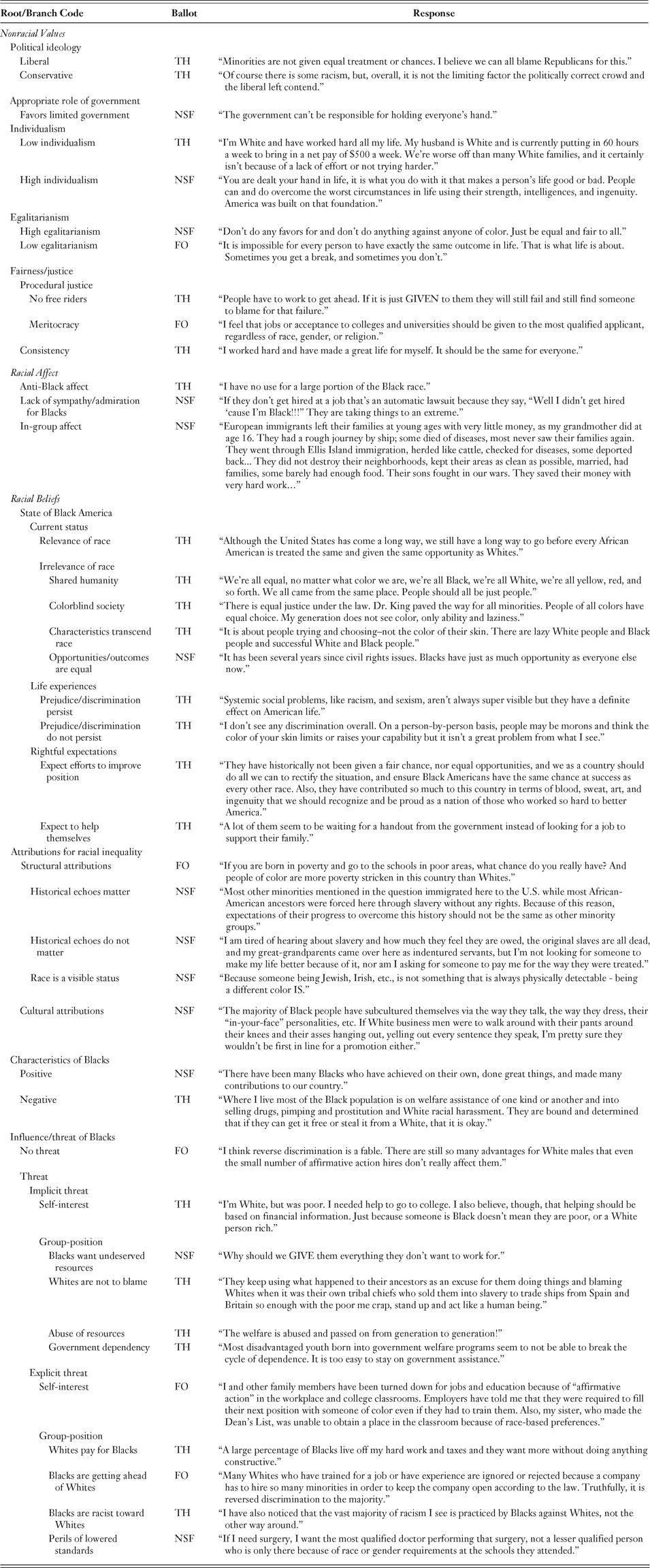
We use the RCAPS’ rich qualitative data to illuminate the meaning of our quantitative results (Krysan Reference Krysan1999). To characterize these data, we developed a coding scheme grounded in Krysan’s (2000) comprehensive review of the relationship between racial attitudes and public policy preferences. She details three central domains of study: non-racial values/principles/politics, racial affect, and racial beliefs. Developing and applying the codes was an iterative process: we drew on the previous theoretical and empirical literature to sketch the parameters of each code, applied the codes to a sample of the data, assessed the fit between the codes and the data, revised the codes, and applied them to a new sample. Overall, we found that our literature-driven categories mapped quite well onto the data.
Our scheme is arranged in a tree structure consisting of three root codes, each with a series of branches. The first root code focuses on appeals to non-racial values; these are abstract ideas about what is good or bad. This root has five branches. Political ideology captures appeals to liberalism or conservatismFootnote 6. Appropriate role of government (Markus Reference Markus1990) focuses on ideas about what the government should and should not do. Individualism (Feldman Reference Feldman1988) centers on appeals to the value of hard work and personal responsibility. Egalitarianism (Feldman Reference Feldman1988) focuses on beliefs about the acceptable degree of inequality in society, encompassing ideas about whether people should have equal opportunities, receive legally enforced equal treatment, and receive rewards from a constrained range, ensuring less disparity. Fairness encompasses ideas about equitable processes and outcomes, and consistency across cases, meaning that if one group experiences X, then every group ought to experience X.
The second root code captures expressions of racial affect, or feelings toward Blacks; this code has three branches. Anti-Black affect captures explicit racial hostility, found in racial slurs and blatant statements of dislike. Lack of sympathy/admiration for Blacks taps racial exasperation, including references to Blacks “complaining,” “having a victim mentality,” and “crying racism.” This code is the hallmark of racial hostility grounded in psychological acrimony. In-group affect measures explicit racial affinity for Whites. In practice, no respondents made explicit declarations of in-group affect; rather, these expressions were tacit, manifesting as romantic descriptions of Whites as paragons of morality.
We label the final root code racial beliefs, which encompass concrete ideas about what is true and false about BlacksFootnote 7; this code has four branches. The relevance of race captures beliefs about the impact of race on Blacks’ life chances in the contemporary US, and the nature of Blacks’ rightful expectations for official efforts to improve their social and economic position. Attributions for racial inequality focus on explanations about why Blacks generally have worse jobs, income, and housing than Whites. Some respondents made structural attributions, arguing that stable patterns of relations are responsible for racial inequality, while others made cultural attributions, arguing that Blacks’ deviance from White middle-class norms is responsible. Characteristics of Blacks aligns with traditional measures of stereotyping, capturing positive and negative traits associated with Blacks, such as hardworking/lazy and prefer to live off welfare/prefer to be self-supporting. Influence/threat of Blacks taps ideas about relative group position, that is, how Whites understand themselves vis-à-vis Blacks. This code is the hallmark of racial animus grounded in social considerations about group status hierarchies. Some respondents argued that Blacks pose no threat to Whites, while others asserted that Blacks are a threat. These latter responses were further categorized depending on whether the perceived threat was based in self-interest or group-interest, and whether the threat was implicit or explicit.
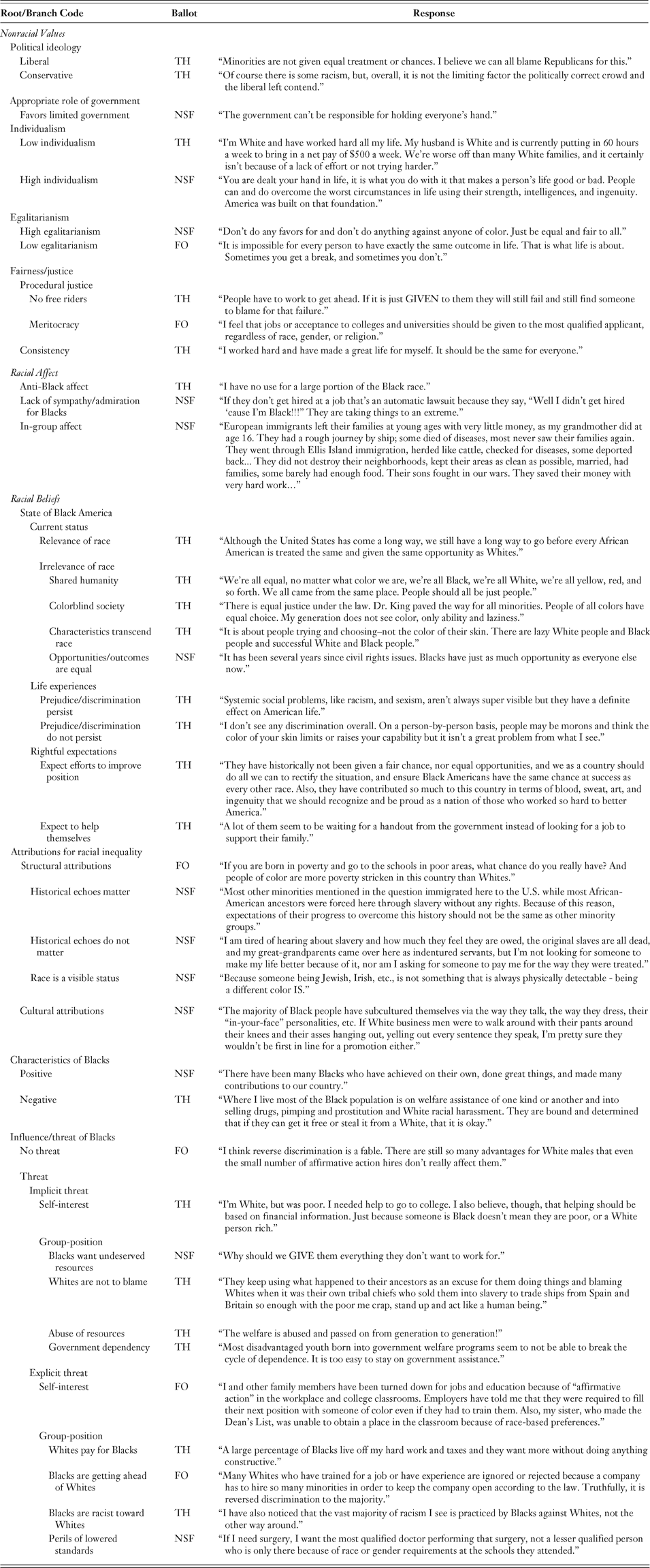
The codes were applied to segments of responses reflecting a frame of reference, meaning that some codes were applied to a single sentence, others to multiple sentences, and still others to the entire response. If a respondent appealed to a frame of reference more than once, all of the relevant statements were captured by a single code. And if a respondent invoked two or more unique frames of reference, each would receive its respective code. Refer to the Appendix for a summary of the qualitative coding structure and exemplary quotes.
RESULTS
Quantitatively Exploring the Locus of Racial Resentment
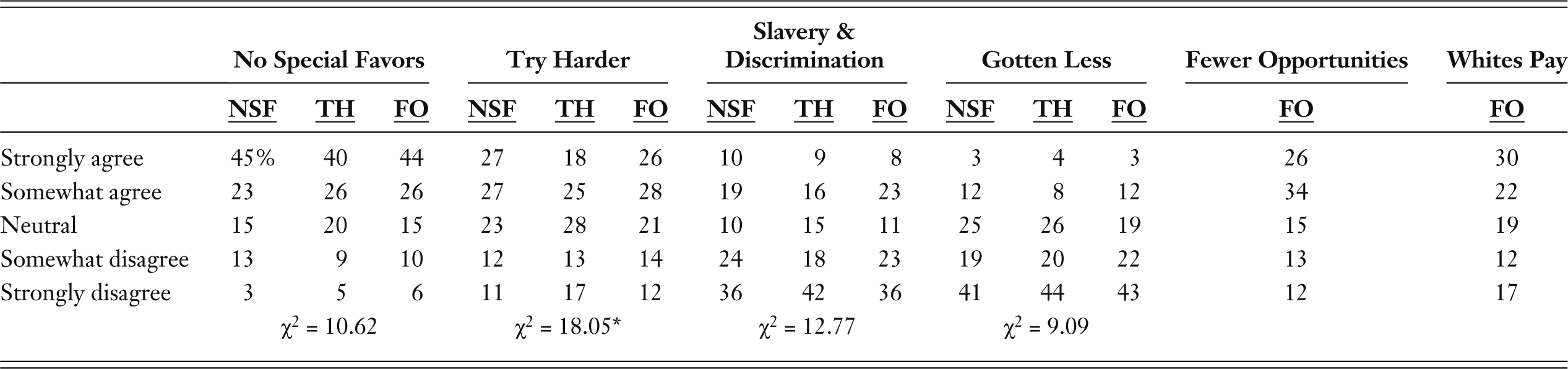
We begin by investigating the extent to which priming social considerations about relative group position affects patterns of RRS responseFootnote 8. If there are substantial differences across conditions, it would indicate that social concerns about group status hierarchies are related to, but distinct from, the considerations informing RRS responses. Table 2 shows that the distribution of responses to three of the four RRS questions are unaffected by ballot assignment. Chi-square tests indicate that responses to the Try Harder question significantly vary across ballots. However, this difference is not caused by priming group position, rather, the Try Harder question itself causes the effect: respondents assigned to the Try Harder ballot are less likely than others to agree that “if Blacks would only try harder, they could be just as well off as Whites”Footnote 9. We suspect that this occurs because the Try Harder question leads with a racial belief that respondents might interpret as overtly critical of Blacks’ personal qualities, thus increasing social desirability pressures.
Quantitative Response Distributions by Experimental Ballot

Note: NSF represents the No Special Favors ballot, TH denotes the Try Harder ballot, and FO indicates the Fewer Opportunities ballot. Slavery and Discrimination and Gotten Less are reverse coded in subsequent analyses. N for the first four columns = 1,050. N for the last two columns = 348. * p ≤ 0.05
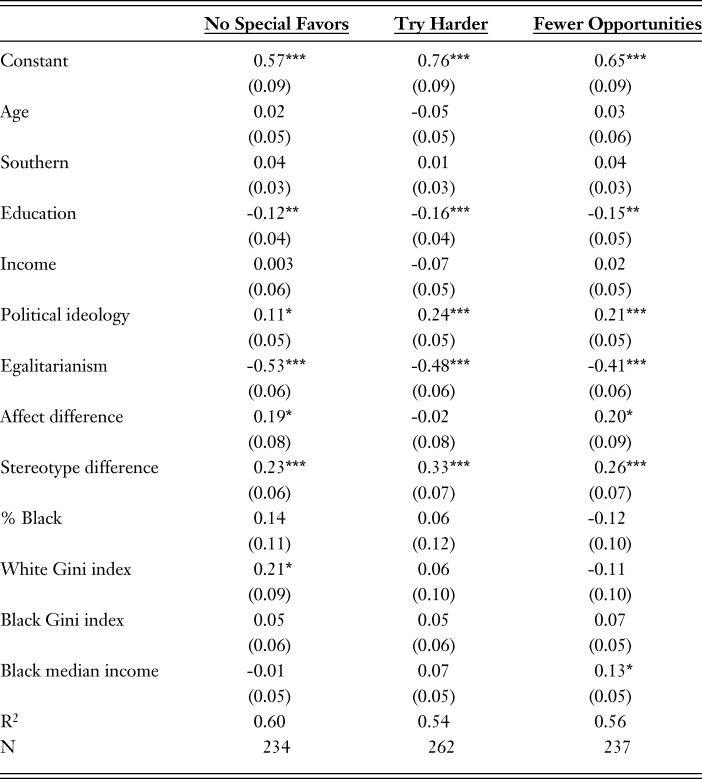
Next, we examine the extent to which priming social considerations about relative group position affects the magnitude, direction, or significance of variables predicting RRS responses. Substantive differences across models would indicate that concerns about racial group hierarchy have noteworthy differences from the considerations informing RRS responses. Table 3 shows OLS regressions predicting RRS responses across experimental ballots. We find considerable overlap across conditions: RRS scores consistently have significant positive relationships with conservative political ideology and unfavorable stereotypes about Blacks, and have significant negative associations with education and egalitarianism. The variance explained by the models ranges from 0.56-0.60.
OLS Regression of Racial Resentment by Ballot

Note: Coefficients are unstandardized with standard errors in parentheses. Higher values on political ideology indicate stronger conservativism. Higher values on the Gini index indicate greater economic inequality.
*** p ≤ 0.001, ** p ≤ 0.01, * p ≤ 0.05
We find few differences across ballots. First, increasing economic inequality among Whites’ in respondents’ census tracts has a significant positive relationship with RRS scores in the No Special Favors condition, but not in the other ballots. In other words, leading with the notion of “special favors” activates concerns about the degree of inequality within one’s own group, and as real in-group inequality increases, so does racial animus toward out-group members. Concurrently the magnitude of the relationship between RRS scores and political ideology diminishes, relative to the Try Harder and Fewer Opportunities ballots. This pattern of results aligns with a narrative where economically disadvantaged Whites ally with conservativism—despite harm to their economic interests—because the ideology serves emotional needs, allowing them to reconcile their real and perceived hardships with the idealized American Dream (Hochschild Reference Hochschild2016). In this model, conservativism serves an expressive, not instrumental, function, hence its diminished explanatory power when a measure of in-group stratification—the source of this tension—is controlled for.
Second, negative affect toward Blacks has a significant positive relationship with RRS scores in the No Special Favors and Fewer Opportunities ballots, but not in the Try Harder ballot. We interpret this dampening of the relationship between racial affect and RRS scores as further evidence that the Try Harder item is particularly vulnerable to social desirability pressures.
Third, in the Fewer Opportunities ballot, Blacks’ median income as a share of Whites’ in respondents’ census tracts is significant, unlike in the other conditions. We interpret this as further evidence that the group position prime successfully activates social considerations about racial group hierarchy. By explicitly highlighting these concerns, the relationship between an objective measure of group stratification and racial hostility toward that group is accentuated.
Additional analyses show that each of these variations have a trivial impact on the models’ R2. Overall, we find no meaningful difference in the significance, direction, or magnitude of RRS predictors across ballots, prompting us to conclude that, in theoretical terms, the models are substantively similar.
The evidence thus far indicates that priming social concerns about relative group position has minimal effects on patterns of RRS response or its predictors. Therefore, we conclude that social considerations about racial group hierarchy are not related to, but distinct from, those activated by the RRS. This null finding has two competing explanations. Perhaps the racial hostility captured by the RRS is substantially grounded in social concerns about group position. Alternatively, these considerations might be wholly unrelated to RRS responses.
To adjudicate between these interpretations, we examine the correlational relationship between the RRS and group position items. We find strong, positive, and significant correlations between the questions (p ≤ 0.001); the RRS items’ correlations with the Fewer Opportunities question range from 0.48–0.60, and its correlations with the White Taxes question range from 0.43–0.67. A principal components analysis indicates that the RRS and group position questions load onto a single factor with a total eigenvalue greater than one (3.56); this factor explains 64% of varianceFootnote 10. As a scale, the measures have a strong alpha reliability (0.89).
These findings clearly indicate that the RRS and group position questions tap into the same underlying constructs. To understand the relative balance of psychological acrimony and social considerations about relative group position in informing RRS responses, and to explore the extent to which responses reflect non-racial values and racial beliefs, we analyze our rich qualitative data to map the frames of reference respondents use to explain their views.
Qualitatively Mapping the Locus of Racial Animus
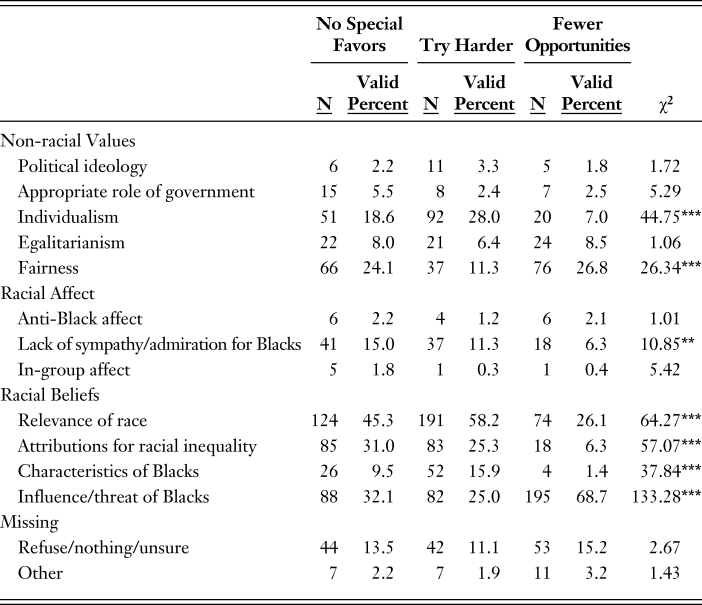
Racial resentment theorists propose that the locus of racial animus captured by the RRS is psychological—a blend of traditional moral values, negative racial affect, and abstract racial beliefs. Table 4 shows that a lack of sympathy/admiration for Blacks was the sixth most frequently used frame of reference to explain responses to the No Special Favors (15%) and Try Harder questions (11%). For instance, consider the response of a 25-year-old Southern man with a high school education who strongly agreed that Blacks should work their way up without any special favors: “I never owned a slave, why do my ancestors get thrown back in my face all the time? Black people use the past to get what they want and it’s a bunch of shit. We have politicians who are so scared of being called racist they do whatever the Black Man wants.”
Branch-Level Coding of Qualitative Responses by Experimental Ballot

Note: Percentages do not sum to 100 because responses can be coded in multiple categories.
*** p ≤ 0.001, ** p ≤ 0.01, * p ≤ 0.05
In contrast, group position scholars argue that the locus of contemporary racial animus is sociological, stemming from perceptions about the hierarchical arrangement of groups. The evidence in Table 4 strongly supports this proposition: the influence/threat of Blacks was the second most frequently used frame of reference when explaining views about the No Special Favors question (32%) and was the fourth most commonly used appeal in response to the Try Harder question (25%). Less than 1% of these respondents argued that Blacks pose no threat. Put differently, when respondents appealed to the influence/threat of Blacks, they did not offer reassurances about a continuing status quo, but rather warned of looming social changes.
A mere 7% focused on threats to individual self-interest, such as a 48-year-old Northern woman with an associates’ degree who somewhat agreed that Blacks should work their way up without special favors: “I am a small business owner and am still struggling to make ends meet because I am not a minority member and cannot get the handouts other “minority” persons do.”
Instead, the vast majority of appeals to the influence/threat of Blacks invoked group-level interests (93%). About half of these responses were implicit (47%). Many of these argued that Blacks believe they are owed valuable resources, such as a 36-year-old Northern woman with a high school diploma who strongly agreed that that Blacks should work their way up no special favors: “Blacks never seek equality, they seek favors and handouts. They have equal rights, they are the only ones who complain about their color. Of all minorities, Blacks are the only ones who can say ‘because of my color,’ and get something for it.” Others critiqued Blacks’ use of government assistance, such as a 49-year-old Southern man with a high school diploma who strongly agreed that Blacks should work their way up with no special favors: “They have had many years to make something for themselves and still want to depend on the government to pay for everything and not work their way through life.”
About half of responses appealing to the influence threat of Blacks were explicit (53%); almost all of these appeals argued that Blacks outpace Whites in opportunities/outcomes (93%). For instance, consider the response of a 19-year-old Northern woman with an associates’ degree who strongly agreed that Blacks should work their way up without any special favors: “Whites are now the minority. Blacks get as much rights as the Whites, they need to quit being stuck on the past. They get more rights than the Whites now, in my opinion.”
Taken together, the evidence indicates that psychological acrimony is a frame of reference for RRS responses. However, it is not a central consideration, used by less than one-in-five respondents. Instead, we find that social considerations about racial group hierarchy is a prominent frame of reference, used by approximately half of respondents. Therefore, we conclude that the locus of the racial hostility captured by the RRS is more grounded in social perceptions of relative group position than in psychological hostility.
Qualitatively Charting Non-racial Values and Racial Beliefs
The theorized narrative animating racial resentment suggests that RRS responses reflect non-racial values about individualism and fairness, and beliefs about the continued relevance of race for Blacks’ life chances and the sources of for racial inequality.
Table 4 shows that beliefs about the relevance of race was the most frequently used frame of reference in response to the Try Harder (58%) and No Special Favors questions (45%). About three-quarters of these respondents asserted that race is not a relevant characteristic, appealing to factors such as shared humanity and a colorblind society where opportunities and outcomes are equal. For example, consider the response of a 53-year-old Southern man with a high school diploma who strongly agreed that if Blacks would only try harder, they could be just as well off as Whites: “One thing about this country and this world for that matter is that EVERYONE has an equal opportunity to succeed if they are ambitious enough.”
Attributions for racial inequality were the third most frequently used appeal to explain responses to the No Special Favors (31%) and Try Harder items (25%). About half of these respondents invoked cultural deficits, such as a 21-year-old Northern woman with some college education who strongly agreed that Blacks should work their way up without any special favors: “the majority of Black people have subcultured themselves via the way they talk, the way they dress, their “in-your-face” personalities, etc. If White businessmen were to walk around with their pants around their knees and their assess hanging out, yelling out every sentence they speak, I’m pretty sure they wouldn’t be first in line for a promotion either.” The other half of respondents invoked structural obstacles, such the visibility of racial status characteristics or the importance of historical echoes, such as this 28-year-old Southern woman with a college degree who strongly disagreed that Blacks should work their way up without any special favors, “Most other minorities mentioned in the question immigrated here to the US while most African-American ancestors were forced here through slavery without any rights. Because of this reason, expectations of their progress to overcome this history should not be the same as other minority groups.”
Individualism was the second most widely used frame of reference in response to the Try Harder item (28%) and was the fifth most widely used appeal in response to the No Special Favors item (19%). Almost 90% of these respondents supported the tenets of individualism, such as a 44-year-old Northern woman with a high school diploma who somewhat agreed that Blacks should work their way up without special favors: “You are dealt your hand in life, it is what you do with it that makes a person’s life good or bad. People can and do overcome the worst circumstances in life using their strength, intelligence, and ingenuity. America was built on that foundation.”
Fairness was the fourth most widely used appeal in response to the No Special Favors item (24%) and the sixth most frequently used frame of reference in response to the Try Harder item (11%). Over half of these appeals focused on procedural fairness (59%). Some invoked meritocracy, such as a 60-year-old Northern man with a high school diploma who strongly agreed that Blacks should work their way up without any special favors: “I feel that the best qualified person should get the job no matter what sex, color, or age they are, and quotas should be abolished instead of rewarded.” Others reproached free riders, such as a 56-year-old Northern woman with some college education who somewhat agreed that if Blacks would only try harder, they could be just as well off as Whites: “Some people are lazy and would rather have things handed to them instead of working hard like other people do.” More than one-third of respondents cited consistency across groups (36%), such as a 32-year-old Southern man with some college education who strongly agreed that if Blacks would only try harder, they could be just as well off as Whites, “I worked hard and have made a great life for myself. It should be the same for everyone.”
Appeals to Blacks’ characteristics were the fifth most prominent frame of reference in regard to the Try Harder question (16%), and were used less often in response to the No Special Favors question (10%). Over 80% of these responses characterized Blacks negatively, invoking stereotypes about intelligence, industriousness, criminality, and family dynamics. For instance, a 60-year-old Southern woman with a bachelor’s degree who strongly agreed that Blacks should work their way up without any special favors asserted, “[Blacks] squander educational opportunities. Their family system has become matriarchal, with lots of baby daddies and no personal responsibility.”
Qualitatively Mapping Non-racial Political Dispositions
Critics allege that the RRS primarily measures non-racial political dispositions, incorrectly characterizing them as prejudice. The evidence thus far rebuts this claim; RRS responses are firmly grounded in beliefs about the contemporary relevance of race and the sources of racial inequality, and non-racial values about individualism and fairness. Table 4 further shows that appeals to political ideology or the appropriate role of government were used by trivial amounts of RRS respondents (No Special Favors: 2% and 6%, Try Harder: 3% and 2%). Almost 90% of these responses signaled conservativism, such as a 71-year-old Northern man with some college education who strongly agreed that Blacks should work their way up without special favors, “The liberals have kept the Blacks on the government (taxpayer) dole for too long just to have a captive voter group.”
Distinctions across Levels of Resentment
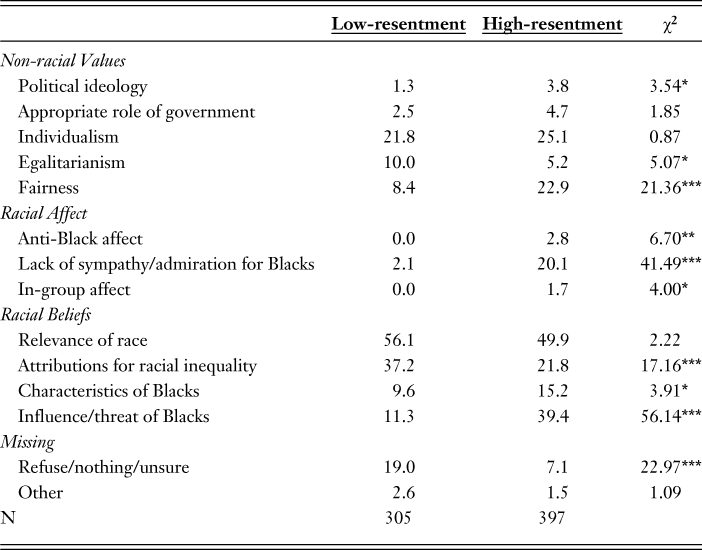
We have shown that the locus of racial animus captured by the RRS is firmly grounded in social considerations about racial group hierarchy. It also reflects beliefs about the current relevance of race for Blacks’ life chances and the sources of racial inequality, and values about individualism and fairness. We have also shown that RRS responses minimally engage non-racial political dispositions. Next, we explore whether the frames of reference informing RRS responses substantively vary across subgroups. We begin by splitting RRS scores at the mean, comparing the appeals invoked by low and high-resentment respondents. To conduct the most stringent examination possible, we use data from the No Special Favors and Try Harder ballots only, examining respondents’ reasoning without interference from the group position prime.
Table 5 shows that social considerations about relative group position are the locus of the racial hostility captured by the RRS. This was high-resentment respondents’ second most frequently used frame of reference (39%), and was used significantly less often by low-resentment respondents (11%). In contrast, psychological acrimony reflecting a lack of sympathy/admiration for Blacks was the sixth most frequently used frame of reference by high-resentment respondents (20%), and was invoked significantly less often by low-resentment respondents (2%).
Branch-Level Coding of Qualitative Responses by Level of Racial Resentment

Note: Level of resentment was determined by splitting the sample at the mean. Includes the No Special Favors and Try Harder ballots only.
*** p ≤ 0.001, ** p ≤ 0.01, * p ≤ 0.05
Among high-resentment respondents, beliefs about the contemporary relevance of race was the most frequently used appeal (50%), with almost all responses asserting that race is irrelevant (87%). Individualism was the third most frequently used frame of reference (25%), with 95% of responses endorsing this value. Fairness was the fourth most frequently used appeal (23%); high-resentment respondents were significantly more likely than low-resentment respondents to invoke this value. Attributions for racial inequality was the fifth most frequently used frame of reference (22%), with 69% of responses offering cultural attributions; high-resentment respondents were significantly less likely than low-resentment respondents to invoke attributions for racial inequality. Although high-resentment respondents were significantly more likely than low-resentment respondents to appeal to political ideology, this frame of reference was rarely used (4%). The constellation of values, feelings, and beliefs favored by high-resentment respondents is exemplified by a 33-year-old Southern woman with some college education who strongly agreed that Blacks should work their way up without special favors:
The times of need for affirmative action are over. The way has been sufficiently paved. Those activists remaining are only serving to propel racist attitudes in our society. I fear the pendulum is swinging in the other direction, meaning Black people are treated in a racist manner by being given a job, loan, etc. based on skin color. Anyone else who should happen to be after the same job, etc. is a victim of racism as well. Giving a person a job (or anything) because of the color of his skin IS racist, whether it be in that person’s favor or not. I also feel an air of racism from Black to White—sort of a sense of “now it’s our time.” That attitude is incredibly racist and reverses our progression toward equality.
Among low-resentment respondents, beliefs about the relevance of race was the most frequently used appeal (56%). Whereas almost all high-resentment respondents contend that race is irrelevant, only half of low-resentment asserted the same (48%). Attributions for racial inequality was the second most frequently used frame of reference (37%). Whereas over two-thirds of high-resentment respondents made cultural attributions, approximately three-quarters of low-resentment respondents made structural attributions (78%). Individualism was the third most frequently used appeal; although almost all high-resentment respondents endorsed individualism (95%), only two-thirds of low-resentment respondents did the same (65%). Egalitarianism was the fifth most frequently used appeal among low-resentment respondents (10%), but was significantly less prominent among high-resentment respondents (5%). Beliefs about Blacks’ characteristics was the sixth most frequently used frame of reference. Low-resentment respondents were significantly less likely than high-resentment respondents to use this frame of reference; whereas almost all high-resentment respondents invoked negative traits (94%), over two-thirds of low-resentment respondents invoked positive traits (69%). The constellation of non-racial values, racial affect, and racial beliefs favored by low-resentment respondents is exemplified by a 24-year-old Northern woman with some college education who somewhat disagreed that Blacks should work their way up without special favors:
Saying that Black people should earn it seems like saying that slavery was less harsh than Hitler’s rule. From what I’ve been taught, African people did not choose to come here; they were brought here and treated as less than human. Then set “free” and expected to succeed in a nation that never became open minded and did nothing to help them succeed. And is embarrassingly still closed-minded today.
Distinctions across Political Ideology
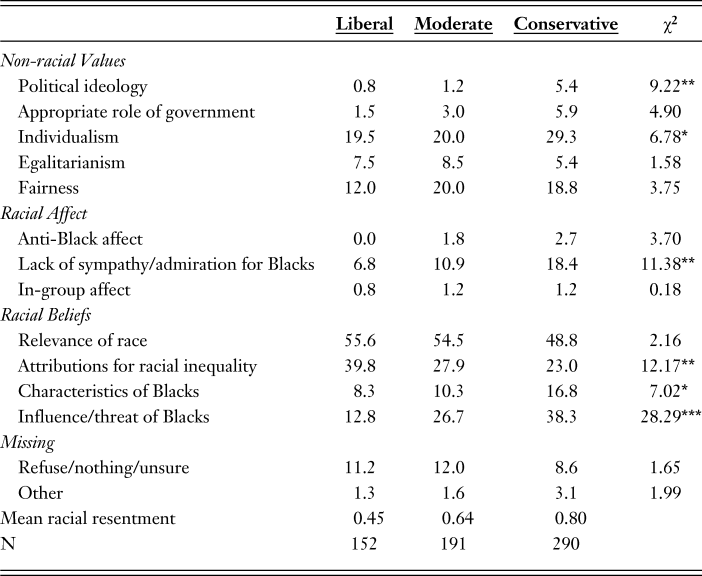
Finally, we use data from the No Special Favors and Try Harder questions to compare the frames of reference liberal, moderate, and conservative respondents use to explain their views. We do so because, as shown in Table 6, the mean level of racial resentment significantly varies across groups, such that conservatives have the highest levels of resentment (0.80), followed by moderates (0.64), and liberals (0.45). Although our previous analyses show that political dispositions have a very limited role in informing RRS responses, perhaps their use is concentrated within a partisan subgroup, offering a potential explanation for the variance in RRS scores across ideology.
Branch-Level Coding of Qualitative Responses by Political Ideology
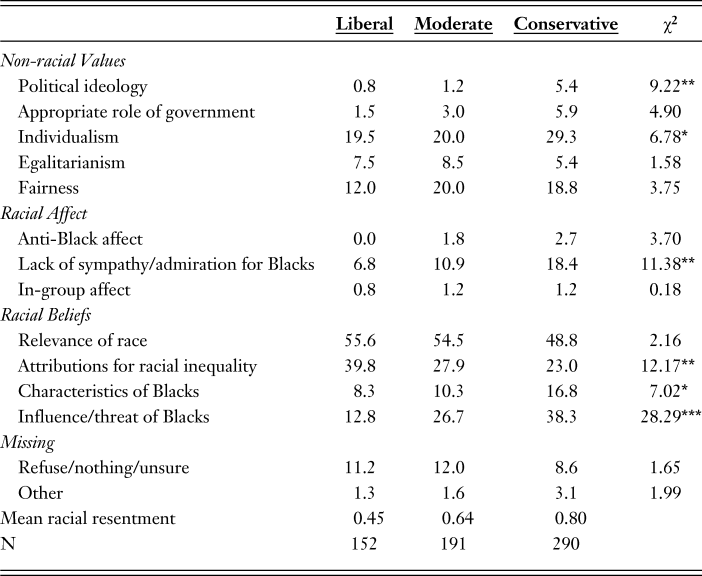
Note: Racial resentment is coded on a 0-1 scale such that high values indicate greater resentment; ANOVA indicates that levels of resentment significantly differ across levels of political ideology (sum of squares = 12.61***). Includes the No Special Favors and Try Harder ballots only.
*** p ≤ 0.001, ** p ≤ 0.01, * p ≤ 0.05
Table 6 shows that the locus of racial hostility animating conservatives is firmly grounded in considerations about relative group position. Invoking the influence/threat of Blacks was conservatives’ second most frequently used frame of reference (38%), and they used this frame of reference significantly more than moderates (27%) and liberals (13%). Conservatives and moderates making this appeal were more likely to assert that Blacks pose a threat (99% and 93%, respectfully) than liberals (72%). Conservatives were also significantly more likely than others to appeal to racial affect reflecting a lack of sympathy/admiration for Blacks; this was their six most frequently used frame of reference.
All groups were equally likely to invoke considerations about the relevance of race. Although this was the most frequently used frame of reference for each group, the nature of this appeal varied; over 90% of conservatives argued that race is irrelevant, compared to 69% of moderates, and 47% of liberals. Conservatives were significantly more likely than others to appeal to individualism; this was their third most frequently used frame of reference (29%). Conservatives were significantly less likely than others to invoke attributions for racial inequality. When they did, 73% of conservatives made cultural appeals, compared to 65% of moderates, and 50% of liberals. All groups were equally likely to appeal to fairness. Finally, conservatives were significantly more likely than liberals and moderates to appeal to non-racial political dispositions about ideology and the appropriate role of government; however, the overall number of conservatives using this frame of reference was small, totaling less than 6%.
Taken together, these results indicate that variance in RRS scores across the political spectrum is not a methodological artifact, whereby the RRS merely measures non-racial political dispositions. Although conservatives are more likely than others to use these frames of reference when addressing the RRS, such appeals are dwarfed by beliefs about the continued relevance of race, social concerns about the influence/threat of blacks, individualism, attributions for inequality, fairness, and psychological acrimony.
DISCUSSION
Our aim has been to map the meaning of RRS responses. One group of scholars have argued that the RRS measures something profound about Whites’ racial outlooks, but disagree about the locus of this racial animus; some foreground psychological acrimony; others, social considerations about relative group position. Our results indicate that the racial hostility captured by the RRS is firmly grounded in social considerations about racial group hierarchy. Appeals to the influence/threat of Blacks was the second most frequently used frame of reference for high-resentment respondents (39%), with 98% arguing that Blacks are a threat to Whites’ group position. Although we also find evidence of racial hostility grounded in psychological acrimony, with 20% of high-resentment respondents appealing to a lack of sympathy/admiration for Blacks, this frame of reference is overshadowed by concerns about Blacks encroaching on Whites’ racial prerogatives.
Another group of scholars have argued that the RRS is an invalid measure of racial attitudes; rather, it measures non-racial political dispositions, incorrectly characterizing them as prejudice. Our findings strongly rebut this claim; RRS responses are deeply rooted in racial beliefs. Considerations about the current relevance of race for Blacks’ life chances was the most frequently used appeal among low and high-resentment respondents (50% and 56%); whereas the vast majority of high-resentment respondents asserted that race is irrelevant, less than half of low-resentment respondents said the same. Such appeals are at the heart of the high-resentment narrative, and are reminiscent of the “minimization of racism frame” described by the color-blind racism perspective (Bonilla-Silva Reference Bonilla-Silva2006).
Moreover, attributions for racial inequality were a frequently used frame of reference by high and low-resentment respondents (22% and 37%), with over two-thirds of high-resentment respondents appealing to cultural barriers (69%). This finding supports racial resentment theorists’ contention that contemporary racial attitudes have shifted from biological to cultural arguments, and corresponds with color-blind racisms’ “cultural racism” frame (Bonilla-Silva Reference Bonilla-Silva2006).
RRS responses are also substantially rooted in non-racial values. Individualism was the third most frequently used frame of reference among high and low-resentment respondents. This is an unexpected finding, and shows that support for individualism is not a sufficient condition for racial acrimony. We suspect that rather than the abstract value of individualism, high-resentment respondents have a narrower concern: racial beliefs about Blacks’ adherence to the tenets of individualism. This might explain why high-resentment respondents are more likely than others to appeal to the characteristics of Blacks when explaining their views. Appeals to non-racial values about fairness were the fourth most frequently used appeal among high-resentment respondents, aligning with theorists’ argument that the current form of racial enmity has shifted toward a cultural foundation.
We find little evidence for critics’ assertion that the RRS primarily measures political dispositions. Appeals to political ideology or the appropriate role of government were rare. Even though conservatives were significantly more likely than others to invoke non-racial political dispositions, these concerns were overshadowed by social considerations about group position and psychological animus, concerns that are at the heart of Blumer’s (1958) and Allport’s (1954) perspectives on racial prejudice. This reminds us that not everything is reducible to politics, and that despite signs of societal progress, racial hostility continues to have profound implications for Blacks’ life chances in the political arena.
CONCLUSION
At the outset, we suggested that our work would help to illuminate something about the tenor of Whites’ contemporary attitudes toward Blacks. We mostly agree with racial resentment theorists’ narrative about the dominant outlook among people who are racially hostile in the new millennium. A large fraction of Whites believes that structural barriers to Blacks’ success are a thing of the past, that Blacks fail to succeed because of their cultural deficiencies, and that rather than striving as individuals to get ahead, Blacks unfairly make group-based claims on government and society at large. The multivariate results in table 3 show the ubiquity of this outlook: it is not generationally specific (age has no effect), and it is more common among those with lower educational attainment.
Yet our results show that this narrative is sorely incomplete. Psychological acrimony is certainly part of the story, but it is considerably overshadowed by social concerns about the influence/threat Blacks pose to Whites’ group position. As the open-ended responses indicate, the views animating racial resentment are articulated as a profound sense of proprietary claim over key resources and outcomes, perceived threat from Blacks and other minorities to those claims, and deep feelings of injustice flowing from these outlooks. Therefore, we highlight an often-ignored piece to the narrative that vitalizes current racial acrimony: the belief that Blacks have been so successful at “playing the race card” that they now outpace Whites in access to valuable resources. For instance, when asked why they felt Blacks should receive “no special favors,” a 55-year-old Southern man with a high school diploma remarked: “What else do they need? The White Americans are now the minority in this country,” a 43-year-old Northern man with a bachelor’s degree said: “Why should any group receive special favors? The whole purpose of equality is for everyone to be equal. If one group receives special treatment, it upsets the balance making some other person or group less equal,” and a 60-year-old Southern man with some college education replied: “I’m tired of hearing about this crap. Minorities have more opportunity than anyone else these days, even illegals. Enough is enough.”
Without explicitly zero-sum wording and links to concrete economic matters, this is how a good many respondents reason through racial resentment. Social considerations about relative group position are the locus of the racial animus captured by the RRS. Prejudice does not merely bring an irrational individual intrusion into politics; rather the politics of race is always a project of social contestation over the status of differently perceived and treated human bodies defined along socially constructed racial criteria (Saperstein et al., Reference Saperstein, Penner and Light2013). At their core, racial attitudes express and bear directly on ideas about group status and position (cf. Ridgeway Reference Ridgeway2013). The following response from a 50-year-old Northern woman with a high school diploma who strongly agreed that all of the special favors given to Blacks and other minorities means fewer opportunities for many whites is illuminating: “When race comes into play, a lot of people of other races are looked over, even if they are more qualified.” Low-resentment respondents believe that race is always in play, and that the game has been unfairly rigged for generations to keep Blacks in a relatively disadvantaged position, no matter how hard they work. In contrast, high-resentment respondents believe that Blacks seek to unfairly put race in play, attempting to cheat Whites out of the relatively advantaged position that they rightly deserve due to their virtuous hard-work.
To wit, the deeper issue here is whether it matters substantively to conclude that the locus of prejudice captured by the RRS is grounded in social considerations about relative group position. The answer to this question bears on how one theorizes the very nature of racial prejudice, possible strategies of amelioration, and the larger nature of intergroup relations. In this regard, we believe that new research should increasingly study how racial animus is articulated and mobilized in specific social contexts and circumstances. Moreover, future scholars should continue to pursue tests of group position theory outside the context of merely Black-White relations (Denis Reference Denis2012; Denis Reference Denis2015; Fox Reference Fox2004), and engage in direct comparisons of the views of subordinate group versus dominant group in the patterning and effects of group position attitudes (Bobo and Hutchings Reference Bobo and Hutchings1996; Hutchings and Wong Reference Hutchings and Wong2014).
More than attitudes are at stake. Racial resentment is a powerful predictor of support for public policies designed to increase racial equity. Hence, future research should, as Bobo and Tuan (Reference Bobo and Tuan2006) stressed, consider wherever possible the roles of influential elites and the critical social cues, rhetoric, and mobilizing efforts in which they engage (Carter and Lippard Reference Carter and Lippard2015), as well as the sometimes unexpected and highly contingent behavioral effects of group position attitudes on patterns of socially consequential behavior (Samson Reference Samson2015). As Blumer stressed from the outset, there is a collective, on-going process of social definition in the struggle over group position. A static sense of resentment neither captures all that is currently at work, nor all that is theoretically important, in thinking about racial attitudes themselves.
Still, it is fair to ask, how clear is our evidence? It is possible that new data collection, posing a greater variety of questions aimed at more distinctly robust measures of non-racial values, racial affect, and racial beliefs could yield more complicated results. We strongly suspect, however, that the patterns of inter-correlation, of similar determinants, and of similar respondent logics and vocabularies of explanation would emerge, given the relative clarity of our results.
We are also conscious of this project’s place in the historical time-line. The RCAPS was conducted in 2009, during the early months in the tenure of the nation’s first Black president, and at a time when 66% of US adults believed that race relations were “generally good” (Pew Research Center 2017). By 2017, the nation was early in the tenure of a president who had promoted conspiracy theories about Obama’s citizenship for the previous six years, and the share of Americans feeling positively about race relations had drastically fallen to 38% (Pew Research Center 2017). Explicitly negative racial discourse has become more widespread, and scholars have shown that although such appeals were largely ineffective at shaping public policy preferences in the post-Jim Crow era, due to internalized egalitarian norms, explicitly negative racial appeals have become more acceptable to the public (Valentino et al., Reference Valentino, Neuner and Matthew Vandenbroek2017). Dovetailing with our findings, Valentino and colleagues (2017) note, “many Whites now view themselves as an embattled and even disadvantaged group, and this had led to both strong in-group identity and a greater tolerance for expression of hostility toward out-groups” (p. 768). In the current climate, we fear that social concerns about relative group position—and thus racial resentment and the expressions of racial prejudice yet to come—will increase in their reach and potency.
ACKNOWLEDGMENT
The authors thank Victoria S. Asbury, Bart Bonikowski, Michèle Lamont, and Jim Sidanius for helpful comments on earlier drafts.
Qualitative Coding Scheme Structure and Exemplar Responses