Corrective feedback research has recently received a great deal of attention in the field of SLA, as evidenced by the significant number of review articles and meta-analyses published on the topic within the last decade (Goo & Mackey, Reference Goo and Mackey2013; Li, Reference Li2010; Long, Reference Long2007; Lyster & Ranta, Reference Lyster and Ranta2013; Lyster & Saito, Reference Lyster and Saito2010; Mackey & Goo, Reference Mackey, Goo and Mackey2007; Russell & Spada, Reference Russell, Spada, Norris and Ortega2006). Previous research on corrective feedback has concentrated on the relative effects of corrective feedback on noticing and/or second language (L2) development. Recently, researchers have started to investigate the role of a wide array of factors in moderating the effectiveness of corrective feedback. Studies contributing to this line of research have focused on cognitive (e.g., working memory), affective (e.g., anxiety), and task-related (e.g., contextual support) factors. Another factor that can be expected to moderate feedback effectiveness is exposure condition. Previous research has investigated the effectiveness of corrective feedback in contexts in which learners experience corrective feedback by directly receiving the feedback on producing inaccurate utterances. However, this is not the only condition under which learners experience feedback. In classroom settings, learners also experience feedback indirectly by hearing the feedback that is provided to other learners. It could even be the case that, in a classroom setting, learners hear the feedback provided to other learners more often than they receive feedback addressed directly to them. Despite this variability in exposure condition, no studies so far have investigated whether learners who directly receive feedback on producing an inaccurate utterance benefit more than learners who are allowed to hear the feedback provided to other learners.
Exploring this issue has important implications for corrective feedback research and practice. Research on this topic could help maximize the benefits of feedback in pedagogical practice by providing information about which exposure condition (direct, indirect, or both) should be promoted for designing various classroom activities. In addition, this research could contribute to the theory of corrective feedback by shedding light on the cognitive processes learners go through when decoding corrective feedback. Finally, the results of this research could inform the corrective feedback research methodology as to whether feedback should be categorized and reported separately depending on exposure condition.
BACKGROUND LITERATURE
Corrective Feedback in L2 Acquisition
Although there is no dispute over the contribution of positive evidence (i.e., targetlike exemplars of language) to L2 acquisition, there is disagreement over the role of negative evidence (i.e., information that indicates what is not targetlike in the L2). A group of SLA researchers (e.g., Krashen, Reference Krashen1981; Schwartz, Reference Schwartz1993) has argued (with some variation in terminology) that the knowledge obtained through negative evidence is not the same as the knowledge that matters for L2 acquisition, and, therefore, negative evidence cannot play a major role in SLA. Despite this opposition, many SLA researchers (e.g., Ellis, Reference Ellis and Ellis1991; Gass, Reference Gass1997; Long, Reference Long, Ritchie and Bhatia1996; Mackey, Reference Mackey1999; Pica, Reference Pica1988) advocate that negative evidence has a facilitative role in L2 acquisition, and some (e.g., White, Reference White1991) believe that negative evidence is necessary for the acquisition of certain L2 targets that cannot be learned through positive evidence alone. Oral corrective feedback is a form of negative evidence, defined as “any reaction of the teacher which clearly transforms, disapprovingly refers to, or demands improvement of the learner utterance” (Chaudron, Reference Chaudron1977, p. 31). Previous research has shown that oral corrective feedback is effective as a pedagogical technique. Comparisons of oral corrective feedback groups with no-feedback control groups (Ammar & Spada, Reference Ammar and Spada2006; Carroll & Swain, Reference Carroll and Swain1993; Doughty & Varela, Reference Doughty, Varela, Doughty and Williams1998; Ellis, Loewen, & Erlam, Reference Ellis, Loewen and Erlam2006; Goo, Reference Goo2012; Loewen & Nabei, Reference Loewen, Nabei and Mackey2007; Lyster, Reference Lyster2004; Mackey & Philp, Reference Mackey and Philp1998; Sheen, Reference Sheen and Mackey2007) or with positive-evidence-only groups (Leeman, Reference Leeman2003; Ortega & Long, Reference Ortega and Long1997) have shown that at least one of the feedback groups in at least one of the investigated target forms outperformed the nonfeedback groups. The overall magnitude of the effect of corrective feedback on L2 acquisition has been reported as medium to large (Li, Reference Li2010; Lyster & Saito, Reference Lyster and Saito2010; Mackey & Goo, Reference Mackey, Goo and Mackey2007; Russell & Spada, Reference Russell, Spada, Norris and Ortega2006).
Previous research has also shown interest in the relative effectiveness of different corrective feedback types. The interaction hypothesis (IH) and the focus-on-form (FonF) perspective have motivated some of the studies comparing different types of feedback. According to the IH (Long, Reference Long and Winitz1981, Reference Long, Ritchie and Bhatia1996), conversational interaction facilitates language acquisition by triggering useful cognitive processes for L2 learning, such as noticing (Schmidt, Reference Schmidt and Robinson2001). Focus on form (Long, Reference Long, de Bot, Ginsberg and Kramsch1991; Long & Robinson, Reference Long, Robinson, Doughty and Williams1998) suggests that learners’ attention should be drawn to language as an object when the need for it arises during a language activity whose primary focus is on meaning. Inspired by these theoretical perspectives, some researchers (e.g., Doughty, Reference Doughty and Robinson2001; Gass & Mackey, Reference Gass and Mackey2006; Long, Reference Long2007) have defended the position that recasts (e.g., targetlike reformulations of L2 utterances) are an ideal form of corrective feedback because learners can benefit from the interaction-induced corrective feedback without compromising the meaning-based nature of the task. Some other researchers (e.g., Carroll, Reference Carroll2001; Lyster & Ranta, Reference Lyster and Ranta1997) have put forward different views, arguing that learners can have difficulty identifying the negative evidence conveyed through recasts because the recasts lack salience. These researchers have suggested alternative forms of feedback that are potentially more salient either because they provide metalinguistic information (Carroll, Reference Carroll2001) or because they push learners to self-repair their errors (Lyster & Ranta, Reference Lyster and Ranta1997).
The two opposing views on the effectiveness of feedback types have given impetus to empirical comparisons of the relative effectiveness of recasts versus other feedback types, such as metalinguistic feedback (i.e., metalinguistic comments and information about the accuracy of learners’ utterances), explicit correction (i.e., explicit provision of the targetlike form), and prompts (i.e., a general category covering feedback moves that push learners to self-repair). The studies comparing recasts versus metalinguistic feedback and prompts have produced mixed results. Some studies have shown an advantage for metalinguistic feedback (Carroll & Swain, Reference Carroll and Swain1993; Ellis, Reference Ellis and Mackey2007; Ellis et al., Reference Ellis, Loewen and Erlam2006; Sheen, Reference Sheen and Mackey2007) or prompts (Ammar & Spada, Reference Ammar and Spada2006; Lyster, Reference Lyster2004), whereas others have shown no difference between feedback groups (recasts vs. metalinguistic feedback: e.g., Goo, Reference Goo2012; recasts vs. prompts: e.g., Lyster & Izquierdo, Reference Lyster and Izquierdo2009). Relatively fewer studies have compared recasts versus explicit correction. The results of these studies have shown an advantage for explicit correction over recasts (Yilmaz, Reference Yilmaz2012, Reference Yilmaz2013a). It has also been suggested that, regardless of the results of the individual studies, one should be cautious about making generalizations from the existing findings because of the methodological variability among studies (e.g., treatment tasks employed, operationalizations of feedback types, outcome measures, target structure choice, and duration of the treatment sessions; see Goo & Mackey, Reference Goo and Mackey2013, and Lyster & Ranta, Reference Lyster and Ranta2013, for some important methodological concerns in feedback research).
A second line of research has investigated whether the effectiveness of corrective feedback changes depending on moderating variables. The majority of the studies in this category have focused on one feedback type, unlike most comparative studies, which have included at least two feedback types. Some of these studies have exclusively focused on recasts and have investigated the various naturally occurring differences in feedback delivery (e.g., length of recasts and intonation) and their effects on the noticing of feedback as measured by custom-made tests or evidence of uptake (e.g., Egi, Reference Egi2007; Loewen & Philp, Reference Loewen and Philp2006; Sheen, Reference Sheen2006). One finding from these studies has been that shorter recasts with interrogative intonation are more noticeable than longer recasts with declarative intonation.
Another group of studies has looked into whether cognitive factors moderate the effectiveness of various feedback types. Cognitive factors such as phonological short-term memory (Mackey, Philp, Egi, Fujii, & Tatsumi, Reference Mackey, Philp, Egi, Fujii, Tatsumi and Robinson2002; Trofimovich, Ammar, & Gatbonton, Reference Trofimovich, Ammar, Gatbonton and Mackey2007), working memory capacity (Goo, Reference Goo2012; Mackey et al., Reference Mackey, Philp, Egi, Fujii, Tatsumi and Robinson2002; Yilmaz, Reference Yilmaz2013a), attention control (Trofimovich et al., Reference Trofimovich, Ammar, Gatbonton and Mackey2007), and language analytic ability (Sheen, Reference Sheen and Mackey2007; Yilmaz, Reference Yilmaz2013b) have been shown to be significantly related to L2 outcomes after feedback treatments. Another potential moderating factor that has received little attention in the corrective feedback literature to date is feedback exposure condition. Despite the current lack of research into this variable, several previous studies have investigated the effects of a similar variable. These studies are summarized in the following section.
Feedback Exposure Condition
Feedback exposure condition refers to whether a learner’s exposure to corrective feedback is direct or indirect. It is considered direct if the learner receives feedback on his or her own incorrect utterance, and it is considered indirect if he or she witnesses another learner receiving feedback on an incorrect utterance. To the best of the researcher’s knowledge, no studies have isolated exposure condition as a variable in a study in which a predetermined feedback type is consistently provided on learner errors. Nevertheless, some previous studies motivated by the IH (Long, Reference Long and Winitz1981, Reference Long, Ritchie and Bhatia1996) investigated a similar variable—which could be called active participation in interaction—specifically exploring its effect on learners’ listening comprehension, vocabulary acquisition, and morphosyntactic development. In these studies, researchers compared the performance of a group that was allowed to interact with a native speaker (NS) interlocutor (interactors) to the performance of another group that was allowed to observe the interaction between the interactor and a NS. Observing the interaction was defined as having the opportunity to listen to the input produced during the interactor-NS interaction. Ellis, Tanaka, and Yamazaki (Reference Ellis, Tanaka and Yamazaki1994) and Pica (Reference Pica, Kramsch and McConnell-Ginet1992) investigated the effect of active participation in interaction on learners’ listening comprehension.Footnote 1 In Ellis et al. (Reference Ellis, Tanaka and Yamazaki1994), vocabulary acquisition was an additional dependent variable. In both studies, learners were asked to follow the directions given by a NS to complete a puzzle. Learners selected pictures of objects from many alternatives and positioned them in their correct locations in a bigger picture. Learners’ comprehension scores were calculated on the basis of the accuracy with which they placed the pictures into their correct positions during the treatment tasks (Ellis et al., Reference Ellis, Tanaka and Yamazaki1994; Pica, Reference Pica, Kramsch and McConnell-Ginet1992). Vocabulary acquisition was measured through a translation and picture-identification test in Ellis et al. (Reference Ellis, Tanaka and Yamazaki1994). Neither on comprehension (Ellis et al., Reference Ellis, Tanaka and Yamazaki1994; Pica, Reference Pica, Kramsch and McConnell-Ginet1992) nor on vocabulary acquisition (Ellis et al. Reference Ellis, Tanaka and Yamazaki1994) did the results reveal a difference between the groups. Because the treatment tasks in these studies did not require learners to produce language forms orally, feedback on oral production was not a feature of the interactor-NS interaction in these studies. In two additional studies (Mackey, Reference Mackey1999; Muranoi, Reference Muranoi2000), however, the treatment tasks did give learners the opportunity to interact orally and receive feedback. These studies are examined more closely in the following paragraphs.
Mackey’s (Reference Mackey1999) study, following a pretest-posttest design with two delayed posttests, looked into the effects of different types of conversational interaction on the acquisition of English question formation. Thirty-four English as a L2 learners were randomly assigned to one of five groups: interactor readies, interactor unreadies, observers, scripteds, and control. The interactors were allowed to interact with the NS, whereas the observers were not. The observers, however, were permitted to listen to the input that was given to the interactors. The interactor readies and interactor unreadies differed in their developmental readiness to acquire the target. The scripteds received canned input modified in such a way that would render negotiation for meaning unlikely. In both the tests and treatment tasks, learners carried out information gap tasks with a NS of English in which the learners asked questions to get the information held by the NS. With regard to the effects of active participation in interaction, the results of the study were positive. The interactors were more likely than the observers to demonstrate sustained stage increase (i.e., the production of at least two developmentally advanced questions). In addition, the mean number of question forms that were more advanced than the learners’ current level was calculated. The interactors increased their scores from pretest to posttest, whereas the observers did not.
Another study that reported findings relevant to the current study is Muranoi’s (Reference Muranoi2000) quasi-experimental study, whose main focus was the relative effectiveness of three types of instruction: interaction enhancement with meaning-oriented debriefing, interaction enhancement with form-oriented debriefing, and no interaction enhancement with meaning-oriented debriefing. The target structure was the English indefinite article. Interaction enhancement involved the provision of a variety of interactional features, such as confirmation checks, clarification requests, requests for repetition, recasts, and models (i.e., positive evidence), during communicative (i.e., role-play) activities. Ninety-one Japanese English as a foreign language learners from three intact classes participated in the study. In each class, 10 students interacted with the instructor to perform the role-play activities, and the rest observed the interaction. The results of the study showed no differences between the observers and interactors in the posttest measures (oral and written production and grammaticality judgment tasks).
To summarize, previous literature shows that active participation in interaction does not make a difference in terms of learners’ comprehension ability and vocabulary acquisition when interaction is operationalized as understanding a NS’s instructions. However, the results of the studies that are more closely related to the current study, in which interaction involved oral production and corrective feedback, were mixed. One study showed positive results for active participation (Mackey, Reference Mackey1999), whereas another study showed no advantage for it (Muranoi, Reference Muranoi2000). It is important to note the key differences between the research reviewed and the current study with regard to their focus variables. The previous studies, as required by their research questions, treated interaction as a global variable, which was a combination of many different interactional features such as clarification requests, confirmation checks, comprehension checks, and recasts. The interactors in these studies were given not only the opportunity to be exposed to these features but also the opportunity to produce output and hear the positive evidence provided by the NS. Consequently, as the learners in the observer and interactor groups in the previous studies differed with respect to many interactional features, these studies cannot be taken as tests of the effects of feedback exposure conditions (nor were they intended to do so). To determine the potential differential effects of being directly versus indirectly exposed to feedback, studies should isolate a specific feedback type from other interactional features to minimize the effects of other potential sources of corrective feedback (e.g., clarification requests and confirmation checks). Similarly, observers and interactors should be matched on their opportunities for output production so that output production can be ruled out as a causal factor.
THE PRESENT STUDY
As laid out in the previous section, to date, research has not examined the effect of feedback exposure condition on the extent to which learners benefit from feedback. To address this gap, the present study aimed to compare the performance of a group of learners, called receivers, who received corrective feedback after making an error to the performance of another group, called nonreceivers, whose members were permitted to hear the feedback provided to the receivers but did not receive feedback on their own errors.Footnote 2 The feedback type chosen for this study was explicit correction, defined as the explicit provision of the reformulation of the learner’s error.
Despite the lack of research in this area, there are grounds for predicting that exposure to feedback condition may play a role in feedback effectiveness. Previous attempts to explicate the mechanisms through which learners benefit from corrective feedback have underlined that a brief attention shift from meaning to form—or an interpretation of the corrective feedback as a comment on the formal aspects of the language—is a critical step (Carroll, Reference Carroll2001; Doughty, Reference Doughty and Robinson2001; Long, Reference Long2007). Long (Reference Long2007), targeting recasts, has argued that being the producer of the corrected utterance plays a crucial role in this brief attention shift from meaning to form as well as in any higher order noticing resulting from this initial noticing. He has stated that in a recast situation, “learners are vested in the exchange, as it is their message that is at stake, and so will probably be motivated and attending, which are conditions to facilitate noticing of any new linguistic information in the input” (p. 114). One can extend this argument to other feedback types, such as explicit correction, because it is likely that having a message at stake during an explicit correction instance, similar to a recast instance, can function as an attention-enhancing factor. As a result, it can be expected that the learner whose erroneous utterance is corrected through explicit correction would benefit more from explicit correction than the learner who hears the feedback provided to the first learner but does not receive feedback on his or her own utterance. This study seeks to address the following question: Is there a difference between the performance of a group that receives corrective feedback after producing an error (i.e., receivers) and the performance of a group that does not receive corrective feedback on their own errors but is exposed to the corrective feedback provided to the receivers (i.e., nonreceivers), as measured by recognition and oral production test scores?
In light of the arguments previously outlined, the following hypothesis was formulated: The receivers will benefit more from corrective feedback than the nonreceivers.
Method
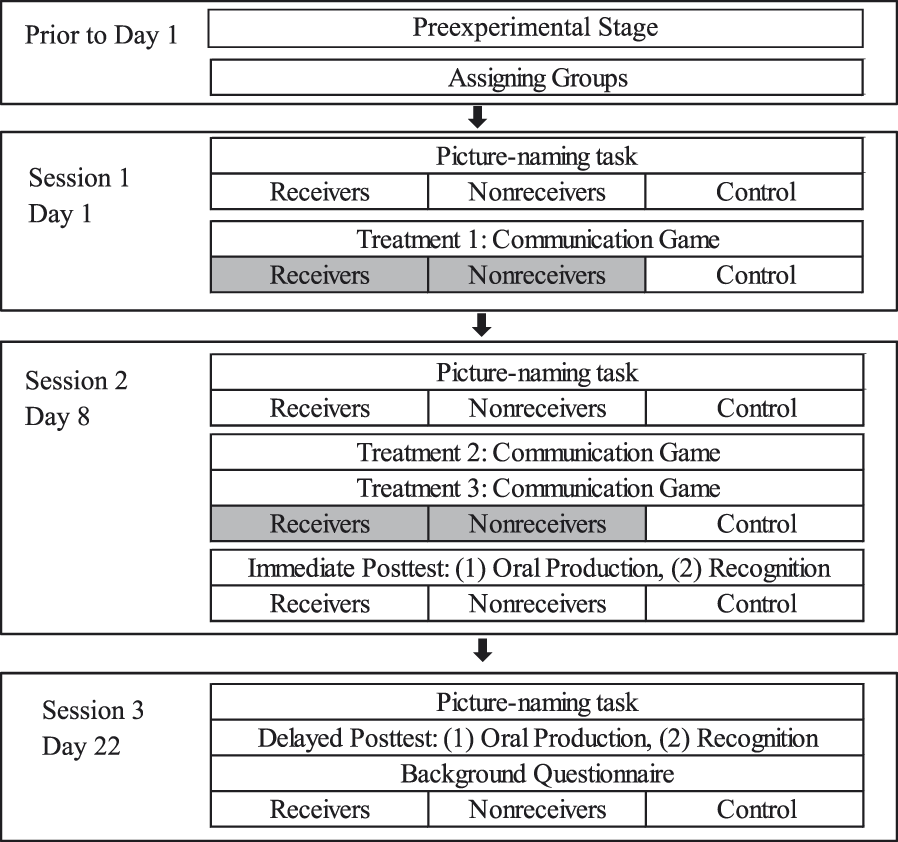
The present study followed a randomized experimental design with an immediate and delayed posttest (see Figure 1). A pretest was not administered because it was possible to assume that learners had zero knowledge of the target forms, as they were absolute beginners with no previous exposure to or knowledge of the target language (i.e., Turkish). Prior to the beginning of the experiment, all learners were asked to study key vocabulary using an instructional Web site to ensure that they had enough vocabulary to begin the experiment. Learners were randomly assigned to one of three groups: receivers, nonreceivers, and control.Footnote 3
Study design; The shaded parts indicate that paired participants from these groups were present during each other’s task performance.

Participants
Participants were recruited at a large university in the midwestern United States. The study was advertised in two ways: (a) via an electronic advertisement using the online classified ads service of the university and various university-related listservs and (b) via flyers posted on bulletin boards around campus. Two hundred and twenty participants volunteered for the study on the basis of the following criteria: (a) being a native speaker of Mandarin Chinese, (b) not having been exposed to Turkish previously, and (c) not having taken any linguistics courses. The researcher explained that they had to learn 39 Turkish words to qualify for the study and provided them with a link to the instructional module for the vocabulary learning activities (see the Tasks and Materials section for a description of the preexperimental stage materials). He asked them to contact him again when they had studied the words and had passed an online vocabulary test by scoring 95%. Forty-two participants (38 females and six males) contacted the researcher after passing the test and constituted the final pool of participants. The reason for targeting a group of participants speaking the same first language (L1; i.e., Mandarin) was to prevent L1 differences from confounding the results. The target population was required to not have any previous exposure to Turkish for the following reasons: (a) to represent the learning processes of learners who are exposed to a L2 for the first time, (b) to better detect differences among the groups (i.e., learners with no prior knowledge would have more room to improve than learners who have some knowledge), (c) to prevent prior knowledge from interacting with treatment effects, and (d) to avoid testing effects that might arise due to the administration of a pretest. It is important to note that learners were not taking any Turkish language courses at the time of the study, which served as an additional control feature to minimize learners’ possibility to receive extra input on the target structures from resources outside the experiment. A background questionnaire revealed that no participant had ever been to Turkey. The average age of the group was 23.58 years (SD = 5.31), and the majority (86%) were university students. All of the participants spoke English as a L2 with an average TOEFL iBT score of 93.48 (SD = 13.72). Participants had received 9.76 years (SD = 3.63) of English language instruction and had lived in the United States for 2.68 years (SD = 1.82) on average. Nine participants had beginner-level knowledge of a third language (L3; Japanese, n = 4; French, n = 2; German, n = 2; Spanish, n = 1).
Target Structures
Two Turkish structures were selected for the study: the plural morpheme /-lAr/, and the locative case morpheme /-DA/. These morphemes were selected because of their predicted low form-meaning salience due to allomorphy. Structures that have allomorphic variation can be a challenge for learners because the learners cannot rely on their tendency to look for one-to-one form-meaning relationships to learn the structure (Andersen, Reference Andersen1984). Turkish, being an agglutinating language, is rich in inflectional morphology, with most suffixes having phonologically conditioned allomorphs. Vowel harmony and devoicing determine the allomorphs of the morphemes under study. Vowel harmony specifies that a native Turkish word should include either exclusively nonfront (i.e., central and back) vowels /a, ɯ, o, u/ or exclusively front vowels /e, i, œ, y/. As shown in examples (1) and (2), the plural morpheme /-lAr/ becomes [-ler] or [-lar] depending on vowel harmony; the choice between /e/ and /a/ is determined by the preceding stem vowel. It is /e/ after front vowels and /a/ after nonfront vowels.
(1) kemer-ler
belt-pl
“belts”
(2) tabak-lar
plate-pl
“plates”
The suffix /-DA/ expresses the locative case in Turkish, and it has four allomorphs, as shown in examples (3)–(6). It becomes [-de], [-da], [-te], or [-ta] depending on vowel harmony and devoicing. The locative /-DA/ becomes [-te] or [-ta] after voiceless consonants and [-de] or [-da] after vowels or voiced consonants. The preceding stem vowel determines the vowel in the suffix, as in the plural morpheme. The meaning of the locative case corresponds to the English prepositions in, on, at, and by.
(3) ev-de
house-loc
“in the house”
(4) masa-da
table-loc
“on the table”
(5) sepet-te
basket-loc
“in the basket”
(6) raf-ta
shelf-loc
“on the shelf”
Tasks and Materials
Preexperimental Stage Materials and Vocabulary Tests.
The purpose of the preexperimental stage was to make sure that learners had enough vocabulary knowledge to describe the pictures used in the treatment and posttests. Learners were asked to learn the orthographic and phonological forms of 39 Turkish words (30 concrete nouns and nine adjectives; see Appendix A) through flashcard and matching activities, which were parts of a Web-based instructional module. Learners were allowed to study the words at their own pace and at their convenience in their preferred location. After studying the words, learners took an online vocabulary test through the same instructional module, during which they matched the orthographic and phonological forms of the words with pictures. Learners who reached a 95% cutoff level qualified to meet with the researcher to carry out the rest of the study. At the beginning of each treatment session, to make sure that learners still remembered the required words, a picture-naming task requiring learners to say the Turkish words for the objects shown in pictures was administered. A perfect score was required on this test. If learners failed, they were allowed to take the test again until they had a perfect score.
Treatment Tasks.
Three versions of a communication game were used in the treatment. The versions shared the same procedure but differed in content. All learners carried out one version in the first session and two in the second. The versions of the tasks were counterbalanced across experimental units (i.e., receiver-nonreceiver pairs and control participants). Each task included eight critical items creating obligatory contexts for use of each target structure and eight distractors. For each task, three folders were created. Two of the folders were exactly the same so that the receivers and nonreceivers could follow each other’s interaction with the researcher. One folder was different from the others and was given to the experimenter. Each sheet in the learner’s folder contained one picture, whereas the corresponding sheet in the experimenter’s folder contained three pictures, one of which was identical to the picture in the learner’s folder. The pictures for the critical items showed more than one object located on top of a different object. The pictures for the distractor items showed two different objects side by side, not touching each other. Learners were asked to describe the pictures on each sheet of their folder to help the experimenter select the same picture on his sheet. During the receiver-nonreceiver sessions, each learner was given one of the two identical folders and was told to pay attention to the pictures being described and the interaction between their partner and the experimenter. Because the learner’s and the experimenter’s pictures differed by more than one characteristic, no one statement by the learner immediately identified the pictures. Thus, if the learner did not exhaustively describe his or her picture, the experimenter would ask clarification questions, such as Masa ne renk? “What color is the table?” or Masa büyük mü kücük mü? “Is the table big or small?” The experimenter explained the meanings of these questions prior to the beginning of the treatment tasks by writing them on the board, modeling their pronunciation, and translating them into English.
The tasks were designed in such a way that the receiver’s selection of the correct pictures did not depend on whether the descriptions included the target structures. For example, in one of the target items, the experimenter saw green apples on a red book in Picture A, green apples on a grey book in Picture B, and red apples on a red book in Picture C. Here, the selection of the correct picture did not depend on the distinction between bare and inflected nouns. Regardless of the picture, the apples should be in the plural form (inflected), and the book should be inflected for location. This feature was incorporated into the task design so that it could be possible for the experimenter to know whether the learner’s utterance was erroneous. The administration of each task took 11 min 43 s on average.
Posttest Measures.
Two types of tests were used to measure learners’ linguistic knowledge gained from the treatment: a multiple-choice recognition test and an oral production test. The recognition test was designed to measure learners’ knowledge about the pattern behind the allomorphic variation for each morpheme under conditions favorable for the use of explicit knowledge; these conditions were as follows: (a) learners had enough time to plan their responses and (b) learners could give a correct response by attending to the form (Ellis, Reference Ellis2005). The test included 48 items: 32 distractors and eight critical items for each target structure. The items were presented randomly through a Web-based testing tool. Each item included a picture and an incomplete two-word sentence (e.g., adam _____), in which one of the words was always provided. The learner’s task was to fill in the gap by selecting from five options (e.g., a. masada, b. masata, c. masate, d. none, e. masade). The options presented the orthographic and phonological forms (through clickable links) of the noun-allomorph combinations. The correct option included the correct noun-allomorph combination (e.g., masada), whereas the incorrect options included incorrect noun-allomorph combinations (e.g. *masata). The items were balanced with respect to which allomorph is considered correct.
The oral production test was designed to measure learners’ ability to mark nouns for plurality or location when necessary and to use the correct allomorphs of the morphemes. The task involved a time limit, and its primary focus was on message creation. In this task, learners were asked to describe the location of the object(s) they saw in the picture. In each version, there were 40 items: 16 critical items, creating contexts for the production of each target form, and eight distractor items. The test was administered using a stimulus presentation computer program. The presentation of the items was random and automatic with an 8-s delay between the items. The items were balanced with respect to which allomorph was considered correct. There were two versions for each of the tests. One version was used on the immediate posttest and the other was used in the delayed posttest. The versions of the tasks were counterbalanced across experimental units.
Feedback Treatment
A native Turkish-speaking research assistant (hereafter referred to as the experimenter) provided explicit correction to the receivers whenever they omitted marking on nouns for plurality and/or location when it was necessary to do so, marked the incorrect noun, or used incorrect allomorphs during the treatment. At no point during the treatment were learners told that they would receive feedback. The feedback type choice was motivated by the results of previous studies showing that explicit correction is an effective form of feedback (Li, Reference Li2010).Footnote 4 Explicit correction was operationalized as a statement indicating what learners should have said. Because learners were absolute beginners, English was used in the feedback to make sure that they understood what was said (e.g., “You should say X”). The explicit correction could be simple, as in (7), or complex, as in (8), depending on whether learners had one or two errors in their utterances. Given the fact that learners were absolute beginners and knew only 39 Turkish words, their initial utterances included only the uninflected nouns, as in (8). After receiving feedback, some learners started to produce sentences, as in (7), that included the plural and/or locative markers but involved the use of an incorrect allomorph. It should also be noted that no additional knowledge of Turkish grammar was necessary to describe the pictures. In other words, it was possible for leaners to produce grammatical utterances as long as they used the inflections presented in the feedback.Footnote 5
(7) Simple explicit correction:
Learner: *Sinekler kitapte.
*Fly-pl book-loc.
“The flies [are] on the book.”
Researcher: You should say kitap-ta.
book-loc
“on the book”
Researcher: Kitap ne renk?
Book what color?
“What color is the book?”
(8) Complex explicit correction:
Learner: *Kedi gemi.
*Cat boat.
“The cat [is] the boat.”
Researcher: You should say kedi-ler gemi-de.
*Cat-pl boat-loc
“The cats [are] in the boat.”
Researcher: Gemi ne renk?
Boat what color?
“What color is the boat?”
The receivers were provided feedback on their own errors during the tasks. The nonreceivers were allowed to hear the feedback provided to the receivers. The control group learners neither received feedback on their own errors nor heard the feedback provided to other learners. To expose the nonreceivers to feedback, each nonreceiver was matched with a receiver and was allowed to be present in the same room with the receiver during the receiver’s task performance. All groups were matched on output opportunities: Each learner interacted with the experimenter by performing three tasks in which he or she described pictures (see the Procedures section for more information). This ensured that all groups had equal opportunities to produce output and to hear input not containing the target structures (i.e., target-irrelevant input). In addition, the practice of pairing a receiver with a nonreceiver has resulted in pairs being automatically matched on the following variables: (a) quantity and type of target-relevant input from the experimenter (i.e., feedback and its idiosyncratic features, e.g., simple or complex), (b) quantity and type of target-irrelevant input from the experimenter (i.e., input not containing negative or positive evidence on the target forms), (c) beginning and end times of the sessions, (d) duration of the sessions, and (e) version of posttest tasks.
Matching the experimental groups on output opportunities required the researcher to make two important experimental decisions. First, learners receiving feedback may naturally attempt to repeat the reformulated part of their utterances immediately after the feedback. This move is known as modified output (or repair), a discourse feature shown to be related to L2 acquisition (e.g., McDonough, Reference McDonough2005). Because modified output was natural only for the receiver role, in order not to give an advantage to the receivers, opportunities for modified output were blocked by asking a question that is relevant to task completion immediately after the feedback (see the feedback examples in [7] and [8]).Footnote 6 The second related issue was that learners’ output was likely to include attempts to use the target forms in subsequent turns. These attempts could function as extra input for the listener (i.e., either the receiver or the nonreceiver). The present study allowed participants to hear each other’s attempts on the basis of the following grounds. First, it was predicted that, unlike modified output that was natural only for the receivers, attempts could be made by both experimental groups, and, therefore, the study would not favor one experimental group over the other. Second, when learners engage in pair work in classroom contexts, they often have the chance to hear each other’s attempts. That is, not separating feedback and attempts in the laboratory setting is a reasonable choice if one aims to simulate the phenomenon under investigation with greater fidelity to the classroom context, as long as hearing these attempts does not pose a threat to internal validity.
Procedures
The procedures of the study were as follows. The researcher set up three meetings with the learners who had studied the vocabulary items and passed the online test. All meetings took place in a research lab. The learners in the control group met with the experimenter individually, whereas the learners in the receiver and nonreceiver groups were paired and met with the experimenter together. These pairs were kept intact until the end of the study. During the receiver-nonreceiver treatment sessions, the receiver and the nonreceiver sat side by side, facing the experimenter. All sessions started with the administration of the picture-naming task. Learners had to score 100% on the test to proceed to the treatment tasks. After passing the test, learners carried out the treatment tasks with the experimenter. In the first session, learners in all groups carried out one treatment task with the experimenter. The study was designed such that the receivers carried out the task before the nonreceivers to match the experimental groups on opportunities to apply the knowledge gained from feedback. One week after the first meeting, the groups met with the experimenter again to carry out two more treatment tasks.Footnote 7 In the first of these tasks, the nonreceivers were the first to carry out the task. In the second task, the learners who performed the task first were counterbalanced across all receiver-nonreceiver pairs. At the end of the session, the learners took the immediate posttest individually in the presence of the experimenter. Two weeks after the second session, the learners met again with the experimenter alone and took the delayed posttest. The meetings of the learners in the receiver-nonreceiver pairs with the experimenter were on the same day and immediately followed each other. In each posttest, the oral production test was administered before the recognition test. Next, all participants responded to a background questionnaire, and the receivers and nonreceivers responded to three manipulation check statements by rating them on a scale from 1 to 9. The manipulation check statements were (1) When my partner was doing the activity with the researcher, I was paying attention to their conversation; (2) I noticed that the experimenter corrected my errors; and (3) I noticed that the experimenter corrected my partner’s errors. Learners’ performance in all treatment tasks and oral production tests were audio recorded.
Scoring and Analysis
Learners’ oral responses to each item in the oral production test were first transcribed and then coded for correct suppliance in obligatory contexts, suppliance in nonobligatory contexts, and misformations in obligatory contexts. The provision of the correct allomorph was coded as correct suppliance, the suppliance of an incorrect allomorph as misformation, and the provision of a morpheme in the wrong context as suppliance in nonobligatory contexts. An independent rater coded 15% of the data for these categories. Interrater reliability for the plural and locative oral production tests was acceptable as indexed by Cohen’s kappa (κ = .86 for the locative; κ = .92 for the plural). The percentage agreement between the two independent coders was 91.3% for the locative and 95.1% for the plural. Disagreements in scoring were then discussed and resolved. Next, for each learner an adjusted target language use (ATLU) score was calculated per target structure using the formula in Ono and Witzel (Reference Ono and Witzel2002):
 $${\rm{ATLU}}\, = \,{{{\rm{(}}n{\rm{\ correct\ suppliance\ in\ obligatory\ contexts)\ (2)\ + \ (}}n{\rm{\ of\ misformations\ in\ obligatory\ contexts)\ (1)}}} \over {{\rm{(}}n{\rm{\ obligatory\ contexts)\ (2)\ + \ (}}n{\rm{\ suppliance\ in\ nonobligatory\ contexts)\ (2)}}}}$$
To calculate learners’ scores on the recognition test, first, learners’ responses to each item were coded as right or wrong. Then a score was calculated for each learner by dividing the sum of correct responses by the total possible score. Cronbach’s alpha coefficient was computed to estimate the internal consistency of each of the two versions of the test (version A, α = .70; version B, α = .71).
RESULTS
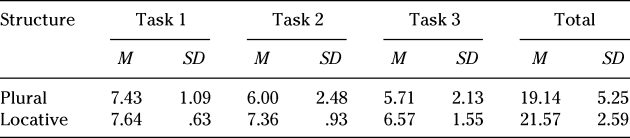
The descriptive statistics for the mean number of explicit corrections across the three tasks appear in Table 1. As shown, there is a gradual decrease from Task 1 to Task 3 in the mean number of feedback instances. This indicates that the receivers produced increasingly more targetlike utterances as the experiment progressed. In addition, the mean number of feedback instances provided for the plural was lower than the mean number of feedback instances provided for the locative. This shows that the receivers were slightly more targetlike with the plural than with the locative.
Mean number of explicit correction instances by task and structure
Next, all data were checked for normality of distribution. As shown by the results of a series of Shapiro-Wilk tests run on each test, target form, and time (see Appendix B), the data failed to demonstrate a normal distribution. The values for skewness and kurtosis were also inspected to better understand the reasons for this nonnormal distribution. The skewness values for the oral production test (immediate plural = .98, immediate locative = .23; delayed plural = 1.31, delayed locative = .76) and for the recognition test (immediate plural = .46, immediate locative = .63; delayed plural = .12, delayed locative = −.06) revealed that the distribution of the scores, especially in the oral production tests, tended to be positively skewed. This means that most of the scores were at the lower end of the scale. The low scores of the control group on both tests might have contributed to these skewness values. The kurtosis values for the oral production test (immediate plural = −.53, immediate locative = −1.84; delayed plural = .74, delayed locative = −1.01) and for the recognition test (immediate plural = −.49, immediate locative = .11; delayed plural = −1.48, delayed locative = −.10) revealed that the distribution was slightly platykurtic in many cases, indicating large variation within scores. Cognitive or affective individual differences among learners, the difficulty level of the tests, or the interaction between these two factors may have given rise to these large variations.
Next, given the nonnormal distribution of the data, various nonparametric tests were carried out to test the hypothesis. First, the performance of each experimental group (i.e., receivers and nonreceivers) was compared to the performance of the control group. A Kruskal-Wallis test, the nonparametric equivalent of a one-way ANOVA, was conducted for each time and outcome measure. Post hoc Mann-Whitney tests were conducted to find out if each of the groups was different from the control group. Second, the performances of the two experimental groups were compared against each other. In this analysis, the observations that came from the receiver-nonreceiver pairs that participated in the same sessions were treated as related because they were matched on many different variables (e.g., quantity and type of feedback; see the Method section). Given that treating the groups as independent when they are actually related may lead to Type II errors (Field, Reference Field2009), a Wilcoxon signed-ranks test, the nonparametric analogue of the paired-samples t test, was carried out for each time and outcome measure. The results of the nonparametric tests are reported for each structure separately.
The Plural Morpheme
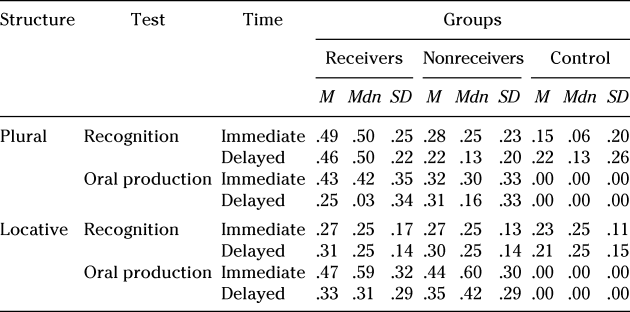
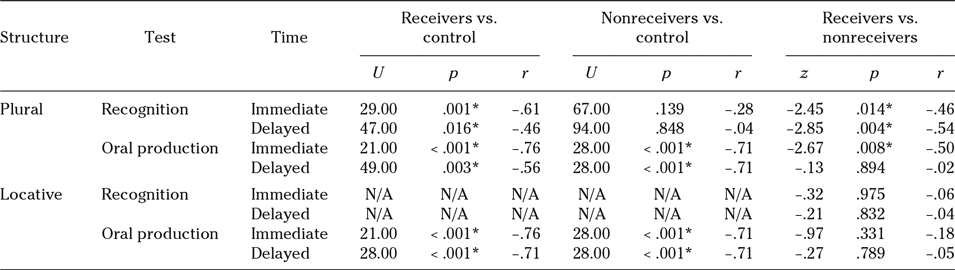
The descriptive statistics for the plural items shown in Table 2 reveal that the receiver group scored higher than the nonreceiver and control groups on the recognition test. On the oral production test, however, the receivers scored higher than the other two groups only at the immediate posttest. Kruskal-Wallis tests showed that there was an effect for feedback exposure condition on both the immediate recognition, H(2) = 11.34, p < .001, and the delayed recognition, H(2) = 8.98, p = .011, posttest. The Kruskal-Wallis tests also revealed an effect for feedback exposure condition on both the immediate oral production, H(2) = 18.05, p < .001, and the delayed oral production, H(2) = 13.44, p = .001, posttests. Post hoc Mann-Whitney tests, reported in Table 3, revealed that the receivers statistically outperformed the control group on both test types regardless of time (i.e., immediate and delayed). The Mann-Whitney tests (see Table 3) also revealed that the nonreceivers statistically outperformed the control group on the oral production test (regardless of time) but not on the recognition test (regardless of time). Wilcoxon signed-ranks tests revealed that the receivers statistically outperformed the nonreceivers on the immediate and delayed recognition posttests and on the immediate oral production posttest but not on the delayed oral production posttest.
Descriptive statistics for test scores
Post hoc results
Note. * = statistically significant, N/A = not applicable.
The Locative Morpheme
Table 2 reveals that the mean scores of all groups on the locative items were very close to one another in the recognition tests, whereas the mean scores of the receivers and nonreceivers were considerably higher than the mean scores of the control group in the oral production tests. Kruskal-Wallis tests showed that there was an effect for feedback exposure condition in the oral production test—immediate: H(2) = 17.69, p < .001; delayed: H(2) = 16.32, p < .001—but not in the recognition test—immediate: H(2) = 0.31, p = .856; delayed: H(2) = 2.72, p = .257. Post hoc Mann-Whitney tests carried out for the oral production test scores revealed that both the receivers and the nonreceivers statistically outperformed the control group regardless of time (see Table 3). Wilcoxon signed-ranks tests showed that neither in the recognition test nor in the oral production test did the receivers and nonreceivers differ from each other (see Table 3).
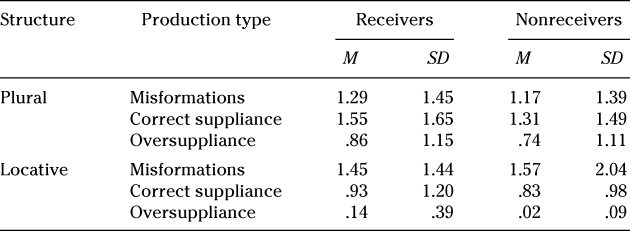
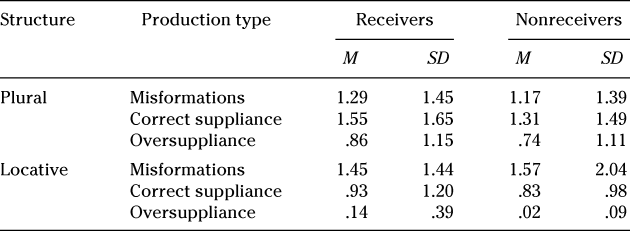
As explained in the Method section, the receivers and nonreceivers were allowed to hear each other’s attempts to produce the target morphemes in their subsequent turns. One consideration with this design decision is that an imbalance in the number of attempts (i.e., extra input for the other learner) between the groups could make it difficult to attribute any differences between the groups to feedback exposure. To account for this, the type and amount of input learners could hear from each other were analyzed. Table 4 shows the descriptive statistics for the type and amount of input to which each experimental group was exposed. As can be seen from Table 4, nontargetlike productions (considering suppliance in nonobligatory contexts and misformations together) were more frequent than targetlike productions. Paired-samples t tests conducted for each morpheme in each category revealed no significant differences between the groups—plural: misformations, t(13) = −.29, p = .77; correct suppliance, t(13) = −.78, p = .45; oversuppliance, t(13) = −.45, p = .66; locative: misformations, t(13) = .27, p = .79; correct suppliance, t(13) = −.58, p = .57; oversuppliance, t(13) = −1.10, p = .29. Therefore, it is possible to assume that the receivers and nonreceivers heard a comparable amount of input from each other.
Type and mean frequency of attempts
Next, various t tests were conducted on the learners’ self-ratings of the extent to which they paid attention to the interaction between their partner and the experimenter. To determine whether learners’ self-ratings were significantly different from chance, each group’s mean score was compared to the median value of the rating scale (i.e., five) using one-sample t tests. The tests revealed significant differences—nonreceivers: t(13) = 14.92, p < .001; receivers: t(13) = 6.41, p < .001. Paired-samples t tests conducted to determine whether the self-ratings of the two experimental groups differed from each other revealed no differences between the groups—nonreceivers: M = 8.35, SD = .84; receivers: M = 7.78, SD = 1.61; t(13) = 1.29, p = .165. These results show that both groups paid attention to their partner’s interaction with the experimenter, and that the degree to which they paid attention to it did not differ between the groups. Finally, two paired-samples t tests were conducted on learners’ self-ratings of the two additional manipulation-check statements. For the statement “I noticed that the experimenter corrected my errors,” the receivers’ ratings were significantly higher than the nonreceivers’ ratings—nonreceivers: M = 5.29, SD = 2.92; receivers: M = 8.14, SD = 1.51; t(13) = −3.68, p = .003. For the statement “I noticed that the experimenter corrected my partner’s errors,” there was a significant difference between the ratings in favor of the nonreceivers—nonreceivers: M = 6.43, SD = 2.98; receivers: M = 3.43, SD = 2.62; t(13) = 2.88, p = .013. These results show that the receivers and nonreceivers not only paid attention to the interaction between their partners and the experimenter but also noticed that the receivers were the ones that were corrected. Overall, the analyses of the manipulation check statements revealed that it was unlikely that the difference between the nonreceivers and receivers in performance is attributable to the nonreceivers’ failure to pay attention to the interaction and feedback between the receivers and the experimenter.
DISCUSSION
The hypothesis of the study predicted that the receivers would outperform the nonreceivers as measured by their recognition and oral production test scores. The hypothesis was confirmed for the plural morpheme because the receivers outperformed the nonreceivers on all the tests (immediate oral production and immediate and delayed recognition) except for the delayed oral production test. Additional indirect evidence confirming the hypothesis came from the comparisons of each group with the control group. The receivers outperformed the control on all the tests, whereas the nonreceivers outperformed the control group only on the oral production test, not on the recognition tests. The hypothesis, however, was not supported for the locative morpheme because on neither of the tests were there differences between the receivers and nonreceivers. The comparisons between each of the groups and the control did not provide any support for the hypothesis either. Contrary to expectations, the finding that neither experimental group outperformed the control group on the recognition test raises doubts as to whether any substantial learning took place for the locative morpheme.
At least two factors may have contributed to the finding that the receivers outperformed the nonreceivers in the plural morpheme. The first is the communicative pressure the receivers might have experienced due to their involvement in an information exchange during which conveying their messages accurately was important. As hypothesized by Long (Reference Long2007), this type of communicative involvement might have facilitated the noticing of new linguistic information in the input by increasing learners’ motivation to attend to the corrective feedback. In the same vein, communicative pressure might have increased learners’ alertness to the incoming corrective feedback instances. According to Tomlin and Villa (Reference Tomlin and Villa1994), alertness is one of the functions that is involved in attention, along with orientation and detection. Alertness refers to a general readiness to receive incoming stimuli. Orientation means directing one’s attentional resources to a particular type of stimuli. Tomlin and Villa (Reference Tomlin and Villa1994) claimed that even though orientation and alertness are not required for L2 learning, they could facilitate detection, the third and most crucial function of attention in L2 learning, which refers to “the cognitive registration of sensory stimuli” (p. 192). Applying these terms to the current study, one can argue that participating in and observing the interaction including feedback may have created different levels of alertness and made the receivers more ready to take advantage of the feedback. The feedback in this context could be considered an orientation device with the potential to promote the detection of the nontargetlike form and its targetlike version.
The second factor that may be at work simultaneously with or independent of the first factor is the customized nature of the feedback for the receivers’ needs. Even though both experimental groups were given equal production opportunities in this study, when feedback was provided, it was the receivers’ turn to describe the pictures. Having an opportunity to receive feedback and to produce output immediately after the feedback may have enhanced the effectiveness of the receivers’ hypothesis testing. They could use the information in the feedback to modify their hypotheses about how the target form worked. Thanks to this opportunity, the receivers could form new hypotheses by refining and modifying the previous ones and could submit them to further testing. It may be that the nonreceivers were not at an equally advantageous position in fine-tuning their hypotheses. They lacked the opportunity to put their newly formed hypotheses to the test. It is well documented in previous studies that learners engage in hypothesis testing as a result of producing output (Swain, Reference Swain, Cook and Seidlhofer1995) and negotiating meaning (Mackey, Gass, & McDonough, Reference Mackey, Gass and McDonough2000; Pica, Holliday, Lewis, & Morgenthaler, Reference Pica, Holliday, Lewis and Morgenthaler1989). Nevertheless, the claim that more effective hypothesis testing and increased alertness played a role in the receivers’ better performance should be seen as tentative. Direct evidence through introspective methods (e.g., stimulated recalls) of data collection is needed to confirm this claim. In addition, despite the overall advantage of the receivers in regard to the plural morpheme, the fact that the difference between the feedback exposure conditions disappeared on the delayed posttest indicates that continuous exposure to feedback or input may be necessary to help the receivers maintain their advantage.
With the locative morpheme, receiving feedback on one’s own errors offered no advantage over hearing the feedback given on someone else’s errors. This suggests that the effect of exposure condition on learning varies depending on the target structure. One factor that may explain this result is the difference between the structures’ morphophonological regularity. Morphophonological regularity is defined as “the degree to which the functors are (or are not) affected by their phonological environment” (Goldschneider & DeKeyser, Reference Goldschneider and DeKeyser2001, p. 26). The locative morpheme is morphophonologically less regular than the plural because it has four allomorphs, whereas the plural has two. Learners may have found the learning of the locative relatively more challenging because they had to link four forms to one meaning. Another factor that could help explain the interaction between exposure condition and target structure is the similarity between learners’ previously learned languages (i.e., L1 and L2) and Turkish (i.e., L3) with respect to how plurality and location are expressed. One cannot claim any similarity between Turkish and Mandarin in this regard because Mandarin expresses plurality and location through free morphemes, whereas Turkish does so through inflectional suffixes.Footnote 8 However, a different pattern emerges if English, the L2 of the learners, is taken into consideration. English and Turkish are similar in that both languages express plurality by inflectional suffixes. However, they differ in the expression of location. Turkish uses a suffix, whereas English uses free morphemes (i.e., prepositions) to express location. The lack of correspondence between learners’ L2 and L3 (i.e., Turkish) as well as the low morphophonological regularity of the locative morpheme may have put learners at a disadvantage in learning the locative. These factors may have made this suffix more difficult to notice and increased the number of hypotheses to be tested.
The experimental groups’ scores for the locative items were significantly higher than the control group’s scores for the locative items only in the oral production test; they were not significantly different in the recognition test. This discrepancy could be attributed to the different levels of knowledge measured by each test. In the oral production test, learners were awarded credit not only for choosing the correct allomorph (i.e., correct suppliance) but also for marking the nouns for location even if they chose the incorrect allomorph (i.e., misformations). In the recognition test, however, the only way to receive credit was to select the correct allomorph. It is possible, then, that learners gained some knowledge as to how to mark the nouns for location but did not gain the knowledge necessary to mark the nouns with the correct allomorph.Footnote 9
The most likely reasons for the limited learning of the locative morpheme are the greater learning challenge the structure poses and the ineffectiveness of the treatment. The duration of the treatment, type of feedback, and the fact that learners learned the morpheme only through corrective feedback may be some of the factors that contributed to the ineffectiveness of the treatment. It could be that absolute beginners need to be exposed to the locative for a longer period of time to distinguish themselves from a control group. It is equally possible that learners need to be exposed to feedback types that not only provide the correct form but also explain the rule behind the structure. In addition, the learners in this study were not provided any additional positive evidence on the target forms (other than the positive evidence provided through corrective feedback). Although this is an essential experimental control feature for attributing the results to exposure condition alone, it may have increased the difficulty of mapping form and meaning. Similarly, these factors may have contributed to the fact that the effect of exposure condition in the plural morpheme was less durable. It could be that these factors decreased the effectiveness of the treatment and prevented the receivers from keeping their advantages on the delayed posttest. Future studies could consider increasing the length and number of treatment sessions as well as the amount of feedback to increase the effectiveness of feedback in the acquisition of the locative. In addition, in future first-exposure studies, a controlled amount of positive evidence could be presented prior to the administration of feedback tasks to facilitate form-meaning mapping. It would be necessary to test learners’ knowledge after this exposure stage to make sure that the amount of learning across conditions is comparable.
In this study, exposure condition was not isolated from the learners’ attempts to produce the target forms. The learners in each of the feedback groups heard their partner’s correct and incorrect attempts to incorporate the knowledge he or she gained from the corrective feedback. Therefore, the feedback exposure variable included the ways that learners attempted to use the correct form in their subsequent turns. Nonequivalent numbers of attempts would potentially confound the results. However, this was not the case, as documented by the follow-up analysis showing that learners were exposed to comparable amounts of targetlike and nontargetlike input. Although this allows one to claim that the effect of exposure condition for the plural morpheme and the lack of it for the locative morpheme cannot be attributed to differing amounts of extra input learners heard from each other, it does not allow one to make any claims about the effect of feedback in the absence of this extra input. In other words, the results should be considered as shedding light on receiver-nonreceiver differences in contexts in which learners are allowed to hear each other’s targetlike and nontargetlike productions.
When interpreting the results, one needs to pay attention to the specific features of the feedback used in this study. It is generally accepted that feedback types differ along an implicit-explicit continuum. Feedback types that present metalinguistic rules or indicate what learners should have said have been considered explicit, whereas the ones that do not present this type of information have been considered implicit. According to this distinction, the feedback used in the present study is relatively more explicit than feedback types, such as clarification requests or recasts, that do not directly indicate what the learners should have said and is different from other explicit feedback types that provide metalinguistic rules. It is possible that the unique nature of explicit correction contributed to the exposure effect observed for the plural. A more implicit feedback type or a feedback type that provides metalinguistic rules, therefore, could lead to different results.
Moreover, Lyster (Reference Lyster2004), using a different classification criterion, has distinguished between feedback types that prompt learners to self-repair their errors and feedback types that provide the correct form. Because the learners in this study were absolute beginners, it was not possible to use feedback types that do not provide correct reformulations. It should be noted, however, that future studies targeting learners who are more proficient and using feedback types that do not provide correct reformulations may produce different results from the results of this study. In addition, the feedback used in this study was intensive, provided on a specific set of target structures, and planned (i.e., the provision of feedback was determined before the task). Therefore, the findings of this study may not be readily generalized to contexts in which feedback is extensive (i.e., provided on many different linguistic targets with incidental feedback).Footnote 10
A methodological issue that deserves attention is the question of which approach should be used to determine whether the nonreceivers paid attention to the interaction or feedback between the receivers and the experimenter. The technique used in this study relied on learners’ subjective evaluations of their experience because it involved learners’ self-ratings of three manipulation-check statements. To obtain a more complete picture of learners’ experience, the data from this technique can be triangulated with data collected with techniques that are more objective. For example, Mackey (Reference Mackey1999) administered a post hoc comprehension check to the observers (nonreceivers) in their L1 to make sure that the observers paid attention to the input. After the experiment, the observers were asked to recall some of the information provided by the NS to the interactors (receivers) during the experiment. The type of tasks used in Mackey (Reference Mackey1999) allowed her to use such a technique. In her tasks, the NS was in the role of an information supplier, and task completion depended on the comprehension of this information by the learners. In contrast, in the present study, the learners were the information suppliers during the tasks; therefore, there was no context for the learners to comprehend the information provided by the NS. Future research could incorporate Mackey’s (Reference Mackey1999) technique by designing tasks in which learners need to comprehend the information provided by the NS.
The findings of this study can inform classroom contexts in which feedback is given during task-based pair work interactions more than contexts in which feedback is given during whole-class activities. It has been shown that task-based pair work interactions in classrooms are comparable to task-based pair work interactions in lab contexts (Gass, Mackey, & Ross-Feldman, Reference Gass, Mackey and Ross-Feldman2011). However, one needs to be careful when applying the findings of this study to whole-class activities. In large language classes in which feedback is given to one learner during a whole-class activity, there is usually more than one nonreceiver, and the chances of these nonreceivers perceiving and processing the feedback vary depending on their physical distance from the receiver. Another difference between the receiver and nonreceiver roles in this study and those in classroom contexts is that in classroom contexts learners could be in both of the roles, whereas in this study learners were always in only one role. Future research comparing groups in which learners are allowed to switch their roles to groups that are allowed to be in only one role can provide valuable insights as to whether being in the receiver role all the time is necessary to take advantage of the feedback to its fullest extent.
CONCLUSION
The results of this study showed that when all other things are equal, learners benefit from feedback most when feedback is given on their own errors. This was found to be the case specifically in the context of acquiring the structure that is morphophonologically regular and similar in bound or free status to the form that expresses plurality in their L2 (i.e., English). It was speculated that communicative pressure and the customized nature of the feedback could be responsible for this finding. Regarding the locative, however, there was no effect for exposure condition. The fact that learners in each experimental group outperformed the control group for the locative morpheme on only one of the tests suggests that a limited amount of learning of this structure took place. Thus, it could not be determined whether the lack of effect was genuine or a byproduct of the difficulty of the learning task. Overall, it seems that there is an interaction between exposure condition and target structure.
Future research in this area is necessary to confirm or disconfirm the findings of this study. There are several benefits to pursuing this line of research. For instance, it would help the field determine whether learning activities should maximize learners’ oral production opportunities to improve their chances of receiving feedback on their own errors. In addition, this line of research can help identify the cognitive processes that are involved in L2 learning through feedback. In this study, the receivers’ higher performance in the plural morpheme was attributed to more effective hypothesis testing and increased alertness. If this interpretation is confirmed by future research, the proposed cognitive processes could be used to explain how learners take advantage of feedback when they receive feedback on their own errors. Finally, the findings of this line of research have important implications for corrective feedback research methodology. A recurrent finding showing an advantage for the receiver role would suggest that studies in which both receiver and nonreceiver roles are present should control for the number of feedback instances learners receive in each role to minimize the potential confounding effects of feedback exposure condition on the variables under investigation.
APPENDIX A
LIST OF WORDS
Balon “balloon,” bavul “suitcase,” bere “hat,” beyaz “white,” büyük “big,” defter “notebook,” ekmek “bread,” elma “apple,” etek “skirt,” gemi “boat,” gri “grey,” inek “cow,” kafes “cage,” kahve “brown,” kama “knife,” kamyon “truck,” kavun “melon,” kazak “sweater,” kedi “cat,” kemer “belt,” kemik “bone,” kirmizi “red,” kitap “book,” kücük “small,” masa “table,” mavi “blue,” miki “mickey,” motor “motorbike,” sapan “slingshot,” sedir “armchair,” sepet “basket,” sinek “fly,” siyah “black,” sopa “stick,” tabak “plate,” tepsi “tray,” torba “trash bag,” yatak “bed,” yesil “green.”
APPENDIX B
NORMALITY TEST RESULTS