The Royal College of Art (RCA) in London has for the last 70 years been an important institution for the study and practice of fashion design – indeed, British fashion education started in earnest here in 1948 – and the RCA's status since 1968 as the only art college in Europe to focus solely on postgraduate-level art and design education has made it a reference point for the history of British and international fashion design.
The College's fashion alumni include a significant number of the visionary designers who put British fashion on the world stage, including Ossie Clark, Zandra Rhodes, Julien Macdonald, the milliner Philip Treacy and, most recently, Erdem Morialioglu and Holly Fulton, and the teaching of fashion at the College has always been led by innovative international practitioners. The RCA archive, housed within the College library's special collections, offers unique, wide-ranging and detailed access to the creation of this important legacy. This article explores the diverse range of materials in the collection – analogue and digital, text- and image-based, published and unpublished – and the opportunities it offers researchers in illuminating the individual careers and reputations of these key alumni, the positioning of fashion within the history of the RCA and the emergence and development of fashion design as an academic discipline in its own right.
History
In his post-war restructuring of the RCA in 1948, Robin Darwin, the College's visionary new principal, insisted that fashion should form one of the design schools in which the newly re-imagined College would train innovative industrial designers to revitalize the bleak post-war cultural landscape. Fashion education had not really existed before the war, and Darwin seized the opportunity to occupy this space, just as ready-to-wear fashion was beginning to fill the gap between high-end couture and local dressmaking services. The first professor of fashion, the influential Madge Garland, a former fashion editor of British Vogue, established the RCA's Fashion School in an elegant house in Ennismore Gardens, Knightsbridge, and made it a significant force in post-war British fashion design.
Under Janey Ironside, Garland's successor from 1956, the Fashion School became a hub of creativity and cultural influence in 1960s and 1970s London, taking its place in the modernist, state-of-the-art college building next to the Royal Albert Hall that opened in 1962. It helped to define the fashion revolution of the 1960s and 1970s, alongside the Fine Art and Graphic Design Schools of the College together they produced such cultural milestones as the Pop Art movement, the Swinging Sixties ‘youthquake’ and the rise of boutique fashion and its key designers, including Ossie Clark, Bill Gibb and Marion Foale and Sally Tuffin.
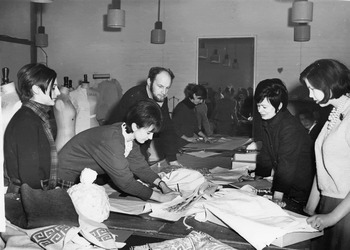
Professor of Fashion Janey Ironside teaching students, 1963. L-R: Angela Sharpe, unidentified, Alan Couldridge, Janey Ironside, Margaret Derrick.

In 1967 the RCA gained university status, enabling it to award master's degrees. A year after the controversial and publicly-debated sole exclusion of the Fashion School graduates from degree status (fashion was not considered ‘academic’ enough), which led to Ironside's resignation and her replacement by Joanne Brogden, the Fashion School was finally allowed to award degrees, firmly establishing the discipline within the academic context. Through the 1980s and 1990s, Fashion, which for an experimental period was combined with Textiles, continued to develop a close relationship with the British and international fashion industry and foster interesting young designers such as Christopher Bailey, Julien Macdonald and Philip Treacy. Graduate work was promoted through the college's high-profile annual catwalk shows, which attracted global audiences and provided a springboard for many of the leading designers for the fashion industry, both at designer level (MaxMara, Donna Karan and others) and on the high street (Marks and Spencer, Topshop and so on).
Wendy Dagworthy, Professor of Fashion from 1998 to 2014, and an important designer in her own right, stimulated an era of international influence and success, nurturing such designers as Erdem Moralioglu, Holly Fulton and Aitor Throup. Current head of the RCA's Womenswear and Menswear Fashion programmes, Zowie Broach, founder (with RCA alumnus Brian Kirkby) of the radical Boudicca label, continues to encourage innovative thinking and practice, and ‘the realization of individuality within a global design context’Footnote 1 that challenges existing traditions and addresses such key contemporary issues as sustainability, ethical fashion, gender fluidity and the engagement of digital technology.
The collections
The RCA archive offers rich documentation of this trajectory, providing a multifaceted picture of RCA Fashion since 1948. The collections include a range of diverse material, both printed and digital. This material was first collected and archived by both the Fashion School, in its various iterations, and the college library. A formal archive of College materials was created by librarian Hans Brill in 1985 and involved physical transfer of individual school materials to central management as part of library responsibilities. In parallel a rich image resource had grown out of the College's slide collection, which had originally held different schools’ images of individual student works. From 1979, a slide curator and technician team photographed all student works in the annual shows and managed these as a college resource.
The college archive holds a range of printed material, including ephemera. This includes printed invitations and catalogues for the graduate shows of the School of Fashion, held annually to showcase and promote student work, from its earliest days in the early 1950s up to the 2000s. These events were the highlight of the Fashion year at the college: from simple staged presentations of students’ designs in the early days of the school, in the 1980s they became glamorous gala events that attracted the attention of the major names in the fashion world and generated interest and sponsorship potential for the College. As the school became key to the development of the British, and increasingly international, fashion industry, invitations to these events became much sought after in the fashion world.
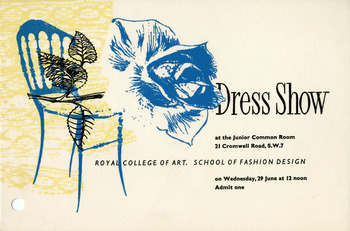
Invitation for RCA Fashion School Dress Show, 1955. ©Royal College of Art.

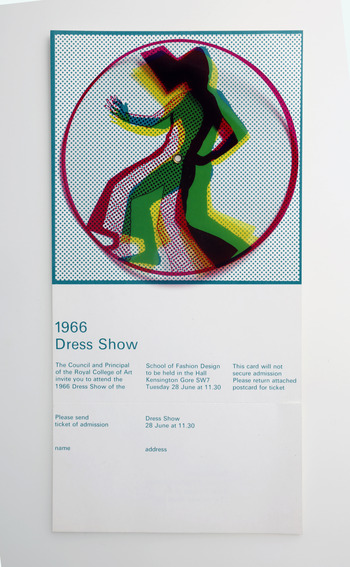
Invitation for RCA Fashion School Dress Show, 1966. ©Royal College of Art. Photo: Nick Frayling

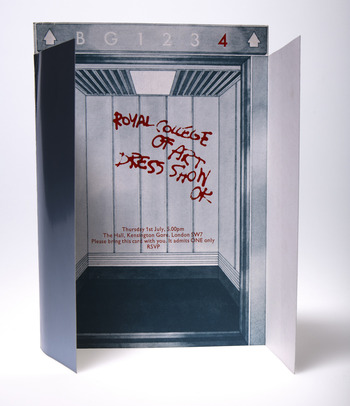
Invitation for RCA Fashion School Show 1976, designed by Gary Cooke (School of Graphic Design) ©Royal College of Art. Photo: Nick Frayling

The invitations and catalogues were produced to a high standard, often innovative in terms of design and typography; as they were usually the work of leading graphic design students at the College, they are evidence of the enduringly interdisciplinary, porous creative activity of its students. They reflect not only the changing stylistic innovations of fashion students’ work, but also the themes and aesthetic concerns that occupied graphic design through these decades. Their graphic style progresses from swinging 1960s and 1970s psychedelia and retro art deco, New Romanticism and late 1970s punk to more minimalist styles of the 1990s and 2000s, and feature such design devices as paper engineering, holograms and embroidered patches. The most recent fashion show catalogues demonstrate cutting-edge publishing design and photography. The 1974 anniversary show catalogue, a lavish, silver beribboned box with single-sheet photographs and biographies of the key designers associated with the RCA from 1949, is particularly interesting. In the 1990s the catalogues briefly took the form of CD-ROMs, reflecting the interest in publishing in this format at this time.
The close relationship of the Fashion School with industry can also be observed in these catalogues: many of the graduate fashion shows were sponsored by major commercial companies, from the fashion retailer Woollands in the very early years to Next in the later 1980s. Sponsoring companies also sought out their new designers from the work they saw at the shows.
The history of fashion teaching at the college is documented in detail in the yearly College prospectuses and annual reports (known by various different names in college history). College prospectuses, published in advance of each academic year almost continuously from 1949 to 2010, provide an outline of what the College offered as an institution and details of its courses and programmes, with a full list of the academic staff teaching in each school. These are valuable for confirming dates, job titles and structures, but also offer important qualitative data about the way the College has positioned itself within the academic world. From these key primary sources it is possible to trace the precise details of RCA Fashion's changing structure, priorities and curricula and academic significance, the different disciplines that have emerged – the development of menswear, accessory design and millinery courses, for instance – and the significant figures involved in the school. Contrasting details, from the 1950s announcement that the Fashion students had sourced French ‘Linguaphone’ courses for their trips to the Paris couture shows that Madge Garland organized to the latest proclamation by Zowie Broach, in the 2017 web prospectus, that Fashion students, in the ‘creative laboratory’ of the RCA, are expected to be ‘the new liquid society that runs through the fingers of the big players – mercurial and magical…’Footnote 2 speak volumes about the progress of fashion education as an academic discipline at the college.
From 2010, details of the college's academic offer and its programmes and schools have been hosted on the RCA's website, www.rca.ac.uk; the problems of digital preservation prevail here in terms of the difficulty of tracing these recent details from expired web pages, beyond relying on occasional snapshots from external web archiving initiatives. It is expected that the College's current work on the implementation of a digital preservation policy and strategy will address this potential lacuna and ensure future digital information is as accessible as its paper antecedents.
The College's annual reports, produced yearly from 1949 to the present, document the work and successes of the College during each academic year – looking backwards, in effect, where the prospectuses look forward – illuminating the development, activity and prominence of fashion at the college. They offer a unique and valuable narrative of College life, formal and informal, and the comings and goings of staff. Prizes, awards and sponsorship offers are celebrated and individual student successes marked, relocations noted and new equipment described, the latter offering fascinating insights into technological developments embraced by fashion practice at the college.
Sadly, there are no annual reports available for the years 1960–1966, a key period for the Fashion School in its emerging national and international prominence under Janey Ironside, and for the notorious 1967 episode relating to degree status. None from this phase of college history have been located, in the RCA or elsewhere, and it is possible that publication during this period was suspended, resulting in another unfortunate lacuna.
The fact that the RCA promotes its achievements and success online in tweets and College website updates (the problematic issue of digital preservation emerging again) means that there is less detail on individual programme developments in recent printed reports, and the latest are stylish promotional publications detailing research grants, sponsorship, student statistics and the global positioning of the RCA ‘brand’.
The archive's press cuttings collection documents fashion at the RCA from the 1950s to around 2010 (press coverage of college work and projects then being superseded by online links, as discussed above). These cuttings, detailing the work featured at the annual graduate shows or noting the collections of significant RCA graduates, were maintained by the Fashion School and later the communications office of the College. They present the critical reception of the RCA students’ work by fashion journalists and the way the reputation of the RCA was perceived more generally. Again, no cuttings exist for the latter half of the 1960s, when the acrimonious debate about the lack of degree status for Fashion took place. However, some archive material exists in the form of the donated personal papers of the RCA student union president at the time, Nick Holland, that include some correspondence with Ironside, campaign flyers and other material protesting about the decision.
The Record of Student Work is a major element of the RCA archive, presenting the work of key designers at the earliest stage of their careers and providing a comprehensive visual overview of each year's student cohort. From the early 1960s onwards a concerted effort was made to record photographically the final show work exhibited by graduating students across all the schools of the College. In Fashion these were the collections at the annual catwalk event held in June. These images were produced and archived as photographic slides up to 2002, and the collection includes around 3,500 such slides of Fashion students’ work: approximately 700 of these have been digitized to represent the most notable alumni. These digitized images can be made public: college regulations have historically allowed the RCA to disseminate images of its students’ work. The resulting scans were shared with the VADS platform in 2011. From 2003, student work has been photographed digitally and uploaded to a digital assets management system (Extensis Portfolio), which offers searchable internal access to all these images, the copyright of which resides with the College. As of 2017, there are around 4,000 such born-digital images of fashion students’ work in total. This archive is invaluable in its comprehensiveness: many images date from a time when professional photography was more difficult and expensive, and the college's records are often all that survives of important student work, especially from earlier years, confirmed during a visit from textiles alumna Zandra Rhodes, a meticulous self-archivist, who noted she had not seen images of her graduate work in decades.Footnote 3
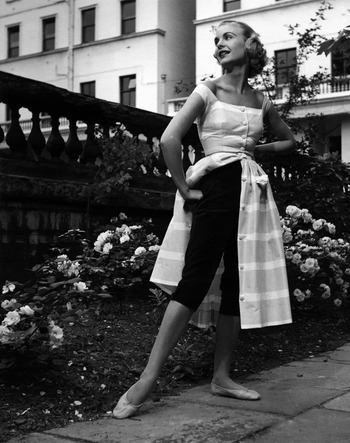
RCA Student work by Helen Jones, photographed in South Kensington, 1953 ©Royal College of Art.

In addition, from the 1980s the annual graduate fashion shows were filmed and copies are held in VHS and, later, DVD format. From 2013 the fashion shows have been streamed for immediate public access. The online hosting and streaming of graduating students’ work has undoubtedly raised their profile, enabling an immediate view of emerging designers’ collections. One of the casualties, however, has been that students can no longer select their own personal choice of music to accompany their work in the show, due to copyright considerations.
From the 1950s to the 1970s, collecting and managing the archive of these images was the responsibility of individual schools, so the coverage is not necessarily comprehensive, and many of the 1970s images are routinely identified as ‘Anonymous’, although some of the work is documented, including a graduate collection by Ossie Clark. However, with the appointment of a slide curator in 1979 the photography, archiving and cataloguing of these images was transformed: a systematic approach was established to obtain comprehensive documentation by the college photographer of every piece by every student in the final show, and to catalogue these images in detail. As well as offering students a dynamic way of promoting their work, this collection offers a unique opportunity to the researcher wanting to build a picture of the development of fashion design at the College. Students from the RCA and elsewhere often use the historical image archive for research for projects on a specific key designer.
The photographing of student work at the end of each academic year is currently under review, however. The opportunity for high-quality photographic documentation of design, including fashion, through portable technology, and the advent of social media has profoundly changed the way students promote their work, with images from the graduate show catwalk appearing instantaneously on smartphones and tablets around the world. Nevertheless, the College's formal record has an authority and consistency of approach that this ad-hoc digital proliferation lacks, and students continue to download the college's official images of their work to use alongside their own.
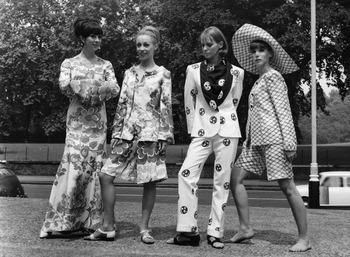
Unidentified RCA Fashion student work photographed in Kensington Gore opposite Kensington Gardens, 1964.

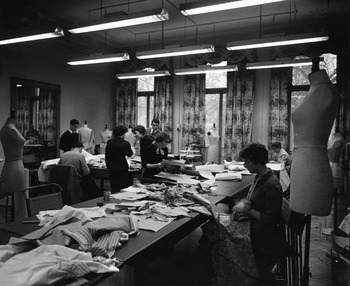
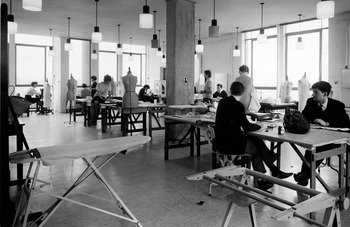
The RCA archive also includes several hundred photographic prints of a wide range of various aspects of fashion activity at the college. These show student work from the early 1950s and 1960s, pre-dating and augmenting the slide documentation of student work discussed above. This series also portrays teaching activity at the college, the studio spaces and garments in progress, graduate shows, including backstage shots, and specific events, such as students attending exclusive launches. These offer a fascinating picture of the early days of the Fashion School, and document in specific detail the manner and the various locations in which fashion was taught, and by whom, from the chintzy, formal surroundings of the grand Ennismore Gardens mansion to the technically equipped state-of-the-art studios in the RCA's new, daringly modernist building. There are classic ‘fashion shoot’, magazine-style, press photographs of work by students in the 1950s, shot in the elegant, Victorian buildings and streets of South Kensington throughout the 1950s; in contrast, a popular location during the early 60s was for the model to perch high on the staircase of the Kensington Gore RCA building, with Kensington Gardens and the Albert Memorial far below, glimpsed through the enormous windows. (The fashion studios there also feature notably in the classic ‘Swinging Sixties’ film Joanna by Michael Sarne (1968).Footnote 4
RCA Fashion School workroom, Ennismore Gardens, Knightsbridge, 1950s.

RCA Fashion studios, Kensington Gore, 1962.

These photographs offer a lively record of the early days of the School, and the rebirth of the RCA itself in the post-war period, revealing the way in which the Fashion School communicated its work as a key player in the burgeoning British fashion industry through these high-quality staged photographs, promoting the work of students as names to watch. In most cases, the earliest student work was identified at the time of capture, so most images from the 1950s can be correctly captioned in some detail, and work by early alumni such as Gina Fratini has been clearly identified. Former staff members with long connections to the College have helped to identify and date the unlabelled and more mysterious series. This is a developing process, with sometimes surprising turns. A rich cache of additional photographs of Fashion activity in the college has recently been unearthed by staff during the Fashion studios’ relocation within the College, with fascinating images of student work and scenes from the Fashion School from the 1950s to the early 1970s, identified and dated. These have considerably enhanced the existing holdings of 1960s work, and added characterful, contextual images of professors Garland and Ironside teaching.
The copyright issues for digitizing the photographic archive (as distinct from the Record of Student Work above) and making it available are problematic, as many of the prints in this collection are by press agencies or commercial photographers. Although they constitute fascinating material for researchers, they cannot be digitized and hosted by the College in an online context without permission from the original photographers. Many other photographs, however, were taken by the college for its own promotional purposes and many of these have been uploaded to the special collections digital assets management system. A risk assessment is carried out on ‘orphan’ works with no clear provenance or attribution. As many in-house RCA photographs have a particular look and feel, experience has allowed reasonable judgements to be made regarding works most likely to be the College's copyright and therefore most straightforward to digitize.
The RCA's special collections also holds a number of donated personal archives of figures with a close academic connection to the College, offering precious primary source material for the researcher. These include the papers of Madge Garland, the RCA's first professor of fashion, containing diaries, photographs, articles, letters and other memorabilia relating to her high-profile career in fashion journalism, and her role in the emergence of the British fashion industry and education.
Research relevance
This range of archival resources for the history of fashion education at the RCA has informed and inspired ongoing research into the mapping of British fashion history. Exhibitions drawing on the archive include former professor of fashion Wendy Dagworthy's 2013 ‘Club to catwalk’ exhibition at the V&A, exploring 1980s fashion and culture;Footnote 5 Tate Liverpool's ‘Glam! The performance of style’,Footnote 6 that highlighted 1970s glam rock and culture, featured RCA Fashion Show invitations and catalogues from the 1970s.
Publications include Lisa Cohen's 2013 triple biography All we know: three lives (2012),Footnote 7 which includes Madge Garland, Anna Buruma's Liberty & Co in the fifties and sixties (2008),Footnote 8 featuring work for Liberty by RCA fashion and textiles students, and Zandra Rhodes: textile revolution (2010)Footnote 9 by RCA alumna Samantha Erin Safer. Other researchers have focused on particular strands, such as the development of menswear and children's wear (both initiatives under Janey Ironside). Most recently, the fashion materials in the archive have been vital to former Senior Tutor in Womenswear Henrietta Goodden's current research into the history of fashion education at the RCA: she says:
The resources for fashion and textiles in the Royal College of Art Archive have been absolutely invaluable to me in my recent research for a book on the School of Fashion on which I am currently working, and also for my previous title, Robin Darwin: visionary educator and painter. The digital photographic archive is a prolific, practical and easily navigable reference tool when searching for particular images of studio practice and students’ work. The archive's wonderful collection of printed ephemera (catalogues, programmes, invitations, posters and more) is also unique in that it delivers not only original material but also a feeling for the all-important zeitgeist of this influential School.Footnote 10
What next for the archive?
Future plans for the RCA archive focus on providing enhanced digital access to this collection, and the preservation (through digitization and cold storage) of the content of increasingly fragile slides from the 1960s and 1970s. The virtual collocation of the archive's material will enable increased visibility of interdisciplinary connections in College history, and offers the opportunity to ‘crowdsource’ more detailed information about the people and work in the images in the fashion collections. This aspiration has been highlighted by recent activity to produce a pilot online exhibition on the history of fashion at the RCA that usefully unites the disparate series within the archive.
Zowie Broach, current RCA Head of Fashion, encapsulates the significance of the collection:
The RCA fashion archive reminds us all how we move forward and how we stand still, like a dance of passions. We need the archive to learn about who we truly are… and to bring together a collision of past, present, future present imagery about the making and design processes we are haunted by and are responsible for: the new ghosts of fashion here at the RCA.Footnote 11
Acknowledgements
Many thanks to Neil Parkinson, Archives & Collections Manager, and Henrietta Goodden, for their contribution to this article.