Implications
The seasonal infertility in boars is detrimental to swine industry. The nutritional management is an economical and useful strategy to improve reproductive performance of boars during the hot summer months. In this study, we investigated the possibility of use and optimal dosage of l-arginine to improve semen quality and libido performance in boars under high ambient temperature. Our results show that l-arginine (supplemented at 0.8% to 1.0%) has clear potential to improve semen quality and libido performance of boars during the hot summer months.
Introduction
Reproductive performance of boars was reduced during the hot summer months and resulted in seasonal infertility. This reduction in reproductive performance of boars was demonstrated by decrease of sperm motility, sperm normality, daily sperm output and libido (Kunavongkrit et al., Reference Kunavongkrit, Suriyasomboon, Lundeheim, Heard and Einarsson2005). Moreover, the pregnancy rate and embryo survival were reduced when gilts were inseminated with semen from boars after heat stress (Wettemann et al., Reference Wettemann, Wells, Omtvedt, Pope and Turman1976). Three basic management schemes for reducing the effect of thermal stress have been suggested (Aggarwal and Upadhyay, Reference Aggarwal and Upadhyay2012): (a) physical modification of the environment, (b) genetic development of less sensitive breeds and (c) improved nutritional managements schemes. The nutritional strategy seem to be an economical way that could be applied in large scale.
l-Arginine is a potential agent for alleviating thermal stress-induced seasonal infertility of boars. First, l-arginine is essential in spermatogenesis, which supported by the observation that the sperm number and motility of adult men were decreased by 90% after feeding 9 days l-arginine deficient diet (Holt, Reference Holt and Albanesi1944). For this reason, raising l-arginine provision may improve fertility of male. For example, the sperm number and motility were remarkably increased in most of infertile men and resulted in pregnant successfully after oral administration of Arg-HCl (0.5 g/day) for 6 to 8 weeks (Tanimura, Reference Tanimura1967). l-Arginine also stimulates the motility of ejaculated human and rabbit sperm in vitro in a concentration dependent manner (Keller and Polakoski, Reference Keller and Polakoski1975; Radany and Atherton, Reference Radany and Atherton1981). In addition, l-arginine is the unique precursor of nitric oxide (NO). Physiological levels of NO stimulate penile erection and relax vessel (Gratzke et al., Reference Gratzke, Angulo, Chitaley, Dai, Kim, Paick, Simonsen, Ückert, Wespes and Andersson2010; Wu, Reference Wu2010). These physiological functions of NO may improve libido and heat dissipation of boars under high ambient temperature. Furthermore, previous reports confirmed that l-arginine increased antioxidant capacity, reduced superoxide release and alleviated lipid peroxidation (Petrovic et al., Reference Petrovic, Buzadzic, Korac, Vasilijevic, Jankovic, Micunovic and Korac2008). These functions may protect boars’ sperm against oxidative damage induced by heat stress. Because sperm is likely to be more susceptible to the effect of heat stress and thus oxidative damage due to the relatively high unsaturated fatty acids in the plasma membrane and low antioxidant capacity in seminal plasma (Esfandiari et al., Reference Esfandiari, Saleh, Blaut, Sharma, Nelson, Thomas, Falcone and Agarwal2002).
In view of the foregoing, we hypothesized that dietary l-arginine supplementation may improve reproductive performance of boars in the hot summer months. The present study was conducted to test this hypothesis. In the experiments reported herein, we assessed semen characteristics and libido performance of boars. Also, relevant parameters, such as scrotal surface temperature, redox status, hormone and mitochondrial ultrastructure, were measured for uncovering the possible mechanism.
Material and methods
The procedures involved in this study were approved by Nanjing Agricultural University Institutional Animal Care and Use Committee, China.
Animal, diets and boar care
This study was conducted at Jiangsu Lihua Animal Husbandry Co,. Ltd, where located at 118.79° north latitude and 34.12° east longitude. The data of day-length in the geographic area where the experiment was performed were shown in the Supplementary Table S1. In all, 20 boars (PIC 1040; 248.59±3.84 kg BW and 407.65±6.40 days of age) with similar semen quality were selected by successive five times evaluation of semen characteristics. The pre-selection data for five evaluations were shown in the Supplementary Table S2. Boars were then randomly assigned to four treatments (0.0%, 0.6%, 0.8% and 1.0%). Each treatment had five replicates with one boar per replicate. Boars were kept individually in pens with half-slatted floors. Given that the duration of the spermatogenic cycle and the sperm transit time in boars is ~42 days, nutritional effects were not expected to be evident prior to 42 days (Swierstra, Reference Swierstra1968). Boars thus were pre-fed their corresponding experimental diets for 42 days. Thereafter, they received their dietary treatments until the end of the experiment. The semen quality was assessed form 28 July to 7 September 2016 for 42 days. The semen in each pig was collected twice per week.
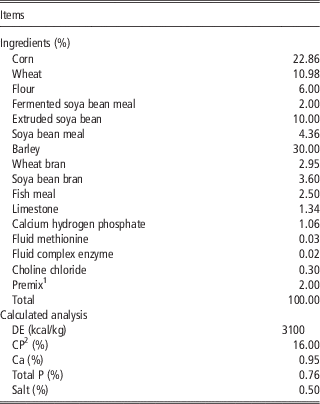
During experiment, boars were fed twice daily (0700 and 1600 h) 1.25 kg of the basal diet supplemented with 0.0%, 0.6%, 0.8% or 1.0% l-arginine (wt:wt). The basal diet (2.5 kg/boar per day) was formulated according to PIC Nutrient Specifications (2008) to mature boars and met the National Research Council (NRC) recommended requirements of nutriments to mature boars (Table 1). The four diets were made isonitrogenous by addition of appropriate amounts of l-alanine: (1) 2.0% l-alanine+basal diet for the 0.0% group; (2) 0.8% l-alanine+0.6% l-arginine+ basal diet for the 0.6% group; (3) 0.4% l-alanine+0.8% l-arginine+basal diet for the 0.8% group; and (4) 1.0% l-arginine+basal diet for the 1.0% group. l-Arginine or l-alanine was added to the basal diet as top dressing (Li et al., Reference Li, Bazer, Johnson, Burghardt, Erikson, Frank, Spencer, Shinzato and Wu2010). l-Alanine was used as the isonitrogenous control, because it is rapidly catabolized by pigs (Wang et al., Reference Wang, Chen, Li, Li, Zhou, Wang, Li, Yin and Wu2008). All boars consumed 100% of the feed provided daily and accessed to water ad libitum.
Nutrient and chemical composition of experimental diet (as-fed basis)

DE=digestible energy.
1 Premix: supplied the following per kilogram of diet: vitamin A (retinyl acetate), 5500 IU; vitamin D3 (cholecalciferol), 1200 IU; vitamin E (α-tocopheryl acetate), 48 mg/kg; vitamin K (menadione sodium bisulfate), 2.4 mg/kg; vitamin B2 (riboflavin), 4.8 mg/kg; vitamin B6 (pyridoxine), 3.2 mg/kg; pantothenic acid, 17.6 mg/kg; nicotinic acid, 30 mg/kg; Fe (from ferrous sulfate), 88 mg/kg; Cu (from copper sulfate), 14.4 mg/kg; Mn (from manganese sulfate), 39 mg/kg; I, 0.55 mg/kg; Zn (from zinc oxide), 88 mg/kg; Se (sodium selenite), 0.3 mg/kg.
2 Analysed composition of amino acid: aspartate plus asparagine, 1.32%; threonine, 0.68%; serine, 0.76%; glutamate plus glutamine, 3.05%; glycine, 0.70%; alanine, 0.73%; cysteine, 0.20%; valine, 0.73%; methionine, 0.23%; isoleucine, 0.60%; leucine, 1.25%; tryptophan, 0.45%; phenylalanine, 0.78; lysine, 0.97%; histidine, 0.39%; and arginine, 0.87%.
Boars were exposed to ambient temperature and natural photoperiod. The temperature and relative humidity in pigsty were recorded daily by generic thermometers at 0700, 1200 and 1600 h. Temperature-humidity index (THI) was calculated as: ((0.65)(dry-bulb temperature)+(0.35)(wet-bulb temperature)) (Council, Reference Council1981). Scrotal surface temperature was measured from each boar during experimental period (from 28 July to 7 September 2016), triweekly, at 1200 h. Before testing the scrotal surface temperature, boars were drove to keep standing at least 15 min. Scrotal surface temperature was measured using a thermal imaging camera (TiR27; Fluke Corporation, Everett, WA, USA), according to the manufacturer’s instructions. The negative pressure ventilation and wet curtain air-conditioning system were used to control the indoor environment.
Semen collection, evaluation and libido
Boars were trained to mount to the dummy and have their semen collected by the gloved hand technique. Semen collections were carried out by the same worker during the whole length of experiment. The entire ejaculate was collected in a pre-warmed insulated container kept at 37°C and gelatinous material was strained from the ejaculate by sterile gauze. Semen volume was measured by weighting and considering 1 g of semen being equal to 1 ml. The sperm motility was assessed microscopically under 200× magnification (Olympus, Tokyo, Japan). In brief, the ejaculates were diluted 1 : 1 (vol:vol) immediately with isothermal semen extender (QuanNengJian®; China Animal Husbandry Group, Beijing, China) and a 10-µl aliquot of the sperm sample was placed on a warmed microscopic slide (37°C) and covered with a coverslip. Each slice was assessed three times, and at least five microscopic fields of vision were evaluated by the same observer. Eosin stain method was used to examine sperm morphology (Kozink et al., Reference Kozink, Estienne, Harper and Knight2004). Sperm with head defects, neck and mid-piece defects, tail defects and excess residual cytoplasm were counted microscopically under 400× magnification (Olympus, Japan). At least 300 sperms were assessed for each ejaculate. The sperm concentration was estimated using a spectrophotometer (721; Shanghai Precision and Scientific Instrument Corporation, Shanghai, China) precalibrated with a hemocytometer (Prathalingam et al., Reference Prathalingam, Holt, Revell, Jones and Watson2006). Total sperm production was calculated by multiplying the volume and concentration of each ejaculate. Effective total number of sperm per ejaculate was calculated by multiplying the total sperm production by motility (Wang et al., Reference Wang, Li, Wei, Zhou, Tan, Sun, Jiang and Peng2016). When semen was used in the experiment reported herein, it was collected from all boars during the same time frame. Boar libido was evaluated by reference to a standard that was reported previous (Louis et al., Reference Louis, Lewis, Weldon, Miller, Kittok and Stroup1994a): (1) the time from when the boar entered the collection area until it mounted the semen-collection dummy and started ejaculating and (2) the duration of ejaculation. These measurements were recorded for each ejaculate throughout the sampling period. Procedures for the collection of seminal plasma and sperm were the same as those described by the previous reports (Ren et al., Reference Ren, Cheng, Wu, Xu, Che, Fang, Lv, Dong and Lin2015).
Blood collection
Given that blood collection caused serious stress in hot weather, this might influence semen quality. Blood was collected immediately at the end of experiment via jugular venipuncture and centrifuged at 3000×g for 10 min. The isolated serum samples were stored at −80°C until determine.
Measurement of nitric oxide content and nitric oxide synthase activity in serum and seminal plasma
The NO level and nitric oxide synthase activity were assayed using commercial reagent kits obtained from the Institute of Biological Engineering of Nanjing Jiancheng (Nanjing, China), according to the manufacturer’s protocols.
Determination of semen redox status
The redox status of semen was evaluated using these parameters, such as ratio of glutathione and oxidized glutathione (GSH/GSSG), total antioxidant capacity (T-AOC), malondialdehyde (MDA), glutathione peroxidase (GSH-Px), superoxide dismutase (SOD) and catalase (CAT). These parameters were measured using commercial reagent kits obtained from the Institute of Biological Engineering of Nanjing Jiancheng, according to the manufacturer’s protocols. The content of 8-Hydroxy-2'-deoxyguanosine (8-OH-dG) in spermatozoa, as a biomarker of DNA oxidative damage, was measured using a commercial ELISA kit (Cell Biolabs, San Diego, CA, USA) following the manufacturer’s protocol. The sperm DNA fragmentation index was determined by the sperm chromatin dispersion test.
Mitochondrial ultrastructure and ATP level
The semen was randomly selected from four treatments on the same sampling day (eight samples totally, two sample/treatment), and diluted to the same sperm concentration (106/ml). Then, a 1-ml sample of the semen was immediately pipetted into 2 ml of fixative solution (2% glutaraldehyde) for evaluation of mitochondrial ultrastructure by transmission electron microscope (Hitachi H-7650; Hitachi Technologies, Tokyo, Japan). The ATP level was measured using commercial reagent kits obtained from the Institute of Biological Engineering of Nanjing Jiancheng, following the manufacturer’s protocols.
Hormone extraction and measurement
The serum samples (100 µl for estradiol-17β and 10 µl for testosterone) were extracted by 2 ml of diethyl ether with vortexing for 3 min in tubes. These samples were placed in a mixture of dry ice and 90% ethanol, and the ether phase was poured into another tube after the aqueous phase was frozen. The ether phase was dried down on the dry heater, rinsed with 500 µl of diethyl ether and again dried down. Dried samples were dissolved in 300 µl phosphate buffer solution based 1% bull serum albumin with vortex for 3 min. These solutions were used for samples to measure E2 and T.
Serum content of estradiol-17β and testosterone were determined with a double-antibody RIA system with 125I-labelled radio ligands. Antiserum to E2 (GDN244) and T (GDN250) were kindly provided by Dr G.D. Niswender (Fort Collins, Co, USA). The intra- and inter-assay CV were 9.8% and 10.8% for estradiol-17β and 5.1% and 8.6% for testosterone, respectively.
Statistical analysis
Each individual boar served as an experimental unit. Before analysis, the data were tested for normality and homoscedasticity. The data were transformed by square root (x), log 10(x), and arcsine square root (x) when the distribution was not normal or was heteroscedastic. Data of semen characteristics was subjected to ANOVA for a repeated measures design using the MIXED procedure (SAS Institute Inc., Cary, NC, USA), and the fixed effects of diet, week, and their interactions were included in this statistical model. When a significant difference was detected between diet treatments, the PDIFF option of the LSMEANS statement in the MIXED procedure was used to compare individual least squares means (Wang et al., Reference Wang, Li, Wei, Zhou, Tan, Sun, Jiang and Peng2016); meanwhile, a polynomial contrast was constructed to determine linear and quadratic effects of dietary l-arginine levels. The other data were subjected to one-way ANOVA with dietary treatment as the main effect, where a polynomial contrast was also constructed to determine linear and quadratic effects of dietary l-arginine levels. For all analyses P<0.05 was consider significant.
Results
Temperature profile
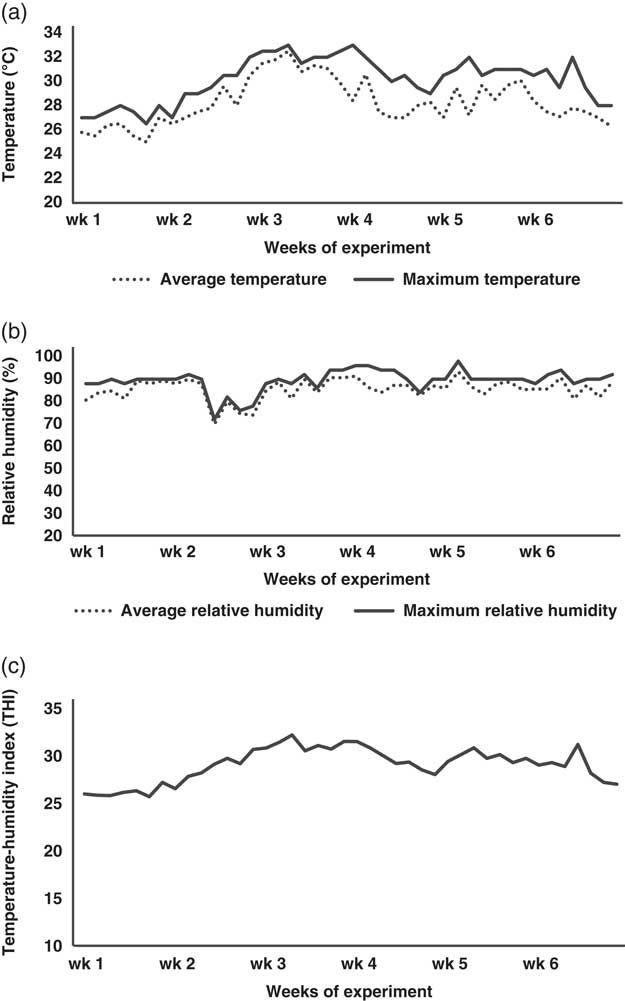
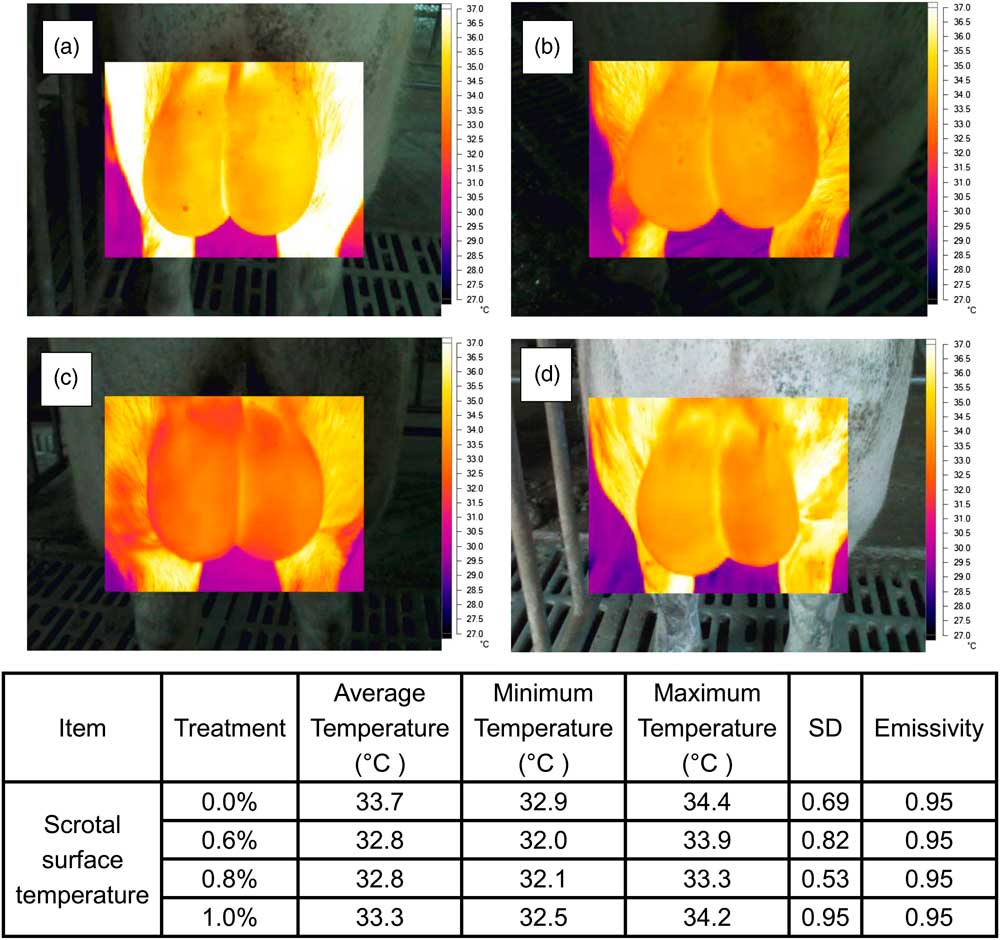
The temperature, relative humidity and THI in the pig house during the pre-feeding period were shown in the Supplementary Figure S1. During the experimental period, the temperature and relative humidity in the pig house were monitored (the Figure 1a and b). According to the Figure 1c, the environmental thermal conditions obtained during the execution of the experiment were close to or more than the upper critical THI of boars which is 26.53. (Kiefer et al., Reference Kiefer, Donzele, Oliveira, Suguisawa, Suguisawa and Marques2012). It was possible to conclude that the experimental boars suffered thermal stress. The scrotal surface temperature of boars following heat exposure was presented in Figure 2.
Room temperature (a), the relative humidity (b), and the temperature and humidity index (c) during the experimental period. Experimental period: from 28 July to 7 September 2016.

Measuring the scrotal surface temperature of boars under high ambient temperature. The IR image of boars in the 0.0% group (a), 0.6% group (b), 0.8% group (c) and 1.0% group (d).

Semen characteristics
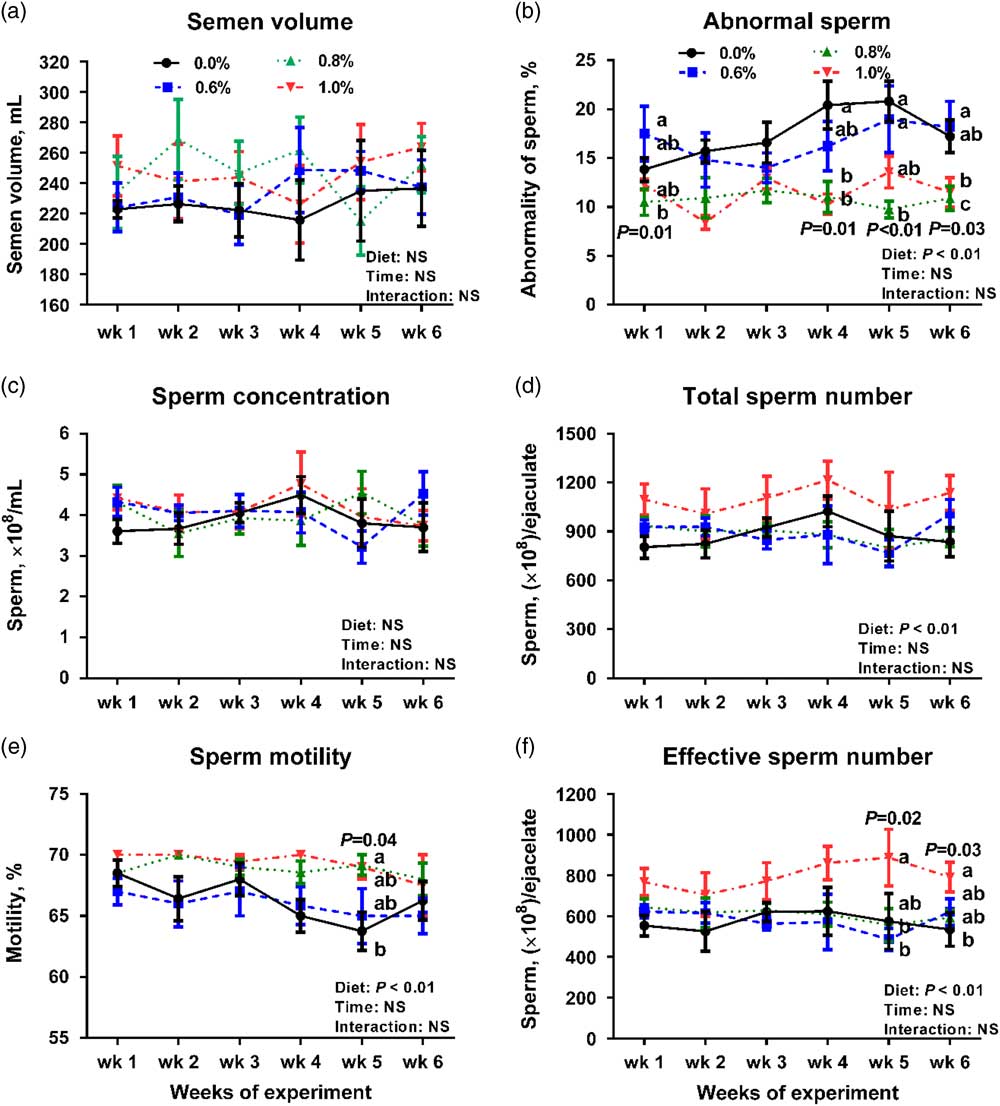
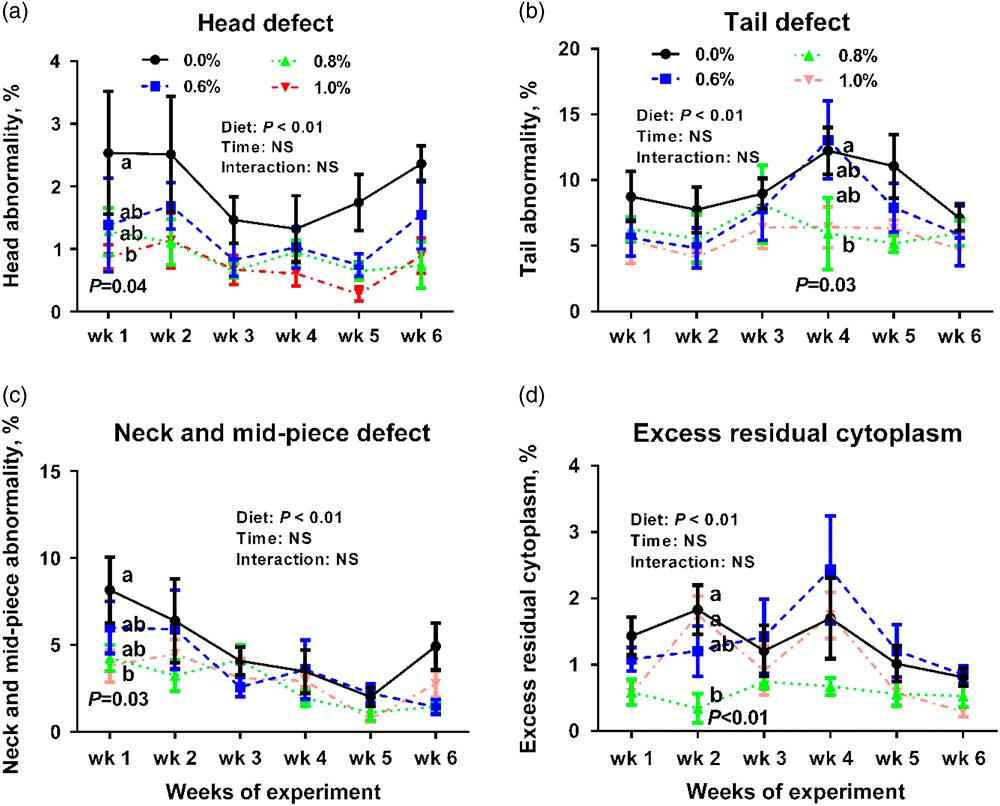
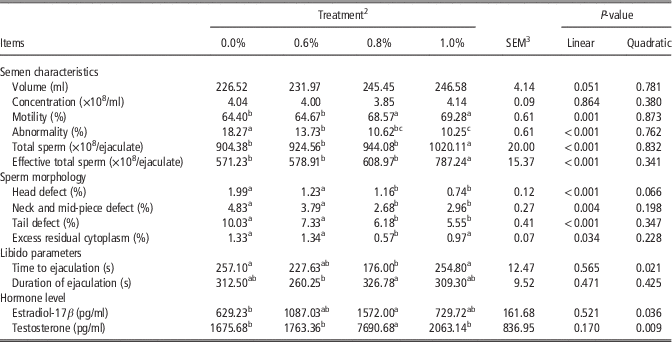
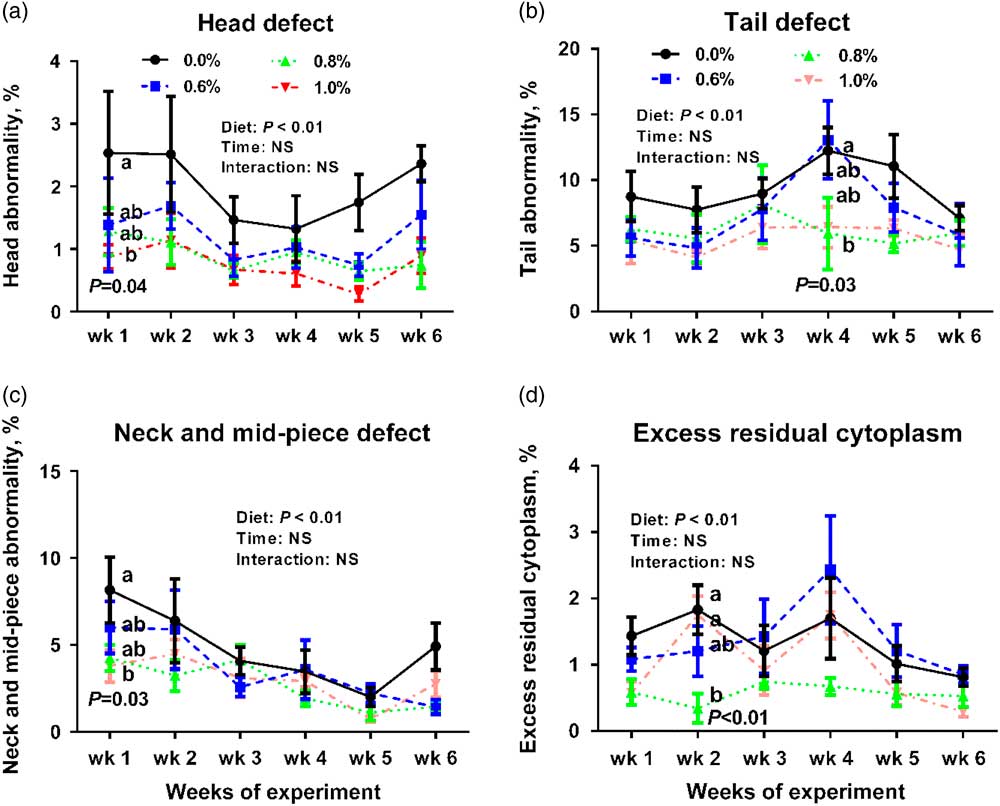
Semen characteristics were shown in Table 2. Dietary supplementation with 0.8% and 1.0% l-arginine greatly promoted sperm motility (P<0.05), normality (P<0.05), total sperm number (P<0.05) and effective sperm number (P<0.05) when compared with 0.0% group. A linear response in sperm motility (P<0.01), sperm morphology (P<0.01), total sperm number (P<0.01) and effective sperm number (P<0.01) were observed as the level of dietary l-arginine increased. As shown in Figure 3, there was an effect of diet on sperm motility, abnormality, total sperm number and effective sperm number (P<0.01). The sperm motility at week 5 in the 0.8% group was greater than the 0.0% boars. There was a significant reduction of the sperm abnormality at week 1 (P=0.01), week 4 (P=0.01), week 5 (P<0.01) and week 6 (P=0.01), respectively, in the 0.8% groups when compared with the 0.0% groups. The 1.0% group presented a greater effective total sperm number at week 5 (P=0.02) and week 6 (P=0.03) than the 0.0% groups. As shown in Figure 4, there was an effect of diet on sperm head, neck and mid-piece, tail defect and excess residual cytoplasma (P<0.01). The percentage of head defect and neck and mid-piece defect at week 1 in the 0.0% group was greater than the 1.0% group. The 0.6% group presented a greater percentage of tail defect than the 0.8% group at week 4. The percentage of excess residual cytoplasm in the 0.0% group was greater than the 0.8% group at week 2.
Effect of l-arginine on semen volume (a), sperm concentration (b), sperm motility (c), the percentage of abnormal sperm (d), total sperm number (e) and effective sperm number (f) during a 6 weeks experimental period. Values were means±SEM, n=5. Solid line: 0.0% group; dashed line: 0.6% group; dotted line: 0.8% group; chain line: 1.0% group. The letters (a and b) show significant difference between any two groups (P<0.05). NS=no significance among treatments (P>0.05).

Effect of l-arginine on sperm head defect (a), neck and mid-piece defect (b), tail defect (c) and excess residual cytoplasma (d) during a 6 weeks experimental period. Values were means±SEM, n=5. Solid line: 0.0% group; dashed line: 0.6% group; dotted line: 0.8% group; chain line: 1.0% group. The letters (a and b) show significant difference between any two groups (P<0.05). NS=no significance among treatments (P>0.05).
Effect of l-arginine on semen characteristics, libido performance and serum hormone level of boars under high ambient temperatureFootnote 1

a,b Values within a row with different superscripts differ significantly at P<0.05.
1 Data are means of five pigs per treatment. Each ejaculate and libido parameters were measured for 6 weeks. 20 samples (five samples/treatment) of serum were analysed.
2 0.0%=basal diet + 2.0% l-alanine; 0.6%=basal diet + 0.8% l-alanine + 0.6% l-arginine; 0.8%=basal diet + 0.4% l-alanine + 0.8% l-arginine; 1.0%=basal diet + 1.0% l-arginine.
3 Pooled SEM.
Libido
The libido performance of boar was shown in Table 2. The boars in the 0.8% group took less time to produce an ejaculate than the 0.0% and 1.0% groups (P<0.05). Duration of ejaculation in the 0.8% group was greater than the 0.6% group. There was a quadratic correlation between dietary l-arginine level and time to ejaculation ( P<0.05).
nitric oxide level, nitric oxide synthase activity and semen redox status
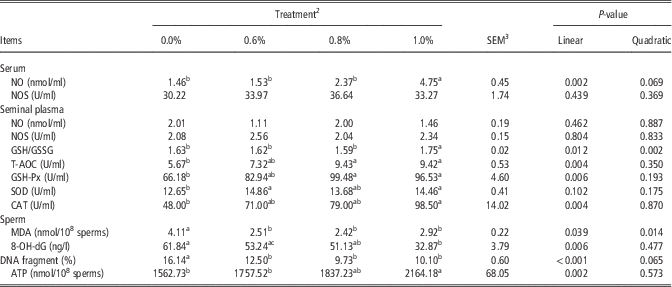
The serum NO content was significantly increased in the 1.0% group than other groups (P<0.01). A linear response in serum NO content (P=0.002) was observed as the level of dietary l-arginine increased.
The redox status of semen was shown in Table 3. When compared with the 0.0% group, the proportion of DNA fragment, MDA and 8-OH-dG content in sperm were significantly decreased (P<0.05) in the 1.0% group. At the same time, T-AOC and GSH/GSSG in seminal plasma were significantly increased in 0.8% and 1.0% groups (P<0.05) when compared with 0.0% group. A linear response in GSH/GSSG (P=0.012), MDA (P=0.003) and 8-OH-dG (P=0.006) content were observed as the level of dietary l-arginine increased. Also, a quadratic response in MDA level (P=0.001) and GSH/GSSG (P=0.002) were detected as the level of dietary l-arginine increased.
Effect of l-arginine on biochemical parameters in serum, seminal plasma and spermFootnote 1

NO=nitric oxide; NOS=nitric oxide synthase; GSH/GSSG=the ratio of glutathione and oxidized glutathione; T-AOC=total antioxidant capacity; GSH-Px=glutathione peroxidase; SOD=superoxide dismutase; CAT=catalase; MDA=malondialdehyde; 8-OH-dG=8-Hydroxy-2’-deoxyguanosine.
a,b,c Values within a row with different superscripts differ significantly at P<0.05.
1 Data are means of five pigs per treatment. 20 samples (five samples/treatment) of seminal plasma and sperm were analysed in each week for 6 weeks.
2 0.0%=basal diet + 2.0% l-alanine; 0.6%=basal diet + 0.8% l-alanine + 0.6% l-arginine; 0.8%=basal diet + 0.4% l-alanine + 0.8% l-arginine; 1.0%=basal diet + 1.0% l-arginine.
3 Pooled SEM.
Mitochondrial ultrastructure and ATP content
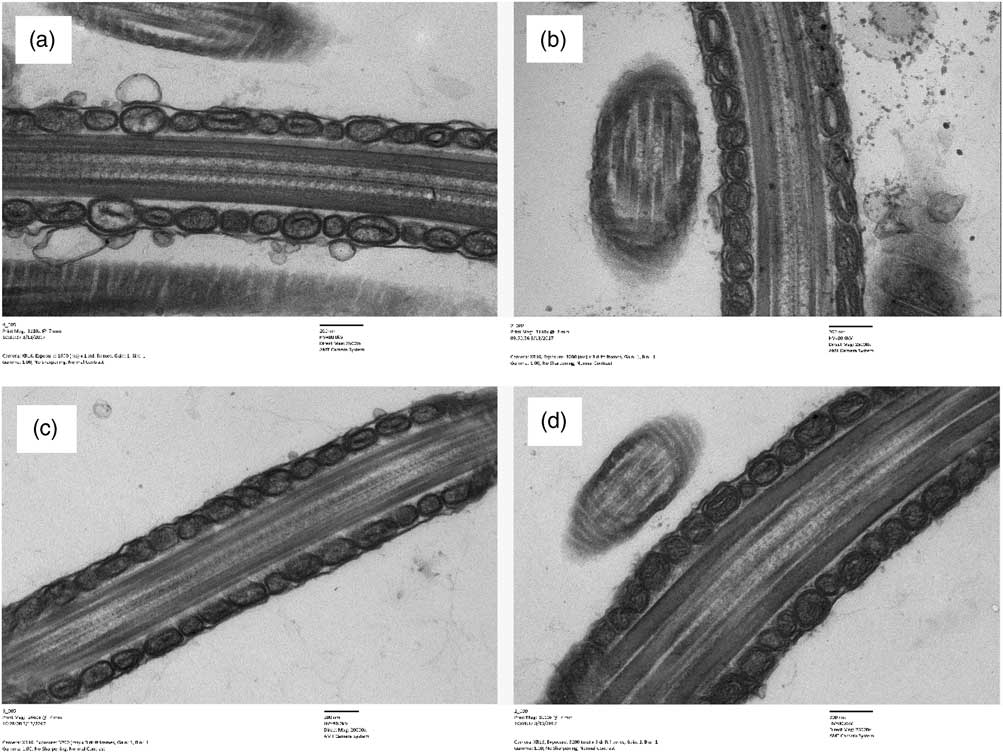
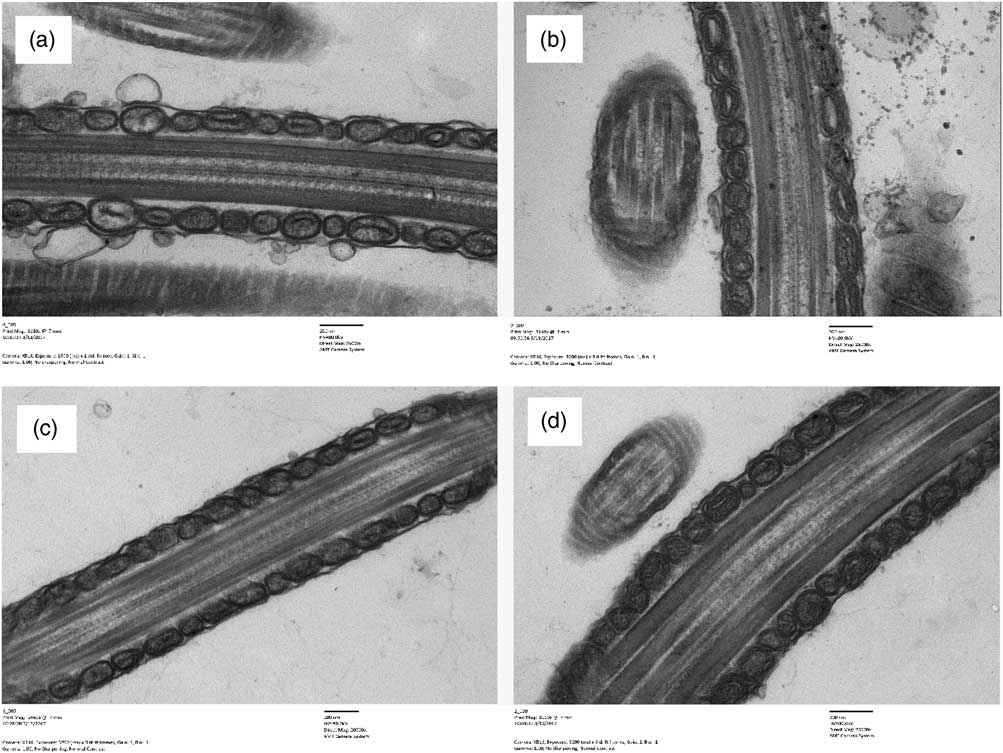
As the Figure 5 shown, in the 0.0% group, the mitochondrial array was altered, leaving gaps between adjacent organelles. Mitochondria presented an oval shape rather than the normal oblong shape. There are also swollen and atrophy mitochondria. Dietary 0.6% l-arginine supplementation maintained the integrity of mitochondrial array (no gaps between adjacent organelles). But the mitochondrial shape were irregular. Dietary 0.8% l-arginine supplementation maintained the integrity of mitochondrial array (no gaps between adjacent organelles) and shape (more oblong organelles) and a close apposition of the plasma membrane to the tail mid-piece. In the 1.0% group, the mitochondrial array was integrated and presented an normal oblong shape. There was a loose apposition of the plasma membrane to the tail mid-piece.
Transmission electron micrographs (80 K) of mitochondria of boar spermatozoa: (a) 0.0% group, (b) 0.6% group, (c) 0.8% group and (d) 1.0% group. Scale bar=200 nm.
The boars fed 1.0% supplement of l-arginine showed a significant increase in sperm ATP content when compared with the 0.0% and 0.6% group. Meanwhile, a linear response in sperm ATP content (P=0.002) was observed as the level of dietary l-arginine increased.
Hormone level
The levels of testosterone and estradiol-17β were significantly increased in 0.8% group (P<0.05) when compared with the other group.
Discussion
Given that seasonal infertility in boars frequently occurred in the hot summer months, this study was designed to examine the effect of different inclusion rates of l-arginine supplementation on semen quality and libido performance of boars during the hot summer months.
High temperature or heat stress frequently lead to sperm motility loss, sperm defect and sperm output loss in boars. The excessive transfer of heat might lead to supraphysiologic reactive oxygen species (ROS) production along the respiratory chain, which may ultimately compromise their structural integrity and functional capacity (Esfandiari et al., Reference Esfandiari, Saleh, Blaut, Sharma, Nelson, Thomas, Falcone and Agarwal2002), such as peroxidative damage to the sperm plasma membrane and DNA strand breakage in the sperm nucleus (Lavranos et al., Reference Lavranos, Balla, Tzortzopoulou, Syriou and Angelopoulou2012). In this study, dietary l-arginine supplementation remarkable improved semen quality, such as sperm motility, normality, total sperm number and effective total sperm number in hot summer months. Meanwhile, diets affect sperm defect, sperm motility, total sperm number and effective total sperm number. The effects displayed by l-arginine might be attributed to its direct and/or NO-mediated antioxidant properties. The augmentation of NO production induced by l-arginine may act as an antioxidant (Kawano et al., Reference Kawano, Motoyama, Hirai, Kugiyama, Yasue and Ogawa2002). It was reported that NO terminates oxidant stress in tissues by suppressing iron-induced generation of hydroxyl radicals via the Fenton reaction, interrupting the chain reaction of lipid peroxidation, augmenting the antioxidative potency of GSH and inhibiting cysteine protease (Chiueh, Reference Chiueh1999). In agree with these observations, the present results demonstrated that the GSH content and T-AOC in the seminal plasma were increased when the l-arginine was administered. Also, the enzymatic antioxidants play important role in quenching ROS and to protect sperm from oxidative damage caused by thermal stress, specifically, SOD detoxifies superoxide radicals to hydrogen peroxide, CAT decomposes hydrogen peroxide to water and oxygen, and GSH-Px converts peroxides and hydroxyl radicals into non-toxic forms. With the increase of l-arginine supplementation, the augment of antioxidant enzymes activities (SOD, CAT and GSH-Px) were also detected. As a consequence, the lipid peroxidation product (MDA) and DNA oxidation product (8-OH-dG) in sperm were significantly decreased in l-arginine treated group, indicating reduction of oxidative stress. Oxidative stress also attacks the integrity of the DNA carried in the sperm nucleus and mitochondria (Agarwal et al., Reference Agarwal, Roychoudhury, Bjugstad and Cho2016). Generally, DNA fragmentation is an useful marker to evaluate DNA damage induced by oxidative stress. In present study, the reduction of sperm DNA fragment index was also observed when the l-arginine was administered. Taken together, dietary l-arginine supplementation might improve semen quality through augmenting antioxidant capacity of seminal plasma.
Supplementation of boars diet with 1.0% l-arginine resulted in increase in total sperm number, effective sperm number and artificial insemination (AI) dose (four billion sperm/AI dose) by up to 12.8%, 37.8% and 13.3%, respectively, compared with the 0.0% group. Therefore, the nutritional management could be applied to increase AI dose by adding 1.0% l-arginine to the diet during the summer hot weather. The increase of AI dose could be benefit to stable production in swine industry during summer. However, in this study, there were not effects of time and interaction between time and diet on semen characteristics. This result can be explained by previous report that l-arginine turns over rapidly in mammals with half lives in the circulation of 1.06, 0.75 and 0.65 h for adult, pregnant and neonatal pigs, respectively (Wu et al., Reference Wu, Bazer, Cudd, Jobgen, Kim, Lassala, Li, Matis, Meininger and Spencer2007).
Mitochondria are known as the ‘power plant’ of the cell because they play a fundamental role in the production of ATP through the oxidative phosphorylation (OXPHOS). However, a long-standing debate exists on which metabolic pathway, OXPHOS or glycolysis, is involved in energy production for sperm motility (Piomboni et al., Reference Piomboni, Focarelli, Stendardi, Ferramosca and Zara2012). Undoubtedly, the intact mitochondrial structure is essential for sperm motility. In this study, most of the mitochondria contained clearly visible intact ultrastructure in the l-arginine-supplemented group. Also, the ATP levels are in accordance with the ultrastructural changes of sperm among four groups. In addition, previous report has confirmed OXPHOS involved in sperm motility, which inhibiting OXPHOS and mitochondrial respiratory chain complex I decreased sperm motility (Guo et al., Reference Guo, Gong, He and Zhao2017). These results seem to suggest that dietary l-arginine supplementation alleviated damage of sperm mitochondria and promoted ATP production under high ambient temperature, which resulted in increase of sperm motility.
For optimal spermatogenesis to occur, testicular temperatures of boars are maintained 4°C to 6°C lower than core body temperature (Setchell, Reference Setchell2006). Raised testicular temperature has a detrimental effect on spermatogenesis and the resultant spermatozoa. Therefore, thermoregulatory failure leading to heat stress can compromise sperm quality and increase the risk of infertility. Our previous study demonstrated that the scrotal surface temperature of boar (Large White, 27 months old) increased by 3.5°C under high ambient temperature (34°C) compared with normal control (20°C to 28°C) (Li et al., Reference Li, Wang, Taya and Li2015), which resulted in sperm defect and sperm output loss. In this study, the scrotal surface temperature was decreased by 0.9°C, 0.9°C and 0.4°C in the 0.6%, 0.8% and 1.0% group, respectively, compared with the 0.0% group. According to our previous data, the normal scrotal surface temperature is 30.2°C to 33.1°C using Large-White boar as a model (Li et al., Reference Li, Wang, Taya and Li2015). This indicated that scrotal surface temperature of boars in 0.0% group were beyond the normal condition. Meanwhile, serum content of NO was increased in a linear response with the l-arginine supplementation increased. Therefore, the effect of l-arginine on testicular thermoregulation may be related to NO. As vascular endothelial cells synthesize NO from l-arginine, and the endothelium of blood vessels uses NO to signal the surrounding smooth muscle to relax, thus resulting in vasodilation and increasing blood flow (Palmer et al., Reference Palmer, Ashton and Moncada1988). The vasodilation of scrotal vessels could facilitate heat dissipation of testes via the counter-current mechanism. In this mechanism, warmed arterial blood entering the testis is cooled by the returning venous blood leaving the testes. This allows the cooling of 38.8°C arterial blood to 36.6°C before it enter the testes (Knox, Reference Knox2003). These findings implied that dietary l-arginine supplementation decreased testicular surface temperature, which might related to NO-mediated vasodilation of testicular vessels network.
In this study, the content of testosterone and estradiol-17β were dramatically increased in the 0.8% group. Also, the boars in the 0.8% groups took less time to ejaculation than boars in the 0.0% group. These results agree with previous reports that boar’s libido performance was positive correlated with serum content of testosterone and estradiol-17β (Louis et al., Reference Louis, Lewis, Weldon, Ermer, Miller, Kittok and Stroup1994b; Ren et al., Reference Ren, Xing, Lin, Wu, Li, Li, Yang, Guo, Ren and Ma2009). Previous study has shown that elevation of scrotal temperature was one of the major factors to impair steroidogenesis in testis (Shiraishi et al., Reference Shiraishi, Takihara and Matsuyama2010). In this study, it was worth noting that the scrotal surface temperature of boars decreased by 0.9°C in the 0.8% group when compared with the 0.0% group. Therefore, we deduced that l-arginine decreased testicular temperature resulting in augmenting level of testosterone and estradiol-17β, which improved libido performance of boars.
In conclusion, dietary l-arginine supplementation improved semen quality and libido performance of boars during the hot summer months. A novel observation was that the boars in the 1.0% group possessed great semen quality and antioxidant capacity, whereas the boars in the 0.8% group presented better libido performance. These findings were useful to alleviate heat stress-induced seasonal infertility in boars by supplemented appropriate l-arginine in summer.
Acknowledgements
This work was supported by the National Key Research and Development Program of China (2016YFD0500505) and the National Natural Science Foundation of China (no. 31402116).
Supplementary material
To view supplementary material for this article, please visit https://doi.org/10.1017/S1751731117003147