Background
Candida auris is an emerging multidrug-resistant fungus that causes significant healthcare infection prevention challenges. It has been associated with human-human transmission, prolonged colonization, invasive life-threatening infections, and outbreaks in intensive care units. Reference Theodoropoulos, Bolstorff and Bozorgzadeh1,Reference Eyre, Sheppard and Madder2
The Centers for Disease Control and Prevention (CDC) has issued general screening considerations for C. auris in the healthcare setting. 3 However, there are limited data or guidance related to perioperative infection prevention in colonized patients, including solid-organ transplant (SOT) donors or recipients. Reference Theodoropoulos, Bolstorff and Bozorgzadeh1,Reference Vu, Jimenez, Anjan and Abbo4,Reference Azar, Turbett, Fishman and Pierce5
This study examined the reported experiences and approaches taken by infectious diseases professionals in managing C. auris colonization perioperatively to identify gaps and opportunities for standardized prevention practices.
Methods
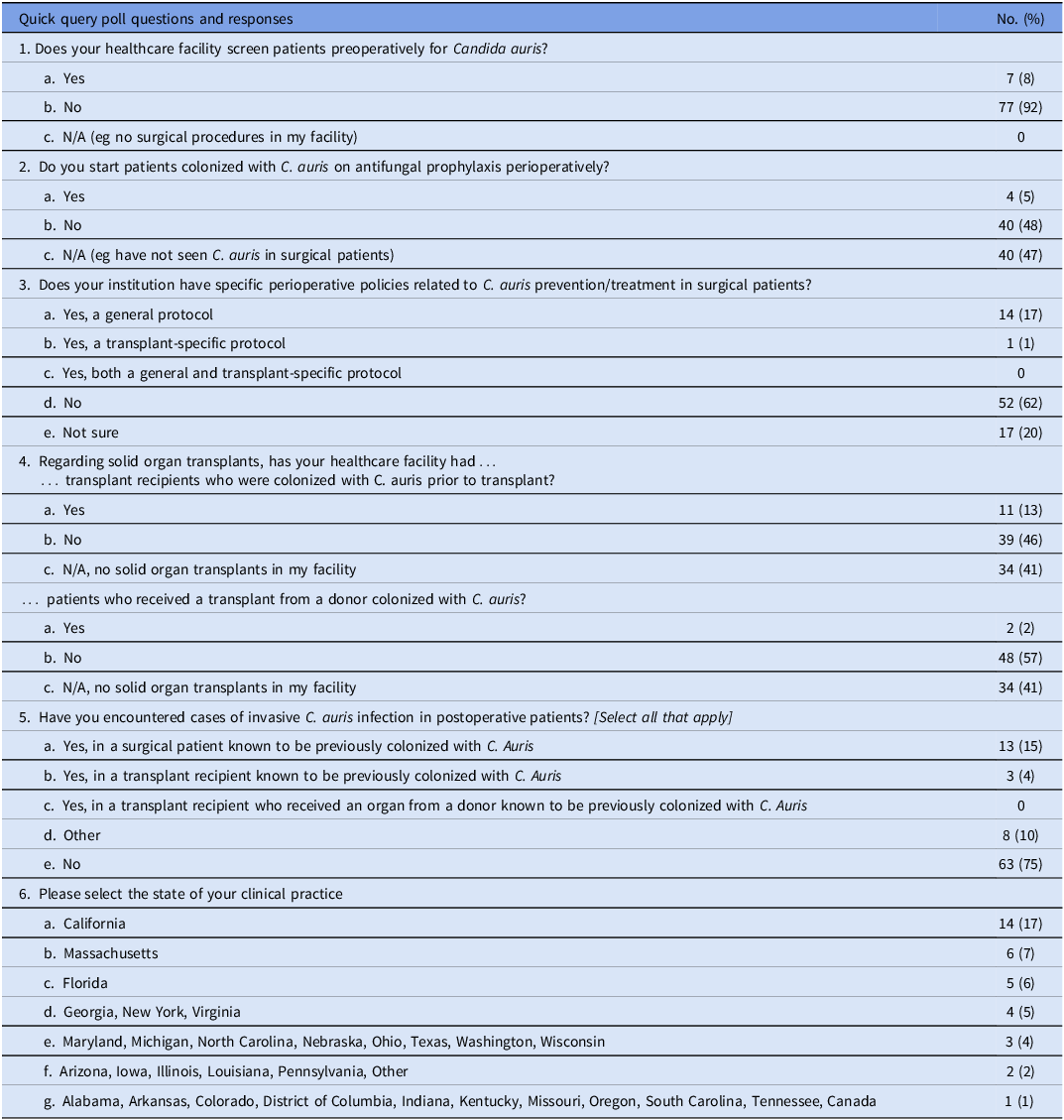
An online “Quick Query” poll was distributed by the Emerging Infections Network (EIN) to ∼3,000 member subscribers on 3 separate occasions ∼1 week apart. EIN Quick Queries are a unique tool that utilizes focused, rapidly deployable, anonymous polls to ascertain members’ opinions/approaches to various emerging infectious diseases. Given the uncommon topics, Quick Queries are sent to all EIN members and consist of a limited number of questions to maximize response rate. Our Quick Query included six targeted questions. (Table 1) Responses were collected and analyzed using descriptive statistics.
EIN C. auris perioperative practices Quick Query poll questions and responses

Table 1 Long description
A table with six questions and responses about Candida auris perioperative practices. The table has six rows and multiple columns with headers labeled as questions and sub-questions. Each row represents a question, and the columns represent the response options and the number and percentage of respondents for each option. Question 1 asks if healthcare facilities screen patients preoperatively for Candida auris, with 7 respondents (8 percent) saying yes, 77 (92 percent) saying no, and 0 indicating it's not applicable. Question 2 asks if patients colonized with C. auris are started on antifungal prophylaxis perioperatively, with 4 respondents (5 percent) saying yes, 40 (48 percent) saying no, and 40 (47 percent) indicating it's not applicable. Question 3 asks if the institution has specific perioperative policies related to C. auris prevention/treatment in surgical patients, with 14 respondents (17 percent) having a general protocol, 1 (1 percent) having a transplant-specific protocol, 0 having both, 52 (62 percent) having no protocol, and 17 (20 percent) not sure. Question 4 has two parts regarding solid organ transplants: 11 respondents (13 percent) have had transplant recipients colonized with C. auris prior to transplant, and 2 (2 percent) have had patients who received a transplant from a donor colonized with C. auris. Question 5 asks if cases of invasive C. auris infection in postoperative patients have been encountered, with 13 respondents (15 percent) in a surgical patient known to be previously colonized, 3 (4 percent) in a transplant recipient known to be previously colonized, 0 in a transplant recipient who received an organ from a donor known to be previously colonized, 8 (10 percent) other, and 63 (75 percent) indicating no. Question 6 asks for the state of clinical practice, with responses distributed across various states and regions.
Results
Eighty-four EIN members completed the poll, representing 29 U.S. states and three other countries/territories (one Canada; two “Other,” non-specified). California accounted for the largest share of responses (17%), followed by Massachusetts (7%), and Florida (6%) (Table 1).
18% (15/84) of respondents reported institutional guidelines for C. auris prevention/management in surgical patients, while only one reported a transplant-specific guideline. Preoperative screening for C. auris was reported by 8% (7/84) of respondents, predominantly from California (5/7). Among the 44 respondents who had previously encountered colonized surgical patients, only four (9% or 4/44) reported current use of perioperative antifungal prophylaxis, with micafungin as the preferred agent.
13% (11/84) of respondents had encountered C. auris colonization in transplant recipients prior to transplantation. Only 2% (2/84) reported encounters involving patients who received transplants from colonized organ donors.
In total, 17% (14/84) of respondents reported encountering postoperative invasive C. auris infections in previously colonized patients. Most encounters involved nontransplant, surgical patients, and three involved transplant recipients. In the free-text comments, three additional cases were described among transplant recipients without known donor or recipient C. auris colonization prior to transplant.
Discussion
Our EIN Quick Query provides initial insight into current experiences around perioperative management of patients with C. auris colonization. This EIN Quick Query began with discussions between our Transplant Infectious Diseases and Infection Prevention and Control teams around the management of potential transplant donors/candidates colonized with C. auris. The first documented case of donor-derived transmission of C. auris was in 2017 in a SOT recipient in Massachusetts. Reference Azar, Turbett, Fishman and Pierce5 Since then, reports of C. auris colonization and infection cases in the U.S. have increased, including in surgical and transplant patients. Reference Theodoropoulos, Bolstorff and Bozorgzadeh1,Reference Vu, Jimenez, Anjan and Abbo4,Reference Azar, Turbett, Fishman and Pierce5
Screening guidance
The CDC issued initial guidance on C. auris screening in June 2016, targeting patients recently hospitalized in countries with reported cases. 3 Since then, recommendations have expanded—driven by rising U.S. cases and emerging evidence—to include patients with tracheostomies, ventilator dependence, indwelling devices, recent carbapenemase-producing organism infection, frequent or long healthcare stays, international healthcare exposure, or recent stays in skilled nursing facilities or facilities with known C. auris transmission. 3 However, there is no national guidance specific to patients undergoing invasive surgeries, transplant donors or recipients, likely due to limited data on screening benefits in these contexts.
Despite this gap, some institutions have begun to implement local perioperative screening guidelines. In this poll, 17% of respondents reported established perioperative screening/management guidelines for C. auris in their institutions, with only one reporting transplant-specific guidelines. This hypothesis-generating poll suggests that further research is needed to evaluate the benefits of C. auris screening in surgical and transplant patients to inform future national guidance.
Barriers to screening
Only 8% of respondents reported routine preoperative C. auris screening, suggesting it is not yet standard practice. In addition to limited guidance, several barriers may contribute to this including lack of available in-house testing, limited laboratory staff availability, and the long turnaround time of culture-based methods. In a recent survey of US healthcare facilities, only 36.8% (92 out of 253 respondents) reported performing in-house testing for C. auris. Reference Hennessee, Forsberg and Beekmann6 Recently, the FDA authorized a C. auris PCR-based assay (DiaSorin) for commercial use, potentially improving testing accessibility and turnaround. 7 As screening for C. auris expands, the development of guidance on screening surgical and transplant patients should be considered by local facilities until comprehensive national recommendations are available.
Role of perioperative antifungal prophylaxis
Reported bloodstream infection rates among C. auris–colonized patients range from 3% to 18%; U.S. surveillance found 6.9% positive clinical specimens among >21,000 colonized patients, with mortality up to 60%. Reference Garcia-Bustos, Salavert and Ruiz-Gaitán8,Reference Baker, Gold and Forsberg9 No data exist on effective decolonization strategies. Reference Vu, Jimenez, Anjan and Abbo4 Eyre et al reported fewer postoperative invasive infections among C. auris–colonized patients following single-dose micafungin prophylaxis as part of a broader infection prevention effort, suggesting a potential role for targeted perioperative antifungal prophylaxis. Reference Eyre, Sheppard and Madder2
Fluconazole, commonly used for pretransplant prophylaxis, demonstrates ∼90% resistance among C. auris isolates in the U.S. 3 In contrast, most U.S. isolates remain susceptible to echinocandins, which may explain their use by poll respondents. Identification of C. auris colonization in transplant patients is important, as it may warrant adjustments in antifungal prophylaxis. Antifungal prophylaxis in colonized patients should be guided by infection risk, regional epidemiology, and antimicrobial stewardship.
Invasive post-surgical infections
Since C. auris colonizes the skin, procedures that disrupt the skin barrier can increase infection risk. A retrospective cohort study in Spain of 206 patients colonized with C. auris identified procedures as an independent risk factor for infection. Reference Garcia-Bustos, Salavert and Ruiz-Gaitán8
SOT recipients face additional risk factors, including immunosuppression, antibiotic and antifungal exposure, prolonged ICU stays, and indwelling catheters. Reference Vu, Jimenez, Anjan and Abbo4,Reference Garcia-Bustos, Salavert and Ruiz-Gaitán8 Fourteen (17%) respondents of our poll reported invasive C. auris infections postoperatively in previously colonized patients, including surgical patients and transplant recipients. Briano et al found a 0.4% incidence of C. auris candidemia in transplant recipients in a tertiary center in Miami (2020–2021). Reference Briano, Magnasco and Sepulcri10 Previously reported cases of donor-derived C. auris infections further highlight the importance of risk assessment before transplantation. Reference Azar, Turbett, Fishman and Pierce5
Mortality in transplant recipients with C. auris is not well described. A small case series of five liver transplant recipients noted 40% mortality, while another study of 27 patients, including four transplant recipients, reported a 26% mortality rate. Reference Theodoropoulos, Bolstorff and Bozorgzadeh1 These cases support the need for evidence-based guidelines determining C. auris risk and a focus on infection prevention in transplant and surgical patients.
Limitations
EIN Quick Queries rely on voluntary self-reporting; providers who had previously encountered patients with C. auris may have been more likely to respond, potentially affecting generalizability. Additionally, limited questions in a Quick Query restrict in-dept assessment and conclusions. Respondent demographic data were limited, and institutional overlap is possible.
Conclusion
The survey highlights the lack of institutional guidelines for C. auris prevention in perioperative settings, including among SOT patients. Although postoperative C. auris infections appear to be uncommon, their reported occurrence in previously colonized patients raises concern about infection prevention gaps and underscores the need for further research and evolving guidelines to optimize perioperative prevention and management of this emerging fungal pathogen.
Acknowledgements
The authors received no financial support for the conduct of this study or the preparation of this manuscript. The authors declare potential conflicts of interest in attached disclosure forms. This work was supported by the Cooperative Agreement Number 5 (grant number NU50CK000574), funded by the Centers for Disease Control and Prevention.