


Theories of international institutions typically contend that these institutions support cooperation among all members. Some scholars have criticized this claim, suggesting that benefits accrue most to the powerful states that created the institutions, potentially at the expense of weak states.Footnote 1 In this paper, I argue that the distribution of benefits can be most productively understood by examining the effects of institutions on the relationships between certain pairs of states. States have more trouble cooperating with some partners than with others, and pairs that find cooperation difficult gain the most from membership in international institutions.
To analyze how membership in international institutions affects particular types of states, I examine the specific case of the World Trade Organization (WTO) and its predecessor, the General Agreement on Tariffs and Trade (GATT).Footnote 2 The distribution of benefits from WTO membership depends on the types of problems that the WTO can solve. Existing theories contend that the WTO can ameliorate time inconsistency problems, which occur when a country's ex ante incentives differ from its ex post incentives, but these theories offer ambiguous predictions about the differential impact of WTO membership.Footnote 3 By contrast, I determine the pairs of states that benefit most from WTO membership by identifying a specific type of time inconsistency problem that is pervasive in international relations: the “political hold-up problem.” Political hold-up problems occur when one state fails to undertake an investment due to the increased ability it would provide another state to extract political concessions. For example, states often hesitate to construct oil and natural gas pipelines because once they invest in building the pipelines, their partners can obtain political concessions by threatening to terminate oil or gas exports. I demonstrate that these problems are most acute for politically dissimilar pairs of states, in which one state has the ability and incentive to extract concessions from its potential trading partner. However, I show that the WTO can solve political hold-up problems by helping to enforce dynamic agreements, allowing countries to trade based on their economic incentives, rather than for political reasons. In so doing, the WTO can mitigate the impact of a variety of political asymmetries between countries, providing the largest benefits for politically dissimilar pairs of states. I first formalize this claim and then empirically test the implications derived from the model, finding that the WTO increases trade most between country pairs that differ in terms of capabilities, regime types, and alliances, by preventing states from holding up their trading partners for foreign policy concessions.
To understand how political hold-up problems form, consider the historical trade relations between the United States and Hawaii. In 1876, the U.S. signed a trade agreement with the Kingdom of Hawaii which eliminated high U.S. sugar tariffs. Hawaii responded by ramping up sugar production for export to the United States, such that Hawaiian sugar exports to the U.S. rose from 21 million pounds in 1876 to 114 million pounds in 1883 (La Croix and Grandy Reference La Croix and Grandy1997). Increasing sugar production required a large investment: sugar producers adopted new sugar processing technology, bought government and private land, undertook large-scale irrigation projects, and invested in fertilizers. The Hawaiian government signed the treaty expecting other markets for its sugar exports to open up by the time of the treaty's renewal (La Croix and Grandy Reference La Croix and Grandy1997). However, when the treaty expired in 1883, Hawaii had no viable alternative export market (Kuykendall Reference Kuykendall1953).Footnote 4 Thus, during negotiations over the treaty's renewal, the United States demanded exclusive rights to Pearl Harbor; otherwise, the U.S. threatened to reinstate the high sugar tariff. The Hawaiian government conceded.
Why couldn't the United States obtain access to Pearl Harbor when the treaty was initially signed?Footnote 5 At that point, the Hawaiian government would have weighed the cost of granting access to Pearl Harbor plus the cost of the sugar investment against the economic gains from increased sugar exports. By the time the treaty was up for renewal, however, the sugar investment had already been made. Thus, the government weighed only the cost of giving up Pearl Harbor against the benefits of trading more sugar. The United States was therefore able to hold up Hawaii for the value of the sugar investment.
In general, I show that states anticipate their partners’ opportunistic behavior and therefore underinvest in the production of goods for trade with these partners. While the Hawaiian government was aware that it could be held up when it chose to sign the initial agreement, it hoped that it could open other markets for its sugar by the time the treaty was renewed.Footnote 6 A less optimistic country could have refused to undertake the investment in the first place. Because states cannot commit to refrain from holding up other states, their partners under-invest, decreasing the welfare of both parties.Footnote 7
Note that the opportunity to demand political concessions dramatically increases states’ incentives to use their trade policies opportunistically. In the aforementioned example, if the U.S. government had no interest in Pearl Harbor, it may have had no reason to hold Hawaii up. Because imports of Hawaiian sugar benefited U.S. consumers, it is not clear that the U.S. government would have wanted to raise its sugar tariffs. The opportunity to link economic and political policies, however, meant that the U.S. government had a large incentive to hold Hawaii up to gain access to Pearl Harbor.
Political hold-up problems create the need for enforceable long-term trade agreements, which allow countries to credibly promise not to raise tariffs to extract political concessions. However, long-term agreements are often unenforceable in a bilateral setting. Luckily, international institutions can help to enforce these agreements, permitting countries to commit to not use their trade policies for political leverage. Countries benefit from tying their hands through the resulting increases in trade and investment. International institutions enable countries to abide by dynamic agreements through a variety of mechanisms; as argued by Axelrod and Keohane (Reference Axelrod and Keohane1985, 235), members “(1) can identify defectors; (2) they are able to focus retaliation on defectors; and (3) they have sufficient long-run incentives to punish defectors.”
The WTO in particular provides transparency and a loss of reputation for violators through its Dispute Settlement Body (DSB), which adjudicates disputes between WTO members. The DSB provides WTO participants with “a guarantee for the right to negotiate, a common standard for evaluating outcomes, the option for several countries to join a dispute, and incentives for states to change a policy found to violate trade rules” (Davis Reference Davis2006). By developing norms and behaviors that states are expected to follow and by specifying which states are noncompliant, the DSB influences members’ reputations, which serves as an effective restraint in many settings (Tomz Reference Tomz2007). The WTO publicizes which countries cooperate with agreements, which allows members to establish reputations for cooperation and encourages continued cooperation in the future. Conversely, if countries are known to violate agreements frequently, their partners may reduce cooperation with them by withdrawing trade concessions, becoming more reluctant to enter agreements, or becoming less cooperative in related areas (Maggi Reference Maggi1999). WTO rulings can also provide countries with domestic political cover for adhering to agreements (Allee and Huth Reference Allee and Huth2006; Staiger and Tabellini Reference Staiger and Tabellini1999) and the ability to develop domestic reputations for compliance (Mansfield, Milner, and Rosendorff Reference Mansfield, Milner and Rosendorff2002). Additionally, if a country frequently breaches WTO law, what is to prevent its trading partners from recurrent violations? This could lead to a breakdown of the system as a whole, an outcome which many states have strong incentives to avoid.
The loss of reputation before the large audience of WTO members appears to be a strong deterrent, as there are many examples of the WTO helping to uphold agreements between powerful and weak states. Powerful states have high rates of compliance with WTO rulings on cases brought by weak states (Busch and Reinhardt Reference Busch and Reinhardt2003 Reference Busch and Reinhardt2004; Davis Reference Davis2006; Wilson Reference Wilson2007). Additionally, Busch, Raciborski, and Reinhardt (Reference Busch, Raciborski and Reinhardt2009) show that large WTO members reduce protectionist practices against small WTO members in particular. By improving members’ abilities to commit to agreements, the WTO can thus help countries to limit political hold-up problems, thereby decoupling trade and politics.
Yet previous work on hold-up problems in the context of the WTO is rare and focuses largely on the determinants of institutional design, rather than on state behavior. For example, Yarbrough and Yarbrough (Reference Yarbrough and Yarbrough1992) and Goldstein and Gowa (Reference Goldstein and Gowa2002) use the logic of economic hold-up problems to explain the selection of trade institutions.Footnote 8 Prior examinations of the role of the WTO point to other types of inefficiencies the WTO can help alleviate. For example, the WTO can also resolve a terms-of-trade prisoner's dilemma, where governments of large countries have an incentive to set tariffs at inefficiently high levels due to their ability to pass some of the cost onto their trading partners through the impact of their tariffs on world prices (Bagwell and Staiger Reference Bagwell and Staiger1999). Further, the WTO can allow countries to avoid succumbing to domestic political pressures (Büthe and Milner Reference Büthe and Milner2008; Maggi and Rodriguez-Clare Reference Maggi and Rodriguez-Clare1998; Mansfield and Pevehouse Reference Mansfield and Pevehouse2008). Although solving hold-up problems is an important function of the WTO, it is by no means the only time inconsistency problem that the WTO can remedy. But while other theories often offer ambiguous empirical predictions, the logic of political hold-up problems generates clear, testable hypotheses.
In the next section, I present a formal model which shows that hold-up problems occur most frequently when one country has the ability and the incentive to hold up a partner country. The model demonstrates that powerful countries have a greater ability to hold up weaker countries, since weaker countries are less able to retaliate. If a weak country tries to hold up the United States, for example, the United States can threaten it with military, financial, economic, or political penalties, while a weak country would find it more difficult to punish the U.S. The model also implies that countries have greater incentives to hold up nonallies and countries with dissimilar regime types, since these countries have more disparate policy goals. Because politically dissimilar countries are most susceptible to hold-up problems, trade and investment should be inefficiently low between these countries in the absence of the WTO. The main benefit of WTO membership, increased trade, should therefore accrue most heavily to these country pairs. In what follows, I formally derive these predictions and then substantiate the claims empirically, finding that the WTO increases trade most for politically dissimilar pairs of countries, which are most vulnerable to hold-up problems. Finally, I provide evidence of the causal mechanism driving the results, demonstrating that WTO membership increases fixed capital investment and that WTO members are more likely to trade goods which rely on contract enforceability.
A MODEL OF POLITICAL HOLD-UP PROBLEMS
Overview
I present a model which shows that the WTO most benefits politically dissimilar country pairs by improving contract enforcement. The model demonstrates that long-term agreements solve political hold-up problems, but are difficult to abide by in a bilateral setting, particularly for dissimilar pairs of states. By contrast, WTO membership allows countries to commit to long-term agreements, resulting in greater levels of investment and trade.
The model features two countries that bargain over the terms of a trade agreement. A two-player model permits a focus on political hold-up problems, since these problems occur when one party makes a relationship-specific investment, or an investment whose returns depend on the continuation of the relationship with a particular partner (Crawford Reference Crawford1990).Footnote 9 A viable alternative trading partner may not exist for several reasons: First, the country's investment may only physically permit trade with a specific market, such as roads that connect the country of origin to the destination. Second, investment may produce a good that is demanded by a unique market, such as a factory designed to build automobiles that meet a partner's especially stringent emissions standards. Third, investment may promote trade in goods for which switching partners is too costly, either because a state's market size is so large that a suitable substitute does not exist (as in the Hawaii example discussed previously), or because the good is supplied at such a favorable price that a feasible alternative is not available.
In the model, one state may choose to make a relationship-specific investment in order to produce a good for export to a partner state. The exporter may desire a lower tariff than the importer wishes to set, so in exchange for a lower tariff, the exporter may offer foreign policy concessions such as human rights improvements, democratization, technology sharing, access to military bases, etc. States could, of course, bargain over tariffs and other economic concessions instead. However, the model's purpose is to demonstrate the conditions under which hold-up problems occur, and economic hold-up problems are typically much less prevalent between countries than political hold-up problems. The model indicates that hold-up problems arise when a state has the ability to hold up its partner; that is, when one state is much more powerful than another. In these cases, the economic concessions that a large state may receive from a small state are often much less valuable than the political concessions the large state can obtain. While trade with a small state tends to represent a minor share of a large state's market, the political importance of small states can be extremely high. For this reason, large states commonly use their trade policies to attempt to obtain political concessions from their partners, both today and historically. Consider a few examples: the renewals of India and Nepal's short-term trade treaties of 1991 and 1996 were contentious due to Indian opposition to Nepal's acquisition of Chinese weapons (Heitzman and Worden Reference Heitzman and Worden1996); trade agreements concluded by the EU with Mongolia, Sri Lanka, Vietnam, and Nepal make respect for human rights a key condition for yearly renewal; China often ties the renewal of short-term agreements to its partner's support for Taiwan (Dumbaugh Reference Dumbaugh2008); the United States frequently linked the renewal of trade agreements with China, Vietnam, and Cambodia to human rights and other political concessions before these states joined the WTO; Russia would only renew the 1797 Anglo-Russian Treaty of Commerce if Britain provided a military diversion (Roach Reference Roach1983).
While the aforementioned examples all occurred in the context of short-term trade agreements, the model indicates that political hold-up problems can be solved with perfectly enforceable, long-term agreements, which allow states to commit not to behave opportunistically. However, long-term agreements can be difficult to abide by in the absence of the WTO, as discussed previously. Indeed, the empirical pattern of agreements seems to match the theoretical expectation. For example, while all agreements signed within the WTO are long-term agreements, short-term agreements remain common outside of the WTO.Footnote 10 Further, I coded the duration of all current United States trade agreements as well as all current Australian trade agreements and found that 116 out of 236 of the United States’ trade agreements and 32 out of 73 of Australia's agreements have limited durations. Additionally, most of these short-term agreements were signed before the advent of the GATT, with a non-WTO member, or between large countries for whom hold-up problems are rare.Footnote 11 The model demonstrates that these short-term agreements cause political hold-up problems, but that the WTO alleviates such problems by helping to enforce long-term agreements.Footnote 12
Setup
Consider a world that consists of one period and two countries, H and F, to be indicated by superscripts. Country F is able to produce good g. Good g is demanded solely by H, but F may export g to H. F may only produce g if F makes an investment i ∈ {0, 1}, such as the development of new technology or infrastructure. If i = 0, g is not produced. If i = 1, F incurs cost i, so that i represents both the investment decision and the cost of the investment.
If i = 1, the amount of g produced depends on H’s import tariff
 $\tau \in [0,\bar{\tau }$
where
 $\bar{\tau }$
is the prohibitive tariff beyond which no g is traded.Footnote
13
H receives utility from the consumption of g and F receives utility from the export of g. Since the amount of g available for export and consumption depends on τ, it is convenient to denote utility over g as a function of τ, or Ω
k
(τ) where k = {H, F}. Ω
k
(·) is a general functional form that allows for the possibility that states may have utility over both government investment and investment by private agents. Governments may care about the welfare of domestic actors either because governments are benevolent, or because of political economy concerns such as the desire to remain in power or interest in collecting rents (Grossman and Helpman Reference Grossman and Helpman1994).Footnote
14
In either case, H’s welfare depends on the tariff, as the tariff will determine the profitability of the investment. Ω
H
(τ) is assumed to have an interior maximum of τ
N
and Ω
F
(τ) is assumed to be concave in τ and monotonically decreasing in τ.
H’s utility function is
 $u^{H}(\tau , f, i)= i\Omega ^H(\tau )+ f,$
 $f \in [0,\bar{f}$
represents F’s foreign policy concessions to H, as described above.Footnote
15
F’s utility function is
 $u^F(\tau , f, i)= i\Omega ^F(\tau )-i - \gamma\, f,$
Short-term and long-term trade agreements are available to governments, in which governments select policies f j and τ j , where j ∈ {st, lt}, through Nash bargaining. H’s bargaining power is denoted by α. If a long-term agreement is chosen, H and F bargain over flt and τ lt , after which F decides whether to invest.Footnote 16 If a short-term agreement is selected, F first chooses whether to invest, and then countries bargain over fst and τ st . Thus the timing is as follows:
-
1. Countries choose whether to sign a long-term agreement specifying τ lt and flt .
-
2. F chooses whether to invest.
-
3. Countries choose whether to sign a short-term agreement specifying τ st and fst if they did not previously sign a long-term agreement.Footnote 17
I make two key assumptions: First, I assume that in the first-best solution, which maximizes the joint surplus, countries trade g; otherwise, investment would be inefficient and hold-up problems would not occur. Second, I assume that parties cannot contract over F’s investment decision, as is standard in models of hold-up problems, because investment cannot be verified. For example, suppose F agrees to invest in its agricultural sector. If F fails to invest, H may observe that agricultural output is low, but cannot tell if low output is the result of a lack of investment or, say, adverse weather conditions.
Short-term Trade Agreements
Suppose first that in the absence of the WTO, only short-term agreements are available. Short-term agreements allow countries to bargain over specific policy levels once the investment is undertaken. The threat point, or the outcome if bargaining breaks down, is the noncooperative equilibrium in which countries play their preferred policies, such that if i = 1, H selects τ N and F selects f = 0.Footnote 18 I show that in this case, hold-up problems arise for sufficiently dissimilar pairs of countries.
Proposition 1. When only short-term agreements are available, hold-up problems occur when H's bargaining power (α) is sufficiently large.
Proposition 1 implies that if the other parameters are such that i = 1 under a short-term contract, then a sufficient increase in α changes the investment decision to i = 0 under a short-term contract. However, if the parameters are such that i = 0 under a short-term contract, then increasing α does not affect the investment decision.Footnote 19 Proposition 1 is proven in the Appendix, but the intuition is straightforward. As α increases, H is able to drive a harder bargain against F, so that H obtains a higher tariff. However, if the expected tariff increases enough, F does not receive a large enough share of the surplus to make an investment worthwhile, and so F decides not to invest. H should lower its tariff to induce F to invest, but because H cannot commit to maintain a low tariff once the investment has been undertaken, there is no way to entice an investment when only short-term agreements are available.
Proposition 2. When only short-term agreements are available, hold-up problems occur when H and F's foreign policy preference dissimilarity (γ) is sufficiently large.
Proposition 2 implies that if the parameters are such that i = 1 under a short-term contract, then a sufficient increase in γ changes the investment decision to i = 0 under a short-term contract.Footnote 20 Proposition 2 is proven in the Appendix. Intuitively, the more dissimilar the countries’ foreign policy preferences, the less F is willing to make the concessions that H desires. Since a higher value of γ means that F’s concessions are more costly, H must lower τ st to induce F to invest, but cannot commit to do so. Thus, a sufficiently high γ causes hold-up problems.
Long-Term Trade Agreements
Suppose that when only short-term agreements are available, i = 0, but now H and F are able to sign a long-term agreement prior to F’s investment decision. Since investment is efficient but does not take place without a long-term agreement, if bargaining breaks down, g is not produced. Therefore, both countries’ reservation utilities are zero. The hold-up problems that arise under short-term agreements can be remedied by long-term agreements, if these agreements are enforceable.
Proposition 3. Perfectly enforceable long-term agreements solve hold-up problems.
Proposition 3 is satisfied by construction because in order to ensure that F undertakes the investment after the agreement is signed, the bargaining problem is subject to the constraint that F’s utility from investing must be greater than its utility from not investing, or Ω F (τ lt ) − 1 ≥ 0.Footnote 21 Since the outcome is guaranteed to satisfy F’s investment constraint, F undertakes the investment.
If long-term trade agreements solve hold-up problems and increase the welfare of both parties, why don't countries always sign them? The problem is that agreements between sovereign nations can be difficult to enforce, as states often receive high payoffs with small penalties from reneging. Many states find it difficult to detect cheating, and have few resources to punish their partners. Thus, I now consider the more realistic case of imperfect enforceability.
Proposition 4. The WTO can enforce long-term agreements when these agreements are otherwise unenforceable.
Suppose that hold-up problems occur under a short-term agreement, such that no investment takes place. A long-term agreement could solve the underinvestment problem, but is often tough to enforce. To see this, suppose countries incur costs from deviating from trade agreements, where H’s cost is denoted CH and F’s cost is denoted CF . These costs are determined outside of the model and represent the ability and credibility of one country to punish the other.Footnote 22 Countries can penalize their partners by using military force, raising tariffs on other goods, cutting off foreign aid, etc. The cost of deviating from an agreement is higher the more effectively the violator can be punished. Hold-up problems occur when H is large, in which case H faces a relatively low cost of reneging on the agreement, since a weak F can do little to punish a powerful H. By contrast, a powerful H is often easily able to retaliate against a small F. Thus, I focus on H’s incentives to breach the agreement. If H reneges, it deviates to τ N . H does not renege when the utility from deviating is less than the utility from abiding by the agreement, or Ω H (τ j ) ≥ Ω H (τ N ) − CH .Footnote 23 However, as discussed, CH is often low for a powerful H.
Luckily, the WTO can help to enforce long-term agreements. The WTO raises the penalty for violating an agreement, increasing CH
to
 $\hat{C^H}$
. H does not deviate when
 $\hat{C^H} \ge \Omega ^H(\tau ^N) - \Omega ^H(\tau ^j)$
. There are many channels through which the WTO raises the cost of breaking agreements, such as fostering the development of norms for compliance (Johnston Reference Johnston2002), increasing domestic pressures to adhere to agreements (Gaubatz Reference Gaubatz1996), and creating incentives to maintain rules that are obeyed by others (Hudec Reference Hudec2002; Jackson Reference Jackson1997; Kovenock and Thursby Reference Kovenock and Thursby1992). Importantly, the WTO also allows H to develop a reputation for compliance by providing transparent, impartial adjudication of disputes. Panels of three judges are selected from other member states, rendering the panelists much more impartial than the parties to the dispute. Third parties may also participate in the dispute, and the verdict is publicly available. Further, the WTO publishes trade policy reviews, collecting and disseminating information regarding states’ adherence to their agreements. Reviews are published every two years for the major traders (such as the United States and the European Union), every four years for the second largest traders, and every six years for the smallest traders.Footnote
24
By contrast, in a bilateral context, the cost to deviating from an agreement can be extremely low. The international community has a difficult time both learning about a potential violation and adjudicating between parties. If one country claims a breach has occurred, while another asserts it has not, third parties may have no way to discern the truth. Without an impartial dispute settlement body, it may be unclear which party's claims are correct. In such a case, the only punishment available for a possible infraction may be the penalty one party to the agreement can apply to the other. Bilateral punishments are often minimal, particularly if a large state breaks the terms of an agreement with a small state, as a small state may have great difficulty punishing a large state. Additionally, anticipating that it will not be able to sanction its partner, a small state may fail to accuse a large state of a breach in the first place, such that the international community may not have the opportunity to learn of the possible violation. A multilateral setting is therefore necessary to allow states to develop reputations for compliance with their agreements.
Interviews with United States trade representatives support the contention that reputation plays a key role in the enforcement of WTO agreements. An official with extensive experience in U.S. trade policy explained, “WTO partners think they have a legally secure agreement. If a country disrupts [an agreement], who knows how many the country will disrupt.” He stated that WTO members’ positive reputations are crucial for maintaining open trading relations because members “must have clear rules and expectations or it all falls apart.”Footnote 25 States fear that if they violate their WTO agreements frequently, others will do the same, which provides strong incentives to abide by their commitments.
The concern for reputation is also evidenced by the United States’ push to strengthen the dispute settlement body prior to the creation of the WTO. In the 1980s, the U.S. took many unilateral actions which violated trade agreements, causing partner countries to reduce trade with the U.S. (Elliott and Bayard Reference Elliott and Bayard1994; Goldstein and Gowa Reference Goldstein and Gowa2002). In response, the U.S. sought to increase the cost of deviating from agreements, leading to the creation of an institution with stronger enforcement capabilities. Unlike the GATT, the WTO disallows states to veto the adoption of a panel or a panel ruling, features an Appellate Body, and imposes strict timetables for adjudication of disputes. The establishment of the WTO was thus a reaction, in part, to the United States’ desire to expand trade by shedding its reputation for opportunism (Goldstein and Gowa Reference Goldstein and Gowa2002).
Deriving Testable Hypotheses
The model generates several empirical predictions. The model indicates that when long-term agreements are not enforceable, political hold-up problems occur. However, WTO membership permits the enforcement of long-term agreements, boosting trade and investment for pairs of states that otherwise would suffer from political hold-up problems. The theory therefore suggests the following hypotheses:
Hypothesis 1. Membership in the WTO increases trade more for pairs of countries with dissimilar capabilities, relative to pairs with similar capabilities.
The model shows that, in the absence of the WTO, powerful countries have the greatest ability to hold up weak countries. When countries have dissimilar capabilities, two dynamics come into play: First, H can extract more from F in a short-term agreement due to H’s large bargaining power, α, providing H with the incentive to hold F up.Footnote 26 Second, H’s cost of reneging on an agreement, CH , is low since weak countries experience difficulty retaliating. Therefore, large power disparities create hold-up problems.
Since weak states anticipate large states’ attempts to hold them up, they fail to undertake investments that would promote trade with their more powerful partners. Once countries join the WTO, H’s cost of deviating from a long-term agreement increases, permitting H to commit to uphold its agreements. In response, weak states invest in the production of goods for trade with H. Thus, WTO membership should increase trade most between powerful and weak states.
Hypothesis 2. Membership in the WTO increases trade more for nonallied pairs of countries, relative to allied pairs.
The model also predicts that hold-up problems are more common when H and F’s foreign policy interests are more dissimilar. A large γ indicates that F dislikes making the concessions desired by H. F then underinvests in relationship-specific goods, and trade between H and F remains low.Footnote 27 Since nonallies have more dissimilar policy preferences, they should underinvest in the absence of the WTO to a greater extent than allies should because nonallies fear being held up by their partners for policy concessions. Since the WTO enforces agreements between nonallies by raising CH , WTO membership should increase trade more for nonallies than for allies.
Hypothesis 3. Membership in the WTO increases trade more for pairs of countries with dissimilar regime types, relative to pairs with similar regime types.
Pairs of states with similar regime types tend to have more similar policy interests, or lower γ, than pairs with dissimilar regime types. Countries worry that partners with dissimilar regimes will hold them up for policy concessions and therefore underinvest in goods for trade with these states. For example, members of the Organization for Economic Cooperation and Development (OECD) have expressed strong ideological commitments to “market economies backed by democratic institutions” (OECD 2011), and have used a variety of carrots and sticks to promote similar regime types in partner countries. Withholding or extending trade privileges to encourage policy reforms, such as human rights improvements or democratization, is common and firmly entrenched in many OECD countries’ policies, so trading partners with dissimilar regimes may underinvest due to the risk of being held up for these concessions. Since the WTO allows countries to commit not to hold up their partners, I expect WTO membership to boost trade between countries with dissimilar regime types in particular.
An Example: U.S. MFN Designation
The insights generated by the theoretical model can be observed in practice in the trade relations between many pairs of states. Examples of countries holding up asymmetric, nonmember trading partners for political concessions abound. For example, the United States often threatens to raise its tariff levels in order to extract political concessions from non-WTO members. When the U.S. Congress disapproves of policies enacted by these trading partners, it often offers the renewal of most favored nation (MFN) status in exchange for policy concessions. MFN status entitles countries to nondiscriminatory trade policies such that a country cannot lower tariffs for a partner with MFN status without lowering tariffs for all partners with MFN status.Footnote 28 While all WTO members must grant each other MFN status, extending MFN status to non-WTO members is optional. Members of the U.S. Congress have explicitly acknowledged that the renewal of MFN status is a valuable tool to obtain political concessions from non-WTO members. For example, Rep. Loretta Sanchez advocated threatening to revoke MFN status from Vietnam in order to extract human rights concessions, stating, “If we insist that Vietnam improve its human rights record as a condition to trading with America, we would gain human rights advances in Vietnam, so I think it is a tragic mistake for the United States to decline to use this tool that is available to us” (The Congressional Record 2001, 14673). As predicted by the model, the U.S. typically has relied on these short-term MFN agreements to govern trade with former Communist countries, which, at the time, were nonallies with dissimilar regime types.Footnote 29 Also in line with the theory, there is considerable evidence that the repeated renewal of the agreements discouraged investment (Devereaux, Lawrence, and Watkins Reference Devereaux, Lawrence and Watkins2006) since the U.S. could not commit to refrain from using its MFN policies to hold up its nonmember partners.
As a more detailed illustration, consider the case of U.S.-China trade relations. In 1979, China signed a bilateral trade agreement with the United States, granting China short-term MFN status, which was renewed yearly by the U.S. The fall of the USSR created a unique point in U.S.-Chinese history when the U.S. had considerable leverage over China (Kissinger Reference Kissinger2011), such that U.S. bargaining power, α, was large due to several factors: First, the potential impact of raising U.S. tariffs on the Chinese economy was severe, as the U.S. was China's most important export market. No other market was large enough to absorb such a high volume of Chinese goods. Second, China had acquired a diminished strategic importance due to the end of the Cold War (Lilley and Willkie Reference Lilley and Willkie1994, 127). Policy preference dissimilarity, γ, was also high because the Tiananmen Square incident increased the salience of differences in human rights policy preferences.
Due to this dip in China's power relative to that of the U.S., the U.S. Congress repeatedly threatened China with tariff increases unless China addressed the United States’ concerns regarding human rights, weapons proliferation, and trade (Lilley and Willkie Reference Lilley and Willkie1994, 24). China made many policy concessions in exchange for low U.S. tariffs. Between 1990 and 1993, China released 881 Tiananmen prisoners, lifted martial law, disclosed information on high profile political prisoners, agreed not to export products made with prison labor, allowed the Red Cross to visit prisoners, sent two human rights delegations to the U.S., and gave passports to many families of political exiles (Lilley and Willkie Reference Lilley and Willkie1994, 86). Investment in China declined over this period (Walmsley, Hertel, and Ianchovichina Reference Walmsley, Hertel and Ianchovichina2006), suggesting that while the United States’ bargaining power, α, and foreign policy preference dissimilarity, γ, were high and while China was not a WTO member, hold-up problems were prevalent. Membership in the WTO was recognized as a means to increase investment in China. U.S. Senator Wellstone argued, “I think the evidence is pretty clear. [Permanent MFN status] will result in. . .more investment” (The Congressional Record 2000, S8676). Indeed, once China joined the WTO, investment and capital stocks grew dramatically (Walmsley, Hertel, and Ianchovichina Reference Walmsley, Hertel and Ianchovichina2006), as political hold-up problems were likely alleviated.
ESTIMATION STRATEGY
To test whether WTO membership increases trade between country pairs most vulnerable to hold-up problems, I estimate a gravity model of bilateral trade. Because of the multiplicity of methods available to estimate gravity models, I follow Head and Mayer (Reference Head and Mayer2013, 2), who “argue against sole reliance on any one method and instead advocate a toolkit approach,” as “the methods should be used in concert to establish robustness.” I therefore begin my analysis by employing a log-linear gravity model, which is the traditional work-horse model in the trade literature (Goldstein, Rivers, and Tomz Reference Goldstein, Rivers and Tomz2007; Gowa Reference Gowa1995; Mansfield and Bronson Reference Mansfield and Bronson1997; Mansfield, Milner, and Rosendorff Reference Mansfield, Milner and Rosendorff2000; Rose Reference Rose2004), before moving on to consider other, more recent models.
Baseline Model
The log-linear gravity model is estimated using OLS with robust standard errors, clustered at the directed dyad level.Footnote 30 In my baseline specification, I use year and directed dyad fixed effects, as fixed effects are robust to many types of misspecification and endogeneity concerns. This specification is a reasonable starting point, and allows for comparability with previous work in this area (Dutt and Traca Reference Dutt and Traca2010; Eicher and Henn Reference Eicher and Henn2011; Goldstein, Rivers, and Tomz Reference Goldstein, Rivers and Tomz2007; Herz and Wagner Reference Herz and Wagner2006; Liu Reference Liu2009; Rose Reference Rose2004; Tomz, Goldstein, and Rivers Reference Tomz, Goldstein and Rivers2007). The data contain 185 countries from 1948 to 2003, resulting in 846,188 directed dyads in the dataset.Footnote 31
The dependent variable, Log Imports, is the log of imports of the first country in a pair from the second (in constant 1995 U.S. dollars) and comes from the IMF's “Direction of Trade Statistics.”Footnote 32 The key independent variables in the analysis include three measures of political dissimilarity and their interactions with WTO membership: First, Large Power Difference is an indicator of whether the difference in power between two countries is greater than the median difference in power in the sample.Footnote 33 This variable is constructed from the Correlates of War's Composite Index of National Capability (CINC) (Singer Reference Singer1988), a widely used indicator of power (Geller Reference Geller1993; Reed et al. Reference Reed, Clark, Nordstrom and Hwang2008), which is derived from six variables: iron and steel production (thousands of tons), military expenditures (thousands of current year U.S. dollars), military personnel (thousands), primary energy consumption (thousands of coal-ton equivalents), total population (thousands), and urban population (population living in cities with population greater than 100,000; in thousands).Footnote 34 Second, Nonallied is an indicator of joint involvement in a political-military alliance (Leeds et al. Reference Leeds, Ritter, Mitchell and Long2002), where an alliance is defined as a defense pact, neutrality or nonaggression treaty, or entente agreement. Third, Dissimilar Regime Types is an indicator of whether one country in a pair is a democracy while the other is not, using Cheibub, Gandhi and Vreeland (Reference Cheibub, Gandhi and Vreeland2010)’s coding of democracies.
The hypotheses state that the effects of Large Power Difference, Nonallied, and Dissimilar Regime Types on trade flows depend on whether states are WTO members. Thus, I interact each key independent variable with Both in WTO, an indicator of joint WTO membership.Footnote 35 I also include One in WTO, an indicator of whether only one state in a pair is a WTO member. Since WTO members may hold up nonmember partners, only Both in WTO is interacted with the key independent variables. Additionally, countries may trade more with partners that grant them special trading privileges, which is captured by several indicators: Currency Union indicates joint membership in a currency union, RTA indicates pairs that are part of a regional trade agreement, GSP i indicates whether an importing country extends tariff preferences to its partner under the Generalized System of Preferences (GSP), and GSP j indicates whether an exporting country provides its partner with GSP status. Since colonizers often accord special trade privileges to their colonies, I also include an indicator of whether the importer is a Current Colonizer of its partner and another indicator of whether the importer is a Current Colony of its partner. Finally, for each country, I control for the log of GDP and the log of GDP per capita, denoted Log(GDP) and Log(GDPPC) respectively, measured in logged constant 1995 U.S. dollars.Footnote 36
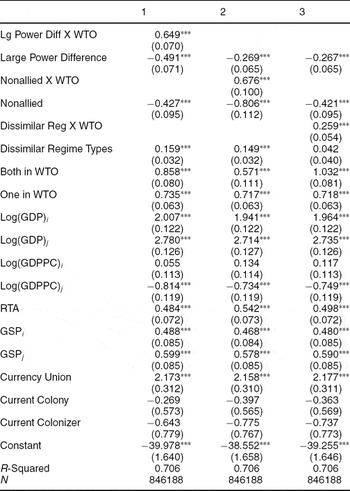
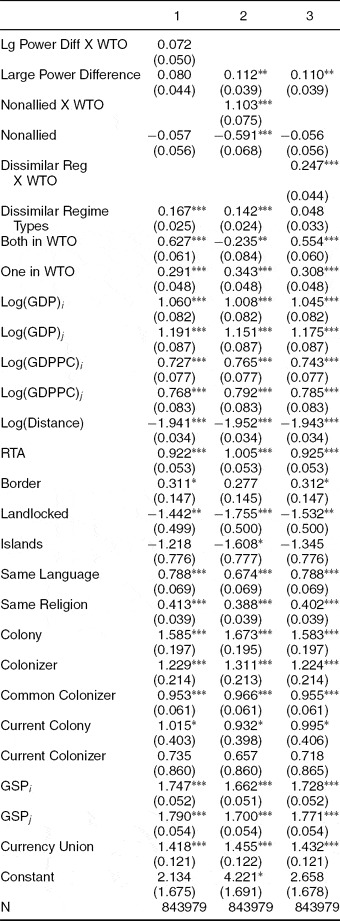
Table 1 presents strong evidence that the WTO increases trade most for politically dissimilar country pairs. The difference between the percent effects for country pairs with dissimilar capabilities and those with similar capabilities is 215% (column 1), between nonallies and allies is 171% (column 2), and between pairs with dissimilar regime types and those with similar regime types is 83% (column 3). Among non-WTO members, having dissimilar capabilities reduces trade by 39%, while being nonallied depresses trade by 55%.Footnote 37 Additionally, the results demonstrate that WTO members trade more on average, along with larger, wealthier countries, and pairs in which one state grants preferential treatment to the other. The model explains over two-thirds of the variation in trade flows, as expected from a gravity model.
Baseline Specification

Notes: Estimates from OLS regression. The unit of observation is the directed dyad year and the dependent variable is the natural log of (imports +1). The data cover 1948–2003. Robust standard errors, clustered by directed dyad, appear in parentheses. All models include year and directed dyad fixed effects, which are not shown. “*”, “**”, and “***” denote p < 0.05, p < 0.01, and p < 0.001, respectively.
Capturing Multilateral Resistance Terms
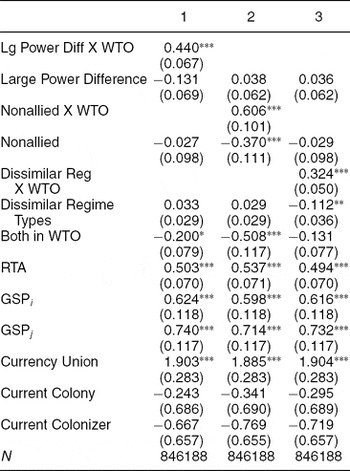
While the baseline model is a reasonable starting point for the analysis, many scholars have pointed to the importance of capturing the “multilateral-resistance” terms, or country-specific barriers to international trade, as described by Anderson and van Wincoop (Reference Anderson and van Wincoop2003). Because these terms are likely to vary overtime, I now re-estimate the model including importer-year, exporter-year, and directed dyad fixed effects.Footnote 38
The results are similar using this specification, and strongly suggest that the WTO boosts trade for politically dissimilar country pairs in particular. Table 2 shows that the difference between the percent effects for pairs with dissimilar capabilities and those with similar capabilities is 45%, between nonallies and allies is 50%, and between pairs with dissimilar regime types and those with similar regime types is 32%. Outside of the WTO, trade is depressed by 12% for states with dissimilar capabilities, 31% for nonallies, and 11% for states with dissimilar regime types. Interestingly, the difference in the effect of WTO membership between dissimilar and similar country pairs is comparable to the coefficient on joint membership in a RTA.Footnote 39
Directed Dyad and Time-Varying Country Fixed Effects

Notes: Estimates from OLS regression. The unit of observation is the directed dyad year and the dependent variable is the natural log of (imports +1). The data cover 1948–2003. Robust standard errors, clustered by directed dyad, appear in parentheses. All models include directed dyad, importer-year, and exporter-year fixed effects, which are not shown. “*”, “**”, and “***” denote p < 0.05, p < 0.01, and p < 0.001, respectively.
Incorporating Zero Trade Flows
Although the log-linear gravity model provides easily interpretable estimates of average effects, a common critique is that it may not treat the observations containing zero trade flows adequately, particularly because the results may depend on the units of measurement. The appropriate method to deal with this issue hinges on the process that generates observations of zero trade. I adopt Eaton and Kortum (Reference Eaton and Kortum2001)’s approach, who stipulate that if ideal trade from exporter i to destination market n, Xni
, falls below a minimum amount of trade, no trade is observed. For example, zero trade flows may arise due to rounding or reporting thresholds, or due to unobserved costs of trading. The dependent variable is constructed by replacing the observations of zero trade with the minimum Xni
for a given n,
 $\underline{X}_{ni}$
, before taking logs.Footnote
40
The model is then estimated using interval regression. Head and Mayer (Reference Head and Mayer2013), who refer to the model as the “EK Tobit,” argue that this model is desirable because it satisfies the following criteria: (1) no exclusion restrictions are required, (2) it has a strong structural interpretation, and (3) in their Monte Carlo simulations, it is preferable to the alternatives under the assumption of log-normal errors.Footnote
41
Using the EK Tobit, I again find results consistent with the theory, as Table 3 shows that the difference between the percent effects for pairs of states with dissimilar capabilities and those with similar capabilities is 14%, between nonallies and allies is 159%, and between pairs with dissimilar regime types and those with similar regime types is 72%.
EK Tobit

Notes: Estimates from interval regression. See text for details. The unit of observation is the directed dyad-year. The data cover 1948–2003. Robust standard errors, clustered by directed dyad, appear in parentheses. All models include year, importer, and exporter fixed effects, which are not shown. “*”, “**”, and “***” denote p<0.05, p<0.01, and p<0.001 respectively.
Robustness Checks
In addition to the results presented above, I demonstrate the robustness of my findings to a variety of alternative empirical specifications. Each robustness check is estimated using the baseline specification, OLS with directed dyad and time-varying country fixed effects, and the EK Tobit. Due to space constraints, the results of the robustness checks are presented in the Supplemental Appendix. In virtually all specifications, my findings remain statistically and substantively significant.
First, a potential concern is that WTO membership may be endogenous, as countries may enter the WTO when they would have increased trade even if they had not joined the institution. However, to explain my findings, countries would have to enter the WTO when they would otherwise have increased trade with politically dissimilar countries in particular, which is a more difficult claim to argue. Further, the majority of my specifications include country-pair fixed effects, which many consider to be “the most promising approach” in the absence of an instrumental variable (Head and Mayer Reference Head and Mayer2013, 31). Nonetheless, I perform two additional robustness checks designed to ameliorate this potential issue. I begin by exploiting an exogenous shock to the enforcement of trade agreements. In 1995, the GATT ceased to exist, and was replaced by the WTO. A major difference between the WTO and the GATT is that the WTO features a strengthened dispute settlement body, as described previously. The WTO's stronger enforcement capability implies that fewer political hold-up problems should occur between members of the WTO than occurred between members of the GATT. Therefore, the establishment of the WTO should increase trade most for those pairs of countries most vulnerable to hold-up problems in the GATT. To test this, I restrict the sample to pairs of states that were WTO members prior to 1990, circumventing possible selection bias. I then estimate the impact of the WTO on trade during the 1990–2000 period, finding confirmation of the theory. As an additional method to deal with endogeneity, I design a simple module of the model and empirics that tries to account for selection effects. I use the theory to identify which variables are important for determining WTO membership and then employ a selection model, substituting the indicator of joint WTO membership with the estimated probability of joint membership.
Next, I demonstrate that the results are not sensitive to the particular measurement of the key independent variables. I first redefine Large Power Difference as an indicator of the one-third of dyads with the largest power differences, and then as a continuous, ordinal ranking of power difference.Footnote 42 I next use alternative measures of power differences, alliances, and regime dissimilarities. Power differences are measured using differences in total military personnel (Geller Reference Geller1993; Reed et al. Reference Reed, Clark, Nordstrom and Hwang2008), alliances are measured using Bueno de Mesquita (Reference Bueno de Mesquita1975)’s coding of shared security interests,Footnote 43 and different regime types are measured using differences in Polity scores.Footnote 44 I also provide an additional check which measures political similarity using United Nations voting behavior similarity.Footnote 45
Additionally, the findings do not depend on the specific covariate profile or sample. I ensure that the results are not driven by countries’ resource endowments, as I control for Capital Stock Per Worker (Heston, Summers, and Aten Reference Heston, Summers and Aten2006). I also separate One in WTO into Importer in WTO and Exporter in WTO. I then show that the effects are not due to especially influential dyads by dropping observations for which the residuals are greater than five times the standard deviation, and observations for which the residuals are greater than three times the standard deviation. Because the impact of joining the WTO may not occur immediately, I also analyze the model using data sampled at five-year intervals. Further, since the choice of the constant in the dependent variable, log(imports + 1), can impose additional structure on the model, I present results using the following alternative specifications of the dependent variable: log(imports + .01), log(imports + 10), and log(imports + 100).
Finally, I show that the results are not sensitive to the particular method chosen to deal with the presence of zero trade flows. There are many issues to consider with each potential alternative, so the discussion of these models and their results are presented in the Supplemental Appendix due to space constraints.Footnote 46
Causal Mechanism
I have empirically demonstrated that the WTO increases trade most for politically dissimilar country pairs. According to the formal model, the mechanism driving these results is the WTO's ability to enforce long-term contracts, which enables members to solve political hold-up problems. Since WTO members need not worry about potential hold-up problems, they increase their investments in fixed capital such as infrastructure, roads, and factories to produce goods for trade with dissimilar partners in particular. The model therefore suggests two empirical tests of the mechanism. First, since the WTO boosts trade by improving contract enforcement, WTO membership should increase trade in goods that require such contracts. I test this hypothesis using industry-level trade data that varies in contract intensity. Second, I use country-level investment data to demonstrate that WTO membership increases fixed capital investment.
Contract Intensity
I first examine the effect of WTO membership on trade in contract-intensive goods. The model is estimated using both OLS with directed dyad-industry and time-varying country fixed effects, and the EK Tobit with industry, year, and country fixed effects, from 1989 to 2000, with robust standard errors clustered at the directed dyad level. The dependent variable, Log Imports, denotes the natural log of the value of imports from one country to another in a particular industry, and is bottom-coded for the EK Tobit specification as described above.Footnote 47 The key independent variable is a measure of contract intensity interacted with joint WTO membership. Data on the Contract Intensity of final goods come from Nunn (Reference Nunn2007) and are coded as the proportion of a good's intermediate inputs that are not sold on an organized exchange. Goods sold on an organized exchange have many potential buyers and sellers, and therefore do not require relationship-specific investments. Note that this measure is time-invariant over the sample period, and therefore only the interaction term appears in the regression due to the inclusion of fixed effects for year.Footnote 48 As above, I control for Log(GDP), Log(GDPPC), One in WTO, RTA, GSP i , GSP j , and Currency Union.
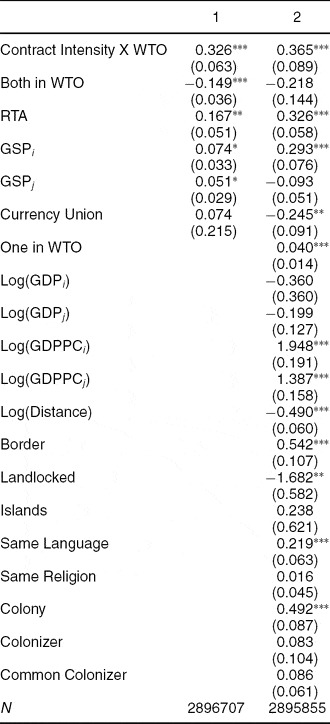
Table 4 provides strong evidence that WTO members trade more contract-intensive goods. The results are similar in both specifications and indicate that WTO membership increases trade in goods with the highest level of contract intensity by about 19%, while decreasing trade in goods with the lowest level of contract-intensity by about 14%.Footnote 49 These results are robust to alternative specifications, shown in the Supplemental Appendix. I demonstrate the robustness of the results to the inclusion of a measure of intra-industry trade, as this variable may be correlated with Contract Intensity.Footnote 50 Additionally, as predicted by the theory, I show that the WTO increases trade in contract-intensive goods most for pairs of states with dissimilar capabilities, dissimilar regime types, and that are nonallied.
Contract Intensity

Notes: Column 1 shows estimates from OLS regression. The dependent variable is the natural log of (imports +1). The model includes directed dyad industry, importer-year, and exporter-year fixed effects, which are not shown. Constant is not shown. Column 2 shows estimates from interval regression. The model includes year, importer, exporter, and industry fixed effects. The data cover 1989–2000 and the unit of observation is the directed dyad-industry year. All models include robust standard errors, clustered by directed dyad, which appear in parentheses. Note that the measure of contract intensity is time invariant. “*”, “**”, and “***” denote p < 0.05, p < 0.01, and p < 0.001, respectively.
Fixed Capital Investment
To test whether WTO membership increases fixed capital investment, I use OLS with year and country fixed effects, with robust standard errors clustered at the country level. The data include 167 countries from 1960 to 2010.Footnote 51 The dependent variable is Log Fixed Capital Investment, which is measured in logged constant U.S. dollars and includes “outlays on additions to the fixed assets of the economy plus net changes in the level of inventories” (World Bank 2011). Unlike ongoing operating expenses, fixed capital investments are sunk costs in physical infrastructure, which are precisely the investments that are most affected by hold-up problems. The key independent variable, WTO Member, is an indicator of whether a country is a member of the WTO. Since investment may be higher in larger, wealthier economies, I control for Log(GDP) and Log(GDPPC).
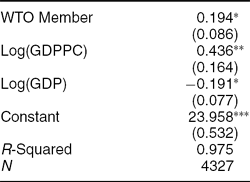
The results presented in Table 5 indicate that, as expected, WTO membership increases fixed capital investment by about 21%. I also present the results of several robustness checks in the Supplemental Appendix: First, incentives to invest often depend on the cost of capital. Thus, I demonstrate that the results are robust to the inclusion of the Real Interest Rate (World Bank 2011), along with other covariates that may affect the investment decision, such as Economic Growth (World Bank 2011) and an indicator of whether a country is a Democracy (Cheibub, Gandhi, and Vreeland Reference Cheibub, Gandhi and Vreeland2010). Second, by increasing fixed capital investment, WTO membership should also increase trade in goods that require such investment, particularly between dissimilar country pairs. I therefore show that WTO membership boosts trade in capital-intensive goods between pairs that differ in terms of capabilities, regime types, and alliances.Footnote 52
Fixed Capital Investment

Notes: Estimates from OLS regression. The unit of observation is the country year and the dependent variable is the natural log of fixed capital investment. The data cover 1960–2010. Robust standard errors, clustered by country, appear in parentheses. The model includes year and country fixed effects, which are not shown. “*”, “**”, and “***” denote p < 0.05, p < 0.01, and p < 0.001, respectively.
CONCLUSION
This paper shows that international institutions can help to solve political hold-up problems by reducing states’ abilities to hold up their partners for foreign policy concessions. While scholars have identified a variety of mechanisms through which international institutions encourage cooperation, I generate novel insights by incorporating the logic of political hold-up problems, which has not been systematically theorized in the international institutions literature. Using the example of the WTO to illustrate the argument, the paper develops a formal model which shows that hold-up problems are most acute for politically dissimilar pairs of states, in which one state has the ability and incentive to extract concessions from its partner. The WTO allows states to solve political hold-up problems by enforcing long-term agreements, increasing trade and investment between states that differ in terms of capabilities, regime types, and alliances. The hypotheses derived from the model are tested using bilateral trade data over a 56-year time span. The empirical analysis strongly supports the theoretical predictions, demonstrating that international institutions can normalize relations between politically asymmetric states.
These findings add to the current understanding of the WTO's benefits. The canonical justification for the existence of the WTO focuses on the WTO's ability to solve a terms-of-trade prisoner's dilemma. This emphasis on economics has led previous researchers to overlook important political benefits of membership: The WTO can decouple economic and political relations by facilitating trade between states that would otherwise face large impediments to economic exchange due to political dissimilarities.
The theoretical framework presented here can also shed light on many additional questions in international relations. Future work might examine the implications of political hold-up problems on other institutions or issue areas, such as the indirect effects of international institutions. This paper shows that the WTO prevents the use of trade policies for political leverage. However, it seems unlikely that states abandon their attempts to wield political influence over their partners. Instead, states may substitute towards the use of alternative, less constrained policies, such as foreign aid or diplomatic tools. Future scholarship may therefore investigate whether, by increasing cooperation in the area it governs, an international institution can politicize other policy areas outside of the institution's domain.
Supplementary Materials
To view supplementary material for this article, please visit http://dx.doi.org/10.1017/S0003055413000646
APPENDIX
Proof of Proposition 1 .
I first demonstrate that investment is efficient by considering the first-best solution to the bargaining problem with complete contracts and cash transfers available. The first-best solution maximizes the joint surplus. Countries select the first-best tariff, foreign policy, and investment levels, τ
fb
, ffb
, and ifb
such that τ
fb
, ffb
, ifb
= argmax uH
(τ, f, i) + uF
(τ, f, i) = argmax i[Ω
H
(τ) + Ω
F
(τ)] − i + f − γf.
 $f^{fb}=\bar{f}$
if γ ≥ 1, and ffb
= 0 otherwise. The first-best tariff solves 0 = Ω
H
τ(τ) + Ω
F
τ(τ). By assumption, maxτ Ω
H
(τ) + Ω
F
(τ) ≥ 1, so investment takes place.
I next demonstrate the threat point of the bargaining problem by characterizing the noncooperative equilibrium. The model is simple to solve. Since neither party is bound by an agreement, each plays its preferred policy. If i = 0, F plays f = 0 and any value of τ can be supported since no good is produced. Both countries receive a payoff of 0. If i = 1, F plays f = 0 and H plays τ = τ N , which is the Nash tariff level, or the tariff that maximizes H’s utility: τ N = argmaxτ uH (τ, f, i) = Ω H τ(τ). In this case, F receives Ω F (τ N ) and H receives Ω H (τ N ). The level of investment undertaken by F maximizes its utility, given that H plays τ N if F invests, so that F invests if Ω F (τ N ) − 1 ≥ 0.Footnote 53 The threat point for H is Ω H (τ N ) and the threat point for F is Ω F (τ N ).
I now characterize the solution of the short-term bargaining problem. Suppose F has invested. The bargaining problem is
 $\mathrm{max}_{\tau , f} [\Omega ^H(\tau )+ f-\Omega ^H(\tau ^N)]^{\alpha }[\Omega ^F(\tau )- \gamma\, f-\Omega ^F(\tau ^N)]^{1-\alpha }.$
Differentiating with respect to f, the first-order condition is
 \begin{eqnarray*}
&&\alpha [\Omega ^H(\tau )+ f-\Omega ^H(\tau ^N)]^{\alpha -1}[\Omega ^F(\tau )-\gamma\, f-\Omega ^F(\tau ^N)]^{1-\alpha } \\
&&\quad-\,\gamma (1-\alpha )[\Omega ^F(\tau )- \gamma\, f-\Omega ^F(\tau ^N)]^{-\alpha }\\
&&\quad \times\,[\Omega ^H(\tau )+ f-\Omega ^H(\tau ^N)]^{\alpha }=0.
\end{eqnarray*}
Differentiating with respect to τ, the first-order condition is
 \begin{eqnarray*}
&&\alpha [\Omega ^H(\tau )+ f-\Omega ^H(\tau ^N)]^{\alpha -1}\Omega _{\tau }^H(\tau )[\Omega ^F(\tau )- \gamma\, f-\Omega ^F(\tau ^N)]^{1-\alpha } \\
&&\quad+\,(1-\alpha )[\Omega ^F(\tau )- \gamma\, f-\Omega ^F(\tau ^N)]^{-\alpha }\Omega _{\tau }^F(\tau )\\
&&\quad\times\,[\Omega ^H(\tau )+ f-\Omega ^H(\tau ^N)]^{\alpha }=0.
\end{eqnarray*}
With two equations and two unknowns, an expression for τ st and fst , the solution to the short-term bargaining problem, can be found. Combining first-order conditions,
 \begin{equation}
\frac{-\Omega _{\tau }^H(\tau )}{\Omega _{\tau }^F(\tau )}=\frac{1}{\gamma }.
\end{equation}
Rearranging equation (1), it is apparent that with short-term agreements,
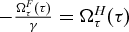 $-\frac{\Omega _{\tau }^F(\tau )}{\gamma }=\Omega _{\tau }^H(\tau )$
, rather than 0 = Ω
H
τ(τ) as in the no trade agreements case.
 $-\frac{\Omega _{\tau }^F(\tau )}{\gamma }$
is weakly positive since F has negative marginal utility with respect to the tariff and since γ is positive, so τ
st
≤ τ
N
. By inserting τ
st
back in to the derivative, fst
can be solved for
 \begin{equation}
f^{st}= \frac{\alpha }{\gamma } [\Omega ^F(\tau ^{st})-\Omega ^F(\tau ^{N})] - (1-\alpha )[\Omega ^H(\tau ^{st})-\Omega ^H(\tau ^{N})].
\end{equation}
Hold-up problems still occur if Ω F (τ st ) − γfst − 1 < 0, as i = 0, whereas in the first-best case, i = 1.Footnote 54 Examining the equation for fst , it is clear that fst increases as α increases. Since α is continuous from 0 to 1, when H’s bargaining power is sufficiently large, hold-up problems occur.
Proof of Proposition 2 . As shown in the proof of Proposition 1, a hold-up problem occurs when Ω F (τ st ) − γfst − 1 < 0. Substituting for fst and simplifying:
 \begin{eqnarray}
&&\Omega ^F(\tau ^{st})- \lbrace \alpha [\Omega ^F(\tau ^{st})-\Omega ^F(\tau ^{N})] - \gamma (1-\alpha )\nonumber\\
&&\quad\times\,[\Omega ^H(\tau ^{st})-\Omega ^H(\tau ^{N})]\rbrace - 1 < 0.
\end{eqnarray}
Examining equation (1), it is clear that as γ increases, τ st increases, so the first term in equation (3) is decreasing in γ. Because H derives less utility under the short-term tariff than under the Nash tariff, the third term in equation (3) is negative, and is therefore decreasing in γ. Thus, for sufficiently high γ, or when there are large differences in H’s and F’s foreign policy preferences, hold-up problems occur.







Comments
No Comments have been published for this article.