Ideas play an important role in processes of policy change. Theories of learning emphasize how ideas structure and update policymakers’ framing of the problem as well as their conception of the appropriate means and ends of policy (Hall Reference Hall1993; Meseguer Reference Meseguer2005; Gilardi Reference Gilardi2010). Coalition theory suggests that ideas influence processes of mobilization that produce change (Sabatier Reference Sabatier1988; Noel Reference Noel2012). Diffusion models propose that the spread of policy ideas is driven by multiple mechanisms including learning, coercion, competition, and emulation (Simmons and Elkins Reference Simmons and Elkins2004; Simmons, Dobbin, and Garrett Reference Simmons, Dobbin and Garrett2008; Sommerer and Tallberg Reference Sommerer and Tallberg2019). Organizational theorists and constructivists argue that policy change is shaped by policy entrepreneurs, organizational culture, expert knowledge, and professional norms (Andonova Reference Andonova2017; Barnett and Finnemore Reference Barnett and Finnemore2004; Chwieroth Reference Chwieroth2010; Farrell and Quiggin Reference Farrell and Quiggin2017; Haas Reference Haas1992; Levinthal and March Reference Levinthal and March1993).
While this work highlights the centrality of ideas in policy change, it brackets precisely what needs to be explained: how creative agents solve problems by inventing new ideas. Most accounts tend to treat individuals as vehicles for ideas, rather than as agents that introduce novel concepts and arguments into the world. In this paper, we engage with growing literatures that theorize the role of creative action in political science (Berk and Galvan Reference Berk and Galvan2009; Berk, Galvan, and Hattam Reference Berk, Galvan and Hattam2013; Herrigel Reference Herrigel2010) and international relations (Adler Reference Adler2019; Búzás and Graham Reference Búzás and Graham2020; Cornut Reference Cornut2017; Gadinger Reference Gadinger2016; Goddard Reference Goddard2009; Hopf Reference Hopf2018; Kalyanpur and Newman Reference Kalyanpur and Newman2017; Katzenstein and Seybert Reference Seybert, Katzenstein, Katzenstein and Seybert2018; Pouliot Reference Pouliot2016; Schmidt Reference Schmidt2014). In particular, we develop Ernst Haas’ argument that policy change “is a form of human problem-solving that requires actors to learn concepts” (Haas Reference Haas1982, 209). Haas (Reference Haas1982, Reference Haas1990) maintained, against the strict rationalist view, that change in international policy regimes is not imposed by states or determined by exogenous changes in costs and benefits. Instead, it is driven by the creative and uncertain process of learning aided by new concepts and ideas.
We offer a new theory of creative learning in organizations. While we frame the theory in terms of general political organizations, we focus on change in international organizations (IOs). We posit that IO officials respond to changes in what we call the problem and solution space. Such changes include the emergence of new policy problems and new solutions in the form of state practices. Creative learning helps policymakers grapple with a changing world while managing the strategic situation they confront. The strategic situation includes principals, client states, and organizational imperatives. IO officials create new ideas to please principals while mobilizing client states to adopt the IO’s preferred policies. We theorize three modes of creative learning that IO officials use to create and implement new ideas: conceptual combination, translation, and repurposing. In this process of creative engagement with problems, IO officials are strategic, but they rarely conduct a systematic search for optimal solutions. They innovate in the dynamic tension between inchoate shifts in their environment and the demands of the strategic situation.
This theory allows us to explain a complex case of ideational change that we have established in previous work: the emergence of green growth and associated ideas from Keynesian and Schumpeterian economics in global environmental policy over the last fifteen years (Meckling and Allan Reference Meckling and Allan2020; cf. Bernstein Reference Bernstein and Falkner2013; Blaxekjær Reference Blaxekjær2015; Han Reference Han2015; Jacobs Reference Jacobs and Falkner2013; Tienhaara Reference Tienhaara2013). The global rise of green growth is a case in which IO officials invented a new concept and associated policy ideas. Our interviews and analysis of IO reports show that the emergence of green growth constituted a major transformation of environmental policy ideas in the World Bank, the United Nations Environmental Programme (UNEP), the Organisation for Economic Cooperation and Development (OECD), and the United Nations Development Programme (UNDP).
The rise of green growth in IOs was a creative response to the rise of climate change on the global political agenda as well as experiments with green industrial policy by a few countries, including Germany and China. Green industrial policy bolstered clean energy technologies, which suggested that climate policy could stimulate economic growth. IO officials responded creatively to these changes by conceptualizing the state practices they observed. “Green growth” first appeared in 2005 in a Ministerial Declaration by an obscure UN agency, the Economic and Social Commission for Asia and the Pacific (UNESCAP). Here, IO officials did not import concepts from the academic literature or outside experts.Footnote 1 They invented new concepts themselves in order to solve specific problems in the organization. Once created, the concepts did not simply diffuse throughout IOs. The concepts and underlying policy ideas were reinvented and transformed as they were taken up by other IOs. The result is major—yet highly variegated—transformation of environmental policy ideas across IOs.
We make two additional theoretical contributions. First, the theory of creative learning provides an alternative to existing rationalist and constructivist models of policy change (Barnett and Finnemore Reference Barnett and Finnemore2004; Chwieroth Reference Chwieroth2010; Hawkins et al. Reference Hawkins, Lake, Nielson and Tierney2006; Simmons, Dobbin, and Garrett Reference Simmons, Dobbin and Garrett2008). Existing models abstract from the specificity and complexity of processes of change. Drawing inspiration from a variety of work on creative action and change (Barnett and Coleman Reference Barnett and Coleman2005; Berk and Galvan Reference Berk and Galvan2009; Herrigel Reference Herrigel2010), we offer a contextual account in which creative learning is a strategic response to managing the multiple pressures organizations face. Second, creative learning provides a lens to think about politics in an era of geopolitical and ecological challenges to the liberal order. In unsettled times, we need theories that foreground the difficult work of human agency to understand and adapt to complex change.
Theorizing Creative Learning
Learning is a change in an actor’s ideas in response to new information about the likely success or failure of a policy option (Simmons, Dobbin, and Garrett Reference Simmons, Dobbin and Garrett2008, 25-27; Gilardi Reference Gilardi2010, 651). Political organizations learn in conjunction with changes in their environment (Mantzavinos, North, and Shariq Reference Mantzavinos, North and Shariq2004). A key element of the environment is the set of available problem frames and policy practices. First, the emergence and politicization of new issues alters the problem space. Second, there are changes in the solution space as governments and other actors conduct policy experiments. Policymakers survey these practices, noting their success or failure, and update their beliefs about what policies are likely to be beneficial.
On the rationalist model, learning is “logically derived from a systematic processing of relevant information” from the environment (Weyland Reference Weyland2012, 920; cf. Mantzavinos, North, and Shariq Reference Mantzavinos, North and Shariq2004; Simmons, Dobbin, and Garrett Reference Simmons, Dobbin and Garrett2008). On the Bayesian model, actors update their baseline beliefs in a rational direction, but this does not necessarily produce a rational outcome (Gilardi Reference Gilardi2010, 651; Meseguer Reference Meseguer2005, 75). Bounded learning models emphasize that learning is difficult because experience is “meager relative to the complex and changing nature of the world” (Levinthal and March Reference Levinthal and March1993, 96; cf. Weyland Reference Weyland2006, Reference Weyland2012). To find a way forward, organizations learn by adapting existing heuristics to problems, satisficing rather than optimizing.
These models of learning explain how pre-existing beliefs are incorporated into organizations via updating. They do not theorize the creation of new entities. The application of heuristics involves using an existing schema to interpret events. Rational updating involves making a cost-benefit analysis of an existing choice set. Neither explicitly explains the generation of novelty. Similarly, diffusion models elide creativity by positing a process in which the same idea is spread throughout the system (Simmons and Elkins Reference Simmons and Elkins2004; Simmons, Dobbin, and Garrett Reference Simmons, Dobbin and Garrett2008). But these models bracket exactly what is to be explained by learning models: how agents creatively respond to a complex and unclear situation by inventing new ideas and tailoring them to their organizational contexts.
Creative learning is a change in policy discourse that is driven by the creation of new entities. For the purposes of this article, we focus on two types of new entities: concepts and policy ideas. Concepts, such as green growth, are general categories that structure the goals and instruments of organizations. By policy ideas, we mean the frames and arguments used to identify problems and solutions. A concept or idea is new if it generates substantive policy insights or opens up new forms of practice.Footnote 2 Existing models fail to distinguish between instances of learning in which existing ideas are used and those in which new entities emerge which substantially change the ideational landscape.
Not all new combinations of things are, however, recognized as creative products (Amabile Reference Amabile1988, 126; Sawyer Reference Sawyer2012, 212-215). A creative product must also be useful or appropriate to some context. A novel combination of economic instruments will not be recognized as creative unless it actually produces a plausible intervention in the economy. Nor will it be recognized as creative if it hews too closely to an established tool in the repertoire. Thus, new entities must be novel, lasting, and appropriate to existing social contexts.
Existing work on creativity in IR is limited in its ability to capture and explain the invention of new entities because it defines action as always and already creative (Adler Reference Adler2019, 223; Cornut Reference Cornut2017, 720; Gadinger Reference Gadinger2016, 191, 199; Hopf Reference Hopf2018, 692-694). Following Joas (Reference Joas1996, 154-167), human action is not guided by exogenously given goals and interests. Rather, all human action involves the creative matching of means and ends in process (Reference Joas1996, 163). On this view, social life is in constant flux (Hopf Reference Hopf2018, 693).
However, such a perspective cannot explain the emergence of lasting new concepts and policy ideas that alter the landscape of politics.Footnote 3 Constant flux contains novelty, but it does not necessarily produce lasting new entities. It begs the question, if all action is creative, why are organizations and institutions not constantly reinventing their core purposes and practices? A theory of creativity in politics must be able to account for how and why the constant flux of social life sometimes generates stability.
Indeed, it was precisely this concern that Mead ( Reference Mead and Morris1934, 215) addressed in his account of how the creative interaction between organisms and environments generates “new objects” that create “a different world.” Adapted to our frame here, the creation of lasting new ideas serves as the engine of substantive policy change. The invention of concepts and the forging of new arguments alters the ideational landscape upon which all political mobilization depends.
Creative Learning in IOs
In this paper, we are interested in IOs that serve as knowledge brokers in international politics. We examine IOs’ ideas about what policies states should adopt. In processes of learning, IOs update their beliefs about what policies would be beneficial for states. To explain which policy ideas IOs develop and promote, we need to think of officials as confronting a strategic situation structured by three kinds of problems.
First, IOs need to obtain financial and symbolic resources (funding and legitimacy, primarily) from the environment or field they operate in (Barnett and Coleman Reference Barnett and Coleman2005; Sending Reference Sending2015). The need for financial resources means that IOs have to satisfy principals and donors. This is a core concern of the existing literature on principal-agent problems (Nielson and Tierney Reference Nielson and Tierney2003; Hawkins et al. Reference Hawkins, Lake, Nielson and Tierney2006). However, a strict principal-agent model misses key dimensions of the strategic relationship between states and IOs. For one, states can fund IOs in multiple ways. States fund IOs through non-voluntary contributions. But they can also give funds directly to the IO for dedicated projects and priorities. This creates an alternative avenue of influence and tends to increase the latitude that IOs have to pursue their own policies (Graham Reference Graham2015). Compounding this is the fact that states are not the only important donors. NGOs, foundations, and other IOs can all contribute to IO projects, further increasing the autonomy of IOs to secure resources for their favored policies. Moreover, if an IO is not regarded as legitimate, donors and principals are unlikely to entrust it with resources. We have to go beyond a strict principal-agent framework to situate IOs in a broader strategic situation. In this broader frame, it is an empirical question whether, how, and which principal demands shape IO behavior.
Second, IOs need to motivate client states to engage with the IO and implement its preferred policies. IOs have their own preferred policy means and ends which they try to implement through projects. Most IOs have only limited tools to coerce client states. Moreover, these tools can be evaded by states that feign compliance. Thus, IOs need to get genuine buy-in from client states if they want their preferred policies to be enacted in a meaningful way. To move client states, IOs need to be regarded as legitimate and have the financial tools to wield that authority effectively.
Third, IO officials must manage these two problems while negotiating internal organizational imperatives. These could be structured by organizational rules, leaders’ reform campaigns, or the need to maintain a distinct identity and position vis-à-vis other IOs.
In sum, the strategic situation is the set of problems that IO officials are grappling with. It is important not to pre-theorize the elements of the strategic situation, as rationalists do by prioritizing and centering principal states. It is an empirical question which problems press on officials at any given moment. These pressures emerge from a dynamic situational order that IO officials actively manage (Pouliot Reference Pouliot2016).
Confronting a problem in the strategic situation, IOs depend on creative learning. When policymakers confront an impasse, they need a creative act that meets the demands of the problem while fulfilling organizational imperatives. Immersed in a situation they do not fully understand, officials must improvise, matching new concepts and practices to problems (Cornut Reference Cornut2017; Pouliot Reference Pouliot2016). New concepts and policy ideas are essential to IOs because they help solve multiple problems in the strategic situation at the same time. New ideas help states build coalitions of principals, clients, other IOs, NGOs, and epistemic communities (Haas Reference Haas1990; Jabko Reference Jabko2006; Noel Reference Noel2012). A successful ideational campaign helps an IO raise money, achieve its mandate, and push its preferred policies with client states in a coherent, motivated way. In order to align these elements, actors must possess the diplomatic skill or virtuosity to “craft compromises, take initiatives or herd others in ways that locally resound with others” (Pouliot Reference Pouliot2016, 62).
Existing theories of creativity posit that all action is creative in some sense. We are particularly interested in when creativity generates lasting change in concepts and ideas. To get at this, we specify the conditions under which policymakers are likely to engage in rational, bounded, or creative learning. Rational learning is only likely in a world of “calculable risk” in which policymakers can and do assign probabilities to events that fall into stable and predictable patterns (Seybert and Katzenstein Reference Seybert, Katzenstein, Katzenstein and Seybert2018, 10, 17-19). In situations of uncertainty and ambiguity, actors are more likely to engage in bounded learning wherein they adapt existing ideas to problems.
When are we likely to observe creative learning? First, there must be a challenge or problem that disrupts existing patterns of policy development and spurs the search for new ideas. This is a key insight of the pragmatist tradition which posits that creative action is a result of the reflection induced by such disruptions (Joas Reference Joas1996, 157–159; Berk and Galvan Reference Berk and Galvan2009, 554; Herrigel Reference Herrigel2010, 8; Schmidt Reference Schmidt2014). This is consistent with studies of ideational change that argue new ideas are only likely to spur major changes in discourses when they are framed as solutions to crises or major problems (Hopf Reference Hopf2018, 699–700). Problems and crises cultivate a sense of contingency and suggest the necessity of new approaches. As in bounded learning, creativity is a response to uncertainty and contingency in such moments (Seybert and Katzenstein Reference Seybert, Katzenstein, Katzenstein and Seybert2018, 31, 38). Second, the policy officials must have the autonomy to create new ideas (Barnett and Finnemore Reference Barnett and Finnemore2004). In a strict principal-agent situation, IOs could be disciplined such that they only deploy ideas vetted by states. Other IOs may operate within discourses they do not control. For example, an IO may have to employ a specialized scientific or legal terminology in order for its policy recommendations to remain legitimate. Third, new ideas are more likely to emerge from peripheral social actors or brokers situated between social networks (Goddard Reference Goddard2009; Hopf Reference Hopf2018). The peripheral position of bureaucracies renders them less vulnerable to political interference, providing greater discretionary space for policy innovation (Breznitz and Ornston Reference Breznitz and Ornston2013). Fourth, the size of an IO is likely to affect its likelihood and rate of change, with large IOs likely to be late, slow adopters (Vetterlein and Moschella Reference Vetterlein and Moschella2014). Finally, competition between organizations in a field can also fuel creativity because of the need for organizations to differentiate themselves by creating unique brands and strategies (Sending Reference Sending2015).
These are enabling conditions. To explain specific episodes of creative learning in organizations, we must analyze the confluence of factors in the strategic situation. We expect creative learning when changes in the problem and solution space align with a perceived problem in an IO’s strategic situation. When a number of IOs pursue such an alignment at the same time, they create a macro-level process of creative learning that restructures the landscape of global governance.
Three Modes of Creative Learning
We theorize three modes of creative learning that help illuminate the mechanisms by which actors creatively grapple with the strategic situation: conceptual combination, translation, and repurposing. These modes emphasize how creative learning draws on the resources at hand, combining and recombining elements into new forms (Joas Reference Joas1996; Herrigel Reference Herrigel2010). As Kalyanpur and Newman (Reference Kalyanpur and Newman2017, 364) put it, the work of changing international institutions “is not problem optimization but the creative use of existing tools.” But, importantly, these modes also help explain the creation of lasting new entities by capturing how policymakers integrate concepts and ideas into organizational contexts by forging connections with existing ideas and practices.
Conceptual combination is the invention of a new compound concept by joining existing terms together (Sawyer Reference Sawyer2012, 115-120; cf. Meadowcroft and Fiorino Reference Meadowcroft and Fiorino2017). The case of “green growth” as well as “human rights,” “gender mainstreaming,” and other new objects of global governance are all examples of this. New compound concepts have a unique meaning because they combine semantic networks, allowing actors to make new connections between previously disparate concepts and ideas (Sawyer Reference Sawyer2012, 116; Kenett, Anaki, and Faust Reference Kenett, Anaki and Faust2014). Thus, new concepts are not just new labels. They are vehicles of associated meanings and practices that can aid actors in thinking through problems in new ways. Policymakers are more likely to engage in conceptual combination when they have a minimum level of ideational autonomy and when they conclude that the articulation of new goals or policy instruments will help them overcome obstacles of political mobilization in the strategic situation.
Translation is the act of importing new entities from outside the organization and reshaping it to work within the new organizational context. We expect translation in cases where another organization in the same or an adjacent issue area has introduced a dynamic new concept or idea that appears to be getting traction with principals and clients, putting pressure on other organizations to engage with it. Stone (Reference Stone2017) defines translation in opposition to the view that entities are “diffused” or “transferred” from one organization to the next. She argues that such language ignores the fact that concepts and policy ideas are adjusted each time they “spread” to a new context (cf. Berger and Esguerra Reference Berger, Esguerra, Berger and Esguerra2017). Translation creates novelty because even if two organizations adopt the same concept, each organization will produce a new combination of practices and substantive policy ideas to support and operationalize it (Hopf Reference Hopf2018, 692). When a new concept is imported, it can be creatively aligned with other arguments and frames that circulate within the organizational context. This produces a unique web of meanings and practices around the concept. Translation is distinct from emulation processes in which an organization merely copies or pays lip service to a concept or idea, rather than working out its implications in the new context. If an imported concept does not produce new policy arguments, then it is a case of rational or bounded learning, depending on the mechanism that generated the outcome.
Repurposing involves the reframing and invigoration of existing policy ideas under a new concept.Footnote 4 The new concept could be an invented conceptual combination or a translated one. Repurposing creates novelty because it results in new combinations of arguments and themes. It is likely when a new concept provides an opportunity for IO officials to adapt practices and ideas they had pursued or pushed before. The novel concept provides a purpose that gives the projects of IO officials new meaning. Repurposing is distinct from “grafting” (Price Reference Price1998) and other mechanisms because it involves a process of metamorphosis in which the ideas are altered as they are adapted to a new purpose. For example, Hafner-Burton and Pollack (Reference Hafner-Burton and Pollack2002) show how women’s groups repurposed ideas from the “Women in Development” discourse into a new “Gender and Development” discourse. This solved a strategic problem, the confinement of women’s issues to reproduction and child-health, by switching the frame from the exclusion of women to unequal relations of power. This highlighted the crucial role of empowering, rather than merely including, women. This combined existing ideas with new ones in an innovative program of gender mainstreaming.
In sum, creative learning is distinct from rational and bounded learning in terms of both the outcome and the mechanism. The outcome of creative learning is a new entity (concept or idea) and the mechanism is not updating but modes of reconfiguration shaped by the strategic situation. These modes of creative learning allow IO officials to mediate between changes in the problem and solution space, principal demands and interests, and clients’ problems and motivations (figure 1). Changes in state practices or the landscape of policy problems provide the stimulus for creative learning. Then IO bureaucrats engage in one or more of the modes of creative learning. They do so under the political constraint of needing to satisfy principals and motivate client states. New concepts and constellations of ideas allow IO officials to align the incentives of principals, clients, and the IO itself.
Overview of the argument

Methods
We employed two sets of methods relating to tracing the evolution of policy ideas, the dependent variable, and to explaining the mechanisms of change in IOs, respectively.
First, to establish the emergence of green growth in IOs, we coded 165 annual reports from four core IOs (OECD, UNDP, UNEP, World Bank) and two state forums (UNFCCC and the G7) over the period 1990–2017.Footnote 5 We coded the documents to identify change in the main environmental goals (e.g., sustainable development, green growth), problem framing (e.g., market failure, technological lock-in), and policies (e.g., market-based mechanisms, subsidies for research and development). Following Hall (Reference Hall1993), we then aggregated related policy problems, goals, and means into policy paradigms, in our case schools of economic thought (neoclassical, Keynesian, Schumpeterian, limits to growth). We describe the method to trace the explanandum in detail in the online appendix.
Second, to identify the mechanism of change, we conducted process-tracing in the OECD, UNEP, UNDP, and World Bank. We collected data from IO documents and thirty-two semi-structured interviews with IO officials and authors of IO reports. We asked interviewees open-ended questions such as how they defined green growth ideas and when and how those ideas emerged. We combined the interviews with our document analysis to establish a timeline. This inductive process led us to the United Nations Economic and Social Commission for Asia and the Pacific (UNESCAP) and we conducted additional interviews with key figures there to establish how the concept of green growth first emerged. While we initially proceeded inductively, once we developed the theory of creative learning in the strategic situation, we developed a list of observable implications which we used to guide analysis of the documents and interviews. In order to distinguish creative from other forms of learning, we identified three criteria to determine whether or not a new entity was introduced in the case: 1) policymakers in the IO created a new concept; 2) policymakers created a new combination of ideas that expressed new arguments about the relation between economic growth and environmental protection; or 3) policymakers created a new agency or institution.
The Emergence of Green Growth in Global Environmental Policy
Our central empirical claim is that the emergence and spread of green growth ideas is a case of creative learning. We first describe our explanandum, the rise of the green growth concepts and associated environmental adaptations of Keynesian and Schumpeterian policy ideas across IOs. Second, we discuss the changes in the problem and solution space that spurred creative learning. Finally, we show how creative learning in IOs was shaped by the conditions and mechanisms outlined earlier.
The Explanandum: Ideas on Economic Growth and the Environment
Our analysis of IO reports reveals a major change in global environmental policy over the last thirty years: the emergence of green growth ideas. This included both the creation of new concepts (“green growth”; “green economy”; “low-carbon growth”) and the rise of substantive policy ideas (Keynesian and Schumpeterian themes). Figure 2 shows the rise of green growth concepts relative to sustainable development. Figure 3 shows the rise of green versions of Keynesian and Schumpeterian policy ideas.
The rise of green growth in global environmental discourse
Note: The y-axis shows the number of times “sustainable development” or “green growth” goals appeared in our sample of 165 IO annual reports, published between 1990 and 2017. “Green growth” includes “green growth,” “green economy,” and “low carbon growth.” Refer to the online appendix for more details.

Economic schools of thought on the environment
Note: The y-axis shows the number of times neoclassical, Keynesian/Schumpeterian, or limits to growth arguments appeared in our sample of 165 IO annual reports, published between 1990 and 2017. To arrive at the aggregate codes for different schools of economic thought, we code policy problems, goals, and means, the three components of policy paradigms following Hall (Reference Hall1993). Refer to the online appendix for more details.

The new ideas that emerged after 2000 were innovative because they articulated the view that there is a strong complementarity between economic growth and environmental protection. Weak complementarity suggests merely that growth and environmental protection are compatible. Arguments for strong complementarity maintain that environmental policies can spur economic growth. Weak complementarity dominated thinking about sustainable development in the 1980s and 1990s. This reflected neoclassical thinking: preserving natural capital was seen as necessary to avoid future declines of economic growth (Solow Reference Solow and Gopalakrishnan1974). On the neoclassical view, the optimal solution is to construct market mechanisms that internalize natural capital through a well-designed Pigouvian tax or a tradable permit scheme. The neoclassical perspective inspired the use of market mechanisms for U.S. efforts to regulate acid rain in the 1980s and the Kyoto Protocol in the 1990s (Meckling Reference Meckling2011).
The innovative arguments for strong complementarity that emerged after 2000 expressed Schumpeterian and Keynesian themes (Bowen and Fankhauser Reference Bowen and Fankhauser2011; Jacobs Reference Jacobs and Falkner2013). In Schumpeterian thought, the environmental problem is one of lock-in into dirty technology. The goal is to develop waves of technological change that will drive the “creative destruction” of polluting firms and technologies while spurring long-term growth (Helpman Reference Helpman1998). In policy terms, Schumpeterian thought proposes government subsidies for research and development and to some extent deployment subsidies (Acemoglu et al. Reference Acemoglu, Aghion, Bursztyn and Hemous2012; Acemoglu et al. Reference Acemoglu, Akcigit, Hanley and Kerr2016; Van Benthem, Gillingham, and Sweeney Reference Van Benthem, Gillingham and Sweeney2008). Adaptations of Keynesian economics argue that environmental policies, such as investments in green infrastructure, could stimulate aggregate demand and therefore growth. The goal is to promote short-term economic growth by increasing the demand for environmental goods and services through, for instance, green economic stimulus. The policy solution of green Keynesianism focuses on fiscal measures, in particular government investment in green infrastructure, including subsidies to deploy clean technologies (Bowen and Stern Reference Bowen and Stern2010). These ideas were not commonplace before 2000. Nor were the Schumpeterian and Keynesian arguments for strong complementarity necessarily drawn from academic work on the topic. Rather, they were created and translated by policymakers who were dynamically responding to changes in the problem and solution space.
The Problem and Solution Space: Climate Change and Green Industrial Policy, 2000–2005
IO officials deployed these new green adaptations of Keynesian and Schumpeterian ideas in response to two changes in the environment. First, there was a shift in the problem space as climate change rose on the global agenda (figure 4). In the 1990s, IOs dealt with a range of environmental problems—including climate change, desertification, loss of biodiversity, and biosafety concerns. After 2000, they increasingly focused on climate change. This focus foregrounded the energy sector and provided a vivid case that made strong complementarity seem viable.
The shifting problem focus
Note: The y-axis shows the number of times we coded that a passage was focused on climate change versus environmental problems generally (including deforestation, desertification, etc.). The UNFCCC is excluded from this graph, so as not to bias the results toward a climate change focus.

Second, policymakers responded to a change in the solution space as the policy practices of states changed. In the 2000s, a number of states conducted experiments with green industrial policy. Green industrial policies include subsidies, regulations, and infrastructure investments that aim to develop environmentally beneficial industries. In the 2000s, Germany and China adopted ambitious green industrial policies in an attempt to stimulate innovation in the energy sector (Rodrik Reference Rodrik2014; Nahm Reference Nahm2017; Meckling Reference Meckling2018).
In the wake of government policy, markets for environmental goods and services in general and markets for clean energy in particular began to grow rapidly in the early 2000s. Between 2001 and 2006, global exports for environmental goods doubled to about USD 460 billion (International Trade Centre 2014). Renewable energy technologies were a key growth sector in environmental goods. Throughout the 1990s, investment in renewable energy technologies grew moderately at a low level of total investment. Between 2000 and 2005, however, global new investment in renewable energy tripled (REN21 2007, 16).
Creative Response: Conceptual Combination in UNESCAP and UNEP, 2005–2008
How did IO officials respond to these changes in the problem and solution space? One alternative explanation could combine a rationalist, Bayesian model of learning with diffusion theory. As climate change rose up the agenda, major states like China and Germany demonstrated the benefits of green industrial policy. This notion then diffused as IOs updated their beliefs about the relative costs and benefits of Keynesian and Schumpeterian policy options in the wake of the 2008 financial crisis. Another possible explanation is that a coherent epistemic community or professional group of environmental Keynesian and Schumpeterian thinkers pressed and diffused the ideas within and across IOs.
These accounts are problematic in two respects. First, they ignore the creative process by which policymakers invented “green growth” and related concepts. In short, it fails to recognize the novelty of the outcome. Second, as we shall see, they posit the wrong mechanism of learning. IO officials did not conduct a systematic review of costs and benefits to decide which policies would be effective. Rather, they invented or translated concepts and ideas to deal creatively with problems in the strategic situation. IO officials usually initiated creative learning themselves, rather than copying concepts and arguments directly from epistemic communities or academic work. Creative learning thus produced distinct but related “green growth” concepts and policy ideas across the IOs. The diffusion frame fails to identify or explain the variegated nature of the spread of new policy concepts and ideas across IOs.
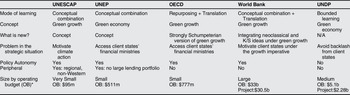
In the case studies that follow, we provide an account of the overall process by which green growth concepts emerged and spread as well as a comparison across cases. The cases in this subsection emphasize emergence while those in the next provide a more structured comparison of modes of creative learning (see table 1). Our comparative explanation emphasizes the role of the strategic situation in shaping the form and content of creative learning in each IO. In each case, we seek to demonstrate whether new concepts or policy ideas were created through the three modes of creative learning. This distinguishes our account from rational and bounded learning on both the mechanism (updating versus modes of creative learning) and the outcome (existing versus new ideas). Looking across the cases, our narrative emphasizes that the new ideas emerged in small, peripheral IOs before spreading to larger, core ones.
Overview of cases

Note: Operating budget is offered as a proxy for size. Full details are available in the supplementary materials. For the organizations with large lending or grant portfolios, we have separated out the project funds.
UNESCAP. The term “green growth” first emerged in a small, peripheral IO, the UN Economic and Social Commission for Asia and the Pacific (UNESCAP), where South Korea championed the new ideas and channeled them into global discourse. The first mention of green growth in an international policy document was the Ministerial Declaration of the Fifth Ministerial Meeting of UNESCAP of March 2005. The conference was organized by UNESCAP joint with UNEP, UNDP, and the Asian Development Bank. The declaration endorsed the green growth approach, while launching the Seoul Initiative on Environmentally Sustainable Growth.
The creation of the term green growth is a case of conceptual combination. The term was invented by Ambassador Rae Kwon Chung, then Director of UNESCAP’s Environment and Development Division. Chung had served as Korea’s climate change negotiator from 1991 until 2004. His work on green growth was a response to a strategic problem that he and other advocates of climate action confronted. He felt that climate negotiations were gridlocked because countries perceived climate action as a “zero-sum game with economic growth.” He was convinced that climate mitigation could be a driver of jobs and growth. Chung felt a new “paradigm” would help: “I tried to harmonize climate action with economic growth. ‘Green growth’ was the right word. When I came up with it, I was thinking ‘green’ was ‘environment’, ‘climate change,’ etc. and that climate action can drive economic growth” (Chung Reference Chung2018).
As UNESCAP’s Environment and Development Director, Chung wrote the background document for the 2005 UNESCAP Ministerial himself. Chung’s status as a relative outsider to the world of IO environmental policy ensured that he did not just replicate well-rehearsed “sustainable development” discourse. His background paper drew on an eclectic set of academic sources to argue that a “positive win-win synergy between environment and economy” was possible (UNESCAP 2005b, 1). Although he did not really have empirical evidence to support the claim, he made the bold, creative case that a combination of pricing schemes, public investment, government regulation, and private sector innovation could generate economic growth and employment (UNESCAP 2005b, 11-18). A purely rational or Bayesian learning theory suggests that learning must be informed by systematic evaluations of the costs and benefits of policy options. But Chung worked from personal experience and conviction, not a careful analysis of the evidence. It was only later that Chung found and drew on the work of economist Paul Ekins who had published a book in 2000 titled Economic Growth and Environmental Sustainability: The Prospects for Green Growth (Chung Reference Chung2018).
The importance of change in the problem and solution space is evident in the fact that Chung was motivated to address problems in climate politics. Moreover, subsequent UNESCAP documents explicitly drew on the economic practice of Asian economies, including South Korea and China (UNESCAP 2005a, 46). For example, a 2006 UNESCAP report stated that “countries such as China are developing visionary Green Growth policies” (UNESCAP 2006, 12).
Chung was the key policy entrepreneur in the early years of the concept, driving its success at UNESCAP, in the Korean government, the OECD, and elsewhere (Chung Reference Chung2018; Nikolova Reference Nikolova2018). Chung personally persuaded Korean President Myung-bak Lee to adopt the concept and support the promotion of green growth ideas (Chung Reference Chung2018). He also succeeded in the drive to have the 2005 UNESCAP Ministerial adopt the concept against developing country opposition. China and India were initially concerned that the concept might establish a new basis for denying the right to grow (IISD 2005). But Chung and his staff worked hard to convince the Chinese and Indian representatives, who allowed the concept to enter the Ministerial statement. Chung’s invention of a new term spurred a dynamic process of creative learning across IOs.
United Nations Environmental Programme (UNEP). UNEP Executive Director Klaus Töpfer was present at the 2005 UNESCAP Ministerial, so the organization was familiar with green growth thinking early on (UNESCAP 2005a, 14). Under Achim Steiner, who succeeded Töpfer in 2006, UNEP engaged in its own process of conceptual combination. Rather than using the term “green growth,” UNEP began systematically developing the concept “green economy” (Interview 1; Steele Reference Steele2017). Fulai Sheng, head of UNEP’s Economic and Fiscal Policy Unit said Steiner “carried the idea of a macroeconomic case [for the environment] into UNEP … In terms of substance, [Achim] wanted to highlight the positive linkages [between the environment and economy]. Achim was stating what was happening in the economy.” In particular, UNEP noted that China was driving growth in environmental goods and services (Interview 1). As Sheng (Reference Sheng2018) puts it, “I was inspired by the growth of China’s environmental industry.” Thus, UNEP’s articulation of the green economy concept was in part a creative response to new state practices and changes in energy markets.
Early on in his tenure, Steiner commissioned an internal report from David Pearce, an economist at University College London, on the links between eradicating poverty and protecting the environment. In 1989, Pearce had published the best-selling Blueprint for a Green Economy, joint with Anil Markandya and Ed Barbier. Fulai Sheng (Reference Sheng2018) explains why UNEP decided to draw on Pearce’s work: “I had looked at the major writings on the topic, and I had concluded that in most cases on the relationship between the economy and environment had been portrayed in a negative fashion … the focus was on costs and negative externalities … how environmental costs translate into economic costs … . Except in Pearce, where there were some signs of showing positive linkages, especially for investments, for example in organic agriculture and clean water, for poverty reduction.” Here, Steiner, Sheng, and others reacted creatively to changes in the solution space by creating new policy arguments for strong complementarity themselves. Academic ideas were brought in after the fact to flesh out and support new concepts. Contradicting the expectations of rational or Bayesian learning perspectives, there was no systematic accounting of whether or not China’s policies vindicated earlier academic work. Rather, learning involved complex combinations of creative impulse, strategic action, and post-hoc academic engagement.
In 2007, the organization’s annual report mentioned the term “green economy” for the first time. Also, as part of the Green Jobs Initiative with the International Labor Organization and other partners, UNEP published the research report Green Jobs though the green growth/economy language had not yet made its way into official policy reports. After 2008, the financial crisis created the impetus for the further development and spread of these ideas. On October 22, 2008, UNEP launched the Green Economy Initiative, funded by the European Commission, Germany, and Norway. As part of the new initiative, UNEP published in March 2009 the briefing A Global Green New Deal: Policy Brief, which offered specific policy advice on a green stimulus response to the financial crisis (UNEP 2009).
What explains UNEP’s invention and integration of the green economy concept? UNEP’s strategic situation is structured by the fact that it does not have a large lending portfolio. It can provide technical assistance but does not have strong levers of influence over client states. To be influential, it must persuade government officials that its preferred policies are necessary and effective. UNEP also depends on voluntary contributions from states, NGOs, and other IOs (Graham Reference Graham2015, 182). Innovative policy work helps it accomplish both these tasks. In this case, UNEP officials used the green economy concept to solve practical problems with client states and to generate revenue. Part of UNEP’s rationale in promoting the concept was to gain greater traction with Finance Ministries in addressing climate change. Finance Ministries controlled funding decisions but were not motivated by neoclassical ideas on negative environmental externalities (Sheng Reference Sheng2018). The growth narrative resonated more strongly with this constituency.
Variation in Creative Learning: Repurposing and Translating Green Growth Ideas, 2008–2012
There is considerable variation in how and when the OECD, World Bank, and UNDP engaged in creative learning after 2008. In 2009, the OECD produced a Ministerial Declaration on green growth that capitalized on the interest in a green stimulus. In doing so, it had to creatively repurpose sustainable development ideas as it translated green growth ideas into its work. The World Bank initially exhibited creativity by inventing a new concept, “low-carbon growth.” But it later incorporated this original work into studies of green growth. It offers a hybrid case in which conceptual combination gave way to translating a pre-existing concept. The UNDP did not adopt green growth ideas until Achim Steiner moved from UNEP to the UNDP. The UNDP case provides some variation that helps us theorize the conditions under which IOs engage in bounded learning or emulation, rather than creative learning. This variation undercuts the simple diffusion narrative on which a single set of ideas spread amongst IOs. Instead, it shows how the strategic situation shapes the production of novel combination of concepts and policy ideas in IOs.
The OECD. The Organisation for Economic Cooperation and Development’s strategic situation is unique because its principals are its client states. OECD policy is determined primarily through declarations by government Ministers. A central task of the OECD directorates then is to motivate member states to comply with these Ministerial declarations. But the directorates also work with activist states to get their preferred ideas into declarations. They help craft the language of declarations and work to persuade reluctant states to support certain initiatives. To accomplish all of this, the staff members have to engage in creative learning that weaves together new concepts, technical policy proposals, and diplomatic skill.
In the runup to the 2009 OECD Council of Ministers, the Environment Directorate confronted two specific problems in its strategic situation. First, efforts to push environmental policy under the umbrella of sustainable development were not working (OECD official 2017). As one official put it, “the failure of sustainable development” was clear (Girouard Reference Girouard2018). Second, the staff wanted to get environmental policy upgraded to the level of the Finance Ministries where it could have a broader impact (Girouard Reference Girouard2018; Kitamori Reference Kitamori2018). Green growth allowed the Environment Directorate to accomplish both these goals.
In June 2009, the OECD Council of Ministers adopted the Declaration on Green Growth. The impetus came from Korea, whose then-Prime Minister Han Seung-soo chaired the OECD Ministerial Council Meeting. He placed green growth on the OECD agenda at the behest of President Lee Myung-bak (Girouard Reference Girouard2018; Kitamori Reference Kitamori2018). Staff in the Environment Directorate sought to use the Korean initiative “as a way to raise awareness and get policy traction on some things we’d been working on” (OECD official 2017).
In short, OECD officials repurposed existing sustainable development policies as they translated green growth policies into their organizational and political context. This was a creative act in that it led OECD staff to articulate a unique constellation of green Keynesian and Schumpeterian ideas. In 2006 and 2007, the OECD had tried to push jobs programs and renewable energy policies under the auspices of sustainable development (e.g., OECD 2006; OECD 2007). The repurposed ideas were new because they emphasized the strong complementarities between growth and environmental protection. For example, in a 2009 report, the OECD argued that states could use stimulus packages to build “new green industries and businesses” through “proactive policies to support innovation and environment-related technological development and uptake” (OECD 2009b, 8, 10). The 2009 ministerial declaration specifically singled out the growth of clean technology markets: “In order for countries to advance the move towards sustainable low-carbon economies, international co-operation will be crucial in areas such as the development and diffusion of clean technologies” (OECD 2009a, 1). The focus on low-carbon technologies here provides evidence that the rise of climate change in the problem space was a key motivation for creative learning.
Since the Environmental Directorate was trying to get the attention of Finance Ministries, it leaned heavily on the financial crisis as a motivating problem. In developing its green growth strategy, OECD officials referenced the report, A Climate for Recovery: The Colour of Stimulus Goes Green, published by the UK bank HSBC in February 2009. As one senior official said: “There was a seminal HSBC paper on green stimulus. Everyone was reading that” (OECD official 2017). HSBC’s report summarized green investments by governments, which shows how emerging state practice—here conveyed through a business publication—shaped policy ideas.
As in other IOs, green growth was contested. European member states expressed interest in the concept, while the US and other states initially rejected it (OECD official 2017; Nikolova Reference Nikolova2018). But despite some resistance, the “Korean argument” was successful in convincing states that there were productivity gains in green investment and the declaration passed (Girouard Reference Girouard2018). After 2009, green growth began to be integrated into the organization’s work. The OECD engaged with UNESCAP’s secretariat, dispatching a representative to Thailand to take notes and learn from UNESCAP’s work (Nikolova Reference Nikolova2018). Ambassador Chung, head of UNESCAP’s environment work, attended green growth-related meetings at the OECD. The OECD also facilitated a working group on green growth among member states.
The 2010 OECD annual report deployed the concept to support a Keynesian argument for green jobs to contribute to climate mitigation. In May 2011, the organization published its green growth strategy, Towards Green Growth. The strategy explicitly referenced emerging policy practice in, for example, China and Korea, in a section called “Green growth in action.” Tying emerging policy practice to revive growth to climate change broadened the target audience of the OECD’s environmental work from environment ministries to finance ministries. This was the same intention and process as in UNEP. “Green Growth has helped coordinate discourse across ministries. This evolution was possible because of a change in the narrative,” an OECD representative said (Girouard Reference Girouard2018). As IO officials see it, learning is not a precise process of weighing costs and benefits, but a process of creating new narratives to address shifts in the problem and solution space while managing the IO’s strategic situation.
The World Bank. The Bank’s large lending portfolio structures its strategic situation. The World Bank uses lending to shape the domestic policies of client states both formally, by attaching conditionalities to loans, and informally, by providing technical assistance that pushes the Bank’s preferred policies. Even so, Bank officials understand that their preferred policies are more likely to be implemented when they have significant buy-in from client states, which are oriented toward economic growth. At the same time, Bank priorities need to be consistent with those of powerful funding states (Nielson and Tierney Reference Nielson and Tierney2003). Officials working on policy campaigns inside the Bank need to manage these two pressures on the strategic situation.
The World Bank began to experiment with Keynesian and Schumpeterian environmental policy ideas after 2000. The impetus for this was the rise of climate change on the agenda between 2004 and 2007 (Brandon Reference Brandon2018; Fay Reference Fay2017). The Bank took an interest in the development of renewable energy and “transitioning to a low-carbon economy” (Gouvello Reference Gouvello2018; World Bank 2006, 18). In the 2008 Annual Report, the World Bank coined the term “low-carbon growth.” According to one official, it was in the 2008 environmental strategy that the Bank “really owned” the ideas underpinning green growth (Lvovsky Reference Lvovsky2017). There, the Bank argued that environmental protection actually “spurs economic growth” (World Bank 2008, 1). However, this insight was incorporated under the banner of reconceptualizing “sustainable development” rather than actually using the term “green growth” (World Bank 2008, 2). Thus, initially, the World Bank did not use the terms green growth or green economy to frame its work.
The invention of the phrase low-carbon growth was an instance of conceptual combination by an environmental group within the Bank. Constrained by the longstanding commitment to economic growth in the Bank, environmental advocates sought to reassert that growth and climate action were complementary. The goal was to use the concept to, as in UNESCAP and UNEP, “create a positive narrative, to reconcile mitigation and development” (Gouvello Reference Gouvello2018). This would be realized practically in energy projects funded by the Bank (Gouvello Reference Gouvello2018). In short, these ideas emerged as a way of talking to client states about undertaking environmental and climate change action now, rather than pursuing the “grow now, clean up later” strategy many states preferred (Fay Reference Fay2017).
After 2010, the Bank took up the concept “green growth.” In 2010, the Bank’s annual report referenced green growth and the Bank funded a “green growth” project in Mexico (World Bank 2010, 27). This switch to using the concept of green growth around 2010 was “a continuation of low-carbon studies” (Gouvello Reference Gouvello2018). It thus translated a pre-existing concept into the context of its own strategic situation. This produced unique constellations of policy ideas consistent with the Bank’s more mainstream economic tendencies. In 2011, the Bank supported the policy research paper “From Growth to Green Growth.” This paper articulated the Schumpeterian and Keynesian bases for the argument that environmental protection could drive growth in mathematical formalisms that could speak to mainstream economists (Hallegatte et al. Reference Hallegatte, Heal, Fay and Treguer2011). This was an original combination that made a real contribution to green growth thinking. In December 2012, the World Bank published the report Inclusive Green Growth which stated the real-world reference: “Beyond stimulus effects, some countries—including Brazil, China, Germany, Japan, the Republic of Korea, and Morocco—are looking at green growth as a potential source of longer-term growth through which to create new markets” (World Bank 2012, 14).
This process of creative learning served as a response to the changing problem landscape and drew on salient state practices in China. As one prominent champion of green growth ideas in the Bank put it, “climate change has been incredibly helpful” in advancing new ideas. New green Keynesian and Schumpeterian ideas “emerged from frustration with the naive approach that ‘a price [on carbon dioxide] can fix everything … [as argued by] mainstream economists” (Fay Reference Fay2017). Once climate change was on the agenda, “tech and finance were the next steps” (Lvovsky Reference Lvovsky2017). As one interviewee said, “technology was changing rapidly, wind, solar” (Fay Reference Fay2017). In addition, decoupling was “already on the top of China’s agenda” (Lvovsky Reference Lvovsky2017). The complexities of the World Bank case show that learning was not a mechanical process of updating beliefs about costs and benefits, but a creative engagement with exemplars of state practice that combined inspiration and evidence.
While the green growth concept has entered the Bank, it is contested. One economist in the Bank suggested: “if you ask mainstream economists or energy specialists, I’m not sure everyone would say that you can reconcile the environment with growth” (Fay Reference Fay2017). Nonetheless, economists in the research division studied green growth, at least in part because the Korean government funded the research (Brandon Reference Brandon2018). Despite those efforts the Bank has not made the concept central to its work. Why? The institutionalized power of neoclassical economists in the Bank means that a new concept rooted in alternative economic knowledge will not disseminate through the Bank easily. Moreover, the Bank is a large IO with a big project portfolio, so it takes time to mainstream new ideas throughout the organization.
UNDP. The United Nations Development Programme case is interesting because there is little evidence that creative learning took place. The UNDP was the last of the IOs in our sample to engage with green growth ideas. The concept “green economy” appears in the UNDP’s Annual Report in 2010, 2014, and 2017, but it is not central to the arguments and proposals. Only in 2017, when Achim Steiner became leader of UNDP, did the concept become significant to its operations (Interview 27). Steiner had helped create the concept “green economy” at UNEP, so it is not surprising that he helped bring it to the UNDP. In deploying the concept, the UNDP essentially followed UNEP (UNDP official 2018). The UNDP thus provides a case of diffusion through bounded learning, in which existing concepts and policy arguments were imported without meaningful alteration.
Why did the UNDP not experiment with new concepts or Keynesian-Schumpeterian ideas before Steiner came to the organization? First, the UNDP’s creativity is constrained by its place in the UN system. As multiple officials noted, the UNDP is reluctant to adopt new concepts like green economy or green growth because “once you adopt such a concept, it becomes a standard that becomes binding” (Interview 26). Once the green economy concept had been created by UNEP, the UNDP could use it. Before that, it lacked the autonomy to deploy a new concept.
Even so, the entry of the concept after 2017 did not lead to repurposing or bold new visions. UNDP officials do not see the concept as all that useful or distinct from their existing concepts. Our interviewees reported that in the day-to-day work of the UNDP, green economy concepts are treated as synonymous with “sustainable development.” As one official explained, the UNDP has always funded “green economy” projects as part of its sustainable development program, even if is only now “terming this green economy” (Interview 27). This is in contrast to UNESCAP, where Chung used the idea to marshal new ideas, or the OECD where the encounter with “green growth” helped create new ideas about fostering innovation and developing industries.
Second, UNDP officials reported that the organization was reluctant to advocate for green economy or green growth concepts because they feared alienating client states. One official reported that green growth generated “pushback” from developing countries on the grounds “that it seeks to protect the environment at the expense of people” (UNDP official 2018). Another official was concerned that once the UNDP was labelled as an “environmental” organization, client states would be less likely to work with the UNDP (Interview 24). Instead of solving a problem in the strategic situation, green growth would have created one.
The UNDP case helps identify the restrictive conditions under which we see diffusion by bounded learning. Recall that Steiner brought the concept to the UNDP. A policy entrepreneur in a powerful position can certainly generate ideational change. However, without a compelling reason to adopt the concept, the IO has no need to translate or repurpose it in order to make the concept suit its particular strategic problems. Thus, it imports existing heuristics without novelty.
Discussion
Of the five cases examined, four are instances of creative learning, whereas the UNDP represents a case of bounded learning. In each of the creative learning cases, we observe novelty. UNESCAP and UNEP introduced new concepts—green growth and the green economy respectively. OECD reinterpreted green growth by repurposing previous work. The World Bank first introduced a new concept, low-carbon growth, before introducing new policy ideas under the green growth concept. UNESCAP, UNEP and the OECD also created new institutions.
These findings are broadly consistent with the conditions under which change is likely to occur that we laid out earlier. First, we saw the importance of problems and crises in inspiring change. In our model, the central problems driving creative learning are felt problems in the strategic situation of the organization. When changes in the political agenda and solution space align with problems in the strategic situation, there is a real impetus for creative modes of learning that generate new ideas in and across IOs. Major crises, like the Great Recession, can be important drivers. But in this case, the macro-level crisis played a secondary role, boosting an ongoing change. Second, the cases demonstrated the importance of the background condition of sufficient autonomy. All the IOs save for UNDP had sufficient autonomy to integrate new ideas into policy documents. UNDP officials felt constrained by the existing UN discourses which they did not feel they could unilaterally deviate from. Third, Chung and UNESCAP’s position outside dominant Western discourses may have contributed to inventiveness and willingness to experiment. Fourth, UNEP’s status as an early innovator was likely enabled by the fact that it is not a large, core IO which must serve powerful state interests. The more central and larger IOs (OECD, World Bank, and UNDP) were late adopters. Finally, the need for IOs to differentiate themselves may have contributed to UNEP’s creation of the green economy concept and the Bank’s initial deployment of “low-carbon growth.” In addition, new ideas are only likely to be widely adopted if they resonate with existing discourses (Hopf Reference Hopf2018, 696-97). Green growth maps onto the ideas and interests of the liberal compromise of environmentalism and broader imperatives for growth (Bernstein Reference Bernstein2001). But these structural conditions leave much for creative learning in the strategic situation to explain.
Conclusion
The emergence of green growth ideas across IOs represents an important case of creative learning. The rise of climate change and the deployment of green industrial policies altered the problem and solution space. IO officials responded by using modes of creative learning that allowed IOs to resolve problems in their strategic situation, pleasing principals and motivating clients. New green growth concepts and Keynesian and Schumpeterian arguments substantially diversified global environmental policy beyond market-based policy to include green innovation and industrial policy. This represents a sustained broadening of IOs’ environmental policy advice. It contrasts with the rather short-lived revival of Keynesianism in economic policy more broadly after the financial crisis (Farrell and Quiggin Reference Farrell and Quiggin2017).
Creative learning provides a more contextual and dynamic model of change than existing approaches. Rationalist and Bayesian models posit mechanical changes in costs and benefits, ignoring how agents create, translate, and repurpose ideas to help them navigate the strategic situation. Constructivists hypostatize ideas, treating them as preformed, stable entities that can be passed between individuals and organizations. Both rationalist and constructivist perspectives downplay the way that ideas are altered and reconfigured by agents as they are integrated into organizations. Thus, existing approaches reduce the complexity and multifaceted nature of change. In contrast, we draw inspiration from pragmatist and ethnomethodological approaches, which embed the creation of ideas in action (Mead Reference Mead and Morris1934; Joas Reference Joas1996; Berk and Galvan Reference Berk and Galvan2009; Herrigel Reference Herrigel2010; Schmidt Reference Schmidt2014; Pouliot Reference Pouliot2016). By placing the strategic situation at the center of our explanation, we foreground the dynamic processes of problem-solving that drive change. Learning is a process unfolding under organizational imperatives and relations rather than a search for optimal, welfare-maximizing, solutions.
While we examined creative learning in the context of IOs, our theory can be used to understand and explain national policymakers and regulatory agencies. Research on domestic policymaking and diffusion has long highlighted the role of policy learning, albeit with a focus on Bayesian updating and imitation or bounded learning (Bennett and Howlett Reference Bennett and Howlett1992; Elkins and Simmons Reference Elkins and Simmons2004; Shipan and Volden Reference Shipan and Volden2008). Recent research has come to acknowledge the “creative capacity of political actors” (Toens and Landwehr Reference Toens and Landwehr2009, 350). Our theory helps to explain how and when creative learning unfolds in domestic contexts, although the specific form of the strategic situation will vary by domain.
A theory of creative learning takes on added significance in times of transformative change that challenge the norms and practices of democratic politics and global cooperation. In an era of power shifts, political realignments, economic instability, and ecological crisis, states and IOs will confront new and complex problems. In such moments, creativity is necessary to the everyday work of politics. It is essential to problem-solving because when actors confront an impasse, they need to break from the bounds of established practice and cognitive bias to reframe policy problems and solutions (Kenett et al. Reference Kenett, Anaki and Faust2014). Combining and recombining the resources at hand brings novel entities into being and presents new pathways for action. A theory of creative learning highlights the importance of human agency in shaping the direction and magnitude of change during unsettled times.
Supplementary Materials
1. Research Design and Case Selection
2. Establishing the Explanandum: Coding IO Reports
3. Process-Tracing: Document Analysis and Interviews
4. Observable Implications: Identifying and Tracing Creative Learning
To view supplementary material for this article, please visit http://doi.org/10.1017/S1537592721000037.
Acnkowledgments
The authors contributed equally. They thank Armen Agopian, Megan Conner, Nicholas Goedeking, Rory Jacobsen, Sunak Kolar, and Zach Woogen for excellent research assistance. They gratefully acknowledge comments received at the Annual Convention of the International Studies Association (2019), the Annual Meeting of the American Political Science Association (2018), and a workshop at Princeton’s Niehaus Center for Globalization and Governance. They thank Steven Bernstein, Ben Cashore, Jérémie Cornut, Stacie Goddard, Erin Graham, Peter Haas, Kathryn Hochstetler, Ted Hopf, Robert Keohane, James Meadowcroft, Matthew Paterson, and Vincent Pouliot for comments on previous versions of the paper.