


Introduction
Otto Nicolai’s opera The Merry Wives of Windsor has been described as a work that expresses themes of a daughter challenging patriarchal marriage arrangements, men and women reclaiming romantic love, and women triumphing over incompetent and untrustworthy men. Such descriptions have come from scholars who considered how the characters, alongside their narrative and musical structures, were designed by the composer and librettist to represent nineteenth-century discourses, practices, and concerns (including those about gender and sexuality), as well as long-held binary cisgender and heterosexual romantic tropes found in music and narrative since at least the eighteenth century.Footnote 1 Given these cisgender and heterosexual themes and constructs, what happens when an LGBTQ+ opera company, LGBTQ+ RESOUND (here under a pseudonym for identity protection), elects to perform it? To what extent does such a production move away from the opera’s conventional representations and concerns?
In this article, I will answer these questions by exploring how the various LGBTQ+ singers in the company not only produced recognizable and intentional representations of normative and non-conforming gender and sexuality but also contributed towards rendering new, elusive, and contingent genders and sexualities, which emerge as unexpected images and thoughts that have yet to materialize as actions and figures on stages. Thus, though I do discuss what LGBTQ+ RESOUND’s production represented vis-à-vis the opera’s historical frameworks and the singers’ intentions, I chiefly dwell on how the production tapped into the work’s immanent nature — as a fluid and ever-changing entity, predicated on how the multiplicity of materials, activities, affects, and ideas involved in producing, performing, and witnessing it interact.Footnote 2 It is by acknowledging and tracing how these various elements continually relate to one another and to me as a researcher, constantly inducing new thoughts and images, that I move this article’s discussions away from what the opera production was and meant to what it can always be and might mean.Footnote 3 I illustrate how LGBTQ+ RESOUND’s production induces me to think with and through the opera, pushing me beyond understanding it within its already predetermined structures and intended representations of gender and sexuality, and beyond viewing gender and sexuality within its familiar or dominant categories. In doing so, I uncover the production’s queer moments, those which avoid all ‘fine distinctions in our [gender and sexuality] protocols’, which do not ‘adhere to any one of the given terms’ about gender and sexuality, but instead ‘both transgress and transcend them — or at the very least problematize them’.Footnote 4 By relating queerness to the multiplicity that arises when opera’s and society’s fixed identity concepts are challenged, I highlight the immense capacity for queer moments to emerge even as LGBTQ+ singers engage with seemingly overtly cis-normative and heterosexual operas.Footnote 5 As a consequence, I seek to transform understandings of opera as an art form by widening how its genders and sexualities might be approached and by troubling its function as solely, linearly, and saliently representing the intentions and concerns of its creator(s).
To explore and present genders and sexualities that emerge from the opera’s immanent nature, I adopt Gilles Deleuze’s conception of the possible and the virtual, and formulate a framework of ‘possibil/virtual/ities’ — that is, how the virtual (potential realities that await materialization) already dwells in and alongside the possible (realities that have already materialized).Footnote 6 With this framework, I acknowledge how, amid the opera’s preestablished structures and its multiplicity of already-materialized elements, there lie potential realities of gender and sexuality that can become exteriorized as new images and thoughts to disturb what has already been seen, heard, and recognized by the audience. I also draw on Deleuze’s understanding of sexualities from his reading of Marcel Proust, where he posits how an artwork’s characters (alongside their relationships and desires) need not necessarily be determined by their creator(s) alone nor bear essential meanings.Footnote 7 Rather, characters’ actions, sayings, and possessions can evoke a plurality of other ideas and impressions for an interpreter that jump-start numerous understandings of these characters, including their genders and sexualities.Footnote 8 It is with these perspectives that I illustrate how, though they do shape and express recognizable genders and sexualities, the singers of LGBTQ+ RESOUND also allow for the persistent presence of semiotically open-ended character elements (i.e. lyrics, music, costumes, and gestures) and their fluid connotations. Consequently, I highlight how the intermixing of these elements and connotations compels me to think of trans-sexual entities, which form via the merging, blurring, and tearing apart of recognizable identities, concepts, and codes of gender and sexuality, rendering new and unwilled genders and sexualities as they emerge from arrangements that are not yet considered harmonious.Footnote 9 Thus I trace and generate genders and sexualities that are relational rather than constative on the opera stage.
As there are many different and potential genders and sexualities operating within and through the performance, I employ Karen Barad’s diffractive analysis to enter into, find tangents away from, and overlap some of them. I use this methodology to harness the various materials and discourses that inadvertently emerge from and entangle with the production when I encounter it, to create different yet interrelated operatic meanings and realities.Footnote 10 Correspondingly, I take on Lisa Mazzei’s process of ‘plugging in’, which she uses when she engages with Barad and which she compares to a machine procedure: in the same way one connects one piece of equipment to another to create a new product, so too does the researcher connect one knowledge set to another to create new knowledge.Footnote 11 Thus, by employing diffractive analysis and plugging in, I form vignettes — bricolages of field data, theories, histories, and sensations that entangle with particular scenes in the opera. These contain subjects, scenarios, and ideas about gender and sexuality that lean into and contradict each other even within the same scene, predicated on how the opera’s multiple elements relate and which data I plug in. With this approach, I do not offer a singular simulacrum of the opera production; instead, I discuss and present a myriad of its realities about gender and sexuality. These contain the opera’s cis- and heteronormative narrative, structures, and themes, the LGBTQ+ singers’ conscious aesthetic choices and sociopolitical agendas, and the trans-sexual entities that the opera production engendered through and in me.
I intend for this article to act as testament to how LGBTQ+ singers need not be exceptions or outliers in opera but rather lynchpins that can operate within the narrative of a cis- and heteronormative work, can offer recognizable and intentional yet non-normative representations of gender and sexuality, and can generate enigmatic and unexpected subjects, meanings, and scenarios. Concomitantly, I seek to highlight how a space that allows for the fluid transfer and intermixing of identities, materials, codes, and ideas within a cis- and heteronormative framework can enact a queer politics that looks towards the future — that is, a politics that not only functions within and expresses familiar non-normative identities and concepts of gender and sexuality but that conceptualizes what these might be and mean in the future.Footnote 12 I argue that it is precisely through this space and this political paradigm that the multiplicities that dwell in and around the opera stage are embraced and empowered. In doing so, binary and oppositional structures of gender and sexuality are disrupted and fragmented to render new aesthetic futures for opera.
The Opera’s Narrative
Otto Nicolai’s Merry Wives of Windsor, written in 1849, is an adaptation of Shakespeare’s play of the same name, and centres around a main plot with two subplots. In relation to its conventional genders and sexualities, in the main plot Mrs Ford and Mrs Page are clumsily seduced by Falstaff via identical love letters; in retaliation, both women plot to punish him for his social and sexual transgressions. In the first subplot, Mr Ford suspects Mrs Ford of infidelity and, driven by his fear of cuckoldry, works tirelessly to expose her supposed misdeeds, including setting up a ploy which culminates in persuading Falstaff to seduce her. The second subplot is based on the romantic relationship between Fenton and Anna, the latter being the daughter of Mr and Mrs Page. The couple ultimately weds, defying the initial marriage arrangements of Anna’s parents. In the last scene of the opera, after Falstaff has initially been entrapped and condemned by the community, reconciliation prevails as he is forgiven by all, and Anna’s marriage to Fenton receives parental blessing. By detailing the opera’s conventional narrative, we can observe how it orients towards themes of a binary sex war, patriarchal control, and even female agency. These themes are especially salient as the characters’ sexual and social misdemeanours occur across a heteronormative matrix.
The Company, Production, and Casting
LGBTQ+ RESOUND is an opera company formed by and for LGBTQ+ singers; the company and its members have been given pseudonyms in this article. It was formed in 2018 by three Norwegian LGBTQ+ singers. As one of the founding members reveals, one of their goals was to ‘make [LGBTQ+ singers] feel that they can bring in all aspects of them[selves] in whatever work they are doing. That they don’t have to perform [in] a certain way’ (interview with Michelle, August 2023). As such, though the production had a director, the singers of the company were given a great deal of room to conceptualize and shape their own versions of the characters they performed. The singers also all identify as members of the LGBTQ+ community, though the gender and sexuality identities within the company are far from homogenous. Rather, singers identify their genders as cis-male, cis-female, transgender woman, non-binary, and gender-neutral, and their sexual orientations as gay, lesbian, pansexual, and demisexual.
The production discussed here was a revival of the same opera first staged in Norway in 2022; the libretto was sung in Norwegian, with English subtitles provided to the audience. English dialogues also replaced the original German. For this article and in the score examples, for the sake of clarity and brevity I cite the libretto in English based on the subtitles provided by the company. Additionally, only a piano reduction and piano were employed; thus I only reference the piano as the opera’s instrumentation.
It is crucial to consider the opera’s casting, since it acts as the foundational framework for enclosing the narratives and discourses about gender and sexuality and the corporeal and sonic materialities within the work. In traditional opera casting, the voice is broken down into its distinct qualities and is attached to other associations (specific corporeal and psychological ideas) to form a legible and cohesive voice–body entity.Footnote 13 Additionally, the voice–body entities contained within the traditional casting list of The Merry Wives of Windsor (see Table 1) abide within a strict binary gender matrix, largely due to the opera emerging out of the nineteenth-century milieu, in which the view that men and women were fundamentally physiologically, and thus functionally, different in society and on the stage was prevalent among opera and vocal practitioners.Footnote 14 Furthermore, because The Merry Wives of Windsor is influenced by eighteenth-century opera buffa, the voices strongly delineate stereotypical gender relationships and underscore the battle between the binary sexes (with intelligent and agential women against ineffectual and foolish men) to hark back to the eighteenth century’s ‘irony of feminine Otherness’ — the anxiety about and yet dependency on female autonomy.Footnote 15 As the LGBTQ+ singers’ avowed genders and sexualities often do not conform to the characters’ conventional genders and sexualities nor entirely align with his/her/their character presentation (see Table 1), there are opportunities for new expressions of gender and sexuality to appear that are not implied by the role archetypes.
CAST LIST FOR OTTO NICOLAI’S THE MERRY WIVES OF WINDSOR
| Roles | Traditional Casting | LGBTQ+ RESOUND’s Casting |
|---|---|---|
| Mrs Ford (Frau Fluth) |
|
|
| Mrs Page (Frau Reich) |
|
|
| Mr Ford (Herr Fluth) |
|
|
| Mr Page (Herr Reich) |
|
|
| John Falstaff |
|
|
| Fenton |
|
|
| Anna Page (Anna Reich) |
|
|
| Slender (Spärlich) |
|
|
| Dr Cajus |
|
|
Table 1 Long description
The table consists of nine rows of roles with their respective casting details.
* Mrs Ford (Frau Fluth): Traditionally a Soprano Female. L G B T Q plus R E S O U N D cast Eden, a non-binary (they/them) Soprano, presenting as non-binary high-femme drag.
* Mrs Page (Frau Reich): Traditionally a Mezzo-soprano Female. L G B T Q plus R E S O U N D cast Michelle, a female (she/her) Mezzo-soprano, presenting as female.
* Mr Ford (Herr Fluth): Traditionally a Baritone Male. L G B T Q plus R E S O U N D cast Philip, a male (he/him) Baritone, presenting as male.
* Mr Page (Herr Reich): Traditionally a Bass Male. L G B T Q plus R E S O U N D cast Margaret, a transgender woman (she/her) Bass, presenting as a closeted transwoman who comes out during the Act I I I finale.
* John Falstaff: Traditionally a Bass Male. L G B T Q plus R E S O U N D cast Mel, a gender-neutral (they/them) Contralto, presenting as gender non-conforming.
* Fenton: Traditionally a Tenor Male. L G B T Q plus R E S O U N D cast Ellie, a female (she/her) Soprano, presenting as gender-fluid.
* Anna Page (Anna Reich): Traditionally a Soprano Female. L G B T Q plus R E S O U N D cast Vanessa, a female (she/her) Soprano, presenting as female.
* Slender (Spärlich): Traditionally a Tenor Male. L G B T Q plus R E S O U N D cast Matthew, a male (he/him) Tenor, presenting as male.
* Dr Cajus: Traditionally a Bass Male. L G B T Q plus R E S O U N D cast Melanie, a female (she/her) Soprano, presenting as non-binary.
The casting changes adopted by LGBTQ+ RESOUND alongside the opera’s traditional cast list. In the roles column, the English names for the characters were the names used by the company for their revival production. The German names in brackets are the names in the C. F. Peter’s Edition score (2007), which was the working score of the company. For this revival production, auxiliary characters such as the chorus, dancers, innkeeper, and citizens of the town were not featured; therefore the table does not include them. In the ‘traditional casting’ column, derived from the Peter’s score cast list, the voice types and the characters’ genders are stated. In the LGBTQ+ RESOUND’s casting column, the voice types are followed by the pseudonyms of the singers, their genders and pronouns, and the gender presentations of the characters they conceived and performed. It must be noted that my descriptions of the singers’ genders and pronouns reflect how the singers self-identified to me and that their characters’ gender presentations are based on the singers’ interpretations.
Theoretical Frameworks: Possibil/virtual/ities and Trans-Sexualities
With the above in mind, Deleuzian philosophy is useful in this study. In his reading of Bergson, Deleuze draws a distinction between the possible and the virtual: the possible is something that has formed and materialized into a distinct object, with a finite form and qualities that limit how people recognize and treat it.Footnote 16 More importantly, the possible acts as a model that people can follow to bring its familiar form and qualities into a space, but doing so forecloses any emergence of difference, since no new thoughts, meanings, and/or actions are engendered.Footnote 17 Seen in this light, the possible gives us pause to ponder on the creative and disruptive capabilities within familiar gender-non-conforming expressions in opera. For example, Ilana Walder-Biesanz questions the effectiveness of the trouser role in contesting gender, since ‘audiences of early opera are used to seeing women play men, and inhabitants of the modern world are used to seeing women in trousers’.Footnote 18 Conversely, male drag, which has been considered as ‘a political statement because it draws attention to […] sexual dissident identities’ by opera singers who do not conform to conventional genders and sexualities,Footnote 19 has been called into question by Claire Colebrook and Judith Butler for risking an imitation and thus a fortification of the very structures of heteronormativity and hegemonic gender that it wishes to subvert.Footnote 20 Though these approaches do offer value for the aesthetics and political representation of non-conformity in gender and sexuality, and provide a sense of belonging and affirmation for non-conforming singers themselves, I wonder if such established and well-conceived representations and expressions might have foreclosed other differences and avenues. It is here that the concept of the virtual proves useful.
The virtual is not predicated on ‘resemblance and limitation’, but on ‘difference or divergence and […] creation’.Footnote 21 Specifically, the virtual are entities that are so far unthought, unexperienced, unwitnessed, and unmaterialized but that always already exist in and alongside an already-formed object, as capacities that can come into cognition, imagination, and, subsequently, materialized forms and actions as actualizations.Footnote 22 However, the virtual does not directly transmute into the actual, nor is the actual a direct transmutation of the virtual. Rather, a virtual entity actualizes as a new form (a new way of being, seeing, hearing, thinking, or doing) by becoming different as it meets with other already-formed elements.Footnote 23 Inversely, as ‘a shape or structure begins to form’, it ‘no sooner dissolves as its region shifts in relation to the others with which it is in tension’ into ‘a turbulent soup of swirling potential’.Footnote 24 This means that as multiple already-formed elements (including materialized actions, developed ideas, and solid objects) move towards forming distinct structures and figures (internally organized and stratified groups of components that function to express specific qualities), they can move away from each other to form alternative structures with all the other elements that surround them.Footnote 25 Crucially, these parts are always coupled with the virtual since they are always surrounded by potential — that is, some relationship, action, concept, or thing that awaits actualization is intrinsically attached.Footnote 26 In this way, there is always a myriad of structures and actualities that forever configure and disintegrate as elements assemble and disassemble and as a single virtual entity meets with different components to transmute into different permutations of the actual, only for these actualities, now formed (and in the context of this article, mainly as developed thoughts and images), to cede back to the potentialities that surround them, to begin the cycle of creation anew.Footnote 27
Opera, and for the purposes of this article The Merry Wives of Windsor, participates in this cycle as it is constituted from a myriad of heterogeneous, already-formed elements (libretti, music, voices, bodies, costumes, intentions, etc.) that, though they do coalesce towards distinctive and preestablished musical and narrative structures and characters, can be split apart to form other structures and characters to allow for the virtual to emerge from and between them. Therefore, as I trace how these elements continuously (dis)entangle with each other, I am able to mark out when elements (dis)assemble towards recognizable operatic models or models of gender and sexuality (and thus are possibilities), and how the liquid movement and relationships between elements always generate new actualizations from the flux between the virtual and the actual. As the actualizations of the virtual emerge at the same time as possible structures form and decay, the framework of possibil/virtual/ities acknowledges how the virtual always resides in between, through, and as part of the possible. Hence I signify this framework by placing slashes, /, to enclose the word virtual within the word possibilities, making apparent their dynamic and interdependent relationship. Overall, by recognizing that LGBTQ+ RESOUND’s production operates within a framework of possibil/virtual/ities, I am able to not solely rely on the opera’s preestablished musical and narrative structures and characters to understand it. Rather, by exploring what possible and, crucially, virtual realities and meanings exist as the operatic structures (dis)assemble, I create a plurality of knowledge beyond what is ostensibly expressed through the work’s preestablished and distinct structures.
I apply Deleuze’s understanding of sexualities from his reading of Proust onto the framework of possibil/virtual/ities to conceptualize heterosexual, homosexual, and trans-sexual readings of this production of The Merry Wives of Windsor. For Deleuze, Proust describes his characters, their relationships, and their sexual desires not by detailing solid and distinct figures and scenarios, but rather through scattering elements associated with the characters — objects, gestures, sayings, and natural phenomena.Footnote 28 These act as signs that (individually and collectively) emit a plurality of potential connotations and sensations, rather than univocal meanings or tightly fixed sets of associated ideas and materials.Footnote 29 Correspondingly, Deleuze posits that the truths of an artwork’s characters might not be fixed essences solely determined by their creator(s), but can require the interpreter to continually encounter, make sense of, and thus make anew.Footnote 30 As such, an interpreter can rely on the signs that characters express to form ideas of and imaginations about who the characters might be and what they desire.Footnote 31 In fact, for Deleuze, interpretation happens when these signs provoke a connection with one another and with other images, thoughts, materials, and memories, so as to produce new ‘truths’.Footnote 32
Adopting these perspectives is suitable for this opera production since, as I will illustrate, LGBTQ+ RESOUND allows singer/characters’ signs to be both firmly and loosely attached to familiar figures and concepts of gender, sex, and sexuality. This creates semiotic gaps, amid familiar semiotic relationships, that allow for the creation of other meanings for gender and sexuality, as semiotically open signs begin to form connections with other materials and ideas. Thus it is through these directly recognizable and semiotically open signs, as well as my relations with them, that a variety of interpretations of the opera’s genders and sexualities emerges. As for what these interpretations might be, Deleuze identifies three broad strains from his reading of Proust, heterosexual, homosexual, and trans-sexual, each of which offers a distinct way of understanding the production in light of the framework of possibil/virtual/ities.
A heterosexual reading of the opera is generated when materials, activities, expressions, and ideas on and off the stage aggregate to connote heterosexual and cis-normative subjects and scenarios. Such a reading operates within the frame of possibility, especially since the narrative and musical structures, which were intentionally designed within a heteronormative grid, prompt me to read the staging of the opera as heterosexual and cis-normative vis-à-vis my knowledge of its performance history and historical context, notwithstanding LGBTQ+ RESOUND’s non-conforming strategies regarding gender and sexuality. Conversely, multiple elements within and through the opera might cohere to connote possible genders and sexualities that operate in what Deleuze, via Proust, terms the homosexual order, meaning genders and sexualities that read as recognizably non-conforming identities and expressions.Footnote 33 I contend that, alongside drag and trouser roles, homosexual and transgender representations, which the LGBTQ+ singers themselves intentionally crafted as performances of the self, are resident in this realm, since they are concepts that draw on previous models and thus require citational strength to be recognized both by the performers and by me.Footnote 34 Deleuze, noting how Proust knew of the difficulties for homosexuals of his time to live open lives, conceptualizes the homosexual order as a covert realm, residing below and within the heterosexual order.Footnote 35 However, as LGBTQ+ RESOUND acts to make salient representations of non-conforming gender and sexuality and is presently active in a social milieu where LGBTQ+ individuals are no longer entirely compelled to live hidden lives,Footnote 36 the homosexual order here functions less with clandestine codes recognized only by the initiated few, and more as a strong and conspicuous picture of non-conforming gender and sexuality, against a heteronormative one.
The third order of reading, trans-sexual readings, resides within and between the possible hetero/homo readings. Here, the opera’s multiple elements leave their familiar structures and associations regarding gender and sexuality to become components that hold the potential to form and be read as new genders and sexualities. Such instances occur when elements become open-ended signifiers, able to relate with one another and with other materials, ideas, codes, and sensations, in a haphazard, non-harmonious, and unorthodox fashion — regarding our present-day dominant constructs and practices of normative and non-conforming gender and sexuality — to constitute meaning.Footnote 37 In the process, these elements reveal and transmute new genders and sexualities from the virtual plane, as they aid in drawing out ‘something that was previously only sensual (felt but not thought) [to be] made present to the mind in an active sense (it becomes an object)’ as an actualization.Footnote 38 Art now works as a machine, forcing me to relate every and any element in order to create new sense objects — new ways of thinking, hearing, and seeing gender and sexuality that continuously pull me away from any concrete heterosexual or homosexual reading of the opera.Footnote 39 In this way, the trans-sexual order enacts a queer practice by rendering readings that forever escape conceptual and categorical capture. Furthermore, since the trans-sexual third order is predicated on the flow of elements, the prefix trans denotes a crossing of heterogeneous elements that are not intentionally mixed. Thus this order is more trans-ontological than ontological, trans-sexual rather than transsexual, open to ‘any material objective individual series to a contemplation beyond the self, a pure intensity that is beyond the habitual time of the body, and the remembered time of the psyche’, and thus cannot reside within nor be intentionally constituted by a single person;Footnote 40 rather, it becomes present via the collective material, conceptual, and physical entanglements within and through the opera production.
Ultimately, all three readings seek to track the movements of elements in and through the opera that cohere into genders and sexualities; they not only reveal how these components might coalesce towards and reinforce binary and normative functions within the opera but also how these functions can be upturned by intentional reappropriations and fragmented by transversal relationships. And since these readings all emerge in between, through, and next to each other from multiple elements within the opera, I consider them to be equally legitimate, with none dominating nor being subsumed by another. Consequently, though I employ binary terms (masculine/feminine, male/female, hetero/homosexuality), the multiple readings I offer through Deleuzian sexualities enable me to invert and fragment these terms from their hetero- and gender-normative binary frames.
As the framework of possibil/virtual/ities charts unorthodox relationships of elements of gender and sexuality, it also accounts for transversal movements of LGBTQ+ subjectivities. Such transversality involves the negotiation of singers’ identities as ‘individuals [who] would join the group as both listener and speaker’, initiating a new kind of dialogue to create ‘a collective mode of expression’.Footnote 41 Individuals leave their more concrete and thus possible subjectivities behind, to form so far unconceived and communal material, discursive, and affective connections — connections that would also be considered non-harmonious in reference to the concrete LGBTQ+ subjectivities that the singers currently hold. As such, the multiple subjectivities residing within the LGBTQ+ company may provide fertile ground for David Ruffolo’s vision of queer politics. According to Ruffolo, who bases his political vision on the works of Deleuze, Félix Guattari, and Mikhail Bakhtin, queer politics should not only seek to acknowledge distinct LGBTQ+ subjectivities and their material realities but also offer alternatives away from the dialectical movements between present-day heteronormative and LGBTQ+ politics and the divisions between LGBTQ+ sociopolitical groups.Footnote 42 Such a politics does not predicate itself on positioning a stable ontological category, such as gay, lesbian, or transgender, to engender social action and visibility, but rather follows the transversal movements of genders and sexualities as ideas, materials, codes, and subjectivities entangle.Footnote 43 Such movements open futures that were previously unthought in identity politics and strategies, as well as on representational platforms such as the opera stage, actualizing collective queer inter-subjective visions and actions that seek to neither dominate nor be teleological. Ruffolo’s politics is thus one that creates ‘new flows of production with queer’ (meaning the practice of always troubling and destabilizing fixed and dominant concepts and categories) yet ‘uphold[s] distinct differentiations from queer’ (if it only entails the fixed identity strategies within present-day LGBTQ+ politics).Footnote 44 Ergo, as I use the framework of possibil/virtual/ities to trace transversal material, semiotic, and subjective movements, I provide insights into how LGBTQ+ RESOUND engenders Ruffolo’s queer politics in the opera and how such transversality could impact opera.
Methodology: Diffractive Analysis and Plugging in
I began investigating the opera production by watching the company’s entire rehearsal process, which lasted three days. I then observed the premiere and generated field notes and post-encounter reflections, before conducting semi-structured interviews with all nine cast members. These interviews focused on the singers’ preparation processes, their conceptions of the characters they performed, and their experiences and views as LGBTQ+ singers. I also obtained the score, libretto, and rehearsal notes from the company.
Alongside these data sets, I adopted an approach which uses a post-qualitative paradigm, specifically employing Barad’s diffractive analysis.Footnote 45 Like Deleuze, Barad recognizes how things in the world and their meanings are always becoming different through the relations they continually enact, and that thinking with the world as it changes brings forth new phenomena.Footnote 46 As Barad expounds, diffractive analysis ‘attends to the relational nature of difference [in the world]; it does not figure difference as either a matter of essence or as inconsequential […] but rather maps where the effects of differences appear’.Footnote 47 As such, diffractive analysis has enabled me to acknowledge how the world is ever-changing in the way its differences continually relate to one another, including when I as a researcher move and act in it. Correspondingly, I could not treat research objects as fundamentally different and thus independent entities that can be simply observed and recorded as research findings. In this vein, though I adopted ethnographic tools (such as conducting interviews and generating field notes) in investigating the relationships between the opera, opera culture, and the lives of LGBTQ+ singers, I did not merely document and report on what the singers did or what I directly witnessed during the production. I deliberately avoided enacting a unidirectional hermeneutics reliant on coding — that is, abstracting presumably stable and inert data from the opera to form a fixed and holistic reading of it predicated on familiar categories and concepts of gender and sexuality.Footnote 48 Instead, as the researcher, I sensitized myself to how I have made and can make a difference to the opera production as I respond to it affectively, cognitively, and bodily. To facilitate this, I followed Mazzei’s footsteps by ‘plugging in’ the various doings, sayings, and expressions in the field to multiple theories, histories, sensations, memories, and materialities, so as to explore how the encounters between these data render a multiplicity of thoughts that widen knowledge of the opera production’s genders and sexualities.Footnote 49 As for deciding which data to involve, such decisions were not intentional but were enacted ‘through chance’, as data plugging in just happens and ‘cannot advance according to [a] ready-made method’.Footnote 50 This process also entailed me plugging in to the field my always-partial self-knowledge as an opera singer, avid opera watcher, and gay man.Footnote 51 In doing so, I attuned to how my gay body, subjectivity, and previous contacts with opera responded to, were affected by, and affected the field.
Additionally, as I continually formed relationships with the data derived from my interactions with the singers (during rehearsals, the performance, and the interviews), these data began to leave their specific time frames and spaces. This is because as I connected my field data together, the activities, materials, sensations, and thoughts that emerged during the rehearsals, performance, and post-performance overlapped and intermixed, thereby obfuscating when and where these data sets occurred. In doing so, I followed in the footsteps of other post-qualitive ethnographers, particularly the ethnomusicologist Pirkko Moisala and others, in viewing my interactions with the opera production as events — ‘relations of movement and rest between […] particles’ or elements, with ‘capacities to affect and be affected’.Footnote 52 Thus I exploited the propensity of the constituent parts to continually come together to overcome the boundaries of time and space, and I operated with a variety of elements: non-human materials such as costumes and the musical score, corporeal materials such as bodily gestures and comportments, and sonic materials such as singing voices and the piano’s melodies and harmonies. This method correspondingly enabled me to investigate the entangled relationships between the semiotics of the score, the materialities and bodies that enacted them, and me as a witness of the opera, thereby blurring the distinction between process (opera and research production) and musical product.Footnote 53
I followed the vibrations of data, sensing their ‘intensities’ that signal potential ‘encounters, motion, and flows’ with other data, and responded to the ‘shock[s] to thought’, the compressed and acute affective experiences of the body when it encounters the opera’s materialities, subjectivities, and expressions.Footnote 54 Such shocks to thought troubled my senses and disrupted immediate semiotic recognition, as they were potent ‘felt forces’.Footnote 55 Consequently, the disruption of the known created gaps in my cognition, rendering ‘local moments’ from which ‘material configurations’ could occur.Footnote 56 These moments were nodal points where data suddenly gathered and interacted in and through me; it was here that I plugged in queer and gender theories, as well as operatic and personal histories, to the data to generate ever-new meanings.Footnote 57 These meanings emerged from spaces of possibil/virtual/ities as I configured the data into multiple possible genders and sexualities and unveiled, within and between them, actualizations that stem from the virtual. In doing so, vignettes were conceptualized around particular scenes in the opera that were replete with speculations, musical and performance descriptions, interview quotes, and field notes, to offer connecting, intersecting, parallel, and disjunct readings that grow from the spaces of possibil/virtual/ities — hetero/homo/trans-sexual readings of gender and sexuality operating within and through the opera as events.
Thus I did not adopt a singular theoretical lens to create stratified and hierarchical interpretations that consist of main readings and subreadings. Rather, I operated as and with a ‘prism’;Footnote 58 in the same way that a single ray of white light splits into a variety of coloured lights, a single nodal point became involved with multiple data sets to render a plurality of meanings. I treated data as ‘only hieroglyphs’: they were now elusive entities that only became meaningful through my acts of interpretation, through how I imbued them with meaning as I connected them with other knowledge sets.Footnote 59 In this way, I was able to generate ‘zones of correlation and correspondence’, and although these do not have an ‘endless reach’, I ‘could go far on these threads’, extending my thoughts beyond the opera’s normative musical, historical, and sociocultural connections as ideas, materials, and sensations overlapped, bent, and spread out.Footnote 60 In doing so, I eschewed analysing the opera via ‘vertical’ hermeneutics that weigh historical and sociocultural extramusical elements against the internal semiotic connections and structures of the score.Footnote 61 Instead, I engaged with ‘horizontal’ hermeneutics, making productive the myriad material, semiotic, psychological, corporeal, and sonic elements that emerged from and entangled with the opera, its creative process, and my research process to undertake new ways of thinking, seeing, and hearing.Footnote 62
Ethical Considerations
After I contacted the company, it announced an internal recruitment call to invite its members to participate. I sought written consent from all participants, and I informed them that their participation was purely voluntary. I conducted checking of interview transcripts with all participants and sought feedback on draft texts from them. I informed them that the generated data will be shared in this article and that their identifiable information will be amended for identity protection. Any data extracted from the company and participants was therefore de-identified.
However, besides following formal ethical consent procedures, my research’s post-qualitative paradigm presented me with other ethical considerations.Footnote 63 Specifically, I was challenged by the view that participants’ subjectivities and intentions could be secondary to the transversal networks that constituted them.Footnote 64 However, I was keenly aware that LGBTQ+ individuals have historically been subjected to ontological and epistemological erasure.Footnote 65 Thus I saw the vital need for my research not only to generate concepts via post-qualitative analysis but also to honour and present my participants’ subjectivities and identity representations. My adoption of a diffractive approach has enabled me to fulfil this ethical duality, since my presentation of hetero/homo/trans-sexual readings foregrounds the identities of my participants while equally investigating transversal and obfuscated ones. With this ethical ethos, I now offer the three vignettes below.
‘Your Daughter?’: Act I, Scene 2
Ellie, playing Fenton, walks briskly onto the stage dressed in a white and light blue striped shirt adorned with a triangular collar; along with a pair of white shorts, white leggings, and trainers, the ensemble seems to cohere towards expressing an archetypical vision of a male sailor. Awaiting Ellie is Margaret as Mr Page, donned in a sharp brown suit and brown-striped tie. Margaret allows her body to find its masculine shape with the costume as she transmutes into the straight posture of Mr Page to exude stoicism. As Mark Graham reminds us, ‘things also shape our bodies through the acquisition of practical skills, like […] wearing (gendered) clothing’.Footnote 66 Clothing shapes the body to give an image of a character, and Margaret, drawing on how the suit enwraps her body, seems to leave her day-to-day comportment and gender identity to become the Phallus — the ideal of manhood ‘that offers an impossible […] measure for the [male] genitals to approximate’, and thus renders such a distinct split from the male anatomy to imply that one does not need to have male anatomy to be the Phallus.Footnote 67 As Margaret explains,
I am an actress. When I’m in costume, I use the name of the character to try to be as much of the character as I am supposed to be […] When I am on the stage, it is like a break from reality for me. (Interview with Margaret, August 2023)
Through costumes and comportment, Margaret and Ellie seem to gather in masculine codes, materializing particular masculinities that play in opposition with one another and that emerge visually as a dialectical relationship between masculine youth and the older patriarchal order. Here, both Ellie and Margaret seem to abide within the opera’s heteronormative narrative and thus enter the realm of Deleuzian heterosexual possibility. Ellie appears to assume Fenton’s tenor male archetype by encircling and edging ever closer towards Margaret/Mr Page, possibly symbolizing through movement the threat of young masculinity destabilizing the patriarch’s social, familial, and financial position.Footnote 68 As Ellie’s voice fuses with the tenor vocal line to buttress Ellie/Fenton’s masculine assault, the quality of her soprano voice bears a firmer and more assertive edge:
Fenton’s tenor part was really stuck in one [vocal] condition. I had to be a bit stronger to keep it in that one tessitura, and it was a bit heavier. It was fun, because when I brought it to my singing teacher, and she said ‘hmmm, I didn’t think it would be a different experience, but this sounds a bit more like a tenor. You sing a bit more “tenory” now.’ And she explained that it was a bit more active and aggressive, in a way. (Interview with Ellie, August 2023)
Ellie, as the tenor Fenton, firmly hits and sustains the tonic note of G5 for five crotchet beats at the entry of her second phrase — a note that Slender, the other suitor, had tried to produce earlier in the opera but could only ineffectually sing a semitone lower. And as Margaret/Mr Page begins a duet with Ellie/Fenton at the E-major tempo primo of the Andante con moto (see Example 1), Ellie/Fenton soars lyrically above, creating undulating melodic gestures that sit within a high tessitura to boldly declare: ‘Do not refuse the highest gift or fear later days’ regrets. I’m not rich in gold and things, but I am rich in love and truth.’ Here, Ellie/Fenton marks long phrases that are metrically out of step from Margaret/Mr Page’s short-phrased ramblings, which are sonically mechanical since they repeat semiquaver and at times staccato lower-auxiliary semitones and staccato quaver leaps. Margaret, drawing from her vocal line’s rigid repetitiveness and lack of rhythmic expansion, seems to sonically align herself with her visual masculine bodily movements to underscore the expectation of a monetary windfall from Anna’s marriage to Slender — something that she, as Mr Page, gleefully expresses through her words. Margaret/Mr Page thus possibly iterates the patriarchal system, ‘choosing [a] politically or financially advantageous marriage’ that entails the ‘distribution’ of the daughter ‘in exchange for a reciprocal gift’.Footnote 69
Fenton’s and Mr Page’s vocal lines, Act I, Scene 2, bars 92–100.

Example 1. Long description
The score consists of four systems, each containing two staves. The top staff is for Fenton (treble clef, four sharps) and the bottom staff is for Mr Page (bass clef, four sharps).
* System 1 (Bars 92 to 93): Marked Tempo Primo. Fenton begins with a rest then sings ‘Do not refuse the highest’. Mr Page sings ‘No! He has put a lot aside that will earn him interest’.
* System 2 (Bars 94 to 95): Fenton sings ‘gift or fear later days’. Mr Page sings ‘He has almost every year six hundred pounds’.
* System 3 (Bars 96 to 97): Fenton sings ‘regrets, I am not rich in gold and’. Mr Page repeats ‘He has put a lot aside’ then ‘every year six hundred pounds’.
* System 4 (Bars 98 to 100): Fenton sings ‘things but I am rich in love and truth’. Mr Page sings ‘and the blooming factory’ followed by ‘Anna is very lucky!’.
The notation includes various accidentals (naturals and sharps), slurs, and staccato markings on Mr Page's eighth-note passages.
But amid this intergenerational masculine combat that dwells within the opera’s heterosexual possibility, Ellie’s soprano voice seems impossible to ignore, because ‘it is the listener who detects timbre and who names the “everything else”’.Footnote 70 Ellie’s soprano diffracts away from the scene of dialectical masculinities to another trope within opera convention, that of the errant daughter and the authoritative father, by seemingly forming a sonic dyad with Margaret’s baritone.Footnote 71 As Ellie/Fenton enters the scene calling out ‘Your daughter!’, with Margaret/Mr Page responding with ‘My daughter?’, I cannot but be struck by the question: who is Margaret/Mr Page addressing here? For as Ellie ardently sings the Andante, there are moments when her body movements, consciously or not, leave her self-assured masculine frame. Hands fold into the body as it draws inwards, as if overwhelmed by its vocal and emotional display: ‘I just wanted to be in my body, and do the movements that came to me, and not be attached to any gender, or try at least’ (interview with Ellie, August 2023).
By not limiting the body possibilities of her gender performance, Ellie opens a space in which the movements that come to her, these micro-moments, might be read as feminine if one follows the trope of emotions being the feminine trait that threatens to destabilize the stoicism of the masculine body.Footnote 72 This opening leads Ellie/Fenton away from being the male authoritative voice that seeks to triumph over another to instead hint at the character being female.Footnote 73 And as I plug in this opening with my memories as an audience member, the Andante, which stands out in the musical structure due to it arresting the fast-paced tempo of the previous section and unfolding a lyrical vocal melody that grows out of Mr Page’s static crotchet assertions in the preceding four bars, now possibly echoes the emergence of ‘O mio babbino caro’, Lauretta’s plea to her father in Puccini’s Gianni Schicchi, as it too seizes the preceding frantic vocal lines to introduce stark lyricism.Footnote 74 When these two scenarios are considered together, Ellie/Fenton’s cries of ‘O hear me!’ before the start of the Andante can be understood as being heard by Margaret/Mr Page. Ellie’s Fenton, then, reads as being closer to Lauretta, the love-struck daughter whose only power is her voice; the voice, being diegetic, arrests the patriarch’s gaze and voice and takes control of the scene through its power.Footnote 75 Here, male Ellie/Fenton’s masculine linguistic proposal for an alternative masculine order gives way to the ethereal sonic qualities of the female voice that seeks to persuade not through reason but through affect.
Or maybe this femininity can be attributed less to the female body. If we plug in Naomi André’s work, Ellie/Fenton, as a trouser role, could possibly signify androgynous and burgeoning manhood akin to Cherubino in Mozart’s Le nozze di Figaro. In this way, Ellie/Fenton can be read as a youthful and passionate man vis-à-vis other, more mature and cynical male figures.Footnote 76 Or if we align with other scholars, Ellie/Fenton could signify the heroic yet vulnerable masculine archetype typical of nineteenth-century opera — though, of course, unlike Catherine Clément’s tenors, Ellie/Fenton does not meet a tragic end.Footnote 77
But Ellie’s female Fenton extends the reading of the scene away from heteronormative structures altogether and leads me towards the Deleuzian homosexual realm. For Ellie’s voice and schizoid gendered movements allow the acknowledgement of the self-identified female singer behind the character, and ‘a modern web of associations around the image of a cross-dressed woman who desires women, and is irresistible to them’ emerges.Footnote 78 Ellie/Fenton now seems to draw lineage from the overt female and lesbian sensibilities of Octavian in Strauss’s Der Rosenkavalier. Footnote 79 For as much as the theatrical androgyny of the trousered mezzo left many critics unconvinced of Octavian’s manhood, Ellie/Fenton, who does not totally embody a full gender inversion, shapes a feminine lesbian presentation that is not predicated on the masculine lesbian stereotype.Footnote 80 Take the stringendo ending in the duet: here, Ellie/Fenton sings her dotted-crotchet motifs independently of Margaret/Mr Page’s undulating chromatic vocal lines and the piano’s upper voices, which melodically double and harmonically support Margaret/Mr Page. As a lone sonic figure, Ellie/Fenton’s voice repeats the tonic note of G5, seeking to secure it in the acoustic stratosphere despite the chromatic rumblings underneath. Ellie/Fenton can thus be read as a lesbian lover seeking acceptance against the odds from the patriarchal father and the structures that surround her. In this way, Ellie/Fenton’s declaration of ‘Your daughter!’ becomes a call to be Margaret/Mr Page’s daughter by marriage, leaving Margaret/Mr Page’s reply as a moment to ponder on lesbian acceptance into the family.
Against Ellie’s beguiling presence and voice is Margaret’s stoic posture and her deep and booming baritone resonance. Margaret taps into her operatic training and technique, producing a voice whose timbre aligns with opera’s and society’s conception of patriarchal identity and phallic authority. With the voice leading the way, Margaret consciously traverses her identity as a transgender woman to become the patriarch and the Phallus, using the safety of the stage for her gender transformations — a safety that society, cruelly, does not offer her:
When I am in public spaces, I can’t speak in the voice that I usually speak in when I am at work — the voice that is closer to how I sing. You might hear right now that I speak in a different voice than what you have heard when I was singing in England. And that’s to avoid any awkward and perhaps dangerous situations. (Interview with Margaret, August 2023)
Through the dark hue of her voice, Margaret becomes Dolar’s ‘voice of the father’, whose sonic presence alone, regardless of the words, stands in for the laws of society and governance and seeks to be obeyed.Footnote 81 Margaret’s baritone resonance seems to echo other operatic lower-voice patriarchs.Footnote 82 The sheer ‘thereness’ of the baritone voice sparks a chain of associations to low-voice cis-male opera singers, leading the audience to overlay a virtual cis-male body onto Margaret/Mr Page to fulfil this familiar semiotic chain.
But Margaret/Mr Page’s phallic and patriarchal performance is not solely predicated on the character’s traditional heteronormative role, and nor does it abide with cisgender constructs. Margaret has conceptualized Mr Page as a closeted transgender woman who only acknowledges her transwomanhood in the Act III finale. In doing so, Margaret has upended the traditional narrative of Mr Page by imbuing the character with a story arc of self-acceptance. Thus Margaret/Mr Page, as the Phallus, now enacts ‘a performance initiated as such by the speech act of a silence’, visually and sonically silencing Mr Page’s transgender womanhood through an effective phallic overlay:Footnote 83
I was the oppressor of freedom. Oppressing myself during the entire show and being toxic to everyone and a bit hypermasculine but who [then] becomes more feminine [at the end of the opera]. I wanted to see myself as a victim by showing how horrible people can be when they do so. Because there are lots of people who view themselves as victims of transgender peoples’ existence. (Interview with Margaret, August 2023)
Here, Margaret wishes to lead Mr Page into a journey of self-discovery that begins with the shame and self-loathing of a closeted existence that resonates with other transgender narratives.Footnote 84 Margaret also uses her role as the phallic and patriarchal Mr Page to highlight how shame can lead LGBTQ+ individuals to deny gender non-conformity and align themselves with the normative structures that oppress others.Footnote 85 As I consider the consequences of a transgender woman bearing the voice of the patriarch, I plug in Butler’s view that the Phallus is effective ‘only to the extent that its construction through the transfigurative and specular mechanisms of the imaginary is denied’, that its constitution as a specific masculine ideal is only deemed natural due to it disavowing its own construction.Footnote 86 Thus Margaret/Mr Page as the Phallus denaturalizes it by revealing that its materialization is not exclusive to the cis-male body and that it can operate outside heteronormative structures.Footnote 87 Following these views, Margaret not only underscores the artificiality of phallic authority itself but also foregrounds the notion that such domination can be enacted by anyone, regardless of sex and gender. Consequently, such a phallic enactment not only oppresses heterosexual love (such as between male-Fenton and Anna) but also non-heterosexual love (such as between a possible female-Fenton and Anna). Therefore, while the evocation of the Phallus possibly places Margaret/Mr Page within the heterosexual and masculine order, her becoming the Phallus does reshape its conditions and effects. Margaret/Mr Page, as the Phallus, now brings to the surface the disquieting concept that the plasticity of the Phallus fortifies its endurance even outside heterosexual and cisgender structures.Footnote 88
But perhaps Ellie/Fenton might not just be male or female, heterosexual or homosexual, and Margaret/Mr Page not just cis-male or a transgender woman enacting maleness. For while the readings above require a semiotic gap between the sources of the voice and their auditory results for the conceptualization of distinct and mostly binary formats of gender and sexuality, perhaps the many signs of gender and sexuality possessed by Ellie/Fenton and Margaret/Mr Page can communicate simultaneously.Footnote 89 As a block of fragmented togetherness, the plurality of signs possessed by and between Ellie/Fenton and Margaret/Mr Page leads me to the ‘point where the associate chain breaks’, which ‘leaps over the constituted individual[s] […] to provide food for thought’.Footnote 90 I thus enter a virtual space that pushes me to ‘lose memory, lose knowledge’ of familiar and familial structures — of the law of the father, suitors against patriarchs, and daughters against fathers.Footnote 91 And as the boundaries blur between where one gender–sex–sexuality entity ends and another begins, the binary frames of masculine/feminine, male/female, cis/trans lose their potency, leading me to an interlaced narrative abundant with unstable categories of gender and sexuality that bear the potential to actualize different interpretations of the scene.Footnote 92 For what does it mean for (male?) (female?) (intersex?) (trans?) (non-binary?) Ellie/Fenton to pursue (heterosexual?) (homosexual?) (bisexual?) (pansexual?) (demisexual?) love against (cis?) (trans?) (intersex?) (patriarch?) (matriarch?) Margaret/Mr Page? Every and no expression of gender and sexuality can lay claim to this ‘movement of love’ — of Ellie/Fenton’s love for Anna, and Margaret/Mr Page’s love for power and money, and perhaps for Anna too.Footnote 93 Ultimately, there seems to be no set framework in opera that can truly capture this movement of love and its conflict. Faced with the (non)sense of plurality from which this conflict emerges, all a witness can do is join one category with another, actualizing a narrative from these fragmented parts, while always knowing that the conflict persists no matter how we choose to name it.
‘Drinking Is No Shame’: Act II, Scene 6
In a tavern, a contest of masculinities, situated within the realm of heterosexual possibility, is about to begin. Mel/Falstaff, who is in a red, blue, and green plaid shirt, dark red leggings, and black high heels, has already exalted the virtues of drinking in the preceding scene — ‘Drinking is no shame, Bacchus drank too!’ — and now lounges confidently in a chair with their legs wide open. Scrambling into the scene is Philip/Mr Ford, dressed in a black suit from the waist up, and also wearing an off-pink skirt, purple leggings, and a pair of white high heels. Now, as a disguise, he also dons a pair of dark sunglasses and a white brim hat, hoping to ensnare Mel/Falstaff in a ruse that will uncover Mrs Ford’s infidelity. Here, Philip/Mr Ford seems to follow the path taken by other operatic men like Mozart’s Don Giovanni, Guglielmo, and Ferrando, using a disguise to entrap a woman and consequently shore up his masculinity.Footnote 94 Mel/Falstaff is also proficient with disguises, earlier becoming a laundry basket and later an old woman. Mel/Falstaff’s comic and carnivalesque displays of fluid identities echo Don Giovanni’s ‘dissolution of identities’ and ‘the transformative power of musical-erotic seduction’.Footnote 95
The contest of masculinities is entangled with symbolically charged material, alcohol, as throughout the opera, Philip/Mr Ford is portrayed as an alcoholic. This stands in contrast to Mel/Falstaff’s confident display of mastery of drink in the preceding scene’s drinking song, where they casually switched between the time signatures of 4/8, 5/8, and 3/8, alongside executing an array of tempo changes from andante and andantino to adagio. Mel’s casual and self-assured approach moves away from the uninhibited drunkenness of Falstaff implied by the quick, haphazard metre and tempo changes of the music. Rather, Mel/Falstaff asserts a type of masculine physical and mental prowess that is predicated on ‘maintaining a semblance of control or even an image of the alcohol not appearing to have any effect at all’.Footnote 96 Conversely, Philip/Mr Ford, who constantly falters as he walks, aggressively patters through this scene’s recitative, leaning into its repeated notes to execute a fiery, semi-syllabic delivery. His lack of physical control and his public display of hyper-emotion, partly due to his alcoholism, reads as effeminate compared to Mel/Falstaff’s assured and nonchalant masculinity when drinking.Footnote 97
As the duet progresses, what was meant to be a gleeful celebration of Mr Ford’s successful tricking of Falstaff into agreeing to meet Mrs Ford, in fast-paced demi-semiquaver exchanges between the two characters, set in the bright and spritely key of A major just before the Allegretto moderato assai (see Example 2), now morphs into a sardonic and hysterical moment for Philip/Mr Ford, as Philip adopts a biting and mournful tone in his voice and couples it with frantic movements of his arms. Alongside his lack of physical control, Philip/Mr Ford’s mournful and almost visceral tone overshadows and defies the logic of his words, ‘What hope, what joy, just hurry to the meeting!’ And as Philip/Mr Ford’s voice incessantly shifts between C♯4 and D4, this higher tessitura, above Mel/Falstaff’s, transforms into a screech-like and almost wordless vocal entity — a ‘voice beyond logos’.Footnote 98 Philip/Mr Ford now occupies a feminine position, disavowing ‘all the features that characterise the rigidity of metaphysical logocentrism […] through a return to the sphere of the vocalic’.Footnote 99 Having abandoned Logos, Philip/Mr Ford’s voice contains a hysteria that is closer to the arguably typical portrayal of nineteenth-century operatic women, as its hyper-emotional and overpowering vocal quality threatens to undermine the narrative and musical structures that constitute the virtual maleness of Mr Ford.Footnote 100 The baritone voice now acts as a feminine entity which overspills Philip/Mr Ford’s cis-male body to reveal him as a gender invert. Finally, as the Allegretto moderato assai emerges from the abrupt dominant seventh of F major at the fermata, it is Mel/Falstaff who, in a stroke of confidence, completes the perfect cadence, pulling the music back to the home key to begin a polka-like tune (see Example 2), which Philip/Mr Ford begrudgingly repeats immediately while reluctantly moving in step to Mel/Falstaff’s dance. Philip/Mr Ford’s coerced musical and physical mimicry signifies his subordinate relationship to Mel/Falstaff, who, having mastery over the music, bodies, and drink, has clearly won this possible contest of manhood.
Act II, Scene 6, bars 168–74.

Example 2. Long description
The score consists of three systems of music.
System 1 (Bar 168):
- Top staff: Mr Ford (bass clef) sings ‘What hope, What joy, just hurry to the mee-'.
- Middle staff: Falstaff (bass clef) sings ‘joy, what hope, what joy, just hurry to the mee-'.
- Bottom staves: Piano accompaniment with a forte dynamic marking, featuring rapid sixteenth-note arpeggios in the right hand and steady eighth-note octaves in the left hand.
System 2 (Bar 169):
- Top staff: M F dot (Mr Ford) continues ‘ting, just hurry to the meeting, to the mee-'.
- Middle staff: F dot (Falstaff) continues ‘ting, just hurry to the meeting, to the mee-'.
- Bottom staves: Piano accompaniment continues with staccato sixteenth-note chords and a pedal marking.
System 3 (Bar 170 to 174):
- Top staff: M F dot finishes with ‘ting!’ followed by rests.
- Middle staff: F dot finishes ‘ting!’ then begins a new section marked Allegretto moderato assai, singing ‘I am pleased, I am pleased, I know where I burn’.
- Bottom staves: Piano accompaniment transitions from a forte to piano dynamic, moving into a steady eighth-note rhythmic pattern with staccato markings and slurs.
But between this homosocial contest, the onstage interaction between Philip/Mr Ford and Mel/Falstaff at the beginning of the Allegretto moderato assai pulls the scene away from a display of a hierarchy of masculinities and brings it into Deleuze’s homosexual order. For, while singing ‘I am pleased, I am pleased, I know where I burn’, Mel/Falstaff stands behind a seated Philip/Mr Ford and begins to caress his chest alongside rubbing their crotch on his shoulder. In this moment, Mel/Falstaff seemingly seduces Philip/Mr Ford and signals a desire to penetrate him. For with drinking and singing, the tavern, with its homosocial bonding, now becomes a possible space for homosexual relations.Footnote 101 And as both characters begin to leave the scene, Mel/Falstaff reaches over and kisses Philip/Mr Ford’s hand, causing him to pause for a moment, seemingly perturbed at this intimate gesture. These interactions seem to hint at possible future homosexual relations between the two characters.
These homosocial and homosexual readings are only made possible if the audience holds fast to Falstaff’s gender–sex as cis-male. But Mel’s voice and presence offer other readings. Mel’s contralto voice pushes Falstaff into a new sonic realm as, if heard along binary lines, it connotes both the dark hues of a cis-male bass and the lighter timbre of a cis-female mezzo-soprano — double genders–sexes situated within a single voice which troubles a definite aural gender–sex identification.Footnote 102 Accompanying Mel/Falstaff’s obfuscating voice is Mel’s androgynous visual presentation, as their costume, short hair, and body movements seem to vacillate between feminine and masculine semiotic codes:
Falstaff enter[s], in my point of view, a liminal zone, that was a certain androgyny […] It was the concept of gender fluidity, and because Falstaff isn’t more than anything, it was a complete no brainer to think that Falstaff is just, can be anyone or anything. There is no question about that. (Interview with Mel, July 2023)
The liminality of Mel’s voice, presence, and presentation bears the potential to extend the carnivalesque erotic powers of the operatic seducer. Mel/Falstaff empowers their gender fluidity by claiming possession of Halberstam’s artificial Phallus, imbuing themselves with the masculine mode without needing to lay claim to a cis-male body.Footnote 103 With this invisible prosthetic, Mel’s Falstaff is able to confidently spread their legs open and perform gestures of penetration to claim masculine and sexual dominion over anyone, regardless of gender and sex, including Philip/Mr Ford.Footnote 104
Philip/Mr Ford, too, seems to obfuscate gender identity, as his cross-dressing is neither explained nor focused on during the opera, rendering his skirt, leggings, and high heels as indices without a narrative or structural function.Footnote 105 Concomitantly, Philip’s performance seems to be void of conscious feminine self-projection and spectacle, which can be found mainly in camp.Footnote 106 Philip/Mr Ford’s femininity, while hysterical, does not seem theatrical, as he does not present an overt display of the artifice of gender, as drag usually offers.Footnote 107 For as much as Philip/Mr Ford falters in his footsteps and adopts a mournful vocal tone, the ways in which he adjusts his skirt and moves in high heels read less as overt feminine displays and more as quotidian micro-movements with an acquired ‘naturalness’ or, at the very least, possessing ‘an hallucinatory effect of naturalised gestures’.Footnote 108 This feminine ‘naturalness’, coupled with his baritone voice and fragile, alcoholic masculinity, seems to transmute what are supposed to be oppositional gender codes into contiguous ones, culminating in a form of male femininity that is neither concretely masculine nor feminine, neither male nor female, but which resides within the same body:
In many ways, male femininity isn’t simply a way for men to ‘get in touch’ with their ‘feminine side’, but, rather, a way of embodying, embracing, and identifying, femininities, or characteristics conventionally associated with womanhood, that are simultaneously neither ‘male’ nor ‘female’, but also both, and perhaps more.Footnote 109
From this liminal presence, Philip/Mr Ford’s non-theatrical and almost understated gender crossings bear semiotic codes that do not fulfil well-defined masculine/feminine or male/female constructs nor effectively buttress the opera’s narrative. Rather, these codes ‘crumble’ Philip/Mr Ford into ‘associate chains and non-communicative viewpoints’, which act as indices that have the potential to connect to other semiotic elements, ‘realising the precious image’ of Philip/Mr Ford from ‘the natural conditions that determine [him], in order to reincarnate [him] into chosen artistic conditions’.Footnote 110 Philip/Mr Ford, through his non-communicative semiotic codes, is pulled towards an array of different gender and sexual personhoods, which are unarticulated on this stage but bear the potential to be actualized thanks to the mere presence of his incomplete gender displays. As Roland Barthes posits, ‘the ratification of indices is “higher up”, sometimes even remaining virtual, outside any explicit syntagm (the “character” of a narrative agent may very well never be explicitly named while yet being constantly indexed), is a paradigmatic ratification’.Footnote 111 Thus there lie hidden lives, virtual lives that are yet to be conceived and that exist away from the mise en scène of Windsor. Philip/Mr Ford bears lives that are beyond this performance and the possible readings of it, but that might one day find actuality through its virtual potential, realities in which Philip/Mr Ford could be a cis-male cross-dresser, a transgender woman, or every or no gender. And as he responds, hesitantly but also inquisitively, to the advances of Mel/Falstaff, their interactions lead us to potential relationships between them that are less homosocial or homosexual but more trans-sexual and indefinite. Both their presences offer genders and sexualities that tangle into a complex and interlocking matrix, no longer aligning along simple and clear oppositional polarities. We as an audience are thus left to define the relationship between the two characters: perhaps that of a possible homosexual reality but also of ‘an unknowable world’ forged from ‘the other contiguous and non-communicating sexes’, that we can only sense but will never be truly privy to.Footnote 112
‘We Forgive’: Act III, Scenes 16–17
‘He still doesn’t confess. Just wait, stubborn wretch! You spirits big and small! Attack him, everyone!’ commands Margaret/Mr Page as Mel/Falstaff is affixed centre stage and surrounded by the rest of the ensemble, having been apprehended in the forest under the cover of night. As the piano rumbles menacing staccato quavers in D minor that ascend towards a sforzando melodic peak at the beginning of the scene (see Example 3), the cast begins to circle around Falstaff, each bearing an item that, as the director had told them, acts like a weapon ready to inflict violence. A scene of torture has thus begun, jump-started by the need to extract a confession from Mel/Falstaff. As Foucault reminds us, penance entails a confession — a ‘confession of the flesh’.Footnote 113 Here, Mel/Falstaff’s confession bears many different meanings.
Act III, Scene 16, bars 8–22.

Example 3. Long description
The score is divided into four systems.
System 1 (Bars 8 to 11): Labeled Allegro. A piano part in 2 over 4 time with a key signature of B-flat major. Both hands play eighth-note staccato patterns. The right hand features a forte dynamic marking.
System 2 (Bars 12 to 15): Continuation of the piano solo. The staccato eighth-note pattern continues with chromatic alterations including B-natural and C-sharp in bar 13.
System 3 (Bars 16 to 19): Labeled ENSEMBLE. Vocal staves for Tenor (treble clef) and Bass (bass clef) are introduced. They enter in bar 18 singing ‘Take him spirits, bring him in, let’ in unison rhythms. The piano accompaniment features sforzando and forte markings with rapid sixteenth-note runs and staccato chords.
System 4 (Bars 20 to 22): The Tenor and Bass continue the lyrics ‘him taste his punishment. Pinch him’. The piano accompaniment maintains a driving rhythm with sforzando accents, trills, and wide-leaping staccato octaves in the bass clef.
By plugging in John Severn’s assertion that the opera is influenced by opera buffa and specifically Mozart’s Figaro, the ending’s confession can be read as part of a moral lesson, culminating in a reminder to the audience of the need to curb sexual excesses to ensure a harmonious society.Footnote 114 Barbara Freedman’s interpretation of Shakespeare’s original play offers a divergent reading; she views Falstaff’s predicament as a ‘self-conscious punishment for sexuality’ in which the community relishes sadism and cruelty.Footnote 115 Harriet Phillips contributes further to this reading by viewing Falstaff as a scapegoat, the figure that is sacrificed by the community to stand in for their own sexual desires and transgressions.Footnote 116
The LGBTQ+ company, keenly aware of the opera’s and the play’s traditional moral messages, now extends the warnings of sexual transgressions to create a moral message that addresses the harms that might be engendered via violence and impositions related to gender and sexuality. For as the ensemble sings ‘Take him, spirits, bring him in, let him taste his punishment. Pinch him’ above the sforzando attacks and the pulsating and incessant tonic pedal in the piano (see Example 3), they begin to contort Mel’s Falstaff body into various feminine poses as some of the singers forcefully apply rouge and red lipstick to Falstaff’s face. As the music shifts to the bright relative-major key, they turn to face the audience and dance around in sadistic merriment. This dance of schadenfreude lasts till the return of the D-minor section, in which the ensemble now attempts to fix Mel’s Falstaff into various masculine postures and gestures.
These violent actions culminate in a spine-chilling screech from Mel/Falstaff as they shout ‘Stop! Do what you want with me!’ Only then do the perpetrators awaken from their bloodlust. Here, the confession that the community seeks from Mel/Falstaff is not that of heteronormative sexual transgressions but that of a marker of a distinct and familiar identity, ‘an insistence that our corporeal pleasures need legitimating and therefore articulation […] The belief […] that the truth of who we are rests in our ability to offer better communication, in telling all.’Footnote 117 By violently seeking this confession, the ensemble seeks to underscore how society imposes identities onto bodies by coercing individuals to constitute normative and thus socioculturally legible bodies. Concomitantly, the ensemble seeks to make salient the violence that comes with such an imposition:
What we wanted to show is that the citizens of Windsor are no longer punishing Falstaff for being fat and being rich and sending these love letters to the women and sleeping around, in a way. Even though the text tells us that […] What we did is to first put Falstaff in a feminine identity, and then changing it into a masculine one; sort of making Falstaff decide, ‘who do you want to be? You can’t do both.’ (Interview with Michelle, August 2023)
The lack of autonomy over one’s gender identity resonates strongly with many of the company’s singers themselves. As one member reveals:
I really felt that it [the scene] represented me as well because at least when I grew up as a girl, I was supposed to have long hair, wear pink, and it didn’t really suit me, and I felt very strange. I feel that this is what we were trying to do to Falstaff, forcing them into this or that. I really get emotional when I think about it, because I have experienced this myself, in a way. (Interview with Melanie, August 2023)
The demand for a normative and thus legible gender identity not only occurs within the singers’ personal lives but operates within their professional singing lives as well. This is partially due to the continued adherence to the binary sonic–visual gender framework in opera practice, which creates ‘organizational identification[s]’ that ‘effectively act to “reduce the range of decision” as choice is, in principle, confined to alternatives that are assessed to be compatible with affirming such identification’.Footnote 118 As Mel states: ‘I think there is much pressure to be a certain way, oh absolutely! There was a stereotype, an opera singer, woman stereotype that we all felt we had to perform’ (Interview with Mel, July 2023). And as the ensemble restages the scene, members of the company recall other past vulnerabilities which, though now muted, still resonate, such as the terrorist attack on a gay and lesbian bar in Oslo in 2022.Footnote 119 The first production of the company’s Merry Wives of Windsor:
was just a month and a half after the terror attack in Oslo at Pride, so Norwegian queer people were traumatized and very recently traumatized […] It’s a very different experience now, it feels more distant, this pain that was placed onto the community than how it was when […] we were still […] scared and we were still in conversations with Pride [the organization that helped stage the company’s first production in another Norwegian city], asking ‘Are we safe? Do you have security at our performance?’ (Interview with Michelle, August 2023)
From these personal, vulnerable experiences, the singers reappropriate their memories of LGBTQ+ erasure and violence, entangling them with the libretto, music, and narrative to form distinct LGBTQ+ representations on the stage. Margaret/Mr Page is a prime example, for amid the violence inflicted on Mel/Falstaff, Margaret/Mr Page ceases to harm Mel/Falstaff but rather attempts to stop her fellow perpetrators, standing by the encircled Mel/Falstaff while gesturing her plea for peace with open arms. And once the violence stops, it is Margaret/Mr Page who first acts to comfort Mel/Falstaff, wiping the tears off Mel/Falstaff’s face alongside providing a gentle embrace. It is in this moment that Margaret envisions Mr Page embracing her own transwomanhood, stepping away from her identity as a phallic and patriarchal oppressor to align herself with Mel/Falstaff in an act of LGBTQ+ solidarity. It is from Margaret/Mr Page’s self-acknowledgement as a transwoman and her act of kindness that the rest of the ensemble joins in in LGBTQ+ solidarity. For as the music moves to the finale’s closing cadence, the entire cast now stands in line, unfurling an array of LGBTQ+ pride flags. Here, character identities retreat as the singers’ self-avowed identities take centre stage, bringing to light their multiple but legible LGBTQ+ subjectivities — gay, lesbian, non-binary, transgender.
But perhaps, alongside the finale’s stark LGBTQ+ visibility and embracement, there lies not a concretization of solid LGBTQ+ identities but an openness to communal variation. Although the singers constitute the finale by drawing on their past hurts and traumas, inflicted on them by implicit and explicit heteronormativity and queerphobia, they also offer forgiveness to the audience, which opens an avenue for future reciprocity. In the Adagio of the final terzettino, as Mrs Ford, Mrs Page, and Anna offer their forgiveness to Mel/Falstaff, they, along with the rest of the ensemble, turn to face the audience, extending the words and sentiment of the libretto: ‘We are rich in graces. We forgive.’ In this moment, the singers not only offer forgiveness to a single individual (which, alongside the out-of-doors night setting, echoes the generous and hopeful clemency of the Countess in Mozart’s Figaro) but also extend it towards the society outside of the mise en scène. In doing so, they seem to move away from engendering feelings of guilt and complicity within the wider community. They seem to stop short of creating an alliance that marks them as different from everyone else, thereby severing any chances of reciprocity.Footnote 120 Rather, by acknowledging and then generously surpassing their painful memories and histories, the singers potentially overcome their personal vulnerabilities and LGBTQ+ familial afflictions to enact a call for allyship with everyone, bringing to the surface a virtual threshold for all genders and sexualities to enter into a new co-existence. For, face to face and troubled by each other’s alterity, the singers and the audience are ‘directed outwards and open to the world rather than directed inwards and individualised through processes of subjugation’, thus extending towards ‘bodies of knowledge, knowledge of bodies’.Footnote 121 The singers seemingly create an open invitation for the audience to respond to — an invitation to overcome distinctions of bodies, cultures, and subjectivities so as to enter into a new social intercourse.Footnote 122 Such an intercourse hangs, at present, in a virtual state of reciprocity which yearns for fulfilment through the future actions of the audience, wider society, and the LGBTQ+ singers themselves.
Conclusion
Lots of people in the conservative opera world still believe that transgender people can’t sing because we have a gender identity and a voice, with some people wanting to change it and some not wanting to change it. They are not taking us seriously. Sometimes it’s very hurtful that they don’t take us seriously. (Interview with Margaret, August 2023)
Throughout their production and performance of The Merry Wives of Windsor, the singers of LGBTQ+ RESOUND entangled music, libretto, narrative, and costumes with their personal identities and presentations of gender and sexuality, thereby demonstrating how effectively they traverse their own identities to become male, female, patriarch, or Phallus, in addition to forming salient LGBTQ+ representations that skew the opera’s traditional narrative. Furthermore, the singers highlight how their presences and presentations empower the transmutation of opera archetypes into representations that are trans-sexual and that offer open, unfinished, and complex readings of gender and sexuality that invigorate this nineteenth-century opera. With every character in the opera presented through an LGBTQ+ perspective, and with those perspectives going beyond the few discussed in this article (such as the high-femme drag of Mrs Ford; see Table 1), the company demonstrates how LGBTQ+ singers and representations of non-conforming gender and sexuality need not function as one-off ‘specter[s] of abnormality and monstrosity’, occupying roles that, while troubling gender, mainly serve to buttress what could be ‘exotic’ and isolating, in contrast to heteronormativity on the stage.Footnote 123 Rather, the singers underscore their creative prowess in rendering traditional heteronormative readings as well as recognizable and elusive representations of gender and sexuality. In doing so, they offer a critical reminder to the opera community that singers with/of difference need not be treated as alterities to be modified or circumscribed to fit within the preestablished musical and narrative structures of an opera. Instead, the differences that singers bear are potentialities that can interject a myriad of discourses and materialities into opera productions, widening the scope of opera aesthetics beyond prescriptive archetypes and linear translations of staged genders and sexualities. LGBTQ+ RESOUND’s production therefore stands as a testament to the professionalism of LGBTQ+ singers and the creative energies and potentialities that they bring to the opera stage.
LGBTQ+ RESOUND also practise a queer politics of representation that is open to the future and which bears consequences for opera. Rather than solely relying on distinct and legible LGBTQ+ identities or strategies of representation that have been employed previously, the company allows for moments that lend themselves to ambiguity — about the precise natures of the relationships between Fenton and Mr Page, Mr Ford and Falstaff, and the singers and the audience. Such ambiguities are but a few of many that engage ‘the creative potentialities of the virtual’, that ‘spatially exist in the actual but are always directed towards the unexpected virtual as they become-other’.Footnote 124 They reveal the ethical disposition of LGBTQ+ RESOUND, which neither reduces the performers’ representations to paper-thin constructs nor compels the audience to feel and respond in a certain way. As such, these ambiguities are prime examples of the myriad of virtual openings that occur if and when opera practitioners and audiences embrace differences on stage to enable spaces of possibil/virtual/ities to emerge.
It is from such spaces that opera practitioners and audiences are invited to consider what new readings (such as in this article) and/or new actions might exist beyond the preestablished frameworks of gender and sexuality. By attuning to virtual openings, individuals can potentially challenge an opera’s ontology and established epistemologies as they leave behind concepts of what an opera is and should be and consider what it might be or can become. Opera as art thus accrues new futurities, disrupting any ossified modes of behaviour and discourses by conceptualizing new visions, that stir individuals into new actions via the transversal power that operates between and through the music, non-human materialities, practitioners, and the audience. Therefore, having journeyed through the spaces of possibil/virtual/ities in LGBTQ+ RESOUND’s production of The Merry Wives of Windsor, I end by bring to the surface a few virtual openings via three questions: how should we, as audiences of, practitioners of, and contributors to opera relate and respond to differences on stage? How should we go beyond what an opera is? And how should we respond to Margaret’s plea to take LGBTQ+ singers seriously?
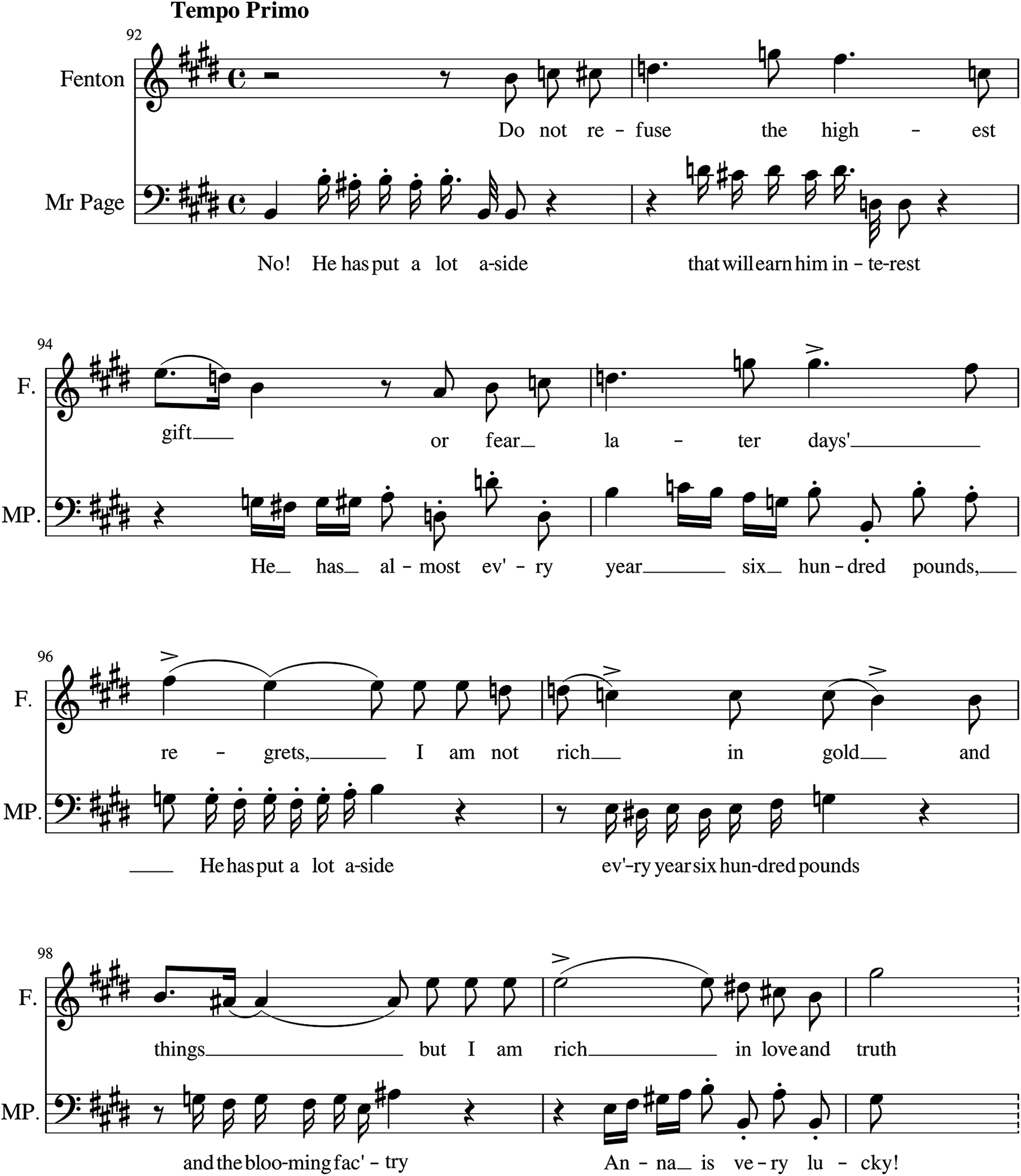
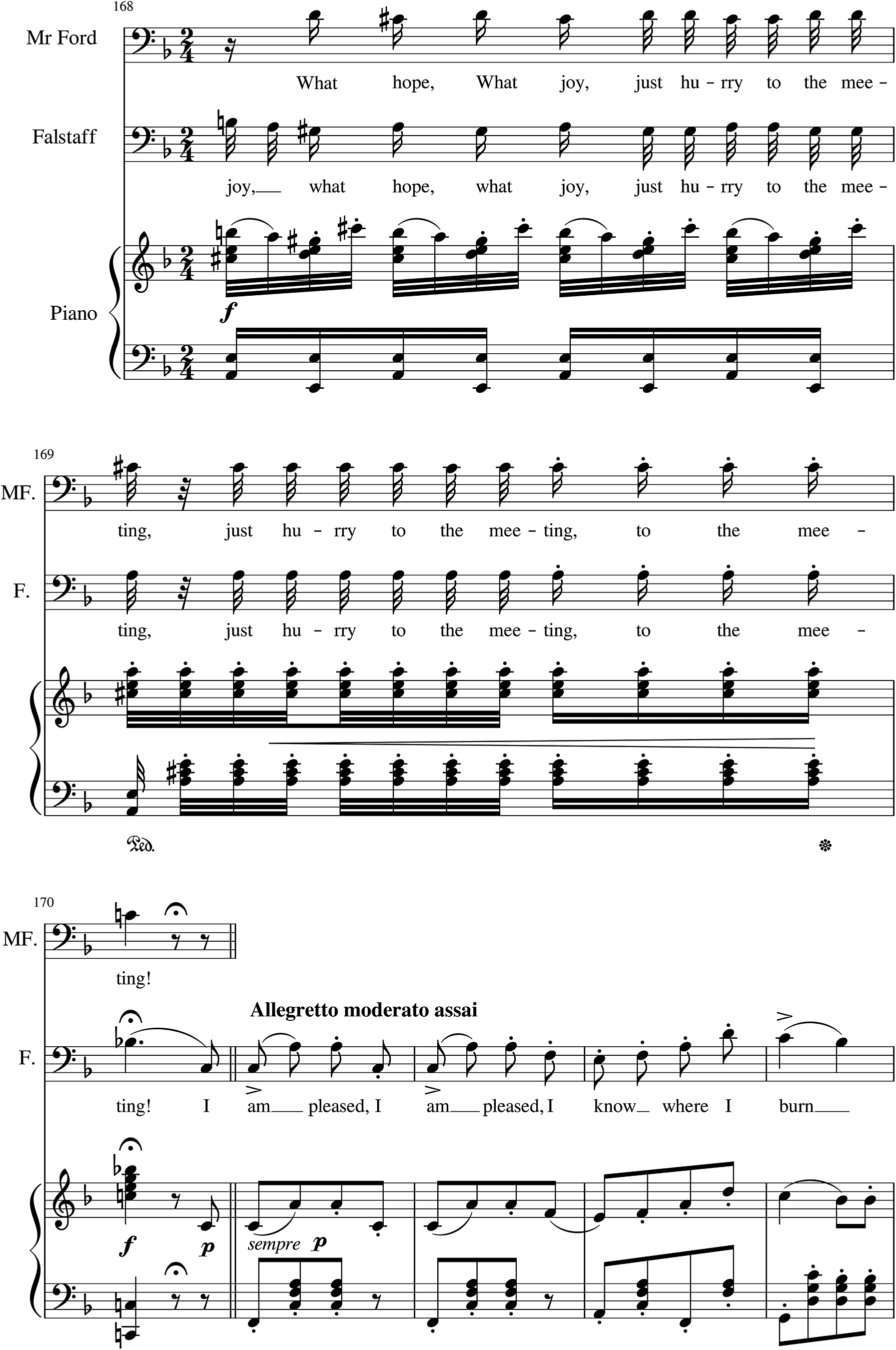
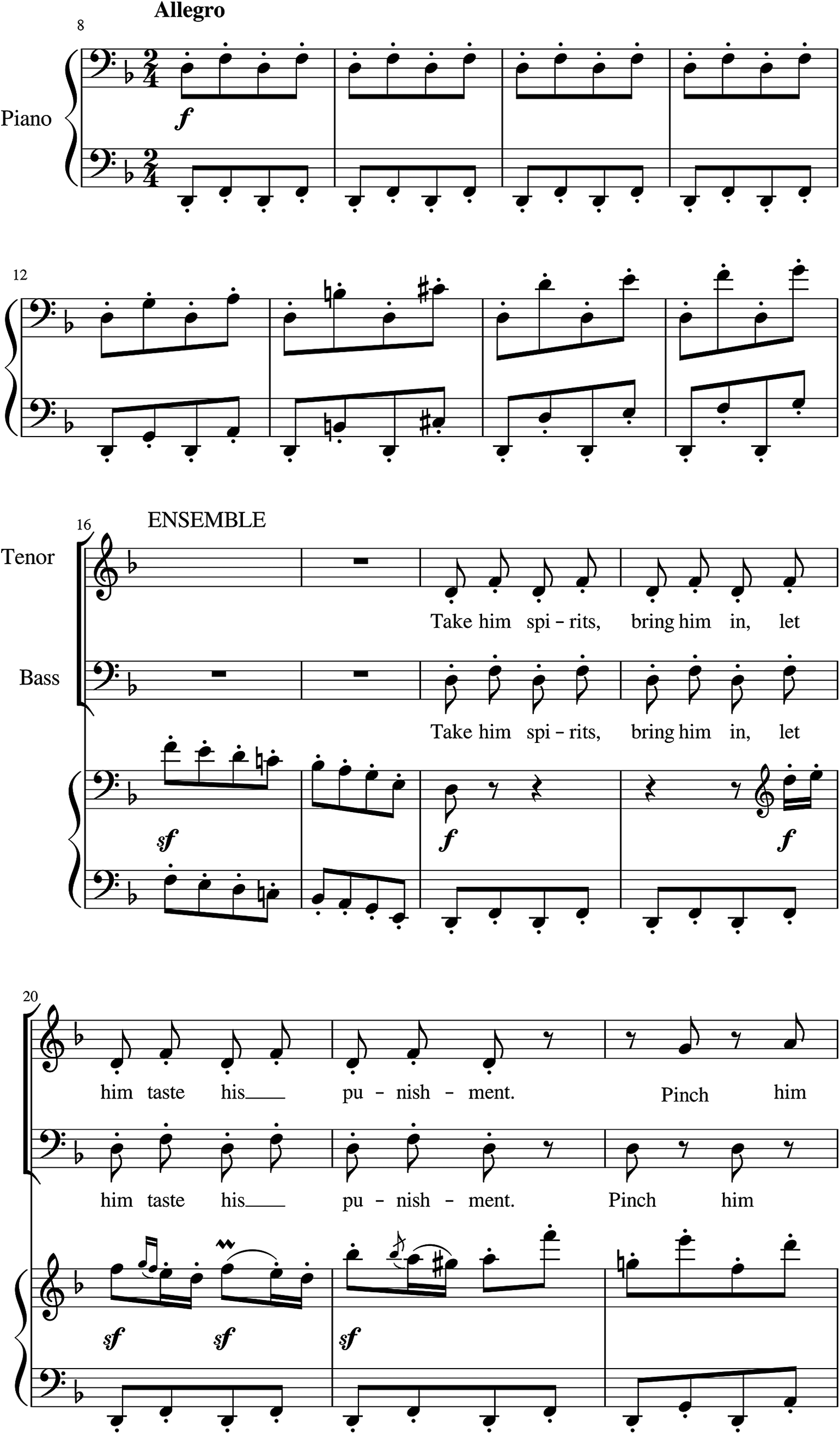

 Open access

