Paediatric cardiac intervention now includes complex catheter-based and hybrid procedures requiring advanced imaging guidance. Unlike adult structural heart disease, interventional paediatric echocardiography lacks clearly defined roles and training standards. Reference Little, Rigolin and Garcia-Sayan1–Reference Callahan, McGovern and Nageotte3 Interventional paediatric echocardiography requires expertise in congenital anatomy, size-adapted imaging, real-time procedural guidance, and multimodality collaboration. Although current ACC/AHA/ASE documents address interventional echocardiography and acknowledge added complexity in CHD, they do not establish a paediatric-specific training pathway, competency standards, or sustainable practice models for interventional paediatric echocardiography. Reference Wiegers, Ryan and Arrighi4
The case for a paediatric-specific discipline
CHD presents imaging challenges fundamentally different from adult structural heart disease. CHD anatomy is highly variable, and procedures span a heterogeneous repertoire—from septal defect closure to hybrid procedures—and imaging workflow cannot be standardised the way adult valve-based platforms allow. Reference Sachdeva, Armstrong and Arnaout5 Patient size dictates probe selection: micro-transesophageal echocardiography is feasible in patients as small as 2.5 kg; 3D paediatric transesophageal echocardiography from approximately 5 kg, while intracardiac echocardiography remains limited by 8–10F sheath requirements. Reference Sachdeva, Armstrong and Arnaout5,Reference Holzer, Bergersen and Thomson6 Echocardiographic guidance also serves as an active radiation reduction strategy; 3D transesophageal echocardiography-guided atrial septal defect closure has demonstrated significantly reduced fluoroscopy and radiation dose compared with standard fluoroscopic guidance. Reference Sachdeva, Armstrong and Arnaout5
Training and competency frameworks
Current paediatric cardiology training lacks a dedicated pathway for interventional paediatric echocardiography. Existing paediatric imaging and transesophageal echocardiography guidelines define foundational competencies but do not establish interventional paediatric echocardiography-specific training standards. Reference Puchalski, Lui and Miller-Hance8,Reference Sanders, Colan and Cordes9 Adult guidelines recommend at least 75 echocardiography-guided procedures for advanced competency, but these benchmarks are not tailored to the lower procedural volumes, greater heterogeneity, and unique complexity of congenital interventions. Reference Wiegers, Ryan and Arrighi4
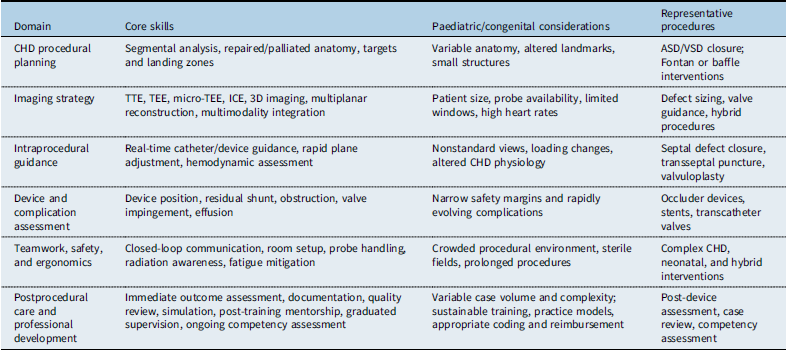
Interventional paediatric echocardiography training should therefore use a paediatric-specific, competency-based framework, incorporating simulation, supervised procedural guidance, progressive entrustment, and longitudinal assessment (Figure 1). Training should address image acquisition, procedural guidance, multimodality integration, communication, complication recognition, and procedural judgement. Operator ergonomics and safety should be incorporated, including room setup, positioning, fatigue mitigation, radiation protection, and closed-loop communication in the crowded catheterisation and hybrid procedural environment (Table 1).
Proposed competency-based training pathway for interventional paediatric echocardiography (IPE). Training progresses from core paediatric echocardiography and TEE competency to IPE-specific education through simulation, supervised procedural guidance, and independent practice. Longitudinal competency assessment incorporates procedural experience, case complexity, direct observation, and multisource feedback. Adult interventional echocardiography volume benchmarks are shown for reference; paediatric-specific thresholds remain to be defined. CHD = congenital heart disease; EPA = entrustable professional activity; IE = interventional echocardiography; IPE = interventional paediatric echocardiography; TEE = transesophageal echocardiography; TTE = transthoracic echocardiography.

Core domains for interventional paediatric echocardiography (IPE)

Table 1. Long description
A table with six rows and four columns detailing core domains for interventional paediatric echocardiography. The columns are labeled Domain, Core skills, Paediatric/congenital considerations, and Representative procedures. Row 1: CHD procedural planning, Segmental analysis, repaired/palliated anatomy, targets and landing zones, Variable anatomy, altered landmarks, small structures, ASD/VSD closure; Fontan or baffle interventions. Row 2: Imaging strategy, TTE, TEE, micro-TEE, ICE, 3D imaging, multiplanar reconstruction, multimodality integration, Patient size, probe availability, limited windows, high heart rates, Defect sizing, valve guidance, hybrid procedures. Row 3: Intraprocedural guidance, Real-time catheter/device guidance, rapid plane adjustment, hemodynamic assessment, Nonstandard views, loading changes, altered CHD physiology, Septal defect closure, transseptal puncture, valvuloplasty. Row 4: Device and complication assessment, Device position, residual shunt, obstruction, valve impingement, effusion, Narrow safety margins and rapidly evolving complications, Occluder devices, stents, transcatheter valves. Row 5: Teamwork, safety, and ergonomics, Closed-loop communication, room setup, probe handling, radiation awareness, fatigue mitigation, Crowded procedural environment, sterile fields, prolonged procedures, Complex CHD, neonatal, and hybrid interventions. Row 6: Postprocedural care and professional development, Immediate outcome assessment, documentation, quality review, simulation, post-training mentorship, graduated supervision, ongoing competency assessment, Variable case volume and complexity; sustainable training, practice models, appropriate coding and reimbursement, Post-device assessment, case review, competency assessment.
3D = three-dimensional; ASD = atrial septal defect; CHD = congenital heart disease; ICE = intracardiac echocardiography; TEE = transesophageal echocardiography; TTE = transthoracic echocardiography; VSD = ventricular septal defect.
Completion of an advanced imaging fellowship will not, in most cases, establish readiness for independent interventional paediatric echocardiography practice. Structured mentorship should continue after fellowship, with the mentor initially present in the catheterisation laboratory or operating room, followed by graduated supervision in which the mentor remains available for consultation. Progression should depend on directly observed performance across procedure types and levels of complexity, including communication and complication management. Paediatric-specific experience thresholds should be developed through multicentre assessment of these competencies and procedural exposure.
Sustainability and reimbursement
Sustainable interventional paediatric echocardiography requires practice models that recognise real-time imaging guidance as procedural work. Current reimbursement structures undervalue this contribution: interventional transesophageal echocardiography (CPT 93355) generates 4.66 wRVUs—a twofold increase over diagnostic transesophageal echocardiography (CPT 93312, ∼2.3 wRVUs)—yet may still undercompensate prolonged procedural imaging relative to the interventionalist’s credited work for comparable bedside time. Reference Hahn, Saric and Faletra2,Reference Little7,Reference Stark and Garris10,Reference Blankenship, Choi and Das11 For intracardiac echocardiography-guided procedures, the add-on code (+93662, 2.80 wRVUs) can only be billed by the interventionalist, leaving no reimbursement mechanism for the imaging physician. Reference Eleid, Chung and Daniels12
This mismatch has workforce implications. When a full day of interventional paediatric echocardiography supports one or two complex cases, conventional productivity models under-recognise the imager’s contribution, discouraging training investment and making it harder to recruit and retain interventional paediatric echocardiography expertise. Solutions include institutional credit for interventional imaging effort, revenue-sharing within congenital intervention programmes, and advocacy for coding reform. Existing expert consensus statements already endorse these approaches, which better reflect value beyond RVU-based productivity. Reference Eleid, Chung and Daniels12,Reference Nishimura, O’Gara and Bavaria13
Conclusion
Interventional paediatric echocardiography remains under-formalised despite its growing procedural role in CHD. The anatomic complexity of CHD, size-related technical challenges, radiation stewardship imperatives, and ergonomic demands of prolonged procedural imaging collectively argue for a paediatric-specific framework rather than an extension of adult interventional echocardiography models. Formal recognition of interventional paediatric echocardiography as a defined area of advanced paediatric imaging would standardise training, improve team communication, and promote sustainable models that value the echocardiographer as an essential procedural partner.
Financial support
None.