Introduction
Due to their superior mechanical and biological properties, rubber foam materials exhibit high elasticity, shock resistance, wear resistance, insulating properties, and physiological inertness [Reference Wu, Li and Feng1, Reference Zhang, Lu and Huang2, Reference Chen, Zhao, Luo, Lei and Li3]. Nowadays, rubber foam materials have been widely used in modern engineering, such as transportation, aerospace, and construction industries. For the purpose of modification, rubber foam materials are usually exposed to high-energy radiation such as Gamma radiation [Reference Suzana, Vojislav, Milena, Jaroslava and Gordana4]. Ashok et al. (2017) noted that the influence of the Gamma radiation affects polymers in two ways. One is chain scission which results in reduced tensile strength and elongation at break. The other is crosslinking which increases tensile strength but reduces the elongation at break [Reference Ashok, Balachandran, Lawrence and Sebastian5]. Many researchers conclude that the Gamma radiation could strongly affect the mechanical properties of rubber materials, which accordingly affects the stability and reliability of the structures. Therefore, the investigations of the Gamma radiation effects on the mechanical properties of rubber materials become essentially important and necessary.
Literature review
The effects of radiation on mechanical properties of rubber or rubber-like materials, including viscosity, hardness, elongation at break, tensile strength, elastic modulus, and compression stress response, have been attracting many interests.
Hill et al. (1995) tested the mechanism of radiation vulcanization of natural rubber with 2-ethyl hexyl acrylate (2EHA) monomer. They noted that the viscosity of the natural rubber latex does not change with the radiation dose. However, the viscosity of the 5% 2EHA added latex increases with the radiation dose increasing [Reference Hill, Donnell, Perera, Pomery and Smetsers6].
The effects of radiation on hardness of rubber or rubber-like materials are very complicated. Abdel and Gwaily (1997) tested styrene-butadiene rubber/lead oxide composites under the Gamma radiation. As the radiation dose increases from 0 to 3000 kGy, the hardness of the samples increases acceleratingly [Reference Abdel-Aziz and Gwaily7]. Khalid et al. (2010) reported that as the radiation dose increases from 0 to 200 kGy, the nanohardness of the standard Malaysian rubber increases as well [Reference Khalid, Ismail, Ratnam, Faridah, Rashmi and Khatib8]. Liu et al. (2012) noted that the hardness of fluorosilicone rubber increases as the Gamma radiation increases from 0 to 300 kGy [Reference Liu, Zhou and Feng9]. After exposing acrylonitrile butadiene rubber (NBR) and ethylene-propylene diene monomer (EPDM) rubber to the Gamma radiation, Suzana et al. (2014) found that the hardness of two samples both increases as the dose increasing from 0 to 200 kGy [Reference Suzana, Vojislav, Milena, Jaroslava and Gordana4]. However, radiation does not always increase the hardness of rubber materials. Zeid (2007) found that the hardness of rubber blend of NBR and EPDM rubber (50/50) decreases as the radiation dose increases from 0 to 250 kGy [Reference Zeid10]. Milena et al. (2015) tested ethylene propylene diene terpolymer/chlorosulfonated polyethylene rubber blend reinforced with 50 phr of carbon black and cross-linked either with sulfur/tetramethylthiuram disulfide or dicumyl peroxide. They reported that as the Gamma radiation dose increases from 0 to 400 kGy, the hardness of the samples increases first and then decreases [Reference Milena, Gordana, Suzana, Jaroslava and Vojislav11]. Madhat et al. (2016) noted that the hardness of natural rubber reinforced with short carbon fibers almost keeps a constant when the dose increases from 0 to 40 kGy [Reference Medhat, Khaled and Anhar12].
Radiation can also strongly affect the tensile properties of rubber materials. Aliev (1999) tested the fluorosilicone rubber containing silica filler irradiated with Gamma rays. As the doses up to 0.5 MGy and the dose rates of 1.4 and 103 Gy/s are used, the rubber elongation at break decreases and the tensile strength increases as the dose increases [Reference Aliev13]. Abdel and Basfar (2000) noted that as the radiation dose increases from 20 to 200 kGy, EPDM rubber exhibits increasing of the tensile strength and decreasing of elongation at break [Reference Abdel-Aziz and Basfar14]. The tests of NBR/EPDM blend by Zeid (2007) show that as the radiation dose increases from 0 to 250 kGy, the tensile strength first increases and then decreases, and the tensile modulus at 100% elongation always increases [Reference Zeid10]. Khalid et al. reported that the tensile strength of the standard Malaysian rubber increases as the radiation dose increasing from 0 to 200 kGy [Reference Khalid, Ismail, Ratnam, Faridah, Rashmi and Khatib8]. Scagliusi et al. (2012) tested the chlorobutyl rubber and found that the tensile strength and elongation at break of the rubber show deep loss properties at doses up to 25 kGy and a stale behavior over up to 200 kGy. The work by Scagliusi et al. (2012) shows that the tensile strength and elongation at break of the fluorosilicone rubber decrease as the Gamma radiation dose increases from 0 to 300 kGy [Reference Scagliusi, Cardoso and Lugao15]. Suzana et al. (2014) noted that as the radiation dose increases, the elongation at break of NBR and EPDM rubber decreases obviously, while the change of the tensile strength is very small [Reference Suzana, Vojislav, Milena, Jaroslava and Gordana4]. As the irradiation dose increasing from 0 to 400 kGy, Milena et al. (2015) found that the rubber materials exhibit decreasing of the tensile strength, and decreasing first and then increasing of the elongation at break retention [Reference Milena, Gordana, Suzana, Jaroslava and Vojislav11]. Medhat et al. (2016) studied the vulcanized natural rubber/carbon fiber composites [Reference Medhat, Khaled and Anhar12]. As the dose increases from 0 to 40 kGy, the tensile strength and the elongation at break of the samples both first increase and then decrease. Cao et al. (2017) investigated the polymethylvinylphenylsiloxane rubbers, which was exposed to a maximum dose of 200 kGy under the condition of 90 °C. The testing data show that elongation at break decreases as the dose increases [Reference Cao, Ao, Chen, Peng, Huang, Li and Zhai16].
The elastic property of rubber materials could also be affected by radiation. Scagliusi et al. (2012) exposed the chlorobutyl rubber to the Gamma radiation. They found that the elastic modulus of the rubber decreases as the dose increases [Reference Scagliusi, Cardoso and Lugao15]. After increasing the radiation, dose increases from 0 to 400 kGy, and Milena et al. (2015) noted that the modulus retention of the rubber material first decreases and then increases [Reference Milena, Gordana, Suzana, Jaroslava and Vojislav11]. Medhat et al. (2016) tested the vulcanized natural rubber/carbon fiber composites. As the dose increasing from 0 to 40 kGy, the modulus elasticity at 100% elongation of the composites keeps a constant [Reference Medhat, Khaled and Anhar12]. Cao et al. (2017) exposed the polymethylvinylphenylsiloxane rubbers to the dose of 200 kGy under the condition of 90 °C. They noted that the elastic modulus of the materials increases [Reference Cao, Ao, Chen, Peng, Huang, Li and Zhai16] after the radiation.
The Gamma radiation effects on the compressive stress response of the polydimethylsiloxane (PDMS) rubber foams were investigated by Sui et al. (2013). Under the different Gamma radiation conditions, the materials exhibit the nonlinear increase of the compressive stress response when the dose increases [Reference Sui, Liu, Zhong, Li, Wang and Ju17].
It can be concluded that almost all the open literature of the radiation effects on mechanical properties of rubber materials report experimental techniques and results. Even though there are a lot of testing data available, it is still quite impossible to understand the mechanism of how the radiation affects the mechanical behaviors of the rubber materials. In the present work, a modeling technique based on a multiscale method combined with finite element method is developed to investigate the effects of the Gamma radiation on the silicon rubber foams. To the best knowledge of authors, such work has not been seen in the open literature.
The structure of the present work is as follows. Section “Introduction” is Instruction. Literature review is given in section “Literature review”. Sections “Experiments and Simulation” are experiments and simulation, respectively. Conclusions and discussions are in the section “Conclusions and discussions”. The final section is Appendix.
Simulation
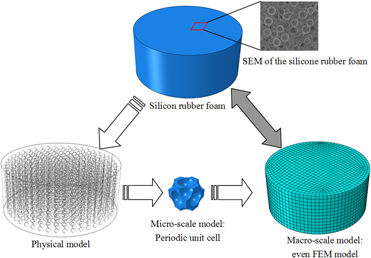
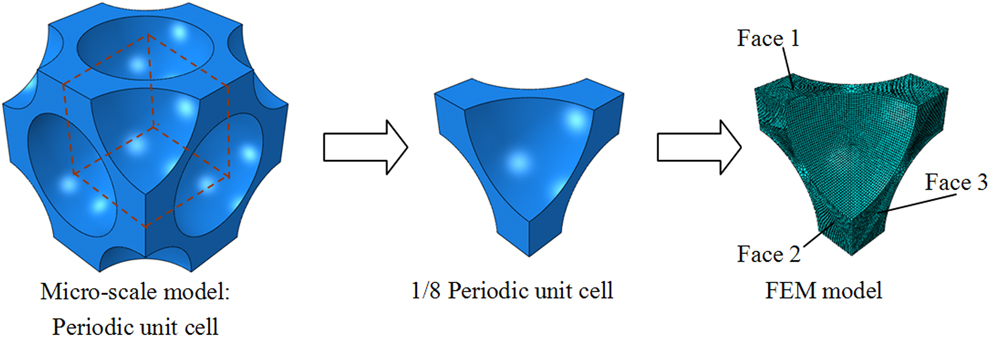
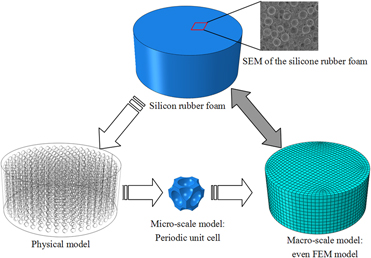
In the present studies, a multiscale method combined with finite element method is proposed to predict the effect of the Gamma radiation on the compressive stress responses of the silicon rubber foams. The illustration of the method is in Fig. 1. The scanning electron microscopy of the silicon rubber foam reveals that almost all the micropores are spherical and they are close to be evenly distributed. Based on this, the physical model is ideally setup as a cylinder where all the pores have the same diameter and are evenly distributed inside. Such physical model has periodic microstructures. Therefore, a periodic unit cell is constructed. Such unit cell is a cube where a semisphere is caved from the center of each surface, and 1/8 sphere is caved from each corner. Such unit cell structure has the porosity of 55%. Considering the microscale model and the applied boundary conditions are both symmetric, only 1/8 part of the unit cell model is simulated. In the Fig. 2, the three planes backward are applied with the symmetric boundary conditions. The three planes frontward (Face 1–Face 3) are applied with the periodic boundary conditions, i.e., they are kept as planes during deformation. The compressive response of the macroscale model is simulated after transferring the stress and strain relation of the microscale model. Finally, verification of the simulation results will be done by comparing with testing data.
Illustration of the method.

Finite element method model of the unit cell.

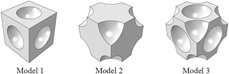
Unit cell models could possibly have different geometries. Such analysis is in Appendix. Considering three different geometries, the unit cell models are numerically analyzed. The results reveal that the unit cell in Fig. 1 is the best for the simulation results of macroscale model to coincide with the testing data. Therefore, all the simulation in the present work is based on Model 3. The details refer to Appendix.
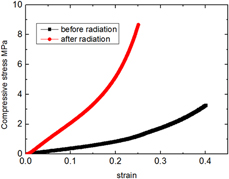
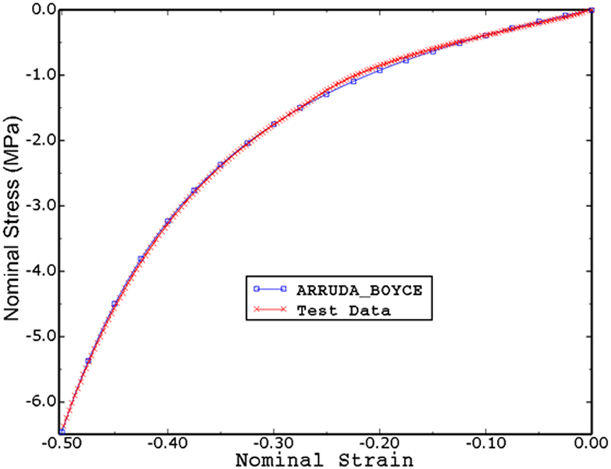
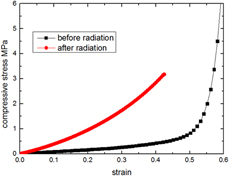
Based on the testing data of the silicon rubber before the Gamma radiation in Fig. 3, the phenomenological constitutive model is setup. Figure 4 shows that as the Arruda–Boyce strain energy function is chosen, the fitted curve agrees with the testing data very well, and the obtained hyperelastic behavior is stable under any strain condition. Therefore, the Arruda–Boyce strain energy function is used in the simulation.
The compressive stress of the silicon rubber.

Comparison between the fitted curve and the test data.

The material of the silicon rubber is assumed as an incompressible material in the present work. The form of the Arruda–Boyce strain energy potentials can be written as,
 $$\eqalign{{U = \mu \left[ {{1 \over 2}\left( {{{\bar{I}}_1} - 3} \right) + {1 \over {20\lambda _{\rm{m}}^{\rm{2}}}}\left( {\bar{I}_1^2 - 9} \right) + {{11} \over {1050\lambda _{\rm{m}}^{\rm{4}}}}\left( {\bar{I}_1^3 - 27} \right) \right}\right}\cr\left\left+ {{19} \over {7000\lambda _{\rm{m}}^{\rm{6}}}}\left( {\bar{I}_1^4 - 81} \right) + {{519} \over {673{\rm{,}}750\lambda _{\rm{m}}^{\rm{8}}}}\left( {\bar{I}_1^5 - 243} \right)} \bigg]\quad ,$$
where U is the strain energy per unit volume;  ${\bar{I}_1}$ is the first deviatoric strain invariant defined as,
 $${\bar{I}_1} = \bar{\lambda }_1^2 + \bar{\lambda }_2^2 + \bar{\lambda }_3^2\quad ,$$
where the deviatoric stretches  ${\bar{\lambda }_i} = {J^{ - {1 \over 3}}}{\lambda _i}$. The symbol of λi is the principal stretches. Shear modulus μ is related to initial shear modulus μ0 as,
 $${\mu _0} = \mu \left( {1 + {3 \over {5\lambda _{\rm{m}}^{\rm{2}}}} + {{99} \over {175\lambda _{\rm{m}}^{\rm{4}}}} + {{513} \over {875\lambda _{\rm{m}}^{\rm{6}}}} + {{42{\rm{,}}039} \over {67{\rm{,}}375\lambda _{\rm{m}}^{\rm{8}}}}} \right)\quad .$$
Analysis is based on the uniaxial testing data, and the obtained values of the parameters are μ = 0.5788, μ0 = 1.1556 and λm = 1.2099.
Similarly, van der Waals strain energy function is chosen for the simulation of the silicon rubber after the Gamma radiation.
After obtaining the phenomenological constitutive model for the rubber materials before and after the Gamma radiation, the quasistatic compression on the microscale model is then simulated. The results in Fig. 5 clearly show that the Gamma radiation strongly increases the hardness of the unit cell model, causing big difference of the compressive stress responses in the microscale model before and after the Gamma radiation.
The compressive stresses of the microscale model.

Analysis reveals that Arruda–Boyce strain energy function is the best to fit the stress responses of the unit cell model before the Gamma radiation, and van der Waals strain energy function is the best for the unit cell model after the Gamma radiation. So the chosen constitutive models for the macroscale model before and after the Gamma radiation are based on Arruda–Boyce strain energy function and van der Waals strain energy function, respectively. Based on this, the quasistatic compression on the macroscale model is then simulated, where the macroscale model has the diameter of 29.0 mm and the height of 12.5 mm.
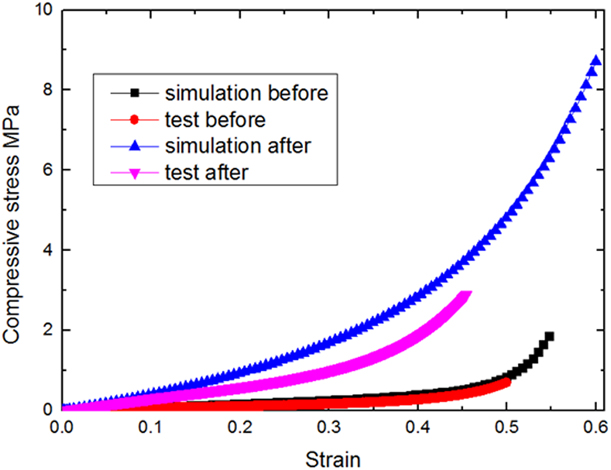
The obtained results are compared with the testing data in Fig. 6. It can be seen that the Gamma radiation obviously increases the compressive response of the macroscale model. The comparison reveals that good agreements between the testing and simulation data are achieved which verifies the simulation method proposed in the present work. The compressive stress of the macroscale model agrees with the testing data very well before the Gamma radiation. The differences between each other after the Gamma radiation become larger. One of the possible reasons is that the microstructures of the silicon rubber foams could be collapsed or deformed under the large Gamma radiation dose [Reference Chen, Liu, Huang and Wu18]. The simulation in the present work is based on the same unit-cell model before and after the Gamma radiation. The changes of the microstructures and the porosity of the silicon rubber foam are going to be considered in our future work.
The comparison of the testing and simulation results.

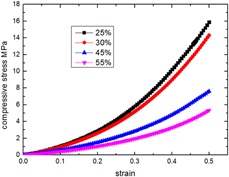
Utilizing the newly developed method, the compressive stress responses of the silicon rubber foams with different porosities after the Gamma radiation are predicted. Figure 7 shows that all the silicon rubber foams have hyperelastic behaviors, and the compressive stress increases as the porosity decreases. Similarly, the effects of different Gamma radiation on the silicon rubber foams can also be predicted.
Prediction of the compressive stresses of the rubber foams with different porosities.

Conclusions and discussions
In the present work, the effects of the Gamma radiation on the compressive stress response of the silicon rubber foams under the quasistatic condition are investigated experimentally and numerically. Testing data show that the Gamma radiation obviously increases the hardness of the silicon rubber and the silicon rubber foams. In the simulation work, a multiscale method combined with finite element method is proposed to investigate numerically the effects of the Gamma radiation on the silicon rubber foams. Simulation results show that the compressive stress of the macroscale model agrees with the testing data well before and after the Gamma radiation, which verifies the newly developed method. Such method proposed in the present work is also applicable to predict the compressive responses of rubber foams with different porosities or under different radiation doses, and is also applicable to predict the effects of radiation on the mechanical properties such as tensile strength, viscosity, and elastic modulus, etc., which could save a lot of designing and testing costs.
Experiments
Materials
In the present work, the silicon rubber is a copolymer of PDMSs and polydiphenylsiloxanes (PDPS), cross-linked by a vinyl monomer/vinyl-specific catalyst system. The percentages of monomer unit in the base rubber are 92.5 wt% PDMS, 7.0 wt% PDPS, and 0.5 wt% polymethylvinylsiloxane. The rubber is then filled by 35 phr of silica, and 6 phr of an ethoxy end-blocked siloxane as a processing aid by using a two-roll mill (SK-160, Shanghai Technical Research Institute of Light Industry Machinery, Shanghai, China) at room temperature. The samples of the rubber foam material are prepared with removable space holder such as prilled-urea which has the particle size between 0.3 and 0.4 mm. The mixture is cured in a stainless steel mold and compression-molded at 120 °C under the pressure of 8 MPa for 120 minus in a hot press rubber curing machine (Shanghai Technical Research Institute of Light Industry Machinery, China). The urea is subsequently washed out after curing then providing the porous structures. The geometry of silicon rubber foam samples prepared in the present work is of spherical, and they have the porosity of 55%. The average diameter of the pores inside is about 0.3 mm.
Gamma radiation
The samples of the silicon rubber and the silicon rubber foams are radiated by using a Cobalt-60 source (Institute of Nuclear Physics and Chemistry, China Academy of Engineering Physics, China). The total absorbed dose for each sample is 500 kGy, and the dose rate applied is 100 Gy/min. Radiations are performed at the condition of a room temperature of 20 °C.
Mechanical testing
Based on China criterion of GB/T 7757-2009/ISO 7743:2007 and HG/T 3843-2008, the samples of the silicon rubber and the silicon rubber foam are prepared as cylinder structures with the diameter of 29.0 mm and the height of 12.5 mm. The test machine has the compression platens made of high strength steel which is heat-treated to its maximum hardness. In order to reduce the friction between both ends of the sample and compressive platens of machine, or to avoid barreling, silicone lubricant high vacuum grease is used as the lubricant material during compression process. On Mechanical Testing & Simulation (MTS) axial compressive/tensile servo-hydraulic test machine, the tests are carried out with the strain rate of 10−3/s to meet the requirements of the quasistatic compression. All the tests are processed at the room temperature of 20 °C.
In the tests, three samples are quasistatically compressed before and after the Gamma radiation. Considering the samples of the silicon rubber are to be both compressed before and after the Gamma radiation, the applied nominal strain is controlled to be less than 40% before the Gamma radiation, in order to avoid unpredictable damaging to the rubber materials under large strain.
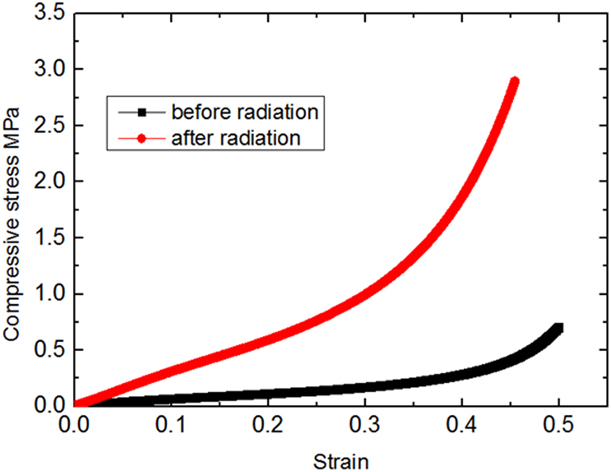
The corresponding data are averaged and plotted in Figs. 3 and 8. It can be clearly seen that the Gamma radiation strongly increases the hardness of the silicon rubber. As the nominal strain is 20%, the compressive stress of the rubber increases over 5 times after the Gamma radiation. Similarly, the Gamma radiation also increases the compressive stress of the silicon rubber foams. The testing data in Fig. 8 show that the compressive stresses also increase over 5 times after the Gamma radiation when the nominal strain is 20%.
The compressive stress of the silicon rubber foams.

It is worthy noticing that the silicon rubber and the silicon rubber foam both exhibit hyperelastic behaviors before and after the Gamma radiation, which guarantees that the hyperelastic constitutive models are applied for silicon rubber and silicon rubber foam in the simulation work.
Acknowledgments
The financial supports of NSAF (No. U1530259) for this work are greatly appreciated.
Appendix
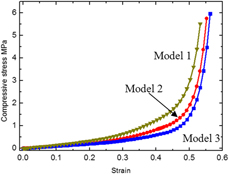
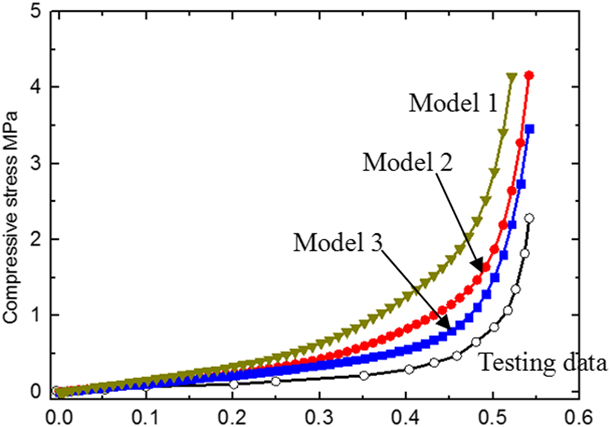
For the purpose of comparison, three different unit cell models are constructed based on the real porous structures, as seen in Fig. 9. The compressive stress responses of the micro- and macroscale models before the Gamma radiation are simulated and plotted in Figs. 10 and 11, respectively. It can be seen that results of Model 3 agree with the testing data the best. Therefore, Model 3 is chosen for the simulation in the present work.
Illustration of the microscale model in different geometries.

Comparison of compressive responses of the microscale models.

Comparison of compressive responses of the macroscale models.