INTRODUCTION
In recent decades, growing numbers of undocumented migrants around the world have motivated a new field of critical migration studies that focuses on examining the sociohistorical development of migrant “illegality” and its impact on migrant groups (Donato and Armenta Reference Donato and Armenta2011). In a seminal article, Nicholas De Genova (Reference De Genova2002, 429) describes migrant “illegalization” as the “legal production of migrant ‘illegality’,” which is produced not only by laws but also by nation-state rulers and agents, employers, and a diversity of social actors who produce knowledge about migrant “illegality” and, in doing so, enable and constrain the possibilities of migrant lives. From this perspective, scholars do not treat undocumented migration as a “problem to be solved” with more sanctions and restrictions. Rather, the goal is to question the purported aims of growing immigration controls and examine how they operate to exploit, segregate, and “illegalize” growing numbers of persons who live in exploitable and deportable conditions (De Genova and Peutz 2010). From a critical migration perspective, deportability refers to a sociopolitical condition that characterizes migrant “illegality” and functions to keep migrants living and working in the shadows of society. That is, it is because migrants are not deported but, rather, must live with the constant possibility of being deported that they build their lives clandestinely and refrain from claiming their rights. This article builds on this work to observe deportability as a psychosocial condition, which develops as migrants endure challenges and adapt their lives to contexts configured by their immigration status.
Beginning in the early 2000s, critical migration scholars introduced new concepts to help elaborate how immigration laws and policies constrained migrant lives and pressed them to live in vulnerable and deportable circumstances. For instance, Cecilia Menjívar (Reference Menjívar2006) introduced liminal legality to help expose the persistent precariousness that frames undocumented migrants’ uncertain legal positions and, thereafter, the notion of hyper awareness aimed to capture the continual thinking about the law and the operations of government that characterizes everyday experiences of deportability (Menjívar Reference Menjívar2011). Leisy Abrego’s (Reference Abrego2011) concept of legal consciousness in turn helps explain how experiences of migrant “illegality” involve a continual sense of the law, which can take varying forms based on migrants’ contexts of socialization and reception, memories of migration journeys, and the responsibility they take for their migration.
More recently, a “second wave” of critical migration studies has begun to explore variations in migrants’ lived experiences and the ways in which these are configured by varied social, institutional, legal, and political contexts (Ruszczyk and Barbosa Reference Ruszczyk2017, 452). As Menjívar and Daniel Kanstroom (Reference Menjívar and Daniel2014, 7) maintain in their volume, experiences of migrant “illegality” are not “homogenous, static, and undifferentiated” but, instead, take multiple forms, carry different intensities, develop at different life stages, and take shape in unique historical and geographic spaces. Within the United States, a visible cohort of 1.5-generation migrants (that is, those individuals who arrived in the United States as children and subsequently grew up there) has brought attention to generational differences in experiences of migrant “illegality” (Yoshikawa, Suárez-Orozco, and Gonzales Reference Yoshikawa, Carola and Gonzales2017). Unlike their adult counterparts, undocumented children are socialized into US society at early ages and through school rather than work. As such, they are taught to become members of American society, speak fluently in English, and come to experience their status situations more in terms of stigma than fears of deportation (Abrego Reference Abrego2011). Further, research with undocumented students highlights this group’s blocked pathways to higher education and their corresponding struggles and strategies to pursue their academic and professional aspirations (Enriquez Reference Enriquez2011; Negrón-Gonzales Reference Negrón-Gonzales2017). With the implementation of the Deferred Action for Childhood Arrivals (DACA) program in June 2012, as well as subsequent terminations and reinstatements of this policy, researchers have also traced the mixed impact of shifting policy contexts on DACA recipients and undocumented immigrants more generally (Gonzales, Terriquez, and Ruszczyk Reference Gonzales, Veronica and Ruszczyk2014; Ellis, Gonzales, and Rendón Garcia Reference Ellis, Gonzales and Sarah2018; Patler and Pirtle Reference Patler2018).
Scholars have also examined how experiences of migrant “illegality” can differ based on migrants’ geographical locations, such as their proximity to the US-Mexico border (Talavera, Núñez-Mchiri, and Heyman Reference Talavera, Guillermina Gina, Josiah, De Genova and Peutz2010), their living in new versus established immigrant communities (Dreby Reference Dreby, Menjívar and Kanstroom2014), and the intersections of state and institutional policies that shape their opportunities for social integration (Enriquez et al. Reference Enriquez, Martha Morales, Daniel and Daisy2019). There is also research on the ways migrants’ racial and ethnic backgrounds impact their experiences of “illegality” (Ko and Perreira Reference Ko and Perreira2010; Patler Reference Patler2018). For instance, Tracy Buenavista’s (Reference Buenavista and Russel2013, 2018) work highlights how Asian undocumented youth navigate different social expectations and “model minority” stereotypes in the United States that make for different experiences than are known to characterize Latinx immigrants. Tanya Golash-Boza and Pierrette Hondagneu-Sotelo (Reference Golash-Boza and Pierrette2013, 271) in turn reveal how Latin American and Caribbean men have become central targets of recent deportation practices in the United States, contributing to “a gendered and racial removal project of the state.” Outside of the US context, international studies of migrant “illegality” and deportability have further revealed the ways in which national laws and policies, immigration discourses, and sociopolitical climates fuel unequal migration conditions, carrying different effects for variably positioned migrant groups (see, for example, Nijhawan Reference Nijhawan2005; De Genova and Peutz 2010; Larchanché 2012; Reeves Reference Reeves2015).
Yet, just as critical migration scholars highlight the diverse and complex nature of migrants’ experiences, the psychology of migrant “illegality” and deportability remains under-theorized, as we lack a general understanding of how conditions of deportability shape and are shaped by migrants’ psychosocial lives. To date studies of migrant “illegality” have been led primarily by sociologists, anthropologists, and legal scholars who tend not to rely on psychological concepts to explain their research findings. Indeed, critical migration scholars as a whole seek to avoid examining essentialized features of “undocumented persons” to instead emphasize contextual, historical, political, and other social factors that shape migrants’ lives. However, just as these approaches help shift the responsibility for migrant “illegality” away from individual migrants, the continued emphasis on social determinants has drawn less attention to theorizing migrant agency (Bloch and Chimienti Reference Bloch and Milena2011). Accordingly, we know much less about how migrants make sense of their conditions and transform their circumstances to meet their aims. Moreover, given the recent turn toward variations in migrant experiences, it remains unclear what, if any, common psychosocial dynamics constitute migrant “illegality” across contexts and groups. Although it is clear that migrants’ experiences are inherently tied to their unique social determinants, insofar as migrant “illegalization” comprises a discernable sociopolitical process and deportability is the resulting sociopolitical condition that characterizes migrant “illegality” (De Genova Reference De Genova2002), it is meaningful to ask: what kind of psychic life is possible within conditions of deportability?
Psychological studies of undocumented immigrants reveal a number of common stressors and concerns that characterize their experiences, including fears of deportation, mistrust and vigilance toward authorities, feelings of shame and stigma, experiences and perceptions of discrimination, worries about education and work opportunities, fears about accessing health care and social services, repeated reminders of being undocumented, and perpetual feelings of uncertainty about the future (Presidential Task Force on Immigration 2012; Gonzales, Suárez-Orozco, and Dedios-Sanguineti Reference Gonzales, Carola and Maria2013; Yoshikawa, Suárez-Orozco, and Gonzales Reference Yoshikawa, Carola and Gonzales2017; Torres et al. Reference Torres, Catherine DeCarlo, Walts and Richards2018; Rayburn, McWey, and Gonzales-Backen Reference Rayburn, McWey and Gonzales-Backen2021). As a whole, this research has extensively highlighted the adverse effects of undocumented status and, correspondingly, the urgent need for immigration reforms and other social supports. At the same time, a growing number of scholars have taken strengths-based approaches to trace undocumented migrants’ modes of agency and capacities for coping and resilience (Contreras Reference Contreras2009; Negron-Gonzales Reference Negrón-Gonzales2014; Suárez-Orozco et al. Reference Suárez-Orozco, Motti-Stefanidi, Amy and Dalal2018). For instance, despite various risk factors, undocumented students overcome academic challenges and reach their personal goals by seeking support from trustworthy peers, teachers, and family members (Enriquez Reference Enriquez2011; Perez et al. Reference Perez, Roberta, Karina, Coronado and Richard2009); developing individual and family-level coping strategies (Kam, Pérez Torres, and Steuber Fazio Reference Kam, Debora Pérez and Keli2018); engaging civically (Borjian Reference Borjian2018); and maintaining hope and optimism for the future (Gonzales 2016). Rachel Goodman and colleagues (Reference Goodman, Vesely, Bethany and Cleaveland2017) in turn show how undocumented and refugee immigrant women facing multiple forms of trauma as well as structural and situational stressors have developed resilience and coping strategies through interpersonal supports (for example, building relations with supportive others, accessing social services) and internal processes (for example, reframing their lives in more positive terms). Still others have traced how undocumented immigrants collectively transform their social and geographic spaces and build spaces of belonging and sanctuary in the face of otherwise hostile immigration contexts (Hondagneu-Sotelo and Ruiz Reference Hondagneu-Sotelo, Jose, Menjívar and Kanstroom2013). Finally, research on immigrant activism has traced undocumented immigrants’ claims-making efforts and capacities for generating social and structural change (Nyers Reference Nyers, De Genova and Peutz2010; Abrego Reference Abrego2011; Negron-Gonzales Reference Negrón-Gonzales2014).
Given the complex dynamics that characterize undocumented migrant lives, conceptual work is needed to theorize how migrant “illegality” both constrains their everyday realities and enables unique forms of agency in the face of challenging conditions. In this article, I draw upon comparative, ethnographic research with migrants from Canada and the United States to develop a psychological theory of migrant “illegality” that can help explain how conditions of deportability shape, and are shaped by, migrants’ psychosocial lives. My research perspective is rooted in the tradition of critical psychology, which shares with critical migration studies the aim to challenge individualist epistemologies in order to observe human experience and development as socially generated processes, emerging in diverse sociocultural and political contexts.
Although critical psychology does not constitute a single discipline, in his review of the field, Thomas Teo (Reference Teo2015, 245) explains: “What unites all critical psychologists is an understanding of society based on intersectionalized societal power differentials with consequences for human subjectivity in the conduct of one’s life.” From here, critical psychologists draw upon sociocultural approaches in psychology as well as more recent critical and ideological theories to examine “the competencies and performances as well as the possibilities of a concrete individual’s mental life, from the first-person standpoint, in the conduct of everyday life” (246). This includes examining how dominant systems of power unequally organize persons’ intra- and inter-psychological processes and, conversely, how persons make sense of their social realities and deploy their agency to achieve their distinct aims (Blackman et al. Reference Blackman, John, Derek, Dimitris and Valerie2008; Kirschner and Martin Reference Kirschner, Martin, Suzanne and Martin2010).
From a critical psychological perspective, then, my work explores the psychosocial dynamics of migrant “illegality” from the standpoint of migrants who live and build their lives within conditions of deportability. Specifically, I compare the experiences of two different groups—1.5-generation undocumented youth in Chicago and first-generation Polish undocumented migrants in Toronto—to better understand what common psychosocial dynamics constituted their lives and, on this basis, outline a theoretical understanding of how migrant “illegality” operates at the psychological level. As I elaborate below, contexts of migrant “illegality” in Canada and the United States differ in major ways due to the two countries’ varying histories of immigration policies, geographical locations, and demographics. Accordingly, my study shows how undocumented migrants in these countries have experienced different challenges and opportunities, which further depend on their unique social positions, life stages, ethnic and racial backgrounds, and other factors. Yet, notwithstanding these important differences, I also show how undocumented migrants in both countries have endured similar psychosocial patterns marked by repeated exposures to status-related events, acute and chronic fears and concerns, as well as the development of creative agencies and coping strategies. I theorize these common patterns as cycles of deportability and show how they can provide a basic framework for understanding the psychosocial development of migrant “illegality” across contexts and groups. Thereafter, I trace how differences in my respondents’ national settings and immigrant generations have shaped their cycles of deportability, including the frequencies of status-related stressors, forms of creative agency, and types of coping strategies required to address their concerns. In so doing, I show how cycles of deportability can serve as a framework to help explain how social contexts and individual-level factors intersect to produce unique psychosocial dynamics and trajectories of migrant “illegality.”
MIGRANT “ILLEGALIZATION” IN CANADA AND THE UNITED STATES
In many respects, Canada and the United States share parallel immigration histories, as both were driven by efforts to establish racially White nations (Ngai Reference Ngai2004; Guo and Wong Reference Guo, Lloyd, Guo and Wong2019). Specifically, both countries were founded by White European settlers who relied on scientific racism to create immigration policies that prioritized, first, White western European immigrants, and, second, eastern Europeans. It was not until the 1960s, largely due to the civil rights movements and rising international repudiation of scientific racism, that state agents in both countries gave up explicitly racist clauses and developed new laws and regulations—that is, the US Immigration and Nationality Act (1965) and the Canadian Norms for Assessment points scheme (1967)—that instead focused on labor market needs, family reunification, and, eventually, humanitarian concerns.Footnote 1
While the entry of liberalized policies opened doors to new waves of immigrants from Asia, Africa, and South America who would significantly transform the ethnic landscapes of each country, the policies also introduced new criteria that prioritized high skilled immigrants (with specialized skills, language fluency, and other economic and social capital). As a result, both countries employed “race-blind” arguments that continued to perpetuate unique racial stratifications of immigrant groups and, correspondingly, unique contexts of migrant “illegalization.” In the United States, migrant “illegalization” has historically functioned to regulate and “racialize” large numbers of primarily Mexican migrants who circulated the US southern states in large numbers as seasonal agricultural workers (De Genova 2014). With the implementation of the Immigration and Nationality Act in 1965, however, countries from the Western Hemisphere were ascribed annual quotas for the first time in US history, which then carried disproportionate effects on Mexican migrants. With limited legal migration routes to meet persisting needs for low-skilled labor in the United States, the vast majority of Mexican migrants had no choice but to rely on illegal migrant routes, contributing to growing numbers of primarily Mexican undocumented migrants (De Genova 2014).
In 1986, the sizeable presence of Mexican migrants motivated the Immigration Reform and Control Act, which significantly enhanced security at the US-Mexico border and introduced sanctions against employers who knowingly hired laborers who held undocumented legal status.Footnote 2 Ironically, however, by failing to expand migration options for low-skilled workers, the Act ultimately led to a surge of undocumented immigrants in the 1990s and 2000s who, no longer able to circulate seasonally, remained in the country and brought their families with them (Chishti, Meissner, and Bergeron Reference Chishti, Doris and Claire2011). Since then, large numbers of primarily Mexican undocumented immigrants have continued to fuel increasingly restrictive immigration policies in the United States and anti-immigrant public discourses that have focused on protecting the US-Mexico border and deporting primarily Latin American migrants (L. Chavez Reference Chavez2008).
In contrast, Canada lacks a comparable history of migration at its southern border, and, given its lack of neighboring countries outside of the United States, a relatively affluent country, Canada has not experienced large numbers of undocumented immigrants over the course of its history (Bou-Zeid Reference Bou-Zeid2009). Accordingly, the issue has rarely surfaced as a public concern, and immigration policies have not focused on the explicit management of undocumented immigrants. It was not until June 2012, with the arrival of migrant boats to Canada’s shores, that the term “irregular arrivals” was incorporated into Canadian immigration policy for the first time (Ellis Reference Ellis2015). Given the limited interest in undocumented migrants in Canada, there have also been no large-scale systematic studies of this population, which has left their estimated numbers, ethnic and racial backgrounds, age distribution, and other characteristics unclear. Government estimates of “irregular” migrants have ranged from eighty thousand to five hundred thousand (Tilson Reference Tilson2009), with the vast majority of persons believed to be living in large city centers, especially Toronto and Montreal (Lakoff Reference Lakoff2013). A small but growing body of research has pointed to the adverse impacts of increasingly restrictive immigration policies on various immigrant groups in Canada (Magalhaes, Carrasco, and Gastaldo Reference Magalhaes, Christine and Denise2010; Preibisch and Hennebry Reference Preibisch and Jenna2011; Goldring and Landolt Reference Goldring and Patricia2013; Villegas Reference Villegas2015; Soberano, Ackerman, and Solorzano Reference Soberano, Philip, Rosa and Jennifer2018; Atak Reference Atak2018). Luin Goldring, Carolina Berinstein, and Judith Bernhard (Reference Goldring, Carolina and Bernhard2009) in turn argue that these restrictions contribute to growing numbers of migrants with “precarious legal statuses,” which include both documented and undocumented forms of migrant “illegality,” as most undocumented migrants in Canada are believed to arrive through legal channels and, thereafter, overstay their visas.
Attention to unauthorized migrants has also risen among Canadian advocacy groups who have pressed local politicians to recognize migrant rights as well as implement sanctuary policies aimed at giving migrants access to city services regardless of their immigration status (Canadian Labour Congress 2017). However, due to limited awareness of the rights and needs of undocumented immigrant rights, sanctuary policies have been difficult to implement (Solidarity City Network 2013). Moreover, at the national level, although all citizen children of unauthorized immigrants in Canada are legally entitled to health care, the children of irregular migrants are regularly denied access (Caulford and Vali Reference Caulford and Yasmin2006). Similarly, whereas Ontario’s 1990 Education Act has for decades granted access to public education to all children regardless of immigration status, education workers continue to request valid immigration documents and deny children access on this basis (Ellis and Stam Reference Ellis and Stam2017a).Footnote 3
In contrast, in the United States, there are an estimated 2.1 million undocumented children and youth whose presence is not only well known to educators but, in recent years, has become a major political issue (Batalova and McHugh Reference Batalova and Margie2010). Since 1982, all children in the United States, regardless of status, are guaranteed access to education from kindergarten to grade 12.Footnote 4 Moreover, given the growing visibility and activism among undocumented students since 2001, Congress has made repeated attempts to pass various versions of the Development, Relief, and Education, for Alien Minors Act (DREAM Act), which has aimed to provide eligible undocumented youth who arrived in the country as children a path to citizenship. When the Act came close to passing but failed in 2010, the Obama administration implemented the Deferred Action for Childhood Arrivals (DACA) policy (US Department of Homeland Security 2012). To date, the DACA program has played a major role in the lives of undocumented youth who, as a result of their status, have experienced relief from deportation fears, have increased agency to pursue their career and educational aspirations, and have grown more integrated into US society (Ellis, Gonzales, and Rendón Garcia Reference Ellis, Gonzales and Sarah2018; Gonzales et al. Reference Gonzales, Ellis, Sarah Rendón and Kristina2018). However, due to the limited and temporary nature of the policy, DACA recipients have continued to face multiple barriers, and as the policy itself has been rescinded and reinstated in different forms during the Trump administration, the future of undocumented youth and their opportunities for citizenship remain unclear. In the meantime, debates over immigration continue to occupy US politics (Uhrmacher, Schaul, and Scherer Reference Uhrmacher, Kevin and Michael2020).
Given variations in historical, geographical, and sociopolitical factors, Canada and the United States offered my respondents distinct contexts of migrant “illegalization” for building their lives. Moreover, as my research explored two different groups—that is, adult Polish migrants in Canada and ethnically diverse 1.5-generation migrants in the United States—their migration journeys and motives also varied. In what follows, I introduce my research by providing more details about the two local contexts within which I conducted my observations as well as the unique characteristics of my respondents in each setting. Thereafter, I discuss my findings: first, to show how both groups of respondents developed comparable psychosocial dynamics to face the challenges of migrant “illegality’ and deportability and, second, to explore variability in these dynamics based on national context and immigration generation.
COMPARATIVE RESEARCH STUDIES
Toronto Study (2012–14)
Immigration Context
Toronto comprises Canada’s largest metropolis with an estimated 2.7 million residents (Statistics Canada 2016). While there are no clear estimates of unauthorized migrants in Toronto, the city receives the most immigrants among Canadian cities each year (El-Assal Reference El-Assal2020). Toronto’s ethnic distribution includes not only residents of primarily European (1.29 million) and Asian (1.08 million) backgrounds but also large groups of residents of Caribbean (165,735), Latin American (113,815), and African (146,870) descents (Statistics Canada 2016). Over the years, the diversity of immigrants in Toronto has contributed to a multiplicity of ethnic neighborhoods that make up the city’s topography, providing supportive cultural and socioeconomic contexts within which newcomers can readily find work and build their lives among co-ethnics.
The Polish Canadian enclave in Toronto is the largest in Canada, with over two hundred thousand Poles in the Toronto area who have historically migrated to “Little Poland” in the city center (Statistics Canada 2011) and, thereafter, moved increasingly westward and into the neighboring city of Mississauga (Pula and Jaroszynska-Kirchmann Reference Pula and Jaroszynska-Kirchmann2011). Given their long-standing history of migration, Polish migrants work in various sectors of the Canadian economy, and one can find across both Toronto and Mississauga numerous Polish delis, restaurants, travel companies, sports organizations, cultural centers, churches, and other Polish cultural organizations and businesses where employees readily speak in Polish and serve Polish clients.
Study Participants and Methodology
I began my research with Polish migrants in Toronto since I was already familiar with the Polish community there, having grown up in Toronto as the child of Polish immigrants. Accordingly, I was also able to leverage my contacts to recruit sixteen first-generation, unauthorized Polish migrants who participated in ethnographic observations and interviews between 2012 and 2014 (nine women, seven men; age range = twenty-one to sixty-three). All my respondents migrated to Canada in the mid- to late 2000s with the help of family members and/or friends in Canada who encouraged them to visit and explore their life opportunities there. Because Polish migrants could travel to Canada legally for six months without having to acquire a visa, all entered Canada legally either as tourists or temporary workers, after which they overstayed their permits and/or began working without authorization. To this end, all occupied “precarious legal statuses” that made them vulnerable to deportation (Goldring, Berinstein, and Bernhard Reference Goldring, Carolina and Bernhard2009). Most of my respondents arrived with no higher education or fluency in English. Moreover, as they arrived to stay with relatives and friends living in Polish Canadian communities, the latter aided them in securing their first jobs in low-skilled jobs in local Polish businesses, either by working for cash or by using social insurance numbers borrowed from their relatives. As these job opportunities were also gendered, nearly all the men in my study worked in Polish construction companies, whereas most women found lower-paying jobs in Polish delis, restaurants, and cleaning companies.
I employed critical ethnographic research methods to observe my respondents in the contexts of their everyday lives and explore how their immigration status shaped their material, social, and psychological lives (Madison Reference Madison2012). Long-term, primarily qualitative, highly participative, and detailed observations within the respondents’ contexts are necessary to produce intricate, actor-oriented descriptions of the symbolic modes through which they apprehend their lives. Accordingly, my research involved spending as much time as possible engaging in my respondents’ daily lives, participating with them in daily activities such as running errands, attending social events, and taking care of children. Although I recognized that my observations and interpretations of their lives were necessarily interpretative and partial, through detailed field notes and reflexive notes, I was able to identify common patterns in their psychosocial dynamics and ask questions about my impressions in the field. I also conducted in-depth interviews, which helped me acquire more reflective knowledge from my respondents about how they understood their lives and the impact of their immigration status on their ways of thinking and being in the world. I analyzed and published my Canadian data before moving to Chicago (see Ellis and Stam Reference Ellis and Stam2017a), where I was able to continue examining the psychological impact of migrant “illegality” from a comparative perspective.
Chicago Study (2015–17)
Immigration Context
With an estimated 2.7 million residents, a highly diverse population, and a topography made up of multiple ethnic communities (US Census Bureau 2020), Chicago shares many similarities with Toronto, which it has also claimed as its “sister city” since 1991 (Loving Reference Loving2016). However, with respect to their immigrant population, history of immigrant activism, and attention given to undocumented migrants in particular, the two cities differ in important ways. Illinois as a whole has been home historically to a large immigrant-origin population, with immigrants comprising an estimated 14.2 percent of the state’s population, of which 4 percent (approximately 511,000) have been estimated to hold undocumented status (Tsao and Paral Reference Tsao and Paral2014). Chicago is home to an estimated 183,000 undocumented immigrants (36 percent of Illinois’s undocumented immigrant population), with the vast majority from Mexico and Latin America. Approximately 9 percent of undocumented immigrants in Illinois are of Asian descent, and 5 percent are from European countries.
With a large number of undocumented immigrants, Chicago has a prominent history of immigrant rights activism, spearheaded primarily by Latin American activists who have led sanctuary and other national immigrant movements in the United States (Pallares and Flores-González Reference Pallares and Flores-González2010), including the recent undocumented youth movement (Nicholls Reference Nicholls2013). There is also a plethora of immigrant-servicing organizations, oriented to serve not only Spanish-speaking communities but also other immigrants. There is also a broad awareness of undocumented immigrants among health care practitioners, social workers, church members, and other groups who openly seek to support immigrant needs and advocate for their rights. Since 1986, immigrant advocacy in Chicago and the state has been largely coordinated by the Illinois Immigrant Rights Coalition, leading to important changes in state-level policies that have expanded immigrant services, increased voter registration, and defended immigrants against detention and deportation.
As my study took place between 2015 and 2017, I entered Chicago during the culmination of the 2016 presidential campaign and the subsequent election of the Trump administration. Accordingly, I observed major shifts in immigrant advocacy and immigrant community experiences as the country phased out of an allegedly “pro-immigrant” Obama administration—which, it should be noted, supported comprehensive immigration reforms but also raised deportation numbers to all-time highs (Budiman Reference Budiman2020)—and shifted into an overtly anti-immigrant administration that sought to criminalize undocumented immigrants, “build a wall” on the US-Mexican border, and further increase deportation numbers (Capps et al. Reference Capps, Muzaffar Chrishti, Julia, Jessica and Ruiz Soto2018).
Study Participants and Methodology
My work in Chicago focused on the experiences of ethnically diverse, 1.5-generation undocumented youth and young adults. Since I arrived in Chicago without any contacts, I began to conduct my study by volunteering my time with immigrant rights organizations, which then helped me establish myself in the immigration community and recruit participants for my study. Thus, in contrast to my studies in Canada, my research in Chicago began within the advocacy context there, and it was initiated with the help of immigrant community leaders and organizers who introduced me to initial respondents in the study. In total, I conducted intensive participant observations and in-depth interviews with nineteen participants, all of whom arrived in the United States as children (that is, before twelve years of age) (fifteen women, four men; age range = fifteen to thirty-three years). My respondents were of varying ethnic backgrounds, including eight Mexican, six Polish, two Pilipino, one Korean, one Brazilian, and one Venezuelan respondent, and most grew up in Chicago and/or neighboring areas. Having arrived as children, most had limited, if any, recollections of their migration journeys and reported not feeling responsible for their decisions to migrate. All grew up attending US schools and, as such, were fluent in English and had no strong foreign accents. Additionally, because Illinois state law has allowed undocumented students to access in-state tuition at colleges and universities since May 2003, all my respondents had either gone to college, were presently in college, or were planning on going to college in Illinois. Finally, most had DACA status at the time of the study, two women had recently acquired permanent residency after having had DACA in the past, and one had only recently learned about DACA and had not yet applied.
Comparative Analyses
The data from each context was first transcribed, coded, and analyzed separately for the purposes of other projects and publications before it was revisited comparatively for the purposes of this article (Ellis and Stam Reference Ellis and Stam2017a, 2017b; Ellis 2019). This preliminary work set the ground for the current study, as it helped me begin to identify common patterns in the experiences of my respondents in both settings, which I discuss below as “cycles of deportability.” Notably, I initially developed this concept in a co-authored publication that focused on the experiences of my adult respondents in Toronto (Ellis and Stam Reference Ellis and Stam2017a). However, as I conducted further research on the experiences of undocumented youth in the United States, including collaborative work on the impact of DACA (Ellis, Gonzales, and Rendón Garcia Reference Ellis, Gonzales and Sarah2018; Gonzales et al. Reference Gonzales, Ellis, Sarah Rendón and Kristina2018), I saw similar patterns in my respondents’ experiences in both countries, which led me to consider if and how cycles of deportability might serve as a more general psychological theory of migrant “illegality.” To explore this question, I conducted secondary, comparative analyses of both sets of my ethnographic data (from Canada and the United States), rereading my notes and interview transcriptions concurrently to discern (1) what psychosocial dynamics characterized the experiences of both groups and (2) how did these dynamics vary based on my respondents’ national and local contexts, social position factors, and other features. These analyses helped me revisit my early ideas to develop a more general understanding of the psychosocial development of migrant “illegality” as well as note key differences in my respondents’ experiences.
FINDINGS
My findings are organized in response to two basic questions. First, what common psychosocial dynamics characterized the lives of undocumented youth in the United States and undocumented adults in Canada? Here, I was interested in common patterns in my respondents’ thinking, feeling, and relating to others. Second, how did these dynamics differ based on my respondents’ national contexts, developmental stages, and other social position factors? In what follows, I answer the first question by drawing upon two case studies—one from Toronto and the other from Chicago—to show how my respondents in both settings developed similar psychosocial dynamics as they endured repeated exposures to status-related barriers and threats. I conceptualize these dynamics as cycles of deportability and illustrate how their key components contribute to the psychosocial development of migrant “illegality.” To answer the second question, I describe key differences in my respondents’ status-related experiences and perspectives, which help identify how cycles of deportability can take different forms based on various social and individual factors, including migrants’ national contexts and immigration generation.
Cycles of Deportability
Case Study 1: Agata in Toronto
Agata arrived from Poland on a tourist visa as a nineteen year old, shortly after completing high school. Her uncle had urged her to visit him in Canada and explore her possibilities there, suggesting that she may pursue college in Canada as well. Soon after she arrived, however, Agata realized that she could not afford international tuition fees and that to remain in Canada would require her to overstay her visa and work clandestinely in low-paying jobs until she could either save enough money to pay for international student fees or until she found a Canadian partner whom she could marry. While the prospect of indefinite challenges made for a difficult decision, Agata explained that because she could imagine a better future for herself in Canada, she chose to overstay her visa, signed up for English language classes, and used a family member’s social identification number to begin working at a Polish deli. Ultimately, she hoped to save money for school in Canada and eventually regularize her status.
I met Agata four years later, at twenty-three years of age. She had been recently promoted to a supervisor position at the deli and had moved out of her uncle’s home to rent an apartment with a co-worker. When I asked Agata to help me understand what it was like to live “without papers,” she explained that, while there are “weeks, even months,” during which she did not think about her status, there are “moments when you are reminded.” For instance, “getting a blood test is an issue.” Agata explained that she needed to have her blood work tested routinely to check on her iron levels. However, Canada’s health care system is freely accessible only to citizens and legal residents who show government-issued health cards. Migrants who lack such cards are not only required to pay high costs ($100 for a lab referral alone, Agata explained), but because they are also conspicuously identified as non-residents, such encounters carry risks of apprehension and deportation that discourage them from seeking health care in the first place (Magalhaes, Carrasco, and Gastaldo Reference Magalhaes, Christine and Denise2010).
Agata vividly recalled a stressful “close call” with deportation at a health clinic, when a receptionist asked her to explain why she did not have her health card. She recalled how the question made her feel frantic, fearful of having her status discovered, and, accordingly, she felt pressured to “invent all kinds of things on the spot.” She responded to the receptionist immediately with a lie, claiming that she was “only visiting” Canada, but, at the same time, she felt nervous about the receptionist’s response and worried about what she (the receptionist) had jotted down in her notepad. Accordingly, as Agata left the clinic, she said that her body was still shaking. Moreover, following the incident, Agata began to look for safer options to address her health concerns, including community-funded clinics that did not require providing health cards or payments. However, at the time of the interview, she had not yet visited another clinic, as she continued to fear disclosing her status and the potential for deportation that this action might bring.
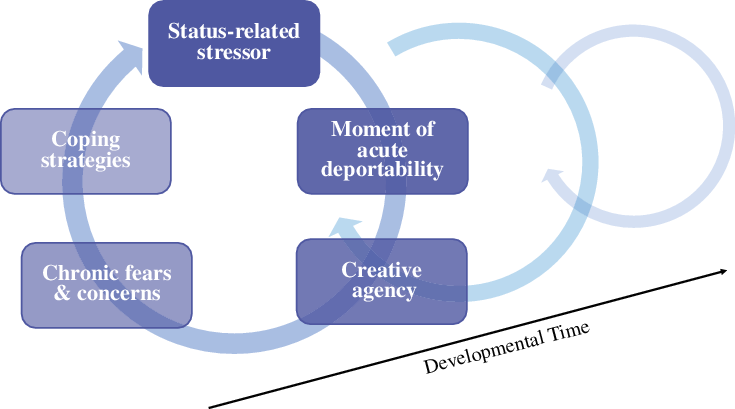
As a whole, Agata’s experience exemplifies a typical cycle of events that I observed repeatedly in the lives of virtually all of my research respondents (both in Canada and the United States) as they developed their lives as undocumented immigrants. Accordingly, I conceptualize these experiences as cycles of deportability and illustrate their different components in Figure 1. First, we see in Agata’s case how what would normally appear as a minor issue for citizens and legal residents—acquiring a blood test—was experienced as a status-related stressor that not only limited Agata from accessing services but also generated heightened levels of fear and awareness of her deportable condition, as evinced by her frantic state and the tremor of her body as she left the clinic and wondered what the receptionist noted about her status. Accordingly, I define status-related stressors as events that trigger thoughts about one’s status and serve as reminders of migrants’ deportable positions. Such fearful episodes took place recurrently in my respondents’ lives in response to various kinds of events—from everyday questions about where my respondents were from and what they did for a living to requests for documentation, health concerns, conversations about family planning, or direct deportation threats from upset co-workers or family members. I describe these unsettling experiences as moments of acute deportability during which migrants’ deportable and vulnerable positions are brought to the forefront of their lived experience, bringing about heightened awareness and concerns about their status situation.
Cycles of deportability: basic elements of cycles of deportability, which characterize the psychosocial development of migrant “illegality” and occur repeatedly over time.

Next, Agata also shows how such fearful episodes motivated the development of creative problem-solving strategies—and, eventually, creative agencies—aimed at avoiding and/or overcoming status-related challenges. Agata describes learning to tell alternative stories about her status—stating, for instance, that she is “just visiting”—to avoid status disclosure. At other times (and for other respondents), creative problem solving involved learning to find more secure employment; avoid exploitative employers; secure an apartment lease with a friend’s credit history; access education for one’s children despite denials from school administrators; or respond to police officers without revealing one’s status. As my respondents explained, there were no instructions for how to survive as an “illegal immigrant.” Rather, surviving migrant “illegality” involved learning to be vigilant, creative, flexible, and resourceful in one’s everyday life in order to address status-related barriers and meet one’s aims without institutional supports. This involved carefully navigating questions from strangers, seeking alternative solutions to institutional barriers, finding loopholes to access services, avoiding government agencies and authorities, and, perhaps most importantly, relying on family and friends to meet one’s needs. Taken together, then, learning to survive as an undocumented immigrant involved learning a unique mode of agency in response to repeated threats and other status-related stressors (see also Ellis and Stam Reference Ellis and Stam2017a).
Yet, while developing a creative agency was important for survival, having to scheme and/or pursue unlawful activities was not only exhausting but also morally difficult to accept. Accordingly, many respondents reported feeling embarrassed about engaging in unlawful activities and regretted not being able to use proper channels to meet their needs. Moreover, and this points to the fourth component of the cycle, although creative agencies were necessary for addressing status-related events, as Agata’s unwillingness to return to the clinic shows, fears of status disclosure and deportation persisted beyond these encounters, developing into more chronic fears and concerns that also generalized onto other situations. For instance, after being questioned about her status by a receptionist at the Ministry of Transportation in Toronto, Kasia, another Polish young woman who was working without authorization, feared returning to the ministry alone and instead had her Canadian boyfriend accompany her when she eventually needed to renew her driver’s license. Ela, a twenty-one-year-old woman who worked at a restaurant using a family member’s social insurance number, described an ongoing fear that “someone could come to [her] work from immigration.” Marzena, a fifty-three-year-old woman who spent most of her time at home caring for her husband, maintained that “people don’t go to public places because they are extremely fearful that someone will take advantage of them.” Finally, sixty-three-year-old Janek, who spent more than a decade working without authorized status in Canada, explained: “The thoughts are there all the time. … They are not terrifying, but people are aware of the ground that they walk on…. They can deport you at any moment.” To summarize the feeling of living “without papers,” he noted, “there’s a lingering chill of uncertainty.”
Returning to Agata, while she too said that she could avoid thinking about her status for “weeks, even months,” she also maintained that she continually felt stuck and uncertain about her life and that she could not imagine remaining in her status situation forever, as she certainly did not want to “wake up in her thirties and realize that she hasn’t moved forward.” Other respondents also bemoaned their inability to make long-term plans and feared the possibility of having their lives uprooted at any moment. In this sense, just as they learned to navigate status-related barriers and avoid threatening experiences by developing creative modes of agency, their deportable status nevertheless continued to haunt their mental lives in the form of chronic fears and concerns that lingered in the back of their minds even in the absence of status-related stressors.
As a result, in addition to learning practical and creative modes of survival, cycles of deportability also involved developing status-related coping strategies—or patterns of thinking, feeling, and relating to oneself—that were necessary to help my respondents reckon with the psychological impact of their deportable status. For instance, Agata maintained that “you need to have patience and cannot forget why you came, constantly reminding yourself of this. You can’t think that this is hopeless but that somehow things will work out.” Other respondents described efforts to downplay, rationalize, repress, forget, ignore, and/or reframe perpetual feelings of uncertainty and fear, including: “you can’t let it get to you,” “think about the positive,” “live day to day,” “be smart about your health,” and “be careful not to dream too big.” As a whole, I argue that these deliberate self-interventions reveal basic psychological tensions and intra-mental dynamics that I observed to characterize my respondents’ lives and, correspondingly, what it was like for them to live as vulnerable and deportable migrants.
Although they varied in their levels of optimism about the future, and some respondents relied on alcohol and drugs to reckon with their status-related concerns, all of them needed to find meaning in their status situations as well as ways to address the repeated status-related barriers and threats that every so often seriously threatened their livelihoods and kept them feeling precarious and limited in their life opportunities. As I elaborate below, in the case of migrants who arrived in Canada as adults, coping often meant reminding oneself of one’s reasons for migrating and maintaining hope that one’s hard work would pay off with a future opportunity to regularize one's status. For undocumented young people, such as Monica in the next case study, coping often involved drawing strength from one’s own accomplishments, seeing value in one’s experiences of hardship, and staying hopeful for future immigration reform. Yet, despite their different coping strategies, to the extent that both respondent groups described deliberate self-interventions to maintain hope and resilience in the face of deportability, I argue that they comprise important components of repeated cycles of deportability, which help explain what living with unauthorized immigration status means from the standpoint of migrants who have chosen to continue despite the challenges of their status.
Case Study 2: Monica in Chicago
Having discussed the components of cycles of deportability in Agata’s case, I discuss Monica’s life story to trace in more detail how these cycles occurred repeatedly in the life course of my respondents. Monica was a twenty-nine-year-old DACA recipient who immigrated to Missouri from Mexico with her family when she was eight years old. Due to a challenging migration journey—during which Monica and her sister used false identities to enter the United States with the help of a “coyote” (that is, a person who smuggles immigrants) and were separated from their parents for more than a month—Monica recalled knowing from a young age that there was “something wrong” with her status, even though she was too young to grasp its full implications. Moreover, she explained that her parents never made special efforts to keep her status a secret.
After spending most of her childhood in Missouri, Monica’s parents decided to move to Illinois to escape what she described as “very racist ideologies” and to give her access to better opportunities for higher education, since Illinois offered in-state tuition to undocumented students. Yet, despite graduating from high school in Illinois and receiving acceptance from the university of her choice, Monica still could not afford the tuition costs of a four-year institution and thus decided to enroll in community college instead. While this helped make her schooling more affordable, because this was at a time before DACA, Monica lacked access to authorized work and, as such, sought work in multiple, low-paying service jobs to keep herself afloat and contribute to her family’s income: “I was working as a cashier [and] in a restaurant … for like 8 years and I did every single job … from a barista, cashier, cook, prep cook, dishwasher. You know, pretty much anything…. They even talked about me becoming a shift leader, but unfortunately to get the position, I couldn’t because I didn’t have a real or valid social security number.”
Monica recalled this period as being very difficult for her psychologically as she struggled to accept the challenges of her status and the delayed pace with which she could take courses and move forward with her life. Moreover, she said she grew increasingly fearful of being caught and apprehended by immigration authorities, citing a close call when she was pulled over for driving without a driver’s license. Monica explained that the experience not only left her feeling afraid of what the police officers might do with her, as she ultimately disclosed to them that she did not have a social security number. She also described feeling deeply ashamed about her status, particularly as the police officers forced her to spend time alone in a cell. Recalling this and other challenging events, however, Monica explained that she coped with them by making efforts to not let her fears and concerns overwhelm her: “[Sometimes] you can’t function. You can’t think right … but when you [experience] fear to the point where you don’t know how to function, that’s when it becomes a problem. I wouldn’t let that [happen].”
To avoid letting her fears “get to her,” Monica maintained that she would deliberately think about her struggles as motivators to help her to keep going: “All those moments about being undocumented. Not being able to go to school. Having two or three jobs. You know, being financially unstable. Getting pulled over by the cops. All of those moments that affect me because of my status. I try not to suppress them. Because that’s what keeps me going.”
Pausing here to analyze Monica’s account, we can begin to see how she developed fearful patterns of thinking as well as strategies for coping with these thoughts that were not unlike the patterns and strategies discussed by Agata and others above. We also see how these developments occured in response to repeated status-related stressors, which ignited in Monica fears at the time of their occurrence, as well as more chronic concerns over the long term. While these dynamics already point to the repeated occurrence of cycles of deportability, further consideration of Monica’s story will help illustrate their operations and how their perpetual occurrence shaped her psychic life.
When Monica turned twenty-four, the Obama administration implemented DACA. Monica recalled feeling skeptical about the policy at first, as she questioned sharing her information with the government, especially given the possibility that the policy could be rescinded by a future administration. However, after further contemplation, she applied for the program and soon found that her new status positively impacted her life. With DACA status, Monica was able to find a better paying job and save money to enroll in a four-year university degree. Further, she described feeling a greater sense of safety and security, along with greater freedom of movement and willingness to disclose her status and connect with others in similar situations. Yet, just as these comprised major improvements in Monica’s life, she emphasized that she continued to struggle financially and that it still took her a lot of effort to stay focused and persevere as an undocumented student. Moreover, with the election of Donald Trump in November 2016, Monica felt her fears about the rescinding of DACA revive once again, this time producing several weeks of irrepressible, status-related concerns. As she explained,
when I first found out that Trump was to become president I cried. Because it meant you don’t know what hap—I mean, you don’t know what’s going to happen with this particular person and his administration comes with such a racist, you know, ideology. So the first thing that comes to mind is, he is going to take it [DACA] away. You know? … So that is the first thing that came to my mind, “how am I going to be able to pay for my education?” The second thing is like, “how am I going to be able to tell my parents that I won’t be able to help them as much financially?” So that was like my two biggest fears. And it was on my head for a while. I’m not going to lie. You know, it was something that almost put me through a depression for the first three weeks. Four weeks. Like a month. I was just thinking about it. I would go to work you know just, my mind would be working a thousand miles per minute just trying to think what is the next move, what can I do before, like not wait for the blow to come, you know, and then decide what to do.
As was the case for many of my respondents in Chicago, the Trump election ignited heightened fears and concerns that many described as difficult to manage. Monica explained that it was not until weeks later, after numerous conversations with her friends and family who also felt affected, that she was able to reframe her perspective and take a different approach to her status situation:
After talking to several people, after you know just kind of taking a step back and you know, I guess just giving it some time to be on my mind, I decided to not let this particular idea of getting DACA taken away take away my peace. … Because fear is really something that the Trump administration wants. You know, to bring fear among people. So we can’t let that happen because when you know when you have fear and you let that overwhelm you, you can’t think. You don’t know what to do. So it’s okay to worry but not to the point where we’re in fear. So, I decided to just constantly be aware of what’s going on and you know, just talking to other people and being informed but to not let it interfere with my everyday life.
Taken together, Monica’s multiple experiences with status-related barriers and threats, as well as the concerns and tensions that these events produced, nicely illustrate how her experience of migrant “illegality” developed through repeated cycles of deportability. First, beginning in her childhood, Monica encountered status-related stressors that every so often helped her grow aware of her vulnerable status, including her clandestine arrival to the United States and her family’s decision to migrate to Chicago, which she understood as a move toward better opportunities for undocumented immigrants. Further, as she reached her high school years, she experienced further status-related barriers when she was unable to work with authorization and afford to attend a four-year university. To the extent that these events generated in Monica heightened awareness of her status and the vulnerability of her position in the United States, I argue that they produced moments of acute deportability, to which Monica repeatedly responded with alternative, creative solutions to meet her needs—learning to find informal work without a social security number or enrolling in community college when a four-year university was unattainable. These resourceful and flexible responses in turn reflect her development of a creative mode of agency suitable for surviving conditions limited by her immigration status. Nevertheless, given how Monica continued to struggle to accept her low-wage circumstances, we see how her creative, practical agency was insufficient to guard against more chronic, status-related fears and concerns. Accordingly, she learned to cope with her psychological challenges by taking pride in her struggles and the hard work it took to survive her life journey.
Notably, even after acquiring DACA status, Monica continued to experience status-related stressors. The fact that the application itself ignited in her fears of deportation reveals how DACA operated as a status-related stressor that spurred moments of acute deportability that could discourage youth from applying for the program. Moreover, while DACA ultimately helped Monica improve the quality of her daily life, as a temporary policy without a pathway to citizenship, it did not resolve her chronic concerns. Further, with the election of Donald Trump—a major status-related stressor—Monica’s fears were once again amplified, developing into what may be considered to be a continuous stream of moments of acute deportability that she reported to last several weeks. Monica’s strategies for maintaining perseverance in the face of repeated challenges and feelings of uncertainty reflect once again the psychological tensions of migrant “illegality,” which require specific coping strategies to stay hopeful and resilient despite persistent concerns and fears. As I will elaborate below, many of my 1.5-generation respondents drew strength from their own as well as their parents’ hard-working ethics, and to the extent that they were also able to gain socio-emotional support from family members, teachers, mentors and peers, many youth learned to gradually reframe their status in more positive terms.
To summarize, Agata’s and Monica’s case studies help reveal how experiences of migrant “illegality” develop through common psychosocial dynamics, producing similar kinds of status-related struggles as well as strategies with which to reckon with these struggles. I describe these dynamics as cycles of deportability to capture how their repeated, cyclical occurrences press migrants to assume unique forms of subjectivity and marginal social positions framed by their deportable positions. Tracing these dynamics from the standpoint of the subject, I argue that cycles of deportability help provide a general theory of “what it’s like” to endure conditions of migrant “illegality,” which involves learning to deal with recurring, yet always unexpected status-related stressors and acute fears, as well as having to develop creative agencies to address these. Further, living with undocumented status means reckoning with chronic fears and feelings of persistent precariousness that remain in the back of migrants’ minds even in the absence of immediate threats, requiring unique coping strategies to downplay, resist, and/or reframe negative thoughts and outlooks to instead stay focused and motivated to continue pursuing one’s life aims.
Variability in Cycles of Deportability
Just as cycles of deportability offer a basic framework for understanding the operations of migrant “illegality” and deportability at the psychosocial level, Monica’s and Agata’s experiences also reveal how these cycles, like experiences of migrant “illegality” more generally, can take multiple forms, carry different meanings, and unfold in unique ways for different groups in different settings. To help elaborate this point as well as demonstrate the applicability of the proposed theory, I show how migrants’ national contexts, racial backgrounds, generational differences, personal motives, and other factors intersected to produce qualitatively different experiences involving variations in frequencies of status-related stressors, intensities of fears, and modes of creative agencies and coping. I subsume these variations under two major points of difference: national context and immigrant generation.
Differences in National Contexts
Race and the politicization of migrant “illegality”
As described above, the contexts of migrant “illegality” in Canada and the United States differ in terms of the larger number of undocumented immigrants in the United States; the resultant, noticeable public attention devoted to the issue there; and the ways in which migrant “illegality” has become racialized into a primarily Latin American problem (Menjívar Reference Menjívar2021). In contrast, undocumented migration has not surfaced as a major political issue in Canadian history nor has any single group become racialized as the most likely group to be undocumented (i.e., in the way that Mexican and/or Latin American immigrants are stereotyped as undocumented in the U.S.). Accordingly, although both of my respondent groups experienced regular status-related stressors and moments of acute deportability in both national contexts, it was evident that my respondents in Canada lived with lower risks of status disclosure than my respondents in the United States and that the former could avoid being reminded of their status for longer durations.
A number of intersecting factors contributed to these differences. First, my respondents in Canada were White Polish immigrants who built their lives within the Polish Canadian enclave in Toronto. Although they tended to receive regular questions from co-workers and friends who asked them about their lives and put them at risk of status disclosure, close calls with deportation were relatively rare, even if alarming. For the most part, as they built their lives among Poles in the Polish enclave and could avoid more mainstream, English-speaking spaces, they could blend in with Polish communities and remain inconspicuous to outsiders and authorities. Additionally, although their Polish accents could be read by strangers as markers of their foreignness, given the limited knowledge about undocumented immigrants in Canada, strangers were likely to assume that my Polish respondents held legal immigration statuses.
In contrast, due to the heightened public awareness of undocumented immigrants in the United States as well as the uniquely racialized context of migrant “illegality” there, my respondents in the United States experienced (1) more frequent status-related stressors through public messages about undocumented immigrants as well as (2) more racially driven status-related stressors, which were further intensified by the Trump campaign and election. Specifically, due to the extensive politicization of undocumented migration in the United States, all my respondents there experienced frequent reminders of their status as they browsed social media, listened to the news, or overheard other peoples’ conversations about immigration. Further, my Latinx respondents felt especially targeted by public discourses and strangers who suspected them of being undocumented solely on the basis of their physical appearance, and they were more likely than my non-Latinx (that is, Asian and White) respondents (in the United States) to experience discriminatory remarks and/or questions from strangers that threatened their status. Non-Latinx respondents in turn described feeling more capable of passing as citizens than their Latinx counterparts, which in turn allowed them more freedom to choose when and to whom to disclose their status.
While racialized discourses of migrant “illegality” grew prominent with the Trump campaign’s promises to apprehend and deport primarily Mexican migrants, both Latinx and non-Latinx respondents described more frequent and heightened fears during the time of the campaign and following the inauguration, as they worried about the ending of DACA and the increased likelihood of their own or their family members’ apprehension and deportation. To address their fears, my respondents also reported more urgent desires and attempts to protect themselves and regularize their status situations. For example, at the first “anti-Trump march” in Chicago, Luis, a well-connected and experienced youth activist from Venezuela, explained that “dealing with this administration is going to be incredibly challenging.” Consequently, he was actively reaching out to other activists, lawyers, and high-stakes employers who he believed could defend him should he receive a deportation order. Vida, a twenty-eight-year-old DACA recipient from Mexico reached out to me after Trump’s election to discuss her increased interest in learning about her options for moving to Canada. Several other respondents expressed that the election made them feel rushed to marry their citizen partners, and three women from different ethno-racial backgrounds did so within weeks after the election.
In contrast, none of my respondents in Canada experienced heightened fears due to large-scale, government targeting of undocumented immigrants. Indeed, this was the case despite the fact that I had conducted my study under the Conservative Harper government, which implemented a number of restrictive measures that limited temporary migrants from permanently migrating to Canada, increased fees for work sponsorship applications, and introduced the term “irregular arrivals” into Canadian immigration policy to manage unauthorized immigrant groups. Yet, because these events were not widely publicized and there were no other obvious national interventions (for example, raids), my respondents were unaware of these changes and did not experience more frequent status-related stressors or fears of deportation as a result.
Advocacy and social support
Just as limited public interest and knowledge about undocumented immigrants in Canada allowed for a less threatening national context, it also meant that there were noticeably fewer resources, advocacy organizations, and other institutional supports in Canada than there were in the United States and in Chicago, in particular. As noted above, long-standing activism in Chicago has led to the establishment of widespread immigrant-servicing organizations that have over the years provided legal, financial, health, and other kinds of supports at low or no costs. Accordingly, my respondents in Chicago described reaching out to community members, advocates, and others to learn about their rights, address legal questions, acquire financial resources, and access spaces where they could talk about their status-related concerns. Such opportunities were severely lacking in Toronto due to comparably limited public knowledge and political activism around the issue. As a result, few of my respondents in Toronto knew about, and/or made use of, the limited city or community services that were available to them. Indeed, three women in the study made use of free community health clinics only after I encouraged them to use these services; whereas one man used false identity documents to access the library without realizing that library services were freely available to all residents regardless of their status. The vast majority of my respondents in Toronto thus relied primarily on friends and family to gain knowledge and support as they navigated status-related challenges.
The fact that my respondents in the United States were mostly undocumented students and DACA recipients allowed them special access to resources and supports developed specifically for these groups. Unlike in Canada, extensive national-level advocacy efforts in the United States have contributed to widespread public support for undocumented students as well as increasing resources in education settings that can help them access college, legal advice, financial aid, mental health supports, and other services (Suárez-Orozco et al. Reference Suárez-Orozco, Katsiaficas, Olivia, Alcantar, Edwin, Yuliana, Minas, Janet and Teranishi2015). While such resources vary across states, cities, and schools across the nation, they constitute as a whole a national-level infrastructure of support that extends to online platforms where youth can connect with others who share their struggles and support their cause. Frida, a twenty-four-year-old college graduate, described experiencing multiple barriers as she pursued her college education, including fears of disclosing her status to administrators, encounters with ill-informed staff who denied her in-state tuition, and having to work multiple jobs while in college to support herself financially. Yet, just as she recalled these experiences as bringing about increased concerns and mental health struggles at different points in her educational trajectory, she also credited her ability to get through these challenges to an extensive “support system” made up of counselors, teachers, administrators, and others to whom she was able to reach out for guidance and who helped her address her mental health concerns. Luis, who was a college student in his final year of his architectural degree, described a long history of network building with teachers, counselors, immigrant advocates, and other allies who helped him access free social services, financial aid to pay his college tuition, mental health counseling, and legal advice. Perhaps most remarkably, having built such extensive networks, Luis raised more than thirty-five thousand dollars for his tuition through crowd funding as an undocumented student online.
Taken together, these findings show how differences in national-level public discourses and immigration enforcement can shape experiences of migration “illegality” by impacting frequencies of status-related stressors and intensities of moments of acute deportability. Under the Trump administration, undocumented communities in the United States experience more frequent threats and heightened levels of fear than migrants in Canada where the levels of immigration enforcement are limited. Moreover, we see how highly politicized contexts of migrant “illegalization” can produce mixed effects when undocumented migrants are both widely persecuted by restrictive state policies and supported by resisting immigration advocates. In the United States, such contradictory circumstances have resulted not only in more frequent status-related stressors and more fearful moments of acute deportability among undocumented youth but also in greater access to resources that help them navigate status-related barriers and address their psychological concerns. As also noted, these patterns intersected with undocumented immigrants’ racial backgrounds, as Latinx respondents experienced both more frequent status-related stressors and greater supports than those from non-Latinx backgrounds.
Given the relatively limited politicization of undocumented migration in Canada, Polish undocumented immigrants were not subject to frequent reminders of their status through media outlets, and to the extent that they could blend in with other Poles in Polish Canadian enclaves, they could experience some protection from status-related threats and fears of deportation. At the same time, limited public awareness of, and supports for, undocumented immigrants in Canada meant that they had to rely more exclusively on friends and family to address their status-related concerns than did immigrants in the United States since the latter had access to a larger infrastructure of supports.
Generational Differences
Implicit cycles of deportability
In addition to living in different national contexts, my respondents migrated at different points in their lives, which further impacted their cycles of deportability. Most importantly, having arrived in the United States as children, 1.5-generation undocumented youth endured status-related stressors during their childhood years, even when they lacked the cognitive capacity to apprehend these events as being status related (Dreby 2015). Indeed, most of my 1.5-generation respondents maintained that they were too young to fully understand the implications of their status during their childhood. At the same time, most also recollected sensing from early ages that “something was wrong” with their status and that they needed to keep it a secret. Lola, a twenty-six-year-old woman who arrived in the United States with her parents from the Philippines at eleven years of age, maintained: “I think I kind of knew somehow that there was some kind of shame that we were hiding in our family, my immediate family, when we moved here … there was like a secretive thing. And I think my parents talked about it … but I didn’t know exactly, I didn’t fully wrap my mind around with how that impacts us.” Frida, who arrived from Mexico at two years of age explained: “My parents always told us that it [immigration status] was something that you weren’t supposed to tell people, that it was just kind of like a secret—so I never told anyone and [my brother and] I kind of grew up with that instilled into our mentalities.”
These comments help reveal how undocumented children can and do experience status-related stressors through early experiences of shame, secrecy, and fears about status disclosure in their families (Suárez-Orozco et al. Reference Suárez-Orozco, Hirokazu, Robert and Marcelo2011). As Frida highlights, undocumented children also learn various creative status-related behaviors, such as concealing their immigration histories, identifying social situations where their citizenship could be questioned, avoiding authorities, and learning to tell alternative stories about their lives to avoid status disclosure (Suárez-Orozco et al. Reference Suárez-Orozco, Hirokazu, Robert and Marcelo2011; Dreby 2015). To the extent that these practices constitute modes of being developed to navigate status-related challenges and threats, I argue that they reveal early lessons in migrant “illegality” and the corresponding development of creative agencies required to navigate conditions of deportability. Further, we see how these early lessons constitute implicit cycles of deportability, as children are not aware of the full implications of their status but nevertheless experience repeated status-related stressors and events that motivate both acute fears and chronic concerns as well as status-related socio-emotional and behavioral responses (for example, vigilance, shame).
Explicit cycles of deportability
Cycles of deportability grew explicit as my 1.5-generation respondents entered adolescence and began to discern status-related events and their implications more clearly. Research in the United States has shown how 1.5-generation undocumented adolescents undergo deeply confusing and unsettling experiences as they begin to encounter barriers to work, travel, financial aid for college, and other barriers that limit their opportunities for adult transitions (Gonzales Reference Gonzales2011). Further, these barriers press undocumented youth to rethink their life aspirations and adopt new ways of being to address their limited, status-defined conditions—a process that Roberto Gonzales (Reference Gonzales2011) describes as “learning to be illegal.” In similar form, my respondents described gradually learning about the implications of their status during their adolescent years as they experienced unexpected, status-related barriers (for example, a lack of access to federal financial aid and work permits), which in turn motivated them to shift their self-understandings, social engagements, and daily practices to adjust to their new, status-defined realities. Viewing these experiences as recurring cycles of deportability, I argue that undocumented youth transition into “illegality” through experiences of increasingly explicit cycles, as they gradually learn to discern how their lives are impacted by their status. These experiences differed from first-generation adult immigrant respondents as the latter did not undergo a shift from implicit to explicit cycles of deportability; rather, as adults, they were able to discern how their status contributed to limited opportunities and stressors.Footnote 5
Developmental stages and identity development
As noted above, all my respondents eventually experienced explicit cycles of deportability, and, in many respects, both 1.5-generation youth and first-generation adults faced comparable limitations to employment, travel, education, and other social provisions. However, due to their differing immigration histories and developmental stages, my 1.5-generation youth respondents differed from first-generation adult respondents in how they interpreted and adapted to their status-related barriers and concerns. First, undocumented youth tended to recall deeply unsettling and excruciating experiences of having to adjust to the barriers of their status not only because this required many adjustments but also because they felt they had no agency in their decisions to migrate. Many described initial feelings of resentment toward their parents, particularly as 1.5-generation respondents tended to have limited, if any, direct experience with the contexts that their parents were escaping. Moreover, given their attachments to US society and integration into this national context, 1.5-generation respondents tended to struggle more with the moral implications of their status and feelings of embarrassment due to their unlawful presence. For instance, Frida recalled “sitting on the side lines” during her high school years, seeking to avoid questions about why she was not applying for scholarships because she feared that her friends would think less of her if they knew she was undocumented.
This contrasted with first-generation adult respondents who understood the risks and sacrifices they were making as they migrated and, as described above, saw opportunities in their new circumstances that encouraged them to stay despite the challenges of their status. In this sense, adult migrants held what Carola Suárez-Orozco and Marcelo Suárez-Orozco (Reference Suárez-Orozco and Marcelo1995) describe as a dual frame of reference, which helped motivate their optimism and willingness to adapt to the demands of their difficult and precarious conditions. Having had no say in their decisions to migrate, undocumented 1.5-generation youth tended to view their undocumented status as something that took away their agency rather than as a means for pursuing better futures. Second, given how 1.5-generation youth were pressed to make sense of their status at a point in their lives during which they were developing their identities and transitioning to adulthood, status-related barriers and threats interrupted normative developmental processes, pressing them to alter their life plans, question their social positions, and engage in protracted identity struggles that lasted into their adult years. Consider how Chet, a twenty-year-old DACA recipient who arrived from Brazil at seven years of age, recalled how he reckoned with status-related barriers as a high school student:
I was still like maturing and I was still trying to understand what it meant to be undocumented and if it was like really looked down upon, and it’s hard when you watch the news and you hear all of these labellings and you just see what’s going on and you don’t really know if you’re contributing to a problem you know, it just—all these different scenarios crossed my mind and that’s why it was always really, I really stayed in my shell.
These remarks illustrate how undocumented status configured not only Chet’s material possibilities but also his modes of self-understanding and maturation—as he withdrew from his peer relationships to make sense of his social standing in US society. Other undocumented young people described similarly drawn-out, personal struggles with the stigma of undocumented status as they questioned what “being illegal” implied about them as persons.
To reckon with these concerns required undocumented youth to develop alternative self-understandings and more positive relationships with their status, which were challenging developmental tasks given both exclusionary public messaging about undocumented immigrants and the youth’s own desires to become accepted members of US society. As Chet continued to explain, it was only with time and the help of supportive others that he gradually came to reframe his status situation in more positive terms as well as to recognize the value of his unique social position as an undocumented young person:
I think once you really … go across that first bridge and tell that first person it really helps you know? And it could go the other way but I really doubt it and if it’s someone who’s really close to you and you’re picking this person it really helps just having affirmation that you are … accepted and people want to know about you and your situation, and … they are not just labeling you and putting you into a box and just all the things they hear in the media … and it was just a really nice way of getting me to go to step two and step three and so on and I know I have more steps ahead … but I think the first step is really just understanding that it is okay to be who you are … that you have something to offer and you have your own story.
We can see in Chet’s multiple steps how he came to develop a positive self-understanding through repeated experiences with others who accepted him and helped him reclaim his identity on his own terms. His trajectory in turn illustrates how status-related stressors intersect with youth’s developmental stage to produce unique processes of identity development that require youth to make sense of their social positions as unauthorized immigrants and long-standing members of US society (Negron-Gonzales Reference Negrón-Gonzales2014). We also see how experiences with supportive others can help redirect the course of migrants’ cycles of deportability as well as shape migrants’ capacities to reckon with status-related stressors, as it is with the help of others that Chet comes to transform how he interprets social media and his belonging in the United States.
It is worth highlighting that such positive developments were facilitated by supportive educational and advocacy contexts in the United States that helped many of my respondents meet others who appreciated their concerns, develop alternative understandings of their histories, and learn to advocate for their membership in American society. Indeed, a number of my young respondents from Chicago participated in advocacy events wherein they publicly disclosed their status and experienced support from others who accepted them and voiced support for their cause. These “coming out of the shadows” events—originally developed by Chicago youth activists (Seif Reference Seif2014)—were seen as deeply transformative experiences, comprising what some described as the “most important,” “most courageous,” and “proudest” moments of their lives. Not only did these events help undocumented youth counter deep-seated feelings of shame and fear about status disclosure, they provided new identity discourses and frames, such as “undocumented, unafraid, and unapologetic,” that helped them to both reposition themselves as deserving members of US society and stay motivated to pursue their aims.
In striking contrast, none of my first-generation adult migrant respondents regarded their status as “undocumented” to be a salient part of who they were or how they identified themselves. In fact, it was only in response to my questions about what it means to “be illegal” that my adult respondents used this kind of framing to explain their lives. For the most part, they spoke about “not having papers” or “byciu na czarno [living in the dark/in the shadows]” as opposed to being illegal or undocumented persons. This is not to say that migrant “illegality” did not take its toll on these respondents or shape their self-understandings. Indeed, as one such respondent explained, “nobody gets better under these conditions, people only get worse as illegal migrants … as the situation leaves you with few options and requires of you to lower your self-worth.” However, given how first-generation respondents did not develop their adult identities in the context of migrant “illegality” and, instead, chose to migrate and endure deportable conditions to satisfy more established life aims, the fact that they were “undocumented” was not seen as a salient part of who they felt themselves to be as persons. Rather, “not having papers” was regarded as a temporary condition—a “hiatus,” as one respondent put it—that adult migrants chose to endure with hopes to improve their life circumstances and eventually regularize their status.
Although adult migrants also suffered from chronic, status-related fears and concerns, due to their different life outlooks and relationships with their status, their worries had less to do with academic and/or career goals and more with their abilities to accomplish their migration aims. For instance, adult migrants frequently questioned if they had made good decisions by staying past their permits, whether their sacrifices would prove worthwhile, whether they would unexpectedly lose all their investments by getting deported, how this might impact their children, and/or whether they should continue in Canada, return to Poland, or move to another country in Europe. Accordingly, in contrast to 1.5-generation undocumented youth, coping for first-generation adult migrants was not about developing a positive undocumented identity or reframing their relationship to their status. Rather, given their dual frames of reference, adult migrants tended to focus on staying on task with their initial migration goals, reminding themselves of why they came, what they hoped to accomplish, remaining optimistic about the possibility of legalizing their status, and, in the meantime, taking steps to prepare in case of deportation. For example, Antek, a thirty-three-year-old undocumented adult migrant, explained to me that he could not plan for the future and instead needed to “live day to day” and “let things be” as he awaited his chance to legalize his status through his employer. In the meantime, to prepare his family for the possibility of having to return to Poland, he enrolled his eight-year-old daughter in an English school in Canada that offered classes in Polish, and, each day after school, his wife worked with their daughter to complete grade-equivalent Polish schoolwork.
Taken together, although all my respondents endured repeated cycles of deportability, each generational group interpreted their status-related stressors and barriers based on their unique life stages and goals. For 1.5-generation youth who did not actively choose to migrate and began to experience explicit cycles of deportability at a time when they were seeking to develop their identities and transition to adult lives, status-related barriers disrupted their sense of continuity and pressed them to rethink their lives and membership in US society. For immigrants who chose to migrate as adults and overstay in order to pursue better futures for themselves and their families, status-related stressors and threats regularly undermined their life pursuits and brought about uncertainties that they regularly justified as temporary sacrifices that would eventually result in better lives for themselves and their families. Thus, just as both groups endured recurrent cycles of deportability, the meanings of these cycles and modes of addressing them took varied forms, making for different—yet comparable—experiences of migrant “illegality” and deportability.
DISCUSSION
Drawing upon ethnographic research with undocumented migrants in Canada and the United States, this article has identified common psychosocial dynamics in both groups, which I have conceptualized as cycles of deportability. I argue that cycles of deportability provide a general framework that can help explain the psychosocial operations of migrant “illegality” and the ways in which varied conditions of deportability in different countries operate in parallel ways to adversely impact migrant lives. Moreover, just as this frame highlights the adverse impact of migrant “illegality” on migrants’ material, social, and psychological lives, it also emphasizes migrant agency and the continued efforts required of migrants who seek to build their lives in increasingly challenging immigration contexts. In what follows, I elaborate on how this framework and its central concepts can help consolidate research findings and guide further research in psychology and critical migration studies.
As previously noted, the psychology of migrant “illegality” remains under-theorized in critical migration studies despite growing research focused on migrants’ experiences. Psychological studies in turn show how undocumented immigrants experience common psychological patterns, including ongoing fears of deportability, persistent feelings of uncertainty, concerns about status disclosure, as well as increased levels of stress, anxiety, and other negative health outcomes (Hacker et al. Reference Hacker, Jocelyn, Carolyn, Robert, Alex, Mohamed, Margaret, Joshua, Acevedo-Garcia and Marlin2011; Presidential Task Force on Immigration 2012). Summarizing research on the lives of undocumented youth, Roberto Gonzales, Carola Suárez-Orozco, and Maria Dedios-Sanguineti (Reference Gonzales, Carola and Maria2013, 1180) note: “It is possible to hypothesize that growing up without legal residency status entails a unique type of stress—one that is linked to repeated experiences of discrimination, blocked access to health care and work opportunities, and the urgent need to develop survival strategies to carry out mundane day-to-day activities while under the constant threat of deportation.”
My work suggests that undocumented stress develops through repeated cycles of deportability as migrants endure regular exposures to status-related stressors that produce both immediate moments of acute deportability as well as more long-term, chronic fears and concerns. To reckon with these challenges requires the development of creative agencies—that is, resourceful modes of being necessary to address practical challenges—as well as psychological coping strategies to address chronic concerns and fears that develop over time. Notably, while cycles of deportability refer to basic psychosocial dynamics that constitute experiences of migrant “illegality,” my findings show how their meanings, frequencies, and intensities can take varied forms based on migrants’ unique histories, social position factors, and other features. Accordingly, in what follows, I discuss how this framework and its key elements can serve to consolidate research findings as well as provide a basic structure for comparing various dimensions of migrants’ experiences across contexts and groups.
Mapping the Developmental Impact of Migrant “Illegality”
First, cycles of deportability can help researchers trace migrant “illegality” as a dynamic, psychosocial process that develops over time as migrants learn to adjust to the confines of their status situations. Studying the developmental trajectories of undocumented youth, Gonzales (Reference Gonzales2011, 2016) maintains that undocumented children grow up in a relatively protected status, and it is not until they reach high school years that they discover how their status matters for their lives and, with this, begin to “learn to be illegal.” Other scholars have in turn emphasized that the children of undocumented immigrants are not immune from the implications of “illegality” as they learn to conflate immigration with illegality, grow vigilant toward the police, and fear their parents non-return (Dreby Reference Dreby, Menjívar and Kanstroom2014; Rubio-Hernandez and Ayón Reference Rubio-Hernandez and Cecilia2016). Indeed, similar fears and vigilant behaviors have been observed in citizen children who grow up with undocumented parents (Brabeck, Lykes, and Hershberg Reference Brabeck, Brinton Lykes and Rachel2011; J. Chavez et al. Reference Chavez, Anayeli, Englebrecht and Viramontez Anguiano2012; Castañeda and Melo Reference Castañeda and Milena2014; Landale et al. Reference Landale, Jessica Halliday Hardie and Hillemeier2015). A cycles of deportability framework can help consolidate these findings by showing how “learning to be illegal” begins in childhood through implicit cycles of deportability, as children learn to configure their behaviors in response to various status-related stressors, which become increasingly explicit as youth mature to see how their lives are limited by their, and/or their parents’, undocumented status. Future research can build on this work to explore variations in “learning to be illegal” by comparing how different groups of children (for example, citizen children in mixed status families versus undocumented children) experience different kinds of status-related stressors with varied frequencies and corresponding experiences of fear and strategies for coping. Indeed, we may expect to see additional variations in children’s response patterns based on family structure, ethno-racial background, and other family characteristics, such as openness to conversations about immigration status.
Tracing Long-Term Psychological Effects of Migrant “Illegality”
Cycles of deportability can also be used as a framework to trace the long-term psychological impact of migrant “illegality,” which can persist even after migrants improve their legal status (Patler and Pirtle Reference Patler2018). Research with older migrants has shown how lifetimes of manual, low-wage work and stresses of precarious status can lead to rapid health decline in late life (Montes de Oca et al. Reference Montes de Oca, Telésforo Ramírez, Rogelio and Jennifer2011). Additionally, studies on the impact of DACA reveal how partial regularization policies can alleviate, but not eliminate, migrants’ status-related concerns as DACA recipients continue to experience uncertainty about their futures and the possibility of their own, and/or their family members’, deportation (Teranishi, Suárez-Orozco, and Suárez-Orozco Reference Teranishi, Carola and Marcelo2015). Indeed, elsewhere, I have described with my coauthors the psychosocial condition experienced by DACA recipients as a form of “illegality-lite,” by which we mean a more bearable form of migrant “illegality” but a form of “illegality” nonetheless (Ellis, Gonzales, and Rendón Garcia Reference Ellis, Gonzales and Sarah2018). Others have also pointed to the ways in which long-term exposure to acute and chronic stress can bring about lasting, negative health effects on migrants’ lives even after regularizing their status, which can then lead to adverse neurobiological and psychological outcomes (Torres and Young Reference Torres and Young2016). By observing migrants’ psychosocial dynamics through the lens of cycles of deportability, we can begin to trace how varying periods of exposure to the cycles, frequencies of status-related stressors, and/or intensities of moments of acute deportability can lead to differing long-term health effects. We may expect, for instance, that migrants who experience more frequent status-related stressors and/or more intense moments of acute deportability will develop more fearful responses to status-related stressors and/or more extensive chronic fears and concerns.
Exploring Varieties of Migrant Agency
As a research framework, cycles of deportability offers a general understanding of the psychosocial development of migrant “illegality” that highlights not only how migrant “illegality” limits migrants’ psychosocial experiences but also how migrants actively adapt to their circumstances and participate in determining their lives. As such, the framework helps counter deficit understandings of migrants’ lives, which tend to treat migrant experiences as outcomes of structural determinants, and instead offers a dynamic, psychosocial, and developmental theory that locates migrant agency at its center. As I have sought to show, cycles of deportability take various forms not only due to varying social and political conditions or social position factors but also due to migrants’ unique life perspectives, goals, and capacities to creatively and resourcefully address their limitations.
Nevertheless, more research is needed to explore variations in the ways in which migrants’ can and do alter the course of their lives. To this end, future scholarship may explore how varying migrant groups draw upon social, cultural, and material resources (for example, social networks, advocacy discourses, material supports) to develop creative strategies and outlooks to address status-related stressors and reckon with acute and chronic fears. Studies across national contexts have shown how migrants rely on culturally specific practices to navigate the demands of informal economies in destination countries (Ledeneva Reference Ledeneva2008; Braun Reference Braun2016; Ellis and Stam Reference Ellis and Stam2017a). We also know that experiences of migrant “illegality” are gendered and racialized, leading to differences in migrant work opportunities, educational experiences, interactions with authorities, fears of deportation, and access to resources (Herrera Reference Herrera2016; Cho Reference Cho2017; Enriquez Reference Enriquez, Martha Morales, Daniel and Daisy2019). Just as growing research unpacks how diverse migrants come to understand their life circumstances and navigate their limited opportunities, a framework of cycles of deportability can help organize these findings by viewing them as variations in the ways in which migrants develop unique modes of agency in response to repeated status-related stressors and fears.
Making Sense of Well-Being in Conditions of Deportability
In recent years, scholars and professionals working with undocumented communities have taken interest in these groups’ capacities for resilience and the ability to thrive in the face of status-related challenges (Perreira and Ornelas Reference Perreira and Ornelas2011; Meir, Slone, and Levis Reference Meir, Michelle and Mira2014; Suárez-Orozco et al. Reference Suárez-Orozco, Katsiaficas, Olivia, Alcantar, Edwin, Yuliana, Minas, Janet and Teranishi2015; Kam, Pérez Torres, and Steuber Fazio Reference Kam, Debora Pérez and Keli2018). This work has helped identify important social and individual factors that contribute to undocumented immigrants’ well-being, including the positive impact of strong social networks, family supports, cultural and spiritual values, inclusive institutional policies, and opportunities for advocacy. Framing these findings within the recurrent operations of cycles of deportability can lead to more nuanced, developmental understandings of how such supportive factors lead to positive outcomes by shaping the unique psychosocial dynamics of migrants’ lives, including migrants’ responses to status-related stressors, responses to fears, or capacities for agency. For instance, we may explore how the development of positive identities, support networks, and/or feelings of safety can transform migrants’ interpretations and experiences of status-related events, such as when previously stressful questions about documentation become empowering opportunities for undocumented activists to share their identities (Negron-Gonzales Reference Negrón-Gonzales2014). Further, by situating such self-transformations and other positive experiences within the frame of cycles of deportability, scholars can develop rich and dynamic understandings of what well-being can look like for different groups of migrants navigating varying conditions of deportability.
At the same time, as a basic framework, cycles of deportability provides an accessible model that can help not only with comparative studies of migrants’ experiences but also with training professionals about what it means to live with undocumented status. In my view, the need for such a framework is especially evident in the United States, where a large number of professionals who work with undocumented immigrants in schools, businesses, community settings, and other spaces have sought resources and training to learn about the unique needs of undocumented immigrants and how they can support them. To the extent that my work provides a fundamental understanding of how undocumented status impacts immigrants’ experiences, the model proposed can be readily used to train professionals about the basic dynamics that characterize these groups’ everyday lives (Ellis 2019).
Study Limitations
It is important to highlight that the findings presented in this article are premised upon the experiences of migrants residing in North American countries that share national ideologies as “immigrant nations” and are made up of diverse ethnic populations. Undocumented migrants living in non-immigrant nations with less racially diverse populations are likely to endure different kinds of concerns, particularly if their racial backgrounds contrast with the dominant population and mark them as conspicuously foreign (Willen Reference Willen2007; Menjívar Reference Menjívar2021). Thus, the generalizability of cycles of deportability to other countries outside of North America remains to be determined. Second, given the size of the studies, I was not able to systematically distinguish the ways in which each of the contextual and social position factors discussed (for example, national context, generation) uniquely impacted my respondents’ psychosocial dynamics. Quantitative research may help further discern the independent contributions of these factors and the ways in which they intersect with others (for example, race, gender) to produce varied frequencies and intensities of status-related stressors, moments of acute deportability, and other psychosocial dynamics.
CONCLUSION
The goal of this article was to outline a general psychological theory of migrant “illegality” that could help explain the psychosocial dynamics of deportable life from the standpoint of migrants who navigate precarious social conditions. Taking the standpoint of migrants is important, I argue, as research on undocumented migration tends to overlook migrant agency when it focuses primarily on the negative implications of living with undocumented status (Bloch and Chimienti Reference Bloch and Milena2011). Observing migrant “illegality” as a dynamic process shaped by migrants who endure repeated status-related stressors and fears and who find creative ways to navigate these and build meaningful lives, the framework of cycles of deportability offers a general, psychological, and developmental theory for thinking about what it means to live in deportable circumstances. In my view, general theories of this sort are needed not only to consolidate research findings but also to provide clear arguments in larger national and international discussions about the implications of increasingly restrictive immigration policies, including how these undermine migrants’ well-being and contribute to growing underclasses of persons who share common struggles and concerns. At the same time, future comparative research can continue to unpack the psychosocial dynamics of deportable life to develop increasingly more nuanced understandings of the psychology of migrant “illegality.”