Introduction
Ethiopia is home to diverse cattle genetic resources that are adapted to and distributed in different agro-ecological zones of the country. As a result, cattle production is one of the main components of agricultural activities in all parts of the country. For smallholder farmers and pastoralists, cattle play multiple roles as source of food, income and serve as an asset and security against risks (Terefe et al., Reference Terefe, Dessie, Haile, Mulatu and Mwai2012). The multi-function of cattle genetic resources in the country is identified through production system and breed characterization studies in their natural production environment (FAO, 2012).
So far, several cattle breed studies have been conducted in Ethiopia to identify the available cattle genetic resources, and describe their phenotypic and genetic diversity, husbandry practices, production systems and breed performances (Albero and Haile Mariam, Reference Albero and Solomon1982a, Reference Albero and Solomon1982b; Rege, Reference Rege1999; Rege and Tawah, Reference Rege and Tawah1999; Ayalew et al., Reference Ayalew, Ephrem, Markos, Yetnayet and Rege2004). These early breed identification and characterization studies in the country classified the available cattle genetic resources into five major groups viz, Large East African Zebu, Small East African Zebu, Senga, Zenga and the Taurine (humpless shorthorn) breeds (Rege, Reference Rege1999; Rege and Tawah, Reference Rege and Tawah1999). These major breed groups were further classified into more than 32 breeds/ecotypes (DAGRIS, Reference Kemp, Mamo, Asrat and Dessie2007). Furthermore, molecular characterization has shown high genetic diversity between and within breeds/populations (Zerabruk et al., Reference Zerabruk, Li, Kantanen, Olsaker, Ibeagha-Awemu, Erhardt and Vangen2012).
The Mursi cattle breed is classified as Small East African Zebu in the Abyssinian Shorthorn subgroup (Rege and Tawah, Reference Rege and Tawah1999). This breed group is believed to have descended from zebu cattle that were introduced into Africa (FAO, Reference Rischkowsky and Pilling2007). The Mursi cattle breed has a relatively large body size compared with other breeds of the subgroup (Rege and Tawah, Reference Rege and Tawah1999). The large body size is due to some ancestral linkage with the Large East African Zebu subgroup. The ancestral linkage might be due to geographical proximity of the breed distribution, human migration, long-distance pastoralist travel in search of pasture and water for their cattle, and markets (Fedlu et al., Reference Fedlu, Bekele, Ayalew and Dessie2007).
The Mursi and Bodi pastoral communities keep the Mursi cattle in the Southwestern rangelands, South Omo zone (Rege, Reference Rege1999). The pastoralists prefer the breed due to its perceived relative trypanotolerance (that is, its ability to survive and produce under trypanosomosis challenge) in trypanosomosis epidemic areas (Terefe et al., Reference Terefe, Haile, Mulatu, Dessie and Mwai2015), where there is little veterinary services. The study reported here is part of a project, which designed to study phenotypic characterization and trypanosomosis prevalence in Mursi cattle breed in its production environment. Therefore, this paper reports the morphological characteristics, production and reproduction performance, and identifies the major production constraints of Mursi cattle in Southwestern Ethiopia.
Materials and method
Study area
The study was conducted in Southern Nations Nationalities and Peoples Regional State, South Omo Administrative Zone in Salamago Wereda, Southwest Ethiopia. It is 870 km to the southwest of Addis Ababa and located in between 6°19′ and 7°10′N latitude, and 15°12′ and 22°25′E longitude with total land area of 451.12 square km. The Wereda has two major agro-climatic zones; the midland that covers 33 percent of the total land and the rest 67 percent of the area is low land. The mean annual temperature was recorded to be 29 °C (ranges from 20 to 37.5 °C). The average altitude of the Wereda is 971 m and receives bimodal rainfall, in which the long rainy season is in the months of March to June, while the short rainy season occurs in the months of August to October. Scattered woodland, savanna grass and large grassland plains dominate the vegetation type of the study area. Acacia, Combretum and Grewia are common woody plant species, whereas Cynodon, Brachiaria, Heteropogon, Cymbopogon, Aristida and Chlorisare common herbaceous grass species found in the study area (Tesfaye, Reference Tesfaye2008). Two locations, Mursi and Bodi areas, where the Mursi and Bodi pastoral communities live, respectively, were selected for this study. The two pastoral communities keep the Mursi cattle breed and share common territorial boundary and the locations also characterized by tsetse fly infested area, where trypanosome is prevalent (Terefe et al., Reference Terefe, Haile, Mulatu, Dessie and Mwai2015).
Sampling and data collection
Two hundred and one animals (28 males and 173 females) were selected from the Bodi and Mursi pastoral communities’ household herd for morphological description and body measurements. The morphological characteristics such as coat colour pattern, coat colour type, horn type, horn orientation, horn shape, hump size, hump orientation, hump position and temperament were recorded according to FAO cattle morphological characteristics descriptor manual (FAO, 2012) and Ayalew and Rowlands (Reference Ayalew2004). Basic temperament of an animal was described in docile, moderately tractable and aggressive during handling for body measuring and blood sampling. Body measurements (body length, chest girth, height at wither, rump length, rump width, tail length and other traits) were made on adult animals using graduated measuring tape to 0.5 cm precision. One hundred and two heads of household (43 from Bodi and 59 from Mursi pastoral communities) were selected for questionnaire survey. Structured questionnaires were designed to collect data communities’ responses on cattle performance, feed resource and utilization, major cattle production constraints and disease challenges that impede cattle production in the area. Additional information such as cattle management, major cattle production constraints and information how the community cope seasonal problems were collected through group discussion with community elders.
Data analysis
Data on physical body measurements were analysed using general linear model procedure of SAS (SAS®, Cary, North Carolina) in which sex of cattle and locations were fitted as explanatory fixed effects while body length, chest girth, withers height and other measured traits were response variables. Descriptive statistics was employed to analyse data on reproductive performance (age at first mating, age at first calving, calving interval and reproductive lifespan) and productive performance (daily milk yield and lactation length). Independent sample t-test was employed to compare the significance level of the two locations. Frequency statistics were used to analyse body morphology such as coat colour type and coat colour pattern, horn shape and orientation, hump size and orientation, udder size and animal temperament.
The morphological variability, that is, variability in coat colour, coat colour pattern, hump size, hump orientation, horn nature, horn orientation and shape, and temperament of individuals in the population was analysed using the coefficient of unalikablity. This measures the within-population variability of categorical variables on a scale from 0 to 1. The higher the value, the more unalike the qualitative variables are. The coefficient of unalikablity (u 2) is calculated using the following formula and is equal to one minus the sum of square of the proportion (P i ) of each category response (Kader and Perry, Reference Kader and Perry2007).
 $${{\bi u}_2} = 1 - \sum\limits_i {\,p_i^2} $$
Rank indices of major cattle production constraints were calculated as the sum of weighted number of response for criterion (n times number of response criterion ranked 1st + n − 1 times number of response ranked 2nd + … + 1 times number of response ranked nth) given to a criteria divided by the total sum of responses under each rank (n times total response ranked 1st + n − 1 times total response ranked 2nd + … + 1 times total response ranked nth) for overall criteria; where n is the number constraints to be ranked.
Result and discussion
Morphological characteristics of Mursi cattle
Qualitative body description
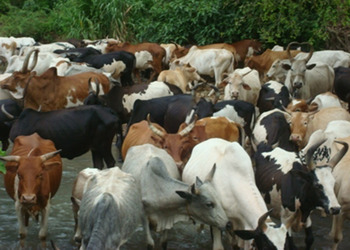
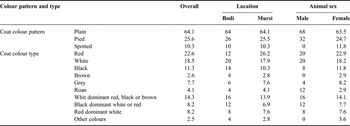
Qualitative body description of Mursi cattle population show variable coat colour pattern and colour types among individual cattle (Figure 1). The most commonly observed coat colour patterns were plain (64.1 percent), pied (25.6 percent) and spotted (10.3 percent) with different colour combinations and were similar in the two study locations. Males predominantly have plain coat colour (68 percent) and while the rest 32 percent possess pied coat colour. Similarly most (63.5 percent) of the female cattle population were of plain coat colour, while 24.7 percent were pied and 11.8 percent of spotted coat colour patterns.
Variable coat colour types and colour patterns of a Mursi cattle herd.

The dominant plain coat colours of Mursi cattle breed were 22.6 percent red, 18.5 percent white and 11.3 percent black, while the rest 14.4 percent were different colour types such as grey, brown and fawn. The pied coat colour are variable, in which white is found to be dominant colour that covers most part of animals’ body with red, black or brown combination (14.3 percent). Black dominated black-white or black-red pied coat colour comprises 8.2 percent in proportion. A dominant red colour with white combination made up the lowest proportion (8.2 percent) of the total population. The remaining 2.5 percent of the population consists of different coat colour combinations (Table 1). Rege and Tawah (Reference Rege and Tawah1999) also reported high coat colour variability for the breed. The variable coat colour probably helps the breed to adapt the very hostile environment through avoiding effects of radiation and heat stress (Olson et al., Reference Olson, Lucena, Chase and Hammond2003) and some colours do not attract the tsetse fly, preventing it landing, and this averts the fly biting the animal (Makokha et al., Reference Makokha, Karugiab, Staalc and Kosura2006).
Colour pattern and colour type (%) of Mursi cattle in the Bodi and Mursi pastoral areas of South Omo zone, Southwest Ethiopia.

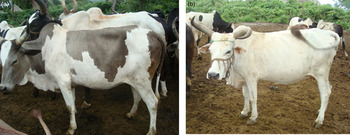
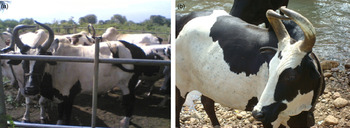
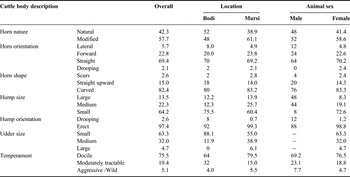
Particular morphological characteristics of Mursi cattle breed include its shiny and smooth hair type with large curved horns (Figures 1–3). Of the total population, 69.4 percent possess straight horns and some, (22.8 percent) possess forward oriented horns. The common horn shape is curved (82.4 percent), while some possess straight upward (15.0 percent) and most of the cattle (57.7 percent) have artificially modified horns. Artificial horn modification is manipulation of cattle horn from an early age to give the horn special shape desired by the owners. Horn modification is usually done through fastening the horn with a knotted rope to give a curved and twisted shape. The tips of the two horns come close together and form circular shape through time (Figures 3A & B). The purposes of horn modification are to give the animal a special look, ease identification of ownership and to protect the cattle from harming each other or humans. It also provides ease of restraint during milking, blood collection, or medication.
Coat colour type and colour pattern of a typical Mursi cows (a and b).

Typical Mursi bull with alternative (a) pied coat colour and (b) modified horn types.

The cattle breed is also characterized by its thoracic hump, which is distinctive characteristic feature of zebu cattle. Most (97.4 percent) of the cattle in the population possess an erect hump, while 2.6 percent have a laterally drooped hump. The hump size of the cattle was variable; most of the animals, (64.2 percent), possess a small hump, whereas the rest (22.3 and 13.5 percent) have medium and large humps, respectively. The male cattle have large (48 percent) and medium (44 percent) humps, whereas, the highest proportion of female cattle (72.6 percent) possess a small hump. As in other indigenous zebu cattle, the udder size of most cows (63.3 percent) is small, whereas, a few cows (32.0 percent) possess medium udder size and only 4.7 percent have a large udder size. Concerning the temperament of Mursi cattle, 75.5 percent of the animals were found to be very docile, while 19.4 percent were moderate and the rest 5.1 percent were very aggressive (Table 2). Male cattle were observed more aggressive than females. The pastoral communities in the two locations used cattle as a source of milk and blood for consumption (Terefe et al., Reference Terefe, Dessie, Haile, Mulatu and Mwai2012), and as a result, animals with good temperament are preferable for easy handling or restraining during milking, blood collection and medication. Therefore, docile cattle remain in the herd through long-term selection for docility.
Body description (%) of Mursi cattle in the Bodi and Mursi pastoral areas of South Omo zone, Southwest Ethiopia.

The morphological unalikability analysis indicated that the cattle breed is very variable. From these morphological traits, 85.9 percent of the population was unlikeable in coat colour type, while, 51.3 percent of the population differs in coat colour pattern. Similarly, the variability of individuals due to hump and udder size was variable with unalikablity coefficient of 0.52 and 0.49, respectively. Lower unalikablity coefficient was observed for hump orientation (0.05) and temperament (0.39) of the population. The variability of the cattle breed due to horn nature (0.49), orientation (0.46) and shape (0.29) may not be genetic but rather it might arise from horn modification made by individual cattle owners in the two communities (Table 2). The high coat colour variability observed in the population implies the existence of heterogeneity within the breed. This multiple coat colour and colour pattern variations come from preferential selection of the pastoral communities toward animals with variable coat colour pattern (Terefe et al., Reference Terefe, Dessie, Haile, Mulatu and Mwai2012) and uncontrolled mating.
Quantitative body measurement
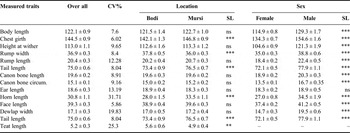
The overall least-square means and standard error of body length, chest girth and height at withers were 122.1 ± 0.9, 144.5 ± 0.9 and 113.0 ± 1.1 cm, respectively (Table 3). The measurements were significantly different (P < 0.001) between the male and female populations. No significant differences in body length and height at wither were observed between the cattle from the two locations. However, there were significant differences (P < 0.001) in chest girth, rump width, tail and horn length observed in Bodi and Mursi areas. Canon bone length and cannon bone circumference were 19.6 ± 0.2 and 15.1 ± 0.1 cm, respectively. Similarly, ear, horn, face, dewlap width and tail length measurements were 18.6 ± 0.3, 30.8 ± 1.1, 39.3 ± 0.3, 17.1 ± 0.3 and 75.0 ± 0.6 cm, respectively. The teat length of cows was 5.2 ± 0.3 cm and longer (P < 0.01) cows in the Bodi (5.6 ± 0.6 cm) than in the Mursi (4.9 ± 0.4 cm) areas. The significant differences of some measured body morphological traits of cattle between the two locations might be due to within breed variability, which has been seen in most cattle breeds in Ethiopia using molecular studies (Fedlu et al., Reference Fedlu, Bekele, Ayalew and Dessie2007). As a comparison with other cattle breed characterization results, the body measurements of Mursi cattle breed were superior to those of Kereyu cattle (Garoma, Reference Garoma2006) and Abigar (Nuer) cattle breeds (Minuye, Reference Minuye2009) under pastoral management system in Ethiopia, but its body frame is comparable with the Boran (Rege, Reference Rege1999) and Ogaden cattle breeds (Mekuriaw, Ayalew and Hegde, Reference Mekuriaw, Ayalew and Hegde2009). Similarly, this breed was found to be superior to the taurine Sheko cattle breed, which survive and produce in trypanosome prevalent area (Ayalew, Reference Ayalew2001).
Least square means and standard error of body measurements (cm) of adult Mursi cattle in the Bodi and Mursi pastoral areas of South Omo zone, Southwest Ethiopia.

SL = significance level; ns = non-significant; ** significant at P < 0.01; *** significant at P < 0.001.
Performance characteristics of Mursi cattle
Reproductive performance
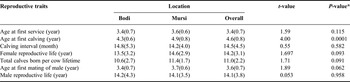
The mean age at first breeding of male and female cattle were reported to be 3.6 and 3.4 years, respectively (Table 4). The average age at first calving (AFC) of the female Mursi cow was 4.6 years and it was significantly (P < 0.001) lower in the Bodi (4.3 years) than in the Mursi (4.9 years) herds. The calving interval (CI) of Mursi cow was found to be 14.5 months and did not differ in the two pastoral communities. However, no notable cattle husbandry practices were observed in the Bodi pastoral communities that led heifers to have a lower AFC (Terefe et al., Reference Terefe, Dessie, Haile, Mulatu and Mwai2012).
Mean and standard deviation of reproductive performance of Mursi cattle in the Bodi and Mursi pastoral areas of South Omo zone, Southwest Ethiopia.

*Significant at P < 0.05.
AFC and CI of Mursi cattle breed is similar to that reported by Tesfaye (Reference Tesfaye2008) on the same breed. As a result, AFC of Mursi cattle in this study was similar to Kereyu cattle (Garoma, Reference Garoma2006) and Borana (Rege, Reference Rege1999) cattle breeds under pastoral management. However, the CI was lower than in Ogaden cattle managed on station farm (Mekuriaw, Ayalew and Hegde, Reference Mekuriaw, Ayalew and Hegde2009), and Abigar cattle under pastoral management (Minuye, Reference Minuye2009). The lower CI in the Mursi cattle might be due to breed difference or uncontrolled breeding practice (Terefe et al., Reference Terefe, Dessie, Haile, Mulatu and Mwai2012). Similar to the Sheko cattle breed, which was reported as a trypanosome tolerant breed in Ethiopia (Lemecha et al., Reference Lemecha, Woudyalew, Hussein, Rege, Tekle, Abdicho and Ayalew2006), the Mursi cattle inhabit a trypanosome epidemic area, and the two breeds have similar reproductive performances such as AFC and CI (Taye, Ayalew and Hegde, Reference Taye, Ayalew and Hegde2007). The lower CI produces more calves per cow, which increases herd size that grants the production of more milk from a larger number of cows in pastoral communities.
The mean reproductive lifetime of Mursi cow was reported to be 14.2 years. Within this reproductive lifetime, the mean number of calves born per cow was estimated to 11 calves (Table 4). The mean reproductive lifetime of Mursi cow is the same as the turine Sheko cattle breed (Taye, Ayalew and Hegde, Reference Taye, Ayalew and Hegde2007); however, the number of calves born in a lifetime of the Sheko cow is eight calves and is lower than the Mursi cow. The large number of calves per cow in Mursi cattle might be due to breed and management differences, with Mursi cattle being managed in open grazing compared with the restricted feeding management of Sheko cattle (Taye, Ayalew and Hegde, Reference Taye, Ayalew and Hegde2007). This uncontrolled breeding results all season reproduction of cattle as compared with the controlled breeding system (Mekonnen et al., Reference Mekonnen, Haile, Dessie and Mekasha2012), which results in a large number of calves produced in a herd that can raise household herd size for sustainable milk production (Terefe et al., Reference Terefe, Dessie, Haile, Mulatu and Mwai2012).
Milk production performance
Cow milking frequency in the two pastoral communities was reported two times as twice a day, in the morning and evening after grazing. The interviewees estimated the amount of milk produced per cow per day in their herd by recalling the apparent milk yield in spite of cows’ lactation stage and andty. The daily milk yield reported here is the amount excluding suckled by the calf. As a result, the daily milk production of Mursi cow does not exceed two “bakacha”, local wooden milking container measuring on average an equivalent of 1.5 litres. The mean daily milk produced per cow for human purpose was estimated to be 2.1 litres and the amount produced in the two pastoral communities did not differ (P > 0.05). The Mursi cow produce a higher quantity of milk compared with Kereyou (Garoma, Reference Garoma2006), and Abigar (Minuye, Reference Minuye2009) cattle, which are adapted in trypanosome free area of the country and are managed under pastoral management system. However, the milk yield was similar to that of Sheko cattle breed (2.3 litres) which is adapted to trypanosome prevalent area of Southwest Ethiopia (Taye, Ayalew and Hegde, Reference Taye, Ayalew and Hegde2007). Similarly, the average lactation length of Mursi cow was estimated to be 7.8 months and did not significantly vary in the two locations. From the mean daily milk yield and lactation length, the lactation yield of Mursi cow was estimated to be 453.4 litres (Table 5).
Mean and standard deviation of milk production performance of Mursi cattle (N = 102) in the Bodi and Mursi pastoral areas of South Omo zone, Southwest Ethiopia

*Significant at P < 0.05.
Cattle management practices
Feed and feeding management
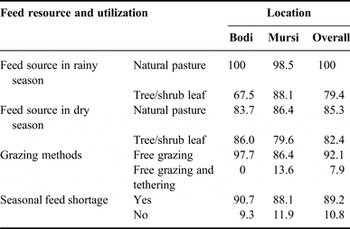
Natural pasture is the most common source for cattle grazing in the rainy season of the two locations. Beside to natural pasture, tree leaves and shrubs are used as cattle feed in rainy and dry periods (Table 6). In the two locations, 92.1 percent of the respondents said that the cattle feeding system is free grazing on communal grazing land. This system is a common feeding practice of cattle and other livestock in pastoral production system in the country. Some pastoral communities in the Mursi areas practice both free grazing and tethering, so that cattle that could not move long distances, such as calves are usually tethered on grazing areas near to the homestead.
Response (%) on feed resource and feeding management in the Bodi and Mursi pastoral communities in the Bodi and Mursi pastoral areas of South Omo zone, Southwest Ethiopia.

The majority of the pastoral communities (89.2 percent) responded that there is frequent seasonal feed shortage in quality and quantity in the two locations. This marked seasonal variation of feed resources is due seasonal variation in rainfall distribution (Tolera and Abebe, Reference Tolera and Abebe2007). The problem is aggravated by absence of feed conservation practices by the pastoral communities for the dry season and frequent droughts due to prolonged dry periods. The communities usually solve seasonal cattle feed shortages by trekking their cattle to the Omo River and grazing on the flood-recessed area. However, sufficient feed is available in the wet season and cattle graze close to human housing, whereas in dry season, animals travel long distances and sometimes the communities shift their location during an extended dry period to areas where grazing is available. They do not provide supplemental feeds for cattle of any production status and age groups that are able to graze on natural pasture. However, a few respondents reported that they provide cut grass to calves and sick cattle, which are unable to move long distances.
Cattle health management
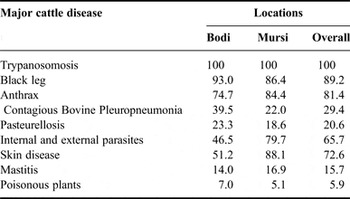
Disease is one of the major constraints of animal farming. The diseases identified from local naming in this study were based on their clinical signs and symptoms. According to the respondents, trypanosomosis, blackleg, anthrax and skin diseases were the major challenges to cattle production in the two pastoral areas (Table 7). Ticks and mangemites were the observed external parasites and where a critical problem in the area. The communities report that Contagious Bovine Pleuropneumonia (CBPP) and Pasteurellosis were the main cattle diseases that cause significant losses through cattle death and reduction of production.
Response (%) on major cattle diseases in the Bodi and Mursi pastoral areas of South Omo zone, Southwest Ethiopia.

The communities use traditional medication to prevent and treat cattle diseases. Local herbs are used to treat sick animals. Moreover, they usually smoke the barns to protect cattle from tsetse fly biting. The communities move their cattle away from tsetse fly infested areas when there is a high infestation during the wet season. Animals are watered at noon when tsetse flies become inactive and hide under vegetation to protect themselves from the intense heat (FAO, Reference Pollock1982).
Major cattle production constraints
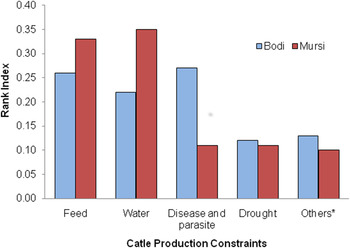
The main cattle production constraints reported by the Bodi communities were disease and parasite (rank index of 0.27), seasonal feed (0.26) and water (0.22) shortages (Figure 4). While the Mursi pastoralist ranked water shortage (0.35) as their first priority problem and feed (0.33) and animal disease (0.11) were second and third in their area. The Bodi communities settle along the Gura a river where water is available for livestock and human consumption, while the Mursi people live far from a water source and state this as the community's primary problem. Water and feed shortage due to erratic rainfall were the major challenges to cattle production in the two study locations, mainly in the Mursi area. The prolonged absence of rainfall in the area leads to drought that causes animal disease outbreaks and results in high cattle mortality. To cope with these problems, the communities move their herd to areas where pasture and water are available and usually cause conflict with neighbouring ethnic groups due to the sharing of resources and can result in theft and raiding of cattle.
Rank indices of major cattle production constraints in Bodi and Mursi pastoral communities in South Omo Zone, Southwest Ethiopia. (*Other production constraints include veterinary services, wild predators, infrastructure such as Market and roads, theft and conflicts that result in cattle raiding.)

Inadequate or complete absence of veterinary services in the area, absence of livestock markets and roads were identified as the major production constraints in the Bodi and Mursi pastoral communities. Absence of market in the areas limited the availability of production inputs such as veterinary supplies, sale of animals and animal products, which influence herd growth, productivity, and general livelihood of the pastoral communities. Hana and Jinka, the Salamago Wereda and South Omo zone administrative towns, respectively, are the only two small marketing places where the Bodi and Mursi communities have to travel long distances for marketing. In these markets, the communities sell their animals and purchase food grains especially in the long dry season. During this period, the communities’ consume mainly a grain-based diet since milk production is low and not sufficient for household consumption. Therefore, the communities have to travel a long distance to sell their cattle in distant markets and even in some worse drought seasons, they exchange live animals for food grains (Terefe et al., Reference Terefe, Dessie, Haile, Mulatu and Mwai2012).
Disease and parasite prevalence were among the listed main constraint that hindered cattle production in the Bodi and Mursi communities. This high disease and parasitic problem in the area might arise from the presence of different wild animals in the area that share common national park ecosystem with the livestock (Bengis, Reference Bengis2003). Besides being a disease and parasite reservoir, the wild animals are potential predators of livestock and are challenges to cattle production in the areas. This is because the communities graze their cattle in the national parks in dry season when grazing pasture is scarce. This situation is common for most pastoral areas that inhabit and share national park boundaries (Gegner, Reference Gegner2002) and these cause significant losses in cattle numbers.
Conclusion
The Mursi cattle breed shows morphological variability. This variability indicates absence of directional selection towards particular objective traits. However, the breed shows peculiar morphological characteristics that enable the separation of Mursi cattle from other breeds and ecotypes. On the other hand, the morphological variability may have contributed to its survival and production in the hot and humid environment where trypanosome is highly prevalent.
The long and large body frame of Mursi cattle compared to some breeds in the country means it could be a genetic resource to use in improvement programs. It provides an option to maximize beef production to satisfy the ever-increasing demand. The breed produces a higher quantity of milk compared with other indigenous cattle breeds that are managed under pastoral management system. The breed can also be used as a potential genetic resource to improve milk production through implementing appropriate breeding strategy in the pastoral production system. With this genetic potential, introducing the breed to a smallholder mixed production system, increases cattle genetic resource for alternate breed improvement in the country.
Even though the breed survives and produces through tolerating the existing hostile environment and trypanosomosis challenge, cattle production in the area is constrained by prevalent disease, seasonal feed and water shortages, and frequent drought. Absence of frequent vaccination and treatment of cattle in such hostile environment make the area potential to harbouring epidemic diseases and parasites that cause loss of cattle number. Therefore, alleviating these constraints should increase the productivity of Mursi cattle in their natural environment.
Acknowledgements
The authors would like to acknowledge ILRI for allocating the required budget and providing facilities for this study. We also acknowledge the South Omo zone and Salamago Wereda Administration and Agriculture office and Kebele agricultural development agents. Finally, we would like to forward our gratitude to the pastoral communities’ leaders for smoothing the progress of the study.