Introduction
The Republic of Ireland fell into economic recession in 2008 (O’Toole, Reference O’Toole2009). This was followed by a period of financial austerity, sharp rises in unemployment, large scale emigration, collapse of the property market and stringent reductions in public expenditure (Hillyard et al. Reference Hillyard, Lundström, Patsios, Machniewski, Taylor and Lyons2010; Taborda, Reference Taborda2014). An overall decrease in self-rated happiness in the general population followed the recession (Doherty & Kelly, Reference Doherty and Kelly2013).
In this study, we examine subjective well-being (SWB) in older Irish adults before and after the recession. We were concerned this population could be at particular risk because public expenditure cuts, such as cuts to the health budget and pensions, disproportionately affect the elderly, and their potential to change their financial situation tends to be more limited.
SWB is an individual’s affective and cognitive evaluations of his or her life (Diener et al. Reference Diener, Oishi and Lucas2002) and comprises a range of components including happiness (current enjoyment) and life satisfaction (long-term fulfilment) (Diener, Reference Diener2000; Kahneman et al. Reference Kahneman, Krueger, Schkade, Schwarz and Stone2006). Steptoe et al. (Reference Steptoe, Deaton and Stone2015) describe three components of well-being: evaluative well-being (based on evaluations of how satisfied a person is with his or her life); hedonic well-being (based on feelings or moods, such as happiness, sadness or anger); and eudaemonic well-being (based on judgements about the purpose and meaning of life).
Higher SWB is associated with multiple social benefits (Lyubomirsky et al. Reference Lyubomirsky, King and Diener2005; Diener, Reference Diener2012), good physical health and longevity (Howell et al. Reference Howell, Kern and Lyubomirsky2007; Chida & Steptoe, Reference Chida and Steptoe2008; Diener & Chan, Reference Diener and Chan2011), although the effects on longevity might not be independent of health status (Liu et al. Reference Liu, Floud, Pirie, Green, Peto and Beral2016).
SWB has been measured in a variety of ways ranging from simple linear scales (Sacks et al. Reference Sacks, Stevenson and Wolfers2012) to more complex, constructed measures (Huppert & So, Reference Huppert and So2013). In this study, we used a composite measure of SWB that includes both happiness and life satisfaction, rated directly by the individual. This measure is consistent with those used in many previous studies (Lee et al. Reference Lee, Kim and Shin1982; Suhail & Chaudhry, Reference Suhail and Chaudhry2004) and meta-analyses (Howell & Howell, Reference Howell and Howell2008), and so facilitates comparison of our findings with previous work.
For the present study, we studied SWB in older Irish adults before and after the recession, comparing findings from two methodologically consistent cross-sectional surveys, one before and one after the recession (as opposed to a longitudinal analysis on the same people).
Methods
This analysis is based on cross-sectional data from the European Social Survey (ESS), an academically driven, biennial cross-sectional survey, collected between 2002 and 2012. Data were collected by hour-long face-to-face interviews (Jowell & the Central Coordinating Team, Reference Jowell2003) and are available on an open access basis (www.europeansocialsurvey.org). A different cohort is used for each round of the ESS so extensive work has been done to ensure the reliability and validity of the methodology (Jowell & the Central Coordinating Team, Reference Jowell2003; ESS, 2012). Response rates over the last 12 years for Irish ESS samples have been almost 70% which is consistent with the ESS target response rate. Samples are designed to represent all individuals over the age of 15 years and are based on strict random probability methods. Our analysis included only individuals aged 65 years or more in Ireland.
We calculated SWB by summing up participants’ responses to two ESS questions: ‘All things considered, how satisfied are you with your life as a whole nowadays?’ (where 0 means ‘extremely dissatisfied’ and 10 means ‘extremely satisfied’), and ‘Taking all things together, how happy would you say you are?’ (where 0 means ‘extremely unhappy’ and 10 means ‘extremely happy’). These questions were answered on Likert scales and, as a result, the potential range for SWB scores was 0–20, with higher scores indicating greater SWB.
The primary exposure in this study was the economic recession, which started in 2008. All data collected from 2002 to 2008 were considered unexposed to the recession and all data collected from 2009 to 2012 were considered exposed. Data from 2008 was considered unexposed because previous papers have demonstrated that the effects of the recession take some time to emerge (Doherty & Kelly, Reference Doherty and Kelly2013; Van Hal, Reference Van Hal2015). We also examined a range of potential confounding variables [subjective general health, living with a partner (yes/no) and area of residence (urban/rural)] and effect modifiers (age and gender). All data were derived from the ESS.
‘Subjective general health’ was assessed by asking: ‘How is your health in general?’ Participants selected one of five responses: ‘very good’, ‘good’, ‘fair’, ‘poor’ and ‘very poor’. The ‘poor’ and ‘very poor’ health categories were combined due to low numbers, and this was treated as a categorical variable.
Area of residence was ascertained by asking participants to choose which term from a list best described where they resided. Big cities, suburbs and towns were coded as ‘urban’; farmhouses and rural villages as ‘rural’.
We analysed data using IBM SPSS Statistics (version 20). Data were checked using frequency distributions for errors and inconsistencies. Missing data were evaluated to ensure they were coded correctly as missing. Data were weighted according to the guidelines given by the ESS (Ganninger, Reference Ganninger2007). t-Tests were used to compare the means of continuous variables before and after the recession. χ 2 Tests were used to compare categorical variables. A multi-variable linear regression model was created to explore covariates with SWB as the dependent (‘outcome’) variable.
Results
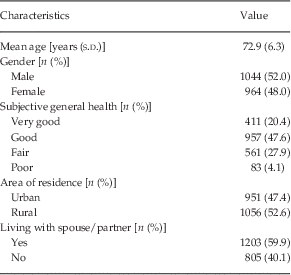
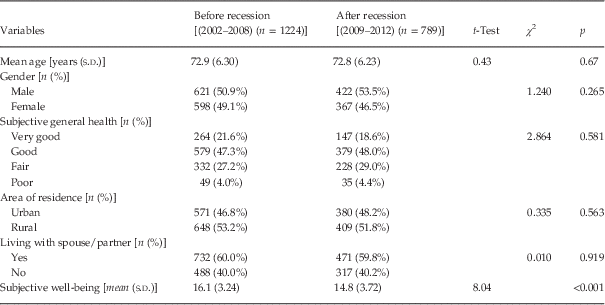
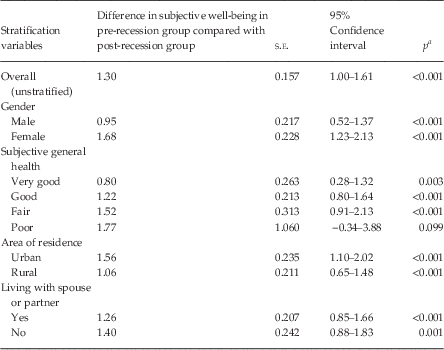
The data set included 2013 participants ranging in age from 65 to 101 years (Table 1). Of these, 1224 (60.8%) were surveyed between 2002 and 2008 (inclusive) and 789 (39.2%) were surveyed between 2009 and 2012 (inclusive). Pre-recession and post-recession samples did not differ in terms of age, gender, subjective general health, area of residence or whether or not the participant was living with a spouse or partner (see Table 2). There was, however, a significant difference in SWB, which was 1.30 points lower after the recession compared with before the recession [s.e. 0.16; 95% confidence interval (CI) 1.00–1.61; p<0.001]. Before the recession, mean SWB was 16.1 (s.d. 3.24), out of a possible 20; after the recession, it stood at 14.8 (s.d. 3.72).
Demographic characteristics of all study participants (aged over 65 years) (n = 2013)

Comparison of study participants before (2002–2008) and after (2009–2012) the economic recession in Ireland

There was minimal variation in the association between age and SWB before and after the recession (Pearson’s correlation coefficient −0.017; p = 0.548 v. Pearson’s correlation coefficient 0.003; p = 0.928) and as a result age was not examined as a potential effect modifier. Female gender, poor health and urban living were associated with larger differences in pre- and post-recession SWB (Table 3). Visual inspection of these graphed trends (not shown) and the variation in SWB observed in Table 3 (the most reliable methods for detecting effect modification), suggested the presence of effect modification.
Reduction in mean subjective well-being in two different groups of older adults in Ireland after the recession (2009–2012) (n = 789) compared with before the recession (2002–2008) (n = 1224), stratified by potential confounders

a Comparing each group before and after recession.
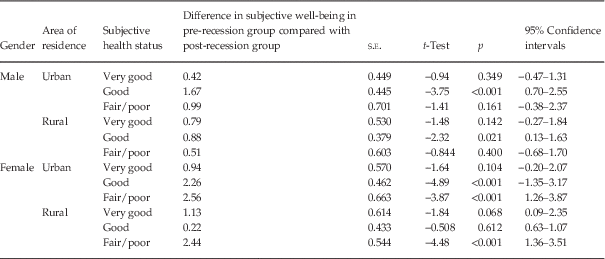
Based on the results of stratification, we created a stepwise linear regression model with SWB as the outcome variable, and, through the addition of interaction terms, found that female gender, urban residence and poor subjective general health all modified the association between recession and SWB: all were associated with greater differences in pre-and post-recession SWB. Results were therefore stratified by these variables. The variables for ‘age’ and ‘living with a partner or spouse’ were included in the regression analysis as potential confounders (see Table 4). Overall, the mean SWB of participants who described their health as ‘good’ was 3.43 points higher than those who described their health as ‘poor’ or ‘very poor’ (s.e. 0.39; 95% CI 2.66–4.20; p<0.001).
Difference in mean subjective well-being in two different groups of older adults in Ireland after the recession (2009–2012) (n = 789) compared with before the recession (2002–2008) (n = 1224), controlled for age and co-habiting status (stratified by effect modifiers: gender, area of residence and subjective health status)

Discussion
We found that Ireland’s economic recession was associated with a significant lower in SWB in older adults, especially women, those with poor health and those living in urban areas. This is consistent with the literature demonstrating that deprivation and deficits in material standards of living, along with compromised social support services, have a negative impact on SWB in older adults (George, Reference George2010). Deprivation was strongly linked with SWB the data examined by Watson et al. (Reference Watson, Pichler and Wallace2010).
Notwithstanding the sampling methodology (two cross-sectional samples), it is notable that pre- and post-recession groups did not differ in terms of age, gender, subjective general health, area of residence or whether or not the participant was living with a spouse or partner (Table 2).
Our results suggest that, among older adults, women, those with poor subjective health and urban-dwellers were disproportionately affected by the recession in Ireland, although it should be emphasised that these observations are based on our comparison of cross-sectional surveys in different people at different times (rather than a longitudinal study of the same people).
Good subjective general health seems to have been protective. Older women in Ireland have previously been identified as having high rates of isolation, lack of personal support and poor community links (Whelan, Reference Whelan2009). Our findings add to this concern by suggesting links between gender and SWB during the recession. Further investigation into the reasons why women might be disproportionally affected by recession would assist in targeting specific strategies for intervention.
Existing literature provides some preliminary suggestions. Whelan (Reference Whelan2009), for example, in her study of 495 people over the age of 70 years in Ireland found that 40.7% of respondents with moderate/severe disability reported no state-provided home-help. Women were significantly more isolated than men: amongst those who lived alone, men were over twice as likely as women to have access to their own car. In terms of physical health, women scored lower than men in all domains examined, the difference being especially marked in terms of physical functioning. These factors – isolation, poor general health and diminished physical functioning – were all more common in women and together might increase women’s vulnerability to the effects of recession on SWB.
It is also possible, though unproven, that a stronger sense of community in rural rather than urban areas might be protective for the SWB of this group, but this possibility requires further research. Other possible contributors, such as direct income reduction, loss of medical cards or benefits, exposure to crime or a greater awareness of financial struggles amongst adult children, also merit further study.
The present study has several strengths. We have addressed an important issue, SWB in older adults, at a critical and arguably unique juncture in Ireland’s economic history. SWB is important not only in its own right but also owing the association between low SWB and poor mental and physical health in the elderly (Ní Mhaoláin et al. Reference Ní Mhaoláin, Gallagher, O Connell, Chin, Bruce, Hamilton, Teehee, Coen, Coakley, Cunningham, Walsh and Lawlor2012). This association is based on cross-sectional findings, which does not elucidate direction of effect, so it is essential that longitudinal work is performed to elucidate the influence, if any, of SWB on later outcomes. Finally, in the present study, we analysed data relating to a large number of older adults, which allowed us to account for multiple potential confounders and optimises the generalisability of our findings.
This study also has limitations. The data used in this study were obtained from a survey not specifically designed for our research questions. It is, however, relevant that extensive work has been done to ensure the reliability and validity of the ESS questionnaire (Jowell & the Central Coordinating Team, Reference Jowell2003; ESS, 2012) and the response rate over the last 12 years for the Irish cohort is good (almost 70%), consistent with the ESS target response rate. Nonetheless, as with any survey, there is a possibility of respondent bias, although it is unlikely that such bias would differ significantly before and after the recession and it is thus unlikely to have affected comparisons in our study.
It should also be noted that a different cohort is used for each round of the ESS. As a result, our analysis was based on cross-sectional survey data rather than looking at the same individuals over time. It is therefore not possible be certain that being exposed to recession is associated with a decline in SWB. A longitudinal study of the same individuals before and after the recession would be necessary in order to elucidate this definitively.
Finally, this study did not take account of socioeconomic status, which is likely to be related to SWB. It is possible, for example, that higher socioeconomic status provided some insulation against the effect of the recession on SWB or, indeed, that people in lower socioeconomic groups, such as those on social welfare, did not feel it’s effects as acutely. In any case, there is a strong need for a study that would control for socioeconomic status and thus identify the effect, if any, of the recession on SWB independent of socioeconomic status. Ideally, such a study, unlike the present one, would have assessed the same cohort of people before and after the recession.
Future research could also usefully examine the possible effects of social welfare benefits restoration or media coverage of economic recovery and the impact, if any, that these had on SWB. The effects of benefit cuts and restorations are likely to be of particular relevance in the special circumstances of many older people on fixed incomes who have diminished ability to alter their economic situation in the face of changes in broader economic circumstances. This group merits particular attention in future studies. The role of media is also likely to be significant, especially as saturation negative coverage of Ireland’s recession gradually shifted to a more positive tone, possibly affecting population SWB in the process. This merits closer study.
Conclusions
The results from our study present significant cause for concern, especially given the potential association between low SWB and increased risk of mental and physical health problems in the elderly. Poor health, in turn, might also diminish SWB in this population and this may lead to a further downward spiral. Following the economic recession in Ireland, there were significant cuts to spending on medical and social care (Hillyard et al. Reference Hillyard, Lundström, Patsios, Machniewski, Taylor and Lyons2010), both of which disproportionately affect the older adult population, especially those with poor health. The risk that austerity measures pose to the most vulnerable has already been highlighted in the literature (Wahlbeck & McDaid, Reference Wahlbeck and McDaid2012). From the perspective of SWB, our findings further emphasise the importance of ensuring protections for this vulnerable group in the event of future economic challenges. Future research could usefully focus on older people on fixed incomes who have diminished ability to alter their economic situation and might thus be more vulnerable to the effects of economic recession.
Acknowledgements
The authors are very grateful to the reviewers for their comments and suggestions.
Financial Support
None.
Conflicts of Interest
None.
Ethical Standards
The authors assert that all procedures contributing to this work comply with the ethical standards of the relevant national and institutional committee on human experimentation with the Helsinki Declaration of 1975, as revised in 2008. The authors assert that ethical approval for publication of this paper (analysis of anonymised data already in the public domain) was not required by their local REC.