

Introduction
Producing sufficient food from animal origin in sustainable production systems is a major challenge in the coming decades. A major difference with the past is that today, for a sustainable future, the growth in food production should come at an acceptable cost to the planet and society as a whole. Therefore, the key issue facing global agriculture is not simply ‘more’, but ‘more for less’, without compromising the health and welfare of animals.
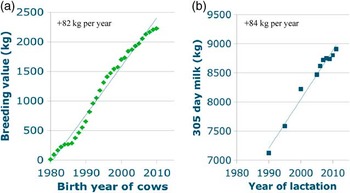
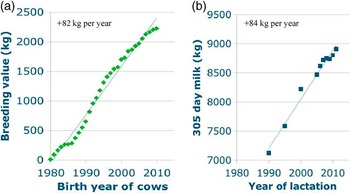
For centuries, animal breeders have very effectively been selecting livestock species, making use of the natural variation that exists within the population. Selection has been successful and, for example, in The Netherlands milk yield increased annually by 84 kg milk/cow per year over the past decades. If we calculate the genetic trend then 82 kg milk/cow per year could be subscribed to the genetic progress (Figure 1). This demonstrates that genetic improvement has been a major driver to increase productivity at the animal level; and has made an important contribution to the positive trend in food security over the past years.
The estimated genetic trend for 305 day milk production per cow per lactation (a) and the observed phenotypic trend (b) in The Netherlands.
Since the mid-nineties most leading EU dairy cattle breeding programmes have expanded their breeding goals to include health and fertility traits in addition to milk production (Miglior et al., Reference Miglior, Muir and Van Doormaal2005). This development was supported by the growing evidence of the genetic variance that exists for these traits, and the existing negative genetic correlation between productivity and some health and fertility traits (Pryce et al., Reference Pryce, Veerkamp and Simm1998a and Reference Pryce, Esslemont, Thompson, Veerkamp, Kossaibati and Simm1998b). At farmer level, the introduction of milk quota supported the emphasis for other traits as well, as cost reduction became relatively more important relative to increasing productivity per se. Longevity was one of the first traits considered in many countries, partly because it did not require additional recording of traits (Veerkamp et al., Reference Veerkamp, Hill, Stott, Brotherstone and Simm1995).
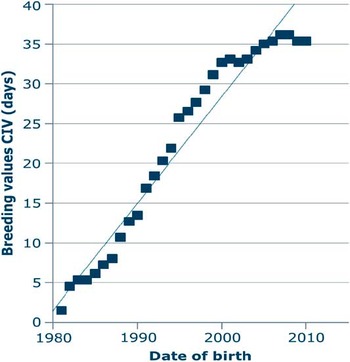
The effectiveness and the need for expanding breeding goals is shown in Figure 2. In the early nineties, the genetic component for calving interval was increasing consistently, making it more difficult for dairy farmers to achieve their fertility targets. However, following the increased emphasis on fertility in the breeding goals and the improved availability of selection tools for fertility, the unwanted genetic trend has levelled off. Today yet further expansion of breeding goals allows animal breeding to contribute to improving welfare and the ethical considerations (D'Eath et al., Reference D'Eath, Conington, Lawrence, Olsson and Sandoe2010; Oltenacu and Broom, Reference Oltenacu and Broom2010; Nielsen et al., Reference Nielsen, Olesen, Navrud, Kolstad and Amer2011; Neeteson-van Nieuwenhoven et al., Reference Neeteson-van Nieuwenhoven, Knap and Avendaño2013).
The estimated genetic trend for calving interval for cows in The Netherlands.

As part of the developments towards broader breeding goals, the RobustMilk project was designed to have a specific focus on improving robustness of cows and improving milk quality. The objective of the project was to develop new practical technologies to allow breeders to re-focus their selection to include milk quality and dairy cow robustness and to evaluate the consequences of selection for these traits taking cognisance of various milk production systems.
Robustness
Robustness is a broad term and has been given several different connotations. We defined robust dairy cows as cows that are healthy, fertile and profitable (i.e. maintain homeostasis) under a range of commonly accepted and sustainable farming systems (ten Napel et al., Reference ten Napel, Calus, Mulder and Veerkamp2009). Robust cows play a central role in the development of agricultural competitiveness and rural sustainability within social constraints. Genetically robust dairy cows are less sensitive to sub-optimal circumstances, and therefore put fewer constraints on new farming systems. In addition, they need fewer drugs or other chemical inputs, without compromising health, welfare or economic efficiency, and as a result are less likely to be prematurely culled. Form this overall definition of Robustness, within the RobustMilk project two priorities were selected, energy balance and environmental sensitivity.
Energy balance
Energy output is greater than energy intake in most mammalian species during early lactation (Robinson, Reference Robinson1986). This leads to the phenomenon now internationally referred to as ‘negative energy balance’ (NEB). Others (Coffey et al., Reference Coffey, Simm and Brotherstone2002) showed how dairy cows selected for high yield progressively lost body energy content over three lactations compared with cows selected for average yield and the same authors showed how diet interacted with genotype for energy content. Several studies have implicated the extent and duration of NEB as a precursor for impaired health in dairy cows (Collard et al., Reference Collard, Boettcher, Dekkers, Petitclerc and Schaeffer2000; Banos et al., Reference Banos, Brotherstone and Coffey2004) and fertility (Beam and Butler, Reference Beam and Butler1998; de Vries et al., Reference de Vries, van der Beek, Kaal-Lansbergen, Ouweltjes and Wilmink1999). Therefore, while the evolved mechanism, in many mammals, of storing body reserves during pregnancy, and mobilising them (with consequent NEB) in lactation might be seen as a robust, coping characteristic, the exaggeration of this phenomenon that has followed from genetic selection for performance can mean that the levels of NEB seen in modern cows represent reduced dairy cow robustness. Genetic studies undertaken (Svendsen et al., Reference Svendsen, Skipenes and Mao1994; Berry et al., Reference Berry, Veerkamp and Dillon2006; Berry et al., Reference Berry, Horan, O'Donovan, Buckley, Kennedy, McEvoy and Dillon2007) have shown genetic variation among animals in energy balance and its component traits, milk production and BW. Nonetheless, studies that estimated genetic parameters for energy balance in dairy cows have generally been confined to a small number of animals from research herds (Svendsen et al., Reference Svendsen, Skipenes and Mao1994; Veerkamp et al., Reference Veerkamp, Oldenbroek, van der Gaast and van der Werf2000; Berry et al., Reference Berry, Horan, O'Donovan, Buckley, Kennedy, McEvoy and Dillon2007) owing to the large resource demand particularly for measuring individual feed intake in dairy cows. Accurate quantification, as well as early prediction of cow and contemporary group energy balance status is vital in everyday herd management as well as identifying animals differing in genetic predisposition to greater negative energy balance and thus reduced dairy cow robustness.
Environmental sensitivity
Ten Napel et al. (Reference ten Napel, Calus, Mulder and Veerkamp2009) defined robustness as ‘the capacity to handle environmental disturbances in common, sustainable, ethically acceptable and economic farming situations’ encompasses two aspects of environmental sensitivity. Firstly, a robust cow is not sensitive to the variations in conditions that she might encounter during her life, normally within the same herd, but performs well (e.g. stays healthy) throughout life. However, a robust cow is also insensitive with respect to the different farming systems she might experience. In other words, it is possible to use a robust cow genotype in all relevant farming systems, and she will perform well (e.g. stay healthy). Note that with this definition of robustness there is no risk of using robust animals instead of having an acceptable farming system, as it is implicit that cows should only be robust to acceptable farming systems, rather than to any farming system. The two aspects of robustness were handled within the RobustMilk project by investigating the sensitivity of animals’ somatic cell counts (SCC) in milk to changes in the macro- and microenvironmental scale, and developing breeding tools for these traits.
Milk quality
The quality of milk comprises several aspects: organoleptic, technological, nutritional, hygienic (safety). Separately and together these aspects contribute to the quality of milk for human health. In a more general setting, the perceived quality of the product is also related to extrinsic factors such as the welfare of animals, the impact of production on the environment, as well as ethical considerations. In the RobustMilk project the nutritional and hygienic elements of milk quality in relation to human health were targeted.
Bovine milk represents a unique source of nutrients and bioactive components that act in synergy as well as independently (Huth et al., Reference Huth, Layman and Brown2004) and that can positively influence human health. For example, the milk fatty acid myristic acid is considered to have deleterious effects on cardiovascular disease (Hu et al., Reference Hu, Stampfer, Manson, Ascherio, Colditz, Speizer, Hennekens and Willett1999; Hu et al., Reference Hu, Manson and Willett2001) while another milk fatty acid, cis-9 trans-11 conjugated linoleic acid, could decrease the incidence of cancer and obesity in humans (Kelly, Reference Kelly2001). The average milk fat of a dairy cow contains 70% saturated fatty acids, 25% monounsaturated fatty acids and 5% polyunsaturated fatty acids. A more favourable makeup would be 30% saturated fatty acids, 60% monounsaturated fatty acids and 10% polyunsaturated fatty acids (Hayes and Khosla, Reference Hayes and Khosla1992; Pascal, Reference Pascal1996). Hence, the fatty acid profile of normal cow's milk is not optimal from a human perspective. However, this specific composition can be altered by using within breed genetic variation. In the same way lactoferrin, a glycoprotein present naturally in milk, is known to have antibacterial (Baker, Reference Baker2005) and antifungal (Farnaud and Evans, Reference Farnaud and Evans2003) effects and seems also to have an implication in host defense mechanisms (Ward et al., Reference Ward, Paz and Conneely2005) and the modulation of inflammatory process (Farnaud and Evans, Reference Farnaud and Evans2003).
Obviously, high SCC is an indication of impaired quality of production, because it is an indication of mastitis and compromised welfare of the cow. Clinical cases of mastitis are generally treated with antibiotics, and milk containing antibiotic residues leads to a possible risk for human health through growing antibiotic resistance of bacteria. For all these reasons, lower incidences of both clinical and subclinical mastitis are of great importance. However, high SCC shortens the shelf life of liquid milk (Ma et al., Reference Ma, Ryan, Barbano, Galton, Rudan and Boor2000) and reduces cheese yield and quality (Kitchen, Reference Kitchen1981; Munro et al., Reference Munro, Grieve and Kitchen1984). High SCC milk has also been shown to have high concentrations of plasmin (Kitchen, Reference Kitchen1981; Munro et al., Reference Munro, Grieve and Kitchen1984; Ma et al., Reference Ma, Ryan, Barbano, Galton, Rudan and Boor2000), an indigenous milk enzyme capable of hydrolysing caseins (Grufferty and Fox, Reference Grufferty and Fox1988; Bastian and Brown, Reference Bastian and Brown1996). Plasmin is the active component of a complex protease–protease inhibitor system in milk. It is relatively heat stable surviving minimum pasteurisation. The proteolytic action of plasmin can have a positive or negative impact on sensory or texture attributes of dairy products (Fajardo-Lira et al., Reference Fajardo-Lira, Oria, Hayes and Nielsen2000; Singh et al., Reference Singh, Drake and Cadwallader2003).
Interactions between robustness and milk quality
The challenge for genetic selection is not to select for more robust cows or healthier milk alone, the challenge is to select simultaneously for robust cows with improved milk quality. The simultaneous selection for more robust cows and higher milk quality might not be simple because biological pathways suggest an interaction between value added milk products and the robustness of the animals themselves. What may be good for human health may not be good for dairy cow health. For example, cows in negative energy balance mobilise body tissue reserves (with a high saturated fatty acid content), primarily in the form of fatty acids that are partitioned towards the mammary gland for milk synthesis, thereby affecting milk composition. Hence, level of free fatty acid content or the fatty acid composition in milk reflects cow energy status as well as potential effects on the quality of the milk produced. Similarly, lactoferrin is a milk bioactive molecule for human health but may also have a positive impact on dairy cow robustness, by way of improved udder health. This means that selection can rarely be aimed at only milk quality or robustness careful and thorough evaluation of the consequences of selection is required.
Development of practical breeding tools to breed more robust cows
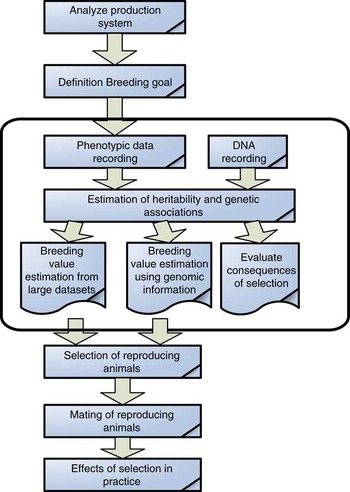
To enable selection and breeding for more robust cows that produce even healthier milk practical breeding tools are required together with careful evaluation of the consequences of these breeding tools. Modern cattle breeding programmes typically follow a sequence of steps, starting with the analyses of the production system and which animals are required in that system (breeding goals), and ending with mating of a selected group of animals (Figure 3). From this scheme, it becomes clear that the development of practical breeding tools for robustness and milk quality requires action in a number of areas.
Typical steps taken when developing a breeding programme.

Database with novel phenotypes
Refocusing breeding programmes requires novel phenotypic measurements for (i) the development of new phenotypic measurement tools, (ii) the evaluation of consequences of selection for traits other than those recorded nationally and (iii) the conduct of large-scale genomic studies.
Dairy cattle research facilities can record traits that are not readily available elsewhere. Examples are feed intake, very frequent measurement of traits such as milk yield, milk composition, live weight, milk progesterone concentrations and milk quality measures. A number of research locations, globally, have the capability for such detailed recording and some have substantial historical datasets. The refocusing of breeding goals will be greatly facilitated, if historical and new data can be merged from those facilities with appropriate recording protocols and data. This is a logical activity although many facilities were established for specific purposes and their data might not be merged usefully in all circumstances. However, since at least some of these facilities have operated distinct genetic lines and that Holstein selection policies have led to related bulls being used all over the world, some research populations are genetically linked sufficiently to enable traditional genetic analyses of merged data. Genomic analysis might be less dependent on genetic linkage between the groups, and in fact a wider range of genetic backgrounds might be advantageous.
Phenotyping
The most direct step to redirect breeding goals is the availability of large-scale phenotyping at low cost in national dairy herds. These phenotypic measurement tools will find their way into animal breeding programmes readily through standard breeding value estimation procedures, which are already in place, after estimation of heritability and genetic parameters, and careful evaluation of the consequences of selection. Currently, milk samples all over Europe are analysed using mid-infrared (MIR) spectrometry as part of routine milk recording. However, the potential availability of a very large amount of absorbance spectral data is currently only used as input for calibrations for estimating the concentrations, in milk, of only a very few major components. There is an opportunity to broaden the estimation of traits for the quality of dairy products and robustness of animals by further exploitation of the MIR spectral data that can be obtained directly from raw milk. For example, partners in this project (Soyeurt et al., Reference Soyeurt, Dardenne, Dehareng, Lognay, Veselko, Marlier, Bertozzi, Mayeres and Gengler2006) developed different calibration equations to estimate the fatty acid profile in milk. Recently, the prediction of lactoferrin by MIR spectrometry was developed (Soyeurt et al., Reference Soyeurt, Colinet, Arnould, Dardenne, Bertozzi, Renaville, Portetelle and Gengler2007). For large-scale practical use, further refinement and validation across systems is required.
Statistical tools
Previous research (Fatehi et al., Reference Fatehi, Stella, Shannon and Boettcher2003; Kolmodin et al., Reference Kolmodin, Strandberg, Jorjani and Danell2003; Petersson et al., Reference Petersson, Kolmodin and Strandberg2005; Calus, Reference Calus2006; Carlén et al., Reference Carlén, Jansson and Strandberg2006; Nauta et al., Reference Nauta, Veerkamp, Brascamp and Bovenhuis2006) has shown that genotype by environment interactions (G × E) are generally stronger for non-production traits, such as fertility, SCC and mastitis, than for milk yield traits. Therefore, it makes sense to evaluate environmental sensitivity of animals when considering robustness and milk quality defined as SCC. The requirement is that data from national recording schemes can be used. Reaction norm models have proven to be able to model environmental sensitivity (Calus and Veerkamp, Reference Calus and Veerkamp2003; Kolmodin et al., Reference Kolmodin, Strandberg, Jorjani and Danell2003; Windig et al., Reference Windig, Calus, Beerda and Veerkamp2006). However, these studies described sensitivity on the macroenvironmental scale. Even if the expected performance of two sires (measured in their daughters) in a certain environment is the same, the variance in performance within their daughter group may differ (Mulder, Reference Mulder2007). This genetic heterogeneity of environmental or residual variance can be considered as reflecting genetic differences in environmental sensitivity to fluctuations in the microenvironment (e.g. Sorensen and Waagepetersen, Reference Sorensen and Waagepetersen2003; Rowe et al., Reference Rowe, White, Avendano and Hill2006).
In RobustMilk analytical tools are developed that use available data from national recording schemes to estimate breeding values for robustness (realising that environments are quite diverse and subject to changes), in milk quality and their interaction for estimating breeding values for robustness.
Genomic tools
Selection for milk quality and robustness is hindered by the scarcity of phenotypic measurements for robustness and milk quality traits. The existing phenotypic measurement tools are often not suitable for use on commercial dairy farms as they cannot be used for large-scale recording of animals. Tools exploiting genomic information may alleviate some of the requirements for these phenotypic measurement tools.
The release of the first draft of the sequence of the cattle genome in October 2004, and the development of >50 K SNP chip for cattle meant that within the RobustMilk project we could begin analysing the bovine genome to uncover more information about individual genes and their effects on important traits in cattle, and to include genome-wide marker information for predicting breeding values. Genomic selection as described previously (Meuwissen et al., Reference Meuwissen, Hayes and Goddard2001) predicts breeding values for a large number of haplotypes across the entire genome that are derived from (combinations of) marker alleles. Compared with traditional breeding practice, including such information yields a considerable increase in selection responses for juvenile animals that do not have phenotypic records (Calus et al., Reference Calus, Meuwissen, de Roos and Veerkamp2008) and potentially can reduce the costs of a breeding programme up to 90% (Schaeffer, Reference Schaeffer2006). Methodology and software to estimate the association of many tens of thousands of SNP with a single trait was developed before RobustMilk, and within RobustMilk this was expanded in several directions, for example, expanding this method to enable estimation of the association of many SNPs with multiple traits. Multiple trait genomic selection might enable selection of genes that influence only one of the breeding goal traits (i.e. milk quality and/or robustness), or influences multiple breeding goal traits, but all in the desired direction.
Conclusions
At the onset RobustMilk was an ambitious programme aiming to develop new practical technologies that will allow breeders to re-focus their selection to include milk quality and dairy cow robustness and to evaluate the consequences of selection for these traits taking cognisance of various milk production systems. For robustness the focus was on energy balance, SCC and fertility, and for milk quality on fatty acid composition, lactoferrin and SCC. In the following papers you will read the developments and outcomes during the project.
Acknowledgements
The RobustMilk project is financially supported by the European Commission under the Seventh Framework Programme, Grant Agreement KBBE-211708. RobustMilk acknowledges the financial support of EAAP towards the cost of publication. The content of this paper is the sole responsibility of the authors, and it does not necessarily represent the views of the Commission or its services.
For more information, please visit the website www.robustmilk.eu, read the other papers in these proceedings or contact the project coordinator: Roel F. Veerkamp (E-mail: Roel.Veerkamp@wur.nl)