INTRODUCTION
Verbal fluency is a linguistic production task that examines the ability to generate words under two constraints: a limited time to perform and a determined word retrieval cue. Traditionally, the cues that have been studied are letters and semantic categories. Subjects are required to say, during one minute, as many words as they can think of that begin with a given letter, or names of objects pertaining to the same semantic category. The task demands not only lexical access but also executive control, given that it requires an active information search.
Impaired verbal fluency is associated with frontal lobe damage, particularly the left frontal lobe (Lezak, 1995; Stuss et al., 1998). Neuroimaging studies consistently support the implication of the dorsolateral prefrontal cortex in this task. However, recent studies have provided some evidence about the involvement of other cortical areas such as temporal and parietal regions (Boivin et al., 1992; Cuenod et al., 1995; Elfgren & Risberg, 1998; Frith et al., 1991; Parks et al., 1988; Shedlack et al., 1991).
Some authors claim that, although executive processes are necessary for initiating and monitoring all verbal fluency tasks, there may be different neuroanatomical substrates for these, depending on the word retrieval cue involved. Fluency tests requiring word generation according to a category of words requires the activation of a semantic system. In contrast, letter fluency must be performed at a phonological level (Leggio et al., 2000). Therefore, it has to rely on an unusual word search in the lexicon, so the process is effortful, less automatic and requires the generation of a novel strategy to make correct selections, to inhibit intrusions, and to keep a constant level of focused attention (Martin et al., 1994). Thus, phonemic fluency might be particularly dependent on executive functions mediated by prefrontal cortex, whereas semantic fluency may be more related to temporal regions. This dissociation has received support from several sources.
Functional imaging studies have revealed consistent activation of prefrontal cortex during phonemic fluency task (Cuenod et al., 1995; Elfgren & Risberg, 1998; Shedlack et al., 1991). Additional regions, including cerebellum, have been reported (Fu et al., 2006; Hubrich-Ungureanu et al., 2002; Schlösser et al., 1998). Regarding semantic (category) fluency, Pihlajamäki et al. (2000), found that the most consistent activation during this task occurred in the temporal lobe. To date, only one study has compared activation during performance on both phonemic and semantic verbal fluency tasks (Gourovitch et al., 2000). They observed that both tasks increased activation in left prefrontal regions, but left temporal cortex was revealed to be activated more during semantic than phonemic fluency. Other electrophysiological data are, in general, consistent with a special relation of phonemic fluency with frontal lobes, although the networks underlying both tasks overlap to some degree (Billingsley et al., 2004; Brickman et al., 2005).
The behavioral data agree with this dissociation. Martin et al. (1994) found that a secondary task designed to activate the frontal lobe (motor sequence) disrupted phonemic but not semantic fluency. A temporal-lobe-activating secondary task (object decision) was associated with the opposite pattern. Regarding clinical studies, Stuss et al. (1998) assessed patients with focal lesions in frontal and non-frontal brain regions. They found that patients with left dorsolateral and/or striatal lesions were most impaired in phonemic fluency. Similar results were obtained by Baldo et al. (2001). They observed that frontal patients produced fewer items in phonemic fluency, compared to control participants. However, semantic fluency did not appear deteriorated in patients.
Recently, the action fluency test (AFT) has been proposed as a new verbal fluency task. This consists of asking the subject to rapidly generate verbs. In a similar way to phonemic fluency, AFT may require unusual lexicon searching, so it may rely heavily on the executive aspects of search and retrieval mechanisms (Woods et al., 2005a). Indeed, some researchers found moderate relationships between action fluency and several putative executive measures (Piatt et al., 1999b; Woods et al., 2005b). Clinical studies with Parkinson's disease and HIV-1 serostatus patients concluded that the AFT may be particularly sensitive to fronto-basal ganglia pathophysiology (Piatt et al., 1999a; Woods et al., 2005a, 2006). In addition, it has been suggested that verb generation is especially associated with frontal lobe functioning. Damasio and Tranel (1993) described three brain-damaged patients with a double dissociation between noun and verb retrieval. Two patients, who had lesions in the left anterior and middle temporal lobe, presented a selective deficit in noun retrieval. On the other hand, the third patient, who had a left premotor lesion, showed a selectively impaired performance in verb retrieval. They have suggested that mediation systems for verb retrieval are in the left frontal region. Similar data were reported by Daniele et al. (1994) in two patients with atrophy of the posterior regions of the left frontal lobes. Neuroimaging data indicate that the neural networks underlying verb and noun generation overlap to some degree, but verb generation is more closely associated with the frontal lobes and the frontal cortical-subcortical systems (Perani et al., 1999).
In recent decades, the cerebellum, a subcortical structure traditionally associated with motor functions, has been related to high cognitive functions (Ivry & Fiez, 2000; Leiner et al., 1986, 1993; Nieto Barco et al., 2004; Schmahmann & Sherman, 1998). Neuroimaging studies have shown cerebellum activation in a variety of cognitive tasks, including verbal fluency (Gourovitch et al., 2000; Hubrich-Ungureanu et al., 2002; Schlösser et al., 1998) and verb generation tasks (Martin et al., 1995; Papathanassiou et al., 2000; Petersen et al., 1989, 1998; Raichle et al., 1994; Seger et al., 2000). Regarding action fluency, to our knowledge, only two studies have examined verb generation in patients with cerebellar degeneration, reporting normal performance in this task (Helmuth et al., 1997; Richter et al., 2004). In both studies, the samples were heterogeneous, including patients with spinocerebellar degenerations and other types of cerebellar ataxia (autosomal dominant cerebellar ataxia type III [ADCA-III], idiopathic cerebellar ataxia [IDCA], etc.). These clinical data have been obtained from tasks where verbs are generated in relation to a given noun or picture. The generation of verbs in the absence of prompting stimuli (i.e., action fluency paradigm) has been unexamined in cerebellar patients.
In the present work we aimed to study phonemic, semantic, and action fluency tasks in patients with Friedreich's Ataxia (FRDA). FRDA is the most common syndrome of the cerebellar ataxias. The pathological changes of FRDA fundamentally involve the spinal cord, with degeneration of posterior columns and spinocerebellar tracts and the dentate nucleus (Berciano et al., 2002). The disease is associated with a mutation that consists of an unstable expansion of GAA repeats in the first intron of the frataxin gene (the X25 gene) on chromosome 9 that leads to a marked deficiency of frataxin (Dürr et al., 1996). Frataxin is a mitochondrial membrane protein involved in iron distribution. Frataxin deficiency causes iron accumulation in mitochondria, fundamentally in cardiac muscle and in the cerebellar dentate nucleus (Waldvogel et al., 1999), which, in turn, produces mitochondrial dysfunction (Bidichandani et al., 1998). This is probably what is responsible for the degenerative changes in FRDA (Berciano et al., 2002; Campuzano et al., 1996; Pandolfo, 2002).
Although established as the most common syndrome of cerebellar ataxias, almost no attention has been paid to FRDA from the neuropsychological field of study. Deficits have been described in some cognitive processes such as executive and mnesic functions and information processing speed, as well as some visuospatial and visuoconstructive functions (Botez-Marquard & Botez, 1993; Fehrenbach et al., 1984; Hart et al., 1985; Mantovan et al., 2006; White et al., 2000; Wollmann et al., 2002, 2004). An explanation for these deficits is that they are caused by the affectation of the cerebro-cerebellar circuits proposed as the anatomical substrate of the cerebellum's involvement in cognitive processes (Botez-Marquard & Botez, 1993, 1997, Wollmann et al., 2002, 2004). This is the most common interpretation of the described findings. A second explanation is that the observed deficits are caused by a primary cerebral affectation. Similarly to neurons of the dorsal root ganglia, spinal cord or dentate nucleus, other neural systems may be affected by the frataxin deficiency, although in a subtler way (Mantovan et al., 2006). There is no neuropathology evidence supporting this interpretation (Lamarche et al., 1984; Oppenheimer, 1979), although it is necessary to consider that it has rarely been investigated until the present.
Fluency deficit is one of the impairments described in patients with spinocerebellar degeneration (Bürk et al., 1999; Hirono et al., 1991; Storey et al., 1999), but results from the examination of phonemic and semantic fluency in FRDA patients are contradictory (Mantovan et al., 2006; White et al., 2000; Wollmann et al., 2002). As we noted earlier, no action fluency data in any type of cerebellar patients have been published until now.
Some authors postulate that the verbal fluency deficits observed in cerebellar patients are not because of an executive/cognitive dysfunction but rather to the dysarthria shown by these patients (Berent et al., 1990). Indeed, the common presence of dysarthria in these syndromes constitutes one of the handicaps for the examination of verbal fluency. Also, the existence of cognitive slowness renders the examination of verbal fluency difficult, given that it is a temporally restricted test (Botez-Marquard & Botez, 1997; Hart et al., 1985; Schmahmann & Sherman, 1998; White et al., 2000; Wollmann et al., 2002, 2004). Therefore, the assessment of verbal fluency in this clinical population requires taking into account the variables mentioned above. However, direct control of these factors has not been reported in the majority of studies.
In summary, our first goal in this study was to address the problem of conflicting data on semantic fluency in cerebellar disorders. Second, we sought to determine whether subjects with FRDA demonstrate particular impairment on fluency tasks, such as letter and action fluency, that places particular demands on executive function. Finally, because subjects with FRDA may demonstrate dysarthria and slowing of responses, both of which could impact verbal fluency task performance, we tested the relationship between measures of dysarthria and response of time and verbal fluency.
METHOD
Participants
Twenty-four FRDA patients and 20 healthy and neurologically normal control subjects were tested. All patients fulfilled the diagnostic criteria of FRDA (Harding, 1981) and presented the molecular genotype of FRDA. They presented a large homozygous GAA triplet-repeat expansion in the first intron of the frataxin gene (X25, within the critical region on chromosome 9). They showed progressive ataxia of limbs and gait, nystagmus, dysarthria and age of onset before 25 years old, except seven cases of Late Onset Friedreich's Ataxia [LOFA] (Dürr et al., 1996). Scoliosis was presented in 11 patients. Diabetes mellitus and cardiomyopathy were less frequent and was only shown by two and five patients, respectively. Four patients showed hypoacusis, but it did not prevent verbal communication. Ten patients were confined to wheelchairs, and the degree of ataxia of the other 14 ranged between minor swaying and standing/walking on a wide base. Other neurological, metabolic and major medical illnesses, Vitamin E deficiency, depression and alcoholism were excluded. The mean duration of illness was 21.54 (SD = 10.50), and the mean age at disease onset was 18.96 years (SD = 11.01). The Rankin Incapacity and the Nobile-Orazio Ataxia Scales were used to quantify disease severity (Nobile-Orazio et al., 1988; Van Swieten et al., 1988). Each patient was assigned a score from 0 (normal) to 5 (most impaired). MRI exams discarded the presence of focal supratentorial lesions. Control participants were free of neurological disease/injury, drug addiction and psychiatric illness histories.
Patients' clinical parameters

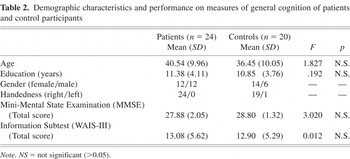
Patient and control groups did not differ with respect to age and level of education. Gender and hand preference were also taken into account, as shown in Table 2. Both groups of participants were informed about the aim of the investigation and participated voluntarily. All subjects gave their informed consent. The data included in the manuscript was obtained in accordance with the regulations of the Ethics Committees of the University of La Laguna and the NSC University Hospital and in compliance with the Helsinki Declaration for human research.
Demographic characteristics and performance on measures of general cognition of patients and control participants

Materials
General cognition was measured with a modified version of the Mini-Mental State Examination (MMSE; Beatty & Goodkin, 1990) adapted to motor and balance deficits. The Information Subtest of the WAIS-III (Wechsler, 1997) was also administered as a general intelligence estimation measure.
Three verbal fluency tasks were used. Phonemic verbal fluency was tested with the Controlled Oral Word Association Test (COWAT; Benton & Hamsher, 1989). Subjects are required to say, in a minute, as many words as they are able to think of that begin with letters F, A, and S, excluding proper nouns, numbers and the same word with a different suffix. The Animal Test was used to explore semantic verbal fluency. Subjects are required to say, in a minute, as many animals as they can think of. This can be addressed in terms of farm animals, zoo animals, wild animals, sea animals, and the like. Action fluency was tested with the Action Fluency Test (AFT, Piatt et al., 1999a). Instructions were adapted as follows: “I would like you to tell me as many different things as you can think of that people do, like dance or think. Just give me single words such as dance, rather than a sentence (i.e., to dance a waltz). Also, I do not want you to use the same word with different endings, like dance, dancing, danced. Remember I would like you to tell me as many different things as you can think of that people do. You will have one minute to do it. I will tell you when the time is over”. If instructions remained unclear or the participant made an error on the first word emitted, we stopped and repeated all the instructions.
Control tasks were reaction time and oral agility. Reaction time (RT) measure was made with the Reaction Unit of the PC-Vienna System (Schuhfried, 1992). A yellow light appeared randomly, at which time patients released their index finger of the dominant hand from one lever, to move it and press, as quickly as possible, another key. This system permits the dissociation of the cognitive component [Reaction Time (RT)] and the motor component [Motor Time (MT)]. RT is the time interval between the appearance of the yellow light and release of the finger. MT is the time interval between release of the finger and depression of the second key. Reaction time (RT) is a cognitive measure of information processing speed. Motor time reflects motor and coordination deficit (Botez et al., 1993).
Oral agility was tested with an adapted version of the articulatory task included in the Spanish adaptation of the Boston Diagnostic Aphasia Examination (García-Albea et al., 1986). This consisted in repeating, as many times as possible, the word “cinco” (“five”), during one minute.
Procedures and Data Analysis
Tasks were administered by an experienced clinical neuropsychologist according to a standard protocol. Additionally, motor and articulation baseline tasks and statistical methods were used to control the differences in psychomotor slowness and dysarthria.
We registered raw scores for the three verbal fluency tasks. The total score for the animals and action fluency tasks was the total number of correct items generated within one minute. Because the phonemic fluency task is based on a three-minute word generation period, the total score for this task was divided by three in order to facilitate equivalence of comparison of the raw production scores across the three fluency tasks.
Data are reported as means and standard deviations. Statistical comparisons were conducted using repeated measures and one-way analyses of variance (ANOVA). We ran correlational analyses using Pearson correlation coefficient in order to examine a significant effect of articulatory deficit and cognitive slowness on verbal fluency performances. All the analyses were performed with SPSS-PC software version 12.0 for Windows.
RESULTS
There were no significant between-group differences in MMSE or Subtest of the WAIS-III (Table 2). In contrast, and as expected, patients showed a poorer performance not only in MT but also in RT and oral agility (Table 3).
Performance by patients and control participants on verbal fluency, reaction and motor time (Pc Vienna System) and oral agility measures

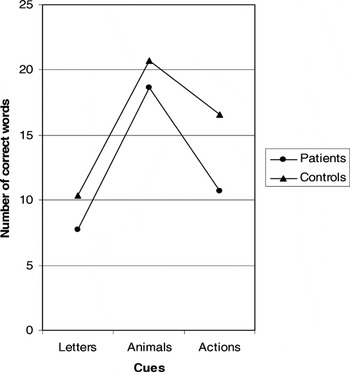
Table 3 shows mean and standard deviations for the three verbal fluency tasks. To determine differences among group performances and possible differential difficulty of the verbal fluency cues, a repeated measures analysis of variance (ANOVA) with group (patients and healthy control individuals) as the between-groups variable and verbal fluency cue (letter, actions and animal) as the within-group variable was conducted. There was a significant main effect of group (F(1,42) = 11.729; p = .001). FRDA patients produced less correct responses on verbal fluency measures relative to healthy control subjects. There also was a significant main effect of task (F(1,42) = 42.623; p = .001). Namely, participants produced more items with semantic cue than with action cue and, in turn, they produced more items with action cue than with letter cues.
The verbal fluency tasks × group interaction, consistent with our a priori hypothesis, was also significant (F(1,42) = 5.269; p = .027). Patients and controls showed comparable animal fluency scores (F(1,42) = 3.03; p = >.05). In contrast, patients performed significantly below the control sample on phonemic fluency (F(1,42) = 9.36; p = .004) and on action fluency (F(1,42) = 12.58; p = .001).

Line graph representing performances of patients and control participants on verbal fluency tasks.
In order to control the possible effects of articulatory deficits and cognitive slowness on phonemic and action fluency performances, we ran correlational analyses as shown in Table 4. No significant correlations were obtained between output on fluency tasks and oral agility or reaction time (RT).
Pearson's correlation between phonemic and action fluency scores and oral agility/reaction time

DISCUSSION
FRDA patients in the present study showed diminished verbal fluency performance in comparison to healthy control individuals. Taking into account the control procedures in the current study, it could be considered that the present results constitute evidence of a specific verbal fluency deficit in these patients that could not be accounted for by general intellectual deterioration, dysarthria or cognitive slowness. Firstly, this verbal fluency deficit is not because of a global cognitive impairment effect, given that patient and control groups did not differ in general cognitive state as they showed similar performance on the MMSE and on the Information Subtest (WAIS-III). Also, FRDA patients and control subjects did not differ in years of education. These results allow us to consider both groups as comparable in global cognitive state. Secondly, the verbal fluency deficit may not be attributed to the dysarthria shown by cerebellar patients. In the present study, this variable was taken into account and a control task in order to examine its possible influence on verbal fluency was designed. Results showed that patients' verbal fluency performance was not significantly associated to articulatory deficit. Thirdly, given that verbal fluency tasks are time-limited tests, cognitive slowness could have caused the lower performance shown by patients. In order to examine this factor, a second control task was introduced. As expected, patients exhibited impaired performance on the Reaction Unit (PC-Vienna System). The slowing was evident not only in MT but also in RT, suggesting a reduction of the speed and efficiency of cognitive information processing in addition to premotor and peripheral slowing (Wollmann et al., 2002). However, correlational analysis showed that verbal fluency performances were independent of this cognitive slowness. Moreover, given that all the verbal fluency tasks were time-restricted tests and that all three required verbal output, if there was a significant influence of motor/articulatory impairment or cognitive slowness on verbal fluency performances, then all three tasks should have been affected. The similar performance of patients and control subjects in the semantic fluency task confirms by itself that the deficit observed in the phonemic and action fluency tasks can not be attributed to dysarthria or cognitive slowness.
As hypothesized, there was a significant interaction between the type of fluency task examined and group. Patients showed impairment in the phonemic and action fluency tests, whereas they performed similarly to control subjects on animal fluency. We will firstly examine the dissociation between phonemic and semantic cues. Performances in both tasks have been examined in several studies about cognitive deficit in cerebellar degenerative disorders. Unfortunately, the interpretation of these results is rather unclear because of the lack of control of the factors mentioned above. To date, as far as we know, only one study has contrasted semantic and phonemic fluency while directly controlling motor/dysarthric affectation in FRDA patients showing impaired phonemic fluency performance and preservation of semantic fluency (Wollmann et al., 2002). Our present results replicate and extend this previous finding. In addition, our results support the semantic/phonemic verbal fluency dissociation observed in previous imaging (Gourovitch et al., 2000), behavioral (Martin et al., 1994) and clinical studies (Baldo et al., 2001; Stuss et al., 1998), and suggest that FRDA patients present difficulties in performing tasks where a greater prefrontal/executive component is required.
Regarding action fluency, it has been proposed that the Action Fluency Test is also a valid measure of linguistic/executive functions (Piatt et al., 1999a, 1999b; Woods et al., 2005a, 2005b, 2006). The AFT has not been examined in cerebellar patients. However, verb generation has been explored in another kind of task where the subject is required to generate a verb in relation to a given noun or picture. To our knowledge, two studies have assessed this type of verb generation in a heterogeneous sample of patients with cerebellar degeneration, both reporting normal performance in this task (Helmuth et al., 1997; Richter et al., 2004). Consequently, in spite of the fact that the neuroimaging data indicate cerebellum involvement in a verb generation task in relation to a given noun or picture (Martin et al., 1995; Papathanassiou et al., 2000; Petersen et al., 1989, 1998; Raichle et al., 1994; Seger et al. 2000), it seems that the presence of cerebellar degeneration is not enough to produce a significant impairment on this task (Helmuth et al., 1997; Richter et al., 2004). Instead, our results suggest that free verb retrieval without semantic cue (i.e., the action fluency paradigm) is impaired in FRDA patients. Therefore, this indicates that verbal fluency deficit appears when the task is more effortful, less automatic and requires the generation of a novel strategy of unusual word searching. Namely, when the task is more dependent on executive functions.
Prefrontal cortex and its connections play a vital role in the mediation of executive function. Thus, our results can be interpreted as evidence of prefrontal dysfunction in FRDA, at least in its executive component. This dysfunction may be caused by primary prefrontal pathology or by alterations in the cerebral-cerebellar pathways. In the first case, the fluency deficit observed in FRDA may be the result of the neuronal damage caused by frataxin deficiency, not only in the cerebellum and the spinal cord but also in other brain areas. There are some reports of atrophy of cerebral gyri, especially in frontal and parietal cortex, but it has been suggested that these changes were secondary to hypoxia resulting from episodes of heart failure (Oppenheimer, 1979; Oppenheimer & Esiri, 1992). Lamarche et al., (1984) examined post-mortem material from six FRDA cases and he found no neuropathological changes in cerebral cortex. Neuroimaging studies have showed that cerebral atrophy, if present, only affected a few patients (De Michele et al., 1995; Junck et al., 1994; Wollmann et al., 2004) and, to our knowledge, no regional cortical studies have been performed. Thus, while the possibility of a primary prefrontal dysfunction is very interesting, further studies, particularly neuropathological investigation, are needed to support this interpretation. The second possible explanation is supported by some anatomic and physiological data. Inputs to the cerebellum arise from multiple cortical areas, such as the frontal, parietal and temporal lobes. Outputs from the deep cerebellar nuclei project to a diverse set of thalamic nuclei and, in turn, these nuclei project to cortical areas other than the motor cortex (Allen et al., 2005; Schmahmann, 1991; Schmahmann & Pandya, 1995;). Middleton and Strick (1994, 1997) provide evidence that dorsolateral prefrontal cortex is a cortical target of a cerebello-thalamo-cortical pathway from the dentate nucleus. This deep cerebellar nucleus is, precisely, the one especially affected in FRDA, showing increased iron and severe neuronal degeneration.
In sum, FA patients showed deficit in verbal fluency tasks where a greater executive control is required. While the possibility of an underlying primary dysfunction has to be considered, and although cerebello-prefrontal projections are modest, the present finding may be interpreted as the result of an affectation of the cerebellar loops with the prefrontal cortex.
ACKNOWLEDGMENTS
This research was supported by the FIS grant G03/056 (Red Española de Ataxias), the CICYT grant BSO2002-04301-C02-01 and ULL-CajaCanarias grant. The authors thank Dr. Berciano (MV Universitary Hospital) and Dr. Arpa (La Paz Universitary Hospital) for providing access to patients and for their helpful assistance.