The relationship between early reading and phonological awareness has been well established across alphabetic languages and for readers who are monolingual or bilingual. These findings are the result of studies where researchers have compared scores on measures of phonological processing across languages for the same readers or across readers for the same language (for some examples, see Bialystok, Majumder, & Martin, Reference Bialystok, Majumder and Martin2003; Branum-Martin et al., Reference Branum-Martin, Mehta, Fletcher, Carlson, Ortiz and Carlo2006; Caravolas, Lervåg, Defior, Málkova, & Hulme, 2013; Cisero & Royer, Reference Cisero and Royer1995; Geva & Siegel, Reference Geva and Siegel2000; McBride-Chang & Kail, Reference McBride-Chang and Kail2002). However, research that systematically compares the relationships between reading and phonological processing across languages within individual readers as well as within a language across readers with different native languages is less common. The present study examined the relationship between phonological awareness and reading in young English as a second language (L2) learners. The children were followed from senior kindergarten to Grade 2 and were tested in their first language (L1) and L2. The children were selected based on their native languages, specifically Spanish, Portuguese, and Chinese, languages that differ in their speech-to-print relations.
MODELS OF READING ACQUISITION
Models of reading development were initially established in order to understand the steps in reading acquisition and the unique challenges that English readers experience (Chall, Reference Chall1996; Coltheart, Rastle, Perry, Langdon, & Ziegler, Reference Coltheart, Rastle, Perry, Langdon and Ziegler2001; Ehri, Reference Ehri, Gough, Ehri and Treiman1992; Seidenberg & McClelland, Reference Seidenberg and McClelland1989). However, researchers claim that accepted models of reading acquisition in English might not be appropriate for other orthographies, even other alphabetic orthographies (Hutzler, Ziegler, Perry, Wimmer, & Zorzi, Reference Hutzler, Ziegler, Perry, Wimmer and Zorzi2004; Share, Reference Share2008). As researchers began to study reading acquisition in other languages, the universality of models posited for English reading was questioned (Nag & Snowling, Reference Nag and Snowling2012; Share, Reference Share2008). Theories have recently been proposed to systematically address the role of language-specific factors in reading acquisition (see Ziegler et al., Reference Ziegler, Bertrand, Tóth, Csépe, Reis and Faísca2010; Ziegler & Goswami, Reference Ziegler and Goswami2005) and to examine the links between oral language and phonological awareness with specific reference to the learners’ L1 or L2 in bilinguals (Caravolas, Reference Caravolas2006; Nag, Caravolas, & Snowling, Reference Nag, Caravolas and Snowling2011). In addition, researchers who study reading in Chinese have adapted reading theory to incorporate differences in the ways Chinese readers access and use phonology when reading Chinese orthography (Perfetti & Liu, Reference Perfetti and Liu2005; Perfetti, Liu, & Tan, Reference Perfetti, Liu and Tan2005).
The psycholinguistic grain size theory is one approach posited to address these critiques and develop universal principles of reading acquisition while taking into account potentially unique differences based on each reader's L1 (Ziegler & Goswami, Reference Ziegler and Goswami2005). The theory states that the grain size, or size of the phonological and orthographic unit that must be learned and used in order to read, has an impact on reading development. According to psycholinguistic grain size theory, reading acquisition requires that children learn to optimally map phonological units of a given language, usually their native language, to the symbol system of that language (Ziegler & Goswami, Reference Ziegler and Goswami2005). This optimal mapping takes into account the most accessible unit that can be consistently represented in the orthography by solving the problems of availability, consistency, and granularity in relation to the key units in the orthography.
Specifically, the availability problem refers to the fact that all phonological units are not equally accessible to nonreaders. Syllables are more accessible than onsets and rimes, which are in turn more accessible than phonemes (Stanovich, Cunningham, & Cramer, Reference Stanovich, Cunningham and Cramer1984). Some researchers claim that in most cases phonemes are not accessible to nonreaders without instruction (Morais, Reference Morais, Brady and Shankweiler1991). In addition, accessibility is believed to interact with linguistic typology to influence awareness of different levels of phonological units (Caravolas, Reference Caravolas2006, see below for a more detailed discussion). Solving the consistency problem is related to the fact that the grapheme-to-phoneme mappings for reading and the phoneme-to-grapheme mappings for spelling are seldom one-to-one mappings. However, in some languages, the grapheme–phoneme mappings tend to be consistent (e.g., Spanish, Italian, and German). In other languages, larger units such as onsets and rimes or syllables are the consistent units of analysis. Granularity refers to the fact that the size of the consistent units is related to the number of units to be learned by the reader. For example, in order to read highly consistent languages, the learner must acquire only a limited number of grapheme–phoneme mappings. However, for less consistent languages, a larger number of sound–symbol mappings or “rules” must be acquired.Footnote 1
The three concepts highlighted in the psycholinguistic grain size theory interact, resulting in the need to identify the most consistent and accessible unit that will allow readers to optimally read their native language. The ease with which children can gain access to phonological units used in reading a particular orthography and the consistency of speech-to-print mappings have an impact on how quickly students learn to read their native language (Seymour, Aro, & Erskine, Reference Seymour, Aro and Erskine2003). Grapheme–phoneme mappings would be most important for reading a highly consistent language (e.g., Spanish), while syllable–symbol mappings would be most important for reading a syllabic or morphosyllabic orthography, such as Japanese kana or Chinese characters, respectively. Although these concepts have been studied in relation to reading in the native language, it is also possible that the ways in which children optimally solve these problems of accessibility and consistency, and the optimal grain size used to read their native language would have an impact on reading strategies across other languages that they learn. Because phonological awareness assessed in either the L1 or the L2 is related to reading, optimal strategies used to read the native language could influence reading in the L2 (see Durgunoglu, Reference Durgunoglu2002; Geva & Wang, Reference Geva and Wang2001, for reviews, as well as a meta-analysis by Branum-Martin, Tao, Garnaat, Bunta, & Francis, Reference Branum-Martin, Tao, Garnaat, Bunta and Francis2012). Research examining the influence of the native language on adults who were reading their second or subsequent languages showed differential results based on whether the languages were written using alphabetic orthographies or whether one of the languages was written using a morphosyllabic orthography (Tan et al., 2003; Wang, Perfetti, & Liu, Reference Wang, Perfetti and Liu2003). However, research is lacking regarding the differences in beginning reading acquisition in L2 learners based on differences in their native language (Bialystok et al., Reference Bialystok, Majumder and Martin2003).
THE ROLE OF PHONOLOGICAL AWARENESS IN READING ACQUISITION
Despite data showing the relationship between phonological awareness and reading in alphabetic languages, researchers continue to debate the exact mechanisms by which phonological awareness is related to reading (Castles & Coltheart, Reference Castles and Coltheart2004; Hulme et al., Reference Hulme, Hatcher, Nation, Brown, Adams and Stuart2002; Schatschneider, Francis, Foorman, Fletcher, & Mehta, Reference Schatschneider, Francis, Foorman, Fletcher and Mehta1999; Ziegler et al., Reference Ziegler, Bertrand, Tóth, Csépe, Reis and Faísca2010). For example, researchers have examined whether the subcomponents of phonological awareness measure one or more underlying constructs (Anthony & Lonigan, Reference Anthony and Lonigan2004; Hoien, Lundberg, Stanovich, & Bjaalid, 1995; Mann & Foy, Reference Mann and Foy2003). Currently, many researchers accept the notion that phonological awareness incorporates a sensitivity to a range of phonological units or subcomponents within a language, including syllables, onsets, and rimes, or body and coda, as well as phonemes (Anthony & Lonigan, Reference Anthony and Lonigan2004; Stanovich, Reference Stanovich1990). These findings reconcile the conflicting data from studies that showed that different measures of phonological awareness were differentially related to reading across time. In addition, these findings are beneficial in helping educators develop optimal and efficient tools for screening phonological awareness skills across ages.
Researchers have explored the role of subcomponents of phonological awareness in reading languages other than English. For example, in Spanish, phonemic awareness was highly related to reading acquisition (Jiménez-González, Reference Jiménez-González1997). In contrast, for Chinese, the role of phonological awareness in reading is less clear (McBride-Chang & Kail, Reference McBride-Chang and Kail2002; Perfetti et al., Reference Perfetti, Liu and Tan2005; Wang & Geva, Reference Wang and Geva2003). In addition, Chinese has the unique feature of tone that influences pronunciation and meaning. Research conducted with young readers in Hong Kong showed that phonological processing was related to reading in Chinese (Ho & Bryant, 1999; McBride-Chang & Ho, Reference McBride-Chang and Ho2000; Shu, Anderson, & Wu, Reference Shu, Anderson and Wu2000; Shu, Peng, & McBride-Chang, Reference Shu, Peng and McBride-Chang2008). However, other studies demonstrated that tone awareness, onset-rime awareness, or syllabic awareness were more important than phonemic awareness for reading Chinese (McBride-Chang et al., 2008; Tong & McBride-Chang, 2010; Wang, Lin, & Yang, 2014; Yeung & Ganotice, Reference Yeung and Ganotice2013).
In contrast to research that has shown language-specific effects of constructs related to reading, researchers have found that despite differences in growth in reading skills, similar cognitive–linguistic variables are related to reading across alphabetic languages (Caravolas et al., 2013). Specifically, phonological awareness was related to reading across several alphabetic languages, although the strength of relationships varies by language (Ziegler et al., Reference Ziegler, Bertrand, Tóth, Csépe, Reis and Faísca2010).
Researchers who have examined relations between reading and phonological awareness in L2 learners have found that phonological awareness skills are related across languages and that phonological awareness skills in the native language are related to reading an alphabetic orthography regardless of the native language (Branum-Martin et al., Reference Branum-Martin, Mehta, Fletcher, Carlson, Ortiz and Carlo2006; Durgunglu, Reference Durgunoglu2002; Geva & Wang, Reference Geva and Wang2001; Gottardo, Yan, Siegel, & Wade-Woolley, Reference Gottardo, Yan, Siegel and Wade-Woolley2001). However, when the role of phonological awareness in relation to reading is examined in bilinguals, most researchers report the results of gross measures of phonological awareness that incorporate all subcomponents of phonological awareness in one task or construct (August & Shanahan, Reference August and Shanahan2006). A recent meta-analysis reported that phonological awareness skills in diverse languages are related to English reading. However, the degree to which phonological awareness skills are related across languages differs and might be influenced by the degree of similarity between the writing systems (Branum-Martin et al., Reference Branum-Martin, Tao, Garnaat, Bunta and Francis2012). One of the challenges faced in conducting the meta-analysis was the inability to examine the specific impact of subcomponents of phonological awareness based on the fact that few researchers unpack phonological awareness skills into subcomponents when examining relations between reading and phonological awareness (Branum-Martin et al., Reference Branum-Martin, Tao, Garnaat, Bunta and Francis2012). Therefore, the role of specific subcomponents of phonological awareness in reading should be examined for bilinguals.
RELATIONSHIPS BETWEEN L1 AND L2 SKILLS: EFFECTS OF LINGUISTIC TYPOLOGY AND ORTHOGRAPHY
At a macrolevel, general theories of L2 oral language and reading acquisition show that L1 skills influence L2 skills (Cummins, Reference Cummins and Bialystok1991; Geva & Siegel, Reference Geva and Siegel2000). In addition, at a microlevel researchers have found that perception of phonemes and phonemic categories in the L2 is influenced by the presence of similar or identical phonemes in the L1 (Flege, Reference Flege, Ferguson, Menn and Stoel-Gammon1992). Specifically, L2 phonemes that are not in the native language are not initially perceived according to L2 phonemic categories but often are represented in ways that combine the contrastive categories of both languages (Eckman, Reference Eckman2004; Flege, Reference Flege, Ferguson, Menn and Stoel-Gammon1992). Differences in phonemic categories are related to reading and spelling performance in L2 learners of English, Hebrew, or Chinese (Geva, Wade-Woolley, & Shany, Reference Geva, Wade-Woolley and Shany1993; Wang & Geva, Reference Wang and Geva2003).
However, an intermediate level of linguistic analysis that has recently received attention is the phonotactic structure of the language. For example, Caravolas (Reference Caravolas2006) found that the complexity of the linguistic syllable in a given language has an impact on the ability to access or manipulate subsyllabic units, as well as determining the strategies used to read the given language. Complex and frequently repeated syllables such as morphological markers can sensitize children to these sound patterns and can be related to the accessibility of smaller phonological units (Caravolas & Landerl, Reference Caravolas and Landerl2010). The syllabic structure of the language can also be further subdivided into onset-rime or body-coda (Kim, Reference Kim2007; Treiman & Zukowski, Reference Treiman and Zukowski1996). These phonotactic constraints have an impact on the units (e.g., syllabic, subsyllabic, and phonemic) and the phonological contrasts believed to be “psychologically real” for the learner. Finally, the phonotactic constraints of the language are believed to have an impact on the availability of units in terms of the psycholinguistic grain size theory (Caravolas, Reference Caravolas2006).
For monolingual English readers, onset-rime awareness is sufficient to begin mapping sounds onto symbols in the early stages of reading acquisition (Stuart & Coltheart, Reference Stuart and Coltheart1988). This finding that onset-rime awareness is highly related to reading in English is consistent with research suggesting that these phonological units are salient and “psychologically real” for English speakers even in spoken language (Rapp, Reference Rapp1992; Treiman & Zukowski, Reference Treiman and Zukowski1996). However, awareness of smaller components of phonology, specifically phonemic awareness, is a better longitudinal predictor of English word reading (Ehri, Reference Ehri, Gough, Ehri and Treiman1992; Hulme et al., Reference Hulme, Hatcher, Nation, Brown, Adams and Stuart2002). Phonemic awareness can be acquired with explicit training prior to reading instruction (Bus & van IJzendoorn, 1999) or through experience with an alphabetic orthography (Perfetti, Reference Perfetti1985).
However, the psycholinguistic grain size theory does not directly address processes related to L2 reading or how L2 readers would solve the problems of availability, consistency, and granularity in their L2. Specifically, the possibility that the phonological awareness skills and sound–symbol strategies required to read the L1 might influence the subcomponents of phonological awareness that beginning readers use to read their L2 has not been tested. Alternately, L2 reading might be most highly related to the properties of the L2 orthography, resulting in similar phonological awareness skills being related to beginning reading acquisition in readers with a variety of native languages. In this case, the optimal strategies would be considered language dependent. These contrasting hypotheses have not been tested explicitly when examining the development of early reading in L2 learners. The current study examined concurrent and longitudinal phonological predictors of reading in children whose L1 Spanish, Portuguese, or Chinese, differs in terms of the grain size of the phonological unit that most consistently maps onto the language's orthography.
The psycholinguistic grain size theory is helpful for examining the interaction between the writing system and reading in the native language. However, the concept of relations between sound and symbol mappings is not new. Previously, the orthographic depth hypothesis was used to define relations between written symbols and the sound units upon which they map in monolingual readers (Frost & Katz, Reference Frost and Katz1992). Orthographic depth refers to the regularity and consistency of sound–symbol mappings, with languages with high consistency and regularity being classified as having a shallow orthography and languages with low consistency and regularity being classified as having a deep orthography. In the current study, participants were selected based on their native language. The languages differed in terms of their sound–symbol relations, with two languages having typologically shallower orthographies, Spanish and Portuguese, and Chinese being written using a deep, morphosyllabic orthography. All the children in the current study were also learning to read in English, their L2. Furthermore, Spanish, Portuguese, and English share the Roman alphabet with many similar grapheme–phoneme correspondences.
English has a deep alphabetic orthography, with many irregular letter–sound relations. However, the regularity of English orthography is encoded at the level of the onset-rime (e.g., kind, find; Plaut, McClelland, Seidenberg, & Patterson, Reference Plaut, McClelland, Seidenberg and Patterson1996; Treiman, Mullennix, Bijeljac-Babic, & Richmond-Welty, Reference Treiman, Mullennix, Bijeljac-Babic and Richmond-Welty1995). Specifically, although consonants tend to have consistent grapheme–phoneme correspondences, vowel sound–symbol relations are consistent at the rime level (Venezky, Reference Venezky2004). English orthography is characterized by complex syllable onsets and unclear syllable boundaries (Alvarez, Carreiras, & Taft, Reference Alvarez, Carreiras and Taft2001). These properties of the language contribute to speakers being more sensitive to onset-rime segments (DeCara & Goswami, Reference DeCara and Goswami2003). In addition, English maintains morphological relationships between root words and derivatives at times at the cost of grapheme–phoneme correspondences (e.g., sign, signal; Seymour et al., Reference Seymour, Aro and Erskine2003). The variety of English being studied has 15 vowel sounds represented by 6 graphemes as well as diagraphs. In relation to the psycholinguistic grain size theory, English shows moderate availability and lower consistency.
The Spanish writing system is a shallow or transparent orthography with regular and consistent mappings between Spanish graphemes and phonemes. For example, the five Spanish vowel sounds are represented by five graphemes. Phonemic awareness and knowledge of letter–sound correspondences may be sufficient to read Spanish (Jiménez-González, Reference Jiménez-González1997). Spanish has a simpler syllabic structure with consistent and easy to determine syllabic boundaries (Bradley, Sanchez-Casas, & Garcia-Albea, Reference Bradley, Sanchez-Casas and Garcia-Albea1993). Therefore, the syllable might be a more psychologically salient sublexical unit in Spanish (Alvarez, Carreiras, & Perea, Reference Alvarez, Carreiras and Perea2004; Bradley et al., Reference Bradley, Sanchez-Casas and Garcia-Albea1993), while the phoneme is a consistent unit for both beginning and skilled readers. In relation to the psycholinguistic grain size theory, Spanish shows moderate availability and high consistency.
In an examination of the relative ease with which young European children learn to read, Portuguese was classified as having a simple syllabic structure and an intermediate level of orthographic depth (Seymour et al., Reference Seymour, Aro and Erskine2003). Portuguese-speaking children made an intermediate number of errors in reading words and nonwords in comparison to readers of a shallow orthography (e.g., Spanish) or a deep orthography (e.g., English; Seymour et al., Reference Seymour, Aro and Erskine2003). Research results corroborate this finding by showing that Portuguese speakers had slower reading rates on words and made more errors on reading nonwords in first grade in comparison to Spanish speakers of the same age (Defior, Martos, & Cary, Reference Defior, Martos and Cary2002). Unlike Spanish, some phonemes in Portuguese are marked by accents and not by specific letters. Portuguese has 14 vowel sounds that are represented by seven graphemes whose pronunciation is determined by accents and contextual markers. For example, the “n” can nasalize the preceding vowel while not being pronounced as a separate phoneme in that context (e.g., quando is pronounced as /kwãdu/). Although Portuguese relies on contextual rules to determine the pronunciation of a number of consonants, these rules are consistent (Defior et al., Reference Defior, Martos and Cary2002). In relation to the psycholinguistic grain size theory, Portuguese shows moderate availability and moderately high consistency.
On the continuum of orthographic depth, Chinese orthography differs substantially from alphabetic orthographies in terms of the nature of its sound–symbol relations. Chinese orthography is described as being morphosyllabic, with characters providing orthographic, morphological, and syllabic information (Leong & Tamaoka, Reference Leong and Tamaoka1998; Li, Anderson, Nagy, & Zhang, 2002). Each Chinese character maps onto a syllable and a morpheme in the spoken language. Most Chinese characters contain semantic radicals that are associated with meaning, and phonetic radicals that are associated with the sound of the character (Ho & Bryant, Reference Ho and Bryant1997; Shu et al., Reference Shu, Anderson and Wu2000). The phonetic component of a character often provides clues as to the pronunciation of the character, ranging from exact homophones to analogy cues based on the syllable onset or rime. The phonetic information in Chinese characters is encoded at the syllabic level and at the level of onset and rime, but not at the phonemic level, as it can be in regular alphabetic orthographies. The components of the psycholinguistic grain size theory have not been examined for Chinese due to the lack of grapheme–phoneme mapping in Chinese characters.
The majority of research examining subcomponents of phonological awareness ignores the potential influence of native language on reading acquisition for bilinguals. The goals of the present study are to examine whether the specific subcomponents of phonological processing, syllables, onsets and rimes, and phonemes, that are related to beginning reading performance are learner-specific or language-specific variables. These goals are addressed through the following questions. Are subcomponents of phonological awareness differentially related to English reading acquisition in young English L2 learners with different native languages? In contrast, are the subcomponents of phonological awareness related to reading a given language, English, the same regardless of the reader's native language? In addition, do patterns of relationships between English phonological awareness and English reading change over time in beginning readers who are L2 learners? Finally, what subcomponents of phonological awareness are related to reading in the learners’ native languages, Spanish, Portuguese, and Chinese?
Based on the psycholinguistic grain size theory, learners of these three languages would be expected to solve the sound–symbol mapping challenges of each language differently. For the present study, we predicted that English reading would be related to similar subcomponents of phonological awareness across groups. Developmental and grade-level differences are also expected in terms of relations between subcomponents of phonological awareness and reading. Initially, large units such as syllables and onset-rime would be related to reading in English, but in later grades, phonemic awareness would be related to English. In contrast, language-specific relations between phonological awareness and reading are expected in relation to the grain size of the language for the specific native languages. For example, awareness of larger phonological units and tone would more likely be related to reading in Chinese, while awareness of smaller phonological units would more likely be related to reading in Spanish. Therefore, greater differences are predicted in terms of subcomponents of phonological awareness related to reading for the different native languages compared to the subcomponents of phonological awareness related to reading in English, across these groups.
METHOD
Participants
Children, who spoke English as an L2 and who spoke Chinese (Cantonese, Mandarin), Spanish, or Portuguese as an L1, were recruited for this 3-year longitudinal study. Due to the difficulty in recruiting participants who were bilingual and capable of completing tasks in English and their L1, children were recruited in cohorts. In kindergarten 180 children were tested (85 males, 95 females). It was difficult to recruit kindergarten children, age 5, specifically in the Chinese–English and Spanish–English speaking groups. This difficulty was due to the parents believing that their young children should not participate in research. Therefore, 72 additional children were recruited in first grade. These children were added to the cohort who had already been tested in kindergarten, resulting in a larger total number of participants in first grade (n = 252).Footnote 2 By the time they were tested in Grade 2, the children had been enrolled in the study for at least 1 year, if not 2 years. A total of 224 children were tested in Grade 2. The following numbers of children were included in the analyses at each age group: Spanish–English speaking children in kindergarten (n = 54, 25 males), in Grade 1 (n = 87, 40 males) and in Grade 2 (n = 73, 32 males); Portuguese–English speaking children in kindergarten (n = 69, 30 males), in Grade 1 (n = 74, 30 males), and Grade 2 (n = 68, 25 males); Chinese–English speaking children in kindergarten (n = 57, 30 males), in Grade 1 (n = 91, 47 males; 60 Cantonese L1 and 31 Mandarin L1), and in Grade 2 (n = 83, 45 males). In addition, the Cantonese L1 and Mandarin L1 groups were compared on all key measures, and no group differences were found. Therefore, the two groups were collapsed and will be referred to as the Chinese–English group.
The children were recruited from 19 schools in predominantly middle-class and working-class neighborhoods in two Canadian cities. English was the language of instruction in all schools. Approximately 25% of the Portuguese–English speakers, 70% of the Spanish–English speakers, and 90% of the Chinese–English bilinguals were enrolled in heritage language classes. On average, children participated in heritage language classes for 2.5 hr per week. Heritage language classes were offered on Saturday mornings by local school boards or in the case of some Chinese–English speakers through private programs associated with Chinese cultural centers. Within Spanish-speaking homes, 30% of parents reported speaking only in Spanish. The other 70% reported conversations occurring in both Spanish and English. For the Portuguese–English group few families (7%) reported speaking only Portuguese in the home. The majority of families spoke both Portuguese and English. All children spoke mostly Portuguese with their grandparents who lived in the same neighborhoods. Within the Chinese-speaking homes, 35% percent of the families reported speaking only in Chinese, with the other 65% reporting conversations occurring in both Chinese and English.
Based on the above information, it is clear that the groups differed somewhat in terms of their bilingual status. The Spanish–English speakers and the Chinese–English speakers could be classified as sequential bilinguals (Gottardo & Grant, Reference Gottardo and Grant2008), learning and becoming reasonably fluent in their native language prior to learning English at school. The majority of the Portuguese–English speakers were classified as simultaneous bilinguals, learning both Portuguese and English at home.
Average family income was low for all groups, $24,539 Cdn for the Spanish-speaking group, $23,804 Cdn for the Portuguese-speaking group, and $23,611 Cdn for the Chinese-speaking group (2004 data). The average level of parental education was high school for all groups. Many of the parents had high school education or less, specifically 70.3% of the Portuguese-speaking parents and 58.8% of the Chinese-speaking parents. Approximately 25% of the Chinese-speaking parents and 10% of the Portuguese-speaking parents had a university education. The Spanish-speaking parents had levels of education more similar to the Chinese-speaking parents and in contrast to the Portuguese sample. The Chinese-speaking and Spanish-speaking families were more recent immigrants. These recent immigrants are selected for entry into Canada based on education and personal wealth, among other factors (http://www.cic.gc.ca/english/skilled). The majority of the Spanish-speaking families emigrated from South and Central America and the majority of Chinese-speaking families emigrated from Mainland China. The Portuguese-speaking families were less likely to be recent immigrants. The majority of the Portuguese families emigrated from the Azores and tended to be from a lower socioeconomic status background in their country of origin.
The Chinese–English speaking children tended to live in predominantly Chinese-speaking neighborhoods. However, this pattern is not the case for Portuguese–English speaking and Spanish–English speaking groups, who tended to live in neighborhoods with demographically greater mix. However, these two groups differed somewhat in terms of the demographics of the neighborhoods in which they lived, with the Spanish–English speakers living in neighborhoods with recent immigrants represented by many different native languages, while the Portuguese–English speakers lived in neighborhoods with more established immigrant families or English-speaking families.
Tasks
Phonological awareness measures
Phonological awareness was measured in English as well as in the children's L1. L1 phonological awareness tasks varied somewhat based on the types of phonological tasks that were plausible for each language. Attempts were made to create tasks that measured awareness of larger and smaller units within the constraints of each language.
ENGLISH PHONOLOGICAL AWARENESS
An experimental measure of phonological awareness was created that addressed subcomponents of phonological awareness based on commonly agreed upon phonological units: syllable awareness, onset-rime awareness, and phonemic awareness (Jared, Cormier, Levy, & Wade-Woolley, Reference Jared, Cormier, Levy and Wade-Woolley2011). This task was administered in both kindergarten and Grade 1. The task required the deletion of units from English-like pseudowords in order to control for lexical familiarity with the items. Equal numbers of items were blocked by unit type, 12 for each block. The first block of items involved the deletion of syllables (e.g., “say bamdaw, now say bamdaw without saying bam”). The second block of items involved deleting initial phonemes from single-syllable words. The items in this block corresponded to onset awareness because all of the phonemes were also simple onsets (e.g., “say vock without saying /v/”). The last block of items involved deleting phonemes within the onset or rime (e.g., “say bip without saying /p/”). Because this measure was experimental, no formal stopping rule existed. However, if the child produced 5 incorrect responses for the possible 12 items in a given block, subsequent levels were not administered. The Cronbach α for this test was calculated to be 0.70, while split-half reliability was 0.92.
SPANISH PHONOLOGICAL AWARENESS
Spanish phonological awareness was measured by subtests of the Test of Phonological Processing in Spanish (Francis et al., Reference Francis, Carlo, August, Kenyon, Malabonga and Caglarcan2001). In kindergarten, two sound-matching subtests were administered. Children received 10 items that required the matching of initial sounds and 10 items that required the matching of final sounds. These subcomponents were amalgamated for a maximum score of 20. In Grade 1, only the final-sound matching stimuli were administered, resulting in a score of 10. For the initial-sound matching task, children were asked if a word began with the same sound as one of three other words (e.g., ¿Qué palabra empieza con el sonido /p/ como piano? ¿hora/ hour, suelo/ floor, o pies/ feet? Which of the following words starts with /p/ sound, like p iano/ piano? H ora/ hour, s uelo/ floor, or pies / feet?). For the final-sound matching task, children were asked if a word ended with the same sound as one of three other words (e.g., ¿Qué palabra termina con el sonido /l/ como miel? ¿Sal, mes, o pan? Which of the following words ends with /l/ sound, like miel/ honey? Sa l / salt, mes / month, or pan / bread?). The Cronbach α coefficient was 0.83 for the initial- and final-sound matching tasks.
The elision task was only administered in Grade 1. For the elision task, the children were required to say what is left after deleting a syllable (3 items) or phoneme (17 items) from a target word (e.g., “Di rojo. Ahora di rojo sin decir /r/. Ojo.” “Say rojo/ red. Now say rojo/ red without saying /r/”). The tests were discontinued after three consecutive incorrect responses. The Cronbach α coefficient was 0.88 for the elision task.
PORTUGUESE PHONOLOGICAL AWARENESS
Phonological awareness was measured in Portuguese using an initial-sound matching task, which was administered in both kindergarten and Grade 1. All 16 items of the task were administered to the children. For example, children were required to judge whether two words began with the same first sound (Diz sofá. Pensas que sofá começa com o mesmo som que sopa? “Say sofa. Do you think that sofa starts with the same sound as soup?”). The Cronbach α coefficient for this measure was .048.
CHINESE PHONOLOGICAL AWARENESS
Chinese phonological awareness was measured using a rime detection measure, a tone detection measure, and an elision measure. For all three measures, versions were created in both Cantonese and Mandarin. The rime detection measure was given in both kindergarten and Grade 1. The tone detection measure was only given in kindergarten, while the elision measure was only administered in Grade 1.
For the rime and tone detection measures, each item consisted of three monosyllabic words. Two of the words had the same rime or tone, while the third word had a different rime or tone. In the rime detection task, tone was allowed to vary across different words. The children were asked to select the word that did not have the same rime/tone as the other two words. An example of the rime detection task was “北/bei3/, 山/shan1/, 严/yan2/,” and an example of the tone detection task was “撼/han4/, 喊/han3/, 汉/han4/”. Both tasks contained 2 training items and 15 test items. The Cronbach α coefficient was 0.78 for the rime detection task and 0.77 for the tone detection task. In the elision measure, the children were asked to delete a syllable or a phoneme in a word (e.g., “跟我念火车/huo3che1/,去掉火/huo3/,剩下的部分怎么念?” “Say /huo3che1/, now say it without /huo3/, what is left?”). Children were given 3 practice items and 20 test items (3 syllable items and 17 phoneme items). Testing was discontinued when three consecutive incorrect responses were made. The test had a maximum score of 20. The Cronbach α coefficient was 0.95 for this measure.
Reading measures
ENGLISH READING
Word-level reading was measured using standardized tests of word and pseudoword reading. English word reading was measured using the word identification subtest of the Woodcock Reading Mastery Test—Revised (WRMT-R; Woodcock, Reference Woodcock1987; e.g., come, boy, summer). The WRMT-R began with high-frequency monosyllabic words (e.g., you, and, up). It included a sufficient number of short, high-frequency items to allow for variability in performance even in beginning readers. Pseudoword reading was measured using the word attack subtest of the WRMT-R (Woodcock, Reference Woodcock1987; e.g., ap, oss, poe). These measures were administered in kindergarten, Grade 1, and Grade 2. Reported reliabilities from the norms for children at ages 6 and 7 are 0.96 for word identification and 0.95 for word attack (Woodcock, Reference Woodcock1987).
SPANISH READING
The word reading subtest of the Woodcock Language Proficiency Battery—Revised was administered, specifically the Identification de letras y palabras (Woodcock & Munoz-Sandoval, Reference Woodcock and Munoz-Sandoval1995). The child read a list of words that increased in length and difficulty (e.g., pan/ bread, mesa/ table, ciudad/ city). The test had a stopping rule of six consecutive words read incorrectly. This task was administered in Grade 1 only. The Cronbach α coefficient was 0.95 for this word reading measure (Woodcock & Munoz-Sandoval, Reference Woodcock and Munoz-Sandoval1995).
PORTUGUESE READING
An experimental measure of word reading was administered in Portuguese. The word list contained many short, high-frequency words (e.g., gato/ cat, novo/ new) as well as longer, lower frequency words some of which contained accents (e.g., perigoso/ dangerous, necessário/ necessary, informação/ information) for a total of 104 words. This task was given in Grade 1 only. Cronbach α coefficient was 0.96 for this word reading measure.
CHINESE READING
Reading was measured in Chinese using an experimental character-reading task in Grade 1. A list of 20 highly frequent characters was presented to the children. These characters are commonly found in texts used by beginning readers, with half of the characters being simple, single-component characters. Children who read 10 of these 20 words correctly were shown a list of 100 characters and asked to read as many of these characters as possible. Characters were presented in rows, and the children were asked to read the isolated characters. The children were encouraged to attempt all the items. However, they were allowed to state that they did not recognize the character. Therefore, many of the items resulted in “no response” coding. The character reading task showed high reliability (Cronbach α = 0.95).
Vocabulary
The Peabody Picture Vocabulary Test—III (PPVT-III; Dunn & Dunn, Reference Dunn and Dunn1997) was administered as a measure of oral language skill in English in Grade 1. Each participant was presented with four pictures and was required to select the picture that represented the word being provided orally. The items became increasingly difficult, and when the child failed at least 8 items in a block of 12 items, testing was discontinued. The reported reliability for English-speaking children at age 6 is 0.95 (Dunn & Dunn, Reference Dunn and Dunn1997).
Nonverbal reasoning
The Matrix Analogies Test (MAT; Naglieri, Reference Naglieri1989), a relatively culture-free test, was used to assess students’ nonverbal ability in Grade 1. It was used to confirm that the participants exhibited learning potential in the broadly average range. This test involved four subtests related to reasoning and problem solving: pattern completion, reasoning by analogy, serial reasoning, and spatial visualization. These four subtests measured variants on the child's ability to select which one of six pictures completed a puzzle-like pattern or visual analogy. The reported reliability from the norms for English-speaking children at age 6 is 0.95 (Naglieri, Reference Naglieri1989).
Procedure
The children were tested initially in winter of senior kindergarten at the age of 5 or 6 years. At this time, they had just begun formal literacy instruction. The children were introduced to letter–sound correspondences on a “letter of the week” basis. As part of their regular curriculum, the schools also participated in a daily home reading program in which children brought books home and were expected to read to a parent or other family member in English. They were required to read several times a week. This program usually begins in schools in late January of the children's senior kindergarten year. Typical books at the beginner level included pattern books with repetitive carrier phrases and one new word in each sentence with the new word being accompanied by a key illustration. The children were tested again approximately 1 year later in winter of Grade 1 and then 1 additional year later in Grade 2. An extensive battery of L1 and L2 tasks was administered at each time point. L1 and L2 tasks were administered on separate days. Native speakers of the three first languages administered the L1 measures.
RESULTS
Group similarities and differences
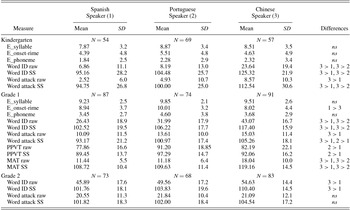
Means and standard deviations were initially calculated for each group to determine group performance. Table 1 displays the mean raw scores and standard scores for the English reading and phonological tasks. Scores for the PPVT-III and the MAT are included to provide a general picture of the students’ vocabulary skills and nonverbal reasoning skills, respectively. The groups had mean standard scores in the low-average range on the PPVT-III. In addition, the groups had mean standard scores in the high-average to above-average range on the MAT. Highlights based on the mean scores for each group indicate that many of the children in each language group were able to read some words in kindergarten. Furthermore, the mean standard scores for word and pseudoword reading for each of the groups were at least within the average range throughout the duration of the study. The mean word reading scores for the Chinese–English speakers were in the above-average range for kindergarten and first grade, with regression to the mean in second grade. Mean standard scores were in the average range for the Chinese–English speakers on pseudoword decoding across the three time points. For the Portuguese–English speakers, mean standard scores on word and pseudoword reading were consistently in the average range. For the Spanish–English speakers, mean standard scores on reading were initially in the low-average range, but progressed to the average range. Mean scores for the English measure of phonological awareness as well as for the subcomponents did not indicate floor or ceiling effects for any of the groups in kindergarten and first grade.
Mean scores and group comparisons for English variables among groups of English learners

Note: E, English; SS, standard score; PPVT, Peabody Picture Vocabulary Test; MAT, Matrix Analogies Test. All differences were significant at p < .05.
The group scores were compared using three-way analyses of variance by group (see Table 1). Post hoc analyses were conducted when significant main effects were found using a Bonferroni correction for the number of variables and a Dunnett T3 test in cases where variances were not normally distributed. The Portuguese–English speakers had higher scores on the measure of vocabulary (PPVT-III) than the Spanish–English speakers (Dunnett T3 = 11.73, p < .05). For most other measures, when group differences existed, the Chinese–English speakers outperformed the other two groups. For example, the Chinese–English speakers had higher scores than the other groups on reading in kindergarten and first grade. The Chinese–English speaking group had higher scores on the measure of nonverbal reasoning (MAT) administered in first grade than members in the Spanish–English and Portuguese–English groups (Dunnett T3 = 6.59, p < .05 and Dunnett T3 = 6. 86, p < .05). In the majority of cases, the groups did not differ on the measures of English phonological awareness.
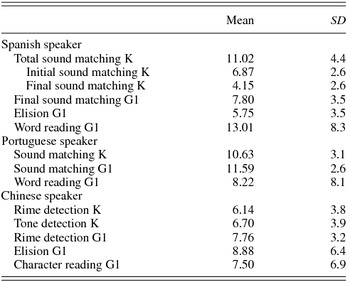
Performance on L1 measures could not be compared across groups. However, relevant means and standard deviations are reported in Table 2. Although no statistical comparisons could be made, the descriptive statistics provided a picture of performance on L1 measures. The Spanish–English speakers were on average the best readers in their L1 in terms of their mean score and variability. This performance is likely due to the ease of reading Spanish as compared to the other two languages. Although Portuguese and Spanish share the Roman alphabet with English, the degree of exposure to the L1 could also be a contributing factor for the Spanish–English speakers when compared to the Portuguese–English speakers. All groups showed variability on the measures of L1 phonological awareness with no floor or ceiling effects.
Mean scores for first language measures

Note: K, Kindergarten; G1, Grade 1.
L1 and L2 variables related to Reading × Language Group
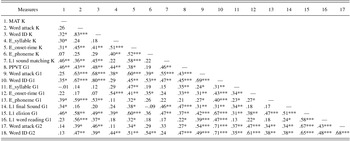
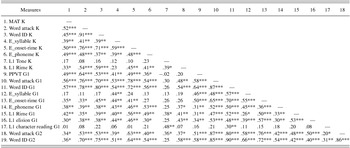
A series of correlational analyses was conducted to determine zero-order correlations among key variables for each of the groups. For the group of Spanish–English speakers, English onset-rime awareness was related to English reading in kindergarten. The English phonological awareness measures were correlated with English reading in Grade 1. Most Spanish variables were interrelated (see Table 3). In terms of cross-language relations, performance on the Spanish elision task was related to all reading measures. Spanish word reading in Grade 1 was also related to English reading at each time point.
Correlations among primary variables for Spanish speakers

Note: MAT, Matrix Analogies Test; K, kindergarten; E, English; L1, first language; PPVT, Peabody Picture Vocabulary Test; G1, Grade 1; G2, Grade 2.
*p < .05. **p < .01. ***p < .001.
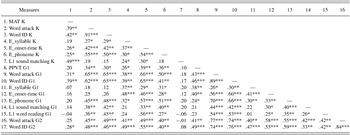
For the Portuguese–English speakers, performance on English phonological awareness in kindergarten and first grade was related to English word and pseudoword reading in kindergarten and first grade (see Table 4). In addition, performance on a Portuguese initial-sound matching task was related to English word and pseudoword reading and English phonological awareness in Grade 1.
Correlations among primary variables for Portuguese speakers

Note: MAT, Matrix Analogies Test; K, kindergarten; E, English; L1, first language; PPVT, Peabody Picture Vocabulary Test; G1, Grade 1; G2, Grade 2.
*p < .05. **p < .01. ***p < .001.
For the Chinese–English speakers, patterns of relationships were as expected. English language, phonological, and reading variables were intercorrelated (see Table 5). Chinese phonological awareness variables were also correlated within language. Chinese rime awareness was related to English reading and to English phonological awareness in both kindergarten and Grade 1. In contrast, Chinese tone detection was related to performance on Chinese variables, specifically Chinese rime detection and Chinese reading.
Correlations among primary variables for Chinese speakers

Note: MAT, Matrix Analogies Test; K, kindergarten; E, English; L1, first language; PPVT, Peabody Picture Vocabulary Test; G1, Grade 1; G2, Grade 2.
*p < .05. **p < .01. ***p < .001.
Relations between subcomponents of English phonological awareness and English reading
Because the focus of the study was on whether the specific subcomponents of phonological awareness were related to reading in English for each group of L2 learners, hierarchical regression analyses were conducted to determine which subcomponents were uniquely related to reading. These analyses reflect the assumption that phonological awareness is a unitary construct that can be measured in different ways with the subcomponents explaining different amounts of unique variance. Because the variables of interest were subcomponents of phonological awareness, tolerance analyses were conducted to test for collinearity for each grade, for the full sample, as well as by language group. The analyses resulted in a minimum tolerance score of 0.584, indicating that collinearity was not a statistical concern for these data.
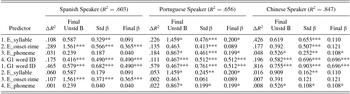
The three subcomponents of English phonological awareness were entered as separate steps as concurrent or longitudinal predictors of English word reading measured in kindergarten and first and second grades. The β values are reported for each measure at each step (see Tables 6, 7, and 8). To increase interpretability of across group comparisons, final unstandardized b and standardized β values are reported in the regression tables. Unstandardized coefficients preserve metric equality of parameter estimates across measures or groups because variables are expressed in the original, raw units. Transparent comparisons are needed to make judgments about the relative levels of phonological awareness. Unstandardized values allow easy and accurate comparisons because one unit increase in the dependent variable, word reading, equates to comparable increases in the independent variables, specifically levels of phonological awareness across groups. Standardized β values allow for comparisons across measures to identify which independent variable has the strongest relationship with the dependent variable.
Predicting kindergarten reading in English (word ID) using English phonological awareness measures in kindergarten

Note: E, English.
*p < .05. **p < .01. ***p < .001.
Predicting Grade 1 reading in English (word ID) using English phonological awareness measures in Grade 1

Note: E, English.
*p < .05. **p < .01. ***p < .001.
Predicting Grade 2 English word reading (word ID) using English measures in Grade 1
Note: E, English; G1, Grade 1.
*p < .05. **p < .01. ***p < .001.
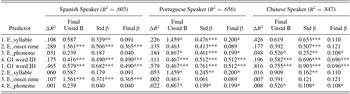
The first series of analyses examined the relationships between English word reading performance and the subcomponents of phonological awareness in English measured in kindergarten. For the Spanish–English group, English onset-rime awareness was most highly related to English reading (b = 0.880, β = 0.372, p < .05). For the Portuguese–English speakers, English phoneme awareness was related to English reading (b = 1.629, β = 0.356, p < .05). For the Chinese–English speakers, onset-rime awareness was the English phonological awareness variable that was most highly related to English word reading (b = 2.760, β = 0.703, p < .001; see Table 6).
Due to substantial differences in sample sizes between kindergarten and Grade 1 (see Participants section) a relatively large proportion of the data was missing for the Spanish and Chinese groups. Therefore, longitudinal predictors were not examined from kindergarten to Grade 1. For this reason, English reading in Grade 1 was examined in relation to performance on the subcomponents of phonological awareness in English measured in Grade 1 (see Table 7). For the Spanish–English speakers, English onset-rime awareness and English phoneme awareness were uniquely related to English word reading in first grade (b = 1.575, β = 0.307, p < .01 and b = 1.996, β = 0.294, p < .01, respectively). For the Portuguese–English speakers, English onset-rime awareness and phoneme awareness were related to English reading in first grade (b = 2.428, β = 0.431, p < .001 and b = 2.463, β = 0.518, p < .001, respectively). For the Chinese–English speakers, English syllable awareness, onset-rime, and phoneme awareness were all uniquely related to English reading in first grade (b = 1.189, β = 0.185, p < .05; b = 1.927, β = 0.510, p < .001, and b = 1.268, β = 0.221, p < .01, respectively).
In addition, analyses were conducted predicting English reading in Grade 2 based on first-grade performance on English phonological awareness (see Table 8). English word reading performance in first grade was included as an autoregressor. The autoregressor was entered as the first step and alternately as the final step in order to examine the unique contributions of the subcomponents of phonological awareness and of past reading performance to second-grade reading. As expected, English word reading performance in first grade was highly related to English word reading in Grade 2, in Spanish–English speakers (b = 0.416, β = 0.490, p < .001; Portuguese–English speakers, b = 0.467, β = 0.512, p < .001; and Chinese–English speakers, b = 0.582, β = 0.696, p < .001). However, for all of the groups, subcomponents of phonological awareness contributed unique variance to reading in second grade. For the Spanish–English speakers, English onset-rime awareness skills (b = 1.561, β = 0.365, p < .001), measured in first grade predicted English word reading performance in second grade even when controlling for the autoregressor. For the Portuguese–English speakers, English syllable and phoneme awareness skills measured in first grade were predictors of second-grade English word reading (b = 1.459, β = 0.200, p < .05 and b = 0.867, β = 0.199, p < .05), even after English word reading skills in first grade were entered as an autoregressor. For the Chinese–English speakers, English phoneme awareness in first grade was a significant predictor of second-grade English word reading performance (b = 0.526, β = 0.108, p < .05), even after English word reading skills in first grade were entered as a control variable.
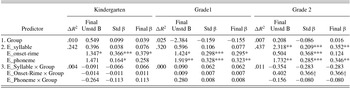
In order to determine if group membership based on the native language systematically influenced English word reading skills, a series of regression analyses were conducted collapsing the data across the three groups. Analyses were conducted separately for each grade. Native language group was entered as a categorical variable as the first step. Then the subcomponents of the phonological awareness task and the interaction term for group by subcomponent of phonological awareness were entered as the second and third steps, respectively (see Table 9). The group variable was not statistically significant. For the kindergarten analyses, onset-rime awareness was the unique predictor of English reading. In first grade, onset-rime and phonemic awareness were related to English reading. In second grade, syllable awareness and phoneme awareness measured in first grade were related to English word reading. The interactions between group and the subcomponent of phonological awareness were not significant for any of the analyses. However, the interaction term for group by onset-rime awareness approached significance in Grade 2. This result could explain the lack of a significant relationship between onset-rime and reading in Grade 2. In summary, for these analyses, group was not related to the components of phonological awareness used to read English.
Predicting English word reading (word ID) with the three groups combined
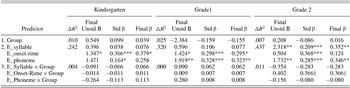
Note: The values are concurrent predictors for kindergarten and Grade 1 and Grade 1 predictors for Grade 2. E, English.
†p < .10. *p < .05. **p < .01. ***p < .001.
Relations between L1 and L2 phonological awareness and reading in the L1
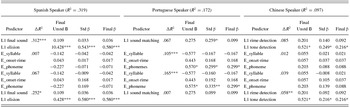
Reading performance in the L1 was examined in first grade. First-grade L1 reading skill was selected as the L1 variable to be examined because not all the children were exposed to L1 reading instruction in kindergarten and variability in the amount of L1 at-home literacy experience could not be perfectly verified. In addition, later L1 reading performance might be influenced by language loss in the L1. In terms of predicting L1 reading in Grade 1, concurrent performance on L1 and L2 phonological awareness was entered into the equation (see Table 10). For the Spanish–English speakers, performance on the Spanish elision task was the only variable uniquely related to Spanish reading (b = 0.428, β = 0.580, p < .001). For the Portuguese–English speakers, English phoneme awareness was most highly related to Portuguese word reading (b = 0.575, β = 0.299, p < .05). For the Chinese–English speakers, performance on the Chinese tone task was the only variable that was uniquely related to Chinese character reading (b = 0.521, β = 0.216, p < .05).
Predicting word reading in the L1 in Grade 1 using concurrent measures of L1 and English phonological awareness

Note: L1, First language; E, English.
*p < .05. **p < .01. ***p < .001.
DISCUSSION
This study examined whether specific subcomponents of phonological awareness in the L1 and L2 were more strongly related to reading in the L1 and L2 in English learners. Groups with three different native languages, Spanish, Portuguese, and Chinese, were selected based on the type of sound–symbol mappings represented in the orthography. Therefore, between-language and between-group differences are highlighted in terms of which subcomponents of phonological awareness are significantly related to word reading.
Initial group comparisons demonstrated that these groups of English L2 speakers were performing at least within the average range on most measures of reading from kindergarten to second grade. The Chinese–English speakers initially outperformed the other two groups in kindergarten and first grade. However, by second grade, the performance of the three groups was similar on word reading. Typical of English L2 speakers, each group had relatively lower scores on vocabulary. However, the mean vocabulary scores for the groups were in the low-average range and not the below-average range. These scores are in contrast to the groups’ nonverbal reasoning scores, which were at least within the high-average range.
In terms of the main research questions, the key findings include a stronger effect of the language being read in terms of the subcomponents of phonological awareness related to reading, as compared to an effect of group when reading the same language, English. Although small differences were found for the effect of native language group on reading the same language (L2), the patterns were not as clear and differed somewhat based on reading level.
The key finding in support of the psycholinguistic grain size theory is that the subcomponents of phonological awareness that are related to reading are specific to the language being read. This finding holds when examining reading in the same language across groups and reading across languages for the same groups. Therefore, the children were relying on language-dependent variables to read the orthographies of their native languages. For example, tone was the only variable related to reading in Chinese. Other phonological awareness skills in Chinese and in English were not related to Chinese reading. In contrast, phonemic awareness predicted reading in Spanish and Portuguese. These groups differed somewhat, with Spanish phonemic awareness being related to Spanish reading and English phonemic awareness being related to Portuguese reading. These group differences are likely related to the nature of the bilingual experience for the two groups. The Spanish–English group demonstrated a pattern of sequential bilingualism and had stronger skills in Spanish. In contrast, the Portuguese–English group demonstrated a pattern of simultaneous bilingualism with stronger scores in English by the time they had been in school for a couple of years. Therefore, relations between subcomponents of phonological awareness and reading differed based on the language being read for the three groups.
All three subcomponents of English phonological awareness were related to English reading for each of the groups at varying time points. Although these variables are not consistently related across groups at each time, some of these differences might be related to the reading skill of each group at a given time. Similarly, despite the fact that they are achieving within the average range in second grade, these children are all still in the process of acquiring word reading proficiency in English. Specifically, phonological awareness continues to explain variance in second-grade word reading even when first-grade word reading is included as an autoregressor, suggesting that additional variance exists beyond earlier reading skill. This finding of a prolonged period of word reading acquisition is typical of English readers when compared to readers of other more regular languages with more consistent small unit sound–symbol relations (Seymour et al., Reference Seymour, Aro and Erskine2003; Ziegler & Goswami, Reference Ziegler and Goswami2005). Finally, the analyses combining the groups show that group membership did not explain variability in the process of reading acquisition. Although the groups differed on word reading performance in kindergarten and Grade 1, by the end of second grade, the groups’ scores were more similar. For none of the full sample analyses did group membership appear to strongly alter the relations between subcomponents of phonological awareness and reading in English. Our findings are in contrast to the results of research with adults that showed that characteristics of L1 orthography influence L2 reading (Tan et al., 2003; Wang et al., Reference Wang, Perfetti and Liu2005). Given the linguistic context in Canada, where children who are L2 learners receive English instruction in an immersion setting and exposure to the L1 is limited to the home environment, the groups are expected to be more similar in their acquisition of English literacy.
However, the analyses conducted with the full group do not provide a complete picture of the results. Although consistent patterns were not found for each group across time points, analyses also show some group differences within each time point. Therefore, some group-dependent factors were noted and will be mentioned in relation to English reading. The clearest group differences in kindergarten and Grade 1 were in comparing the Spanish–English speakers and Portuguese–English speakers to the Chinese–English speakers. For the Spanish–English and Portuguese–English speakers, English reading was related to onset-rime or phoneme awareness skills in English. In contrast, the Chinese–English speaking group was the only group for whom syllable awareness was related to English word reading in first grade. The other subcomponents were also consistently related to English reading in the Chinese–English speaking group. These findings are noteworthy in that the Chinese–English speaking group was the group with the highest English reading scores in kindergarten and first grade. Therefore, the relationships between reading and awareness of larger phonological units, specifically syllables and onset-rimes, were not based on being beginning readers or on using unsuccessful reading strategies. Mean scores on pseudoword reading also showed that the Chinese–English speaking children were capable of decoding unfamiliar words. Therefore, the strategies that this group was using for word-level reading appeared to be successful and productive.
The results of this study are supportive of the general premises of the psycholinguistic grain size theory. The concept of availability, which suggests that all phonological units are not equally accessible to nonreaders, or this case beginning readers, is supported by the fact that in kindergarten, larger units were most likely to be related to reading performance for the groups. In addition, despite having lower English reading scores, the Spanish–English speakers and Portuguese–English speakers did not differ on English phonemic awareness. However, L1 linguistic typology did not appear to systematically influence the subcomponents of phonological awareness related to L2 reading. Consistency, in terms of the grapheme-to-phoneme mappings, and its interaction with granularity, the size of the consistent units to be mapped, were apparent in this study. Reading performance in the languages with the consistent small unit mappings, Spanish, and to some extent Portuguese, was more highly related to phonemic awareness. In contrast, reading in Chinese, the language with inconsistent sound–symbol mappings, was uniquely related to tone detection. Tone detection is a metalinguistic skill related to Chinese oral and written proficiency that does not map specifically onto phonemic units. Therefore, its relation to Chinese orthography is not clearly understood. However, its early acquisition and ease of processing for native Chinese speakers suggests that it is a key component of Chinese language knowledge (Li & Thompson, Reference Li and Thompson1977; Tong & McBride-Chang, 2010).
Unfortunately, all subcomponents of phonological awareness were not measured for each language. In some cases, subcomponents were omitted based on the structure of the language. For example, tone detection was only measured in Chinese. In addition, in Spanish rhyming generally involves two-syllable words in which the second syllable is identical. This task would be very different from an onset-rime task. In other cases, measures were not readily available in the language of interest (i.e., Portuguese). Future research should systematically examine all subcomponents of phonological awareness in each language.
Finally, all of the subcomponents of phonological awareness were related to English reading skill, with a tendency for larger units to be related to reading in the earlier grades and smaller units to be related to reading in the somewhat older, more proficient children. The less than perfect pattern of results should be interpreted with caution, because the results could be a statistical artifact. The general pattern of results in this study mimics findings with native English speakers that show the development of phonological awareness progressing from onset-rime to phonemic awareness (Anthony & Lonigan, Reference Anthony and Lonigan2004; Stanovich et al., Reference Stanovich, Cunningham and Cramer1984). This trend in terms of the subcomponents of phonological awareness related to reading likely reflects the inconsistencies in the English orthography as well as developmental changes in the access to phonological units. In addition, existing English proficiencies might reflect subtle differences in the components related to English reading. For example, the Portuguese and Chinese speaking groups had strengths in English oral language proficiency and reading, respectively, which facilitated their reading acquisition. In contrast, the Spanish speakers had weaker English skills. These patterns of strengths and weaknesses might have influenced cross-language relations.Footnote 3 The findings are also compatible with the orthographic depth hypothesis (Frost & Katz, Reference Frost and Katz1992), showing differences in relationships between reading and phonological awareness skills based on orthography.
Although the orthography being read seems to be the larger factor, patterns were not identical across groups for English reading. Therefore, being bilingual and achieving well in reading in the L2 might have highlighted the similarities and differences in the orthographies of two languages for the children in this study (Kuo, & Anderson, Reference Kuo and Anderson2010). Similar to previous research, the current findings show that phonological awareness skills across languages and across subcomponents within language are considered somewhat separate but related constructs that can change with development (Anthony & Lonigan, Reference Anthony and Lonigan2004; Branum-Martin et al., Reference Branum-Martin, Mehta, Fletcher, Carlson, Ortiz and Carlo2006; Gottardo & Mueller, Reference Gottardo and Mueller2009). Therefore, as these children progressed in the acquisition of reading skills, the groups became more similar and more successful in solving the “problem” of learning to read English.
In summary, the data supported the language-dependent nature of solving the problem of the optimal grain size for each orthography. This problem appears to be solved in similar ways in relation to reading English in groups of beginning readers with a wide range of native languages. The relations are also different across languages for the same groups, suggesting that different strategies are being used to successfully read different orthographies even in young bilingual readers.
ACKNOWLEDGMENTS
We thank the teachers, principals, parents, and students who participated in this study and everyone who was involved in the assessment teams over the duration of the study. This research was supported by a grant (to A.G.) from the Social Sciences and Humanities Research Council of Canada and the Canadian Language and Literacy Research Network. We also acknowledge the support of Wilfrid Laurier University and the University of Toronto.