1. Introduction
Science is constrained by the methods available, and so scientists necessarily spend much of their time looking under the lamppost. Microbiologists mostly used to study the tiny fraction of micro-organisms that can be grown in petri dishes (Zhang, Reference Zhang2004). Social scientists mostly study undergraduates at selected institutions in the West (Henrich, Heine, & Norenzayan, Reference Henrich, Heine and Norenzayan2010). But sometimes, the gaps in our knowledge have other origins. One notable gap in psychology is that, in comparison to the vast literature on objects and object representations, our field has had comparatively little to say about events or their representation. The most obvious explanation for this gap is that events are complicated and abstract and thus hard to study, but that only makes them that much more important to understand.
Into this void steps Event Cognition by psychologists Gabriel Radvansky and Jeff Zacks: a simultaneously fascinating, challenging, and inspiring attempt to provide that missing psychological theory of events for a wide readership. Noting the recent “emergence of event cognition as a vibrant topic of scientific study”, they present their book as an “attempt to wrangle the effusion of empirical and theoretical work into a consistent framework, and to trace its relationships to broader currents in cognition science” (p. ix). This is no mean task. Event cognition is very much a Wild West of phenomena and fragments of theories. Bringing together a hodgepodge of insights and theoretical perspectives on events in one book is a difficult endeavor, and this is a promising start – a start with loose ends, but a start that invites the opportunity to tie the strands further together.
2. A theory of events
After a brief historical introduction, the authors devote much of the first half of the book to laying out a theory of event cognition: the somewhat ominously named Event Horizon Model, which subsumes an earlier Event Segmentation Theory (Kurby & Zacks, Reference Kurby and Zacks2008). At the heart of the Event Horizon Model is the event model, which contains information about the relationships between the entities present in a scene. Event models are augmented by schemata or scripts: stored knowledge about common types of events, their internal structure, and temporal order (Schank & Abelson, 1977).
Adults, it is assumed, have acquired models of frequent events and use them to predict what will happen next; for instance, upon ordering a drink, the drink will be prepared by the bartender. If the environment changes significantly – for instance, the customer goes to get cash, or the bartender faints – these predictions will start to fail, prompting the individual to abandon the current event model and develop a new one. This gives Radvansky and Zacks their definition of event: “a segment of time at a given location that is conceived by an observer to have a beginning and an end” (p. 2), though spatio-temporally discontinuous events are allowed if there is a “unifying relationship, such as a causal one” (p. 20).
Events (and their models) can be hierarchically nested: one event (making dinner) may abstract over several subevents (chopping vegetables, roasting the vegetables, etc.), each of which has its own model. Importantly, humans cannot represent two or more unrelated events at the same time: someone who is multitasking (cooking and watching TV) is not involved in two unrelated events but a single event of cooking-while-watching-TV, plus any subevents or super-events.
Much of the evidence for this part of the theory comes from the vast literature on ‘event segmentation’. This literature grew out of Newtson & Engquist’s (Reference Newtson and Engquist1976) finding of high between-subject agreement on the location of ‘event boundaries’ in a movie. Numerous factors reliably predict segmentation behavior: changes in location, time, and even body posture. Subjects who are asked to provide fine-grained segments provide a segmentation that can be hierarchically nested within segments provided by subjects asked to provide coarse-grained segments. Radvansky and Zacks argue that these and related findings can be accounted for by the Event Horizon Model.
The Event Horizon Model extends beyond segmentation to the organization of memory. In particular, the authors argue that much of memory is organized around event models, which are themselves organized according to their causal relationships. Based on this intuition, the authors make several broad predictions about memory. One is that the strength and number of causal connections between (pieces of) an event model with others correlate with ease of recall: for instance, if obtaining a drink always precedes payment, it will be easier to recall (or reconstruct) that payment event. However, the more similar two event models are, the more they compete with one another during retrieval: if someone goes to all the karaoke nights in San Diego surfer bars, they become indistinguishable from one another in memory; if one of those karaoke nights involved a Nobel Prize winner, it may be more memorable. Finally, it is easier to remember two pieces of information that are tied to two different event models than two pieces of information tied to the same event model: it may be hard to remember all the songs sung on 11 March 2006; but it is easier to remember that ‘Total Eclipse of the Heart’ was not one of them, because that one was performed on a later karaoke night.
It should be noted that the exact circumstances that lead one of these principles to apply and not another is not entirely clear – at least not to us. Part of this results from the theory being defined more intuitively than mechanistically. What does it mean for event models to be causally connected? When one entity appears in multiple event models, is this through linked copies? Pointers? Is the first instance special, or the last? What about a surprising event that co-occurred with the usual event – will that lead to stronger or weaker memory of either or both? Event models describe events and make predictions, but how? Are they a generative model? A flow chart? Much of this remains to be fleshed out.
But we also recognize that there are glimpses of fascinating points of data on representational issues, which will help in starting to answer all these questions. As researchers who specialize in event representations, we were particularly interested in those places where Radvansky and Zacks provided more detailed insights, or made more precise claims, on how people represent events. For instance, they posit that when a model is consistent with a schema, “copies of the relevant portions of a script are copied into the memory trace” (p. 126). They also suggest, based on several patient case studies, that the identities of individuals participating in an event are stored in memory separately from the rest of the event model (pp. 128–130). They note that event models must sometimes explicitly represent the lack of an entity, rather than merely lack a representation of the entity, leaving negation to inference (p. 176). A mechanistic theory of events will need details like these.
3. The importance of events
Providing a theory of events was only one of the authors’ goals. As exemplified by the title of the first chapter (‘The importance of events’), the other central goal is to motivate more psychologists to think about event cognition. This comes to the fore particularly in four chapters in which they discuss the role of event cognition in perception, memory, problem-solving, planning, and decision-making:
Theories such as the Event Indexing Model, Event Segmentation Theory, and the Event Horizon Model provide theoretical frameworks that can be used to organize, understand, and explain a variety of phenomena, at a number of different levels, that have been known to cognitive science for quite some time. Bringing all of this work together into a common framework allows for new predictions to be made and new facts to be discovered that were not possible before. (p. 213)
Across four chapters, they provide some compelling examples. For instance, we have already mentioned the principle that information is more easily remembered when spread across events. Thus, because events are spatio-temporally bound, learning the first half of a word list in one room and the second half in another room decreases retroactive interference in the first list (p. 144). Another example: according to the Event Horizon Model, transitions between events are a period of heightened attention, leading to the prediction that “information that is present during an event boundary will be encoded more richly in long-term memory” (p. 133).
For most of the phenomena they discuss, however, the new insight rarely extends much beyond noting that events are involved. For instance, they review the classic fortress/tumor problem (Gick & Holyoak, Reference Gick and Holyoak1980), in which subjects are asked to solve two problems that have the same structure:
If one recognizes that this problem has the same structure as the fortress problem, the tumor problem can be solved easily. The catch is that very few people spontaneously perceive that analogy, and so most do not show any benefit from the prior problem in solving the new problem … Exposing people to multiple problems with the same structure substantially improves the odds that people will notice the structural similarity. This is consistent with the principal from the Event Horizon Model that repeating an attribute across event models facilitates its retrieval. (p. 179)
Few would dispute that seeing multiple examples of a pattern makes it easier to recognize the pattern. The difficulty has always been in explaining how the pattern was abstracted in the first place, which the Event Horizon Model does not address.
They provide a similar reinterpretation of boundary extension (Intraub, Bender, & Mangels, Reference Intraub, Bender and Mangels1992), in which subjects misremember pictures as having been taken from a wider angle, including crucial parts of a scene that the subject inferred, but were missing from the actual stimulus: “This appears to happen because when one views a picture, one constructs an event model that represents the scene depicted by the picture” (p. 137). Modulo wording, this is the standard explanation. So what does the application of Radvansky and Zacks’ theory add to the understanding of this effect?
To be clear: we fully support the program of highlighting the central role of event representation in essentially every cognitive question. We are also sensitive to the advantages of a broad, unifying framework. However, four chapters of text with a low density of novel insight is dissatisfying and perhaps counter-productive. Although the ubiquity of events is demonstrated, the overall effect is to make one feel that Radvansky and Zacks’ unifying framework seems to largely predict the same phenomena in the same way as the standard theories. This risks giving the impression that event cognition can be safely ignored.
4. What is an event?
One difficulty Radvansky and Zacks face is their extremely broad definition of event. For example, their account of boundary extension above requires applying the principles of event cognition to static images of objects. They also conceptualize doing arithmetic as an ‘event’, applying their model to the fact that people find it easier to do mental arithmetic with semantically related objects (3 tulips + 5 daisies) compared to objects that are semantically unrelated (6 hens + 2 radios), or had a functional relationship (4 records + 4 songs) (Bassok, Pedigo, & Oskarsson, Reference Bassok, Pedigo and Oskarsson2008). Finally, they even argue that “camouflage is an attempt by the animal to hide … the nature of an event” (p. 209).
If event cognition seems in danger of swallowing all of perception, that is not wrong: “successful perception is tantamount to creating an appropriate event model for a perceived event” (p. 209). For that matter, “successful [language] comprehension is tantamount to the creation of an appropriate event model of a described situation” (p. 210). This makes sense once one realizes that, for Radvansky and Zacks, an event model is one’s entire representation of the current environment and situation (or, in the case of remembered events, a prior environment and situation). The downside is that this expansive notion of ‘event’ must necessarily be extremely flexible, risking becoming merely a redescription of the problem.
It is worth considering what the alternative is. Linguists and philosophers have, for their own reasons, thought a great deal about events. One task for both is to characterize the meanings of words and sentences. As we often talk about events, a theory of events is needed. This is made only more true by the realization of Filmore (1967) that many rules of grammar depend on the kind of event being talked about: Abigail is standing at the corner is grammatical, but The house is standing at the corner is not. Why? That’s because in English, you can use the progressive tense (is standing) to imply a temporary situation (Grafmiller, Reference Grafmiller2013). Houses normally remain at corners permanently. However, if someone jacked up a house, put it on a trailer, and started driving it across town only to be stopped at a red light, it would be perfectly acceptable to say that the house is standing at the corner while the driver waits for the light to turn green.
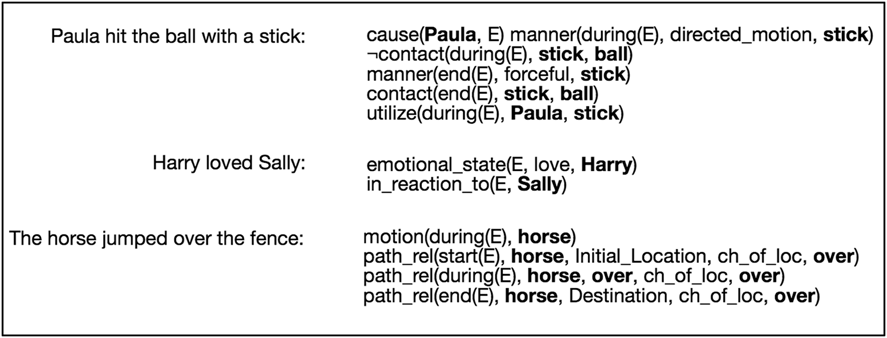
In order to explain why languages have the structure that they do and not some other structure, linguists and philosophers have developed a number of rich formalisms for describing events (see Figure 1) (Kipper, Korhonen, Ryant, & Palmer, Reference Kipper, Korhonen, Ryant and Palmer2006; Levin & Rappaport Hovav, 2005). Importantly, the difficulty in linguistic theory-building has also been to find the right balance between over- and undergeneralization: we want a theory that prohibits The house is standing, but allows The house is falling apart. Thus, linguists’ goals in creating these formalisms is to generate a range of possible expressions with a fixed set of rules, accurately predicting which sentences are well-formed, which are odd but rescuable in the right context and using human creativity, and which are completely impossible. Thus, they provide some of the constraints on prediction that we wished to see in the Event Horizon Model.
Event representations in VerbNet (http://verbs.colorado.edu/verb-index/vn3.3/).

Strikingly, many if not most of the events people talk about are not ‘events’ under Radvansky and Zacks’ definition. We talk about tax reform or the development of evolutionary theory (no spatio-temporal coherence), the rise and fall of the Roman empire (too long), or our regular trips to Darwin’s Cafe (happens on a regularly spaced interval). As already mentioned, multitasking is verboten: cooking dinner while watching TV must be treated as a single event, completely losing the relationship with events of only cooking or events of only watching TV: cooking-dinner-while-watching-TV is an atomic event under Radvansky and Zacks’ model. What, then, happens when the bacon burns? In language, we would describe that as a failure in cooking, but not watching TV. The opposite is true when the toddler grabs the remote. Clearly, converting simultaneously occurring events into atomic units does not do justice to our human capacity of rapid task-switching under the umbrella of a larger goal, or seven. Interestingly, some linguists have discussed the connection of hierarchically structured complex events and subevents, and events occurring in parallel, using their analytic tools (see, for a recent instance, Jackendoff, Reference Jackendoff2007, ch. 4).
A related issue, which has consumed much of language research for decades, is the problem of multiple construals (cf. Gleitman, Reference Gleitman1990). The cat chased the mouse and the mouse fled from the cat can both refer to the same event, but they do not have the same meaning: the former profiles the cat’s intentions, whereas the latter profiles the mouse’s intentions. The fact that these dissociate can be seen in the anthropomorphism of the tsunami chased me up the beach or the tornado fled from me. In fact, it is almost always the case that any given sentence profiles only one part of a situation (e.g., the chasing or the fleeing or the running or the hiding, etc.). Language researchers would say that these refer to different event representations that are simultaneously in play. For the Event Horizon Model, the problem cannot even be articulated.
To be fair, linguistic event theories likewise flail when confronted with the robust event segmentation phenomena that motivate much of the Event Horizon Model. If many event representations are in play at any one time, why do people reliably segment videos in the same places? Take, for instance, a morning routine in any given household. If a camera was mounted in the kitchen, moments of high visual transitions would be reliably marked as event boundaries: the moment when morning cereal is eaten and the children go to brush their teeth; the moment in which the coffee pot is taken off the stove; the moments of the beginning and end of a tantrum related to which shoes to put on. Linguistically, however, those events are often described in chunks, arches, and spotlights: drinking the coffee covers many sips across brushing of children’s teeth, getting dressed oneself, mopping milk off the floor, and forgetting one’s keys. Remembering where the keys are, albeit the most important event of the morning, would not be predicted by event segmentation, simply because it happens in the middle of the tantrum. Likewise, the linguistic theories do not obviously make sense of the many memory phenomena identified by Radvansky and colleagues. To be even fairer, the linguistic theories do not entirely explain language, either: otherwise, we would speak of ‘linguistic theory’ in the singular.
This illustrates the challenge of event research. As Radvansky and Zacks show, events touch much of cognition, and so any complete theory must do an enormous amount of work. Moreover, as they touch much of cognition, events have been explored from many angles and many research traditions. We describe linguistics research above, but events have been much discussed in artificial intelligence and robotics (Tellex, Thaker, Joseph, & Roy, Reference Tellex, Thaker, Joseph and Roy2013; Toussaint, Reference Toussaint2015), perception and action (Papeo, Negri, Zadini, & Rumiati, Reference Papeo, Negri, Zadini and Ida Rumiati2010; Saltzman & Holt, Reference Saltzman and Holt2014), and elsewhere.
If Radvansky and Zacks did not pull together all these threads, they pulled together many. If their theory is frustratingly incomplete even with respect to that part of event cognition it takes on, it is nonetheless more complete than its forebears. That is as much as any researcher can hope for, and the next researchers who try to push the work forward will be in that much better a position.