




No CrossRef data available.
Article contents
- Abstract
- Exploring the White House and the Press
- Center Advisory Board Named
- 2003-2006:
- 2003-2005:
- 2003-2004:
- In The News
- In Profile Kevin Quigley
- The Centennial Center is Open to You
- Funding Opportunities Through the Centennial Center
- Fund For Latino Scholarship
- Warren E. Miller Fellowship in Electoral Politics
- Special Fund for the Study of Women and Politics
- The Presidency Research Fund
- Marguerite Ross Barnett Fund
- Paul Volcker Endowment
Center PAGE A Look at the Centennial Center for Political Science & Public Affairs
Published online by Cambridge University Press: 26 February 2004
Article contents
- Abstract
- Exploring the White House and the Press
- Center Advisory Board Named
- 2003-2006:
- 2003-2005:
- 2003-2004:
- In The News
- In Profile Kevin Quigley
- The Centennial Center is Open to You
- Funding Opportunities Through the Centennial Center
- Fund For Latino Scholarship
- Warren E. Miller Fellowship in Electoral Politics
- Special Fund for the Study of Women and Politics
- The Presidency Research Fund
- Marguerite Ross Barnett Fund
- Paul Volcker Endowment
Abstract
An abstract is not available for this content. As you have access to this content, full HTML content is provided on this page. A PDF of this content is also available in through the ‘Save PDF’ action button.
Information
- Type
- Association News
- Information
- Copyright
- © 2004 by the American Political Science Association
Exploring the White House and the Press
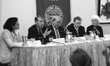
The Centennial Center opened with a splash in October by hosting a public presentation that examined the White House and the Press. Cosponsored by the White House Historical Association, the event was held at the Woman's National Democratic Club. Martha Joynt Kumar of Towson University organized and moderated the session, which included Dan Bartlett, current White House Communcations Director; Mike McCurry, former Press Secretary to President Clinton; Bill Plante, White House Correspondent, CBS News; and Alexis Simendinger, White House Correspondent, National Journal.

The panel discussed how the relationship between the White House and press corps changed over time as the news cycle changed, the audience fragmented, and the relationship between the media and the executive branch became less cooperative and more adversarial. The session was covered by C-SPAN and received considerable press coverage. A reception and open house at the Centennial Center followed.
The event is the first in a series of programs through which the Centennial Center will bring together the scholarly community, policy makers, media, and the public.
Center Advisory Board Named
At its fall 2003 meeting in Philadelphia, the APSA Council approved the selection of nine individuals to serve on the Centennial Center Advisory Board. These individuals will provide leadership and guidance in Center programming and development.
2003-2006:
Mark Hansen, University of Chicago, Chair Christopher Deering, George Washington University Martha Joynt Kumar, Towson University
2003-2005:
Valerie Martinez-Ebers, Texas Christian University Christopher Foreman, University of Maryland Alan Abramson, The Aspen Institute
2003-2004:
Karen O'Connor, American University Mark Jones, Michigan State University Martin O. Heisler, University of Maryland
In The News
Centennial Center Visiting Scholar Michael Heaney has drawn national media attention through his exploration of the role of health policy interest groups. Following passage of the Medicare Prescription Drug and Modernization Act in November, Heaney scored articles on Medicare reform and grassroots influence in the opinion pages of the Washington Post and Washington Times. He was also quoted in numerous newspapers, including the Wall Street Journal and Denver Post, as well as in several trade newsletters.
In Profile Kevin Quigley
Y2K was described by President Clinton as one of the most complex management challenges in history. Margaret Beckett, Y2K Coordinator for the British government, described it as the largest operation since the Second World War. The two governments spent over $10 billion on central government operations alone and took over three years to complete the process. And, in the end, few systems failures were reported. Did this mean success? Despite the scope and cost of the project it has received almost no critical analysis, academic or otherwise, post-January 1, 2000.
Today, Queen's University (Belfast) doctoral candidate Kevin Quigley is taking one of the first in-depth looks at the issue. For three months Quigley was a visiting scholar at the Centennial Center conducting fieldwork on specific U.S. government agencies, allowing him to put the U.S. and U.K. cases in comparative perspective. In Washington he gained access to the critical players at his chief US case studies-the Federal Aviation Administration and the Bureau of Labor Statistics. He also met with professional and political staff from congressional committees and the President's Y2K Council. His stay also took him to Silicon Valley in California to meet with leading Y2K commentators and information technology leaders who helped shape Y2K planning.

“My research thus far suggests that the technical nature of a risk is only one of several features of a risk case that shapes risk management strategies. Public opinion and the role of special interests, for instance, can also influence the manner in which risk is perceived and managed,” Quigley said.
Quigley plans to present his findings at a conference in the fall with a journal article to follow. Defense of his dissertation, “Y2K as a Lens on New Public Management, Risk Management, and Bureaucratic Behaviour in the U.S. and British Governments,” is planned for the winter of 2004/05.
The Centennial Center is Open to You
The Centennial Center is the first tangible product of the Association's successful Centennial Campaign and its commitment to creating new opportunities for current and future generations. As part of its activities, the Centennial Center has designed a Visiting Scholars Program to provide space for scholars pursuing their own research and teaching projects, at the same time creating an environment for collaboration and professional development. The Center brings together scholars from different institutions, fields of study, parts of the world and stages of career. It has office space to support 10 scholars at any one time, with additional plug-in space for day visits in the Center's library and conference room. Located within the Association's headquarters building, the Center provides desks, computers, phones, and other infrastructure needs for stays ranging from a few days to 12 months.
Visiting Scholar stays are limited to members of APSA. Space is available for faculty members, post-doctoral fellows, and advanced graduate students—whether from the United States or abroad. Scholars are expected to cover their own expenses during the stay and, for scholars staying longer than two weeks, a modest facilities fee. Scholars with shorter stays will be charged a daily or weekly rate. These fees will assist the Center's development and maintenance and cover access to all its available resources.
Prospective Visiting Scholars may apply at any time. Positions are awarded on a space-available basis. Full details on the Center and the Visiting Scholars Program, including an application form, may be found online <www.apsanet.org/centennialcenter>. To discuss the Center and its resources please contact Sean Twombly at twombly@apsanet.org.
Funding Opportunities Through the Centennial Center
As a result of generous contributions by members and friends to the Centennial Campaign, APSA has developed a number of endowments to support a diverse range of grant programs. These grants may support stays at the Centennial Center or research expenses elsewhere. The areas supported are listed below; application materials for each can be found on the Center web site <www.apsanet.org/centennialcenter>. The application deadline for all programs is February 28, 2004.
Fund For Latino Scholarship
This fund provides support to individuals or programs that promote the recruitment, retention, and promotion of Latino and Latina political scientists. The fund also provides travel grants to support research work or presentations.
Warren E. Miller Fellowship in Electoral Politics
This fund provides supplemental support for research residencies in national and comparative electoral politics at the Centennial Center.
Special Fund for the Study of Women and Politics
This fund provides supplemental support for the study of women and politics to both resident and nonresident scholars.
The Presidency Research Fund
This fund provides supplemental support for examination of the presidency for both resident and non-resident scholars.
Marguerite Ross Barnett Fund
This fund supports research on issues of diversity, cultural nationalism, African-American voting behavior, educational policy, and urban and minority politics for resident or non-resident scholars.
Paul Volcker Endowment
This fund provides support in research and theory building on public administration issues affecting governance in the U.S. and abroad for resident or nonresident scholars.

“The Centennial Center provided me with a valuable research home-base to which I could come at the end of a day of archival research and interviews at the nearby IMF Headquarters. Having my own office, phone, and computer, as well as non-stop Internet and printing access, made my research much more productive than it would have been otherwise. Most importantly, I was able to interact and exchange ideas with other visiting scholars: I am convinced that those contacts will continue well into the future.” Jana Von Stein, University of California, Los Angeles

Pamela Blackmon (r), a fall 2003 Centennial Center Visiting Scholar, joins Robert Pace (l), executive director of the American-Uzbekistan Chamber of Commerce, at the Uzbekistan Independence Day Celebration at the Embassy of Uzbekistan. Blackmon noted that her stay in Washington provided invaluable access to resources for her dissertation.


“The Centennial Center provided me with a valuable research home-base to which I could come at the end of a day of archival research and interviews at the nearby IMF Headquarters. Having my own office, phone, and computer, as well as non-stop Internet and printing access, made my research much more productive than it would have been otherwise. Most importantly, I was able to interact and exchange ideas with other visiting scholars: I am convinced that those contacts will continue well into the future.” Jana Von Stein, University of California, Los Angeles
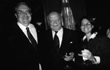
Pamela Blackmon (r), a fall 2003 Centennial Center Visiting Scholar, joins Robert Pace (l), executive director of the American-Uzbekistan Chamber of Commerce, at the Uzbekistan Independence Day Celebration at the Embassy of Uzbekistan. Blackmon noted that her stay in Washington provided invaluable access to resources for her dissertation.
 You have Access