Introduction
Developed almost three decades ago, the Geriatric Depression Scale (GDS; Yesavage and Brink, Reference Yesavage and Brink1983) has been one of the most commonly used depression screening tools administered in geriatric populations. The GDS is a self-report scale consisting of 30 items (10 worded negatively and 20 worded positively) answered using a yes/no response format. Values on the scale range from 0 to 30, with higher values indicating more symptoms of depression. A score of 10 is typically used as the threshold to separate patients into depressed and non-depressed groups (Brink et al., Reference Brink, Yesavage, Lum, Heersema, Adey and Rose1982). To alleviate respondent fatigue, several short forms of the GDS have been developed. Among these, the 15-item version (Sheikh and Yesavage, Reference Sheikh and Yesavage1986) is the most frequently used. Additional short forms that have been examined in research include versions with 10 items (D'Ath et al., Reference D'Ath, Katona, Mullan, Evans and Katona1994; van Marwijk et al., Reference van Marwijk, Wallace, de Bock, Hermans, Kaptein and Mulder1995), 5 items (Hoyl et al., Reference Hoyl1999), 4 items (D'Ath et al., Reference D'Ath, Katona, Mullan, Evans and Katona1994), and 1 item (D'Ath et al., Reference D'Ath, Katona, Mullan, Evans and Katona1994). While the GDS was originally developed in English, it has been translated into more than 30 different languages including Chinese, French, Greek, Japanese, Italian, Turkish, and Spanish (http://www.stanford.edu/~yesavage/GDS.html).
There are several strengths of the GDS over other depression screening tools. One of the important features of the GDS is that the scale was developed specifically for older adults. As most available depression screening tools were developed and validated in samples of medically healthy younger adults, certain depressive symptoms (such as sleep difficulties and decreased energy) included in those screening tools are often found among non-depressed older adults (Lichtenberg, Reference Lichtenberg2010). The GDS, on the other hand, limits itself to symptoms of depression that are not otherwise likely to appear in older adults. The GDS does not contain somatic symptom items such as loss of appetite and effort (Kessler, et al., Reference Kessler, Foster, Webster and House1992). These somatic complaints are likely to be shared by those with medical disorders, older adults, or people from certain cultural groups (Lewis-Fernández et al., Reference Lewis-Fernández, Das, Alfonso, Weissman and Olfson2005; Kalibatseva and Leong, Reference Kalibatseva and Leong2011), making them less valid indicators for depression for members of those groups. Finally, the GDS is easier for older adults to complete because its items are written using relatively simple language using an easy, yes/no response format.
A number of psychometric studies have reported good reliability and validity for the GDS (e.g Yesavage and Brink, Reference Yesavage and Brink1983; Burke et al., Reference Burke, Roccaforte, Wengel, Conley and Potter1995). Previous studies also suggest that the reliability of the GDS is satisfactory in diverse elderly populations (Mui et al., Reference Mui, Burnette, Chen, Skinner, Teresi, Holmes, Stahl and Stewart2002; Mui et al., Reference Mui, Kang, Chen and Omanski2003; Malakouti et al., Reference *Malakouti, Fatollahi, Mirabzadeh, Salavati and Zandi2006). For example, the GDS has been found to have a Cronbach's alpha of 0.90 among Iranian elders (Malakouti et al., Reference *Malakouti, Fatollahi, Mirabzadeh, Salavati and Zandi2006). Mui and colleagues (Reference *Mui2003) also found both long and short forms of the GDS to be reliable measures for assessing depression among community-dwelling elderly Asian immigrants.
The factor structure of the GDS has been examined in a number of previous studies (e.g. Parmelee et al., Reference *Parmelee, Lawton and Katz1989; Sheikh et al., Reference *Sheikh1991; Abraham et al., Reference *Abraham, Wofford, Lichtenberg and Holroyd1994; Mui, Reference Mui1996a; Adams et al., Reference Adams, Matto and Sanders2004; Lai et al., Reference *Lai, Tong, Zeng and Xu2010). The reported number of factors of the GDS has ranged from two (Chiu et al., Reference *Chiu, Lee, Wing, Kwong, Leung and Chung1994; Incalzi et al., Reference *Incalzi, Cesari, Pedone and Carbonin2003; Brown et al., Reference *Brown, Woods and Storandt2007) to nine (Salamero and Marcos, Reference *Salamero and Marcos1992), depending upon versions of the GDS, factor analytic methods (exploratory factor analysis vs. confirmatory factor analysis), and study population. Using an exploratory factor analysis (EFA), the factor structure of the GDS was first reported by Sheikh and colleagues (Reference *Sheikh1991) with the following five factors: (1) sad mood and pessimistic outlook (9 items); (2) a lack of mental and physical energy (6 items); (3) positive or happy mood (6 items); (4) agitation or restlessness (3 items); and (5) social withdrawal (2 items). Sheikh and colleagues (Reference *Sheikh1991) found that four items (i.e. #1 “satisfied,” #3 “life empty,” #14 “memory,” and #17 “feel worthless”) did not load on any of the factors. Adams and colleagues (Reference Adams, Matto and Sanders2004) conducted a confirmatory factor analysis (CFA) using 26 items of the GDS (excluding four items – #14 “memory,” #11 “restless and fidgety,” #24 “frequently get upset,” #27 “enjoy getting up in the morning”), and confirmed the five-factor structure (dysphoric mood, withdrawal-apathy-vigor, hopelessness, cognitive, and anxiety).
Previous studies found evidence that the factor structure of the GDS may vary depending on respondents’ language use and cultural background (e.g. Eartan and Eker, Reference *Ertan and Eker2000; Jang et al., Reference *Jang, Small and Haley2001; Lai et al., Reference *Lai, Fung and Yuen2005; Pocinho et al., Reference *Pocinho, Farate, Dias, Lee and Yesavage2009). For example, in a study conducted among older Koreans (interviewed in Korean) and Americans (interviewed in English), Jang and colleagues (Reference *Jang, Small and Haley2001) found few similarities in the factor structures of the GDS-short form (SF; the 15-item version) between the two language/cultural groups. In their study, a three-factor structure of the GDS-SF (“internal perceptions,” “external aspects,” and a group containing two items of “staying at home” and “problem with memory”) was found among Koreans interviewed in Korean, whereas a four-factor structure (“positive mood,” “sad mood/pessimistic outlook,” a third group containing incongruent items, and a single-item group containing “staying at home”) was found among Americans interviewed in English. The authors suggested that the different structures may reflect different interpretations of and responses to depressive symptom items included in the GDS (Jang et al., Reference *Jang, Small and Haley2001). In another study conducted among Turkish older adults (interviewed in Turkish), Eartan and Eker (Reference *Ertan and Eker2000) found a seven-factor structure of the 30-item version of the GDS, but argued strongly that a two-factor structure (negatively-worded and positively-worded factors) would be easier for interpretation in this language/cultural group. Taken together, the literature provides evidence that the factor structure of the GDS may vary across different language versions.
Given the lack of consensus on the factor structure of the GDS, as well as the fact that the GDS factor structure appears to vary across diverse cultural and/or language groups, the present study sought to systematically review literature on the factor structure of the GDS using a meta-analytic approach. The main purposes of this meta-analytic study were to (1) determine as to what factor structure fits best the data provided by prior factor analyses and (2) identify the effects of language on the factor structure of the GDS.
Methods
Initial literature search
A two-phase search strategy used in previous research (Kim et al., Reference Kim, DeCoster, Huang and Chiriboga2011) was employed to identify articles for the current meta-analysis. The initial search phase focused on identifying the full range of articles that may potentially be related to the topic of interest. Computerized indices were searched where terms related to GDS, such as “GDS,” and “Geriatric Depression Scale” were paired with terms related to factor analysis, such as “factor,” “component,” and “structure.” These paired terms were submitted to the following online databases to identify articles that had examined the factor structure of the GDS in different languages: PSYCINFO (May 1980–August 2010), PubMed (May 1980–August 2010), and Digital Dissertations (May 1980–August 2010). We have also ensured our search from the three databases covers all possible studies for inclusion by submitting our search to the Google Scholar search engine. After excluding duplicated articles, a total of 629 potential articles were found.
Inclusion criteria
The second search phase aimed at finding articles that specifically met the study-inclusion criteria. The abstracts of the 629 articles identified in the initial search phase were reviewed, and 41 articles that included an exploratory factor analysis (EFA) of the GDS were identified. Articles reporting confirmatory factor analyses (CFAs) were not included in the sample due to the following reasons: (1) the inclusion of CFAs would allow researchers' expectations to influence results (because CFAs are model-driven; Kim et al., Reference Kim, DeCoster, Huang and Chiriboga2011), (2) meta-factor analyses have traditionally focused on EFAs, and (3) only two studies using CFAs were identified in our search. (Please note that the two studies conducted both CFA and EFA, and thus EFA results of the two studies were included in our study.) The 41-factor analysis articles were then reviewed to locate studies where (1) the factor analysis of the GDS was conducted either on the long-form version (30-item/27-item) or on the short-form version (15-item) of the GDS; (2) the factor-analytic results were reported separately by language or the study only used a single language version; (3) the results provided adequate information to determine which items loaded on each factor for each language group; and (4) the sample in the study did not overlap with those from other articles that had already been included. When two studies shared participants, only the one that had larger sample size was screened in so that no redundant samples were included, which would falsely inflate the study population. All four of the authors jointly decided on the inclusion criteria and made decisions jointly whenever there was any question about whether a study met the criteria.
Studies were not restricted with regard to extraction or rotation methods because the goal was to identify the robust structural characteristics of the GDS across a broad range of analytic strategies. A total of 26 studies that examined the GDS in ten different languages (i.e. Chinese, English, Greek, Hindi, Iranian, Italian, Japanese, Korean, Portuguese, and Turkish) met the above-mentioned criteria and were included in the current analysis. Although we would have excluded any studies if their results suggested that the analysis was not performed correctly, we did not see evidence of this in any of the studies we examined. Thus, we did not exclude any studies on a methodological basis.
Data analysis
The current meta-analysis was based on the meta-analytic methods suggested by Loeber and Schmaling (Reference Loeber and Schmaling1985) and Frick and colleagues (Reference Frick1993), which have recently been used by Shafer (Reference Shafer2006) and Kim and colleagues (Reference Kim, DeCoster, Huang and Chiriboga2011). The procedure is as follows:
First, the factor loadings were recorded for each study in the literature that performed a factor analysis of the GDS where the entire sample was assessed in the same language. If a study reported multiple factor analyses that had each been performed on the same language, each was recorded separately. Second, the factor loadings were used to create a co-occurrence matrix with 15 rows and 15 columns for each of these analyses, indicating whether each pair of items in the short version of the GDS did or did not load on the same factor. A pair of items was identified as loading on the same factor when they both had their highest loadings on the same factor and the magnitudes of both of those loadings were at least 0.30. Items were not considered to have loaded on the same factor when the loading magnitudes were both greater than 0.30 but one of the items had a higher loading on a different factor. Secondary loadings were not considered when generating the co-occurrence matrices. Studies were included if they used the full version of the GDS, but the co-occurrence matrix only included the results for items that are part of the short version. Third, the co-occurrence matrices were averaged within each language that had more than one representative factor analysis (i.e. Chinese, English, Japanese, and Korean). This average is the “aggregate correspondence matrix,” which indicated the proportion of the factor analyses in which each pair of items loaded on the same factor. For example, when determining the aggregate correspondence matrix, if the first item and the second item loaded on the same factor three times out of a total of five analyses, the entry in the first row and second column (as well as the entry in the second row and first column) would be equal to 0.6. These proportions can be thought of as measures of the similarity between each pair of items, ranging from 0 (not at all similar) to 1 (very similar). We also created an overall aggregate correspondence matrix that averaged across all of the studies included in this meta analysis, including those from languages that only had a single representative factor analysis. A meta-factor analysis was performed by using the full 30-item version of the GDS, but none of the resulting aggregate correspondence matrices was positive definite and so could not be analyzed.Footnote 1
The final step was to perform an EFA on each of the aggregate correspondence matrices to determine the factor structure of the GDS separately for each of these samples. Although factor analyses are typically performed on correlation matrices, the aggregate correspondence matrices also possess the qualities needed to act as the basis of a factor analysis (Tatsuoka, Reference Tatsuoka1971). Principle components extraction was used, keeping any factors with eigenvalues greater than 1. The Scree plots of the eigenvalues were also examined, but did not provide any evidence that basing the factor selection on eigenvalues distorted the results. After determining the number of factors in the solution, a varimax rotation was used on the extracted factors to simplify the interpretation of the results.
Results
Characteristics of studies meeting the meta-analytic inclusion criteria
Table 1 summarizes the descriptive characteristics of the studies included in the meta-analysis divided by language. There were between one and ten studies for each of the ten included languages. One study (Jang et al., Reference *Jang, Small and Haley2001) contributed to both the English and Korean language samples. Some studies analyzed more than one subgroup; the number of subgroups included per study ranged from one to three. The overall combined sample size including all language groups was 14,669 with a mean sample size of 1,467 per language. The Portuguese language had the smallest sample size (n = 200), whereas the English language had the largest (n = 5,543). The publication year of the studies ranged from 1989 to 2010. The number of GDS factors found in the included studies ranged from two to nine. The English language had the largest number of studies, subgroups, and within-language factor variability in the number of extracted factors. A summary of basic characteristics of all 26 included studies is displayed in Table 2.
Descriptive characteristics of the GDS studies included in the meta-analysis by language (n = 26)

Notes. One article (Jang et al., Reference *Jang, Small and Haley2001) contributed to both the English and Korean meta-analyses; While all 26 articles were included in our meta-analysis, only four language groups (Chinese, English, Japanese, and Korean) having two or more studies were separately analyzed.
Summary of the GDS studies included in the meta-analysis (n = 26)

Notes: M = Mean; SD = Standard Deviation; n.a. = not available
aKim et al. (Reference *Kim2008) only reported overall factor loadings that included all 3 subgroups combined.
Language effects on factor structure
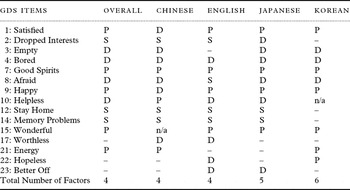
The rotated factor loadings from the meta-analysis for each language are presented in Appendix I. These are summarized in Table 3, which reports the factor each item of the GDS loads on for each language. Given that meta-analysis required multiple studies for synthesis, we only meta-analyzed the four language groups (Chinese, English, Japanese, and Korean) that had two or more studies. Other six language groups (Greek, Hindi, Iranian, Italian, Portuguese, and Turkish) having only one study were not separately analyzed, but were included in the overall meta-analysis. The initial aggregate correspondence matrix for the Chinese version of the GDS produced a non-positive definite matrix, and so could not be analyzed. Dropping either one or two items from the matrix was never sufficient to produce a positive definite matrix, but we did find that there were three sets of three items that, when dropped, would lead to an analyzable, positive-definite aggregate correspondence matrix. These sets were (items #7, #15, #17), (items #7, #15, #23), and (items #10, #15, #17). The results for the Chinese version of the GDS presented in Appendix I and referenced in Table B are, therefore, determined by averaging the results across the three analyzable matrices after equating the factors. In addition, the initial aggregate congruence matrix for the Korean version of the GDS was also not positive definite. However, we did obtain a positive-definite matrix when we dropped item 10, so this is what is presented in Appendix I and referenced in Table E.
Factor names of highest factor loadings of the GDS items by language

Notes. P = positive mood; S = social withdrawal-apathy-cognitive impairment; D = dysphoria; – = Items did not load on any of the three common factors; n/a = No information available because of a lack of convergence
As shown in Table 3, three common factors appear consistently across most of the languages. The first common factor was primarily composed of “dysphoria” (items #3, #4, #8, and #10), which appeared in all of the solutions. The second common factor was “social withdrawal-apathy-cognitive impairment” (items #2, #12, and #14), which appeared in all of the solutions except that for the Korean language. The third common factor was “positive mood” (items #1, #7, #9, #15, and #21), which appeared in all of the solutions. The remaining factors were more idiosyncratic and did not replicate across languages. Many of these did not appear to have meaningful interpretations, and thus we do not present interpretations of these additional factors.
Global comparisons of the GDS factor structures between languages
After obtaining the factor-analytic results for each language, we determined the extent to which the factor structures were equivalent across the different languages. Paralleling the prior work of Kim and colleagues (Reference Kim, DeCoster, Huang and Chiriboga2011), we used the method proposed by Kaiser and colleagues (Reference Kaiser, Hunka and Bianchini1971) and implemented by Fleming (Reference Fleming1992). The Kaiser method was chosen because it is well –established; has an accepted criterion for determining equivalence; and has a software implementation. The Kaiser method allows pair-wise comparisons of the full factor structures between groups to determine the degree to which they are similar. Bushman and colleagues (Reference Bushman, Cooper and Lemke1991) describe three principal steps to the Kaiser method. First, the variable vectors from both groups must be normalized to ensure that the variables make equal contributions to the final results. Second, the factor loadings are used to position the variables from the two samples in a common vector space. This provides a representation of how the variables are related to the factors in each of the two samples. Finally, the factor axes are rotated to provide maximal overlap between the two samples. After the solution is obtained, the cosines between pairs of variable vectors (defined across the factors) can be taken as a measure of the equivalence of the factor structure between the two groups. The cosines range from −1 to 1, with values closer to 1 indicating greater congruency. Kaiser et al. (Reference Kaiser, Hunka and Bianchini1971) suggest that a mean variable cosine of 0.85 or higher indicated that the fit between the samples was “reasonable,” although Barrett (Reference Barrett1986) recommends a more conservative cutoff of 0.90. These cutoffs are independent of the number of scale items and the number of factors in the scale.
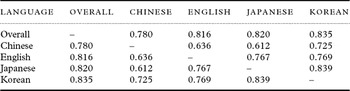
Table 4 presents the mean variable cosines comparing the observed factor structures of the GDS across the different languages. Comparisons with the Chinese version always excluded item 15 and comparisons with the Korean version always excluded item 10 because these items were not part of the aggregate correspondence matrices for these languages. The mean variable cosines obtained when comparing the structure found in the overall sample to the individual languages range from 0.612 to 0.839 with an average of 0.76. None of the mean variable cosines from comparisons between individual languages exceeded Kaiser et al.'s (Reference Kaiser, Hunka and Bianchini1971) suggested cutoff (0.85) for “reasonable” fit, suggesting that the different languages produced distinct factor structures.
Mean variable cosines comparing factor structures between languages

Notes: Only four language groups (Chinese, English, Japanese, and Korean) having two or more studies were separately analyzed. Other six language groups (Greek, Hindi, Iranian, Italian, Portuguese, and Turkish) having only one study were included in the overall meta-analysis.
Comparing individual factors between languages
The three common factors of “dysphoria,” “social withdrawal-apathy-cognitive impairment,” and “positive mood” appeared in almost every solution. However, the loadings for these factors were not always consistent across the different languages. Therefore, congruence coefficients were calculated to determine whether the loadings of these three factors were individually equivalent across the different languages. Unlike the Kaiser method, which assessed the equivalence of the full factor structure between groups, the congruence coefficients assessed the equivalence of individual pairs of factors. The congruence coefficient can have values between −1 and 1, where values closer to 1 indicate a greater correspondence between the two factor definitions. Mulaik (Reference Mulaik1972) suggests a rule of thumb wherein congruence coefficients greater than 0.90 indicate that the factor loadings are invariant between two groups.
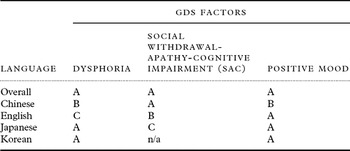
To simplify the presentation of these comparisons, homogenous subsets are provided in Table 5. The purpose of this analysis is to identify language groups that have equivalent definitions for each of the three factors, where equivalence is indicated by having a congruence coefficient greater than 0.90. Comparisons with the Chinese version always excluded item 15 and comparisons with the Korean version always excluded item 10, because these items were not part of the aggregate correspondence matrices for these languages (please see Appendix I Tables A and C). For the “Dysphoria” factor, the structures are equivalent between the Japanese and the Korean versions of the GDS, but the structures for Chinese and English are unique. For the “Social Withdrawal-Apathy-Cognitive Impairment” factor, each language appears to have its own unique structure. For the “Positive Mood” factor, the English, Japanese, and Korean versions appear to have similar structures, but the factor structure observed in the Chinese version is not equivalent to those found in the other languages.
Factor equivalencies across languages

Notes. Within a factor, language groups not sharing any Roman letters have distinct factor loadings (i.e., congruence coefficient less than .90); the ‘dysphoria’ factor includes items #3, #4, #8, and #10; the ‘social withdrawal-apathy-cognitive impairment’ factor includes items #2, #12, and #14; and the ‘positive mood’ includes items #1, #7, #9, #15, and #21; There is no subgroup assigned to the SAC factor for the Korean language because that factor did not appear in the Korean solution.
Discussion
The GDS has been widely used in diverse cultural groups and has been implemented in more than 30 different languages. However, prior to this meta-analysis, there was still a lack of consensus on the overall factor structure of the GDS, and only a few studies had investigated how this varies between languages. The present meta-analysis sought to fill the gap by examining the effect of language on the factor structure of the GDS. Using data from 26 published factor analyses of the GDS across ten languages, we found clear evidence of language differences in the factor structure of the GDS. While a number of empirical studies have suggested the possibility of differences in the factor structure of the GDS across diverse cultural or language groups, none has reviewed existing literature systematically using a meta-analytic approach. To our knowledge, this is the first meta-analysis of the GDS factor structure, which has implications for both research and practice.
The most important and intriguing finding was that different languages produced distinct factor structures of the GDS. This was evidenced by comparisons of the mean variable cosines comparing the overall factor structures, as well as the congruence coefficients comparing the factor loadings of the factors that were found in common. While a four-factor structure of the GDS was observed in the overall sample, the number of factors observed in each language ranged from four to six factors. Empirical studies included in our meta-analysis also reported a wider range of factors, ranging from two to nine in different language groups. The combination of these findings clearly suggests that the factor structure of the GDS varies significantly depending on linguistic and/or cultural factors. This implies that researchers and clinicians need to be careful about interpreting the factor scores of the GDS when it is administered in languages other than English.
Similarities in the GDS factor structure across different languages should also be noted. Three common factors (dysphoria, social withdrawal-apathy-cognitive impairment, and positive mood) appeared in almost every language group, although the factor loadings for the individual items were not always consistent. The positive mood factor had the most in common across different languages, especially for English, Japanese, and Korean. In a recent meta-analysis of the Center for Epidemiologic Studies Depression Scale (CES-D) factor structure, items related to positive mood turned out to be most consistent across five different racial and ethnic groups (Kim et al., Reference Kim, DeCoster, Huang and Chiriboga2011). The reasons why the positive mood factor has repeatedly been more consistent across different cultural or language groups are not clear. One possibility is that the idea of positivity may be simple enough that it is defined in a common way across cultures and languages. Alternatively, it could be argued that the items included in this factor are typically all worded in the same direction, whereas the other factors are more likely to have items with reversed wordings. If this is the case, the consistency may be more of a methodological artifact than a theoretically meaningful fact. Further research is needed to elucidate reasons for such findings.
Implications for both research and practice should be discussed. Our results show that the GDS includes some common depressive symptom items shared across different languages, as well as language- and/or culture-specific items and factors that are unique to certain groups. Differences in the factor structures arising from language may suggest cultural differences in the conceptualization and expression of depressive symptoms included in the GDS measure (Kim, Reference Kim2010). In a previous meta-factor analysis on the CES-D, the authors suggested that different cultures conceptualize, experience, and express depressive symptoms in different ways, and that there may be no equivalent concepts for depression in certain non-Western cultures (Kim et al., Reference Kim, DeCoster, Huang and Chiriboga2011). In clinical settings, clinicians and practitioners should be aware that older adults with diverse cultural and language backgrounds may express their depressive symptoms differently when languages other than English are used to administer the GDS. Thus, as previous research suggested (Mui et al., Reference Mui, Burnette, Chen, Skinner, Teresi, Holmes, Stahl and Stewart2002; Kim et al., Reference Kim, Chiriboga and Jang2009), clinicians should also recognize that biases stemming from poor equivalence across different languages and/or cultures may produce false estimates of depressive symptoms, and that some adjustments, such as deletion of culturally or linguistically inappropriate items, may be needed. While researchers are working on the equivalence issues of the GDS, bilingual clinicians and practitioners are well suited to work with geriatric patients from diverse cultural or language groups. At minimum, clinicians should be trained to be more culturally and linguistically competent in clinical settings.
Some study limitations should be noted. First, the current meta-analysis did not include articles using CFA, mainly because CFA is not the ideal methodology due to potential introduction of bias. Second, although most of the GDS studies included in our meta-analysis used older adult samples, we were unable to control for the age range that each study used in their factor analyses. Given that the GDS was developed specifically for the geriatric population, it is not certain if the same factor structures exist when the GDS is applied to other age groups, or if its structure differs among the oldest old. Third, only four languages (Chinese, English, Japanese, and Korean) were examined by individual meta-analyses because other languages did not include multiple studies. Meta-analytic methods are designed to aggregate findings across studies, so might be used by future researchers to examine more languages when additional data become available. Fourth, we were limited to examining the items from the 15-item version of the GDS because the aggregate correspondence matrix from the 30-item version was not positive definite. Future researchers might explore variations in the factor structure of the full version of the scale using either primary studies or a different meta-analytic database. Lastly, the current meta-analysis was unable to control for potential confounding factors such as race/ethnicity, gender, socioeconomic status, and the level of acculturation that might affect the factor structures of the GDS. For example, previous research reported that the structure of other mental health screening tools varied by the level of acculturation and race/ethnicity (Chiriboga et al., Reference Chiriboga, Jang, Banks and Kim2007; Kim et al., Reference Kim, DeCoster, Huang and Chiriboga2011). While our investigation on the effect of language may overlap with testing the effect of race/ethnicity, this is not always true; so the relation between the two effects should be explored. Thus, further meta-analytic research separating the effects of language and culture on the GDS factor structure is clearly needed.
In sum, the factor structure of the GDS varied by language. As was suggested in previous research (Kim, Reference Kim2010; Kim et al., Reference Kim, DeCoster, Huang and Chiriboga2011), different factor structures across different cultural and language groups may suggest potential differences in the conceptualization of overall depressive symptoms. When factor analyses for the GDS are conducted, researchers should recognize potential structural differences in the GDS arising from language in which the measure is assessed. Future research should further examine the factor structure of the GDS to confirm the structure. We recommend that researchers use exploratory factor analysis to verify the factor structure of the GDS whenever it is translated into a new language so that structural differences can be taken into account when researchers interpret this measure.
Conflict of interest declaration
None.
Description of authors’ roles
Giyeon Kim directed and designed the study, supervised the data collection and analyses, and wrote the paper. Jamie DeCoster was responsible for the statistical design of the study and for carrying out the statistical analyses and contributed to drafting the Methods and Results sections. Chao-Hui Huang searched and collected data for the meta-analysis and assisted with manuscript preparation. Ami N. Bryant searched and collected data for the meta-analysis and assisted with manuscript preparation.