Introduction
Becoming more common in an aging society, dementia, considered one of the most devastating of general disorders, imposes a terrible burden for individuals, communities, and health services organization. Dementia has been estimated to contribute 11.2% of years lived with disability in people aged 60 years or older (Ferri et al., Reference Ferri2005), which is more than for stroke, musculoskeletal, and cardiovascular diseases.
Previous studies have shown that dementia is linked to old age, low education levels, cardiovascular risk factors (Rosano and Newman, Reference Rosano and Newman2006) as well as depression (Ownby et al., Reference Ownby2006). Some risk factors, however, are now the object of research, especially in consideration of the different roles they may play at various stages in life. The role of lipids, for example, is emblematic: some studies show that hypercholesterolemia in the elderly people represents a protective factor for the development of dementia, while in young adulthood it is a predictor of dementia (Mielke et al., Reference Mielke2005). Analogously, it has been demonstrated that higher body mass index (BMI) in midlife is associated with an increased risk of Alzheimer's disease (AD) later in life (Gustafson et al., Reference Gustafson2003), but longitudinal studies of participants aged 65 years or more have shown that low BMI is associated with an increased risk of developing dementia (Nourhashemi et al., Reference Nourhashemi2003).
Sex is an important risk factor for AD among elderly people. Several factors, such as steroid hormones, lifestyle, genetic polymorphism of sex-related genes, might confound the relationship between sex and dementia incidence. Data from the 1995 follow-up of the Italian Longitudinal Study on Aging (ILSA) have been used to estimate the incidence of dementia, AD, and vascular dementia in older Italians (Di Carlo et al., Reference Di Carlo2002). The authors reported a significant gender effect for the incidence of major dementia subtypes in Italy.
Other studies and reviews (Letenneur et al., Reference Letenneur2000; Ruitenberg et al., Reference Ruitenberg2001; Azad et al., Reference Azad, Bugami and Loy-English2007) have addressed the issue of how gender influences the incidence of dementia, considering gender a predictor and not a stratification variable. However, this approach does not allow to focus on gender-specific predictors.
We hypothesized that risk factors for incidence of dementia are different in men and women. We observed that gender is often considered as a risk factor for dementia, but it might also be an effect modifier of other risk factors and, in this case, it would be more appropriate to present different measures of associations as according to gender. In the present work, we first updated estimates for the incidence of dementia in Italy on the basis of data from the 2000 follow-up of the ILSA Study, separately for men and women. Second, we investigated for gender differences in risk factors for incidence of dementia adjusting by potential confounders and mediators such as socio-demographic characteristics, health-related behaviors, laboratory tests performed on a blood sample and health conditions.
Methods
Study population
All analyses were performed utilizing data from the ILSA, an epidemiological study conducted in Italy, described in detail elsewhere (Maggi et al., Reference Maggi1994). A random sample of 5,632 individuals aged 65–84 years, stratified by age and sex using an equal allocation strategy, was selected from the population registries of eight Italian municipalities. The study protocol was approved by the Ethics Committees of the participating centers. The study aims were explained to each potential participant and those in agreement gave written informed consent.
The baseline survey (1992) included a standardized interview on health-related behaviors, a medical history, laboratory tests performed on a blood sample obtained after an overnight fast, a medical examination, and selected diagnostic tests. Plasma lipids and glucose were measured using standard enzymatic methods.
Diagnosis of health conditions
The conditions being investigated were Angina, Myocardial Infarction, Congestive Heart Failure, Peripheral Artery Disease, Hypertension, Diabetes, Stroke, Parkinsonism, Distal Symmetric Neuropathy of Lower Limbs, and Dementia. Diagnosis of the conditions considered was carried out in two phases: a screening phase and a clinical confirmation phase. The criteria for diagnoses and the method to calculate prevalence rates have been published elsewhere (The Italian Longitudinal Study on Aging Working Group, 1997). Moreover, hypotension was defined as diastolic blood pressure lower or equal to 60 mmHg.
The diagnostic criteria adopted for dementia were: the DSM III-R criteria for the dementia syndrome (American Psychiatric Association, 1987), the NINCDS-ADRDA criteria for possible and probable AD (McKhann et al., Reference McKhann1984), the ICD-10 criteria for vascular dementia and other dementing diseases (World Health Organization, 1992). The assessment of dementia was conducted in the following two phases: screening phase (I): total score < 24 in the Mini-Mental State Examination (Folstein et al., Reference Folstein, Folstein and McHugh1975), or a previous diagnosis reported by a proxy respondent. Medical confirmation phase (II): CAMDEX section B and H (Roth et al., Reference Roth1986), the Pfeffer Functional Activities Questionnaire (Pfeffer et al., Reference Pfeffer1982), and a neurological examination. A review of available clinical records (blood test, CT scan, and/or brain's MRI) was also carried out.
Assessment of depressive symptomatology
The Geriatric Depression Scale (GDS), a 30-item assessment used to identify depression in the elderly people was administered (Brink et al., Reference Brink1982). The total score was calculated by dividing the number of positive answers with respect to the number of questions answered. If six or more items were missing, the total score was set to missing. A cut-off of 20/30 was used to define participants with severe depressive symptomatology; a score between 10/30 and 20/30 was considered an indicator of mild depressive symptomatology.
The ILSA study included two follow-up waves: in 1995–96 and in 2000. The deaths occurring between baseline and the follow-ups were ascertained and verified.
Statistical analysis
To generalize the ILSA sample to the Italian population, a set of weights was defined according to the sex, the age distribution of the reference popuation (Census 1991, available at demo.istat.it), and the sample fraction, and applied to the analyses.
The incidence rates of dementia per 1,000 person-years were then calculated separately for men and women for the 2000 follow-up. Different dementia types (AD, vascular dementia, and mixed dementia) were considered to be competing causes of dementia.
The association of baseline characteristics and the incidence of dementia were evaluated using the χ2 or exact test for categorical variables by gender. The difference between the mean values for quantitative variables was evaluated using the generalized linear model, testing for homoschedasticity through Levene's test; Welch's ANOVA was used in the event of heteroschedasticity.
The failure time (years) was calculated from the baseline enrollment to the date of dementia ascertainment or death. The data were prepared by duplicating the dataset, giving each participant a separate observation for each outcome as described by Lunn and McNeil Reference Lunn and McNeil(1995). Cox proportional hazard regression models by event type were used to evaluate the association between risk factors and outcomes; a stepwise selection method (p ≤ 0.15 to entry, p ≤ 0.20 to stay) was used (Fabbris, Reference Fabbris1997; Hosmer and Lemeshow, Reference Hosmer and Lemeshow1999). The proportional hazard assumption was verified considering Schoenfeld's residuals of the covariates. For quantitative variables, the assumption of linearity was evaluated considering the analysis of quartiles. Interactions between variables selected through the stepwise procedure were also evaluated; significant interactions (p-value from the Wald χ2 statistics) between sex and a large number of the variables justify the decision to build Cox models stratified by gender.
The analyses were performed using SAS statistical package, release 9.2 (SAS, Cary, NC).
Results
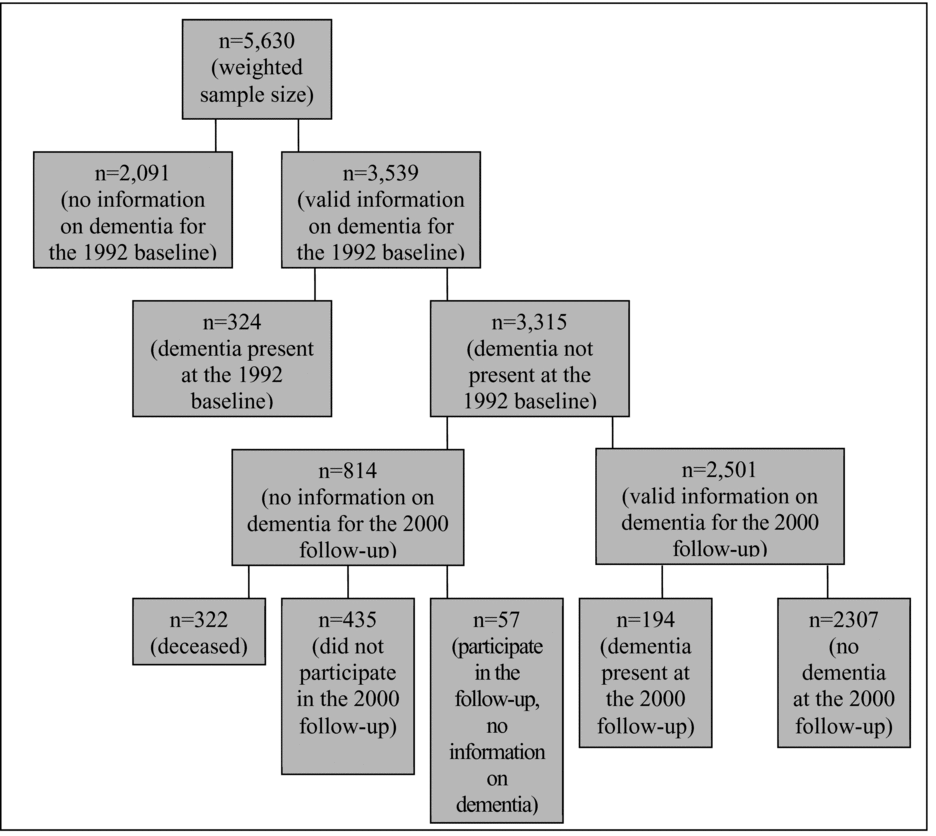
Considering the availability of information on dementia (present vs. not present), the baseline ILSA sample could be divided into two groups: 2,091 participants did not have a valid dementia evaluation at baseline, while 3,539 participants did. Among the participants who did not have dementia at the 1992 baseline (n = 3,315), 2,501 had information for the 2000 follow-up in relation to dementia or death (Figure 1).
Availability of the data. ILSA study, weighted data.

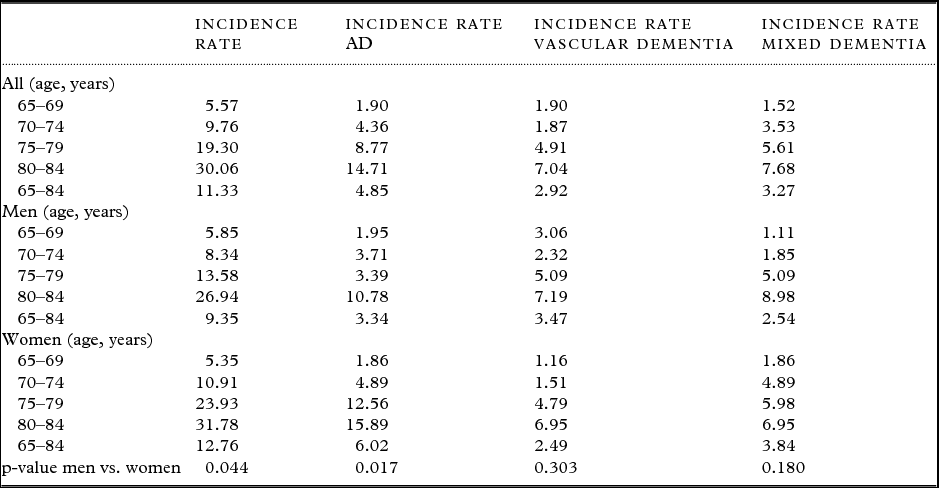
A total of 194 new dementia cases were identified after 17,669 person-years of follow-up (median follow-up period 7.8 years). AD was diagnosed in 83 participants (42.8%), vascular dementia in 50 (25.8%), and other dementia or mixed dementia in 61 (31.4%). Table 1 shows the incidence rate of dementia-specific for gender and five-year age classes. The incidence rate of dementia increased from 5.57 per 1,000 person-years at 65–69 years of age to 30.06 per 1,000 person-years at 80–84 years; the incidence rates for women were significantly higher than those observed for men (p = 0.0444). AD incidence rates for women were higher than those calculated for men (p = 0.0174), while vascular dementia incidence rates were higher for men of all ages but the difference was not statistically significant.
The incidence rate of dementia (per 1,000 person-years) for the 2000 follow-up, stratified according to sex and age classes. ILSA study, weighted data
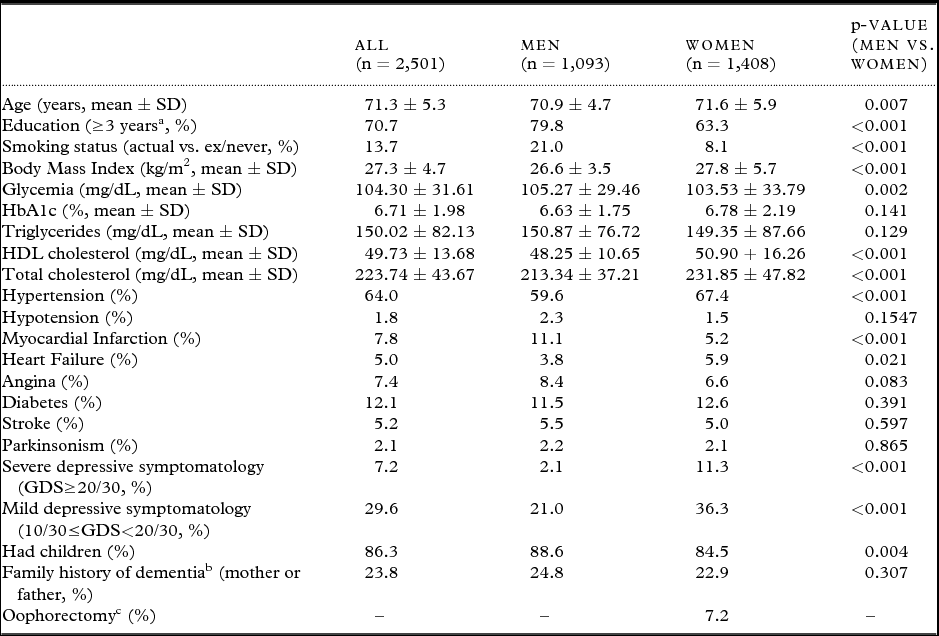
Baseline characteristics of participants considered in the longitudinal analyses are presented in Table 2, stratified according to sex. Women were significantly older, less educated, and less frequently actual smokers. Women had significantly lower BMI and glycemia levels, while their mean HDL cholesterol values were higher than those in the men. The women were also found to have a significantly lower prevalence of myocardial infarction with respect to men, and higher prevalence of hypertension, heart failure, severe and mild depressive symptomatology.
The baseline (1992) characteristics of the participants considered in the longitudinal analyses stratified according to sex. ILSA study, weighted data
aThree years corresponds to Q1 of the distribution of years of schooling.
bBased on the question “Do you know if your mother or your father has/had dementia, Alzheimer's disease, or cerebral arteriosclerosis?.”
cIncludes unilateral and bilateral oophorectomy.
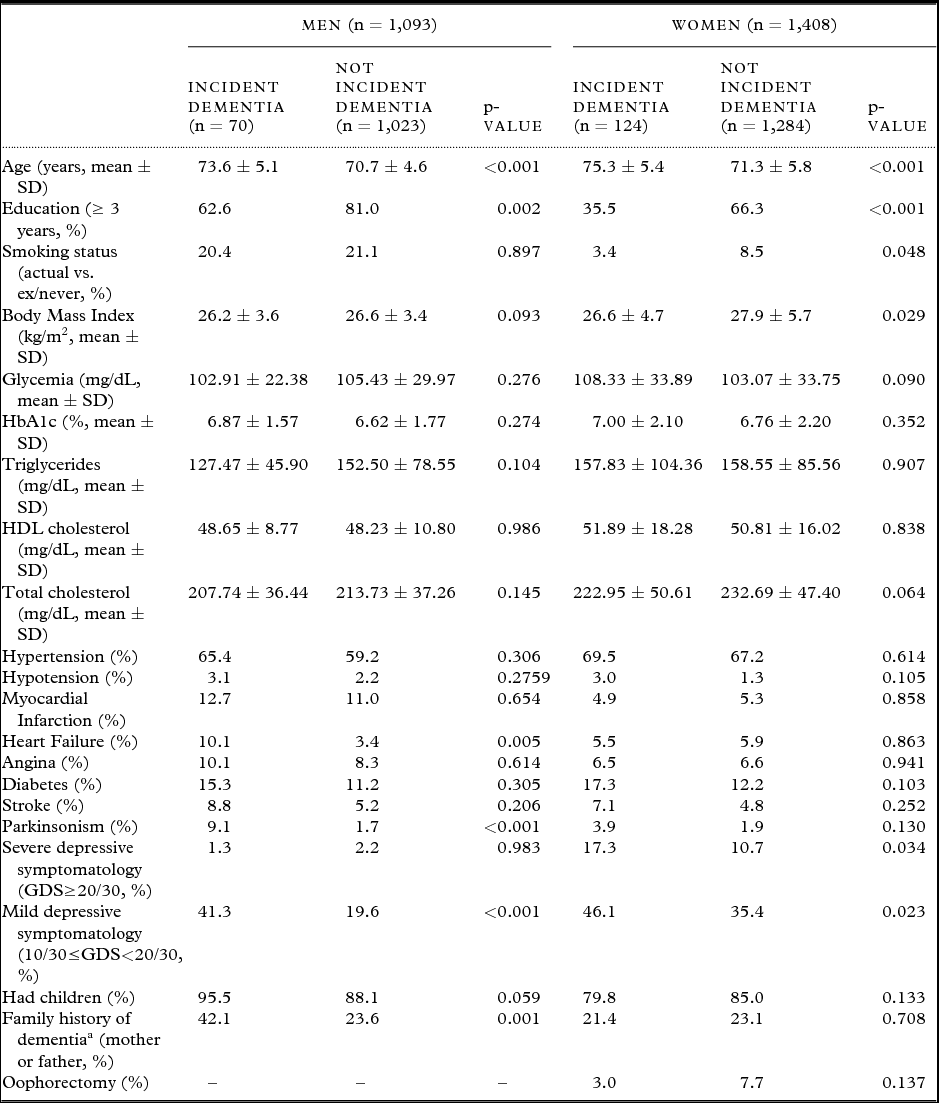
The analysis of the association between the incidence of dementia and participants’ baseline characteristics stratified according to sex is presented in Table 3. Among men, increasing age, lower level of education, heart failure, Parkinsonism, and mild depressive symptomatology were significantly associated with the incidence of dementia. Among women, increasing age, lower education, current smoking, lower BMI, and mild and severe depressive symptomatology were all significantly associated with incidence of dementia. Only for men, but not for women, reporting a family history of dementia (mother or father) was significantly more frequent in the participants with incident dementia.
Baseline (1992) characteristics of participants considered in the longitudinal analyses stratified according to sex and incidence of dementia (2000 follow-up). ILSA study, weighted data
aBased on the question “Do you know if your mother or your father has/had dementia, Alzheimer's disease, or cerebral arteriosclerosis?.”
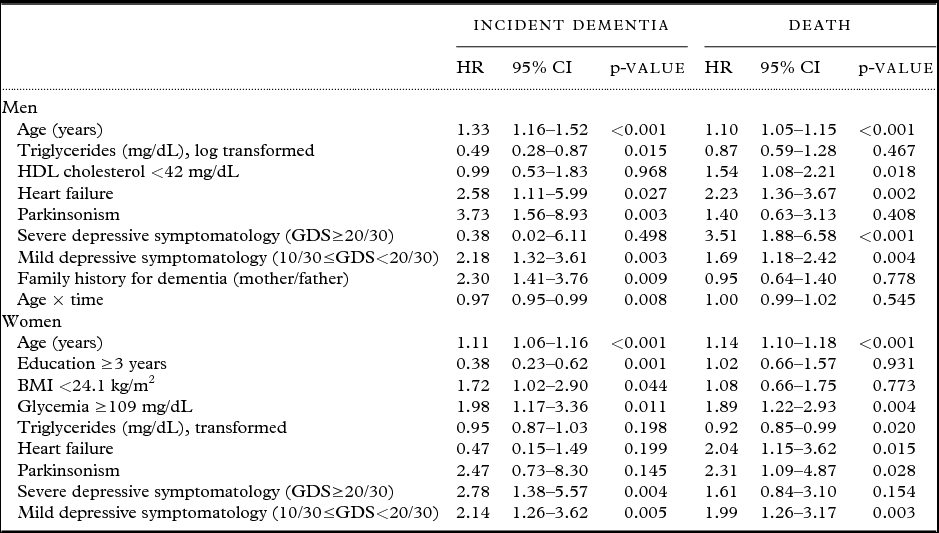
The evaluation of the association between risk factors and competing outcome (incidence of dementia and death) was performed defining, first, a Cox proportional hazard regression models by event type, not stratified by sex. Significant risk factors selected with a stepwise procedure were sex, age, education glycemia, total cholesterol, heart failure, Parkinsonism, and depressive symptomatology. Significant interactions with sex were related to education (hazard ratio (HR) = 1.81, 95% confidence interval (CI) = 0.91–3.60, p = 0.08) and heart failure (HR = 3.96, 95% CI = 1.19–13.23, p = 0.03) for incidence of dementia, and to Parkinsonism (HR = 0.42, 95% CI = 0.16–1.01, p = 0.07) and severe depressive symptomatology (HR = 2.23, 95% CI = 1.01–4.97, p = 0.05) for death. Cox proportional hazard models were therefore stratified by gender and significant risk factors selected with a stepwise procedure are presented in Table 4. Among men, heart failure (HR = 2.58, 95% CI = 1.11–5.99), Parkinson's disease (HR = 3.73, 95% CI = 1.56–8.93), and reporting a family history of dementia (HR = 2.30, 95% CI = 1.41–3.76) were all significant risk factors for dementia incidence. Mild depressive symptomatology was a significant risk factor for incidence of dementia (HR = 2.18, 95% CI = 1.32–3.61), while severe depressive symptomatology did not reach statistical significance. An increase of 1 unit of natural logarithm of triglycerides (TG) was associated with an HR of 0.49 (95% CI = 0.28–0.87) of developing dementia. Age was a significant risk factor for incidence of dementia (HR = 1.33, 95% CI = 1.16–1.52); the interaction of age with time was also significant with a HR of 0.97. Among women, significant risk factors in relation to incidence of dementia were increasing age (HR = 1.11, 95% CI = 1.06–1.16), without interaction with time, depressive symptomatology, both mild and severe (HR = 2.14, 95% CI = 1.26–3.62; HR = 2.78, 95% CI = 1.38–5.57, respectively). Having a glycemia ≥109 mg/dL was also a significant risk factor (HR = 1.98, 95% CI = 1.17–3.36), as well as having a BMI < 24.1 kg/m2 (HR = 1.72, 95% CI = 1.02–2.90). Education to little as three years of school was a significant protective factor from the incidence of dementia (HR = 0.38, 95% CI = 0.23–0.62).
Risk factors in relation to incident dementia (1992–2000): Cox proportional hazard models for competing risks (incident dementia, death) divided according to sex. ILSA study, weighted data
Significant risk factors for all-cause mortality among men were age, low HDL (less than 42 mg/dl), heart failure, and depressive symptomatology (both mild and severe). Among women, significant risk factors for death were age, high glycemia (more than 109 mg/dL), heart failure, Parkinsonism, and mild depressive symptomatology. TG level (log-transformed) was a significant protective factor.
Discussion
In the present study, we investigated the potential gender differences in risk factors for incidence of dementia in a seven-year follow-up of the ILSA cohort.
AD incidence in the Italian cohort of elderly participants studied over almost an eight-year period was similar to that found in the Rotterdam Study (Ruitenberg et al., Reference Ruitenberg2001) for both men and women. In our study, however, the incidence of vascular dementia was higher, especially in men. Although age was a significant risk factor for the incidence of dementia in both genders, the interaction of age with time was significant for men, indicating that there is a reduction in the impact of age over time. The effect of age, in fact, was no longer significant eight years after the baseline.
The analyses presented confirm that women and men have different risk factors for incident dementia cases. Evidence for gender differences is most salient for education and heart failure, for which significant interactions with sex were detected in the Cox model predicting incidence of dementia.
Gender differences could express biological, survival, or cohort differences. For example, Parkinsonisms seem to be a significant risk factor for dementia in men, but not in women. In women, however, they double the risk of death, suggesting a potential survival effect: men with Parkinsonisms survive longer than women and, therefore, are at higher risk of developing related dementia. Some studies have, in fact, suggested that survival may be worse in women than in men with Parkinsonisms (Elbaz et al., Reference Elbaz2003), but this pattern has not been confirmed by others (Berger et al., Reference Berger2000). On the other hand, it could also be hypothesized that dementia may reduce survival in women with Parkinsonisms and more women than men might have developed dementia between the baseline evaluation and death.
In the cohort studied, a higher level of education has a protective effect on the risk for dementia only for women and not for men. A lower level of education has frequently been studied as a risk factor for dementia and cognitive impairment. Previous report (Mortel et al., Reference Mortel1995) demonstrated an increased risk of AD for participants with lower level of education, adjusting analyses for sex but not evaluating the effect modification associated with sex. The effect modification by sex may reflect a differential distribution of unmeasured confounding factors, such as socio-economic status (SES), which can be related to early-life exposure potentially influencing brain development, as suggested by Letenneur et al. Reference Letenneur(2000). Low SES is associated with late menarche and an earlier menopause, therefore with a shorter exposure to estrogens compared to those in higher SES (Genazzani et al., Reference Genazzani2007). We can hypothesize that potential effects of SES were not mediated by differences in the use or access to health services based on gender, considering that in our cohort virtually all women were married or widowed and their SES reflected that of theirs spouses.
In our study, an association between higher TG levels and decreased risk of dementia was observed only for men. It should, in any case, be remembered that the TG mean level in both genders was about 150 mg/dL, and thus overall in the normal range. One potential explanation is that TG level is positively associated with alcohol consumption and that moderate alcohol consumption, as reported in our cohort of men, appears to be protective against dementia development (Chen et al., Reference Chen, Lin and Chen2009). In women, most probably, the modest/null alcohol consumption is not sufficient to affect the lipid profile. In our cohort, alcohol consumption was not associated with dementia and an interaction with the TG level must be ruled out. There are several other possible explanations for the negative association between TG levels and dementia in men. First, the TG level in older individuals may not represent their lifetime pattern, because many lifestyle factors and diseases may modulate it with advancing age. Thus, TG values measured in old age may differ considerably from those determined by genetic and dietary factors in young and middle age. Second, it is possible that the study population was already selected at baseline according to TG levels and that those who remained in the cohort may have been relatively resistant to the negative effects of TG. In the present study, the inverse association between TG and total mortality in women was probably caused by the confounding of the secondary reduction of TG concentration due to age-related lifestyle factors (poor diet and malnutrition) linked to chronic diseases and fragility, more frequent in women than in men (Whitson et al., Reference Whitson2010). Our findings suggest that TG concentrations are sensitive to many gender-specific factors, making it an unreliable marker for estimating risk of dementia and death in an older population. The conclusion that higher TG concentrations could to some extent have a protective effect in men against dementia cannot be excluded.
Accumulating evidence from population-based studies suggests that higher BMI in younger adults is associated with higher dementia risk at older ages (Atti et al., Reference Atti2008). Low BMI in our older women was found to be a strong predictor of dementia, as already reported in the Paquid Study (Nourhashemi et al., Reference Nourhashemi2003). Biological mechanisms seem to support the beneficial role of being heavier later in life with regard to dementia development. A higher BMI is also associated with a higher insulin-like growth factor-1 level, which is linked to better cognitive performance in older women (Yamamoto and Kato, Reference Yamamoto and Kato1993). Leptin, which is produced by adipose tissue, might also play a role in regulating hippocampal synaptic plasticity by enhancing N-methyl-d-aspartate receptors. A cognitive enhancer, leptin has been found to improve learning and memory performance in rodents (Harvey et al., Reference Harvey, Solovyova and Irving2006). Just as for TG, the meaning of BMI at an old age may differ considerably from that at in young and middle aged persons.
Another interesting gender-specific issue is related to the role of hyperglycemia, which is a risk factor for both dementia and mortality in women but not in men, as previously reported (Barrett-Connor and Ferrara, Reference Barrett-Connor and Ferrara1998). The role of hyperglycemia in determining dementia in women has been amply discussed (Jankowiak, Reference Jankowiak2004). The mechanisms for this association could include modifications in basal insulin and cortisol levels over time, correlating with memory changes. These results suggest that glucoregulatory abnormalities could contribute to the pathophysiology of dementia in women, but not in men and further investigations with regard to the association with various subtypes of dementia should be carried out, as well as genetic analyses.
Our results support the puzzling hypothesis that family history is a significant risk factor only for men. Gatz et al. Reference Gatz(2003) reported no differences in the genetic risk of men and women for dementia in two Swedish twin samples, but suggested that genetic factors may be more prominent in women than in men and may differ by gender. The issue that different genetic processes may affect the risk of dementia in men and women warrants further study.
Vascular risk factors are generally considered to be among the most important predictors for dementia (Plassman et al., Reference Plassman2010; Barnes and Yaffe, Reference Barnes and Yaffe2011). Except for heart failure in men only, these risk factors do not figure prominently in the present study. One potential explanation could be a survival bias, due to higher mortality rates among those with multiple cardiovascular risk factors. In men, cardiovascular risk factors could lead to heart failure, which is a condition in the pathway to the development of dementia in men. Finally, we cannot rule out complex sex-specific genetic interactions with cardiovascular risk factors, but unfortunately our study cannot address this issue
Mild and severe depression symptoms were found to be risk factors in women, while only mild symptoms were significant in men. There was a more than threefold increase in mortality in men with severe symptoms and it cannot be excluded that those who developed dementia after baseline had experienced a higher mortality rate. However, it should be considered that sampling variation due to the low prevalence of severe depression symptoms in the male subsample could also be a likely alternative explanation.
Our risk factors for mortality in men and women were in agreement with those previously reported (Louis et al., Reference Louis1997; Philbin et al., Reference Philbin1999; Marzari et al., Reference Marzari2005; Nilsson et al., Reference Nilsson2009; Zambon et al., Reference Zambon2009).
Our study has several strengths, including its prospective design and the large number of non-institutionalized individuals participating, providing information on biological parameters and clinical diagnoses. The main limitation of our study is the fact that it is based on a relatively small number of cases of dementia (n = 194), and that we are unable to carry out analyses specific for the subtypes of dementia. Second, our study cohort is composed of individuals aged 65 years and over and, despite adjusting for several risk factors, we cannot rule out the possibility of a survival bias or potential residual confounding of underlying risk factors not measured or having an effect earlier in life. Third, only 62.9% of the original sample had information on dementia at baseline. The reduction of the sample size with respect to the total original sample is in part due to the two-phase scheme adopted to assess dementia in the ILSA Study (Maggi et al., Reference Maggi1994). This may have led to an underestimation of some risk factors for the incidence of dementia and mortality, considering that the participants lost are mostly women (63.1% vs. 56.3% among participants with complete data) and were older (72.8 ± 5.6 years vs. 72.3 ± 5.6 among participants with complete data). Finally, causes of death were not known for the whole sample and all-cause mortality was considered as the competing event: some misclassification on outcomes might have occurred, considering that some deaths related to dementia probably occurred.
Our results suggest that there is an effect modification by gender with regard to the association of selected factors with dementia. In particular, low education levels, lipid profiles, BMI, glycemia have been found to be gender-specific and a direct effect of these factors on the brain has not been fully elucidated. Potential underlying confounding factors warrant further study.
Conflict of interest
None.
Description of authors’ roles
M. Noale, F. Limongi, and S. Maggi contributed to the study concept and design. M. Noale, S. Maggi analyzed the data and wrote the paper. F. Limongi, S. Zambon, G. Crepaldi, and S. Maggi contributed to the interpretation of data. All the authors discussed the results and approved the final paper.
Acknowledgments
The ILSA Working Group: E. Scafato, MD, G. Farchi, MSc, L. Galluzzo, MA, C. Gandin, MD, Istituto Superiore di Sanità, Roma; A. Capurso, MD, F. Panza, MD, PhD, V. Solfrizzi, MD, PhD, V. Lepore, MD, P. Livrea, MD, University of Bari; L. Motta, MD, G. Carnazzo, MD, M. Motta, MD, P. Bentivegna, MD, University of Catania; S. Bonaiuto, MD, G. Cruciani, MD, D. Postacchini, MD, Italian National Research Center on Aging, Fermo; D. Inzitari, MD, L. Amaducci, MD, University of Firenze; A. Di Carlo, MD, M. Baldereschi, MD, CNR, Firenze; C. Gandolfo, MD, M. Conti, MD, University of Genova; N. Canal, MD, M. Franceschi, MD, San Raffaele Institute, Milano; G. Scarlato, MD, L. Candelise, MD, E. Scapini, MD, University of Milano; F. Rengo, MD, P. Abete, MD, F. Cacciatore, MD, University of Napoli; G. Enzi, MD, L. Battistin, MD, G. Sergi, MD, G. Crepaldi, MD, University of Padova; S. Maggi, MD, N. Minicuci, PhD, M. Noale, ScD, CNR, Aging Branch, Padova; F. Grigoletto, ScD, E. Perissinotto, ScD, Institute of Hygiene, University of Padova; P. Carbonin, MD, Università Cattolica del Sacro Cuore, Roma.
The Italian National Research Council supported the ILSA project from 1991 to 1998 as part of the Progetto Finalizzato Invecchiamento. Since 1999, the Italian National Research Council, the “Biology of Aging” Strategic Project, and the Ministero della Sanità, through the program “Epidemiology of the Elderly” of the Istituto Superiore di Sanità and the “Estimates of Health Needs of the Elderly” Special Programme of the Tuscany Region, have been supporting the ILSA.
The authors thank Linda Inverso Moretti for reviewing the English version of this paper.