Introduction
This paper seeks to explore the archaeological and bioarchaeological evidence for captive taking and enslavement in Iron Age (IA) Britain (seventh century bc–ad first century) and uses these strands of evidence to suggest a framework with which to identify these behaviours and individuals, focusing particularly on the use of osteobiography. It is not a comprehensive review of the funerary, material culture and bog-body evidence, which remain active areas of research by other scholars (e.g. Giles Reference Giles2009; Reference Giles2016; Sharples Reference Sharples, Cahen-Delhaye and de Mulder2014). Nevertheless, it must be acknowledged from the outset that in this period both sources are beset with issues. Foremost, the widespread use of an invisible burial rite for the majority of the population, where bodies were treated in a way that has prevented their remains from becoming part of the archaeological record (e.g. water disposal). This is compounded by a paucity of human remains from many parts of the country, a situation perhaps best summed up by Harding (Reference Harding2016, 2) who states, ‘Regrettably, the primary data for IA burial in Britain is too often flawed.’ Although captives/prisoners and enslavement are terms and areas of discussion that have featured in the literature (most notably by Aldhouse Green Reference Aldhouse Green2001; Reference Aldhouse Green, Parker Pearson and Thorpe2005; Reference Aldhouse Green, Otto, Thrane and Vandkilde2006), how people came to these states of ‘social death’ (Patterson Reference Patterson2018) is concluded to be warfare and/or raiding (e.g. Aldhouse Green Reference Aldhouse Green, Parker Pearson and Thorpe2005), but rarely are these activities explored in detail. To expand this area of research, Whitehead's (Reference Whitehead and Whitehead2004) ‘poetics of violence’ perspective has been used, which recognizes that violence and warfare are created and enacted through social relations, and encompasses violence for which there is often no archaeological trace (i.e. verbal aggression), urging ‘us not immediately to solutions but perhaps to a sense of new approaches, questions and strategies’ (Whitehead Reference Whitehead and Whitehead2004, 76) (see also Pérez Reference Pérez, Zuckerman and Martin2016). Using this approach, the paper aims to investigate how funerary and bioarchaeological data may be tentatively used to identify captives and the enslaved by drawing on the work of Cameron (Reference Cameron2008a,Reference Cameron and Cameronb; Reference Cameron2011; Reference Cameron2013; Reference Cameron and Wilson Marshall2015), whose cross-cultural and temporal reviews of captives has demonstrated their presence in small-scale communities who engage in warfare and raiding.
Violence: ways of being and behaving
Archaeologists frequently employ new models or theoretical approaches in order to ‘see’ familiar data afresh, and for the IA this can be seen in the shift from a ‘pacified past’ perspective to one which accepts that violence was present in daily life (James Reference James, Haselgrove and Pope2007; Reference James, Haselgrove, Wells and Rebay-Salisbury2018), with a focus on martial equipment and evidence for killings (Giles Reference Giles2015; Inall Reference Inall2012; King Reference King2010; Sharples Reference Sharples1991)—in part because these are the most visible and recognizable to us. Limited attention has been paid to the different types of violence (i.e. ritual and assault) and their performative power (e.g. Giles Reference Giles2015), in contrast to the following Roman period (e.g. elder abuse and enslavement) (Redfern Reference Redfern, Fagan, Fibiger, Hudson and Trundle2020).
It is now well established within the social science literature that violence is not limited to physical hurt (Aijmer & Abbink Reference Aijmer and Abbink2000; Kirmayer et al. Reference Kirmayer, Lemelson and Barad2008), and we understand that different types of violence exist (e.g. warfare and child abuse) and that these are inter-connected, varying according to age, gender and status. This is evident in the web of violence model (Hamby & Grych Reference Hamby and Grych2013), which shows that in contemporary societies, patriarchal cultures permit and perpetuate the abuse of women and children, and are more likely to engage in warfare (Engle Merry Reference Engle Merry2009; Turpin & Kurtz Reference Turpin and Kurtz1997).
The social dimensions of violence, such as gender, ancestry and status inequalities, have been modelled (e.g. intersectionality and structural forms of violence) (Cho et al. Reference Cho, Crenshaw and McCall2013; Farmer Reference Farmer2004), and bioarchaeology has been able to identify these in many past societies (amongst others, Harrod & Martin Reference Harrod, Martin and Wilson Marshall2015; Klaus et al. Reference Klaus, Harvey and Cohen2017). Using these approaches, it has been possible to establish that different types of violence were present in IA Britain (Redfern Reference Redfern, Fagan, Fibiger, Hudson and Trundle2020): performative, such as head-hunting (see Armit Reference Armit2012), or scapegoating/outcasts (see Aldhouse Green Reference Aldhouse Green2001, 144–5, 168–9; Harding Reference Harding2016, 208–18; Sharples Reference Sharples2010; Reference Sharples, Cahen-Delhaye and de Mulder2014); physical acts of inter-personal and small-/large-scale acts of aggression, including raiding and the desecration of hillforts (e.g. Sharples Reference Sharples1991; Western & Hurst Reference Western, Hurst, Knusel and Smith2014); and ritual deaths (e.g. bog- bodies: see Aldhouse Green Reference Aldhouse Green2001; Giles Reference Giles2009).
British Iron Age Communities: variation in life and death
The archaeology of IA Britain suggests that considerable heterogeneity existed between the various communities (Cunliffe Reference Cunliffe2009), but how they were organized remains an area of debate. These spatial variations and the apparent socio-cultural changes throughout the IAFootnote 1 suggest that it may be unwise to impose one model on these communities, as many in southeast Britain appear to have changed in response to the Roman conquest of Gaul and the invasion and subsequent client-kingdoms established by Caesar in the first century bc. However, social identities expressed through weapon and mirror burials of the late IA (first century bc–ad first century) show similarities across Britain and also to the Continent (Creighton Reference Creighton2000; Giles & Joy Reference Giles, Joy and Anderson2007; Jordan Reference Jordan2016; Joy Reference Joy, Moore and Armada2011; Lamb Reference Lamb2018). Drawing on Roman and CelticFootnote 2 source evidence, hierarchical models have also been suggested, particularly for the late IA (LIA), with power concentrated on a chief/king/queen figure, or focused upon different areas of skill (e.g. trade and production), as well as more egalitarian approaches (Collis Reference Collis, Moore and Armada2011; Davis Reference Davis2019; Fernández-Götz & Liceras-Garrido Reference Fernández-Götz, Liceras-Garrido, Ray and Fernández-Götz2019; Hill Reference Hill, Moore and Armada2011; James Reference James2002). Other suggestions include communities who were organized according to place, kin-group, genderFootnote 3 and status, linked by personal networks, and the presence of skilled specialists/crafts-people or Druids (Giles Reference Giles2012; Moore Reference Moore2011; Sharples Reference Sharples2010). Despite slaves being listed as a British export to the Roman world by Strabo (Geography, IV.5.2–3), captives and the enslaved are rarely explicitly included in these ‘living’ social models or the focus of study (cf. Arnold Reference Arnold, Gibson and Geselowitz1988; Nash Reference Nash, Macready and Thompson1984; Nash Briggs Reference Nash Briggs2003), but are included in funerary studies (Aldhouse Green Reference Aldhouse Green, Parker Pearson and Thorpe2005; Sharples Reference Sharples2010; Harding Reference Harding2016).
Recent interpretations of the funerary record also emphasize temporal changes throughout the period, particularly from the middle to late IA (400–100 bc), when there is a distinctive shift. From the middle IA (MIA) phase that resulted in fragmentation of the human body and encompassed lengthy funerary treatments, believed to reflect the importance of group identity, to the LIA, where we see the resurgence of the individual and the shift in some locales (e.g. Cornwall) to organized burial grounds, where individuals were interred with structured classes of grave-goods (Harding Reference Harding2016; Lamb Reference Lamb2016; Pearce Reference Pearce, Haselgrove and Moore2007; Sharples Reference Sharples, Cahen-Delhaye and de Mulder2014). Taphonomic studies have shown that practices were more complex and nuanced than previously considered, revealing evidence for greater variation in the treatment of dead humans (and animals), demonstrating that there were many ways of exposing and curating the dead, which often involved many seasons of time or indeed generations of people (Booth & Madgwick Reference Booth and Madgwick2016; Madgwick Reference Madgwick, Davis, Sharples and Waddington2008). For example, at Harston (Cambs), in a LIA pit, the tightly flexed remains of an adult female were determined to be 50 years older than the deposits immediately beneath her skeleton (O'Brien Reference O'Brien and Gaeng2014), showing that the remains of dead people could stay alongside the living for more years than an average person's life-span (Redfern Reference Redfern2006).
‘Predatory landscapes’: means and motives
The physical environment of IA Britain is most familiar to us as one of farms, grazing land and wild uncultivated areas (O'Connor & van der Veen Reference O'Connor, van der Veen and Bayley1998). The evidence for ritual activity in certain locations, such as bogs and rivers (Schulting & Bradley Reference Schulting and Bradley2013; Williams Reference Williams and Williams2003) and the importance of track-ways (Chadwick Reference Chadwick2016), suggests that the landscape was also understood and used in a psychogeographical way.Footnote 4 Being open to landscapes as having value beyond agricultural production means that we can also regard them as ‘predatory’, whereby the practice of captive taking and enslavement shapes and negotiates how different communities engage and connect socially, economically and politically (Cameron Reference Cameron2008a). While understanding that captive taking is ‘a phenomenon that comes into our vision peripherally, indirectly through its effects on a range of practices’ (Stahl Reference Stahl and Cameron2008, 39), it is important to bear in mind that such a perspective casts a sinister light over past interactions; but Cameron (Reference Cameron and Cameron2008b, 11) reminds us that predator/predated communities may also engage in ‘normal’ marriage or trading relations, with captives/enslaved people helping to facilitate these interactions.
The material culture of IA Britain reveals short- and long-distance connections across Britain, but also to the Continent, with Mediterranean imports (e.g. olive oil) being the clearest evidence for these networks (Cunliffe Reference Cunliffe2009). Isotope research on faunal remains has provided further evidence, with some animals travelling over 100 km (Bendrey et al. Reference Bendrey, Hayes and Palmer2008; Hamilton et al. Reference Hamilton, Sayle, Boyd, Haselgrove and Cook2019; Montgomery et al. Reference Montgomery, Lakin, Evans, Brown, Howard-Davis and Brennand2007; Schulting et al. Reference Schulting, le Roux and Gan2019; Stevens et al. Reference Stevens, Lightfoot, Hamilton and Hedges2013a). This provides further evidence for short-term, seasonally based movement by communities, which has previously been suggested from the exploitation of natural resources (Champion et al. Reference Champion, Haselgrove, Armit, Creighton and Gwilt2001): for example, in Dorset, where shale was extracted at Kimmeridge and exported as blanks or made objects (e.g. armlets) from Hengistbury Head (Gale Reference Gale2003). The seasonal movement of people, resources and animals, as well as small groups of people engaged in agricultural work at planting and harvest times, would have made them vulnerable to attack, as attested in the anthropological and ethnohistorical literature (Cameron Reference Cameron2008a).
Long-distance travel by water is also attested not only by these imports, but through the discovery of vessels such as the Poole (Dorset) log boat, which could carry 18 people (Berry et al. Reference Berry, Parham and Appleby2019), and wooden representations, in particular the Roos Carr (Yorkshire) wooden figures and boat with an anthropomorphic prow (Coles Reference Coles1990). The threat of violence from waterways is embodied and striking in the Roos Carr model: the figures are hyper-masculine with menacing stone eyes, and two carry shields (Coles Reference Coles1990).Footnote 5 Evidence for the movement of subadults and adults within Britain has been identified (Jay et al. Reference Jay, Montgomery, Nehlich, Towers and Evans2013; Madgwick et al. Reference Madgwick, Evans, Sloane, Brittain, Sharples and Evans2013; Millard Reference Millard, McKinley, Leivers, Schuster, Marshall, Barclay and Stoodley2015; Montgomery Reference Montgomery2017; Redfern Reference Redfern2016b), with isotope data showing that many of sampled adults and subadults spent their lives ‘local’ to the area/region where they grew up (e.g. southern Britain) (Jay & Montgomery Reference Jay, Montgomery and Halkon2019; Jay & Richards Reference Jay and Richards2007; Millard Reference Millard, McKinley, Leivers, Schuster, Marshall, Barclay and Stoodley2015; Redfern et al. Reference Redfern, Hamlin and Beavan Athfield2010; Stevens et al. Reference Stevens, Lightfoot, Hamilton, Cunliffe and Hedges2013b).Footnote 6 A minority were long-distance migrants; excavations along the A1(M) in west Yorkshire, strontium and oxygen analyses revealed the presence of migrants from elsewhere in Britain, and possibly from Europe (Montgomery et al. Reference Montgomery, Lakin, Evans, Brown, Howard-Davis and Brennand2007) and five individuals from Cliffs End Farm (Kent) revealed highly complex and long-distance movement over their lifetimes (Millard Reference Millard, McKinley, Leivers, Schuster, Marshall, Barclay and Stoodley2015): for example, an early IA 30–35-year-old female (3656) had grown up in two different locations outside Britain before coming to Kent, and a MIA female aged 30–40 (3644) had spent her childhood in Kent but then moved abroad between the ages of 9 and 12, before returning to her natal locale (Millard Reference Millard, McKinley, Leivers, Schuster, Marshall, Barclay and Stoodley2015).
Material culture associated with this ‘predatory landscape’, namely metal chains and restraints, have been recovered in Iron Age Britain (Thompson Reference Thompson1993). These have been found in ritual and settlement contexts, but also at hillforts, with iron chain-gangs and fetters recovered from Bigberry (Kent) (Thompson Reference Thompson1993). The majority were designed to hold multiple people, such as the six-person iron neck-ring chain from Hay Hill (Lords Bridge, Cambs) (Thompson Reference Thompson1993); Taylor (Reference Taylor, Parker-Pearson and Thorpe2005) suggests that this was an effective way to move both groups of people and metal between locations. Aldhouse Green (Reference Aldhouse-Green2004; Reference Aldhouse Green, Parker Pearson and Thorpe2005; Reference Aldhouse Green, Otto, Thrane and Vandkilde2006) draws on the evidence from bog-bodies and later Roman imagery of captives to show that restraints made of organic materials could be as, if not more, effective than metal ones.Footnote 7 Beyond their ability to control a captive, her work has also focused on the power that restraint, display and humiliation have for community acts of performative violence, transforming people into prestige items, manifested in the burial of their body or body parts with weaponry and other items of value—making the important distinction between captives taken to exchange for labour, and elite/martial captives whose capital lay in their social power (Aldhouse Green Reference Aldhouse-Green2004; Reference Aldhouse Green, Parker Pearson and Thorpe2005; Reference Aldhouse Green, Otto, Thrane and Vandkilde2006).Footnote 8
The means and motive for this activity in IA Britain are likely to have arisen from the activities of small-scale societies, as they frequently engage in raids against neighbouring or distant communities,Footnote 9 as well as participating in larger-scale acts of organized violence which give perpetrators the opportunity to acquire goods, food and social prestige (Arkush & Allen Reference Arkush and Allen2008; Cameron Reference Cameron2008a; Ferguson Reference Ferguson, Arkush and Allen2006). Captive taking is an important part of these activities and often the reason for undertaking it in the first place. Typically, the lowest-ranking people (often females of reproductive age) and young children are taken, but if warriors and other adult males are captured, they are immediately traded, because they represented a significant threat.Footnote 10 Ethnohistorical accounts show us that the captive's ability to undertake the return journey also strongly influenced a captor's choice, with those not selected being killed (e.g. babies and the elderly) (Cameron Reference Cameron2008a).Footnote 11 From a buyer's perspective, studies of Roman slavery conclude that the majority of newly enslaved people would be adolescents and young adults (Scheidel Reference Scheidel1997), which corresponds to ethnohistorical accounts.Footnote 12
Arnold (Reference Arnold, Gibson and Geselowitz1988) and Lenski (Reference Lenski and Cameron2008; Reference Lenski and Maas2014) have shown how Continental IA communities living on the borders of the Roman Empire used captives and the enslaved to access Mediterranean luxury goods, acquiring people from neighbouring communities to act as reciprocal commodities, but also having those in debt slavery within individual household groups.Footnote 13 IA Britain was economically and politically connected to the Roman world (Mattingly Reference Mattingly2006), with LIA social changes showing that communities changed in response to the Empire, most clearly seen in the development of client kingdoms in southeast Britain (Creighton Reference Creighton2000), which in all likelihood built on and expanded existing notions of the social ‘other’, allowing communities seen as ‘outsiders’ to be exploited for trading with the Empire.Footnote 14 The exchange and social networks which existed between Britain and the Continent would have facilitated the transport of captives (e.g. Hengistbury Head, Dorset: Cunliffe Reference Cunliffe1987). The finding of slave-chains in Wales (Macdonald Reference Macdonald and Aldhouse Green1996) and in locations close to the English coast hints at extensive transportation networks,Footnote 15 with people likely to have been passed between several different communities before reaching the Continent.Footnote 16
The material culture and primary source evidence also reflects a very well organized and supported system, suggesting that this activity involved high numbers of captives/enslaved. The work of Sealey (Reference Sealey2016) has gone some way to addressing this issue: his study of 25 settlements across Essex found that 9 were abandoned in the LIA and during this time there was evidence for an increase in woodland, suggesting that large stretches of the agrarian landscape had been abandoned. Sealey (Reference Sealey2016) proposes that because Essex was part of the Belgic (Gaul) sphere of interest, the emptying of the landscape reflected the enslavement of these communities—potential evidence for a ‘predatory landscape’.
Power of the captive
Much work has been undertaken exploring the role of the captive/enslaved in the production of material culture (Cameron Reference Cameron2011), including that of Lenski (Reference Lenski and Cameron2008) who suggests that locally made Germanic objects with Mediterranean designs reflect the work of captured Roman metalsmiths. Emphasis has also been given to their knowledge, whether medical,Footnote 17 craft or ritual (Cameron Reference Cameron2011); however, for IA Europe and most likely in Britain too, the majority of work undertaken by captives would have been agricultural,Footnote 18 thereby freeing up their captors to undertake specialist craft production (e.g. metalworking) or martial activities (Arnold Reference Arnold, Gibson and Geselowitz1988; Lenski Reference Lenski and Cameron2008). Beyond the value of their labour, ethnohistorical accounts highlight the importance of captive bodies in acts of performative violence (Robb Reference Robb, Boric and Robb2008), whether this resulted in their death or incorporation into captor society (Ames & Maschner Reference Ames and Maschner1999; Cameron Reference Cameron and Wilson Marshall2015).Footnote 19 Aldhouse Green (Reference Aldhouse Green2001; Reference Aldhouse Green, Otto, Thrane and Vandkilde2006) has linked such reported behaviours in the primary sources to Roman images on the Trajan column (ad 107–113), where relief XLV shows Dacian (Romanian) women torturing and ‘sorting’ the Roman military captives.
The incorporation of pieces of disarticulated and articulated human remains into IA structured deposits and their modification for display or curation represents one part in a chain of violent events that occurred within a context where the destruction, separation and manipulation of a human body was recognized as having social power and agency—an expression of performative violence.Footnote 20 The majority of these deposits contain the remains of adult male skulls/crania and limb bones, with the former found on both settlement and hillfort sites and post-cranial material most frequently encountered at settlement sites (Woodward Reference Woodward and Carver1993). Sharples (Reference Sharples2010, 311–12) suggests that the employment of these human remains in these deposits reflects a society ‘riven by brutal internal and external violence … contact with external communities would be … shrouded in taboo’ (see also Sharples Reference Sharples, Cahen-Delhaye and de Mulder2014). Ethnohistorical and anthropological studies have repeatedly emphasized the power and value of human bodies in ritual activities, often occurring after episodes of inter-group violence (e.g. Blom & Janusek Reference Blom and Janusek2004; Chacon & Dye Reference Chacon, Dye, Chacon and Dye2008; Fausto Reference Fausto2007; Oestigaard Reference Oestigaard2000; Selinsky Reference Selinsky2015; Verano Reference Verano, Silverman and Isbell2008), with the fragmented bodies of adults and children attesting to this practice in Britain (e.g. Shapland & Armit Reference Shapland and Armit2012).Footnote 21 The extensive writings of Aldhouse Green (Reference Aldhouse Green2001; Reference Aldhouse Green, Parker Pearson and Thorpe2005; Reference Aldhouse Green, Otto, Thrane and Vandkilde2006) have discussed the copious material culture, funerary and Roman primary source evidence for this behaviour in IA Britain and Europe, with more recent work by Armit (Reference Armit, Moore and Armada2011; Reference Armit2012) focusing on how head-hunting was used to express social prestige and power by these communities.Footnote 22 Similarly to the works above, Harding's (Reference Harding2016) review of the funerary evidence for IA Britain suggests that the burials of bodies with bound extremities/limbs, as well as isolated body parts, are those of the enslaved or captured,Footnote 23 with scholars now appearing to be more accepting of the graphic descriptions in the Roman primary sources of human sacrifice and the burial of slaves/dependents.
Bioarchaeological evidence for captives and the enslaved
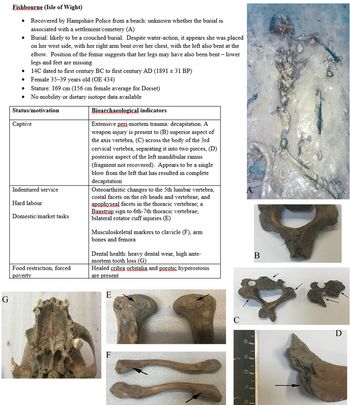
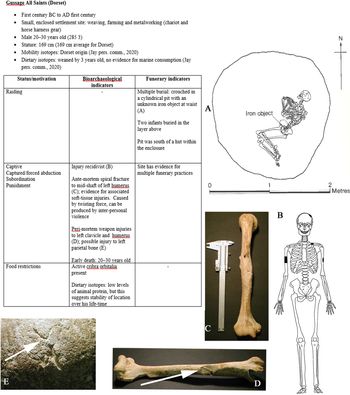
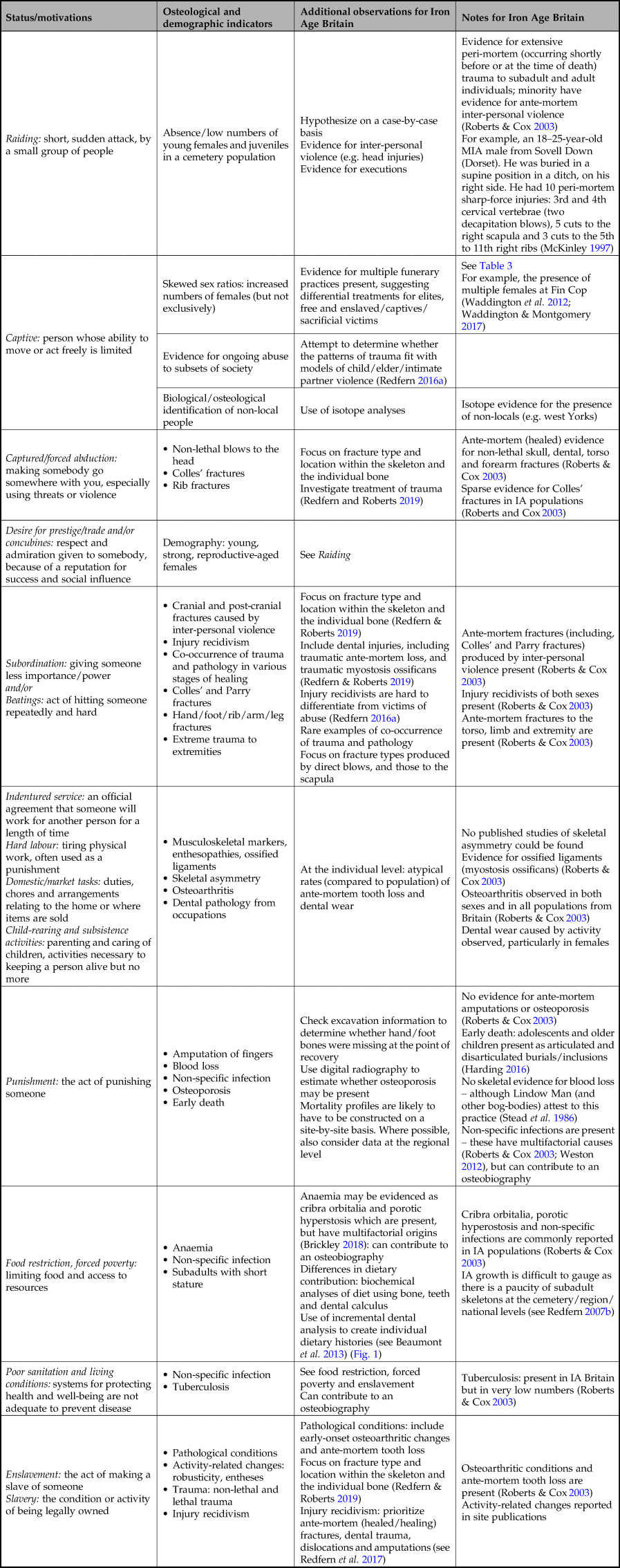
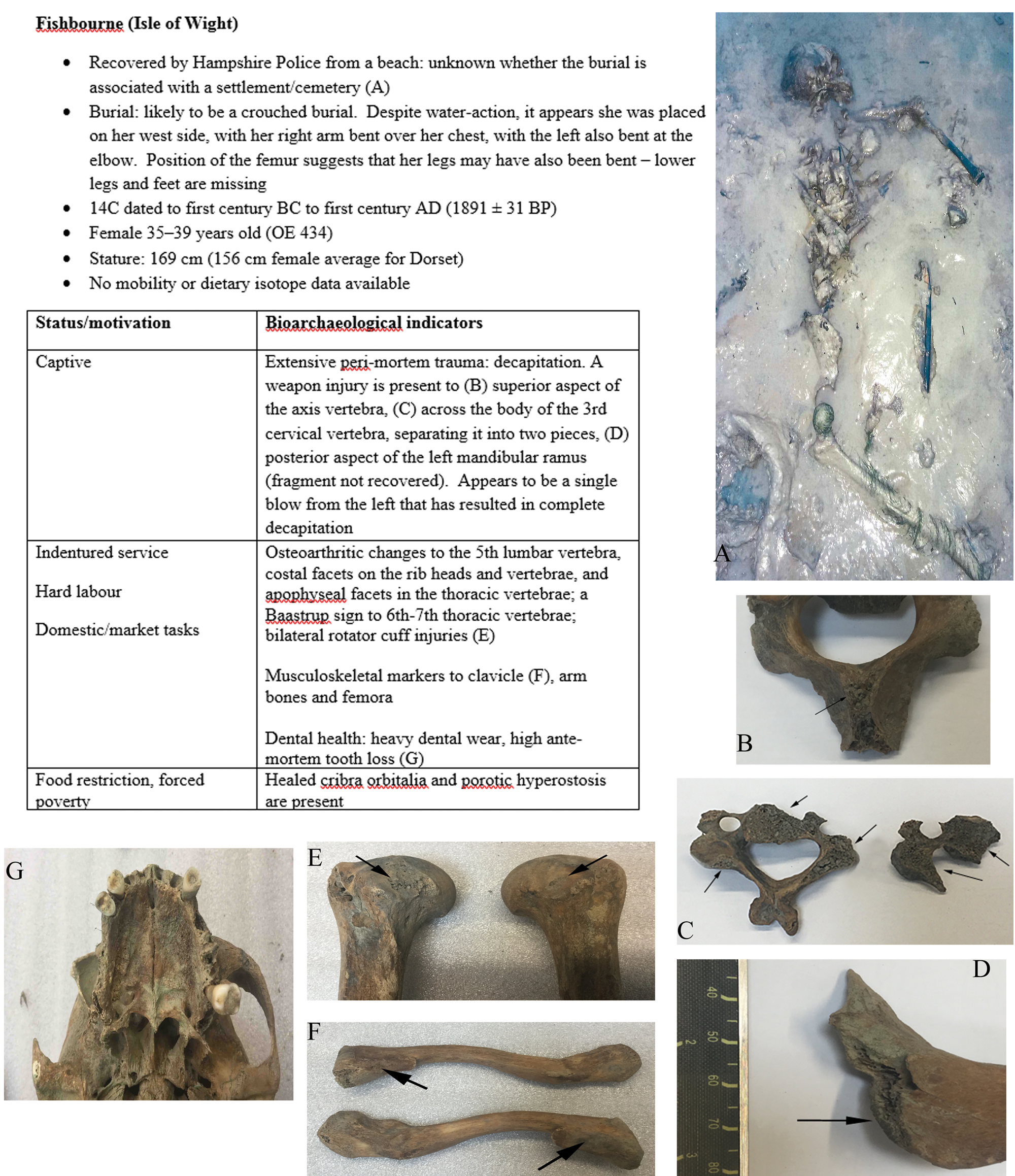
Cameron (Reference Cameron and Cameron2008b,168) recommends that human remains ‘are also our best line of evidence for the presence of captives’, with Martin and colleagues re-examining Pre-Contact (pre-ad 1492) human remains from North America to suggest various bioarchaeological and funerary indicators of captivity and enslavement (Tables 1 & 2) (Baustian et al. Reference Baustian, Harrod, Osterholtz and Martin2012; Harrod & Martin Reference Harrod, Martin, Martin and Anderson2014; Reference Harrod, Martin and Wilson Marshall2015; Martin Reference Martin and Cameron2008; Martin & Harrod Reference Martin and Harrod2016; Martin & Osterholtz Reference Martin, Osterholtz, Zuckerman and Martin2016; Martin et al. Reference Martin, Harrod and Fields2010). It is recognized that many of the osteological, demographic and funerary variables posited by these authors are difficult to apply to IA Britain, because ‘there was a multiplicity of rites, many of which did not involve the segregation of the dead into a special location’ (Harding Reference Harding2016, 7) and to work successfully, they rely on the presence of complete, articulated and well-preserved human remains, which are the minority of the IA dead.Footnote 24 Nevertheless, they provide a new ‘lens’ with which to re-examine the IA dead, but only with reservations, because many of the variables (e.g. non-specific periosteal infection) are commonly observed in archaeologically derived populations and can have multiple aetiologies (e.g. Weston Reference Weston and Grauer2012), or are present only in very low numbers in IA Britain (Table 1). Given these issues, it is proposed that an osteobiographic approach (Hosek & Robb Reference Hosek and Robb2019) should be applied, whereby the different forms of archaeological and bioarchaeological evidence are integrated to create a life-story in order to suggest, on a case-by-case basis, whether the remains of a particular individual or group of remains could reflect a captive or enslaved person(s) (Figs 1 & 2).
Case study of a potential captive/enslaved person from the Isle of Wight. (A © Hampshire Constabulary; B–G © Isle of Wight County Archaeology and Historic Environment Service.)
Case study of a potential captive/enslaved person from Dorset. (A after Wainwright Reference Wainwright1979, fig. 25. Bioarchaeological data and images B–E are from Redfern Reference Redfern2006.)

Summary of the potential bioarchaeological indicators of captivity and enslavement (after Alt Reference Alt and Cameron2008; Cameron Reference Cameron2008a,b; Martin Reference Martin and Cameron2008; Martin & Harrod Reference Martin and Harrod2016; Martin & Osterholtz Reference Martin, Osterholtz, Zuckerman and Martin2016). Definitions of status/motivations from Cambridge Dictionary (2020).
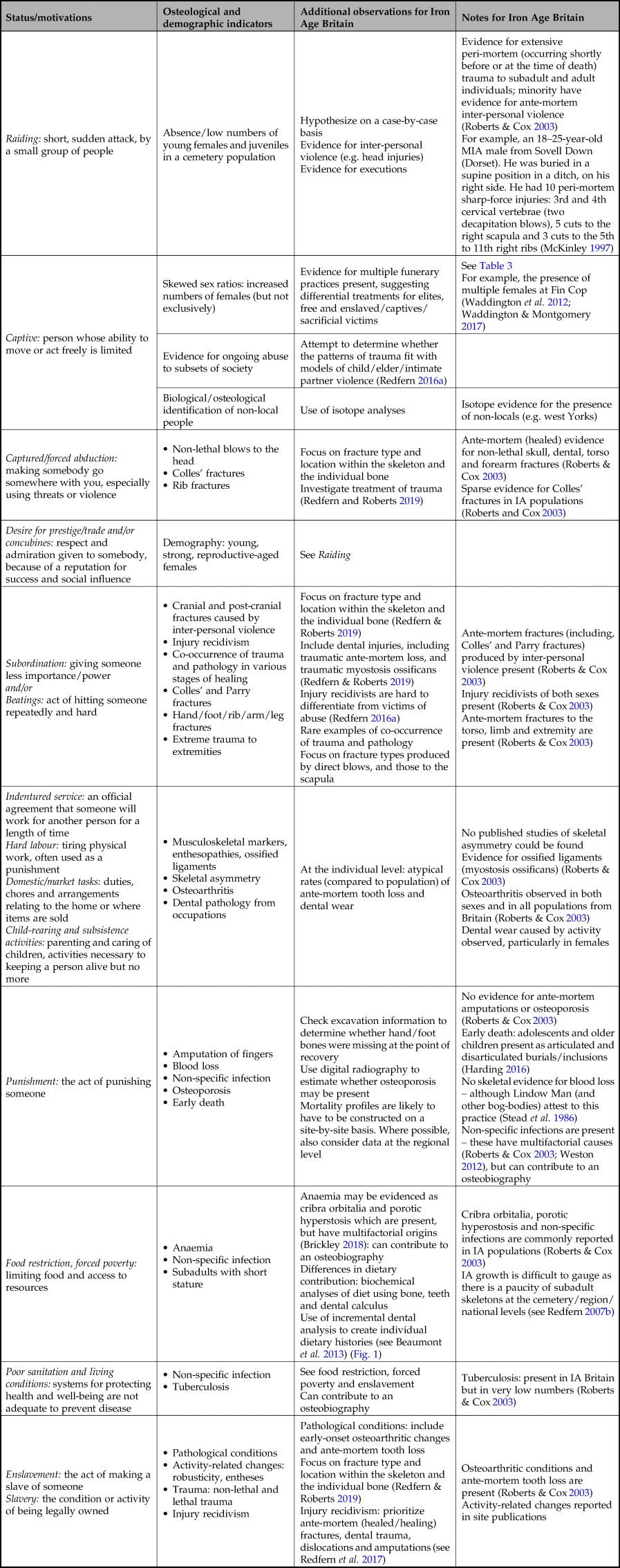
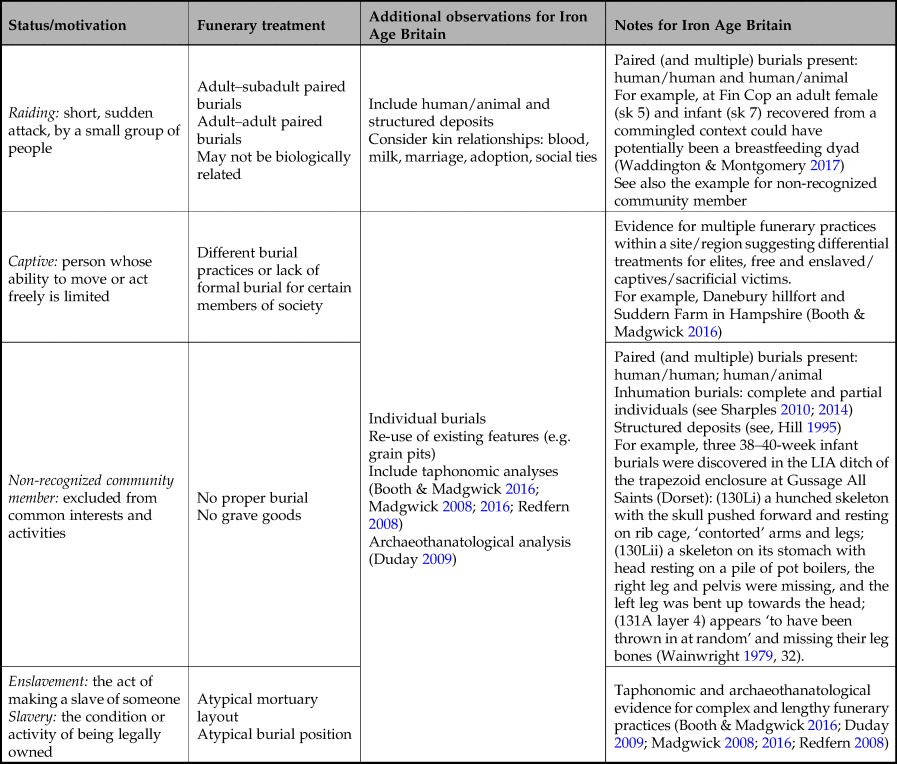
Table 2 highlights the funerary practices that may be indicators of captivity/enslavement. These indicators are very evident, perhaps over-represented, even within a single phase and region in the IA. The need to include funerary, taphonomic and archaeothanatology (Duday Reference Duday2009) data is paramount, because it is clear that for IA communities, a person's body (social and physical) continued to have meaning and purpose after their death, and the treatment and disposal of their remains may be the only evidence for their captive/enslaved status.Footnote 25 Therefore, it is the taphonomic evidence from Hampshire sites which appears to show the way forward, as it has provided data challenging excarnation as a majority funerary rite, emphasizing that similar actions and processes were experienced by human and animal bodies and revealing highly complex and lengthy rites (Booth & Madgwick Reference Booth and Madgwick2016; Craig et al. Reference Craig, Knüsel, Carr, Parker Pearson and Thorpe2005; Madgwick Reference Madgwick, Davis, Sharples and Waddington2008; Reference Madgwick2016). Such investment may seem at odds with the violent breaking-down of a person's body, but the work of Cameron (Reference Cameron and Wilson Marshall2015; Reference Cameron2016) suggests that it is the high social and economic value for the captor/owner contained within the captive/enslaved body that makes their killing and death so prestigious for an owner/community, particularly if the victim was of high status.Footnote 26 The act of captivity is likely to have transformed the captive's (or enslaved) status, making them ‘not human’ and changing them into a ‘gift’ (Cameron Reference Cameron and Wilson Marshall2015; Peregrine Reference Peregrine and Cameron2015). The act of performative violence—their killing and subsequent actions—may have been conceived as a creative act which perpetuated relationships within these communities and those they encountered in their ‘predatory’ landscape (Giles Reference Giles2015; Murer Reference Murer2014); as Robb (Reference Robb, Nilsson Stutz and Tarlow2013) explains, ‘human body substance and fragments may be viewed as innately powerful, or they may serve as symbolic anchors to history or referents of social values.’
Summary of the potential funerary indicators of captivity and (after Alt Reference Alt and Cameron2008; Cameron Reference Cameron2008a,Reference Cameron and Cameronb; Martin Reference Martin and Cameron2008; Martin & Harrod Reference Martin and Harrod2016; Martin & Osterholtz Reference Martin, Osterholtz, Zuckerman and Martin2016). Definitions of status/motivations from Cambridge Dictionary (2020).

Also raised as potential evidence are atypical mortuary practices and burials, and the work of Aldhouse Green (Reference Aldhouse Green2001) and Harding (Reference Harding2016) provides numerous examples of these in the archaeological record (e.g. Danebury hillfort), frequently interpreted as acts to ensure fertility/prosperity. ‘Foundation’ deposits—single individuals (subadult/adult) buried in pits within settlements and hillforts—are frequently cited as key evidence (e.g. Craig et al. Reference Craig, Knüsel, Carr, Parker Pearson and Thorpe2005; Sharples Reference Sharples2010; Reference Sharples, Cahen-Delhaye and de Mulder2014) of this behaviour. One such example was encountered at Great Houghton (Northants), where the body of a 30–40-year-old female who may have been wearing a lead-alloy torc around her neck, had been placed prone in a pit within an enclosure: her arms were folded under her torso, hands placed under her face, and her legs tightly contracted, suggesting that she had been ‘trussed in this position’ (Chapman Reference Chapman2001).Footnote 27 Paired or double burials are also posited as evidence, and there are many such burials in IA Britain (Harding Reference Harding2016, 127–62, 241–66), such as at Wattle Syke (Yorks), where there was the double burial of two adults, and two possible infant twin burials (Martin et al. Reference Martin, Richardson and Roberts2013). For IA Britain, this category must be widened to include human–animal burials and remains in structured deposits (as per Hill Reference Hill1995).Footnote 28 For example, at Blewburton Hill (Oxon), an older adult female was buried in one of the hillfort's ditches, and appears to have been bound in a riding position to a six-year-old female horse and accompanied by an adult male dog (Bendrey et al. Reference Bendrey, Leach, Clark, Morris and Maltby2010).Footnote 29
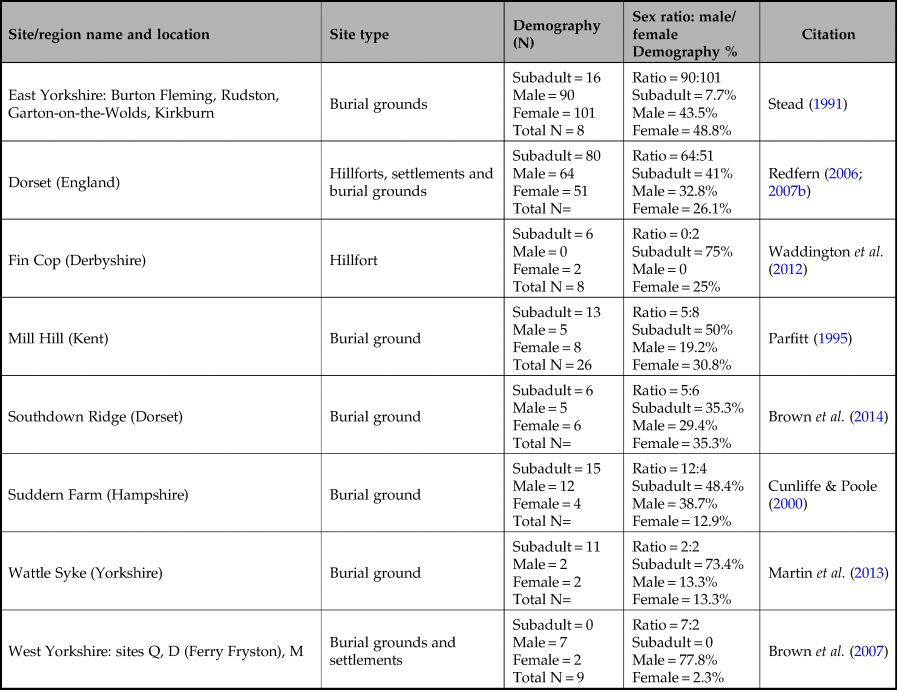
Employing demography to investigate this topic is problematic, given the complexities of funerary rites in this period and the limited emergence of inhumation burial grounds in the LIA, and even these do not appear to have included the whole community. For example, Table 3 gives demographic data from several sites, each showing different results; but interestingly, when data are pooled at the regional level, a normal sex ratio may be observed (e.g. Dorset: see Redfern & DeWitte Reference Redfern and DeWitte2011). The situation is made all the more complex because of the difficulties in providing refined age-ranges for disarticulated remains.Footnote 30 Therefore, it is suggested that sex and age data should be explored on a case-by-case basis, such as at Danebury, where deposition categories A (pit burials) and D (skulls and fragments of skulls) are dominated by the remains of adult males aged between 20 and 35 years old, with females and subadults under-represented (Walker Reference Walker, Cunliffe and Poole1984). Demographic data are key to an osteobiography, helping to determine whether remains have early-onset degenerative osteoarthritic conditions or higher than expected levels of dental wear and tooth loss.
Examples of IA demography from sites/regions across Britain. N = number of inhumed sexed adults and aged subadults. Subadult <20 years old, adult >20 years old.

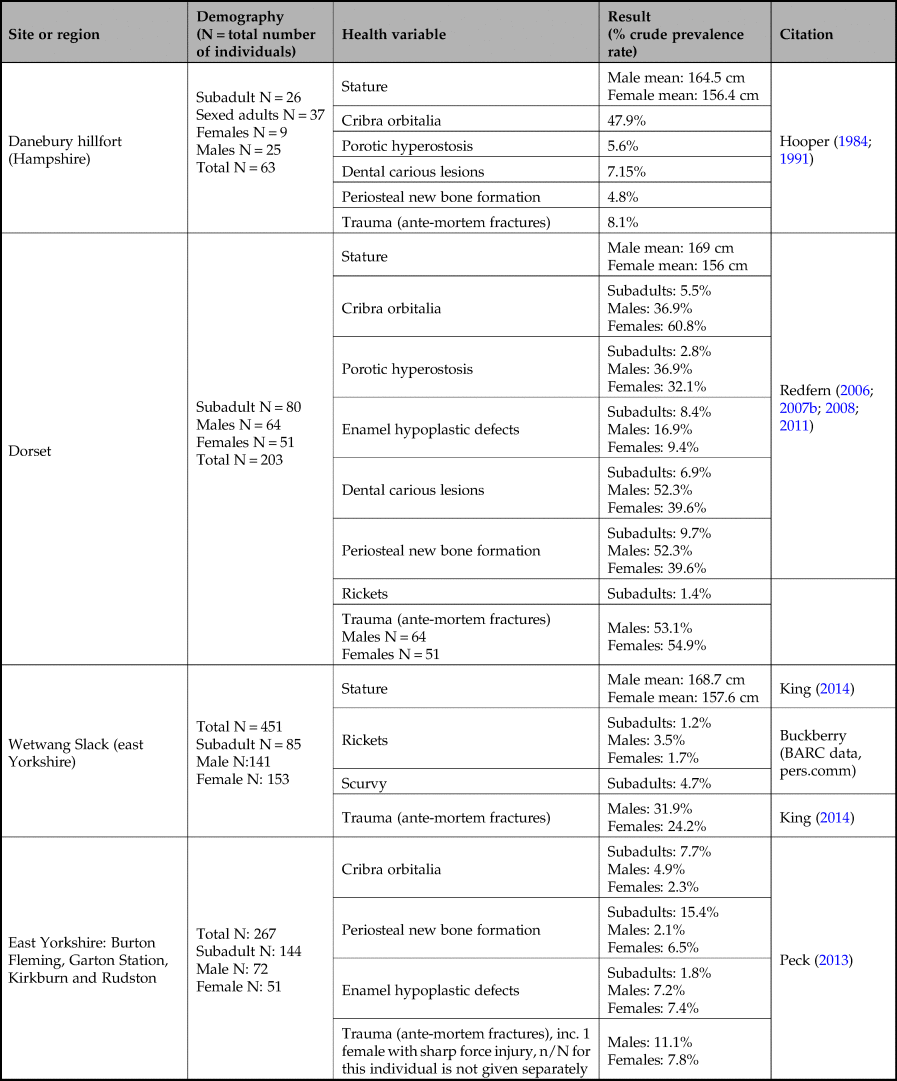
The work of Martin and colleagues on Pre-Contact human remains from North America have demonstrated clear health and dietary differences between captives/enslaved and the wider captor community in which they lived (Table 1), but for IA Britain these distinctions are not so clear-cut. For example, in Peck's (Reference Peck2013) study of MIA east Yorkshire, he determined that health differences were present between elite (e.g. chariot burials) and non-elites (few to no grave-goods). Despite non-elites having higher rates of degenerative joint disease, reflecting their involvement in the agricultural economy, overall health differences between the groups were not marked, underlined by them having comparable frequencies of dental health variables (e.g. carious lesions) (Peck Reference Peck2013). Dietary isotope analyses of this population also failed to observe differences between those with/out chariot burials, as well as between adult males and females (Jay & Richards Reference Jay and Richards2006; Jay et al. Reference Jay, Montgomery, Nehlich, Towers and Evans2013). Comparison between disarticulated and articulated individuals for age at death, stature, other health variables and dietary isotope data (Table 4) between the Danebury population and individuals interred in burial grounds across Britain found that although health differences were present, they were not distinct enough to suggest that the Danebury individuals had experienced hardships. At Danebury, dietary isotope analysis also failed to identify differences between distarticulated and articulated individuals.Footnote 31
Comparison of health parameters between Danebury hillfort and formal cemetery populations in Britain.
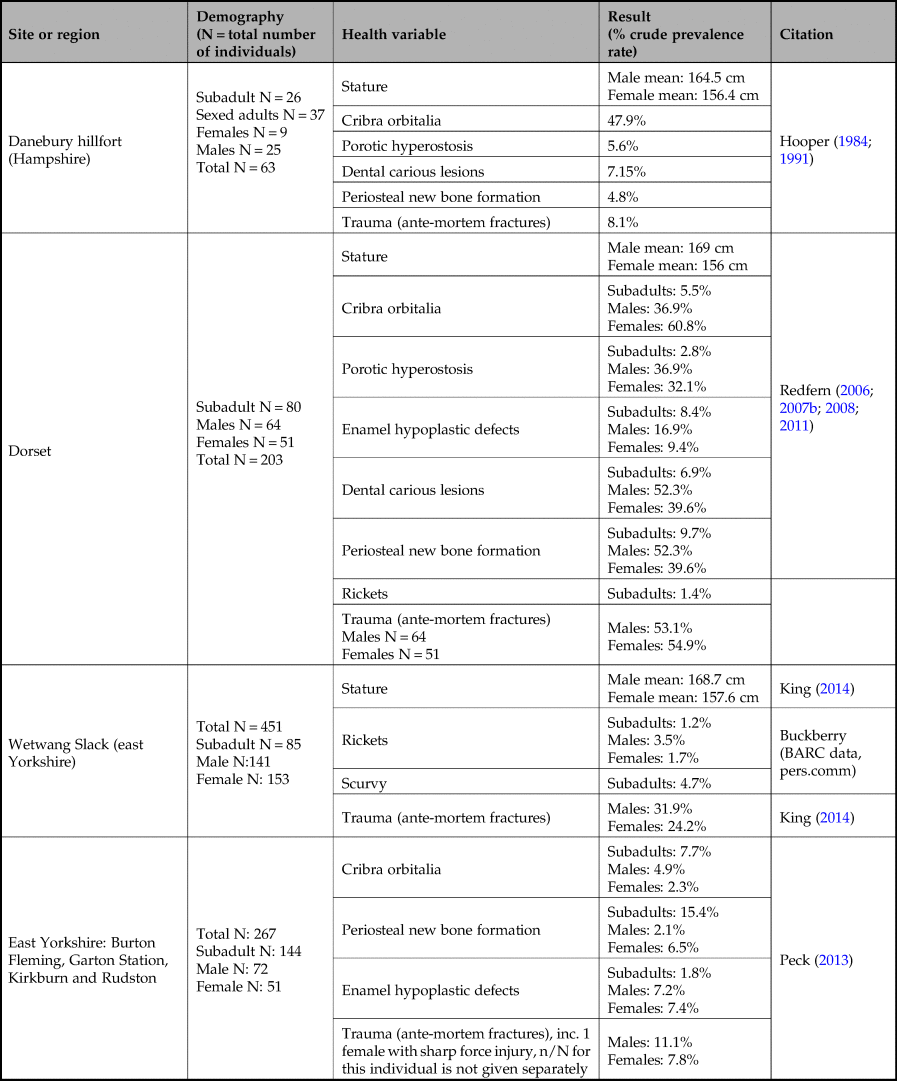
Table 1 also raises musculoskeletal markers and skeletal asymmetry as markers of servitudeFootnote 32 and the potential is there for these to play their role,Footnote 33 with individuals such as Deposit 6 (Danebury) who had changes to his femora and a foot bone suggestive of intense and repetitive physical activity, and other individuals reported in the literature with ossified tissue deposits.Footnote 34 Also raised as a marker is occupationally related dental wear: in the literature, a few individuals are noted as having atypical dental wear (e.g. Danebury and east Yorks), such as a 20–35-year-old female (T6, Maiden Castle hillfort) who has a groove on the labial aspect of her anterior mandibular dentition. Unfortunately, the reported cases from Britain are too low to make any meaningful interpretation at a larger scale, although the presence of this change may inform an individual's osteobiography.
Importantly, the lack of a clear difference between the various types of deposits/burials and individuals may not be as concerning as we might first suppose, as other bioarchaeological studies comparing owner/retainer burials have also failed to find significant differences (e.g. Buzon & Judd Reference Buzon and Judd2008). Therefore, it could be that the IA bioarchaeological data are showing us that the numbers of the enslaved/captured were low,Footnote 35 that the roles and labour they performed were comparable to free low-status individuals, making them harder to find—‘their subordinate status and alien origins leave few traces’ (Cameron Reference Cameron2008a, 20)—or, if they were of high status, their ‘poetics of violence’ were such that they did not negatively impact on their health or diet.Footnote 36
The evidence for skeletal trauma in IA populations is dominated by fractures and weapon injuries, many occurring shortly before or at the time of death (peri-mortem). They are most frequently observed in adult males and reported in both disarticulated and articulated human remains (Redfern Reference Redfern, Fagan, Fibiger, Hudson and Trundle2020; Roberts & Cox Reference Roberts and Cox2003). Sharp-force weapon injuries conform to those sustained during combat (and/or funerary practices: see Giles Reference Giles2012; Reference Giles2015), particularly in articulated inhumations, but for disarticulated human remains they also reflect the creation of fragmented bodies and the disarticulation of bones.Footnote 37 Many people with peri-mortem and ante-mortem (healed) traumas are likely to include members of the warrior-class, particularly those accompanied by martial equipment (Collis Reference Collis1972)—the captive takers—but ethnohistorical evidence suggests that we should be open to the possibility that they could also be captives, who may have had to turn against their own community (Cameron Reference Cameron2008a).Footnote 38 Complete individuals with healed trauma are most often encountered at burial grounds (e.g. east Yorks) and hillforts (e.g. Bredon), and studies of fracture type have shown that the majority were produced by episodes of inter-personal and/or community conflict, and some by accidental mechanisms (King Reference King, Knüsel and Smith2014; Redfern Reference Redfern, Fagan, Fibiger, Hudson and Trundle2020;). Therefore, fracture type (e.g. oblique or transverse) and location (bone, side and segment) must be used to establish whether it occurred by accident or from a direct blow (Redfern Reference Redfern2016a). These data provide the detail needed to re-visit the evidence, notwithstanding the caveat that alterative scenarios are also possible. For example, Colles’ fractures to the distal radius bone are produced by falling onto an outstretched hand, but we cannot rule out a person being pushed, falling and breaking their wrist (Judd Reference Judd2004).
Using the variables given in Tables 1 and 2, a number of potential captives can be suggested (see also Figs. 1 & 2), including one who may have survived only for a short time before being killed. This is skeleton 1 (Fin Cop hillfort, Derbyshire), a 21–53-year-old female who has active periosteal new bone formation to her torso and legs that could have been caused by beatings shortly before her death. Her body went into a ditch from the outer edge and was covered by stones from the wall destruction layer (Waddington et al. Reference Waddington, Beswick and Brightman2012). Her strontium isotope results suggest that she was non-local to England, potentially coming from the Scottish Highlands, Wales, Ireland, or Continental Europe (Montgomery Reference Montgomery2017). Survivors of capture may include individuals of both sexes with healed skull injuries and those with fractures to the forearm bones (see King Reference King2010; Redfern Reference Redfern2006; Roberts & Cox Reference Roberts and Cox2003, 99–100). For example, at Wetwang Slack (east Yorks), an adult male (B291) and an adolescent (B336) have healed mandibular fractures, both caused by direct force blows to the face (King Reference King2010, 168), and at Maiden Castle (Dorset), adult male P23 had a healing short-oblique fracture to the end (distal third) of his right ulna, produced by a direct force, such as a blow from above whilst trying to shield his face (Redfern Reference Redfern2011). Fractures to the shoulder-blades (scapulae) are considered to be indicative of beatings (Blondiaux et al. Reference Blondiaux, Fontaine and Demondion2012), but are rarely reported from IA Britain, such as two adult males from Wetwang Slack (014 and 225) (King Reference King2010, 110) (see P36, below). Cases of myostosis ossificans indicating muscle trauma could reflect direct blows (see Table 1), and this may have been the cause in an adult male (P9) from Maiden Castle who had this trauma on the lateral border of his right scapula.
Injury recidivists are a distinct sub-group within trauma studies and it is very difficult to distinguish them from victims of intimate partner violence (Redfern Reference Redfern2016a, 149). Typically, males with multiple unhealed and healed injuries from IA Britain are believed to have sustained these during combat, and the same may be true for females with similar injuries (Redfern Reference Redfern, Davis, Sharples and Waddington2007a). Nevertheless, looking through the lens of captivity/enslavement, the female evidence can be seen differently. Table 1 lists multiple injuries as indicating long-term service, and two females from Maiden Castle may reflect this. T13 was 20–35 years old and, apart from one mandibular tooth, was edentulous; she also had osteoarthritic changes to her spine and one thumb, and secondary osteoarthritis following a compression fracture to the proximal joint surface of her right 1st metatarsal (big toe bone). This female has a well-healed fracture caused by a direct force to the top (proximal third) of her right humerus, as well as healing fractures to multiple unsided rib shafts and the right scapula body. The healing fractures may indicate a beating she sustained a few weeks before death, whether as a captive or victim of intimate partner violenceFootnote 39—a likely overlap for this experience. P36 was 35–39 years old; she had musculoskeletal markers present to her limb bones and atypical heavy wear of her anterior dentition and ante-mortem loss of her molar teeth. She had multiple healed fractures present, including a compression fracture to her 12th thoracic vertebra, a contre-coup tibial-fibular fracture and oblique fractures of her nasal bones. The spinal and leg fractures could have been produced by accidental mechanisms and are often seen in agrarian populations, but the nasal bone fractures are caused by direct blows to the face, and as the leg fractures were produced by high-energy mechanisms (i.e. falls from a height) (Redfern Reference Redfern2016a), capture cannot be excluded as a possible cause.
Conclusions
The IA people of Britain are elusive in the archaeological record, but their remains give us a unique insight into this complex period of social and political change. By combining bioarchaeological, archaeothanatological, taphonomic and funerary data to create personal osteobiographies, it is hoped that their remains have shown how important these stories are to understanding and exploring captive taking and enslavement in this period. The human remains provide further evidence for the predatory landscapes and activities seen in the material culture and primary sources. Their osteobiographies and data reveal the complex ways in which different forms of violence were created and utilized by IA communities. Furthermore, by learning more about enslavement in this period, we can become more adept at understanding how it was practised after the Roman conquest of ad 43 (Redfern Reference Redfern2018).
It is clear that diverse funerary practices in this period both provide and hide the evidence for these activities, but the presence of chains and restraints and the often gruesome descriptions in the primary sources suggests that we should be more open to captivity and enslavement as being the causes of many of the skeletal changes and injuries observed. A ‘poetics of violence’ approach (Whitehead Reference Whitehead and Whitehead2004) can help, allowing us to see the purpose and value that these bodies held for the diverse IA communities of Britain, while recognizing the subtlety that violence could take in this period.
Acknowledgements
This work is dedicated to the memory of Peter Woodward, who did more than anyone else to introduce me to the Durotriges. I would also like to thank Linda Fibiger and colleagues for their comments on my 2020 chapter—origin of many of the ideas developed and explored in this paper. Thanks are also given to Mandy Jay (Durham University) for her help with the Fin Cop and Dorset isotope results; Jo Buckberry (Bradford University) for sharing BARC data on the Wetwang cemeteries; Dana Campbell (Derbyshire HER) and the Isle of Wight County Archaeology and Historic Environment Service for providing archive material, access to their collections and permission to use the Footnote 14C dating; Hampshire Police Service for image and archive permission; and Sally Worrell for checking the PAS database. I am most grateful to Anne Chippindale, and the reviewers and editor whose enthusiasm and support made all the difference.