Introduction
Towards the end of World War II, the morale of British units stationed in Burma and India was on a downslide. In contrast, the morale of Indian units was quite high. In 1942, after the Singapore debacle, the morale of the Indian Army units stationed along the India-Burma front reached rock-bottom. However, after the 1943 Arakan Campaign, the Indian units recovered their morale slowly but steadily. Ironically, as the war was coming towards an end, the morale of the British units went on a downward curve. Morale and discipline of the Indian troops are compared and contrasted with another colonial army: the African troops. This paper, following the comparative approach, makes a case study of the African, British and Indian troops deployed in Burma and India and attempts to show how and why the contours of morale and discipline changed among the various groups of troops at different times. The study of morale and discipline of the troops deployed in these two regions represents two extreme conditions: while Burma remained a war front, India did not experience any actual warfare except for some skirmishes with Indus tribes at the northwest frontier. This study also throws light on the motivational aspects of the soldiers.
In general, bad discipline is partly responsible for bad morale and vice versa. This adversely affects the fighting power of armies and, in turn, brings back the issue of ‘why do men fight’? While one group of scholars focus on ideological-genetic-cultural factors, another group emphasizes organizational fabric, especially on the primary group solidarity and material environment, in shaping soldiers’ attitude to combat in the killing field. On a general level, Hew Strachan (belonging to the second group) emphasizes the role of battle drill and discipline in strengthening the morale of combatants.Footnote 1 As regards the Wehrmacht during late 1944 in the Western Front, Robert S. Rush asserts that organized terror kept the soldiers in battle lines and when the military leadership failed to provide their basic needs, it became difficult to motivate them to fight.Footnote 2
Two important proponents of the first group are Joanna Bourke and Omer Bartov. Bourke, taking a universalistic approach, portrays the pugnacious mentality of males in general who seem to enjoy killing the male species more than having sex with females.Footnote 3 Bartov's approach is narrower, focussing on the role of a particular ideology (National Socialism, including personal devotion to Adolf Hitler) which heightened combat effectiveness of a particular army (Wehrmacht) in a particular theatre (Russia) during a particular period of time (1942–1945).Footnote 4 The point to be noted is that not all the armies of the totalitarian states during the Second World War relied on secular ideologies. In fact, the Red Army soldiers’ will to war did not depend on Marxist ideologies when the firefight (derived from the German term ‘feurkampf’—when the battlefield becomes live with bullets and shrapnel) started.Footnote 5
The Indian Army during World War II did not rely on nationalism or any other secular ideology. Anirudh Deshpande asserts that the Indian officers and the jawans (Indian Other Ranks/IORs) were mercenaries.Footnote 6 This does not explain why the ‘mercenaries’ fought so badly against the numerically inferior Japanese troops in Malaysia and Burma during 1942 and in the first half of 1943. Further, how do we account for the rising combat-effectiveness of the Indian Army in Burma from late 1943. Tarak Barkawi fuses organizational and cultural factors to explain the cohesion of the Indian Army in Burma during World War II. ‘Primary group cohesion strengthened by training and use of sexual metaphors and imageries to strengthen the manliness of the soldiers’, writes Barkawi, enabled the Indian Army to weather the storm.Footnote 7 In another article, Barkawi harps on the racial hatred of the enemy which kept the Indian soldiers going. This racial hatred, for him, was the product of harsh battlefield conditions and ‘hate propaganda’.Footnote 8 Here, one can smell the influence of Bartov.
Another group of historians following Strachan's line, focus on battle-drill to explain the increasing combat-effectiveness of the Indian Army in Burma during the later part of World War II. Training from late 1943 onwards, argues two historians, strengthened the confidence of Indian units in Burma and raised their military effectiveness.Footnote 9 From late 1943 till 1945, British and Indian units stationed in India, preparing to go to Burma, received the same kind of intense battle training.Footnote 10 However, morale and discipline of these troops varied. Hence, in addition to battle drills and training, other factors also shaped morale and discipline of these troops.
This paper will look for the causative factors shaping discipline and morale of both the metropolitan and colonial soldiers. This paper moves at two levels: at one level it evaluates the different arguments of Bourke and Strachan, along with others, as regards why men fight well; and at another level, the paper attempts to account for the particular political factors and practical reasons to explain the differences in morale, discipline and combat effectiveness of the African, British and Indian troops in two theatres during the second half of World War II.
This paper is based mainly on military intelligence reports on morale. The information for these quarterly reports was drawn from monthly security intelligence reports of the units and individual officers. In August 1944, about 12,000 officers of the India Command and the South East Asia Command (henceforth SEAC) provided information on morale. In addition, field censorship reports, reports from civil liaison officers and touring officers belonging to security, and welfare and morale organizations all provided data for preparing the quarterly reports. The quarterly reports were prepared jointly by the Military Intelligence Directorate (General Staff Intelligence) and the adjutant-general. One might argue that various military agencies and uniformed individuals feeding intelligence data were biased. To help corroborate these reports, published memoirs of those officers who were stationed in Burma during wartime and the report by the Earl of Munster have also been used. In September 1944, Winston Churchill instructed the Earl of Munster to proceed to India and to report on the welfare of the troops under India Command and the SEAC. He reached Delhi on 10 October and visited rear areas, like Pune, Ranchi and Kolkata and forward areas, like Cox Bazar and Imphal. He held discussions with the commander-in-chief of India, the Viceroy, the SEAC commander, Lord Mountbatten, and staff officers. He visited numerous camps, hospitals and canteens and submitted a detailed report in November 1944. Munster admitted that his report mainly concentrated on British troops as he did not have a good grasp on the social and cultural aspects of Indians. We shall see that rather than grand ideas like nationalism and anti-fascism, mundane factors like supply of good rations and access to sex and service conditions influenced the soldiers’ morale and discipline, which in turn shaped their differing combat-effectiveness.
The Commonwealth Armies in Burma and India: 1943–1945
The attitude of soldiers, which changed with time, revolved around the following issues: conditions at the front where they were deployed, conditions at home (The United Kingdom, East and West Africa and India respectively for the British, African and Indian soldiers), situations at other fronts (the British soldiers in particular realized that the progress of global war was dependent on the performance of the Allies at various fronts) and finally their perception of the post-war scenario (the issue of demobilization and post-war job prospects). In relation to morale, this paper also analyzes the disciplinary charges brought against the troops and attempts to account for such indisciplinary activities by the soldiers.
Let us have a cursory look at the three armies which were deployed in India and fought in Burma. Each Indian division comprised two Indian brigades and one British brigade. A significant number of commissioned officers of the Indian regiments and battalions were British. However, the Indian Army had Viceroy's Commissioned Officers (hereafter VCOs) and most of them were promoted from the ranks. The VCOs functioned as a link between the IORs and the British officers. The VCOs, in descending order, were subedar-major (resaldar-major in the cavalry unit), subedar (resaldar in the cavalry), and jemadar. Below the VCOs were the non-commissioned officers (henceforth NCOs). The NCOs, in descending order, were havildar-major, havildar, naik and lance-naik.
Due to greater literacy, the political consciousness of British soldiers and officers was much higher than that of African and Indian soldiers. About the British soldiers who fought in Normandy, Michael Howard writes: ‘They were basically civilians in arms: intelligent, literate, fundamentally unmilitary and longing to get home’.Footnote 11 As regards the British soldiers in India and Burma, from the analysis of the morale reports, we will see that the second and the fourth characteristics applied well. Most of the IORs and VCOs were from the backward rural regions. However, the Indian Commissioned Officers (henceforth ICOs), and especially the Emergency Indian Commissioned Officers and men in the technical branches, were from the politically conscious urban educated communities. Due to the pressure of war, the Indian Army had to recruit large numbers of urban middle-class Indians in the commissioned ranks. Between 1 October 1939 and 1 September 1945, the number of Indians in the commissioned ranks rose from 396 to 8,340.Footnote 12 D.F. Karaka, a war correspondent of the newspaper Bombay Chronicle, covering the activities of the XIVth Army during late 1943 and early 1944, rightly noted that while most of the Indian soldiers were volunteers who had joined because the army offered them a steady job, most of the wartime British soldiers were conscripts.Footnote 13 Service in the Indian Army remained popular. Even in August 1945, unlike the British Army, there was no shortage of volunteers for joining the Indian Army. And unlike the British, the Indians were eager to stay on and evade demobilization.Footnote 14
While service in the Indian Army was considered honourable in India, most Africans, writes David Killingray, viewed colonial military service with disdain. Poor people who were not accepted in their society, as well as runaway slaves, joined the African colonial armies. However, a good number of literate men were recruited during World War II.Footnote 15 About 400,000 Africans served under the British during World War II, and most of the recruits came from Nyasaland (Malawi).Footnote 16 About 56,000 African troops served in Burma.Footnote 17
In mid 1943, the Indian Army had 17 divisions and of them 12 (5, 7, 14, 17, 19, 20, 23, 25, 26, 36, 39, 44) were deployed in India and along the India-Burma border. Later, 14 and 39 divisions were converted into training divisions and stationed in India.Footnote 18 Between September 1944 and May 1945, the SEAC had at its disposal 11th East African Division, 81st and 82nd West African Divisions, 7 Indian Divisions (5, 7, 17, 19, 20, 25, 26) and the 2nd and 36th British Divisions.Footnote 19 The XIVth Army under SEAC comprised one million men and of them 700,000 were Indians.Footnote 20 In total, the Allied forces in Burma and Assam during 1944–1945, inflicted 180,000 casualties on the Japanese and themselves suffered 71,244 casualties. Of the Allied casualties, 50 per cent were Indian troops, 28 per cent British, 6 per cent African and 16 per cent unspecified.Footnote 21
Discipline and Morale of the African, British and Indian units in India: July 1943 to May 1945
The July 1944 morale report noted that as the British soldiers in Burma were engaged in active military operations against the Japanese, they had less time to air their usual grouses. But, those British soldiers in the India Command (especially those engaged in internal security duties and in the reserve battalions) had more time to think about their real and perceived troubles. Furthermore, they were demoralized by the thought that they operated in a backwater front. In order to counteract this mentality, for the British troops stationed in northwest India, lectures were held emphasizing the necessity of frontier defence.Footnote 22 How successful these lectures were, is open to question.
On 17 August 1944, the director, a major-general of intelligence of the India Command, noted in the morale report:
. . . enthusiasm engendered among British personnel by the increasing success of the Allies, Indian personnel shows less interest in, or perhaps appreciation of, events in Europe. Flying bombs are alluded to . . . as causing anxiety among those whose families are in the danger area.Footnote 23
Stephen Hart writes that by 1944, war weariness had gripped Britain and civilians found it hard to endure the German V-weapons.Footnote 24 British civilians who had relations in the India Command and in SEAC must have been writing letters about the destructiveness of Hitler's rockets which in turn adversely affected morale of the British troops. Obviously, the illiterate and the semi-literate IORs could not be interested in events occurring outside their mental horizon. Nor did the Indian troops have any stake, unlike the British soldiers, about what was going on in Britain.
During July and August 1944, news about Normandy was received by the British troops in both Burma and India with tremendous enthusiasm and with Russian advances running a close second. Due to the successful landing in Normandy, British troops anticipated a quick collapse of Germany. They believed that after a quick German collapse, the war would end and all of them would be demobilized and would be able to go home. In addition, the war in Burma was going well. This further raised the troops’ self-confidence and morale.Footnote 25
Overall, British soldiers, especially those under India Command, disliked service in India and preferred service in the European theatres where the increased activity and favourable situation of the Allies in Europe accentuated their desire to go there. Why did the British soldiers hate service in India? Most British soldiers, both under India Command and the SEAC, believed that the India Command was a dead end and disliked Indians and believed that India was not fit for independence or even self-rule.Footnote 26
An exception was Clive Branson. He was an ‘army brat’ (a soldier whose father had also served in the army) and was born in India in 1907 and then went to England. In 1932, he joined the Communist Party. In 1937, he participated in the Spanish Civil War. In 1941, he joined the Royal Armoured Corps and came to India in 1942. On 25 February 1944, he was killed in action in Burma. Even Branson believed that the Indians were incapable of self-government but in general he empathized with them.Footnote 27 On 29 November 1943, he wrote in a letter:
It is unnecessary for me to make any comment except that there seems to be no limit to which the bloody Government of Delhi will not go to antagonize and degrade our allies, the Indian people. But, of course, one must keep in mind that the Indians are incapable of self-government so we must maintain our ‘trusteeship’ and show them how it should be done.Footnote 28
Several factors accounted for dislike of service in India by the British troops. Though some of the large Indian cities were partly westernized, there was a general lack of amenities which were taken for granted in Europe. The Earl of Munster commented that there were few cinemas catering for Europeans and almost no public houses and little organized public amusement for them. The situation was far worse in the small, remote stations. Hence, British troops were left without any proper avenues for entertainment and relaxation. Furthermore, after coming from the United Kingdom, British troops were kept at the Deolali Camp where accommodation facilities were inadequate. Not only were the facilities overcrowded but most of the troops remained in tents and huts. And during the monsoon living conditions deteriorated.Footnote 29 British soldiers believed that the higher administrative fabric in India was totally indifferent to them and that senior administrators were out of touch with reality.Footnote 30 British soldiers hated profiteering in India and had no faith in the capability of the administration to check this abuse.Footnote 31 They complained that the canteens run by Indian contractors were not only dirty but provided bad food at high prices. Though the canteens run by the YMCA were appreciated, British soldiers complained that they were not as good as the canteens of the American soldiers. British military personnel pointed out that, unlike them, the American soldiers were allowed to import duty-free beer, tobacco and cigarettes in India. The three bottles of beer per month which allotted to each British soldier was considered insufficient. The British soldiers’ pride also suffered due to the fact that ill-fitting, poor quality uniforms were issued to them.Footnote 32
British troops in India and Burma were also angry with the War Minister, the War Office and the House of Commons. Especially, they were angered by a statement made in the House of Commons that British troops were not kept in unhealthy areas for a long time. This especially irritated the soldiers stationed in the northwest frontier, Arakan and Imphal-Kohima front. The soldiers were especially eager to get news back from their loved ones in Britain. Another erroneous statement made in the House of Commons was that the time taken for air mail letters to reach India and Burma from the United Kingdom was six days. This also irritated the ‘Tommies’ as in reality they took 10 to 12 days.Footnote 33
The high command was concerned with the yellow press (illustrated magazines and local newspapers which focus on rumours and cheap stories with sexual overtones) emphasizing relationships between American soldiers stationed in Britain and British women. As a result the British soldiers of both the India Command and the SEAC felt demoralized. Many felt that it was no more worth fighting for home. The anti-Venereal Disease campaign initiated by the government further strengthened their belief about the infidelity of their women back home. The soldiers felt that the long period of overseas service resulted in increasing infidelity among their female partners.Footnote 34 Inadequate leave facilities further depressed them. The morale report for July 1944 categorically stated: ‘The soldier considers himself as a citizen in uniform. He resents the explanation about lack of shipping delaying his repatriation by pointing out about a week's home leave after every 3.5 month's service in Normandy.’Footnote 35 At least there was a silver lining for the fact that from July 1944, the departure of the American soldiers from Britain for fighting in Normandy reduced the anxiety of those soldiers whose wives were in the United Kingdom.Footnote 36
Indian soldiers had other reasons for worrying. In mid-1943, the famine in Bengal resulted in distress for the Indian soldiers stationed in the eastern part of the subcontinent. Some sympathized with the affected civilians and contributed to the relief fund. The Eastern Command reported that some IORs and VCOs resented the reduction of certain items in their rations due to the famine. Since rice was in very short supply in Bengal, atta (flour), maize and jowar were substituted for rice. Atta was the basic cereal for the Punjabi soldiers but not for the Gurkhas, Madrassis and the Marathis, who naturally resented this measure. Soldiers recruited from Punjab expressed apprehension that the heavy export of food grains from their province may cause a local shortage in the near future. The soldiers’ families informed their male relations in the army about the general shortage of food grains. Since, the soldiers could do nothing, they felt helpless and depressed. In order to regain confidence of the soldiery, the Viceroy in mid-1943, announced that the army would participate in the public distribution system, and would see that those soldiers’ families without any male members get their rations from the ration shops.Footnote 37 By August 1944, the food situation started improving in south India.Footnote 38 This was not of much help because most of the Indian soldiers in the combat branches were recruited from Punjab and northwest India. Between 3 September 1939 and 31 August 1945, 754,551 recruits came from Punjab, 103,114 from North West Frontier Province and 593,432 from the Madras Presidency.Footnote 39
Among the Indian soldiers, both in Burma and in India, certain factors resulted in a favourable attitude towards possible demobilization in the near future. Especially, those Indians in the technical branches realized that after the war the technical skill which they had acquired in the army would stand them in good stead as post war India (possibly independent) would need workers with technical skills for industrialization.Footnote 40 And from mid-1943, the IORs and the VCOs expected that after the war the demobilized soldiers would be granted jagirs (land grants) on a lavish scale as was the case after the First World War.Footnote 41 This aspiration was strongest among the Punjabi soldiers who were either younger sons of the small peasant farmers or small farmers themselves (each of them owning between one to two acres of land). Social status in the villages depended on ownership of land. Hence, each peasant farmer not only clung tenaciously to their hereditary holding but also tried to expand it.Footnote 42
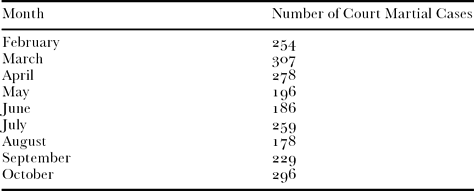
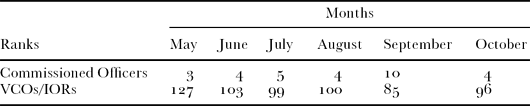
Let us now analyse the disciplinary cases brought against Indian soldiers under India Command. During 1943 and 1944, the authorities were happy that the incidence of crime among Indian soldiers was generally low and that discipline was quite good. Tables 1 and 2 confirm this assertion. Desertion and absence without leave (hereafter AWOL) were the principal indisciplinary activities of the soldiers. Between May and July 1943, there were 62 cases of desertion with arms, and the number fell to 52 for the period between August and October of the same year. Most of the deserters were recruits who had not been adequately inculcated in regimental ethos. The other cases of indisciplinary activities were assaults and affrays with the civilians.Footnote 43 The cases of AWOL could be explained due to the soldiers’ anxiety to visit their families to see if they were getting adequate food grains. Those soldiers’ families without any male relations in particular experienced problems in drawing rations from the ration shops located far away from their villages.Footnote 44
Number of Court Martial Cases of Indian Soldiers under the India Command from February to October 1943
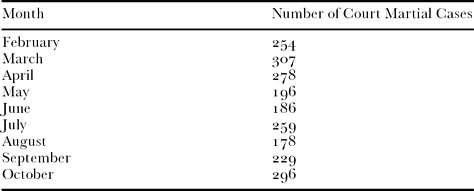
Source: Morale Reports, India and SEAC, 15 July–15 October 1943, Part II, Para 2 (a), L/WS/2/71, IOR, BL.
Court Martial Cases (excluding Summary Court Martial) of Indian Soldiers under India Command May to October 1944
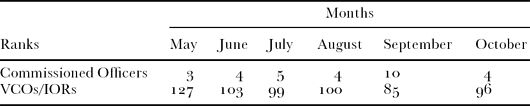
Source: Army in India Morale Report for the three months ended 31 October 1944, Part II, Para 3, L/WS/2/71, IOR, BL.
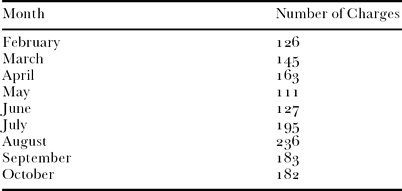
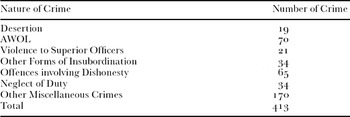
As shown in Table 4, the most common form of undisciplined activity concerning British soldiers was AWOL, followed by offences involving dishonesty and neglect of duty. The cases of AWOL were because they vanished in the cities to drink and for the company of women rather than spending time in the dreary cantonments. Neglect of duty was because the British soldiers were bored with duty in a secondary theatre. Incorrect dress and bad saluting, which also were products of boredom, were common indisciplinary activities of British privates (henceforth BORs). However, British officers were reluctant to discipline troops for these actions.Footnote 45
Number of Court Martial Charges brought against British Soldiers under India Command between February and October 1943.
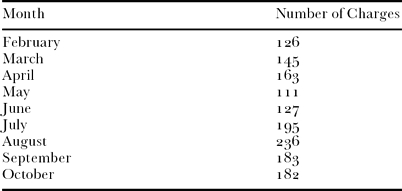
Source: Morale Report, August to October 1943, Part I, Para 2, L/WS/2/71, IOR, BL.
Nature of Court Martial Charges brought against British Soldiers under India Command between August and October 1944

Source: Army in India Morale Report for the three Months ended 31 October 1944, L/WS/2/71, IOR, BL.
Between May and July 1944, the average monthly figures of court martial trials per 1,000 military personnel for the ICOs under India Command were .56. For the same period, the average monthly figures of court martial per 1,000 military personnel for the British officers were .52. And for the period, August to October of the same year, the average monthly figures per 1,000 military personnel for the ICOs came to about .85. For the British officers, the average monthly number of trials for 1,000 military personnel for the same period was .59. For the VCOs and the IORs, the average monthly number of court martial trials per 1,000 men for the period between May and July 1944 came to .13. The average monthly figure of court martial trials per 1,000 men for the BORs during the same period was 1.04. For the period between August and October 1944, the average monthly number of court martial trials per 1,000 men for the VCOs and the IORs came to about .12. The corresponding figure for the same period for the BORs was 1.01. All these figures exclude the cases of summary courts martial which dealt with petty crimes. Thus, we see that on average the IORs, including VCOs, were more disciplined than the BORs. However, British officers appeared to be much more disciplined than the ICOs. This was partly because the ICOs’ grievances centered around certain service issues and they felt racially discriminated against vis-a-vis the British officers. Most of the ICOs complained about low pay and absence of family allowances. They demanded a pay equivalent to that of the British officers.Footnote 46 An ICO had written in his memoir: ‘The ICO was the lowest of the low in the hierarchy of officers, was paid far less . . . . It was in 1945, after six years of campaigning, that the ICO's status and pay was equalized.’Footnote 47 The India Command had 70,000 soldiers for guarding the northwest frontier and 130,000 troops for internal security duties.Footnote 48 Considering quite the large number of troops under the India Command, the figures from Tables 1 to 4 show that disciplinary cases for both the British and Indian military personnel of all types were quite low.
The African units were rotated between Burma and India. In India, they were accommodated in the Ranchi Leave Camp. The relationship between West African troops and Indian civilians was not good. The West African military personnel regarded Indian civilians with contempt, and the Indian civilians believed and spread the rumour that the African troops practiced cannibalism. Affrays between Indian civilians and West African troops were common. There were some reported instances of Indian females being raped by West African soldiers. However, some Indian female coolies visited the West African troops willingly who, in turn, provided food for their children. Lack of female company depressed West African soldiers.Footnote 49 Timothy Parsons, while analyzing the evolution of King's African Rifles, writes that there were a few rebellions when the askaris were denied access to women. And in Ethiopia after the surrender of the Italians in 1941, they got hold of Italian women who serviced the African troops for feeding their babies.Footnote 50 In fact, before World War II, the British authorities had encouraged African soldiers to keep many women both for physical and mental satisfaction and also for the fact that the women did the soldiers’ cooking.Footnote 51 The West Africans were more friendly with British troops than with the Indian soldiers because they knew English and were ignorant about Indian languages. In the hospitals especially, West Africans resented being in the same wards as the IORs. Moreover, they resented eating the same rations as the IORs since at the front they got British rations. It was very difficult for West Africans to send parcels home. Again, many parcels coming from West Africa were pilfered and never reached the addressee. The army authorities urged the issue of Air Letter Cards to West African personnel. By mid-1944, an increase in pay and leave facilities somewhat raised the morale of West African troops.Footnote 52
In July 1944, the India Command became concerned since discipline was deteriorating in the East African units. The unit commanders reported cases of insubordination and disobedience. They considered the leave facilities inadequate as some men did not get leave even after serving for three years. East African troops also resented the lack of amenities like wireless sets and footballs. Due to lack of space, sports grounds could not be developed. The Morale Committee noted that East African soldiers required careful handling by those British officers who understood their cultural sensibilities.Footnote 53
Discipline and Morale of the African, British and Indian Units stationed in Burma: Mid-1943 to August 1945
British soldiers were interested in world politics and, to an extent, also in Indian politics. The July 1944 report noted that British soldiers were quite distressed by the Prime Minister's speech, in which he took a soft stance towards Spain. The soldiers’ criticized Churchill's soft approach towards the Spanish dictator General Franco, who was considered an ally of Hitler. The attitude of the soldiers was that since Britain was fighting against Fascism, London ought to take a harder line against Franco. While British soldiers were motivated by their desire to save the ‘free’ world from fascism, such feelings were not present among Indian and African soldiers. In general, British military personnel were little interested in Indian politics though some (probably those with socialist and liberal backgrounds) welcomed the release of M.K. Gandhi as an act of goodwill on the part of the British government.Footnote 54 Socialist sympathies seemed to be rising amongst British soldiers. C. Bayly and Tim Harper write that a leftward trend in the attitude of the BORs in India during late 1943 and 1944 was present. This trend was also present among the British soldiers of SEAC. During mid-1944, British troops believed that the European war was one for survival, while the Eastern war was a separate imperialist war.Footnote 55 It seems that liberal-leftist tendencies and empathy with Indian nationalist aspirations were part of what could be called ‘pre-combat motivation’. In the midst of the danger-filled battlefields of Burma, rather than such high flowing pre-combat motivations, in-combat motivation based on more mundane factors mattered more.
Overall, the British soldiers of the XIVth Army were interested in news from the other fronts because they realized that victory over Japan was also dependent on success at the other fronts. Churchill's speech at the end of March 1944, that he could not promise victory by the end of 1944 caused some depression and impatience among the British soldiers.Footnote 56 However, in July 1944, the British troops experienced a feel-good effect due to the opening of the Kohima-Imphal Road, success in north Burma, the bombing of Japan and the success of the Americans in the Pacific theatre, especially in Saipan. The ‘Tommies’ believed that Japan would collapse soon. In July 1944, the XIVth Army's British soldiers were more interested in the situation in Normandy rather than in Italy because they realized that in Europe, Italy had become the secondary theatre compared with Normandy.Footnote 57
The British personnel of the XIVth Army vehemently believed that since Britain was heavily committed against Japan, in Britain, more publicity should be given to the activities of the ‘Forgotten Army’ vis-à-vis the Normandy Front.Footnote 58 Munster in his report noted: ‘Troops in India and South East Asia Commands feel strongly that their achievements and the conditions under which they have to fight have not been brought sufficiently prominently before their fellow countrymen.’Footnote 59 The SEAC magazine started by Mountbatten proved to be popular as it brought to the British soldiers updated information, even when they were in contact with the enemy.Footnote 60
In contrast with British units, the Indian units were not much concerned with the fact whether the war with Burma was getting due recognition in the United Kingdom or not. This was because none of the relations of Indian soldiers were living in Britain. The attitude of British officers who commanded the Indian units was not much different because the Indian Army had a long autonomous tradition. Scott Leathart, an officer of the 3/9 Gurkhas (which fought both in Arakan and with the Chindits) noted in his autobiography: ‘I do not think that we in Gurkha regiments ever worried much about whether our folk at home were interested in our doings. We lived in a world of our own, with a job to do, never doubting that, with the men we led, it would be done to the full.’Footnote 61
Again, leave facilities for the British troops of the XIVth Army were inadequate. British troops travelling by rail were issued with 2nd class tickets, but 2nd class carriages were few due to shortages of rolling stock. Hence, they were forced to travel in 3rd class with Indian troops, whom they disliked. Furthermore, 3rd class carriages lacked bulbs, proper lavatories and canteen facilities. Worse, theft was common in such carriages. In the transit camps the facilities for washing, feeding and sleeping were inadequate.Footnote 62
British military personnel continued to grumble about their rations. They believed that soya beans were made available to them because the American troops would not eat them. The BORs complained that they got only brown bread and bully beef whilst the Americans got chicken, eggs and white bread even when both the British and Americans drew rations from the same depot.Footnote 63 Indian troops also complained about the quality and quantity of rations. Tinned fish was not appreciated and reduction of meat ration was also resented. Furthermore, the Indians complained that the quality of atta and rice given to them was not good.Footnote 64
In general, like the British soldiers, Indian soldiers also preferred fighting the Japanese in Burma rather than deployment in India for internal security duties.Footnote 65 The literature on insurgencies/pacification show that soldiers found counter-insurgency tasks just as wearisome and demoralizing. During October 1943, the morale report for the Indian soldiers of SEAC noted that they had developed a blind faith in the final victory over the Axis powers in the near future. Two Indian divisions (with many male relations) were deployed in Italy and this made the Indian soldiers interested in Italy but not Normandy. The capitulation of Italy also raised the Indian soldiers’ confidence.Footnote 66
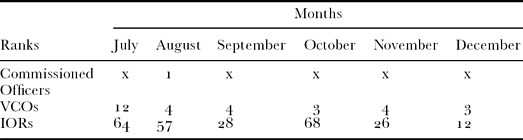
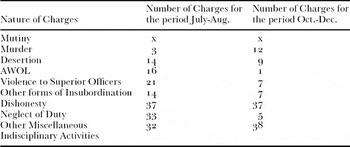
While analysing the British IInd Army's morale in Normandy between June and August 1944, David French asserts that AWOL offences were directly proportional to the intensity of fighting.Footnote 67 As Table 5 shows, the quantum of court martial cases of Indian soldiers under SEAC (considering their large numbers) was quite low. While the most common form of indisciplinary activities of Indian soldiers under India Command were desertions and AWOL, for the Indian soldiers under SEAC, the most common form of indisciplinary activities, as evident from Table 6, were ‘neglect of duty’ and ‘dishonesty’. The difference in indisciplinary activities of the Indian soldiers under the two commands could easily be explained. When stationed in India, Indian soldiers had a chance of visiting their families in the villages but it was not possible when they were deployed in Burma. When functioning as part of the XIVth Army, they preferred to remain within the army rather than be killed while surrendering to the Japanese or being taken to the horrendous Japanese Prisoner of War Camps. In March 1944, two dead bodies of Indian soldiers were found which were used for bayonet practice by the Japanese soldiers.Footnote 68 Such acts by the Japanese deterred the Commonwealth troops from surrendering to the Japanese. Hence, desertions remained negligible. However, AWOL among Indian soldiers in SEAC was more common during July and August compared with the period October to December 1944 because most intense fighting along Imphal-Kohima and central Burma occurred during mid-1944. Charges brought under ‘neglect of duty’ could be explained as part of battle fatigue which was also directly proportional to the intensity of combat. The Indian divisions were continuously in action from the beginning of the Japanese offensive in February 1944. However, by the end of October 1944, the Japanese were to a great extent a spent force and retreated east of Irrawaddy. In Burma, the soldiers were occasionally irritated by being harangued by their officers. Hence, there were few cases of violence against their superiors. The decline in the quality of British officers discussed below, could explain the officer-soldier affrays.
Court Martial Cases (excluding Summary Court Martial Cases) of Indian soldiers in SEAC between July to December 1944
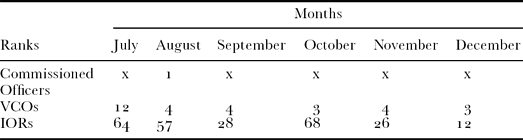
Source: Report on the Morale of British, Indian and Colonial Troops of Allied Land Forces South East Asia for the months of August, September and October 1944, Part II, Para 70, Report on the Morale of British, Indian and Colonial Troops of Allied Land Forces, South East Asia for the Months of November, December 1944 and January 1945, Part II, Para 69, L/WS/2/71, IOR, BL.
Analysis of Court Martial Charges (excluding Summary Court Martials) of Indian Troops under SEAC from July to December 1944

Source: Report on the Morale of British, Indian and Colonial Troops of Allied Land Forces South East Asia for the months of August, September and October 1944, Part II, Para 70, Report on the Morale of British, Indian and Colonial Troops of Allied Land Forces, South East Asia for the Months of November, December 1944 and January 1945, Part II, Para 69, L/WS/2/71, IOR, BL.
Officer-soldier relationships constituted a crucial component of command. Officers played a vital role in maintaining morale and discipline of privates especially during the firefight. By April 1944, the higher authorities noted that some junior officers were unable to gain the confidence of their men and that the numbers of such officers were increasing.Footnote 69 Graham Dunlop writes that:
many of the recently recruited British officers failed to take interest in the welfare of their men and were unable to communicate in vernaculars with the soldiers under their command. The communication gap and indifferent attitude towards the IORs to a great extent explain the dislocation of sahib-sepoy relationship.Footnote 70
Several factors accounted for the British officers’ decline of morale which resulted in their relative failure in man-management duties. British officers considered that the pay increase as too small to provide any real economic improvement. Inter-service rivalry was another important factor. In July 1944, British Army officers were angry because of the preference shown to Royal Air Force officers as regards repatriation.Footnote 71
While 60 to 70 per cent of Indian soldiers wanted to remain in the army even after the war, very few British soldiers were interested to remain in service. British troops were concerned with getting jobs after demobilization and about the level of wages. The memory of bad economic conditions after the last war was still vivid in their mind.Footnote 72 After touring the SEAC and India in July 1945, the director of military training noted that due to the PYTHON scheme of repatriation (i.e. those who had served for three years and four months were bound to leave for home), most British personnel were not interested in anything except going home on the next ship. The director continued that soldiers with such mentality could not be profitably employed for any duty. Not only the British infantry battalions but also the Indian units were hard hit due to the departure of British officers. Worse, the young cadets from Britain were without any knowledge of Urdu the lingua franca of the Indian Army), jungle training and acclimatization. Hence, they were proving to be useless in the Indian formations.Footnote 73 The director of military training noted in his report: ‘Unlike British infantry, Indian infantry could be deployed at a stretch for 4 months upto a year in Burma, because the Indians were at home with climate and terrain.’Footnote 74
John Prendergast, commander of 3rd Rajputana Rifles speaks derisively of a British battalion of the 19th Indian Division in south of Toungoo in early 1945. He writes that ‘the British soldiers broke the cardinal rules of jungle warfare’. Luckily, Japanese opposition at that time was so little that they got away with it. Prendergast noted:
. . . but were by then under the unnatural stress of having to repatriate men on a series of announced dates. I feel it was difficult for officers and men, knowing they were to go home in a matter of days, really to put their hearts into battle. They were also very short of reinforcements and by then lacked well-tried NCOs.Footnote 75
Probably Prendergast, as a British officer of an Indian regiment, had his own axe to grind but official reports and other officers’ memoirs also support him.
Scott Gilmore of the 8th Gurkha Rifles noted the King's Own Scottish Borderers stationed around Kohima:
More important, their reinforcements were seldom men trained in their own depot, steeped in their own traditions. Replacements tended to be a ragtag bunch of men from units surplus to requirements such as anti-aircraft batteries. Also by mid 1944 the British battalions with the Indian Army were beginning to lose their remaining experienced men either on long overdue leave or through repatriation.Footnote 76
The disintegration or probably weakening of primary group units reduced solidarity, adversely affected morale and hence combat effectiveness.
By April 1944, the West African troops’ morale was considered as unreliable. Relations with civilians in Burma deteriorated as the troops went in search of liquor and women. Assaults and affrays between civilians and West African troops were more frequent compared with British and Indian troops. West Africans were bitter due to the absence of home leave, even though it had been promised to them before they left West Africa.Footnote 77 West African personnel did not like the fact that their British officers and NCOs were repatriated before them and demanded automatic lighters as matches did not strike in the wet weather of Burma.Footnote 78
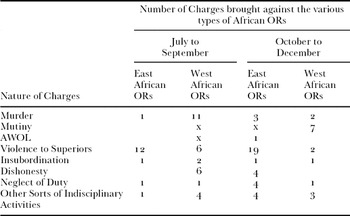
In August 1944, the 11th East African Division was operating along the Palel-Tamu Road.Footnote 79 Heavy losses from disease in the unhealthy Arakan theatreFootnote 80 depressed the morale of East African soldiers, and irritated them. The East Africans despised the Indians and considered the Burmese civilians as a low species.Footnote 81 From Table 7, we see that there were quite a few cases of violence against superior officers. This was probably because all the officers in the colonial African forces were British. Towards the end of the war, African troops were becoming colour conscious and aware of racial discrimination against them.Footnote 82 Nevertheless, large-scale desertions were absent. This was because African soldiers had nowhere to run. The Japanese tortured and executed captured African soldiers.Footnote 83
Nature of Charges brought against the East African and West African Other Ranks under SEAC between July and December 1944

Source: Report on the Morale of British, Indian and Colonial Troops of Allied Land Forces South East Asia for the Months of August, September, October. 1944, Part III, Para 104, Part IV, Para 112, Report on the Morale of British, Indian and Colonial Troops of Allied Land Forces South East Asia, for the Months of November and December 1944 and January 1945, Part II, Para 100, Part IV, Para 110, L/WS/2/71, IOR, BL.
In the end probably hatred for the enemy strengthened the will to war and kept British soldiers going in Burma. William Pennington of 340th Battery of 134 Field Regiment, which was part of the 19th Indian Division, noted in his autobiography:
And it was ruthless, because of the enormous enmity between the Japanese and us. It was very different for those fighting in Europe: there was not the same degree of hatred between the British and the Germans. It wasn't natural for British troops to so loathe their enemy, though there were certainly men who did just want to kill for the sake of killing . . . . But eventually, even the most decent British soldier became as ruthless as his enemy, and returned in good measure what had been dealt to him—this particularly applied to the Gurkhas.Footnote 84
The religious ideologies of the different ethnic regiments (Sikhism in case of the Sikh regiments, Islam in case of the Muslims and parbatia Hinduism in case of Gurkha units) enabled the IORs to withstand the ‘face of battle’. S.P.P. Thorat, an Indian commissioned officer of the 2/2 Punjabis who fought in Burma, narrates in his memoir that different religious battle cries raised the bloodthirstiness of the various ethnic communities in the battlefield. While attacking, the Sikhs shouted ‘Saat Sri Akal’ and the Muslims ‘Maro Nara Haidari ya Ali’.Footnote 85
Logistical support, use of a large number of tanks and mortars, and firepower support by aircraft enabled the 1st West African Infantry Brigade not only to withstand vicious Japanese rearguard actions but to drive them out from the Arakan between late 1944 and March 1945. Success in small unit actions against the Japanese patrol, due to better training and superior firepower, raised the morale of the 1st Battalion (Nigerian) of the 1st West African Infantry Brigade.Footnote 86 No greater tribute can be paid to the combat effectiveness of West African soldiers than the following report taken from a diary of a Japanese soldier of the 54th Division in the Arakan:
The enemy soldiers are not from Britain but from Africa. Because of their beliefs they are not afraid to die, so even if their comrades have fallen they keep on advancing as if nothing had happened. They have an excellent physique and are very brave, so fighting against these soldiers is troublesome indeed.Footnote 87
Conclusion
Constructing a general model of the will to war is difficult, if not impossible. Morale and discipline were components of the will to war for all soldiers in history. As far as the Commonwealth armies were concerned, there were some common as well as distinctive factors that affected morale and discipline of the soldiers at a war front and in the case of their deployment in a comparatively peaceful region. The military authorities believed that, as far as an ordinary soldier was concerned, an idle brain was a devil's workshop. Both tangible and non-tangible factors shaped the soldiers’ attitude towards morale and discipline. Cultural factors also shaped the soldiers’ attitude towards morale. For instance, unlike the British and African soldiers, Indian soldiers were interested in jagirs. And the African soldiers, unlike the British and Indian troops were obsessed with having sex with females. Again, unlike the British soldiers, the Indian soldiers both in India and Burma were anxious about food shortages adversely affecting their families. India, being a conservative society at that time and due to the presence of the joint family system in rural regions from where most of the soldiers came, the IORs, unlike their British counterparts, were not unduly worried about their wives having extra marital relationships. Again, same type of indisciplinary activity was caused by different factors in different circumstances. For the Indian soldiers under India Command, AWOL was due to their desire to see if their families were getting an adequate supply of food grains, while for the Indian soldiers under SEAC, AWOL during July and August 1944 was due to the intensity of fighting in Burma. British troops were demoralized as they felt discriminated against by the greater privileges enjoyed by American troops, but never acknowledged that African and Indian troops were even less privileged than the ‘Tommies’. However, there was no joint front among the colonial soldiery. The West African troops felt more comfortable with British soldiers than with the Indians.
Besides the material determinants, the political context also shaped the soldiers’ attitude towards military service. Britain being a democratic country could not use harsh punishment like the Wehrmacht and the Red Army to keep the African, British and the Indian soldiers in line when the going was hard. In fact, political conditions made it necessary for the Government of India, unlike the British government, to restrain from imposing conscription in India and to rely on volunteers.
In the final analysis, the Commonwealth armies’ morale and discipline in the battlefields depended on the supply of food, drink, sex and qualitative and quantitative superiority in military hardware. These constituted the crucial components of in-combat motivation. By May 1944, the logistical apparatus of the Japanese units in Burma collapsed.Footnote 88 In contrast, between mid-1943 and August 1945, large scale breakdown of morale and discipline in the Commonwealth armies was averted because the British military leadership was able to supply the troops with basic amenities in Burma and India. However, there is a caveat.
In the Burma campaign between 1943 and 1945, it was the African and Indian soldiers (except for a short stint by the 2nd British Division) who, for most of the time, fought in the most unhealthy region—the Arakan theatre. And from the beginning of the Japanese offensive in February 1944, both in the Arakan and the Imphal-Kohima sector till the continuing advance across the central plain of Burma amidst monsoon, the Indian divisions played the premier role. If the war had continued for another year, then large scale disintegration of the morale of the British soldiers would have occurred but the African and Indian soldiers would have continued to fight. And this could have had radical ramifications on the post-war world. In fact, after the war, the Fifteenth Indian Corps fought well as peacekeepers in Batavia, Indonesia.Footnote 89 The objective here is not to provide a chauvinistic nationalist interpretation about the glory of the Indian Army but to speculate that at times colonial armies had stronger morale and performed better than metropolitan armies, at least in some theatres in the age of Total War.