Introduction
Major depression is a mental disorder that has been identified in all countries and among all ethnic and racial groups studied (Weissman et al. Reference Weissman, Bland, Canino, Faravelli, Greenwald, Hwu, Joyce, Karam, Lee, Lellouch, Lepine, Newman, Rubio-Stipec, Wells, Wickramaratne, Wittchen and Yeh1996; Kessler et al. Reference Kessler, Berglund, Demler, Jin, Koretz, Merikangas, Rush, Walters and Wang2003). Major depression is a major public health problem and is projected to be the second largest contributor to global disease burden by 2020 (Murray & Lopez, Reference Murray and Lopez1996). The ubiquity and the serious consequences of major depression call for prompt actions in increasing our understanding of its phenomenology, assessment, diagnosis and treatment. Although depression is found universally, it is also thought that culture plays an important role in the aforementioned processes and affects the way depressive symptoms are experienced, expressed, described and measured.
A wide array of theoretical and clinical publications attests to the existence of cultural differences in the expression and experience of depression (e.g. Tanaka-Matsumi & Marsella, Reference Tanaka-Matsumi and Marsella1976; Kleinman & Good, Reference Kleinman and Good1985; Marsella, Reference Marsella, Marsella, Hirschfeld and Katz1987; Kirmayer & Jarvis, Reference Kirmayer, Jarvis, Stein, Kupfer and Schatzberg2006). One of the most widely circulated claims in cross-cultural psychopathology is that people of Asian descent somatize psychological distress, and depression in particular. It has been hypothesized that Asians report primarily somatic symptoms and endorse affective symptoms (i.e. sad mood, anhedonia) more rarely, which may explain the low rates of depression reported in some Asian countries (Kleinman, Reference Kleinman1982).
Epidemiological studies have shown that socially disadvantaged racial and ethnic minority groups in the USA report significantly lower lifetime risk for depression than non-Latino whites despite higher levels of stress (Breslau et al. Reference Breslau, Aguilar-Gaxiola, Kendler, Su, Williams and Kessler2006; Williams et al. Reference Williams, Gonzalez, Neighbors, Nesse, Abelson, Sweetman and Jackson2007). In a nationally representative sample from the USA, only 9.1% of Asian Americans were diagnosed with depression (Takeuchi et al. Reference Takeuchi, Hong, Gile and Alegría2007) compared to 17.9% of non-Latino whites (Breslau et al. Reference Breslau, Aguilar-Gaxiola, Kendler, Su, Williams and Kessler2006). The discrepancies in prevalence rates in depression across racial and ethnic groups, especially Asian AmericansFootnote 1 Footnote †, have raised concerns about the cultural equivalence of depression as a construct.
One of the major problems with ethnocultural variations of depressive disorders is evident in the measurement of depressive experiences. The existing assessments of depressive symptoms may have limited cultural validity that may reduce their clinical utility in non-Western populations (Marsella et al. Reference Marsella, Sartorius, Jablensky, Fenton, Kleinman and Good1985; Kalibatseva & Leong, Reference Kalibatseva and Leong2011). In particular, measurement variance may result in misclassification, such that minorities are less likely to meet DSM-IV criteria despite similar levels of an underlying disorder. The symptoms of major depression according to DSM-IV may not be equally culturally sensitive to depressive experience in all populations, that is symptoms may be endorsed differently (Marsella et al. Reference Marsella, Kinzie and Gordon1973). Thus, measurement bias or non-equivalence remains a potential methodological explanation for the lower prevalence of depression among certain ethnocultural groups (Rogler et al. Reference Rogler, Mroczek, Fellows and Loftus2001).
Differential item functioning (DIF) and the assessment of depression
One way to assess measurement variance in depression symptoms among racial and ethnic minorities is to use DIF. Item response theory (IRT) has been used extensively to detect DIF in educational and psychological testing (Hambleton et al. Reference Hambleton, Bartram, Oakland, Martin, Cheung, Knowles, Kyrios, Littlefield, Overmier and Prieto2011), and has gained popularity in clinical assessment and health and mental health settings (Teresi, Reference Teresi2006). In the case of depression assessment, DIF refers to a situation where the probability of endorsing a particular question about depression differs for individuals who have the same underlying level of depression but belong to different ethnic groups (Breslau et al. Reference Breslau, Javaras, Blacker, Murphy and Normand2008).
Some studies have explored the endorsement of depressive symptoms among Asian Americans with DIF (e.g. Jang et al. Reference Jang, Kim and Chiriboga2005; Huang et al. Reference Huang, Chung, Kroenke, Delucchi and Spitzer2006). However, few studies have used IRT to detect DIF in diagnostic clinical interviews that assess depression among different ethnic groups (Breslau et al. Reference Breslau, Javaras, Blacker, Murphy and Normand2008; Chang et al. Reference Chang, Hahm, Lee, Shin, Jeon, Hong, Lee, Lee and Cho2008; Uebelacker et al. Reference Uebelacker, Strong, Weinstock and Miller2009). Only one study has included Asian Americans in a DIF analysis of DSM-IV depression symptoms (Uebelacker et al. Reference Uebelacker, Strong, Weinstock and Miller2009) and another has included South Koreans and Americans of predominantly European origin (Chang et al. Reference Chang, Hahm, Lee, Shin, Jeon, Hong, Lee, Lee and Cho2008). Uebelacker et al. (Reference Uebelacker, Strong, Weinstock and Miller2009) found that Asian Americans were more likely to endorse suicidal ideation given equal levels of depression severity in comparison to European Americans. At the same time, poor concentration was easier to endorse among Asian Americans than European Americans. The study by Chang et al. (Reference Chang, Hahm, Lee, Shin, Jeon, Hong, Lee, Lee and Cho2008) revealed that Americans favored depressed mood and thoughts of death and Koreans favored low energy and concentration difficulty.
However, Uebelacker et al. (Reference Uebelacker, Strong, Weinstock and Miller2009) did not find any evidence that somatic symptoms would be endorsed more often among all racial/ethnic minorities than European Americans. Furthermore, although low energy was more easily endorsed by Koreans in the study by Chang et al. (Reference Chang, Hahm, Lee, Shin, Jeon, Hong, Lee, Lee and Cho2008), none of the other somatic symptoms revealed DIF. Therefore, more research is needed to examine the manifestation of depression among Asian Americans and test the assumption that they endorse somatic symptoms of depression more easily.
Most of the existing literature has investigated depression among Asian Americans in out-patient and community samples and relied on self-report questionnaires. The current study builds on the previous research by using a nationally representative sample of Asian Americans and analyzing data from a structured clinical interview. In this study, systematic analyses were performed to examine the frequencies of discrete depressive symptoms to form a symptom profile of depression among Asian Americans. The symptom profile of depressed Asian Americans was then compared to that of depressed European Americans to detect similarities and differences in the manifestation of depression between the two ethnocultural groups. Based on the existing literature, differences in affective and somatic symptoms were expected. Lastly, the study used IRT to look for DIF in the symptoms.
The aim of the current study was to answer the following questions:
-
(1) What depressive symptoms have the highest endorsement rate among Asian Americans?
Hypothesis 1: Asian Americans would have the highest endorsement rates for somatic symptoms (e.g. appetite changes, sleep disturbance and loss of energy).
-
(2) What symptoms do Asian Americans endorse more often than European Americans and vice versa?
Hypothesis 2: Asian Americans would endorse somatic depressive symptoms more often (e.g. appetite changes, sleep disturbance, psychomotor disturbance and loss of energy) than European Americans, who would endorse affective depressive symptoms more often (e.g. depressed mood, discouragement, anhedonia and self-reproach) than Asian Americans.
-
(3) Is there measurement variance in depression symptoms among Asian Americans and European Americans?
Hypothesis 3: Given equal levels of depression, Asian Americans would endorse somatic symptoms more easily than European Americans and European Americans would endorse affective symptoms more easily than Asian Americans.
The ultimate aim of this study was twofold: to provide information about the nature of depression among Asian Americans and to look for potential measurement variance. A more nuanced understanding of the phenomenology of depression among Asian Americans will allow for better recognition, assessment and diagnosis of depression in this population.
Method
Secondary data analysis was conducted using data from the Collaborative Psychiatric Epidemiology Surveys (CPES; Pennell et al. Reference Pennell, Bowers, Carr, Chardoul, Cheung, Dinkelmann, Gebler, Hansen, Pennell and Torres2004). The CPES includes the National Comorbidity Survey-Replication (NCS-R), the National Latino and Asian American Study (NLAAS) and the National Survey of American Life (NSAL; Heeringa et al. Reference Heeringa, Wagner, Torres, Duan, Adams and Berglund2004). The NLAAS is the first nationally representative community household epidemiological survey of Latinos and Asian Americans in the USA (Alegría et al. Reference Alegría, Takeuchi, Canino, Duan, Shrout, Meng, Vega, Zane, Vila, Woo, Vera, Guarnaccia, Aguilar-Gaxiola, Sue, Escobar, Lin and Gong2004a ). The NCS-R and NSAL are nationally representative surveys of English-speaking household residents aged ⩾18 years who live in the coterminous United States. These surveys collected data on the lifetime and 12-month prevalence of psychiatric disorders and mental health use. To examine the proposed research questions, data for Asian Americans and European Americans were drawn from CPES. The CPES studies are compatible in the sampling methods and measures they used and allow comparisons of psychiatric disorder characteristics between European, Hispanic, African American and Asian American adults. The CPES dataset is the largest available epidemiological dataset that includes a nationally representative sample of Asian Americans and European Americans.
Sampling design
The CPES used a four-stage stratified probability sampling procedure to recruit and survey adult non-institutionalized Asian Americans and European Americans. The sampling procedures are described in detail in Heeringa et al. (Reference Heeringa, Wagner, Torres, Duan, Adams and Berglund2004).
Participants
The participants were 2095 Asian Americans drawn from the NLAAS, 189 Asian Americans and 6696 non-Latino Whites from the NCS-R, and 891 non-Latino Whites from the NSAL. Among the NLAAS respondents there were 600 Chinese, 508 Filipino, 520 Vietnamese, and 467 Other Asians. The Asian American participants from the NCS-R (n = 189) were part of the Other Asian category.
Measures
The NLAAS measures were translated into four Asian languages: Cantonese, Mandarin, Tagalog and Vietnamese. The core CPES questionnaire was based on the World Health Organization (WHO) version of the Composite International Diagnostic Interview (CIDI 3.0). The CIDI is described in detail in Kessler & Üstün (Reference Kessler and Üstün2004). The WMH-CIDI starts with a screening section that includes questions about particular disorders. If participants endorsed one of the questions for a particular disorder, they were asked to complete the module associated with the disorder later.
This study aimed to explore depressive symptoms among all participants who completed the WMH-CIDI depression module. The rationale for examining this sample was that it would provide more variation within the sample and allow the examination of participants with subthreshold levels of depression who may otherwise be ignored.
Race/ethnicity
The NLAAS targeted Asian American participants of Vietnamese, Filipino and Chinese background. There was a fourth category of ‘Other Asian’ that included participants of all other Asian ethnicities in the NLAAS and all Asian participants from the NCS-R. The four categories were combined to create one category of Asian Americans. European Americans were drawn from the NCS-R and the NSAL.
Depressive symptoms
The depression section of the WMH-CIDI included questions about depressive symptoms during the most severe major depressive episode (MDE) in the participant's life (V00 863–V00 892). Questions were relevant to DSM-IV MDE symptoms, and symptoms were rated as present or absent. Based on the DSM-IV MDE diagnostic rules, the endorsement or denial of a symptom (e.g. worthlessness) defined further inquiry about other related symptoms (e.g. guilt).
Lifetime DSM-IV MDE
Lifetime DSM-IV MDE diagnosis was coded as present or absent based on the number of symptoms and rule-outs.
Procedure
Data collection for the NCS-R, NSAL and NLAAS took place between 2001 and 2003. Initially, households and respondents were selected based on probability sampling. The interviewers obtained informed consent and conducted interviews by telephone or in person using computer-based software. All instruments were translated and back-translated into Cantonese, Mandarin, Tagalog and Vietnamese according to standard techniques (Alegría et al. Reference Alegría, Vila, Woo, Canino, Takeuchi, Vera, Febo, Guarnaccia, Aquilar-Gaxiola and Shrout2004b ). Participants received monetary compensation for their participation. Pennell et al. (Reference Pennell, Bowers, Carr, Chardoul, Cheung, Dinkelmann, Gebler, Hansen, Pennell and Torres2004) detail the development and implementation of the CPES studies.
Data analyses
Only participants who endorsed depressive experiences in the screening questions and answered questions about symptoms of their most severe MDE were included in the analyses. Therefore, the subsequent analyses are with a limited sample. Frequencies were obtained and χ 2 tests conducted with the Complex Samples module in IBM SPSS 20.0 (SPSS Inc., USA) using sample weights and controlling for sample design effects due to sample stratification and clustering. Additionally, Mplus 6.0 (https://www.statmodel.com/) was used for confirmatory factor analysis; and IRTLRDIF 2.0 (Thissen, Reference Thissen2001) was used for DIF analyses.
Confirmatory factor analysis (CFA)
The 29 items used for the previous analyses were reduced to 15 items by combining some of the items based on the CIDI flow. Thus, appetite and weight items were recoded into appetite disturbance; insomnia and hypersomnia into sleep disturbance; and agitation and retardation into psychomotor disturbance. Cognitive difficulty items were combined in one item along with self-reproach items; and five suicidality items were clustered in one suicidality item. Cronbach's α, a measure of the internal consistency of the 15 items, was 0.70. The hypothesized one-common-factor structure for depression was evaluated with a CFA using the Asian and European samples together. As all indicator variables were dichotomous, a weighted least squares means and variance adjusted (WLSMV) approach was applied as the estimator of the polychoric correlations. Studies have shown that WLSMV performs well (Muthén et al. Reference Muthén, du and Spisic1997; Flora & Curran, Reference Flora and Curran2004). As a result, the overall model fit was acceptable [χ 2 = 803.15, df = 90, root mean square error of approximation (RMSEA) = 0.059, Comparative Fit Index (CFI) = 0.855], and all factor loadings were above 0.3, indicating that the one common latent factor model was tenable in both samples.
DIF
IRT likelihood ratio (IRT-LR) tests were applied for detecting DIF (Thissen, 2001; Cohen et al. Reference Cohen, Kim and Wollack1996; Ankenmann et al. Reference Ankenmann, Witt and Dunbar1999). The IRT-based procedure for DIF detection is preferred over the observed score-based procedure when the latent trait's distribution is likely to differ between the comparison groups. The basic idea of the IRT-LR is to compare the goodness of fit between two models: an unconstrained and a constrained model. The unconstrained model allows item k's parameters to be estimated differently between the comparison groups, and the constrained model hypothesizes item k's parameters to be equal between the groups. When the unconstrained model and the constrained model for item k are statistically different in model fit, item k is considered to have DIF between Asian and European Americans.
The test was carried out in two steps. First, a fully unconstrained model hypothesizing that both slope and threshold parameters of item k were different between the two groups was compared to a fully constrained model hypothesizing that both slope and threshold parameters of item k were identical between the groups. When no difference in model fit between the two models was found, we concluded that the item did not show DIF. If the difference in model fit was statistically significant, we took the second step: a compact unconstrained model with different threshold parameters between the two groups was compared with a compact constrained model with equal threshold parameters under the equal slope parameter. When a difference in model fit between the two compact constrained models was found, we concluded that the item showed DIF. All test statistics and item parameters were obtained from IRTLRDIF 2.0 (Thissen, Reference Thissen2001). More information about this method is provided in Cohen et al. (Reference Cohen, Kim and Wollack1996).
Results
Screening
Twenty-three per cent (n = 2284; 310 Asian Americans and 1974 European Americans) of all Asian and European Americans in the CPES (n = 9871) endorsed depressed mood, lack of interest or discouragement for a period of at least 2 weeks during their lifetime and completed questions about their depressive symptoms. Thus, 13.2% of Asian Americans compared to 25.9% of European Americans completed questions about their depressive symptoms [χ 2 (1, n = 103) = 45.467, p < 0.001]. The proportion of Asian Americans with lifetime MDE (9.1%, s.e. = 0.8%) was significantly lower than that of European Americans (20.3%, s.e. = 0.5%) [χ 2 (1, n = 88) = 38.660, p < 0.001].
Descriptives
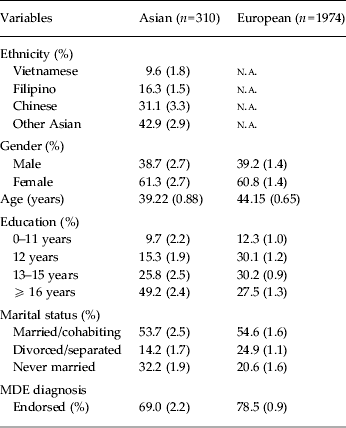
Descriptive statistics are presented in Table 1. The mean age was 39.22 (s.e. = 0.88) years for Asian Americans and 44.15 (s.e. = 0.65) years for European Americans. Both racial groups had more females than males. Three-quarters (77%) of the participants at risk for depression met criteria for DSM-IV MDE. Of those participants, European Americans (78.3%) were more likely to be diagnosed with MDE than Asian Americans (69%) [χ 2 (1, n = 71) = 3.037, p = 0.001].
Descriptives

MDE, Major depressive episode; n.a., not applicable.
Values given as mean (standard error).
Question endorsement, symptom prevalence and symptom profile
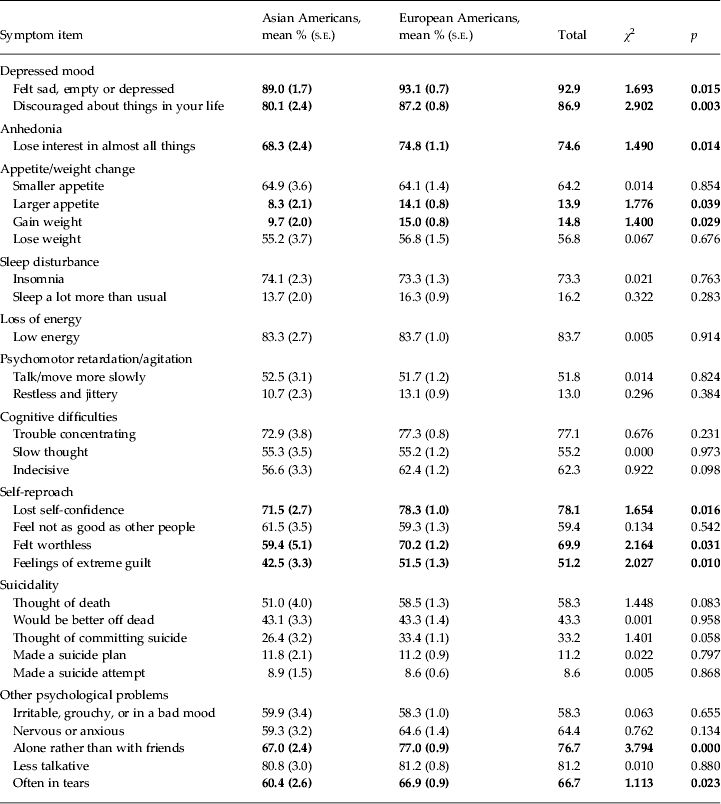
The endorsement rates of depressive symptoms according to DSM-IV MDE criteria for each racial group and χ 2 comparisons are presented in Table 2. Among the most frequently endorsed symptoms (>70%) for Asian Americans were feeling depressed, feeling discouraged, trouble sleeping, low energy, trouble concentrating, loss of self-confidence and feeling less talkative. Thus, there was partial support for hypothesis 1.
Endorsement and prevalence of depressive symptoms among Asian Americans (n = 310) and European Americans (n = 1974)

s.e., Standard error.
Percentages are weighted.
Statistical tests are design adjusted. Boldface type indicates a significant χ 2 test for difference at the p = 0.05 level.
χ 2 analyses: ethnicity × depressive symptoms
Significant differences in endorsement rates were found between Asian Americans and European Americans for 10 of the 29 questions, with Asian Americans endorsing all nine questions less frequently than European Americans (see Fig. 1). In particular, Europeans were significantly more likely than Asians to report feeling sad/empty/depressed, feeling discouraged about life, loss of interest, larger appetite, weight gain, loss of self-confidence, feeling worthless, feeling guilty, desire to be alone rather than with friends, and crying often (see Table 2).
Frequency of depressive symptoms among Asian Americans and European Americans.

IRT-LR tests for detecting DIF (IRT-LR DIF)
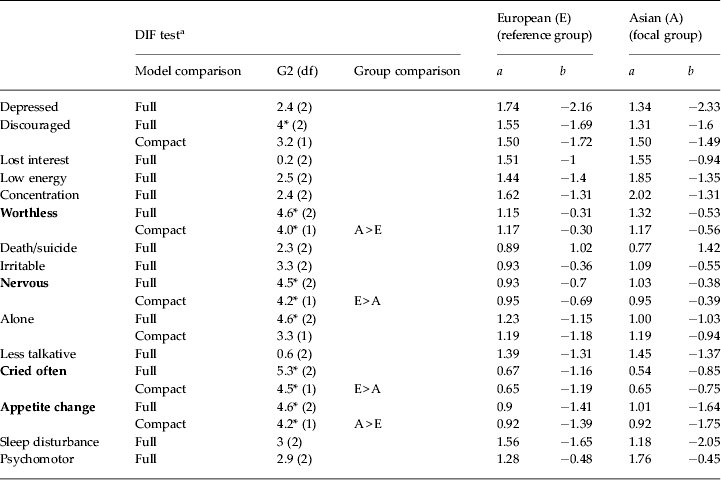
As the overall model fit was significantly better in fitting the two-parameter logistic (2PL) model [–2 log likelihood (–2LL) = 41 056.95] than in fitting the 1PL model (–2LL = 41 745.09), and the estimated slope parameters were substantially different across items (see Table 3), the 2PL model was applied for the following IRT-LR tests. In addition, as no interaction between group and threshold was hypothesized, this study focused on detecting uniform DIF. Accordingly, the DIF tests were performed only with threshold parameters.
Estimated item parameters by group and IRT-LT DIF test results

IRT-LT DIF, Item response theory likelihood ratio differential item functioning.
Boldface type indicates items that revealed differential item functioning.
a In the model comparison, ‘full’ means that a constrained model with equal a and b parameters between the two groups was compared to an unconstrained model with group-specific a and b parameters; ‘compact’ means a constrained model with an equal b parameter was compared with an unconstrained model with a different b parameter between the two models: G2(df) = –2(LLconstrained – LLunconstrained).
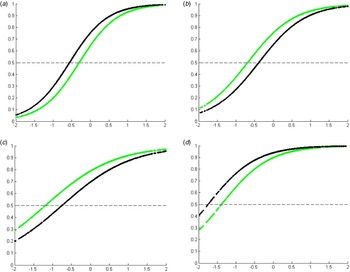
The results are displayed in Table 3. Notably, the estimated means of the latent trait, depression, in the Asian group were consistently lower than those in the European group. The estimated means for Asian Americans ranged from –0.21 to –0.17 and were fixed to 0 for European Americans. Under these distributions, we found that four items (i.e. worthless, nervous, cried often, and appetite change) demonstrated DIF. Specifically, when their estimated depression levels were equal, Asian Americans reported more easily that they felt worthless and experienced appetite changes compared with European Americans. By contrast, European Americans reported feeling nervous and crying more often than Asian Americans given equal levels of depression (see Fig. 2).
Expected probability of endorsing through the estimated level of depression by group membership (dark lines represent Asian Americans; light lines represent European Americans; the t statistic is associated with the difference in the expected probability between the two groups). (a) Worthless (t = 1.47, p = 0.142); (b) Nervous (t = −11.44, p < 0.001); (c) Cried often (t = −13.38, p < 0.001) (d) Appetite (t = 0.42, p = 0.671).

Discussion
This study examined a symptom profile of depression among a nationally representative sample of Asian Americans and compared it to that of European Americans. Overall, Asian Americans at risk for depression had high endorsement rates (>70%) for a variety of depressive symptoms, including depressed mood, discouragement, insomnia, loss of energy, trouble concentrating, loss of self-confidence and decreased talkativeness. This pattern is partially consistent with our hypothesis that somatic symptoms would be most prevalent among depressed Asian Americans. Indeed, trouble sleeping and low energy are somatic in nature and the endorsement rate of appetite/weight changes was above 70% when endorsement rates of decreased (64.9%) and increased (8.3%) appetite were considered jointly.
However, high endorsement rates of affective symptoms were also observed among Asian Americans. In particular, feeling sad, feeling discouraged about things in life and losing self-confidence were endorsed most often. The high endorsement rates of affective symptoms could have several possible explanations. First, the results are consistent with findings that Asian Americans experience depressive affective symptoms and are not denying the underlying psychological problems in depression (e.g. Lu et al. Reference Lu, Bond, Friedman and Chan2010). Second, the high endorsement rates of affective symptoms among Asian Americans might be related to their acculturation level because more acculturated Asian Americans may be more likely to manifest depression similarly to European Americans (Lee, Reference Lee2002). Third, the diagnostic measure (WMH-CIDI) in the CPES used a screening process that emphasized affective symptoms of depression (i.e. felt sad, empty, or depressed; felt discouraged; lost interest in things). Therefore, it is possible that the participants who completed the WMH-CIDI depression module were already primed to report their affective symptoms.
The screening process that was used in CPES limited our sample to 23% of the original sample who answered all questions about their most severe depressive episode. Although these results suggest that the core features of depression are present in different racial/ethnic groups, it is important to consider this finding in the context of the methodology that was used, as noted in the following classic example from cross-cultural psychology. The International Pilot Study of Schizophrenia (IPSS) conducted by the WHO in the 1970s provided the first data for cross-cultural comparisons of schizophrenia and concluded that psychoses presented similarly across cultures. However, Kleinman (Reference Kleinman1988) later criticized the methodology of the IPSS for using stringent inclusion and exclusion criteria, which yielded an ‘artificially homogenous sample’ (Thakker & Ward, Reference Thakker and Ward1998, p. 516), and suggested that the observed ‘similarity was an artifact of methodology’ (Kleinman, Reference Kleinman1988, p. 19). In the present study, a similar phenomenon may have been observed, as the screening questions for depression were based on DSM-IV MDE criteria. Specifically, the CIDI may show good diagnostic validity in undeprived contexts within the USA but may miss cases of depression in deprived environments (Hicks, Reference Hicks2002). Nevertheless, considering the scarcity of research with racial and ethnic minorities, we consider that this study provides important information about the expression and experience of depression.
To examine similarities and differences in depressive symptoms among Asian Americans and European Americans, the frequencies of endorsement were compared. Ten differences were found and, for all of them, European Americans endorsed the symptoms significantly more often than Asian Americans. In particular, European Americans more frequently endorsed feeling sad, empty or depressed, feeling discouraged about things in life, losing interest in almost all things, having a larger appetite, gaining weight, losing self-confidence, feeling worthless, feeling extreme guilt, wanting to be alone, and crying often. These findings were only partially consistent with our second hypothesis, which predicted that Asian Americans would endorse somatic symptoms more often and European Americans would be more likely to endorse affective symptoms. We observed that, although the first part of this hypothesis was not supported, the second part was confirmed. European Americans were more likely to endorse depressed mood, anhedonia and self-reproach symptoms. This finding is consistent with the proposition that Westerners are more likely to ‘psychologize’ depression than Asians whereas somatic complaints are ubiquitous (Kirmayer & Young, Reference Kirmayer and Young1998; Ryder et al. Reference Ryder, Yang, Zhu, Yao, Yi, Heine and Bagby2008).
Additionally, higher endorsement rates of increased appetite and weight gain were observed among European Americans but not among Asian Americans. Although we did not have a hypothesis for this particular symptom, Marsella et al. (Reference Marsella, Kinzie and Gordon1973) reported a similar pattern, with Japanese and Chinese Americans endorsing a lack of appetite and European Americans endorsing an urge to eat.
The DIF analysis indicated that four of the 15 items examined revealed measurement variance. Assuming equal levels of depression, Asian Americans endorsed feeling worthless and appetite disturbances more easily whereas European Americans endorsed feeling nervous and crying often more easily. These results provide partial support for the third hypothesis, as Asian Americans endorsed one somatic and one affective symptom more easily than European Americans. Consistent with the hypothesis and previous research, European Americans reported two affective symptoms more easily than Asian Americans with the same level of depression (Ryder et al. Reference Ryder, Yang, Zhu, Yao, Yi, Heine and Bagby2008).
We can speculate that the expression of negative emotions is more socially acceptable among European Americans than Asian Americans due to possible differences in the interaction between self-construal and emotional regulation. Independent self-construal involves construing the self as an individual, whose behavior is organized and meaningful based on the person's own feelings, thoughts and actions. Interdependent self-construal entails perceiving oneself as part of social relationships and realizing that one's behavior is contingent on and organized by the person's perception of others’ thoughts, feelings and behaviors (Markus & Kitayama, Reference Markus and Kitayama1991). Markus & Kitayama (Reference Markus and Kitayama1991) suggested that independent self-construal is observed in Western cultures and interdependent self-construal is more common in Asian cultures, although variations within cultures are possible. In terms of emotional regulation, the authors implied that a person's self-construal can affect the expression, intensity and frequency of emotions. Specifically, those with independent selves learn how to communicate their ‘ego-focused’ emotions, such as sadness or frustration, very effectively. By contrast, people with interdependent self-construal need to control and de-emphasize their private feelings so as to fit into the interpersonal context. Therefore, European Americans may put more weight on expressing negative affect (e.g. depressed mood, discouragement, crying often) than Asian Americans when they suffer from depression. Using the self-construal framework, we can also discuss European Americans’ higher endorsement of wanting to be alone rather than with friends. The desire to be on one's own when depressed may be related to the concept of independence and individualism seen more often among Western cultures. Conversely, Asian Americans may seek help from their social network or they may simply not have the choice to be on their own because isolation and avoidance are not socially appropriate.
The DIF results suggest evidence for measurement non-equivalence for two affective items for European Americans and for one somatic and one affective item for Asian Americans. However, the items that demonstrated measurement variance would probably not explain the significantly higher rate of depression diagnosis among European Americans than Asian Americans.
Clinical implications
The reported findings have important implications for mental health professionals and primary care physicians who work with Asian Americans. A culturally informed assessment of depressive symptoms among Asian Americans would equally emphasize affective and somatic symptoms and may inquire about self-worth and appetite changes. Although affective symptoms may be present among depressed Asian Americans, they may not be the most salient ones or the reason why clients sought help in the first place. In addition, taking into consideration the client's acculturation and probing further may be essential for the assessment, diagnosis and treatment of depression among Asian Americans.
Limitations
This study had several limitations that need to be addressed in future research. First, the screening process that was used in the WMH-CIDI limited our sample to Asian Americans who reported past experiences of sad, empty or depressed mood, discouragement, and lack of interest. Although this screening process is consistent with the DSM-IV diagnosis, it might have eliminated Asian American participants who experienced depression differently. However, we consider that the sample we examined still presented with reasonable cultural variations in depression and provided valid data to answer our research questions. Another limitation of the current study was the small cell counts to examine differences in depressive symptoms based on ethnicity. Although one of the strengths of the CPES dataset is the oversampling of Chinese, Filipino and Vietnamese participants, we could not take advantage of this feature because of the small number of individuals in each ethnic group.
Finally, considerable research has shown that acculturation level is a significant moderator of Asian Americans' mental health status and service utilization (Leong & Lau, Reference Leong and Lau2001). It is possible that measurement variance in depression may differentially affect Asian Americans with high versus low levels of acculturation. However, acculturation was not measured in this dataset.
Directions for future research
The systematic examination of symptom profiles of mental disorders among ethnic and racial minorities and cross-culturally can provide valuable information for improving assessment, diagnosis and treatment. In the case of depression, it may be particularly important to examine symptoms among individual ethnic groups of Asian Americans and other racial minorities. In addition, although we found cross-racial differences, testing the mechanisms behind these differences in depressive symptoms among Asian Americans will be an important next step. As mentioned earlier, another topic that deserves more attention is the effect of acculturation on the overall prevalence of depression, and of depressive symptoms in particular.
Furthermore, given the importance of face and shame in Asian cultures (Zane & Yeh, Reference Zane, Yeh, Kurasaki, Okazaki and Sue2002), differential symptom expression of depression in questionnaires (e.g. the Beck Depression Inventory-II) versus clinical interviews (e.g. the CIDI) could be examined in future studies to determine possible method variance (Ryder et al. Reference Ryder, Yang, Zhu, Yao, Yi, Heine and Bagby2008). Lastly, future research of depressive symptoms endorsed by both depressed and non-depressed Asian Americans may help to elucidate the diagnostic validity of the DSM-5 MDE diagnosis. In general, having a sample with a wide variation of clinical symptoms, as opposed to a sample limited to participants with a DSM diagnosis, will allow us to examine cultural variations of depression and other disorders more thoroughly.
Acknowledgments
We thank Dr N. Schmitt for his help with earlier versions of this manuscript. We also thank the CPES principal investigators, M. Alegría, J. Jackson, R. Kessler and D. Takeuchi, for initiating and completing this important project and allowing other researchers to use the datasets.
Declaration of Interest
None.