Introduction
The elderly population size is increasing worldwide (Shah and McKenzie, Reference Shah, MacKenzie, Bhugra and Bhui2007). Traditionally, suicide rates increased with aging (Shah and De, Reference Shah and De1998). A recent cross-national study of 62 developing and developed countries reported an increase in suicide rates with aging in males and females in 25 and 27 countries respectively (Shah, Reference Shah2007). The elderly are at high risk of developing tuberculosis (Trenton and Currier, Reference Trenton and Currier2001; Pesut et al., Reference Pesut, Gledovic, Grgurevic, Nagorni-Obradovic and Adzic2008; Zanni and Wick, Reference Zanni and Wick2008) and the incidence of tuberculosis in the elderly has increased in recent years (Pesut et al., Reference Pesut, Gledovic, Grgurevic, Nagorni-Obradovic and Adzic2008).
The prevalence of depression and anxiety are higher in those with tuberculosis than in the general population (Trenton and Currier, Reference Trenton and Currier2001; Aydin and Ulusahin, Reference Aydin and Ulusahin2001; Vega et al., Reference Vega2004; Husain et al., Reference Husain, Dearman, Chaudhry, Rizvi and Waheed2008). The incidence of depression, anxiety and psychosis emerging during the course of treatment for tuberculosis is also higher than in the general population (Vega et al., Reference Vega2004). There are reports of psychosis and suicidal ideation associated with isoniazid (Pallone et al., Reference Pallone, Goldman and Fuller1993; Iannaccone et al., Reference Iannaccone, Sue and Avner2002), a commonly used drug in the treatment of tuberculosis. However, there is also evidence that psychiatric disorders at baseline improve during the course of treatment for tuberculosis (Vega et al., Reference Vega2004).
Disorders of the respiratory system have been identified as risk factors for completed suicide in the elderly (Horton-Deuth et al., Reference Horton-Deuth, Clarke and Farran1992). A positive correlation between suicide rates and rates of mortality due to tuberculosis has been reported for East European countries (Kondrichin and Lester, Reference Kondrichin and Lester2001). Therefore, a preliminary cross-national study of the relationships between elderly suicide rates and (i) the prevalence of tuberculosis, (ii) the proportion of detected cases of tuberculosis, and (iii) the proportion of cured cases of tuberculosis was undertaken. The null hypothesis was that there will be no association between elderly suicide rates and the three variables related to tuberculosis.
Methods
Data on elderly suicide rates for males and females in the age-bands 65–74 years and 75+ years was ascertained from the World Health Organization (WHO) website (http://www.who.int/whosis/database/mort/table1.cfm). Data were excluded if raw numbers of suicides were available but the suicide rates were not, unless the number of suicides was zero (in which case the rate would be zero). Data on suicide rates were collected for the latest available year and the median (range) of this latest year across the different countries was 2000 (1985–2003). This method of collecting data on suicide rates in the elderly has been successfully used in other studies (Shah et al., Reference Shah, Bhat, MacKenzie and Koen2008).
Data on the prevalence of tuberculosis (per 100,000 population), the proportion of detected cases of tuberculosis (percentage of estimated cases) and the proportion of cured cases of tuberculosis (percentage of detected cases) were ascertained from United Nations Development Program (UNDP) website (http://hdr.undp.org/en/media/HDR_20072008_Tables.pdf). The data for the prevalence of tuberculosis and the proportion of detected cases of tuberculosis were for 2004 and data for the proportion of cured cases of tuberculosis were for 2003.
The relationship between suicide rates for both sexes in both elderly age-bands and (i) the prevalence of tuberculosis, (ii) the proportion of detected cases of tuberculosis, and (iii) the proportion of cured cases of tuberculosis was examined using Kendall's rank correlation coefficient (Tau-b).
Post hoc analysis was conducted by dividing the 69 countries into two equal groups using the median of the prevalence rates for tuberculosis and by separately repeating the correlations between suicide rates and the proportion of cured cases of tuberculosis in the two groups to examine the strength of this relationship in countries with a higher prevalence of tuberculosis. A further post hoc analysis was conducted by dividing the 69 countries into two equal groups by the median of the gross national domestic product (a measure of socio-economic status) and by separately repeating the correlations between suicide rates and the proportion of cured cases of tuberculosis in the two groups to examine the strength of this relationship in countries with a high and low income.
Results
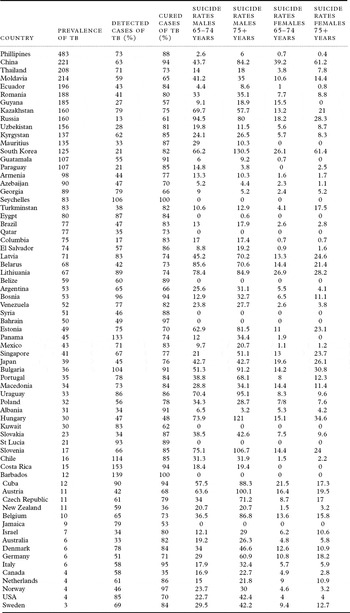
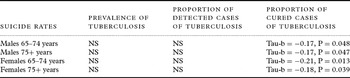
A full data set was available for 69 countries. Table 1 illustrates the measured parameters for each of the 69 countries. Table 2 illustrates the relationship between suicide rates for both sexes in both elderly age-bands and (i) the prevalence of tuberculosis, (ii) the proportion of detected cases of tuberculosis, and (iii) the proportion of cured cases of tuberculosis. There were no significant correlations between suicide rates for both sexes in both elderly age-bands and the prevalence of tuberculosis and the proportion of detected cases of tuberculosis. There were weak but significant negative correlations between the proportion of cured cases of tuberculosis and suicide rates in males aged 65–74 years, males aged 75+ years, females aged 65–74 years and females aged 75+ years.
Suicide rates and tuberculosis parameters for all 69 countries*

TB = tuberculosis
*Rates for prevalence of TB are per 100,000 general population; suicide rates are per 100,000 of the relevant age and sex group.
Correlations between suicide rates and parameters for tuberculosis

NS = not significant
In the first post hoc analysis, there were no significant correlations between elderly suicide rates and the proportion of cured cases of tuberculosis in countries with prevalence rates of tuberculosis below the median. However, in countries with prevalence rates of tuberculosis above the median, there were stronger (than the whole group) significant negative correlations between the proportion of cured cases of tuberculosis and suicide rates in males aged 65–74 years (Tau-b = −0.33, P = 0.004), males aged 75+ years (Tau-b = −0.32, P = 0.006), females aged 65–74 years (Tau-b = −0.42, P < 0.0001) and females aged 75+ years (Tau-b = −0.30, P = 0.01). In the second post hoc analysis, there were no significant correlations between elderly suicide rates and the proportion of cured cases of tuberculosis in countries with both high and low income.
Discussion
Cross-national data on suicide rates should be viewed cautiously for a number of reasons: data are not available from all countries (Moscicki, Reference Moscicki1995; Wasserman et al., Reference Wasserman, Cheng and Jiang2005); the validity of these data are unclear (Diekstra, Reference Diekstra1989; Wasserman et al., Reference Wasserman, Cheng and Jiang2005); the legal criteria for the proof of suicide vary between countries (Shah and Ganesvaran, Reference Shah, Ganesvaran, Chiu and Ames1994; Wasserman et al., Reference Wasserman, Cheng and Jiang2005); some countries have poor death registration facilities (Shah and Ganesvaran, Reference Shah, Ganesvaran, Chiu and Ames1994); cultural and religious factors and stigma attached to suicide may lead to under-reporting of suicides (Wasserman et al., Reference Wasserman, Cheng and Jiang2005; Abrahams et al., Reference Abrahams, Abrahams and Jacob2005); and utilizing national aggregate data is likely to miss regional variations in suicide rates in individual countries (Rehkopf and Buka, Reference Rehkopf and Buka2006). Data on the three studied parameters for tuberculosis should also be viewed cautiously because the validity of these nationally collected data is unclear; and some countries may have poor registration facilities for data on health-related measures.
The absence of significant correlations between elderly suicide rates and the prevalence of tuberculosis and the proportion of detected cases of tuberculosis confirmed the null hypothesis. The significant negative correlations between the proportion of cured cases of tuberculosis and suicide rates for both sexes in both elderly age-bands rejected the null hypothesis. These may be spurious correlations because of the methodological issues discussed above. Also, other factors, including the quality and quantity of available healthcare services, may independently affect both suicide rates (Shah et al., Reference Shah, Bhat, MacKenzie and Koen2008; Shah and Bhat, Reference Shah and Bhat2008a; Reference Shah and Bhat2008b) and mortality due to tuberculosis. However, this finding is consistent with the observed association between suicide rates and rates of mortality due to tuberculosis (Kondrichin and Lester, Reference Kondrichin and Lester2001); those with untreated tuberculosis or with tuberculosis resistant to treatment are more likely to die from tuberculosis, and are also more likely have ongoing depression and anxiety (Trenton and Currier, Reference Trenton and Currier2001; Aydin and Ulusahin, Reference Aydin and Ulusahin2001; Vega et al., Reference Vega2004; Husain et al., Reference Husain, Dearman, Chaudhry, Rizvi and Waheed2008), both risk factors for elderly suicides (Shah and De, Reference Shah and De1998). Therefore, other potential explanations are considered below in light of the available literature.
The prevalence of depression and anxiety are higher in those with tuberculosis than in the general population (Trenton and Currier Reference Trenton and Currier2001; Aydin and Ulusahin, Reference Aydin and Ulusahin2001; Vega et al., Reference Vega2004; Husain et al., Reference Husain, Dearman, Chaudhry, Rizvi and Waheed2008). The incidence of depression, anxiety and psychosis emerging during treatment for tuberculosis is also higher than in the general population (Vega et al., Reference Vega2004). There is also evidence that depression and anxiety at baseline improves during the course of treatment for tuberculosis (Vega et al., Reference Vega2004). There may be several possible explanations for this. First, the treatment of tuberculosis itself may improve depression and anxiety because such treatment may alleviate the stressful life event of having a diagnosis of tuberculosis, reduce the disability associated with tuberculosis (Aydin and Ulusahin, Reference Aydin and Ulusahin2001) and improve the negative illness perceptions (Husain et al., Reference Husain, Dearman, Chaudhry, Rizvi and Waheed2008). Second, isonaizid, commonly used in the treatment of tuberculosis is a monoamine oxidase inhibitor (Pletscher, Reference Pletscher1991; Moncrieff, Reference Moncrieff2008), and its antidepressant properties may improve the depression. Third, clinicians treating the tuberculosis may also have had an opportunity to identify and treat psychiatric morbidity. Improvement in depression associated with the treatment of tuberculosis, through whichever mechanism, may make a contribution to reduction in elderly suicide rates because up to 90% of completed suicides in the elderly are associated with depression (Shah and De, Reference Shah and De1998) and disorders of the respiratory system are recognized risk factors for elderly suicides (Horton-Deuth et al., Reference Horton-Deuth, Clarke and Farran1992). Post hoc analysis revealed no significant correlations between elderly suicide rates and the proportion of cured cases of tuberculosis in countries with prevalence rates of tuberculosis below the median. However, in countries with prevalence rates of tuberculosis above the median, there were stronger (than the whole group) significant negative correlations between the proportion of cured cases of tuberculosis and suicide rates in both sexes in both the elderly age-bands. This suggests, therefore, that these observed negative correlations may be particularly important in countries with a high prevalence of tuberculosis. However, this relationship was not observed when groups of high income or low income countries were examined separately.
Caution should be exercised in interpreting the findings and causal direction of the relationship from this cross-sectional ecological study because of ecological fallacy. Moreover, data on all the studied parameters were used for individual years and it is possible that the observed relationship may not hold if the studied parameters changed over time. However, if the above speculated model for reduction in elderly suicide rates due to the treatment of tuberculosis is true, then it potentially has important implications for prevention of elderly suicides, particularly in countries with a high prevalence of tuberculosis. The reasons for this include: 182 countries had implemented the WHO recommended “Directly Observed Treatment, Short-course” treatment for tuberculosis by 2003; tuberculosis is often treated in primary care in many countries (Trenton and Currier, Reference Trenton and Currier2001); enhanced treatment of mental illness in primary care has been strongly advocated for developing countries (Shah et al., Reference Shah, Murthy and Suh2002) where secondary care specialist mental health services are poorly developed (Shah, Reference Shah2009); and some developing countries lack the essential prescribing list of drugs recommended by the WHO (Shah and Bhat, Reference Shah and Bhat2008a; Reference Shah and Bhat2008b), and isonaizid, with its antidepressant properties, may have an important role in this context when used in the treatment of tuberculosis.
Conflict of interest
None.