Introduction
This paper provides a case study of the development of a long-term care (LTC) system in a single country, South Africa, and relates it to wider experiences in low- and middle-income countries (LMICs). In so doing, the paper makes two conceptual contributions. First, it develops a general model of LTC systems, which is applicable to all countries. Second, it establishes a framework to distinguish between global and more specific influences on the nature of these systems.
The World Health Organisation (WHO) argues that all countries should have an LTC system of some kind, defining these broadly as:
‘Activities undertaken by others to ensure that people with or at risk of a significant ongoing loss of intrinsic capacity can maintain a level of functional ability consistent with their basic rights, fundamental freedoms and human dignity’ (WHO, 2015: 127).
It adds:
‘. . . long-term care systems refer to all these caregivers and the settings in which they operate, as well as the governance and support services that can help them in their roles’ (2015: 128).
According to the WHO definition, LTC systems do not just include organised, formal service provision but also cover informal actors, such as families and social networks. This paper takes a similar approach but does not adopt WHO's normative premise that LTC systems are defined in terms of positive outcomes, acknowledging that LTC systems can sometimes generate neutral or negative effects. In other words, instead of defining an LTC system as ‘what should be out there’, the paper defines it in terms of ‘what actually is in place.’
It is useful to distinguish between three broad elements that make up any LTC system - demand, provision and outcomes. Growing demand for LTC is increasingly a global phenomenon. United Nations data show that the populations of most LMICs are now ageing rapidly, with especially sharp increases in numbers of people at very old ages (Table 1). Within older populations, there are strong associations between age, frailty and limited function (Harttgen et al., Reference Harttgen2013). It is estimated that, between 2015 and 2050, the number of people in LMICs with dementia will more than treble (ADI, 2015). By strict definition, any country containing dependent older people has a LTC system, even if adequate care is largely absent.
Population aged 75+ (million) in less developed regions

Source: United Nations Population Division 2015.
The provision element of LTC systems encompasses many different components and there is considerable national diversity in how these are combined. Comparisons across OECD countries show large variations in terms of overall spending on LTC, the relative importance of state, private sector and family provision and the specific kinds of services being offered (OECD, 2011). National variations have been explained in terms of differences in state ideologies, culture norms and pre-existing welfare systems (Pfau-Effinger, Reference Pfau-Effinger2012).
Given the variety across high-income settings, it is to be expected that LTC provision will take diverse forms across LMICs. However, current analysis of LTC provision in these countries is hampered by a lack of robust, comprehensive data (Lloyd-Sherlock, Reference Lloyd-Sherlock2016). This has encouraged a number of broad observations. On one hand, it is sometimes claimed that larger households and stronger norms of intergenerational solidarity mean families are better-placed to meet care for older people than in high-income countries (Brijnath, Reference Brijnath2012). On the other, there are accounts that rapid modernisation (defined loosely) is undermining ‘traditional’ family care-giving, through a range of effects, such as population mobility, changing household structures, female roles and cultural norms (Sinunu et al., Reference Sinunu, Yount and El Afify2009; Cheung Wong and Leung, Reference Cheung Wong and Leung2012). There is also evidence of a very rapid and largely ad hoc extension of formal services (Sasat et al., Reference Sasat, Choowattanapakorn, Pukdeeprom, Lertrat and Aroonsang2013; Camarano et al., Reference Camarano, Kanso, Leitão e Mello, Fernandes Carvalho and Camarano2010). For example, in Argentina there were fewer than 200 residential care homes operating in the 1980s, but by 2015 there were over 6,000 (Lloyd-Sherlock et al., Reference Lloyd-Sherlock, Penhale and Redondo2018a).
The third, and most neglected, element of LTC systems relates to outcomes, including for both care-givers and care-receivers. WHO (2015) argues that LTC systems should aspire to enhance the functional status and quality of life of older people, wherever possible. In practice, outcomes for dependent older people should be understood as a spectrum ranging from WHO's laudable aspirations to more negative ones, including reduced quality of life, the abuse of basic rights and avoidable mortality. Systematic data comparing the effects of LTC systems on these outcomes are not available for OECD countries, and even less for LMICs. However, there is fragmentary evidence from some LMICs that LTC systems expose significant numbers of dependent older people to different forms of neglect and abuse (Lloyd-Sherlock et al., Reference Lloyd-Sherlock, Penhale and Redondo2018a; Giraldo-Rodríguez et al., Reference Giraldo-Rodríguez, Rosas-Carrasco and Mino-León2015). LTC systems can generate a range of other important outcomes, most notably for people engaged as care-givers, both on a paid or unpaid basis. It has been widely observed for OECD countries that this is an overwhelmingly female, low-status workforce (OECD, 2011).
Given growing demand for care in LMICs, there is an urgent need for a stronger evidence base on LTC systems. This should include national case studies to evaluate whether emerging systems conform to general patterns or are shaped by more specific contexts. South Africa was selected in part for opportunistic reasons, emerging from a separate piece of desk research commissioned by UN Women. However, country selection also reflected an a priori hypothesis that specific features of the South African context would significantly influence the form of its emerging LTC system. These features include apartheid and its racial legacy, a generalised HIV epidemic and a state that invests substantial resources in redistributionist welfare programmes. The paper does not systematically assess how representative the South African experience is of other LMICs, as there is insufficient detailed research on most other countries to permit robust comparison. Instead, we aim to assess the validity of our analytical approach for examining South Africa's LTC system, with a view to its potential application to research elsewhere.
The paper does not draw on original data, relying instead on published studies, grey literature and media reporting. By the standards of other LMICs, this material is relatively abundant for South Africa. Nonetheless, the analysis reveals important gaps in what is currently known about the country's LTC system, which in itself is a significant finding. The following section explores in more detail potentially relevant aspects of South Africa's historical and developmental experiences, followed by sections focused on demand, provision and outcomes of the LTC system.
A unique national context for LTC
For countries like South Africa, LTC for older people is seen as a modern challenge, but the specific nature of that challenge is strongly framed by historical effects. For example, the legacies of the former apartheid system continue to exert powerful effects on most aspects of society and public policy. Apartheid was formally implemented in the late 1940s, with legislation discriminating against different racial groups, including geographical segregation, employment discrimination and different entitlements to services (Feinstein, Reference Feinstein2005). Officially, apartheid came to an end in 1994 with the election of the African National Congress government. However, such was the impact of apartheid that its effects continue to shape the country today. For example, per capita income of Africans (who account for around 80 per cent of the national population) is around an eighth of that for whites (who account for around 9 per cent) (Gradín, Reference Gradín2013).
Coinciding with this political transition, South Africa saw the arrival and rapid escalation of the HIV/AIDS epidemic (Shisana et al., 2014). Between 1990 and 1998 the proportion of antenatal clinic attendees testing positive for HIV rose from under one per cent to 22.8 per cent. Prevalence is currently estimated at around 20 per cent for the total population, with 280,000 deaths related to HIV/AIDS in 2010. Mortality is concentrated among younger age groups, due to lower prevalence among older people (around 4 per cent for both men and women aged 60 and over). This affects the age structure of the population and the composition of households, with related implications for LTC. Since 2012 the rapid extension of anti-retroviral therapies (ART) has led to a fall in HIV/AIDS-related mortality, down to 180,000 a year in 2015. However, the social and demographic legacies of the epidemic will endure for several decades to come.
Understandably, health policy has mainly focussed on HIV/AIDS, and associated issues such as TB and reproductive health. This focus is, however, increasingly out of kilter with South Africa's main epidemiological challenges. Despite the scale of the HIV/AIDS epidemic, the leading causes of death and illness in South Africa are now non-communicable diseases (NCDs), such as stroke, heart disease, cancer and diabetes (Mayosi et al., Reference Mayosi, Flisher, Lalloo, Sitas, Tollman and Bradshaw2009). For example, South Africa has the world's highest reported prevalence of hypertension (Lloyd-Sherlock et al., Reference Lloyd-Sherlock, Minicuci, Beard, Ebrahim and Chatterji2014). In part this high prevalence may be due to an elevated risk of arterial hypertension for people taking some forms of ART (Calò et al., Reference Calò, Caielli, Maiolino and Rossi2013). NCDs remain relatively neglected in South Africa and this forms part of a wider neglect of health conditions of relevance to older people. For example, specialist gerontology training was recently removed by the South African Nursing Council from its required nursing qualifications. In 2010 South Africa only had eight registered geriatricians for a population of nearly four million people aged 60 or more. Where they exist, relevant health services are concentrated in more prosperous urban areas, reflecting a geographical distribution of hospital infrastructure established under apartheid (Mooney and McIntyre, Reference Mooney and McIntyre2008).
More specifically, there is very little research or policy focus on dementia in South Africa. There are no reliable surveys of prevalence of the condition, and awareness of the condition is limited, even among health professionals (de Jager et al., Reference de Jager, Joska, Hoffman, Borochowitz and Combrinck2015). There is evidence of a link between HIV and dementia risk, including for populations receiving ART treatment (Robbins et al., Reference Robbins, Remien, Mellins, Joska and Stein2012). At the same time, the roll-out of ART means that increasing numbers of people with HIV are surviving into later life. Consequently, the prevalence of dementia among older South Africans may be significantly higher than in countries less affected by HIV/AIDs.
The lack of focus on non-communicable diseases and geriatric health has several potential consequences for LTC. First, they contribute to levels of care dependency in old age. For example, exposure to uncontrolled risk factors such as hypertension increases the incidence of conditions such as strokes, which are a major cause of disability in later life (Maredza et al., Reference Maredza, Bertram and Tollman2015). Second, the limited training of nurses in primary health centres represents a barrier to the development of integrated health and social care systems for older people, especially in rural areas.Footnote 1
A more positive legacy of South Africa's past has been the emergence of a broadly universal welfare system, including non-contributory pensions (known as ‘Old Age Grants’) paid to the large majority of older people, regardless of race. Before 1994, the value of benefits varied by racial groups, but they were subsequently harmonised at approximately US$110 dollars a month. It is claimed that the social pension does not just benefit older people, but is pooled across entire households (Duflo, Reference Duflo2003; Lloyd-Sherlock et al., Reference Lloyd-Sherlock, Barrientos, Moller and Saboia2012). In settings of high unemployment, they may represent the only reliable source of household income and can encourage family members to live with older people to share the pension income (Hamoudi and Duncan, Reference Hamoudi and Duncan2014; Schatz et al., Reference Schatz, Madhavan, Collinson, Gómez-Olivé and Margaret Ralston2015).
Taken together, pension pooling and care of AIDS orphans have generated a strong focus on the role of older Africans as carers of other family members. This is also reflected in public policy. Sagner and Mtati (Reference Sagner and Mtati1999) observe:
By emphasising the poverty-alleviating function and the development-oriented role of social assistance money in general and old-age pensions in particular . . . the state also stresses the ‘rightness’ of pension sharing. . .. The state-supported ideology of the moral virtue of pension sharing and of the ‘natural’ selflessness of old-age pensioners dominates much of the public discourse on older people.
The extent to which pension-sharing is always a consensual process is a moot point (Lloyd-Sherlock et al., Reference Lloyd-Sherlock, Ayiga and Penhale2018b). More specifically, this focus on older Africans as carers has over-shadowed concerns about meeting the needs of those older people who are themselves care-dependent. This can be seen in the published literature, which, as shown below, includes a substantial body of work on the former issue and almost nothing on the latter.
In sum, South Africa's complex historical experience has given rise to a unique context that has a range of potentially significant effects on its LTC system. The following sections assess these effects on the three elements of this system: demand, provision and outcomes.
Racial dimensions of demand for long-term care
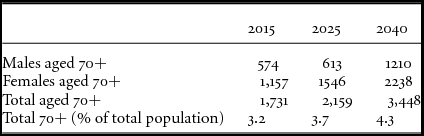
There is a broad relationship between old age and the likelihood of requiring care, and this link becomes more pronounced beyond the age of 70 (WHO, 2015). Table 2 shows that the number of South Africans aged 70 and over will roughly double between 2015 and 2040, reaching 3.5 million people, and that a disproportionate share will be women.
Population estimates and medium variant projections by sex (1000 people)

Source: UN Population Division 2015.
Rather than a single trend of demographic transition and population ageing, it is more instructive to look at the experiences of racial categories separately. Even before the formalisation of apartheid, the demographic profiles of racial groups were very different. For example, between 1940 and 1950 the total fertility rate for white women was 3.5, compared to 6.5 for all other racial groups (Chimere-Dan, Reference Chimere-Dan1993). Africans have historically experienced much lower levels of life expectancy than other racial groups. In 1997 life expectancy at birth was 77 years for white women, compared to only 55 years for black women (Kinsella and Ferreira, Reference Kinsella and Ferreira1997). These long-run demographic differences between racial groups continue to affect patterns of population ageing today. The HIV/AIDS epidemic has also had a demographic impact, especially among Africans. In 2012, it was estimated that 15 per cent of Africans were HIV positive, compared to only 0.3 per cent of whites (Shisana et al., Reference Shisana, Rehle, Simbayi, Zuma, Jooste, Zungu, Labadarius and Onoya2014). HIV/AIDS mortality has been concentrated among younger adults and children, which will have increased the percentage of Africans in older age groups.
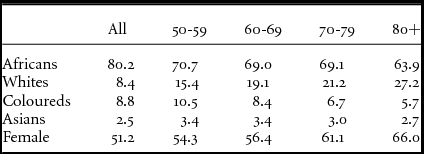
Table 3 compares levels of population ageing for different racial groups in 2014 and shows that whites are disproportionately represented in the oldest age groups. This indicates that historical variations in fertility and life expectancy between racial groups more than counter-balanced racial variations in age-specific HIV/AIDS mortality. Nevertheless, Africans still accounted for around two-thirds of the population aged 70 and over in 2014. The racial composition of South Africans aged between 50 and 69 indicates that whites will account for a shrinking proportion of the oldest old in future decades.
Sex and race composition of different age groups (per cent), 2014

Source: Statistics South Africa (2014).
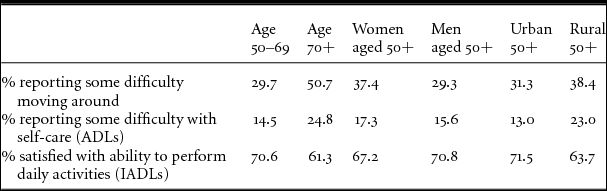
Relationships between chronological age and dependency are variable, and reliable estimates of care dependency rates are not easily obtained (WHO, 2015). Table 4 summarises data from a nationally-representative survey of older people. It refers to different aspects of care dependency, with higher rates associated with rural location, older age and female sex. Since more women survive to older ages than men, female sex does not exert an independent effect. Table 4 shows that a quarter of South Africans aged 70 and over reported difficulty with self-care: equating to 433,000 people in 2015.
Indicators related to care dependency for people aged 50 and over

Source: calculated from He et al., (Reference He, Muencrath and Kowal2012).
Assuming that age-specific care-dependency rates do not vary by racial groups, older Africans would account for around two-thirds of long-term care demand. This assumption would, however, appear to be far from valid. Data from the 2011 National Census shows that the share of older Africans reporting severe difficulty with self-care was more than double that for whites, and they were four times more likely to report severe cognitive impairment (Statistics South Africa, 2014). This is in keeping with studies in other countries that show a strong link between early life disadvantage and the risk of care dependency in later life (Bowen, Reference Bowen2009). Despite being more likely to need them, the census shows that Africans were less likely to use assistive devices or medication to manage chronic conditions: for example, only 22 per cent used glasses, compared to 80 per cent of whites.
Despite the acknowledged link between HIV status and dementia risk, there is little information on the prevalence of dementia in South Africa. A survey of 200 Africans aged 60 and over in an urban setting found dementia rates of around 6 per cent (de Jager et al., Reference de Jager, Joska, Hoffman, Borochowitz and Combrinck2015). Given the growing rates of HIV prevalence among Africans (as ART extends survival), it is likely that this group will be disproportionately affected by dementia.
In sum, the legacies of apartheid and ongoing effects of the HIV/AIDS epidemic have done much to frame the racial dimensions of demand for care in later life. The African population has been less affected by demographic ageing than whites, but still accounts for a growing majority of people at old ages. Lifetime disadvantage and exposure to HIV-infection have led to higher rates of dependency and cognitive impairment among older Africans. As part of efforts to resolve the discriminatory legacy of apartheid, it might be expected that government interventions would devote disproportionate resources to the needs of these historically-disadvantaged groups.
Long-term care provision for Africans: keeping it in the family
In 2014 a prominent African politician commented:
Black and white are different in terms of their culture and traditions. While whites prefer to take their old to these homes for the aged, black people prefer to live with their children and grandchildren and be taken care of up until they die.Footnote 2
This view reflects wider sub-Saharan discourses about the need to avoid western norms and models of LTC provision (Aboderin, Reference Aboderin and Lloyd-Sherlock2004). It would appear to be a widely-held view and to have deep historical roots. For example, a survey of care homes conducted in 1998 observed:
Welfare and church organisations, mainly from the white population groups, developed institutional care within their own cultural background to take care of their older people (Perold and Muller, Reference Perold and Muller2000: 87).
The implication of this observation is that racial traditions of LTC were substantively different, and rooted in fundamental cultural differences.
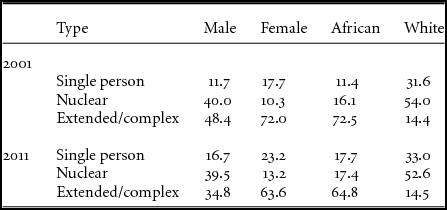
This view is often justified in terms of variations in living arrangements between different groups of older people. Table 5 presents data on living arrangements, by gender and race for 2001 and 2011. Older Africans are much more likely to live in extended/complex households than older whites, although the proportion has fallen somewhat since 2001. Despite this, it is noteworthy that 17.7 per cent of older African were living alone in 2011, with the proportion rising to over one in five older female Africans.
Living arrangements of people aged 60 and over by sex and population group (%)

Source: Statistics South Africa (2014).
Relationships between living arrangements and older people's access to care from family members are not straightforward (Schatz et al., Reference Schatz, Madhavan, Collinson, Gómez-Olivé and Margaret Ralston2015). For example, the category ‘extended/complex households’ includes skip-generation households (where grandparents live with a grandchild aged under 15, but no adult children). It has been estimated that at least 15 per cent of Africans aged 60 and over were living in skip-generation households (Noumbissi and Zuberi, Reference Noumbissi and Zuberi2001).Footnote 3 As such, living with children and grandchildren may have as much to do with older people providing care as with their access to care. These data on living arrangements call into question generalised claims that almost all older Africans have direct access to family support.
While caring for older Africans may be viewed as a family matter, there is little research or policy debate about how well families are providing care. Rather than by LTC, the main focus on older Africans’ family relations has been framed by concerns about HIV/AIDS. There is a large body of research and policy focused on the role of older people, particularly women, as carers for adult children who are ill with HIV/AIDS or their surviving grandchildren (Ardington et al., Reference Ardington, Case, Islam, Lam, Leibbrandt, Menendez and Olgiati2010; Kimuna and Makiwane, Reference Kimuna and Makiwane2007). This is often framed in terms of a somewhat stylised narrative of heroic grandmothers caring for vulnerable children within skip-generation households (HelpAge International, 2005). It has been estimated that South Africa contained as many as 1.2 million AIDS orphans in 2005, and that up to 40 per cent of them lived with their grandparents (HelpAge International, 2003; UNAIDS, 2006). This suggests that a very high proportion of older people, especially Africans who have been worst-hit by the epidemic, have been left with the sole responsibility for raising young children.
While there is some truth in this representation, it needs some qualification. First, in many cases these grandmothers are in their 40s or 50s and are therefore better described as ‘middle aged’ than ‘in later life’. Although the prevalence of skip-generation households has increased with HIV/AIDS, this was already a common household structure among rural Africans, as children migrating to cities would leave their children behind with grandparents (Merli and Palloni, Reference Merli, Palloni, Cohen and Menken2006). This historically-established grandparenting role is likely to continue in South Africa, despite recent reductions in AIDS-related mortality.
Some studies highlight the burden of care by grandmothers, in terms of physical and emotional health, as well as financially (Schatz, Reference Schatz2007; Schatz and Gilbert, Reference Schatz and Gilbert2014). However, there is a tendency to frame family relations in broadly altruistic terms, which does not coincide with wider evidence of prevalent domestic violence. For example, it is widely observed that older people share pensions with household members, and some commentators claim that this enhances the social status of the older person within the household, potentially increasing their authority to call on care from other household members (Sagner, Reference Sagner2000; Lloyd-Sherlock and Barrientos, Reference Lloyd-Sherlock and Barrientos2002). Yet there are growing indications that pension sharing is not always consensual and, in some cases, amounts to financial abuse (Bigala and Ayiga, Reference Bigala and Ayiga2014).
Some studies report that older women voice expectations that they will go on to receive care from children or grandchildren in return for the support they themselves provided (Schatz and Seeley, Reference Schatz and Seeley2015). However, published research on family care for older people is extremely scarce. One important exception is Nyirenda et al. (Reference Nyirenda, Mutevedzi, Hosegood, Falkingham and Newell2015) who conducted a survey of 422 people aged 50 and over in households in rural Kwazulu Natal where a member was either living with or had recently died of HIV/AIDS. The survey demonstrates high level of inter-dependency in households, with most respondents reporting that they both gave and received care from other family members.
There are indirect indications that many long-term care needs, particularly of more affluent older people of all races, are met by paid carers at home, rather than in an institutional setting. South Africa has strong traditions of paid domestic service, especially by Africans for whites (Fish, Reference Fish2006). It is estimated that nearly three million paid carers and domestic staff previously engaged in duties such as childcare and housework are being required to take on elder-care duties (Lund and Budlender, Reference Lund and Budlender2009). There is a considerable presence of private elder-care agencies advertising on the internet, but there is no systematic data about the scale of this sector or the quality of care it provides.
Public policy supporting home care is mainly limited to a ‘Grant-in-Aid’ benefit to older people who have been assessed as ‘requiring regular care’. In 2012 68,000 benefits worth around £17 a month were being paid out, at a total cost of £14 million (Department of Social Development, 2012). This is equivalent to 4 per cent of the population aged 70 or over and, in most cases, is likely to represent only a small part of actual home care costs. As such, it can be viewed as a somewhat tokenistic intervention.
Overall, the basis for the view that most older Africans have access to adequate LTC from family members would appear very flimsy. Moreover, it considerably simplifies and essentialises cultural differences across racial groups (which is itself a legacy of apartheid). There are indications that not all Africans conform to this stereotyped discourse. According to an African voluntary worker, interviewed as part of a larger study:
The government does not want this type of home for elderly people. It says that in our culture elderly people are the responsibility of the community. They must be left in their houses and relatives and friends must look after them. . ..But when we leave them at night criminals come in and not only rob them but also beat them up, rape them and in some instances, kill them (Protasia and Torkington, Reference Protasia and Torkington2000: 143).
Formal LTC services: Apartheid's heavy legacy
South Africa contains a large number of residential care homes for older people, including over 400 care homes that are on official registers. Historically, the use of care homes was heavily concentrated among white older people. In 1982 the percentage of white South Africans living in state-subsidised or private old-age homes was the highest in the world, at 11 per cent of the population aged 65 and over (Seedat, Reference Seedat1984). By contrast, state and private provision for other racial groups at that time was minimal. It has been claimed that residential care for older people has become increasingly acceptable among richer Africans (Chabeli, Reference Chabeli2003). However, supporting evidence is not available, since the national census does not include people living in communal establishments.
Residential care homes are mainly run by NGOs or religious organisations, and only eight are run directly by local or national government agencies. The country has a well-established and diverse network of NGOs and other third sector organisations, which play substantial roles in many aspects of development, including the health sector (van Pletzen, Reference van Pletzen2014). Historically, charities and church organisations have been the main providers of care home services for the white population, albeit with considerable state funding. As demand has risen, many of these organisations have seen rapid expansion.Footnote 4 Many NGOs operate within a body called ‘Age in Action’, which claims to represent over 1,200 member organisations and has over 30 offices across the country. Age in Action has close links with the national Ministry of Social Development which provides a substantial part of its funding. Registered homes are entitled to apply for a state subsidy for individual residents, currently worth around £100 a month. The Department of Social Development screens applicants according to their level of frailty, family situation and economic status. In 2014 the total cost of this scheme was £50 million, indicating that around 42,000 care home residents were receiving subsidies (National Treasury, 2015).
There have been mounting concerns about the cost of these care home subsidies and efforts to rein them in (Department of Social Development, 2005). A government white paper published in 1997 stipulated that state subsidised residential care should only be made available for frail older people, but did not provide a definition of frailty. The monthly value of the subsidy has been reduced over time and now only represents a small part of the total cost of residential care. It has been observed that the reduction in the value of the subsidy has discouraged residential facilities from providing services to poor, frail older people (who are eligible for the subsidy) and focuses provision on wealthier older people (who pay themselves) (Department of Social Development, 2005).
There is evidence that the racial composition of old age homes has as much to do with discrimination as it does with purported cultural preferences. A national survey in 1998 found less than half of care homes admitted people from all racial groups, and over 45 per cent only admitted whites (Perold and Muller, Reference Perold and Muller2000). A government white paper published in 1997 stipulated that the race composition of care homes should broadly reflect that of the older population as a whole. However, there is little sign of progress. A survey of Western Cape conducted in 2010 found that only four per cent of care home residents were African (Department of Social Development, 2010). The national Department for Social Development observed:
All the homes said that their admission criteria were based on non-discrimination. . . the practice of many homes was very different. . .. A few homes had residents of different race groups, [but] this was a very small minority. . . In at least 10 homes there was a physical separation between white and black residents and there was evidence to show that the residents were not receiving the same quality and standard of service. . . Some homes that had only white residents indicated that when black families brought their relatives to see the place they never returned their applications (Department of Social Development, 2010:40-41).
By contrast, more than half of care home staff were black and a separate study noted that:
Different home language orientation and cultural habits were often blamed for misunderstandings and cultural conflicts [between staff and residents] in old age homes (Perold and Muller, Reference Perold and Muller2000: 91).
The limited available data point to wider concerns about the quality of services provided by care homes and the treatment of residents. Whilst over 400 care homes are registered with official agencies, it is thought that there are also growing numbers of informal, unregistered care homes. According to a representative of the South African Human Rights Commission:
We don't know precisely how many (unregulated homes) there are out there, but we know that people have a tendency of opening their houses and converting them into residential homes for older persons. . . In Pretoria there are about six places operating within a very small radius from one another and they are functioning without control. . .We are saying that these places need to be registered so they comply with standards.Footnote 5
Additionally, state oversight of registered homes would appear to be very limited. For example, in its 2012–2015 Strategic Plan, the Department of Social Development reported that only 13 of 412 registered homes had been assessed for compliance with norms and standards (Department of Social Development, 2012). A national survey of 405 regulated homes in 2010 found that only a quarter of staff knew about official norms and standards (Department of Social Development, 2010). Most homes reported they did not feel suitably equipped for residents with complex care needs such as dementia. Over a fifth of care homes never had access to a trained nurse. There were indications of poor conditions for care home staff, including low pay and a lack of managerial support (Department of Social Development, 2010).
It is likely that these unregulated care homes cater mainly for poorer social groups, such as older Africans, by charging lower rates. Even for regulated care homes, information about service quality is limited and often points to serious shortcomings. In a qualitative study of one of the few official care homes catering for Africans, testimonies of residents were suggestive of poor quality care and potential elder abuse (Chabeli, Reference Chabeli2003, 25). These accounts of poor care quality and resident abuse are echoed in numerous media reports. Despite these widely-acknowledged concerns, most regulated care homes were reported to have long waiting lists for admission (Department of Social Development, 2010).
There is evidence of a growing level of policy engagement and debate relating to LTC services, although this remains strongly focussed on care homes and formal services for richer sections of the older population. A number of legal frameworks for overseeing care quality have been enacted, the most recent and significant of which is the South African Older Persons Act, 2006.Footnote 6 This Act provides a regulatory framework for the care of older people. One key objective is to shift the emphasis from institutional care to community-based care, to ensure that older people remain at home as long as possible. Another is to regulate the registration, establishment and management of residential facilities and other services for older persons.
However, several aspects of the Act have been criticised (Malherbe, Reference Malherbe2007). First, it mainly focusses on residential services, which, as seen above, are mainly provided to white South Africans. Family and community care account for less than three pages of the Act, but residential care receives five pages. The Act states that the state should only be responsible for indigent, frail older people who lack relatives to care for them. The assumption would seem to be that almost all Africans do have family support. The Act stipulates that information, education and counselling should be provided to family carers, but does not set out specific responsibilities or delivery mechanisms.
Second, the Act does not include specific enforcement mechanisms to ensure the quality of residential and non-residential LTC. As part of this, some objectives appear to be unrealistic. For example, the Act stipulates that older residents have guaranteed privacy, but this contradicts the generally accepted official standard that homes can contain up to four people in a dormitory. The Act stipulates that no person may unfairly discriminate against an older person applying for admission to a residential facility on the grounds referred to in Section 9 (3) of the Constitution, but there appear to be no enforcement mechanisms.
LTC outcomes
Direct information about the effects of South Africa's LTC system on older people needing care and those people who provide it is extremely scant, reflecting the limited policy and academic engagement with this issue. A number of broad and more specific inferences can still be made, however. For example, Africans’ more limited access to assistive devices is likely to reduce their independence and quality of life. Likewise, the limited scope of state support for home carers is likely to both increase the burden associated with care-giving and reduce the quality of care provided. Overall, the likelihood that the LTC system is maximising dependent older people's functional status and quality of life is remote, barring some exceptional cases.
Somewhat more information is available about the quality of formal care services and in recent years this has emerged as a high-profile political priority. In 2010 a report by the South African Human Rights Commission observed that residential care was under-funded, facilities were often in a poor condition and that few complied with official norms and standards (SAHRC, 2010). In 2017 the Office of the Health Ombudsman published a report with the uncompromising title ‘The Esidimeni scandal: No Guns: 94+ silent deaths and still counting’ (Makgoba, Reference Makgoba2017). This relates to the transfer of 1,371 people from a state-run hospital to a network of state-subsidised NGO LTC providers, and the subsequent unaccounted deaths of at least 94 of these people. The report concludes that these deaths were unlawful and that the transfer of patients had been a ‘precipitate and disastrous’ cost-cutting exercise, noting: ‘Newly-established NGOs were mysteriously and poorly-selected, poorly prepared, “not ready”, their staff was not trained’ (Makgoba, Reference Makgoba2017:2). The report highlights the case of a 61-year-old patient who died with: ‘a wound to the head, blisters around the ankles. . ..’ His family were only allowed to visit him on the veranda of the care home and were told that he had died of ‘unspecified natural causes’. The Ombudsman was able to systematically review 38 of the 94 unaccounted deaths, of which 15 were of people diagnosed with dementia. Of these 38 cases, 29 were African, two were coloured and seven were white.Footnote 7 It was later revealed in a public hearing that another 59 people discharged from the Esidimeni Hospital could not be located or accounted for, yet the Hospital had continued to receive their pension payments.Footnote 8 The Esidimeni scandal prompted the resignation of a senior health official, a public enquiry and considerable media attention. Footnote 9 The Ombudsman's report calls for more effective vetting and regulation of care providers, and this may lead to a reassessment of relationships between government agencies and subsidised NGO LTC providers.
Discussion
In South Africa, LTC competes against many other pressing policy priorities, which are often related to the lasting effects of apartheid and the impact of HIV/AIDS. While older people are well-provided for in terms of pensions, their wider needs, including both health and social care, are largely neglected. There is a continued tendency for both researchers and policy-makers to view older people as agents of family welfare, rather than as people with their own vulnerabilities and care needs. Some progress has been made in shifting the emphasis of state funding from supporting care homes (which mainly cater for richer whites) to community-based caring, such as the provision of carer benefits. However, spending on subsidies for care homes is around three times the amount devoted to home care cash benefits. At the same time, NGOs, most notably the Age in Action network, are playing a growing role in supporting poorer African family carers. It is, however, evident that the capacity of the state to regulate formal services and to support informal ones is extremely limited. The private for-profit sector will probably become increasingly prominent in future decades and, without more effective state action, will continue to offer services of uneven quality.
Inequalities in the LTC system are strongly related to the racial categorisations established under apartheid and many aspects of the system continue to reflect principles of apartheid. This can be seen in terms of service segregation, discrimination against Africans and the privileging of older whites. Information about the paid LTC workforce is scarce but it would appear to be overwhelmingly female and African. It is to be hoped that the racial legacies of apartheid will diminish over time, as a result of focused public policies, such as affirmative action.
The Esidimeni scandal should not be seen as an isolated aberration. It is part of a wider story of how in South Africa, just as in many other countries, the state is struggling to respond to rapid increases in demand for social care. Although politicians frequently assert that informal family care is the ‘African way’, there is growing evidence that families are struggling to meet this need and a largely unregulated care industry is emerging. Concerns about the fiscal cost of institutional care have led to substantial reductions in state payments to care homes and have hampered efforts to maintain service quality and avoid abuse.
Given the gaps in available information, specific, detailed policy recommendations would not be appropriate. However, broader lessons include a clear need to promote research in this area in order to generate a stronger evidence base to challenge generalised understandings of LTC, as well as demonstrate the speed at which need for LTC is growing and the need for more concerted state action in areas such as regulating providers and supporting family carers.
Conclusion
The definition of LTC applied in this paper and the distinction between demand, provision and outcomes provide a helpful framework for analysing the South African experience. In the absence of similar case studies for other countries, it is not possible to make systematic cross-national comparisons. Nonetheless, it is possible to make tentative observations about how closely different aspects of South Africa's LTC system conform to (or differ from) those in other LMICs.
In terms of demand, South Africa broadly conforms to a global trend of having growing numbers of people at older ages with functional limitations. At the same time, however, the South African experience is shaped by the racial legacies of apartheid and the ongoing effects of the HIV epidemic. Whites account for a disproportionate share of people at oldest ages, but rates of age-specific functional limitation are higher for Africans. This shows the importance of comparing patterns of demand within national populations, and their relationship to wider patterns of national inequality.
Similarly, emerging forms of LTC provision in South Africa appear to share some common features with those revealed by the limited information for other LMICs. The main, default, form of provision remains unpaid family care, almost always provided by female relatives. This would appear to be a universal experience (UN Women, 2017). Likewise, the rapid growth of weakly regulated formal LTC services, offering services of uneven quality and excluding people with more complex care needs has been reported for several other LMICs, including China, Argentina, Egypt and Thailand (Cheung Wong and Leung, Reference Cheung Wong and Leung2012; Lloyd-Sherlock et al., Reference Lloyd-Sherlock, Penhale and Redondo2018a; Sinunu et al., Reference Sinunu, Yount and El Afify2009; Sasat et al., Reference Sasat, Choowattanapakorn, Pukdeeprom, Lertrat and Aroonsang2013). However, patterns of LTC provision in South Africa also have several distinctive features. Policy is strongly influenced by a powerful discourse of racial difference, despite evidence that this is not always matched by norms or behaviour. Policy is also shaped by an overwhelming focus on the role of older women as care-providers for people at younger ages. This in turn is linked to a wider welfare system whose emphatic focus is the provision of cash transfers, including pensions and care grants, as a means to enhance the wellbeing of older people and their capacity to support others.
It is not possible to compare outcomes between South Africa and other countries due to the extreme scarcity of data. Across LMICs, there are no widely reported LTC scandals of a scale comparable to Esidemeni. This may reflect South Africa's particular political environment rather than an absence of similar experiences. The very limited evidence for other countries points to wider experiences of substandard care and human rights abuses (Lloyd-Sherlock et al., Reference Lloyd-Sherlock, Penhale and Redondo2018a). As with demand for LTC and patterns of provision, there are indirect indications that outcomes vary substantially across racial groups, with older Africans disproportionately experiencing the negative consequences of inadequate care, and African women the consequences of unsupported caregiving.
The South African case study presented here has many gaps, reflecting the limitations of available data. Nonetheless, a key conclusion to emerge from this paper is the urgent need to conduct similar, systematic research into the LTC systems of other LMICs. Current knowledge about service provision remains scant, encouraging generalised (and sometimes politically convenient) assumptions about family caregiving. In many countries, these assumptions may be increasingly out of touch with the reality of rapidly expanding and increasingly diverse sets of care arrangements. In all countries, knowledge about the outcomes of LTC systems is almost non-existent, reflecting a generally low priority afforded to the wellbeing and human rights of frail older people (Lloyd-Sherlock et al., Reference Lloyd-Sherlock, Ebrahim, Prince and McKee2016). Ultimately, in all LTC systems the cost is shared by different constituencies: the state, unpaid or exploited carers and dependent older people themselves (through foregone wellbeing due to inadequate care). There are indications that the second and third of these costs vastly outweigh the first, but receive considerably less attention. Obtaining better information on the outcomes of LTC systems for carers and cared-for will be a vital first step towards improving awareness about who pays the real price for the failings of LTC systems.