INTRODUCTION
The deep-sea heterotrophic benthic fauna can be trophically supported by multiple food sources (e.g. plant detritus, animal carcases, zooplankton remains, bacteria and fungi; Gage, Reference Gage and Tyler2003). However, in particular systems like those in which chemically reduced compounds fuel primary production (e.g. hydrothermal vents and methane seeps), chemosynthetic bacteria and archaea may be also an important food source for the heterotrophic fauna (Levin, Reference Levin2005; Thurber et al., Reference Thurber, Levin, Orphan and Marlow2012, Reference Thurber, Levin, Rowden, Sommer, Linke and Kröεr2013). At these sites mobile species (e.g. fish, asteroids and echinoids) can export production from reducing environments into adjacent areas (MacAvoy et al., Reference MacAvoy, Carney, Fisher and Macko2002, Reference MacAvoy, Macko and Carney2003; Carney, Reference Carney2010), impacting the local biogeochemical cycles.
The carbon (C) and nitrogen (N) stable isotope ratios of animals have helped to identify the energy flow in deep-sea aquatic food webs, including those in seep ecosystems (Van Dover, Reference Van Dover, Michener and Lajtha2008). In general, the carbon isotope ratio (δ13C) is used to discriminate the origin of the carbon sources (e.g. photosynthetic and/or chemosynthetic) in the food web, and the nitrogen stable isotope ratio (δ15N) provides an estimation of the trophic positions of heterotrophic organisms (Cabana & Rasmussen, Reference Cabana and Rasmussen1996; Carlier et al., Reference Carlier, Riera, Amouroux, Bodiou and Grémare2007). Furthermore, based on these ratios, a series of metrics of trophic structure in the food web have been proposed by Layman et al. (Reference Layman, Arrington, Montaña and Post2007), and reformulated using Bayesian inference, providing information on isotopic niche width in populations, functional groups (e.g. trophic guilds) and communities (Jackson et al., Reference Jackson, Parnell, Inger and Bearhop2011), allowing more powerful comparisons and inferences in the field of the trophic ecology.
Recent surveys on the continental margin off Chile (shelf, slope and adjacent areas), have described macrobenthic zonation (Gallardo et al., Reference Gallardo, Palma, Carrasco, Gutiérrez, Levin and Cañete2004) and diversity patterns of benthic fauna (Sellanes et al., Reference Sellanes, Neira, Quiroga and Teixido2010), macro- and megabenthic community structures (Palma et al., Reference Palma, Quiroga, Gallardo, Arntz, Gerdes, Schneider and Hebbeln2005; Quiroga et al., Reference Quiroga, Sellanes, Arntz, Gerdes, Gallardo and Hebbeln2009) and new bathyal chemosynthetic communities associated with methane seepages off Concepción, central Chile (Sellanes et al., Reference Sellanes, Quiroga and Gallardo2004). These seep areas are now known to be among the largest on active continental margins worldwide (Klaucke et al., Reference Klaucke, Weinrebe, Linke, Kläschen and Bialas2012). New species of chemosymbiotic bivalves (e.g. Holmes et al., Reference Holmes, Oliver and Sellanes2005; Oliver & Sellanes, Reference Oliver and Sellanes2005; Sellanes & Krylova, Reference Sellanes and Krylova2005), as well as numerous heterotrophic species (e.g. Polyplacophora: Schwabe & Sellanes, Reference Schwabe and Sellanes2010; Gastropoda: Houart & Sellanes, Reference Houart and Sellanes2006; Vilvens & Sellanes, Reference Vilvens and Sellanes2006; Fraussen & Sellanes, Reference Fraussen and Sellanes2008; Houart & Sellanes, Reference Houart and Sellanes2010; Vilvens & Sellanes, Reference Vilvens and Sellanes2010; Warén et al., Reference Warén, Nakano and Sellanes2011; Fraussen et al., Reference Fraussen, Sellanes and Stahlschmidt2012; Polychaeta: Quiroga & Sellanes, Reference Quiroga and Sellanes2009; Crustacea: Guzman & Sellanes, Reference Guzmán and Sellanes2011) have been discovered in the last years. New records of species have been also established (e.g. Baez & Sellanes, Reference Báez and Sellanes2009; Guzman et al., Reference Guzmán, Báez and Sellanes2009). However, the knowledge about benthic communities living in the deep-sea environment is still quite limited. Only a few studies have reported on the trophic structure of benthic bathyal communities of the south-east Pacific (e.g. Andrade, Reference Andrade and Arana1986; Sellanes et al., Reference Sellanes, Quiroga and Neira2008; Zapata-Hernandez et al., Reference Zapata-Hernández, Sellanes, Thurber, Levin, Chazalon and Linke2013). Hence, the potential role of the benthic fauna in the food web of the Chilean continental margin environments is still poorly understood.
The Chile Triple Junction (CTJ, ~45°S), located off the Taitao Peninsula, is an active spreading ridge, which together with adjacent young oceanic crust is subducted beneath the continent of South America (Waseda & Didyck, Reference Waseda, Didyk, Lewis, Behrmann, Musgrave and Cande1995). Moreover, bottom-simulating reflectors (BSRs), which are indicative of the presence of methane hydrate deposits, have been mapped in the adjacent slope (Brown et al., Reference Brown, Bangs, Froelich and Kvenvolden1996). Owing to this particular geological context, the presence of chemosynthetically-driven ecosystems (e.g. methane seeps and hydrothermal vents) located in close geographical proximity has been predicted (German et al., Reference German, Ramirez-Llodra, Baker and Tyler2011). A recent expedition, carried out on the upper slope adjacent to the CTJ, detected evidence of the presence of a methane seep habitat, indicated by the occurrence of carbonate blocks and fresh empty shells of vesicomyid, lucinid and solemyid bivalves, as well as vestimentiferan tubeworms, which are typical chemosymbiotic species inhabiting seep areas. Moreover, a considerable diversity of megafauna, including numerous invertebrate taxa and demersal fishes, were observed in the area.
In the present study we provide the first direct evidence of the presence of a seep site off the Taitao Peninsula which, to date, constitutes the southernmost record of this kind of habitat for the Chilean coast. Based on previous observations at other seep sites on the Chilean continental margin (Sellanes et al., Reference Sellanes, Quiroga and Neira2008; Zapata-Hernández et al., Reference Zapata-Hernández, Sellanes, Thurber, Levin, Chazalon and Linke2013), we hypothesize that the eventual increased availability of food sources should translate into a wider trophic spectrum of benthic communities inhabiting this area. Therefore, using C and N stable isotope ratios we evaluate the trophic structure of the benthic fauna collected at this site in order to understand: (1) the origin of the main trophic sources used by the fauna (i.e. photosynthesis vs chemosynthesis); (2) their trophic position; and (3) the isotopic niche width and ontogenic changes in the use of food sources in selected demersal fish. This information contributes to the understanding of the trophic roles of different species in the community and the energy transfer mechanisms in the benthic food webs along the Chilean continental margin. This study also provides valuable information about the biodiversity present in deep-water environments, which can be used in the implementation of management plans and conservation measures for bathyal ecosystems.
MATERIALS AND METHODS
Samples collection and processing
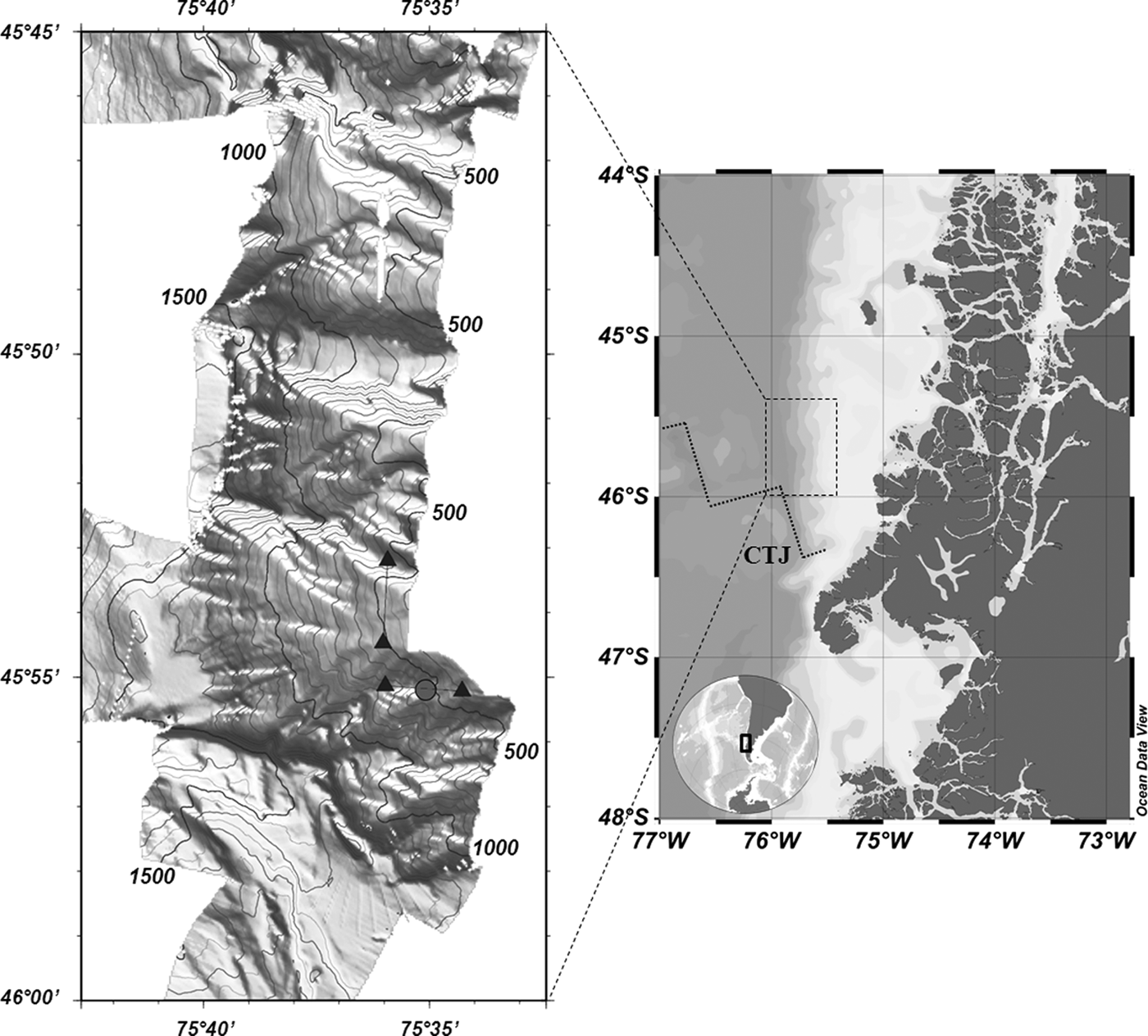
Samples were collected from the upper slope adjacent to the CTJ, in front of the Taitao Peninsula (~45°S) (Figure 1), during the INSPIRE cruise (February–March 2010) aboard the RV ‘Melville’ (MV1003, Scripps Institution of Oceanography). At this site, the presence of methane seepage was suggested by anomalously high concentrations of methane in the water column. At the sampling depths (460–700 m), temperature ranged from 7 to 5.4°C, oxygen between 3.5 to 4.7 ml l−1 and salinity was near-constant at ~34.3 psu. There was a weak oxygen minimum zone present between 180 to 350 m, with a minimum oxygen value of 1.9 ml l−1.
Map with the location of the two trawls transects at the upper slope off peninsula Taitao. The Chile Triple Junction (CTJ) is located further offshore (Ocean Data View Map; Schlitzer, Reference Schlitzer2012). The circle represents the site in which an anomalously high concentration of methane has been detected in the bottom water.
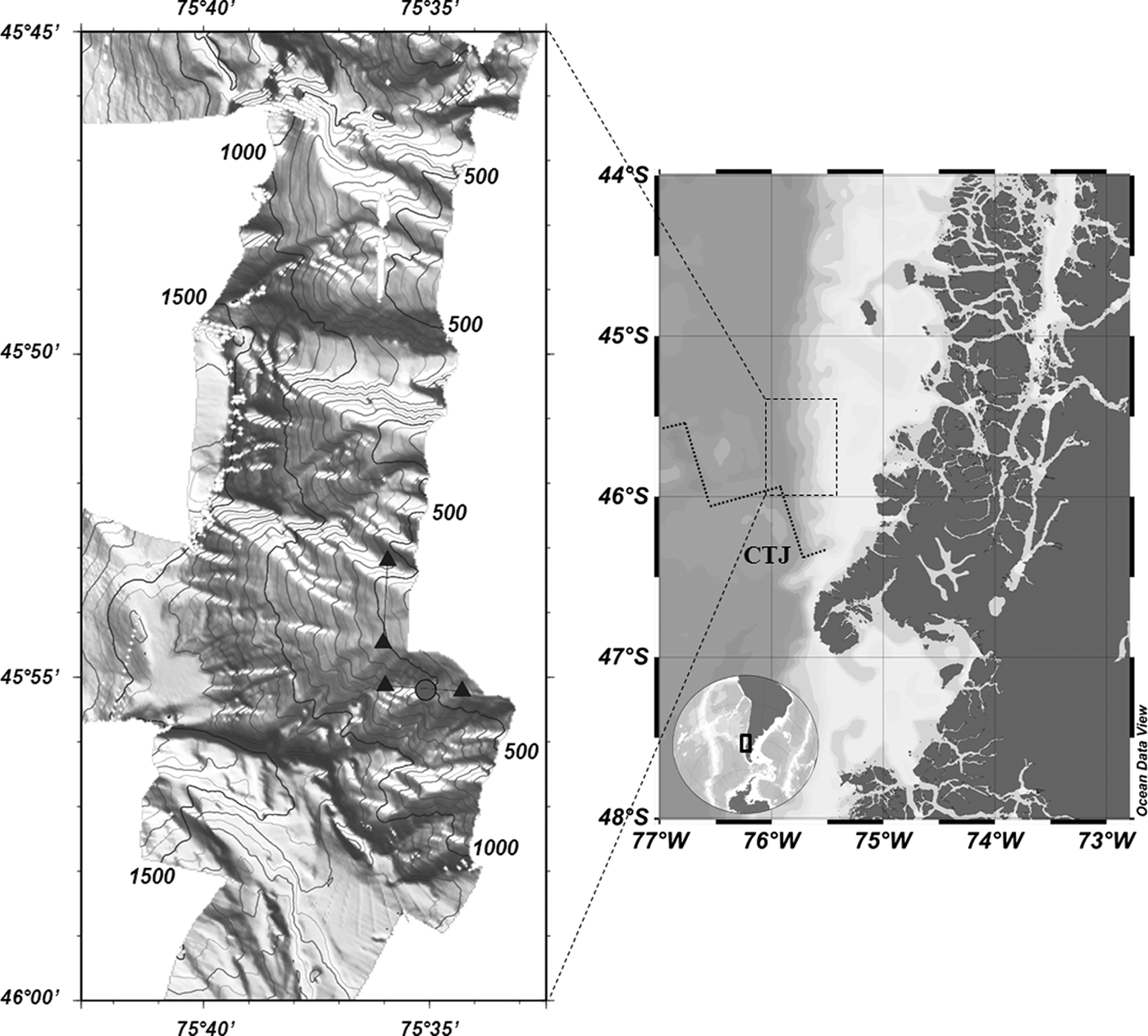
Multibeam bathymetry data were also considered for the selection of the sampling sites. An Agassiz trawl (AGT) with an opening of 1.5 × 0.5 m and a mesh of 10 × 10 mm at the cod-end was deployed twice on the upper slope (Figure 1). Unfortunately, the presence of hard bottoms, potentially associated with authigenic carbonates, precluded sediment sampling using a video-guided multi-corer (TV-MUC) on the continental slope. Samples for sedimentary organic matter (SOM) were obtained from a sediment core (0–3 cm) collected in the CTJ area (3097 m depth) and values of its isotopic composition were pooled with data previously obtained by Hebbeln et al. (Reference Hebbeln, Marchant, Freudenthal and Wefer2000), De Pol-Holz et al. (Reference De Pol-Holz, Robinson, Hebbeln, Sigman and Ulloa2009) and Sepúlveda et al. (Reference Sepúlveda, Pantoja and Hughen2011) at different depths (160–3485 m) on the continental margin between 42° and ~44°S.
Immediately after the collection by AGT, invertebrates and fish were sorted. The latter were identified to species, and the standard lengths (L S) of all individuals were taken. Appropriate amounts of tissue (~1 mg) were dissected from fish and invertebrates, washed with mili-Q water, stored in pre-combusted vials and frozen at −80°C. Voucher specimens of invertebrates and fish were preserved in seawater–formalin solution for further taxonomic study. Once in the laboratory, the samples for stable isotope analysis were dried in an oven (60°C) for 12 h. Lipids were removed from fish tissues using a solution of chloroform:methanol (2:1) (Folch et al., Reference Folch, Lees and Sloane-Stanley1957; Bligh & Dyer, Reference Bligh and Dyer1959) and agitated in a shaker for 30 min and repeated at least three times, until a clear solution (no evidence of lipids) was obtained. Then, the tissues were rinsed with mili-Q water and dried in an oven (40°C) for 12 h. The tissue samples were ground in an agate mortar to a fine powder, and ~0.5 mg was placed in pre-weighed tin capsules and stored in a desiccator.
Stable isotopes analyses
The isotopic composition was analysed at the School of Biological Sciences, Washington State University, using a Eurovector elemental analyser, coupled to a Micromass Isoprime isotope ratio mass spectrometer. Stable isotope ratios are reported in the δ notation as the deviation from standards (Pee Dee Belemnite for δ13C and atmospheric N for δ15 N), so δ13C or δ15N = [(R sampleR −1standard)–1] × 103, where R is 13C:12C or 15N:14N, respectively. Typical precision of the analyses was ± 0.5‰ for δ15N and ± 0.2‰ for δ13C.
Trophic positions
The calculation of the trophic position was performed for all consumers using the equation detailed by Vander Zanden & Rasmussen (1999):
 $${\rm TP}_{\rm consumer}=1+\lpar {\rm \delta}^{15}{\rm N}_{\rm Consumer}-{\rm \delta}^{15}{\rm N}{_{\rm SOM}}\rpar {{3.4}^{-1}}$$
where TPconsumer is the estimation of the trophic position of the consumer, δ15Nconsumer is the measured δ15N value in the consumer analysed. Due to the high isotopic variability of potential primary consumers (e.g. suspension feeders and deposit feeders), the value of the sedimentary organic matter (SOM) was used as the base signature (δ15NSOM) for calculation of trophic position, assuming that this is the main nutritional source for primary consumers at the base of the food web. The constant 1 corresponds to the level of primary sources of the food web (Iken et al., Reference Iken, Bluhm and Dunton2010). A value of 3.4‰ is assumed as the average enrichment in δ15N per trophic level (Minagawa & Wada, Reference Minagawa and Wada1984; Post, Reference Post2002).
Isotopic niche width and ontogenic trophic changes
Estimations of the corrected standard ellipse area (SEAC) for the convex hull encompassed in the δ13C–δ15N bi-plot space were performed only for those species with N > 10 samples (Jackson et al., Reference Jackson, Parnell, Inger and Bearhop2011). This metric is analogous to the total area of the convex hull (TA) proposed by Layman et al. (Reference Layman, Arrington, Montaña and Post2007), but unbiased with respect to sample size (Jackson et al., Reference Jackson, Parnell, Inger and Bearhop2011), thus providing quantitative measures of the trophic ecology from animal populations (Jackson et al., Reference Jackson, Donohue, Jackson, Britton, Harper and Grey2012). SEAC measurements were calculated using the routine SIBER (Stable Isotope Bayesian Ellipses in R) incorporated in the statistical package SIAR. Statistical analyses and SIAR calculations were performed using R 2.15.3 software (R Development Core Team, 2013).
In order to detect ontogenic changes in prey selection and the trophic position of the most abundant fish species, the banded whiptail Coelorinchus fasciatus, Pearson's correlation coefficient was used to determine the relation between the standard length (L S) and the δ13C and δ15N tissue values.
RESULTS
Faunal composition of bathyal benthos
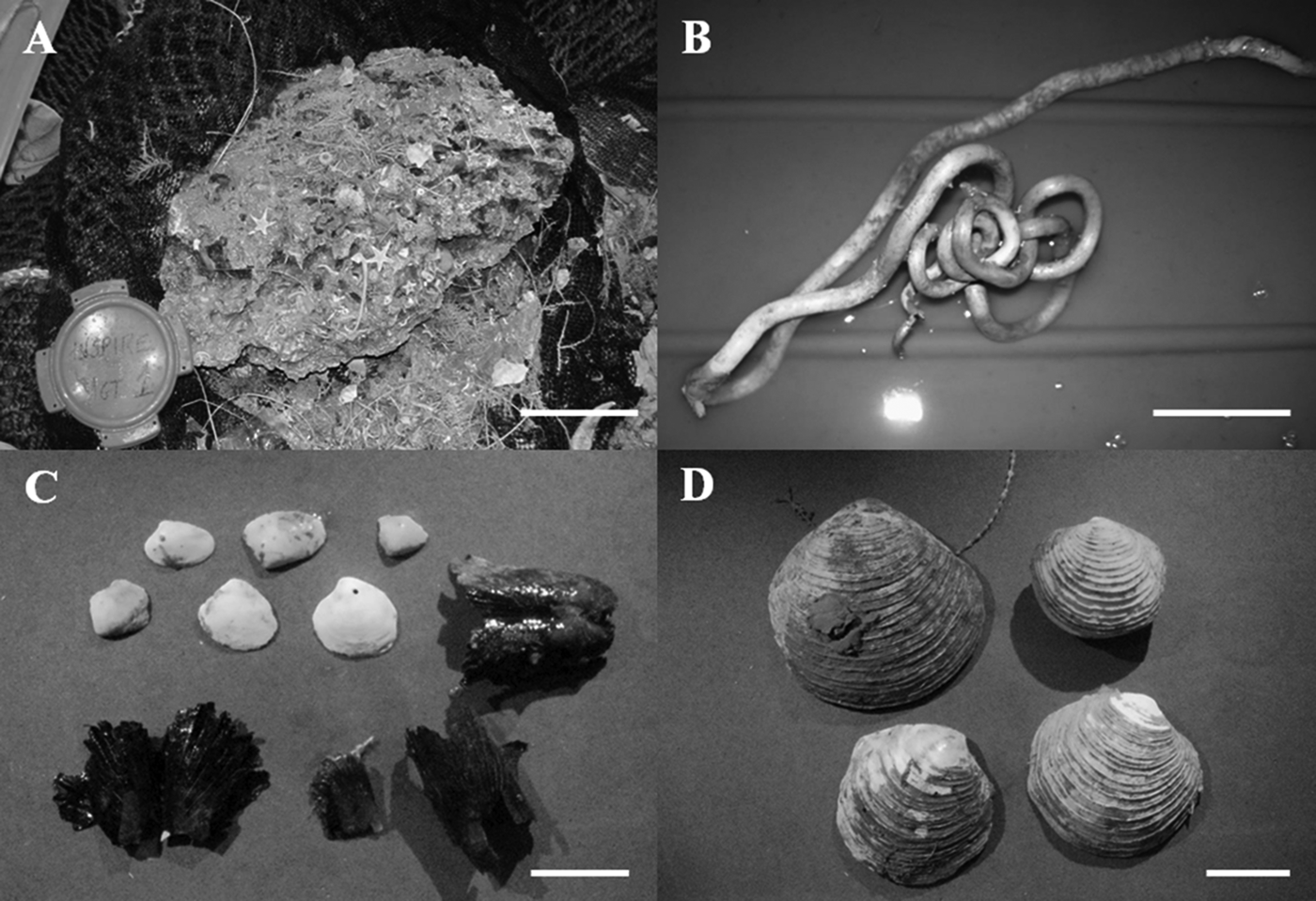
Evidence of the presence of seep communities recovered in the trawls consisted of authigenic carbonate blocks (Figure 2A), vestimentiferan tubeworms (Lamellibrachia sp., Figure 2B), as well as empty shells of vesicomyid (Calyptogena aff. gallardoi), solemyid (Acharax sp., Figure 2C), and lucinid bivalves (Lucinoma aff. metanophila, Figure 2D). In addition, a live-ingested individual of Acharax was collected from the stomach of a macrourid Coelorinchus fasciatus. On the other hand, an abundant and diverse assemblage of heterotrophic animals was collected, including 53 invertebrate taxa (i.e. sponges, cold-water corals, nemerteans, crustaceans, pycnogonids, polychaetes, sipunculids and echinoderms; Table 1) and seven species of demersal fish, all of which were analysed for stable isotope analysis (Table 1).
(A) Authigenic carbonate blocks from the upper slope off Taitao Peninsula (scale bar: 15 cm); (B) empty tube of siboglinid tubeworms Lamellibrachia sp. (scale bar: 5 cm); (C) shells of vesicomyid and solemyid bivalves (scale bar: 2 cm); (D) empty shells of lucinid bivalves (scale bar: 2 cm).

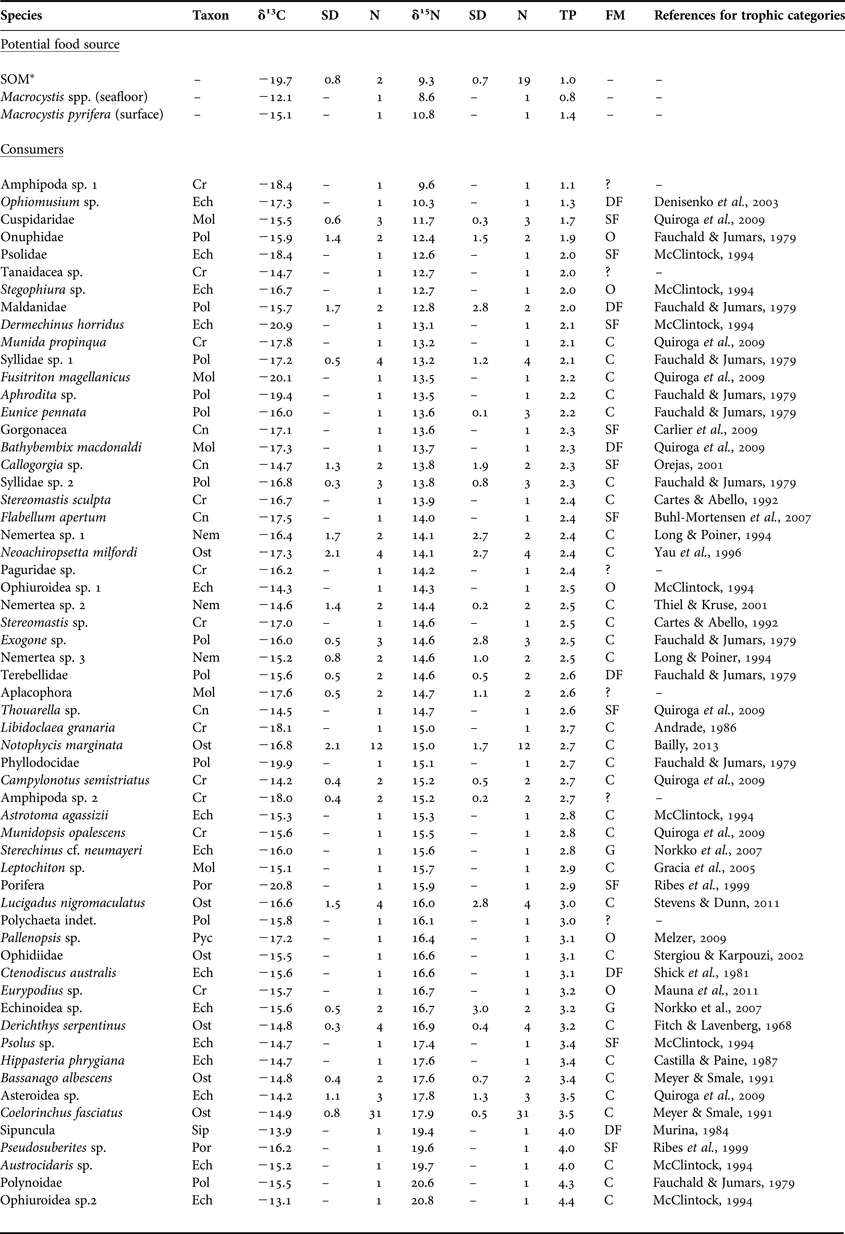
Summary of δ13C and δ15N values of the potential food sources and heterotrophic macro- and megafauna. Taxa ordered from lower to higher δ15N values, which is a proxy for trophic position (TP). Abreviatures for taxa: Cn, Cnidaria; Cr, Crustacea; Ech, Echinodermata; Mol, Mollusca; Nem, Nemertea; Ost, Osteichthyes; Pol, Polychaeta; Pyc, Pycnogonida; Sip, Sipuncula. Feeding mode (FM): DF, deposit feeder; SF, suspension feeder; G, grazer; O, omnivore; C, carnivore; ?, indeterminate feeding mode. SD, standard deviation; N, number of samples.
*, averaged values of the sedimentary organic matter (SOM) from 1 TV-MUC (this study) and the data from Hebbeln et al. (Reference Hebbeln, Marchant, Freudenthal and Wefer2000), De Pol-Holz et al. (Reference De Pol-Holz, Robinson, Hebbeln, Sigman and Ulloa2009) and Sepulveda et al. (2011) from the continental slope off Chile between 42° and ~45°S and between 160 and 3485 m.
Stable isotope composition of food sources and benthic consumers
Among the potential photosynthetic food sources analysed, the allocthonous macroalgae Macrocystis spp. collected on the sea floor and in surface waters had less depleted values for δ13C (–12.1 and –15.1‰, respectively). In contrast, the δ15N values was lower in samples collected on the seafloor (8.6‰) compared to samples collected on the sea surface (10.5‰; Table 1; Figure 3). In contrast, their δ15N values was lower in samples collected on the seafloor (8.6‰) compared to samples collected on the sea surface (10.5‰; Table 1, Figure 3). The values obtained for sedimentary organic matter (SOM) were the most 13C-depleted (mean δ13C ±SD = –19.7 ±0.8‰) and intermediate for δ15N values (mean ±SD = 9.3 ±0.7‰) (Table 1, Figure 3). The solemyid bivalve Acharax sp., found in the stomach of an individual of C. fasciatus, registered the lowest δ13C and δ15N values (–31.6‰ and 3.4‰, respectively; Table 1, Figure 3).
Plot of δ13C and δ15N of potential food sources and invertebrate macro- and megafauna and the fish species collected in the upper slope off peninsula Taitao. SOM, sedimentary organic matter.
The invertebrate megafauna had a narrow δ13C range (7.8‰), with the cactus urchin Dermechinus horridus having the most 13C-depleted values (–20.9‰) and Ophiuroidea sp. 2 the least 13C-depleted values (–13.1‰) (Table 1; Figure 3). Among the fish fauna, the finless flounder Neoachiropsetta milfordi had the most negative δ13C value (–17.3 ±1.1‰), while the narrow necked oceanic eel Derichthys serpentinus and the hairy conger Bassanago albescens had the least 13C-depleted values (–14.8 ±0.3‰; Table 1). The dwarf codling Notophycys marginata had the widest overall carbon isotopic niche due to a wide variation of δ13C values (range = 8.9‰) (Figure 3).
The range of δ15N values was slightly higher (11.2‰) than that reported for δ13C, with Amphipoda sp.1 having less 15N-enriched values (9.6‰) and Ophiuroidea sp. 2 more 15N-enriched values (20.8‰) (Table 1, Figure 3). Among the δ15N values for the fish fauna, the flatfish N. milfordi had the most 15N-depleted values (14.1 ±1.4‰) and the banded whiptail C. fasciatus the most 15N-enriched values (17.9 ±0.1‰; Table 1). Despite this, N. milfordi showed the wider intraspecific variation of δ15N values (range = 6.5‰), followed by N. marginata (5.9‰) and the blackspotted grenadier L. nigromaculatus (5.8‰).
Trophic positions of benthic consumers
The primary consumers (trophic position 2), including 37 taxa, were represented mainly by crustaceans (i.e. peracarids and decapods), polychaetes (e.g. polynoid, syllid and eunicid), and echinoderms (i.e. echinoid, ophiuroid and holothuroid), and to a lesser extent by molluscs (e.g. gastropods, bivalves, aplacophora and polyplacophora), cnidarians (only cold-water corals), nemerteans, sponges and fish (Table 1).
The secondary consumers (trophic position 3) included 13 taxa represented mainly by echinoderms (i.e. asteroids, echinoids, holothuroids), fishes (i.e. L. nigromaculatus, Ophidiidae, D. serpentinus, Bassanago albescens and Coelorinchus fasciatus) and some crustaceans, pycnogonid and polychaetes (Table 1).
Only five invertebrate taxa (i.e. sipuncula, the sponge Pseudosuberites sp., the echinoid Austrocidaris sp., the polychaete Polynoidae sp. and a brittle star Ophiuroidea sp. 2) were categorized into even higher trophic positions (trophic level 4) than those estimated for fish (Table 1).
Isotopic niche width of fish
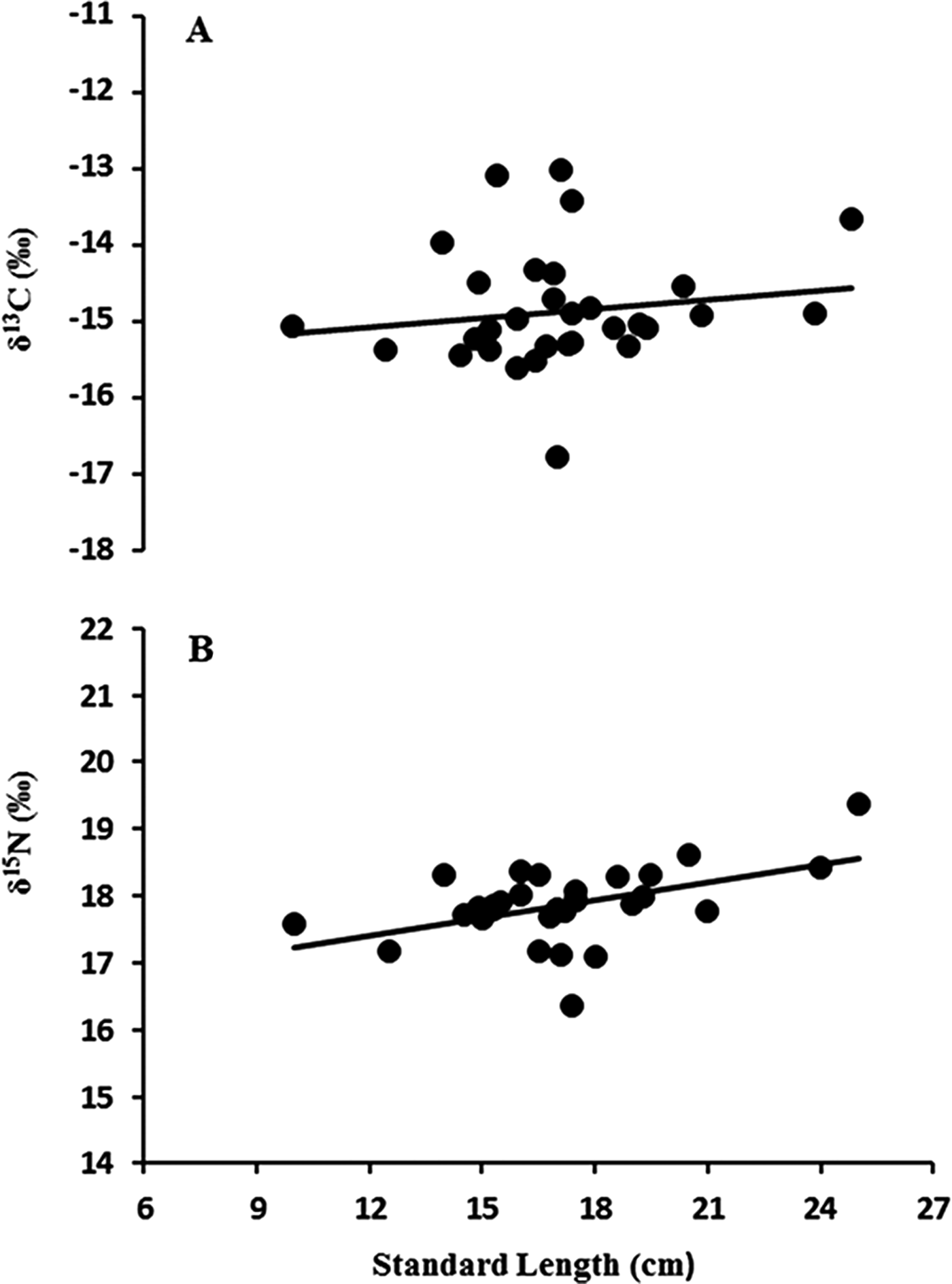
Sample availability (N ≥ 10) allowed the estimations of isotopic niche width, through the calculations of the corrected standard ellipses area (SEAC), for only two fish species (C. fasciatus and N. marginata). Results indicated that C. fasciatus possessed a narrower isotopic niche width (SEAc = 1.1‰), than N. marginata (SEAC = 5.1‰, Figure 4). No overlap was observed between the ellipses of the two fish species, reflecting distinct diets (Figure 4). No correlation between the standard length (L S) and the δ13C (r 2 = 0.02, df = 29, P > 0.05) or δ15N values (r 2 = 0.23, df = 29, P > 0.05; Figure 5) was detected in C. fasciatus population.
Convex hulls (polygons) and corrected standard ellipses areas (SEAC) in the δ13C–δ15N bi-plot space for two fish species analysed at upper slope area: Coelorinchus fasciatus (grey ellipse) and Notophycis marginata (black ellipse).
Regressions between standard length (LS) and δ13C (A) and δ15N (B) for Coelorinchus fasciatus. The curves were fitted to: (A) y = 0.039x − 15.54 (r2 = 0.022) and (B) y = 0.088x + 16.35 (r2 = 0.233).
DISCUSSION
The presence of massive methane deposits (i.e. in the form of gas hydrates indicated by bottom simulating reflectors) along the Chilean continental margin (35°–45°S) was documented almost two decades ago (Brown et al., Reference Brown, Bangs, Froelich and Kvenvolden1996; Morales, Reference Morales2003). Previous studies in the Chile Triple Junction (CTJ) have confirmed presence of the methane throughout the continental slope, with extremely low δ13C values (−86 to −61‰), suggesting a biogenic origin (Waseda & Didyk, Reference Waseda, Didyk, Lewis, Behrmann, Musgrave and Cande1995). Chemosymbiotic fauna associated with methane seeps often depicts low δ13C isotopic values in their tissues. In our study, only empty shells and tubes of seep fauna were directly collected, but a freshly ingested specimen of the solemyid Acharax sp. was found in one fish stomach. As expected for this group, which is known to be a facultative heterotrophic feeder that also has symbiotic sulphide-oxidizing bacteria (Barry et al., Reference Barry, Buck, Goffredi and Hashimoto2000), this specimen exhibited a low δ13C value (–31.6‰), similar to values reported for other congeners from other chemosynthetic environments (e.g. Gulf of Alaska–Sea of Okhotsk, Sahling et al., Reference Sahling, Galkin, Salyuk, Greinert, Foerstel, Piepenburg and Suess2003, Unimak Margin, Levin & Mendoza, Reference Levin and Mendoza2007; Gulf of Cadiz, Rodrigues et al., Reference Rodrigues, Hilário and Cunha2012).
Several studies, conducted to date at methane seeps from different regions reveal benthic food webs supported largely by chemosynthetic production, where the tissues of heterotrophic organism typically have highly negative δ13C values (<−50 to −21‰; summarized in Levin & Michener, Reference Levin and Michener2002), in contrast to species dependent on phytoplankton-derived organic matter (δ13C = −25 to −15‰; Fry & Sherr, Reference Fry and Sherr1984). Some examples of these chemosynthetic-based methane seeps have been documented for the Oregon margin, Eel River margin and Gulf of Alaska (Levin & Michener, Reference Levin and Michener2002), Blake Ridge (Van Dover et al., Reference Van Dover, Aharon, Bernhard, Caylor, Doerries, Flickinger, Gilhooly, Goffredi, Knick, Macko, Rapoport, Raulfs, Ruppel, Salerno, Seitz, Sen Gupta, Shank, Turnipseed and Vrijenhoek2003), Aleutian Islands (Levin & Mendoza, Reference Levin and Mendoza2007), Gulf of Mexico (Levin & Mendoza, Reference Levin and Mendoza2007, Demopoulos et al., Reference Demopoulos, Gualtieri and Kovacs2010), Hikurangi margin, New Zealand (Thurber et al., Reference Thurber, Kröger, Neira, Wiklund and Levin2010), eastern Mediterranean Sea (Carlier et al., Reference Carlier, Ritt, Rodrigues, Sarrazin, Olu, Grall and Clavier2010), Norwegian margin (Decker & Olu, 2012) and Chilean margin off Concepción (Zapata-Hernández et al., Reference Zapata-Hernández, Sellanes, Thurber, Levin, Chazalon and Linke2013). However, for this study the C isotopic values of most of the heterotrophic species were within the typical range of organisms that depend on C fixed by photosynthesis (>−25‰) and similar to that reported by Sellanes et al. (Reference Sellanes, Quiroga and Neira2008) and Zapata-Hernández et al. (Reference Zapata-Hernández, Sellanes, Thurber, Levin, Chazalon and Linke2013) in some megafaunal taxa from the Concepción Methane Seep Area (CMSA).
On the other hand, it is recognized that the different biogeochemistry of multiple local microhabitats (e.g. clams bed, siboglinids fields and microbial mats) leads to heterogenic isotopic signatures in the fauna (Bernardino et al., Reference Bernardino, Levin, Thurber and Smith2012). In this sense, the absence of a signature derived from chemosynthetic carbon (δ13C = < −25‰), could also be an effect of the lack of selectivity of the benthic trawl, which samples mobile fauna that feed and dwell in areas comprising both seep and non-seep slope habitats. Therefore, other devices (e.g. ROVs, TV-MUCs and TV-Grabs) that allow selective sampling of carbonate rocks and distinctive biogenic features at seeps could provide samples from specific microhabitats, in which the incorporation of chemosynthetic production could be substantial among the heterotrophic benthic fauna.
In contrast with typical bathyal communities further north, whose structure is mainly controlled by the south-east Pacific permanent oxygen minimum zone (Sellanes et al., Reference Sellanes, Neira, Quiroga and Teixido2010), the normoxic conditions at the study area, associated with the presence of the well-oxygenated Antarctic Intermediate Waters (AAIW) covering the continental slope (~400–1200 m depth; Quiroga & Levin, Reference Quiroga and Levin2010), could largely explain the diverse assemblage of heterotrophic fauna observed. Furthermore, the presence of carbonate blocks and habitat-forming taxa (e.g. chemosymbiotic clams, tubeworms, sponges and cold-water corals) could also be facilitating colonization by several organisms (Cordes et al., Reference Cordes, Cunha, Galéron, Mora, Olu-Le Roy, Sibuet, Van Gaever, Vanreusel and Levin2010) from different trophic levels, which could be using these sites for settlement, food, refuge and nursery (Sellanes et al., Reference Sellanes, Neira, Quiroga and Teixido2010; Treude et al., Reference Treude, Kiel, Linke, Peckmann and Goe dert2011), increasing the biodiversity in the area and generating more complex trophic interactions over time (Zapata-Hernandez et al., Reference Zapata-Hernández, Sellanes, Thurber, Levin, Chazalon and Linke2013).
Cold-water corals form important habitats for many species in the deep sea (Buhl-Mortensen et al., Reference Buhl-Mortensen, Vanreusel, Gooday, Levin, Priede, Buhl-Mortensen, Gheerardyn, King and Raes2010). In the south-eastern Pacific numerous cold-water coral reefs have been detected in southern Chile fjords (Jantzen et al., Reference Jantzen, Laudien, Sokol, Forsterra, Haussermann, Kupprat and Richter2013), on the continental slope (Sellanes et al., Reference Sellanes, Quiroga and Neira2008, Reference Sellanes, Neira, Quiroga and Teixido2010) and on seamounts (Cañete & Haüssermann, Reference Cañete and Haüssermann2012 and references therein). Some coral species associated with methane seeps have previously been reported for the CMSA at central Chile (Sellanes et al., Reference Sellanes, Quiroga and Neira2008, Zapata-Hernandez et al., Reference Zapata-Hernández, Sellanes, Thurber, Levin, Chazalon and Linke2013). These studies have found no trophic relationship between the corals and the chemosynthetic production, but corals seem to benefit from the presence of a hard substrate (pavements of carbonate) generated through the anaerobic oxidation of methane (AOM) (Sibuet & Vangriesheim, Reference Sibuet and Vangriesheim2009). As at the CMSA, the cold-water corals at the seep site off Taitao Peninsula (e.g. Gorgonacea, Callogorgia sp. and Flabellum apertum) were classified as primary consumers, consistent with suspension feeder feeding mode, possibly consuming the sinking particulate organic matter (Carlier et al., Reference Carlier, Le Guilloux, Olu, Sarrazin, Mastrototaro, Taviani and Clavier2009 and references therein).
Among the crustacean taxa, the galatheids Munida propinqua and Munidopsis opalescens were positioned as primary consumers. It has been reported that galatheid species show a wide spectrum of feeding modes; they can be detritivores, suspension feeders, carnivores, scavengers and cannibals (Romero et al., Reference Romero, Lovrich, Tapella and Thatje2004; Vinuesa & Varisco, Reference Vinuesa and Varisco2007). In some deep-water environments off central Chile (i.e. methane seeps and seamounts), the galatheid crabs are typically found associated with the branches of cold-water corals (e.g. Callogorgia sp.), using them as substrate (Cañete & Haüssermann, Reference Cañete and Haüssermann2012). Therefore, it is feasible that both species could be feeding on particulate organic matter (POM), using corals as a perch to capture their food at higher positions in the water column, or they may feed directly on the tissues of these organisms (Macpherson & Segonzac, Reference Macpherson and Segonzac2005) and gain protection from the strong bottom currents and predators (Etnoyer & Morgan, Reference Etnoyer, Morgan, Freiwald and Roberts2005).
To date, the majority of deep-water polyplacophorans reported for Chile have been found associated with hard substrates (authigenic carbonates) near methane seeps (Schwabe & Sellanes, Reference Schwabe and Sellanes2010), but their trophic ecology has not been properly studied. In general littoral chitons are considered as grazers, but they nevertheless display a high trophic versatility, including detritivorous, carnivorous, herbivorous and omnivorous lifestyles (Latyshev et al., Reference Latyshev, Khardin, Kasyanov and Ivanova2004), as well as feeding on decaying wood (Sirenko, Reference Sirenko2001). In the present study, the polyplacophoran Leptochiton sp. has an intermediate trophic position (TP = 2.9), suggesting a detritivorous or omnivorous feeding mode, in which they obtain their food from the hard substrate where are confined (i.e. authigenic carbonates) (Lyons & Moretzsohn, Reference Lyons, Moretzsohn, Felder and Camp2009).
The echinoderms, including several taxonomic classes, were positioned in all the trophic levels estimated in this study, suggesting an important role in the transfer of energy within the benthic food web. The wide variability in the δ15N values and trophic position of ophiuroids probably corresponds to the broad range of feeding strategies of this group, which include suspension-feeding, deposit-feeding, scavenging and predation (Stöhr et al., Reference Stöhr, O'Hara and Thuy2012); similar variability was also detected in the echinoid taxa. However, the asteroid species were all positioned at higher trophic levels, highlighting their important role as predators in benthic ecosystem.
In general, fish were positioned in the third level of the food web. There are records of some species of shark, hake, and conger off the Taitao Peninsula (>500 m) (Sielfeld & Vargas, Reference Sielfeld and Vargas1999 and references therein), also including the Patagonian toothfish Dissostichus eleginoides, which has been observed further north at seep sites off Concepción (Sellanes et al., Reference Sellanes, Pedraza-García and Zapata-Hernández2012). These species were not captured during the present study, probably because of the insufficient sampling effort and the type of gear used, or because of their relative scarcity in the area. Therefore, a greater sampling effort in the area would help to better understand the role of the fish assemblage in the food web of this bathyal environment.
The large isotopic niche width estimated for N. marginata indicates that it is probably a generalist consumer, despite the limited number of samples obtained. Additional samples could increase the isotopic niche width, reaffirming our hypothesis. However, the high variability within a population is a typical feature of some predators, due to a high degree of intraspecific competition (Quevedo et al., Reference Quevedo, Svanback and Eklov2009). Moreover, ontogenic differences (e.g. Taylor & Mazumder, Reference Taylor and Mazumder2010), sex (Bolnick et al., Reference Bolnick, Svanbäck, Fordyce, Yang, Davis, Hulsey and Forister2003), nutritional conditions (Bearhop et al., Reference Bearhop, Adams, Waldron, Fuller and Macleod2004), and/or the variability of prey availability in the environment (Frédérich et al., Reference Frédérich, Fabri, Lepoint, Vandewalle and Parmentier2009) affect the trophic niche of animal populations. In contrast, our results suggest that C. fasciatus has an extremely narrow isotopic niche width which, together with an absence of ontogenic change in carbon source and trophic position, indicates that this species is likely a trophic specialist throughout most of its life. This type of trophic behaviour could be the result of a trophic niche separation driven by a strong evolutionary pressure associated with competition for food (Iken et al., Reference Iken, Brey, Wand, Voigt and Junghans2001), or be associated with the abundance of a particular prey in their environment (Gartner et al., Reference Gartner, Crabtree, Sulak, Randall and Farrell1997).
Finally, it is also important to note that our knowledge concerning the biological and ecological history of bathyal species is quite limited and restricted to taxonomic lists or records of by-catch of specific fisheries. Therefore, future studies in the trophic ecology field should consider the incorporation of fatty acids analysis, molecular sequencing of the stomach contents and the analysis of sulphur stable isotopes. Given increasing pressures on continental margins from human activities (Levin & Sibuet, Reference Levin and Sibuet2012), such studies, together with the characterization of these ecosystems in terms of micro-habitats, biodiversity levels, community structure, trophic guilds and ecological interactions, will provide a basis for the proper sustainable management of the suite of benthic environments present along and across the vast Chilean continental margin.
ACKNOWLEDGEMENTS
We thank the captain and crew of RV ‘Melville’, as well as the remaining scientific party, for support at sea during INSPIRE cruise. Thanks also to F. Chazalon, who helped with the translation of the first draft of this manuscript.
FINANCIAL SUPPORT
Ship time was funded by Scripps Institution of Oceanography, and participation of GZ-H and other Chilean researchers in the INSPIRE cruise was funded in part by a grant of the programme COMARGE and ChEss of the Census of Marine Life. The Centre for Oceanographic Research in the eastern South Pacific (COPAS) provided partial support to J.S. during the writing phase of the manuscript. This work was funded by FONDECYT project No. 1100166 to J.S., NOAA/OE grant NA08OAR4600757 and University of California Ship Funds and partial funding during the writing phase was also provided by FONDECYT No. 1120469.