Implications
In concurrently pregnant and lactating does the energy and nutrients supply to the foetuses is often limited and equal to some form of maternal undernutrition. At the same time, developmental programming experiments in other mammals have shown that gestational maternal undernutrition has the potential to impair growth and body composition of the offsprings. The present study shows that maternal feed restriction during pregnancy in rabbit does not affect performance or meat quality of the offsprings. However, increased mortality rates peripartum and at weaning are expected when mothers are undernourished during mid gestation.
Introduction
Modern rabbit breeding is based on a circular production system and the does are being inseminated every 35 or 42 days. In such a system, the females are always either gestating, suckling or both gestating and suckling at the same time. These two physiological functions, especially lactation, are very costly in terms of energy (Fortun-Lamothe, Reference Fortun-Lamothe2006). A lactating doe suffers from a negative energy balance and considerable mobilisation of body fat, because feed intake cannot cover the requirements for both maintenance and milk production, even though feed intake increases rapidly after kindling (Parigi-Bini et al., Reference Parigi-Bini, Xiccato and Cinetto1990). This energy deficit increases when females are concurrently pregnant and lactating (Parigi-Bini et al., Reference Parigi-Bini, Xiccato, Cinetto and Dalle-zotte1992). In fact, lactation could have a detrimental effect on foetal growth (Fortun-Lamothe et al., Reference Fortun-Lamothe, Prunier, Bolet and Lebas1999).
The adverse effects of lactation on foetal growth can be partially simulated by the restricted feeding of the does during gestation (Fortun-Lamothe and Prunier, Reference Fortun-Lamothe and Prunier1999). Variation in the nutrient supply during foetal life and especially maternal undernutrition has been highlighted as a dominant cause of developmental programming. This concept implies that a stimulus or insult acting during critical periods of growth and development may result in developmental adaptations that permanently change the structure, physiology and metabolism of the offspring (Barker, Reference Barker1995). Maternal undernutrition may impact upon offsprings’ growth efficiency and body composition (Greenwood et al., Reference Greenwood, Hunt, Hermanson and Bell2000; Caton et al., Reference Caton, Reed, Aitken, Milne, Borowicz, Reynolds, Redmer and Wallace2009) and is crucial for both skeletal muscle (Greenwood et al., Reference Greenwood, Hunt, Hermanson and Bell2000) and adipose tissue development (Taylor and Poston, Reference Taylor and Poston2007).
With regard to farm animals, the effects of maternal undernutrition during gestation on performance and/or body composition of the offsprings has been extensively studied in sheep (Krausgrill et al., Reference Krausgrill, Tulloh, Shorthose and Sharpe1999; Fahey et al., Reference Fahey, Brameld, Parr and Buttery2005; Zhu et al., Reference Zhu, Ford, Means, Hess, Nathanielsz and Du2006; Daniel et al., Reference Daniel, Brameld, Craigon, Scollan and Buttery2007), pigs (Bee, Reference Bee2004; Gondret et al., Reference Gondret, Lefaucheur, Louveau and Lebret2005; Rehfeldt and Kuhn, Reference Rehfeldt and Kuhn2006) and cattle (Long et al., Reference Long, Prado-Cooper, Krehbiel, DeSilva and Wettermann2010; Robinson et al., Reference Robinson, Cafe and Greenwood2013). In rabbits, feed restriction in late pregnancy may alter mortality rate and birth-to-weaning weights (Nafeaa et al., Reference Nafeaa, Ahmed and Hallah2011), although the timing of feed restriction is likely important for reproductive performance (Manal et al., Reference Manal, Tony and Ezzo2010). Simultaneous gestation and lactation alters the development of muscle fibres in the 29-day-old rabbit offspring; however, this effect is transient and no differences in muscle features have been demonstrated at commercial slaughter age of 70 days (Gondret et al., Reference Gondret, Fortun-Lamothe and Bonneau1997). Previous research from our team has shown that a 50% maternal feed restriction during gestation compared with a daily feed allowance of 100% of maintenance requirements had no effect on performance and meat quality characteristics in does’ offsprings (Symeon et al., Reference Symeon, Goliomytis, Bizelis, Papadomichelakis, Pagonopoulou, Abas, Deligeorgis and Chadio2015). However, no other published studies on effects of maternal feed restriction on performance and meat quality traits of offsprings in rabbits are available in the literature. The purpose of the present study was to further evaluate the effects of maternal undernutrition in comparison with ad libitum feed consumption and not to maintenance requirements. Therefore, we applied a 75% feed restriction regime on rabbit does, during the mid 2/3 (7th to 26th days) of gestation in order to investigate the undernutrition effect on growth and meat quality of the offsprings.
Material and methods
Animal management and experimental design
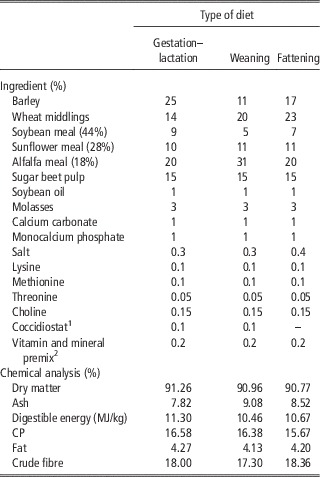
A total of 26 Hyla Nouvelle Generation primiparous non lactating does (Oryctolagus cuniculus), 7 months old, were purchased from a local breeding farm right after weaning of their first litter. The does were individually caged indoors (40×100×39 cm) with a 16-h light : 8-h dark light schedule, which is the common practice in commercially raised does. The air temperature in the experimental house ranged from 12±4.7°C to 19.3±5.2°C. The does were allowed to adapt to experimental environment for 3 days before insemination. They were artificially inseminated with sperm from Hylamax bucks and they were then induced to ovulate by intramuscular injection of 10 mg of synthetic GnRH (Buserelin, Receptal; MSD Animal Health, Milton Keynes, UK). The does were randomly allocated to two equally numbered treatment groups: the Control group (C, n=13), fed ad libitum throughout the experimental period and the feed restricted group (R, n=13) fed at 75% of energy maintenance requirements between the 7th and the 26th day of pregnancy. Day 0 was considered the day of artificial insemination. For the remaining experimental period R does were fed ad libitum. Does were fed a commercial gestation–lactation pelleted diet until the 25th day of lactation and thereafter they were fed a commercial weaning diet (Viozokat, Katerini, Greece). Composition and calculated analysis of the experimental diets are presented in Table 1. All does had free access to drinking water. Daily feed allowance for the R group was calculated individually for each doe by taking into consideration the initial BW at the beginning of the experiment, the energy requirements of 430 kJ/kg BW0.75 per day (Xiccato and Trocino, Reference Xiccato and Trocino2010) and the digestible energy content of the provided feed.
Ingredients and calculated chemical analysis of the diets

1 Robenidine 66 mg/kg of diet.
2 The vitamin and mineral premix supplied per kilogram of diet: vitamin A, 12.500 IU; vitamin D3, 2.000 ΙU; vitamin Ε, 75 mg; vitamin Κ3, 3 mg; vitamin Β1, 2 mg; vitamin Β2, 6 mg; vitamin Β6, 3 mg; vitamin Β12, 20 mcg; nicotinic acid, 60 mg; pantothenic acid, 15 mg; folic acid, 1.50 mg; biotin, 250 mcg; Zn, 90 mg; Mn, 80 mg; Fe, 80 mg; Cu, 15 mg; I, 1.50 mg; Co, 1 mg; Se, 0.10 mg.
At the 10th and 13th day of gestation all does were palpated for pregnancy check and one non pregnant doe from group R was excluded from the experiment. Parturition took place after 30.96±0.12 days of gestation. At the second day after kindling litter sizes were standardised at nine kits per doe by cross fostering within treatment groups except from two does from the R group, one doe with a litter size of two living kits and one doe with a litter size of nine stillborn kits, that were excluded from further measurements.
Weaning took place at the 35th day of kits’ age. In all, 72 rabbits/treatment (36 male and 36 female) were randomly selected and were reared indoors in individual cages until the 72nd day of age. The light schedule consisted of 12-h light and 12-h dark and air temperature ranged from 20.3±2.3°C to 29.2±2°C throughout the fattening period. All rabbits received a commercial weaning diet until the 49th day of age and thereafter they were transferred to a fattening diet (Viozoiki; Table 1). Feed and water was provided for ad libitum consumption. At the 72nd day of age, 24 rabbits/treatment group (12 male and 12 female) were randomly selected, electrically stunned and were then slaughtered for meat quality assessment.
The methods used in the present experiment have been approved by the Research Ethics Committee of the Department of Animal Science and Aquaculture of the Agricultural University of Athens.
Measurements
BWs, feed intake and litter parameters
At days 0, 10, 17, 24, 27 of gestation and at parturition the does were individually weighed. Feed intake was recorded individually on a daily basis. Litter weight and size (alive and stillborn kits) as well as the individual weight of the kits were recorded at parturition, at 14th day of kits’ age and at weaning (35th day of age). Fattening rabbits were then weighed and feed intake was recorded weekly until slaughter. Feed conversion ratio (g feed per g BW) was calculated from weaning until slaughter.
Carcass and meat quality
At slaughter, BW and cold carcass weights as well as dressing percentage and liver and perirenal fat weights were recorded. After 24 h of slaughter meat quality was assessed in dissected longissimus lumborum (LL) muscle. The pH 24 h postmortem (pH24) was measured at the level of the fourth lumbar vertebra of left side using a Sentron 1001 pH system model (Sentron, Roden, the Netherlands), with the electrode inserted into the muscle. Meat colour was measured at the sixth lumbar vertebra section of the LL muscle on the internal surface of the muscle using a Miniscan XE chromameter (Hunterlab, Reston, VA, USA) set on the L*, a*, b* system (L*=lightness, a*=redness, b*=yellowness). Percentage of released water (PRW) was studied in a sample of meat of the seventh lumbar vertebra. A sample of intact meat weighing 300±5 mg was placed between two disks of Whatman No. 1 filter paper. The papers with the meat were placed between two Plexiglas plates and a load of 2.25 kg was applied for 5 min. The PRW was calculated as the ratio of the percentage of weight of released water to intact meat (Hernández et al., Reference Hernández, Aliaga, Pla and Blasco2004). Intramuscular fat (IMF) was measured using a chloroform (Carlo Erba Reactifs–SDS, Val De Reuil, France): methanol (Merck, Darmstadt, Germany) 2 : 1 (v : v) solution and a cold extraction procedure according to the method of Folch et al. (Reference Folch, Lees and Sloane Stanley1957).
For cooking loss and shear values measurements, the right loin of each carcass was weighed, placed in plastic bag, cooked in a water bath at 80°C for 1 h, left under tap water for 15 min, and then left to cool in room temperature (Combes et al., Reference Combes, Lepetit, Darche and Lebas2003). Cooking loss was estimated as the percentage of the weight of the cooked samples with respect to the raw ones. Warner–Bratzler (WB) measurements were carried out on cooked samples according to the procedure described by Ramírez et al. (Reference Ramírez, Oliver, Pla, Guerrero, Arino, Blasco, Pascual and Gil2004). The samples for WB test were obtained by cutting two parallelepipeds of 1×1 cm of cross section (1 cm2), and 2 cm-length along muscle fibre axis. They were completely cut using a WB shear blade with a triangular slot cutting edge with the blade travelling at 100 mm/min to the sample (Combes et al., Reference Combes, Lepetit, Darche and Lebas2003). Peak force values (N) were recorded.
Statistical analyses
Data were analysed using the SAS statistical software (SAS Institute Inc., 2005). The doe’s BW, feed intake, gestation length, litter size, litter weight and kit birth weight were analysed using a mixed model with treatment as a fixed factor. For litter weight analysis, litter size was also included in the model as a covariate. The percentage of stillborn kits has been analysed using the Genmod procedure with binomial distribution and identity link function. The BW, feed intake, carcass weights and meat quality measurements of the offsprings were analysed using a mixed model with treatment, sex and their interaction as fixed factors as well as the doe as a random factor. The effect of the offsprings’ sex was not significant and was therefore excluded from the models except from that of perirenal fat. Significance level was set at 0.05. All results are presented as least square means and SEM.
Results and discussion
BW, feed intake, kindling and weaning performance of the does
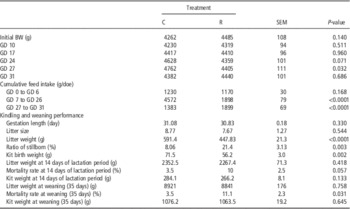
Results on does’ BWs throughout the gestation period are presented in Table 2. No differences between does of C and R groups were detected except from the 27th day of gestation when does from the R group were lighter than those from the C group (P<0.05) as a result of the 20-day feed restriction. However, at the final day of gestation (day 31), after 4 days of ad libitum feed consumption for the R group, the BW difference between groups had been eliminated (P>0.05). Does of group R gained weight due to the rapid increase in feed consumption from the end of the malnutrition period at day 26 until parturition at day 31 (Table 2). The feed restricted does consumed in 5 days the amount of feed (1899 g) that they consumed in the previous 20 days of the feed restriction period (1898 g) in order to compensate for the former nutrient intake deficiency. Feed intake for the feed restricted does was lower in the feed restriction period compared with C group does and the reverse was observed from the 27th to the 31st day of gestation (P<0.05).
Effect of gestational feed restriction on BW (g), cumulative feed intake (g/doe), kindling and weaning performance of does

C=does fed ad libitum (n=13); R=does restricted fed to 75% of maintenance energy requirements from day 7 to day 26 of gestation (n=12, except from measurements taken at 14 and 35 days of lactation period where n=10); GD=gestation day.
Kindling and weaning performance are presented in Table 2. Gestation length was not affected by undernutrition of the does (P>0.05). Maternal feed restriction during gestation had an adverse effect (P<0.05) on ratio of stillborn kits, 8.1±2.5% v. 21.4±3.8% in C and R groups, respectively. In addition, mortality rate until weaning was greater in the R group than in C group (P<0.05). In contrast to results of the present study Manal et al. (Reference Manal, Tony and Ezzo2010) reported a higher ratio of stillborn kits in ad libitum fed group of does in comparison with does that were feed restricted at 1.32 times maintenance requirements during the first 10, 15 or 20 days of pregnancy. However, they attributed this detrimental effect of feeding to appetite on reduced feed consumption of does of the control group during the last third of pregnancy, which negatively affected kit survival. More recently, Martinez-Paredes et al. (Reference Martinez-Paredes, Rodenas, Martınez-Vallespın, Cervera, Blas, Brecchia, Boiti and Pascual2012) found that ad libitum feeding programmes have led to a higher toxaemia of females, thus increasing mortality of both females and new-born rabbit kits peripartum. However, results of the present study are not directly comparable with those reported by Martinez-Paredes et al. (Reference Martinez-Paredes, Rodenas, Martınez-Vallespın, Cervera, Blas, Brecchia, Boiti and Pascual2012) because of their different experimental design, which included different feeding strategies during rearing of nulliparous does.
Litter weight at parturition was negatively affected by the gestational maternal undernutrition (591.4±20.9 v. 447.8±21.7 g, for the C and R group, respectively, P<0.05). This difference is attributed solely to the reduced kit birth weight in the R group (56.2±3.4 v. 71.5±2.5 g in the R and C group, respectively, P<0.05), since litter size was not affected by the gestational undernutrition of the does (P>0.05). However, maternal undernutrition had no effect on litter weight and weight of kits either at the 14th day of lactation or at weaning (P>0.05). This elimination of birth differences throughout lactation may be attributed to compensatory growth of kits from the R group. Moreover, taking into consideration that fattening rabbits spend half of their life with their mothers the main factors affecting their growth are litter size and birth weight. However, homogenisation of litter sizes, as practiced in the present experiment, can markedly reduce the negative effect of low birth weight on postnatal growth (Poigner et al., Reference Poigner, Szendro, Levai, Radnai and Biro-Nemeth2000). In close agreement with results of the present study Fortun et al. (Reference Fortun, Prunier, Etienne and Lebas1994) and Cappon et al. (Reference Cappon, Fleeman, Chapin and Hurtt2005) reported reduced foetal weights as a result of gestational feed restriction of 75% of maintenance energy requirements compared with ad libitum feed consumption or feed consumption ⩽75 g/day compared with 110 and 150 g/day. On the other hand, Rommers et al. (Reference Rommers, Meijerhof, Noordhuizen and Kemp2004) and Rizzi et al. (Reference Rizzi, Chiericato and Dalle2008) did not report any effect of gestational feed restriction on kit birth weight probably because of the less severe feed restriction applied, 1.35 times maintenance requirements and 80% of ad libitum consumption, respectively, compared with the restriction level of 75% of maintenance requirements in the present study. In previous research from our team in the same experimental facilities and with does of the same genetic origin, we detected only an insignificant slight decrease in kit birth weight even though the does were undernourished more severely, to 50% of maintenance requirements during gestation (Symeon et al., Reference Symeon, Goliomytis, Bizelis, Papadomichelakis, Pagonopoulou, Abas, Deligeorgis and Chadio2015). This difference may be attributed mainly to the different daily feed allowance of the control groups (ad libitum in the present study v. 100% of energy maintenance requirements in Symeon et al., Reference Symeon, Goliomytis, Bizelis, Papadomichelakis, Pagonopoulou, Abas, Deligeorgis and Chadio2015). Therefore, it can be concluded that discrepancies among studies in the literature may be attributed not only to different levels of feed restriction, different environmental conditions, number of parturition or genotype, but to the different daily feed intake of the control groups as well.
The negative effect of feed deficit during pregnancy on offspring’s birth weight is also well documented in other farm animals (Wu et al., Reference Wu, Bazer, Wallace and Spencer2006) such as cattle (Robinson et al., Reference Robinson, Cafe and Greenwood2013), pigs (Bee, Reference Bee2004), sheep during late pregnancy (Reed et al., Reference Reed, Ward, Vonnahme, Neville, Julius, Borowicz, Taylor, Redmer, Grazul-Bilska, Reynolds and Caton2007; Swanson et al., Reference Swanson, Hammer, Luther, Carlson, Taylor, Redmer, Neville, Reed, Reynolds, Caton and Vonnahme2008), but not in sheep during mid pregnancy (Daniel et al., Reference Daniel, Brameld, Craigon, Scollan and Buttery2007).
Growth performance and meat quality of the offsprings
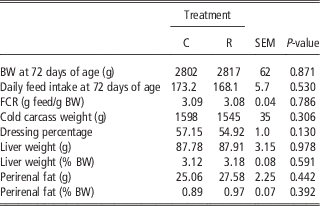
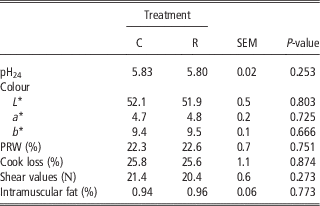
Growth performance of offsprings reared to 72 days of age is presented in Table 3. Rabbits’ BW, feed intake, FCR, dressing percentage, liver and perirenal fat weights were unaffected by maternal undernutrition during pregnancy (P>0.05). There was a sex effect (P<0.05) for perirenal fat (weight and percentage of BW) but no sex by maternal undernutrition interaction was detected (P>0.05). Birth weight differences have already been eliminated at weaning (35 days of age) and therefore, no performance differences were observed at 72 days of age. Meat quality traits measured were also not affected by maternal undernutrition (P>0.05, Table 4).
Effect of gestational maternal feed restriction on performance parameters of rabbit offsprings

C=rabbits born from does fed ad libitum; R=rabbits born from does restricted fed to 75% of maintenance energy requirements from day 7 to day 26 of gestation, n=24; FCR=feed conversion ratio from 35 to 72 days.
Effect of gestational maternal undernutrition on longissimus lumborum muscle meat quality characteristics of rabbit offsprings

C=rabbits born from does fed ad libitum; R=rabbits born from does restricted fed to 75% of maintenance energy requirements from day 7 to day 26 of gestation, n=24; L*=lightness; a*=redness; b*=yellowness; PRW=percentage of released water.
Similar results were obtained by Symeon et al. (Reference Symeon, Goliomytis, Bizelis, Papadomichelakis, Pagonopoulou, Abas, Deligeorgis and Chadio2015) when maternal feed restriction to 50% of maintenance energy requirements compared with 100% of maintenance energy requirements was applied to rabbit does. However, in sheep, maternal feed restriction during gestation increased offsprings’ IMF (Zhu et al., Reference Zhu, Ford, Means, Hess, Nathanielsz and Du2006), increased fat-to-lean ratio (Daniel et al., Reference Daniel, Brameld, Craigon, Scollan and Buttery2007) and decreased muscle weight and number of fast fibres in longissimus dorsi and vastus lateralis muscles in neonatal lambs with possible implications for subsequent meat quality (Fahey et al., Reference Fahey, Brameld, Parr and Buttery2005). In addition, in pigs, Bee (Reference Bee2004) reported lower birth weights that were accompanied with higher body fat percentage at conventional slaughter weight of 104 kg in piglets born from undernourished sows. Rehfeldt and Kuhn (Reference Rehfeldt and Kuhn2006) reported that meat percentage, loin muscle areas and heart weight were lower in low birth weight than in high birth weight pigs while the internal fat percentage and drip loss were higher at slaughter weights of 106 to –116 kg. In accordance with the previous researchers, Gondret et al. (Reference Gondret, Lefaucheur, Louveau and Lebret2005) found that low birth weight pigs exhibited lower feed conversion ratio, lean meat content and meat tenderness scores and higher proportion of subcutaneous fat at slaughter weight of 112 kg.
The fact that the lower birth weight in other farm animals such as sheep and pigs may affect performance, body composition and meat quality whereas this was not the case in our study, may reflect a species effect on susceptibility to restricted foetal nutrition. Probably rabbits are more resistant to feed intake manipulations during pregnancy in comparison with other farm animals regarding the effects on offsprings’ performance and meat quality.
In conclusion, undernutrition of rabbit does at the level of 75% of maintenance energy requirements compared with ad libitum feed consumption during the mid 2/3 of the gestation period did not impair growth performance and meat quality of the offsprings but it significantly increased mortality rates at parturition and until weaning. This suggests that even though both the mother and the offspring possess appropriate physiological mechanisms in order to compensate dietary insults that may occur during gestation, nevertheless adverse effects, such as the increased mortality, are present, and their extend is dependent on the severity (quantity and extend) of the insult.