In early 2017, Brazilian MC Rodrigo Brandão left popular song for free improvisation. The country had seen a fundamental change – one that necessitated a different mode of artistic engagement. ‘These days in Brazil’, he told me in June 2018, ‘you don't know what will happen tomorrow. We don't even know what will happen tonight, things are so out of control. So, given all that, it seems to me that if I try to work on a show today to present next week, this could sound like something premeditated – something really prepared that no longer fits the moment, the instant we're living in. Whatever I thought yesterday might no longer work now.’Footnote 1
Free improvisation, he argued,
gives you this mobility to keep things genuine. In the moment you might say, ‘Great, things have changed since the last time I rehearsed, but it's okay, because it's free, so I can incorporate the news that I just heard on the radio on my way here.’ For me, this is one of the most important things – the power for you to speak in real time.Footnote 2
Brandão was discussing the motivation behind a nascent collaborative project in which he, clarinettist and percussionist Rogério Martins, and keyboardist and electronic musician Guilherme Granado performed freely improvised concerts with a rotating set of musical guests from diverse stylistic backgrounds. Many participants had extensive experience playing in popular styles: Brandão had spent decades as an MC in São Paulo's hip-hop scene and hosted the MTV Brazil hip-hop programme Yo!, while drummer Pupillo, for instance, first became known for his work with the pioneering manguebeat band Nação Zumbi. Other members, such as Martins, primarily engaged in experimental practices such as free improvisation. The project culminated in a 2017 concert series, Carta Branca (Carte Blanche), and an album, Outros Barato, released in August 2018, two months before the national elections. Since then, Brandão has continued to perform open-ended improvised concerts with a range of artists at venues within and beyond the city of São Paulo.
The Carta Branca project arose amidst a series of turbulent developments in the Brazilian political sphere.Footnote 3 In 2016, in the midst of a multiyear recession, the democratically elected leader of the PT (Partido dos Trabalhadores, or Workers’ Party), Dilma Rousseff, was impeached on dubious charges and replaced with Vice President Michel Temer in a process that critics likened to a non-violent coup d’état.Footnote 4 In 2017 and 2018, former president Lula da Silva, the presumptive candidate for the PT in the 2018 national elections, was prosecuted in a series of politically motivated trials in which the presiding judge, Sérgio Moro, was later found to have illegally collaborated with prosecutors. Lula's conviction set the stage for the precipitous rise of the reactionary right, embodied most acutely in the ascendance of President Jair Bolsonaro, a former senator who celebrated the torture of dissidents, promised to privatize the country's cultural institutions, denigrated women and Black citizens, and called for the return of the military dictatorship. In the first year of his presidency, Bolsonaro opened protected indigenous-owned land in the Amazon to occupation by agribusinesses and mining corporations, revoked protections for Brazil's LGBTQ populations, eliminated the Ministries of Labour and Culture, and moved to prosecute journalists for publishing news of government corruption.
During this period, events moved at a breakneck pace. On the late June 2018 day that Brandão and I shared our first conversation, for instance, citizens awoke to the news that former President da Silva's request for release pending judicial appeal was denied; at the same time, the Brazilian Federal Police affirmed to the Supreme Court their belief that then-President Temer had engaged in extensive bribery. The broader cultural conversation surrounding these developments seemed to emerge just as rapidly. Sharp social divisions played out in incendiary fashion on social media, led by Bolsonaro himself, who launched viral invectives on platforms such as Twitter and WhatsApp as part of his insurgent campaign.
Such were the circumstances that provoked the Carta Branca musicians’ figurative departure from popular song. In so doing, they left behind a musical mode of expression that has constituted a formal backbone of Brazilian musical culture and the primary modality in which cultural producers have negotiated socio-political discourse since the advent of radio. Whether in the form of mid-century nationalist sambas such as Ary Barroso's ‘Aquarela do Brasil’ (1939), which lauded the grace of the Brazilian nation, or protest songs such as Chico Buarque's ‘Apesar de você’ (1970), which emerged during the 1964–85 dictatorship, popular song, or canção popular, has long served as a forum for negotiating pressing social questions.
In this article, I address the political ramifications and expressive possibilities of the decision to depart from canção popular – why canção matters in Brazil, and why it is significant that musicians might choose to consciously leave it behind for more open-ended means of musical expression. I contend that free improvisation, tempered by the strategic maintenance of certain core elements of song forms, can facilitate more flexible and collective forms of critical engagement with the experience of being in Brazil today not afforded within the context of canção popular. I propose that their actions constitute evidence of a broader ‘post-canção’ moment in the experimental corners of the Brazilian popular music sphere, with distinct elements of form and content that draw from earlier periods of politically informed song yet constitute a new profile in response to the country's unique contemporary circumstances. The critical potential of the musicians’ improvisational turn ultimately arises from its ability to foster a renewed engagement with a broader form of cultural improvisation with close ties to notions of national identity and being in the world specific to Brazil.
My analysis centres on an extended creative relationship between the musicians Rodrigo Brandão, Guilherme Granado, and Rogério Martins, who formed the project's core trio during its initial period and participated in an ongoing series of improvised performances with artists from diverse stylistic backgrounds. I concentrate on two manifestations of this project: the in-house residency Carta Branca, hosted at the São Paulo venue Estúdio Fita Crepe in August 2017, and the 2018 album Outros Barato, in which Brandão collaborated with sixteen other artists on a freely improvised LP. Following an overview of the history and core qualities of canção, I show that the seeming radical break implied by the Carta Branca musicians, far from representing an unprecedented foray, constitutes part of a long history of politically informed experimental interventions into the modality of canção popular initiated in the early 1970s. Then, using the Carta Branca project as a case study, I examine how contemporary popular musicians have begun to engage in open-ended improvised concerts as a means of leaving – yet not entirely abandoning – the formal orthodoxy of canção. The article centrally investigates the distinct frames of reference and types of commentary that emerge from these performances, focusing on elements of intertextuality, montage, and allegorical narrative. It then addresses the broader cultural context of the improvisatory turn and how the musicians’ actions tie into powerful narratives of the improvisative that have long shaped understandings of Brazilian national identity. I conclude with a consideration of the limitations and possibilities of the departure from song in light of Brazil's reactionary turn.
Constructing canção
In Brazil, canção enjoys an iconic status as the country's musical tradition par excellence. The term canção (‘song’; distinct from canto, which refers to a sung melody) bears some elaboration. On a basic level, it acts as an umbrella term for music with melody-and-lyrics-centred song structures. Canção also connotes a particular mode of expression – a modality of sorts in which an individual singer-songwriter situates a linear lyrical narrative within a structured harmonic and rhythmic framework. This expansive understanding of the term has historically encompassed a variety of genres under its conceptual roof, from the iconic fixtures of the Brazilian popular music canon – samba-canção, bossa nova, música popular brasileira (MPB), Tropicália – to styles such as soul and funk whose practitioners sought to disrupt the norms of the Brazilian cultural industry.Footnote 5
Scholars and cultural commentators in Brazil frequently employ the terms canção and canção popular interchangeably to encompass those genres of canção that have circulated on a national level, particularly in tandem with the rise of recording technology and mass media.Footnote 6 Contemporary Brazilian musicians often employ canção in conversation as loose formal shorthand for music that incorporates song-based structural frameworks, regardless of genre. As I will discuss in the following sections, until recently, being a popular musician in Brazil has historically entailed making music in the vein of canção. Conversely, formal experimentation in the popular music sphere has involved departures from its core structural framework.
Brazilian canção popular first appeared as a distinct phenomenon in the late 1910s with the advent of the gramophone.Footnote 7 This coincided with the emergence of nationalist sentiments that promoted the form as a potential vehicle for national unity.Footnote 8 These developments accelerated in the 1930s with the popularization of radio, which provided an ideal format for the mass dissemination of songs, as well as the actions of political leaders such as President Getúlio Vargas, who encouraged the production of songs that celebrated the distinct character and beauty of the Brazilian nation.Footnote 9 Beginning in 1965, major television networks such as TV Excelsior and TV Record produced a series of televised contests such as the Festival Internacional da Canção in which leading popular musicians performed original songs, typically within the purview of the broad genre of MPB.Footnote 10 Charles Perrone draws attention to how this period saw literary critics begin to approach song texts as major poetic works in their own right.Footnote 11 Individual songwriters, he notes, ‘came to be considered not just as “poets of popular music” but as the best young Brazilian poets. They were likened to the ancient troubadours who blended words and melodies in compositions for performance.’Footnote 12 Because they emerged in the wake of the 1964 coup, the festivals also came to act as a key site for popular musicians to express opposition to the nascent military dictatorship.
Chroniclers of popular music in Brazil have adopted idealistic appraisals of canção popular that have played a major role in sustaining its lionized status in the collective national consciousness. Beginning in the 1960s, scholars such as Walnice Galvão and Roberto Schwarz began to develop methods of analysing the structural and symbolic elements of Brazilian popular song.Footnote 13 Today, scholarly discourse on canção popular is exemplified by the works of a trio of songwriter-scholars – Arthur Nestrovski, José Miguel Wisnik, and Luiz Tatit – whose publications, aimed at both academic and popular audiences alike, have helped to situate the modality as a fundamental element of Brazilian national artistic culture.Footnote 14
The most influential framework for examining canção has come from Tatit, who has not only argued for the centrality of canção in Brazilian culture, but also theorized its structural elements through an analytic model focused on the interplay of melody, lyrics, and intonation.Footnote 15 Drawing from the work of Yann Plougastel, Tatit asserts that for most of the twentieth century, canção acted as an ‘autonomous artistic form’ distinct from instrumental and classical music, with a discrete set of parameters situated on the meeting point between music and spoken language.Footnote 16 He emphasizes the formal rather than generic designation of the term, arguing that canção is defined by its emphasis on the voice rather than any particular collection of stylistic qualities.Footnote 17
Tatit's model portrays canção as an individually directed pursuit at heart, driven by a single, authorial figure: the cancionista (singer-songwriter).Footnote 18 He identifies the intonational power of the cancionista's voice as the central mechanism by which he is able to negotiate the inherent tension between music and speech and transform a song into more than the sum of its constituent parts.Footnote 19 While collaborating musicians are not irrelevant in this framework, they represent secondary members of a supporting cast.
Tatit frames the creative process of the cancionista as a meticulous endeavour, with minimal elements of spontaneity. Although he acknowledges the improvisational nature of the songwriting process, he argues that more spontaneous performance qualities became minimized due to the Brazilian culture industry's demand for polished products resulting from extensive refinement and recording.Footnote 20 Tatit further emphasizes the exacting and rigorous qualities of canção and contrasts them with those of improvised genres. Speaking of bossa nova, for instance, he argues that ‘improvisation, so dear to jazz, is considered a useless complication incompatible with the precision of bossa nova’.Footnote 21 Thus as canção entered the popular sphere, the modality's once prominent improvised roots became a marginal feature.
The end of song
Despite the symbolic dominance of canção popular, experimentally oriented popular musicians in Brazil have periodically released works that challenge the form's structural integrity. One celebrated period of experimentation in this regard came in the 1970s during the most repressive period of the military dictatorship, when renowned singer-songwriters such as Caetano Veloso, Walter Franco, and Tom Zé released albums that radically challenged the standards of the form. Some of the albums of this period, such as Veloso's Araçá Azul (1972), Franco's Ou Não (1973) and Revolver (1975), and Zé's Se o Caso É Chorar (1972) and Estudando o Samba (1976), have achieved iconic status despite earning only modest sales upon their initial release. These instances of experimentation with the structural framework of canção emerged alongside nascent musical movements that contested the values and stylistic norms of the Brazilian popular music sphere while maintaining song forms.Footnote 22
Herom Vargas and Roberto Bozzetti identify qualities such as incoherence, collage, incommunicability, silence, and the deconstruction of melody and lyrics as distinctive sonic elements of experimental canção of the era.Footnote 23 They argue that these techniques functioned as part of a broader creative strategy by popular musicians in order to express alienation and confront censorship without criticizing existing power structures outright. As Bozzetti asserts, their presence demonstrated an attitude in which what musicians wanted to say ‘could only be said and should only be perceived in tatters, as if the difficulty to speak incorporated itself into the very fabric of the song, as if what to say, being so fundamental and obvious, had to be hidden and thrown into the face of “those who do not understand anything”’.Footnote 24 In this context, radically departing from the framework of canção compensated for being unable to enact explicit lyrical critiques. Notably, improvisation constituted a minimal element of the often ornately structured experimental songs of the era, which often incorporated extensive studio editing to achieve the desired effect.
Running throughout these experimental works is a subversion of the songwriter's voice and the linear continuity of canção. Franco's song ‘Xaxados e Perdidos’, for instance, from the album Ou Não, begins as a straightforward baião, but then abruptly cuts from the middle of a sung phrase to forty-five seconds of heavily muted, distant zabumba percussion, before finally cutting back to the original song. Franco would later explore more radical elements of vocal fragmentation on the track ‘Toque Frágil’ on Revolver, in which he superimposed a series of arrhythmic laughing voices and distorted synthesizer melodies over a heaving industrial beat.
Veloso's Araçá Azul presents an even more extreme destabilization of the narrative framework of canção. While he periodically incorporates bits of lyric comprehensibility, he more often sings or speaks cryptic or nonsensical strings of words. In the song ‘De Palavra Em Palavra’ (‘Of Word in Word’), for instance, Veloso uses basic words such as ‘mar’ (‘sea’), ‘maré’ (‘tide’), ‘amarela’ (‘yellow’), and ‘anil’ (‘indigo’) to create a series of invented compound words (‘Amarelanil’, ‘Anilina’, ‘Amaranilanilinalinarama’). This type of lyrical fragmentation was influenced in part by the techniques of Brazilian concrete poetry, which Veloso had incorporated into his work since the 1960s-era project of Tropicália.Footnote 25 It is reminiscent of the non-linearity of Stockhausen's Momentform, in which musical fragments follow one another without adhering to a continuous narrative.Footnote 26
For decades, these experimental iterations of canção represented exceptions to the norms of the Brazilian popular music sphere. Over time, however, as the ability to electronically manipulate sound became more affordable and widespread, more musicians gained access to the basic creative materials needed to transform the structural framework of canção popular. The individualistic model of the cancionista became further complicated by the prevalence of studio production, in which the various sonic qualities of songs were modified, mixed, and transformed far beyond their original acoustic forms, either by the songwriter, producers, or both in tandem. Today, studio-based collaboration is commonplace in many popular genres.Footnote 27
In the minds of certain chroniclers of canção, these developments represented a sea change. Such was the perspective suggested in 2004 by musicologist and journalist José Ramos Tinhorão, one of the country's most well-known traditionalist commentators on popular music, who declared that ‘canção has ended’ in an interview with Folha de S. Paulo.Footnote 28 ‘Today’, he proclaimed, ‘it is all collective, with electronic resources’.Footnote 29 These comments gained greater prominence later that year, when singer-songwriter Chico Buarque echoed Tinhorão's statements in another interview in the same newspaper. In the conversation, Buarque, who had risen to prominence during the 1960s Festivals of Popular Song, characterized canção as a ‘phenomenon of the twentieth century’.Footnote 30 These statements, disseminated in the country's most widely circulated publication, constituted major cultural news. Between Tinhorão and Buarque, the notion of a threat to the integrity of canção popular became established in the broader popular conversation. The implicit question lingered: What had happened to the musical patrimony of Brazil?
For some, the supposed demise of canção presented neither a problem to be solved nor a tragedy to be mourned, but instead an intriguing creative opportunity. Such was the perspective adopted by Zé, who in 2006 released the lyric-less experimental concept album Danç-êh-sá: Dança dos Herdeiros do Sacrifício (Danç-êh-sá: Dance of the Heirs of Sacrifice). Zé conceived the album as an explicit creative response to Buarque and Tinhorão's comments, and included the subtitle ‘(Pós-canção) 7 caymianas para o fim da canção’ ((Post-song) 7 caymianas for the end of song) on the album cover.Footnote 31 To reinforce this idea, he employed the invented word caymiana, likely derived from the name of iconic twentieth-century Brazilian singer-songwriter Dorival Caymmi, instead of canção, to refer to the album's tracks.
Zé enacted the album's ‘post-canção’ concept by incorporating a collaborative, studio-based creative approach and avoiding conventional song structures.Footnote 32 The album is devoid of sung melodies or lyrics, and epitomizes the practice that Tinhorão characterized as ‘collective, with electronic resources’. Instead, the album foregrounds rhythmic patterns, collage aesthetics, and timbral subtleties, weaving a series of minimalistic semi-melodic motifs from a striking mixture of traditional Afro-Brazilian religious music, electronic music, folkloric Brazilian genres, nonsense vocables, and recorded noise. Working in tandem with producer Paulo Lepetit, Zé created a bank of samples sorted by timbre, which they matched to specific keys on a keyboard and then mixed on a computer. The effect is upbeat and bizarre – simultaneously reminiscent of the various constituent genres from which it draws thematic inspiration yet entirely distinct in form from the narrative framework of canção.
The post-canção moment
Zé's concept album exhibits a certain characteristic flair for the dramatic, but presaged an important shift in the experimental corners of the Brazilian popular music sphere from experimentation with the structural framework of canção to outright departure. Indeed, while few artists have been as explicit about their rejection of canção as Zé, over the past decade, the Brazilian cultural industry has seen a proliferation of work that moves beyond conventional song structures. The musicians engaging in these productions hail from a range of backgrounds, from the trio Metá Metá, whose members mix elements of free jazz with Brazilian practices such as Candomblé, to Rio de Janeiro-based noise artist Cadu Tenório, who has collaborated with singers and poets to produce bleak, noise-laden inversions of mid-century samba-canção. Although many of these figures incorporate elements of melody and lyrics, their work also foregrounds more abstract textures and tends to depart from the individualistic modality of the cancionista in favour of more collaborative configurations. To be an experimental popular musician in Brazil today is to engage in this post-canção framework.
One of the most radical shifts in this experimental opening has been the prominent and increasingly frequent incorporation of free forms of improvisation. Although Brazilian popular musicians have incorporated elements of improvisation into their performances for some time, until recently, projects centred on more open-ended approaches have remained rare. Similarly, free improvisation circuits in Brazil have seldom featured performing musicians from popular styles. Carta Branca, in this context, represented the culmination of an unusual partnership – one with distinct creative and discursive possibilities but also challenges specific to its hybrid profile.
I first saw Brandão, Martins, and Granado's project in August 2017, when the three musicians performed a three-concert artistic residency, Carta Branca (Carte Blanche), at the São Paulo experimental performance venue Estúdio Fita Crepe. Over the course of the series, which was curated by the prolific São Paulo saxophonist Thiago França, the artists performed with a rotating set of invited musical guests, including bassist Marcos Gerez, keyboardist Leandro Archela, drummer Pupillo, and singer Tulipa Ruiz. Each show featured a different collage of sonic textures that changed depending on the distinct permutations of musicians present and the direction in which each musician decided to take the performance in the moment.
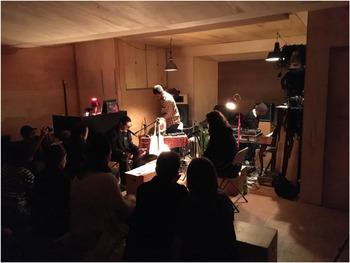
On the final night of the residency, the musicians onstage (Brandão, Granado, Martins, and Ruiz) wove a subdued mood. Brandão sat at the far left of the stage in front of a table covered with a worn Portuguese-language copy of Patti Smith's memoir Just Kids (Só Garotos) and an assortment of scattered papers with lyrics written on them. Toward the back of the room, Martins and Granado stood in front of two tables that had been set up with a variety of acoustic and electronic instruments – a metal agogô, a carved wooden recorder, a children's xylophone, cowbells on a chain, a cymbal, a bass drum, a clarinet, a Korg sampler, and a range of synthesizers, mixers, and pedals. Ruiz sat alone at the front of the stage with only a microphone (Figure 1).
(Colour online) Rodrigo Brandão, Rogério Martins, Tulipa Ruiz, and Guilherme Granado (left to right) perform at Estúdio Fita Crepe. Photo: by author, 15 August 2017.

As the musicians settled into the beginning phase of the show, Brandão murmured deeply into the microphone, Martins gently tapped a cymbal with a soft mallet, Granado played a minimalistic loop of notes on a xylophone, and Ruiz's voice wavered between pitches in a ghostly fashion. Ruiz then cut through the undulating texture with a bright cackle identical to the cry of a tropical bird. ‘São Paulo é selva’ (‘São Paulo is a jungle’), Brandão declared in response, quoting a phrase from Racionais MC's song ‘Artigo 157’. The mood intensified. Martins played a semi-pitched blast on his clarinet rich with harmonics as Granado cut a short loop on his keyboard and tapped the side of his xylophone. In the background, there was a soft sheen of feedback. Ruiz's voice wandered in a high register and Brandão's delivery assumed a more urgent tone. At times, he read from the Patti Smith book and the sheets of lyrics in front of him; at other times, he spoke without the assistance of any prepared material. Towards the end of the show, he moved about the space, taking time to stop in front of each attendee, look them in the eye, and pronounce a sharp spoken phrase. The musicians continued for almost an hour, leaving a surreal sonic impression flecked with echoes of song and spoken word.
The Carta Branca project emerged in the midst of a tumultuous political environment in early 2017. At the time, the country's recession endured unabated, austerity programmes devastated the budgets of cultural institutions, and the fallout from Dilma Rousseff's impeachment had shaken the country's left wing on a fundamental level. Brandão had recently returned from a collaborative project in New York City and was struck by the recent developments. Although he had extensive experience as an MC in São Paulo's hip-hop circles, he found himself motivated to move beyond the genre's structured song-like framework:
When we came back, this whole scenario that's happening in Brazil had already started to take place. So I started to understand – I said, ‘To do rap today, in the same format and structure of canção, with a pre-recorded beat, with a defined map, seems to me something that's too ready-made for a time where things are happening in a very urgent rhythm.’ I began to understand that. I said, ‘Wow, I need to find another form of expression that isn't that of rap, of canção’, in order to be able to have more of a dialogue with what's happening nowadays.Footnote 33
While he professed an appreciation for canção, he felt that its detached and individualistic approach no longer afforded a sufficiently direct response to the challenges of the moment. Taking the time to write songs, he argued, meant that
you'll have to go back home to compose the song. Which I fucking love – I love canção too, and I don't rule it out in any way. In another moment, I'll go back to canção. But in this moment, in this place we're living in, I feel that this break is important because you're talking more directly with people, and you have that opportunity to really touch the spirit of the day.Footnote 34
Improvisation struck Brandão as a natural way of engaging in this type of conversation, particularly more open forms of improvisation that went beyond the kind of highly structured frameworks for improvised performance found in practices such as freestyle rap. He stressed the importance of developing new creative forms as part of the group's critical mission. ‘How’, he asked, ‘are we going to respond to this effectively without using the same methods that they're using? Because if I don't want to become the same as whoever's acting in an arbitrary manner, I can't be arbitrary either.’Footnote 35 Rather than developing oppositional content in the form of a protest song, his strategy represents a more comprehensive re-evaluation of the creative languages individuals employ to engage with contemporary issues.
Brandão's claims of using improvisation to enact a unique break from canção deserve a measure of scepticism, however. Multiple Brazilian genres incorporate forms of vocal improvisation that offer immediate responses to contemporary concerns while maintaining song structures. Master vocalists in the samba subgenre of partido alto, for instance, often incorporate political commentaries into their improvised verses, while in the Brazilian northeast, participants in embolada and cantoria (also known as repente) often respond to social concerns as part of the improvised sung duels that constitute the genres’ core practices.Footnote 36 Scholars emphasize how these styles have acted as sites for explicit political commentary but have also afforded implicit responses to broader marginalizing socio-political forces; Stephen Bocskay, for instance, notes that during the 1970s-era military dictatorship, ‘the roda of partido alto represented a moment of liberty and of improvised verses; a mode of resistance to the compromises and reduction of creativity in samba enforced by the limits of carnival’.Footnote 37 If one extends the purview of canção to encompass hip-hop, as Brandão does, freestyle rap has also long offered a space for MCs to improvise often explosive responses to a variety of issues.Footnote 38 As a result, while the unpredictable sonic trajectories underlining Brandão's improvised vocals bear little resemblance to the highly structured frameworks that form the musical foundation of these improvised genres, the Carta Branca project is far from alone in its incorporation of improvisation as a means of speaking truth to power.
Rather than characterize the Carta Branca project as a total departure from canção, then, it may be more accurate to view it as a remix or reconfiguration – a hybrid framework that integrates abstract textures with lyrics and stylistic quotations structured by the logic of collage and pastiche. For Brandão, the lingering presence of canção was inevitable due to the musicians’ shared history of participation in the form. As he noted, ‘In the end, even when we depart from canção, the language of canção informs the improvisation. Because like it or not, we've learned the format of canção.’Footnote 39 Brandão is describing a departure from the formal orthodoxy of canção rather than a wholesale rejection of the modality. His integrative attitude, shared by his collaborators, reflects a perspective that seeks to enact a conscious break with existing musical frameworks while still valuing their considerable symbolic power.
The hybrid landscape that emerges embodies both the contradictions and possibilities at the heart of the meeting of canção and free improvisation. On the one hand, the project is ostensibly open-ended, with no pre-arranged melodies or structural decisions made beforehand by any of its participants. The musicians also avoid incorporating any of the delineated rhythmic or harmonic frameworks that form the structural backbone for vocal improvisations in genres such as partido alto or freestyle rap. On the other hand, the project defies the conventional contours of free improvisation. While the Carta Branca affiliates do not shy away from difficult sonic configurations, they also embrace more consonant sounds, many of which evoke established styles in overt ways. The commonplace presence of lyrics, samples, and extramusical references lends connotative and discursive power to performances that can be accessible to specialists and casual listeners alike. These qualities distinguish Carta Branca from ‘non-idiomatic’ forms of improvisation practised in genre cultures dedicated to free improvisation, whose practitioners generally avoid lyrical commentary and tend to view explicit quotations or extended stylistic markers as limiting.Footnote 40 For the project's musicians, this approach affords a measure of freedom in both the creative and the discursive realms – a critical means for contemporary cultural producers to develop new expressive responses to disturbing social and political trends.
Post-canção poetics
As a result of the musicians’ decision to preserve certain verbal elements of canção, they are afforded avenues of explicit commentary not normally available within freely improvised performance settings. Examining the lyrical decisions made by the project's vocalists reveals narrative patterns characterized by multiplicity, intertextuality, and metaphor, with coded references that draw from both the personal experiences of the individual musicians and the iconic works of Brazilian canção popular. To create these narratives in performance, they generally employ spoken word techniques, which allow them to invent more complex and flexible verbal narratives on the fly than might be possible with more constrained modes of vocal delivery. Their choices build on the practices of improvised genres such as freestyle rap and partido alto, but also introduce more wide-ranging and performatively fluid narratives than are found within the highly structured lyrical purview of improvised song. The participants’ approach enables them to respond to the history of critique and allegory embedded within the lineage of canção popular, while at the same time enacting a break that affords the incorporation of new emotional responses, historical frames of reference, and intertextual conversations.
Central to this process is the presence of narrative fragments that allow for complex intertextual references and allegorical commentary. The track ‘Bebo Tempestade’, on the Outros Barato album, provides a characteristic example. The piece centres on a repeated verbal motif, ‘Eu vou pra rua e bebo tempestade’ (‘I go to the street and drink the storm’), adapted from Chico Buarque's 1973 song ‘Bom Conselho’. Brandão integrates the verbal refrain with more extended improvised narration, performed in decisive and arresting spoken word:

As Brandão's delivery intensifies, the instrumentalists escalate their playing in turn, generating a chaotic set of punctuated sonic vectors sharing little in common with the pensive, meandering texture that begins the track. After his verse ends, the texture becomes fragmented and scattered, as fading echoes of vibraphone, electronic tones, and percussive shots reverberate.
The words of ‘Bebo Tempestade’ exemplify the curious lyrical quality of the Carta Branca project: an emphasis on metaphor and broad political allusion rather than extended explicit references to specific contemporary events. The track is laden with mentions of symbolically important political figures and wide-ranging critiques of dominant institutions and the persecution of the marginalized elements of society. Some of these combine references to external movements with allusions to contemporary concerns in Brazil. Midway through the track, for instance, Brandão dedicates the work accordingly:

Brandão's words draw connections to movements and experiences that resonate in a variety of political contexts within and beyond Brazil: the Black Panther Party, demonstrations in the Bronx, activism, police brutality, the experience of racism and poverty. Save for a mention of milícia, a term that means ‘militia’ but is also used to refer to Brazilian right-wing paramilitary groups often made up of former police officers, the lyrical focus of the track is broad.
Those attuned to the history of Brazilian protest music may notice a pointed layer of encoded meaning. The refrain of ‘Bebo Tempestade’ cites an apt source – the final lyrics of Chico Buarque's 1973 song ‘Bom Conselho’ (‘Good Advice’), which Buarque wrote during the most repressive period of the military dictatorship. Like many works of the era, Buarque's song employs metaphorical narratives to circumvent existing censorship and suggest a mood of resistance without explicitly mentioning ongoing events.

By beginning his narrative in ‘Bebo Tempestade’ with the very words Buarque employs at the conclusion of ‘Bom Conselho’, Brandão is able to situate the track as a sort of intertextual response to Buarque's work. In certain ways, his judicious sampling recalls the strategies of jazz musicians, who often quote standards as a means of mindfully situating their performance in musical-historical context. As Ingrid Monson notes, such musical allusions can create a situation in which ‘a chain of associations is set off that engages the listener and unites her or him with a community of individuals who share a similar musical point of view’.Footnote 42 Just as the icons of MPB employed the modality of canção to respond to the twentieth-century military dictatorship, the members of the Carta Branca project participate in the construction of a post-canção framework to react to the precarious straits in which Brazilian democracy finds itself today.
Curiously absent from this improvised narrative are the individual antagonists of the Brazilian right wing, including, most notably, reactionary politicians such as Bolsonaro and earlier figures such as Temer who advocated for economic austerity measures and facilitated Rousseff's impeachment.Footnote 43 Although many of the Carta Branca vocalists address problems that have emerged or become exacerbated in the wake of these developments, they typically avoid mentioning individual political figures or specific events. Given the central roles of figures such as Temer and Bolsonaro in creating Brazil's present situation and Brandão's stated desire to ‘respond’ to these developments, this stance could appear incongruous with the project's critical mission. After all, the individuals responsible for Brazil's reactionary turn are not out of the minds of the performers, many of whom are vocal in their opposition to the country's political developments.
One way to reconcile the project's ostensibly oppositional critical mission with its vocalists’ broad lyrical approach is to view it in personal terms, as a means of collectively expressing reactions to a moment rather than seeking to call out any individual figure or event. In this context, the participants in Carta Branca are not reacting first and foremost to specific individuals or events, but the experience – their experience – of being in Brazil today. Given the speed at which the political landscape of the post-Rousseff era has moved and the seismic shifts a single day's news can bring, the timelessness of allegorical speech may capture the current moment more honestly than specific language.
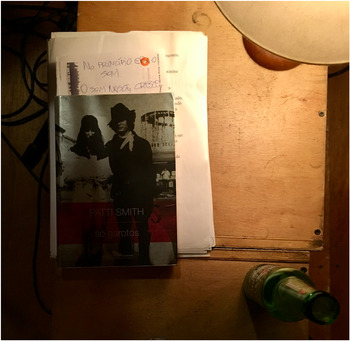
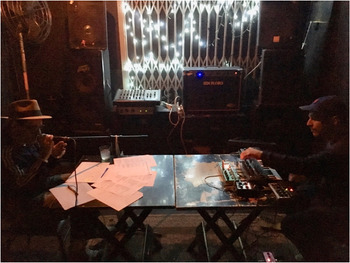
To facilitate the performance of these complex extended narratives within open improvisational settings, Brandão brings textual material to each show. These texts encompass a variety of sources: in the concert discussed earlier, for instance, he incorporated the Portuguese-language version of the Patti Smith book Just Kids (Só Garotos), printed-out lyrics from other songs, and poetic material of his own design (Figure 2). In another show, by contrast, he brought copies of the lyrics to Gilberto Gil's song ‘Tempo Rei’ (Figure 3). He typically avoids laying out any pre-determined order in which he will engage with the texts, preferring instead to employ them as lyrical material to quote as he sees fit in the moment of performance and as general conceptual stimuli for his own spoken word improvisations. During the recording of the Outros Barato album when he shared the studio with vocalists Juçara Marçal, Rodrigo Carneiro, and Tulipa Ruiz, the texts functioned as a shared point of thematic reference around which the vocalists grounded their otherwise open performances.Footnote 44
(Colour online) Rodrigo Brandão's texts: Patti Smith's Just Kids (Só Garotos) and a mixture of lyrical material by Brandão and other artists. Photo: by author at Estúdio Fita Crepe, 15 August 2017.

(Colour online) Rodrigo Brandão (left) and Guilherme Granado (right) perform. Brandão has the lyrics to Gilberto Gil's ‘Tempo Rei’, among other works, in front of him. Photo: by author at Hotel Bar, 27 June 2018.

The Carta Branca project's open space of improvisation also affords engagement with modes of expression from beyond the conventional purview of cançao; specifically, the Afro-Brazilian religion of Candomblé. Multiple participants are themselves active practitioners of the religion, and regularly integrate allusions to orixás in their work.Footnote 45 The vectors of expression afforded by these performances, although less explicitly political than some of the other tracks, foster engagement with no less personal (and arguably just as political) questions and experiences.
In certain instances, invoking Candomblé serves to condition the space of performance and foster feelings of connection between musicians. Before shows, it is common for participants to ask for the blessing of the orixás – a practice that Brandão likened to ‘clearing the air, putting everyone … you know, letting the dust settle and getting everyone ready to dive in together’.Footnote 46 On Outros Barato, the musicians employ a similar strategy. The album opens with the song ‘Laroiê’, sung by Marçal in a reverent manner:
That the group should begin the album with such a song is no accident – ‘Laroiê’ is a type of sung greeting for the orixá Exú, who opens the door to the world of the orixás and is typically invoked at the beginning of Candomblé rituals. In this context, Marçal's decision to sing ‘Laroiê’ straight through without any incorporation of spoken word makes sense, as it is neither spoken social commentary nor lyrics fashioned by a cancionista, but a prayer of sorts that sets the stage for the space of expression explored on the rest of the album. This approach shares certain qualities in common with Afro-Cuban hip-hop musicians, who often incorporate references or ceremonial songs from the religion of Santería into their performances and recorded works.Footnote 47
On the track ‘Kolofé Iya Agba’, Marçal employs such references to engage in more extended spoken word commentary. Like ‘Bebo Tempestade’, the performance centres on a repeated lyrical motif: ‘Kolofé Iya Agba’, integrated with Portuguese-language narrative peppered with terms from Candomblé such as axé. Yet this time the source material is not the Brazilian popular songbook, but Afro-Brazilian religious practice: ‘Kolofé’ is a common greeting in ceremonies of Candomblé and Umbanda, while variations on the words iya and agba typically refer to mother figures, both in terms of worshippers’ women ancestors and female orixás.Footnote 48

For listeners not familiar with Afro-Brazilian religious practices, much of Marçal's verse may appear opaque. Indeed, her salute to ancestral maternal figures is laden with terminology and metaphors from outside the conventional linguistic purview of canção, such as Motumbá (a Yoruba term for blessing) and Ilê (Yoruba for ‘home’; also part of the nomenclature of Candomblé terreiros). Only those with embodied experience participating in Afro-Brazilian religious practices would fully understand the references without external research.
This may be by design. Indeed, Marçal's inclusion of these terms suggests the presence of a subtext that she and only a select few understand, and is not necessarily meant for all. Her approach provides a marked contrast with works from the canon of canção popular that refer to Afro-Brazilian cultural practices but do not feature the perspectives of practitioners – as in, for instance, Baden Powell and Vinícius de Moraes's album Os Afro-Sambas (1966). Marçal and Brandão are not merely name-dropping orixás – they draw from a deep embodied history of practice, which allows them to improvise more sincere and symbolically rich responses than would be possible from vocalists with only a cursory familiarity with the religion.Footnote 49 Marçal's approach speaks to the potential of the post-canção stage to incorporate languages, both literal and metaphorical, of subaltern groups whose voices have historically been excluded from the Brazilian culture industry.
Speaking in real time
That these conversations foreground open-ended rather than structured approaches to improvisation is key to their immediacy and critical force. Rather than operating within a determined framework, the Carta Branca participants enjoy a measure of semantic and expressive flexibility – albeit one that maintains a crucial dimension of prepared lyrical structure – that does not exist in the context of canção. Instead, they engage with a broader yet arguably more significant narrative of cultural improvisation that has long formed a key element of popular constructions of brasilidade (Brazilianness). To fully understand the broader social import of the post-canção improvisatory turn, it is necessary to examine the ways in which the move towards free improvisation also entails a return to this powerful cultural narrative.
Improvisation has long informed understandings of national qualities and notions of being in the world specific to Brazil. Jason Stanyek draws attention to an ‘elaborate and long-standing discourse that links improvisation with Brazilian national identity’.Footnote 50 As he argues:
Improvisation – as both discourse and practice – has at times had a cophasal relationship with the broad contours of national belonging. Indeed, from sports to politics, from economics to pedagogy, from the arts to the quotidian expanses of everyday Brazilian life, the social and cultural spheres of Brazil have often been characterized as having decidedly improvisative valences.Footnote 51
He connects this to understandings of brasilidade, and suggests that ‘improvisation forms one of the principal ballasts for notions of a Brazilian exceptionalism’.Footnote 52 José Miguel Wisnik emphasizes the colloquial nature of improvisation in Brazil, and contrasts it with what he views as more tightly structured manifestations prominent in the United States. ‘Jazz’, he asserts, ‘gives a complex and refined form to improvisation, one that is codified in its harmonious and melodic syntax. The Brazilian improvisation we're talking about is essentially informal, and hasn't constituted itself as a genre.’Footnote 53
Discussions of improvisation in Brazil largely portray it as a distinct strength that lends its residents an inventiveness and pragmatism that enable them to overcome otherwise unsurmountable obstacles. Multiple concepts in Brazilian popular culture contain core ties to metaphors of improvisation. One of the most iconic of these is the notion of the jeitinho brasileiro (roughly, the ‘Brazilian way’), a Brazilian cultural term that characterizes the impromptu tactics individuals employ as a means of circumventing inequitable societal structures. Bernardo Borges Buarque de Hollanda makes the connection explicit, likening the jeitinho to ‘the improvisational concept of systematically outsmarting the rules’, while Stanyek asserts, ‘Of all the available terms used to mark Brazilian forms of worldmaking, it is the jeitinho brasileiro that is the most vital for summoning up improvisation's place within the architectures of national belonging.’Footnote 54 Equally significant is the notion of malandragem (roughly, ‘roguery’ or ‘trickery’) and the figure of the malandro (‘rogue’ or ‘hustler’) – a streetwise character in Brazilian popular culture celebrated by samba songwriters for his savvy and ability to invent novel ways of achieving goals in the face of societal barriers that would be impossible to surmount using conventional means. Wisnik connects malandragem to a broader mode of resistance and self-liberation necessary in a profoundly unequal society, arguing that it facilitates the construction of a sense of ‘precarious citizenship’ in which improvisation plays a key role.Footnote 55 ‘This’, he argues, ‘is the essence of improvisation. It is the matrix, in the sense of a base of reference, for a culture of improvisation: the bricolage with which you constitute an identity in a precarious condition.’Footnote 56
These understandings of cultural improvisation in Brazil relate in turn to a broader spectrum of improvised responses to marginalization taking place in the broader African diaspora. George Lipsitz identifies the presence of an ‘improvisational response’ to white supremacy in the African diaspora that manifests within and beyond the sphere of music.Footnote 57 ‘Afro-diasporic improvisation,’ he asserts, ‘is an art of interruption. It teaches performers to prepare for rupture and to respond to it. It is not simply an aesthetic practice but rather an epistemological and ontological imperative. Improvisation entails distinct ways of knowing and ways of being. It emerges from insubordinate spaces and creates emancipatory temporalities.’Footnote 58 Given the ties between the necessity of the jeitinho and the figure of the malandro to the social experiences of Afro-descendent Brazilians, these connections are appropriate.
Whether in the form of the jeitinho, malandragem, or other concepts, understandings of cultural improvisation in Brazil connote a certain creativity and thinking-outside-the-box that is not only inventive in its own right, but also necessary in the face of absurdity or injustice. They share a common valuation of free-form performative liberty as a strategy of resistance. The malandro transcends structures, and it is only in the departure from existing frameworks that his improvisatory actions are able to succeed. Similarly, the jeitinho derives its distinct power precisely because of its embrace of maximal flexibility and adaptability. In other words, the improvisation so central to brasilidade is a kind of free rather than structured improvisation.
Improvisation has not always connoted positive associations in Brazil. Stanyek identifies a simmering unease with the improvisative, and connects it to long-standing anxieties about underdevelopment and Brazil's supposedly marginal status on the world stage. ‘In this view’, he notes, ‘improvisation is something to be surmounted, left behind in the forward progress toward Brazil's vaunted “future”.’Footnote 59 Wisnik is equivocal about the tendency towards improvisation present in different facets of Brazilian society, arguing that ‘the jeitinho, adaptability and the like, are forms through which personal relations – and therefore personal interests – prevail, or have very often prevailed, over public interests. This is all deeply ambivalent, and therefore both positive and negative.’Footnote 60
It is not difficult to see parallels between the drive to minimize tendencies towards the improvisative, rooted in notions of modernizing Brazilian culture and removing its more informal tendencies, and the elimination of improvisation in canção popular in the name of producing a more refined product. Although scholars such as Tatit have acknowledged the improvisatory roots of canção and the extemporaneous nature of the songwriting process, the figure of the cancionista is if nothing else an icon of studied preparation rather than performative spontaneity.Footnote 61 By its very nature, the Brazilian culture industry has tended to hide the more informal elements of the creative process in favour of the polish of the recorded work. To present an improvised work of canção popular to the Brazilian consumer would be a contradiction in terms – a corruption rather than a continuation of the ethos of progress that informed the modality as it entered the popular sphere.
In this light, it is possible to view the Carta Branca group's departure from canção in favour of free improvisation as a political end in its own right – a return to the freely improvisative ethos of malandragem that has long formed a strategy for overcoming otherwise overwhelming structural forces. Although this new creative direction does not entirely abandon the structured framework of canção, particularly concerning Brandão's incorporation of prepared textual material, it represents an essentially distinct approach from that of the cancionista. The decision shares certain elements in common with the 1970s-era transition to partido alto as a reaction to limitations in Carnival imposed by the military dictatorship, albeit in a different form. This process offers more than the possibility of critical discourse. It can itself constitute an act of meaningful social engagement and self-transformation – a crucial means of not only imagining, but embodying new ways of being in the world with considerable precedence in Brazilian popular culture.
This transformation occurs on multiple levels. The most basic and immediate change is interactional, in the reconfigured relationships between musicians who might otherwise adhere to the implicit hierarchy of canção. Indeed, an understanding of the Carta Branca project as conversational was central to its practitioners, who emphasized the value of cultivating trust, mutual respect, and a shared set of communicative dynamics specific to the group. Granado, for instance, spoke of a ‘musical language’ that the trio had developed over multiple years playing together that enabled them to negotiate the format's inherent unpredictability towards productive rather than conflicting ends.Footnote 62 Brandão contrasted the curated experience of studio recording with the essentially collective experience of improvisation, noting, ‘On the stage, you have to improvise in a way that will speak with the people who are present.’Footnote 63
The interactional potential of this new context is closely tied to the live qualities of the encounter and the ambient energy of the physical space in which it takes place. The captured performances featured on the Outros Barato album notwithstanding, the Carta Branca project is an essentially live endeavour, and derives much of its distinct expressive power from the possibilities of co-presence. In shows, Brandão is finely attuned to both the musicians and the audience, and frequently chooses to break the fourth wall and directly engage with those in the room. He is able to lend the impression that he is speaking to and with those present as much as he is speaking about pressing social questions – a crucial quality for a creative space in which potentially volatile themes are addressed in the open. Brandão's collaborator Rogério Martins highlighted the striking qualities of Brandão's voice as a key reason the project differed from conventional free improvisation contexts. As he noted, ‘That voice gives way to other possibilities, really interesting, rich, very dynamic, very expressive, communicative. You connect more with who else is listening, with people – people seem like they're more connected here, you know?’Footnote 64 The project's grounding in co-presence suggests the possibility of a reversal of the historical transition from live performance to mediatization in the Brazilian popular sphere – a departure from the cultivated milieu of canção popular in favour of the spontaneity afforded in improvised encounters between living, breathing human beings.Footnote 65
All of these changes suggest the potential of a broader embodied transformation in the way one situates the self in Brazilian society. In part, this occurs on an individual level, in the cultivation of new forms of flexibility not present in the context of canção popular – the proverbial ‘mobility to keep things genuine’, as Brandão put it.Footnote 66 This attitude shares certain elements in common with the maverick spirit of the malandro or the ethos of evasion implicit in the notion of the jeitinho. In a way, it represents a looser, more unregulated habitus – Pierre Bourdieu's term for the source of the unconscious ‘regulated improvisations’ that make up the actions of everyday life – with the potential to challenge rather than uphold existing structures.Footnote 67
Yet this transformation also occurs on a collective level that is not always suggested in conventional notions of Brazilian cultural improvisation. The malandro is not an icon of group solidarity, after all, and the inventive potential of the jeitinho does not always serve the interests of the greater group. Brandão drew attention to the ‘greater responsibility’ participation in free improvisation entailed in comparison to studio work, and emphasized the ways in which it enabled the cultivation of lasting interpersonal relationships whose rewarding qualities came in part from the necessity of trusting each other to support one another in the moment. He characterized the experience in intimate terms, as ‘a special, spontaneous, and genuine moment’ for those involved: ‘I believe that the presence, the encounter, is what matters. The encounter is the most important thing, because when we're together, we'll do it in a way that we wouldn't have done if each of us were in a separate room, exchanging files.’Footnote 68
The musicians’ emphasis on mindful social engagement as both a necessity and a valued outcome of improvisation resonates with the testimony of improvising musicians across genre boundaries. Garry L. Hagberg, for instance, likens effective group improvisation to ‘a knowledgeable family living inside a world of possibility’, while Ellen Waterman emphasizes the potential of improvisation to exemplify ideal interpersonal relationships, situating it as ‘a site of dialogism-in-action, where we bring our personal histories and values into contact with others in a spirit of openness to change.’Footnote 69 To speak ‘in real time’ is to speak with others – with words, sounds, and bodies – and in so doing, cultivate more collective inclinations with enduring social consequences.
Concluding thoughts
Projects such as Carta Branca are representative of an emerging shift in practice in which experimentally oriented popular musicians in Brazil have begun to not only foreground unorthodox aesthetic profiles, but also adopt entirely new creative approaches outside the purview of canção. This transition has manifested across various genre boundaries, from post-punk bands such as Auto and Rakta, who integrate loose interpretations of songs within extended open improvisation sessions, to popular songwriters such as Negro Leo and Ava Rocha, who supplement performances of their more conventional song-based repertoire with freely improvised concerts with rotating sets of artists. Even the mainstream Brazilian cultural press, not known for its attention to more unorthodox musical developments, has begun to take note. In 2018, for instance, GQ Brasil declared that ‘a new trend is spreading in São Paulo: improvisation shows. These are performances, generally without rehearsal and with minimal publicity, that end up attracting the attention of many who are passing by, without obligation. More paulistano than that? Impossible.’Footnote 70
From afar, these events are hardly perceptible. Popular labels prefer to produce prepared rather than freely improvised projects, and the few recordings of the events that circulate online generate limited engagement in conventional media. Public videos of the Carta Branca group's concerts on YouTube are rarely viewed, and more than two years after the release of Outros Barato on Spotify, no track had been listened to more than 2,600 times. The improvised encounters driving the current post-canção moment are not taking place in the traditional media venues of the Brazilian culture industry. This represents a meaningful obstacle to the potential resonance of the projects in question.
Yet the cultural importance of Brazil's improvised musical moment should not be measured by pageviews or an extensive streaming footprint. The point is to be there – to experience an ephemeral narrative in front of a performer, to see forms of musical expression less likely to occur in the curated halls of a recording studio, to feel the community and warmth of co-presence. For those present in the physical spaces in which the shows take place, they are spirited and often urgent affairs. The power of the experimental opening to free improvisation must be experienced live.
To be sure, canção will likely remain the dominant creative framework in the Brazilian popular music sphere for the foreseeable future. Yet if the form persists atop its symbolic perch, its boundaries have never been more fluid and destabilized. While the historic constituent parts of canção remain stalwart fixtures of the Brazilian culture industry, popular musicianship no longer necessitates their exclusive use. For curious musicians today, canção offers creative tools that musicians may integrate with each other or with entirely new references and approaches as they see fit. In the context of free improvisation, these tools can be adapted in entirely new musical and social configurations with restorative and resistant potential.
It is only appropriate that this improvised approach should differ from the earlier strategies of experimental popular musicians. Despite the shared spectre of authoritarianism, Brazil faces different challenges today than in previous generations. In spite of extensive irregularities and outright fraud in the cases of Rousseff's impeachment and Lula's imprisonment, most Brazilian citizens consider the current government electorally legitimate. Nor is the culture industry unified in opposition to the right wing, as was the case in the wake of the 1964 coup. Those who seek to contest these developments thus respond to a broader reactionary shift occurring on multiple levels of Brazilian society writ large. They must also react to the sheer speed of it all – the sudden convulsions in politics and media that can seem to upend reality on a daily basis. As a result, the expressive strategies employed by artists must necessarily change.
Free improvisation may thus represent a potential model for artistic discourse in our contemporary global reactionary moment, both within and beyond Brazil. In contrast to the measured, curated approach taken by cancionistas, improvisation offers cultural producers the chance to transform both product and praxis to collectively meet the speed of the present. Although this strategy may not produce the same iconic calls of protest of earlier generations, broadcast and commodified in recorded songs and televised performances, it presents something potentially more valuable: the opportunity to re-orient the musical self to transform and transcend an impossible situation.