


Introduction
Bacterial resistance to antibiotics is increasingly widespread, with intensive antibiotic use in human and animal health as a primary factor of diffusion, representing a serious problem for the economy and public health (Corrêa et al., Reference Corrêa, Evangelista, de Nazareth and Luciano2019; Evangelista et al., Reference Evangelista, Corrêa, Pinto and Luciano2021). Such products are widely used in livestock, and it has been shown that soil in the vicinity of animal production contains microorganisms with a high prevalence of antibiotic-resistance genes (ARGs) (Duan et al., Reference Duan, Gu, Wang, Li, Zhang, Hu and Zhou2019). This and other factors lead to the conclusion that the indiscriminate use of antibiotics in intensive animal production may be one of the leading causes of resistance among zoonotic microbial pathogens.
ARGs have been constantly found in Enteric commensal and pathogenic bacteria from production animals. Escherichia coli has been largely studied (Lanz et al., Reference Lanz, Kuhnert and Boerlin2003; Zhang et al., Reference Zhang, Ye, Zhang, Pan, Sun and Cao2017a, Reference Zhang, Shen, Zhang, Song, Wang, Shang, Yue, Qu, Li, Wu, Zheng, Aditya, Wang, Xu and Wu2017b, Reference Zhang, Abbas, Rehman, Huang, Zhou, Gong, Yang, Chen, Wang and Cheng2020; Poirel et al., Reference Poirel, Madec, Lupo, Schink, Kieffer, Nordmann and Schwarz2018; Li et al., Reference Li, Pei, Zhang, Wu, Liu, Zhou, Ma, Chen, Liang and Yang2019) and strains that cause diarrhea in pigs have been identified as resistant to several classes of antibiotics, including colistin, an antibiotic used to control multi-resistant microorganisms (Le Devendec et al., Reference Le Devendec, Jouy, Paboeuf, de Boisséson, Lucas, Drider and Kempf2018). Strains of Salmonella Typhimurium isolated from humans and animals in China have presented genes for resistance to a wide range of quinolones, aminoglycosides, and colistins (He et al., Reference He, Sun, Sun, Wang, Jin, Pan, Xu, Chen and Jiao2020). Polymyxins, which belong to the colistin antimicrobial group, are still extensively used in animal production and have been found ineffective against many enterobacteria isolated from livestock (Giamarellou, Reference Giamarellou2016). Having ushered in a new era in medicine, the emerging ineffectiveness of antibiotics puts health at risk across the world. It is estimated that the United States spends $20 billion annually on treating antibiotic-resistant infectious diseases (Dadgostar, Reference Dadgostar2019).
In addition to antimicrobial resistance, antiparasitic resistance in animal production has also been an emerging problem due to the indiscriminate use of these compounds. Currently, the largest classes of drugs used to control intestinal parasites – imidothiazoles, tetrahydropyrimidines, benzimidazoles, and avermectins – have gradually lost effectiveness (Dey et al., Reference Dey, Begum, Anisuzzaman and Alam2020). Resistance to anthelmintics is increasing; among the farms tested, no antiparasitic activity of albendazole or fenbendazole was found against eggs of Haemonchus contortus, Teladorsagia circumcincta, and Trichostrongylus spp. (Claerebout et al., Reference Claerebout, De Wilde, Van Mael, Casaert, Velde, Roeber, Veloz, Levecke and Geldhof2020). This also represents a serious problem, and it is estimated that the economic impact in Europe is about 38 million euros annually due to resistant parasites (Charlier et al., Reference Charlier, Rinaldi, Musella, Ploeger, Chartier, Vineer, Hinney, von Samson-Himmelstjerna, Băcescu, Mickiewicz, Mateus, Martinez-Valladares, Quealy, Azaizeh, Sekovska, Akkari, Petkevicius, Hektoen, Höglund, Morgan, Bartley and Claerebout2020). Another reason for the decreased effectiveness of these products is due to soil contamination by antiparasitic agents, as shown by de Oliveira Ferreira et al. (Reference de Oliveira Ferreira, Porto and Rath2019), who identified avermectins and moxidectin residues in Brazilian soils in concentrations close to 0.1 mg kg−1.
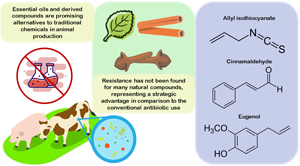
As an alternative to the treatment of both bacteria and resistant parasites, the use of essential oils (EOs), which can also be later processed into purified compounds, has been evaluated (Shen et al., Reference Shen, Ni, Thakur, Zhang, Hu and Wei2021; Zhang et al., Reference Zhang, Wang, Shen, Thakur, Zhang, Hu and Wei2021). For instance, in vitro tests using 1 mg ml−1 of Ruta chalepensis (fringed rue) flower EO showed positive effects (87.5% efficacy) leading to the death of H. contortus larvae, whilst 1 mg ml−1 albendazole had relatively lower beneficial effects (75% of efficacy) (Akkari et al., Reference Akkari, Ezzine, Dhahri, B'chir, Rekik, Hajaji, Darghouth, Jamâa and Gharbi2015). Cuminum cyminum oil (cumin) was responsible for 99% ovicidal activity in Fasciola hepatica, using a concentration of 0.03 mg ml−1 (Silva et al., Reference Silva, Zehetmeyr, Pereira, Pacheco, Freitag, Pinto, Machado, Villarreal Villarreal, de Oliveira Hubner, Aires Berne and da Silva Nascente2020), which is a parasite that has been found resistant to albendazole (Ceballos et al., Reference Ceballos, Canton, Pruzzo, Sanabria, Moreno, Sanchis, Suarez, Ortiz, Fairweather, Lanusse, Alvarez and Valladares2019). For bacteria, tested EOs also show good results against human and animal pathogens, such as Melaleuca alternifolia (tea tree) (Silva et al., Reference Silva, de Figueiredo, Stamford and da Silva2019), Syzygium aromaticum (clove), Cinnamomum cassia (Chinese cinnamon) (Khaleque et al., Reference Khaleque, Keya, Hasan, Hoque, Inatsu and Bari2016), Cinnamomum zeylanicum (true cinnamon tree), Origanum vulgare (oregano), Thymus vulgaris (thyme) (Mazzarrino et al., Reference Mazzarrino, Paparella, Chaves-López, Faberi, Sergi, Sigismondi, Compagnone and Serio2015), and Brassica nigra (black mustard) EO – composed mainly of allyl isothiocyanate, that has one of the greatest antimicrobial potentials among the essential oil compounds (EOCs) studied (Clemente et al., Reference Clemente, Aznar, Silva and Nerín2016; Reyes-Jurado et al., Reference Reyes-Jurado, Cervantes-Rincón, Bach, López-Malo and Palou2019).
To be able to consider their use in animals, there must be little or no interference in the beneficial animal microbiota (Ambrosio et al. (Reference Ambrosio, de Alencar, de Sousa, Moreno and Da Gloria2017). Understanding of EO mechanisms of action is still lacking, but in general, some of the reported effects are the impairment of cell membrane integrity (e.g., cinnamaldehyde, present in cinnamon EO); the inhibition of protein synthesis (e.g., thyme EO); and the inhibition of genetic material repair (e.g., the effect observed in E. coli through phenolic compounds and terpenes, which can also affect the transfer of electrons in cellular respiration) (Ju et al., Reference Ju, Xie, Guo, Cheng, Qian and Yao2019).
This review aims to compile information about EO and EOC, covering their use as alternatives to antimicrobials and antiparasitics, evaluating their mechanisms of action, critically analyzing the information available about this topic, as well as to identify knowledge gaps in the available literature.
EO and EOC mechanisms of action as antiparasitic and antimicrobial agents
Mechanisms of action differ among EOs and EOCs (Table 1). In general, scientific studies found in the literature show that the main bactericidal activity occurs through plasmic membrane damage with extravasation of intracellular content, or an increase in its permeability (Lin et al., Reference Lin, Preston and Wei2000; Bischoff et al., Reference Bischoff, Wicklow, Jordan, De Rezende, Liu, Hughes and Rich2009; Hemaiswarya and Doble, Reference Hemaiswarya and Doble2009; Bassolé et al., Reference Bassolé, Lamien-Meda, Bayala, Tirogo, Franz, Novak, Nebié and Dicko2010; Tyagi and Malik, Reference Tyagi and Malik2012; Shen et al., Reference Shen, Zhang, Yuan, Lin, Xu and Ye2015; Xu et al., Reference Xu, Liu, Hu and Cao2016; Wang et al., Reference Wang, Wei, Song, Jiang, Tian, Yi, Yu, Song, Sun, Bao, Wu, Huang and Li2017; Zhang et al., Reference Zhang, Ye, Zhang, Pan, Sun and Cao2017a, Reference Zhang, Shen, Zhang, Song, Wang, Shang, Yue, Qu, Li, Wu, Zheng, Aditya, Wang, Xu and Wu2017b; Bouyahya et al., Reference Bouyahya, Abrini, Dakka and Bakri2019; Cui et al., Reference Cui, Zhang, Li and Lin2019; Hu et al., Reference Hu, Li, Dai, Cui and Lin2019; Churklam et al., Reference Churklam, Chaturongakul, Ngamwongsatit and Aunpad2020; Liu et al., Reference Liu, Cai, Chen, Zhong, Hou, Chen and Chen2020, Reference Liu, Kang and Liu2021). Other effects observed were the inhibition of metabolic and genetic pathways and damage to genetic material (Cui et al., Reference Cui, Zhang, Li and Lin2019; Hu et al., Reference Hu, Li, Dai, Cui and Lin2019; Wang et al., Reference Wang, Shen, Thakur, Han, Zhang, Hu and Wei2020; Liu et al., Reference Liu, Kang and Liu2021), morphological changes (Clemente et al., Reference Clemente, Aznar, Silva and Nerín2016), antibiofilm effects (Bouyahya et al., Reference Bouyahya, Abrini, Dakka and Bakri2019; Liu et al., Reference Liu, Kang and Liu2021), and anti-quorum sensing activity (Clemente et al., Reference Clemente, Aznar, Silva and Nerín2016). The accumulation of monoterpenes and phenylpropanoids (compounds present in many EOs) in the lipid part of the plasma membrane was responsible for destabilizing the structure of the phospholipid bilayer, depolarizing it, and increasing its permeability, compromising its proper functioning, and eventually causing cell death (Hammer and Heel, Reference Hammer and Heel2012).
Effects of essential oils and isolated compounds on bacteria of relevance to animal production

ND, Not determined.
Carvacrol, the major compound from oregano EO, caused the disruption of the cell membrane and increased transmembrane permeability (Cui et al., Reference Cui, Zhang, Li and Lin2019). This is supported by the presence of free genetic material in the culture medium of treated groups and the increased concentration of carvacrol in the cytoplasm. Anti-quorum sensing activity and inhibition of peptidoglycan synthesis, which avoids repair and maintenance of the cell wall structure, were also reported (Bouyahya et al., Reference Bouyahya, Abrini, Dakka and Bakri2019; Ni et al., Reference Ni, Wang, Shen, Thakur, Han, Zhang, Hu and Wei2021). Similar to carvacrol, Zingiber officinale (ginger) EO presented a membrane-related effect against E. coli and Staphylococcus aureus. The EO also caused metabolism disturbance, compromising the citric acid cycle, and inhibiting DNA repair and replication mechanisms (Wang et al., Reference Wang, Shen, Thakur, Han, Zhang, Hu and Wei2020).
The diversity of compounds present in EOs is extremely high. As an example, Pinus spp. (pine) EO was identified with 116 constituents, mostly belonging to the terpene class (Mitić et al., Reference Mitić, Jovanović, Jovanović, Mihajilov-Krstev, Stojanović-Radić, Cvetković, Mitrović, Marin, Zlatković and Stojanović2018). In the EO of some plants, the prevailing terpene is limonene, a compound that has anthelmintic activity on H. contortus and is bactericidal for Salmonella Paratyphi A and Pseudomonas luteola, with a moderate effect on Enterococcus faecalis. The mechanism of limonene is still not fully understood, but studies show that it can destroy cell integrity and cell wall structure of bacteria through an increase in conductivity and the leakage of intracellular biomacromolecules (nucleic acids and proteins) (Squires et al., Reference Squires, Foster, Lindsay, Caudell and Zajac2010; Han et al., Reference Han, Sun and Chen2019; Yazgan et al., Reference Yazgan, Ozogul and Kuley2019).
The action of EO depends on different mechanisms inherent to each compound present or the association of mechanisms from the distinctive compounds, making it difficult to elucidate the exact pathways in which these complex solutions work. The resolution of this knowledge gap is of utmost importance, due to the growing need for alternatives to antimicrobial compounds. Another aggravating factor is the lack of adequate methodologies for identifying mechanisms of antimicrobial activity. Many studies use minimal inhibitory concentrations (MICs) and neglect effects that may not even have been documented because they appeared before the MIC was reached and the occurrence of morphologic alterations occurred in a way in which metabolic dysfunctions and genomic alterations become less noticeable.
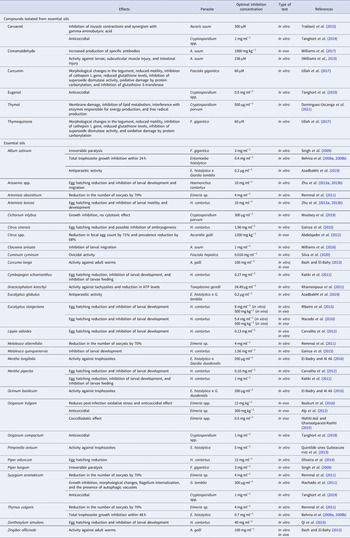
EOs and EOCs are also used to control parasites (Table 2). Cinnamaldehyde, for example, had its mechanism of action against Caenorhabditis elegans – a free-living nematode used as a model organism – based on an interference of several genes that regulate the expression of glutathione, inhibiting the metabolism of xenobiotics, and leading to death of the organism (Lu et al., Reference Lu, Shu, Chen, Yang, Ma, Zhu and Shi2020).
Effects of essential oils and isolated compounds on parasites of relevance in animal production

Many compounds were studied, but only a few had proven antiparasitic effects (Tavares-Dias, Reference Tavares-Dias2018), and little is known about their mechanisms of action against these pathogens. Although many studies have shown effectiveness (Camurça-Vasconcelos et al., Reference Camurça-Vasconcelos, Bevilaqua, Morais, Maciel, Costa, Macedo, Oliveira, Braga, Silva and Vieira2007; Ji et al., Reference Ji, Lu, Kang, Wang and Chen2012; De Aquino Mesquita et al., Reference De Aquino Mesquita, E Silva Júnior, Panassol, De Oliveira, Vasconcelos, De Paula and Bevilaqua2013; De Moraes et al., Reference De Moraes, Almeida, Brito, Marques, Lima, De Sousa, Nakano, Mendonça and Freitas2013; Godinho et al., Reference Godinho, Aleixo De Carvalho, Barbosa De Castro, Dias, Pinto, Crotti, Pinto, De Moraes and Da Silva Filho2014; Qi et al., Reference Qi, Wang, Dai and Zhu2015; Fabbri et al., Reference Fabbri, Maggiore, Pensel, Denegri and Elissondo2020), some compounds may exhibit an in vitro effect but have little or no activity in vivo. For example, artemisinin, derived from Artemisia annua (sweet wormwood) EO, was tested in rodents to evaluate its action against H. contortus, where it showed no beneficial effects (Squires et al., Reference Squires, Ferreira, Lindsay and Zajac2011). Even though it does not affect this parasite, the possibility of presenting effects against other species was not excluded, requiring further in vivo research.
Encapsulated EO and EOC forms usually stand out over their free forms, due to greater resistance to stomach acids and increased bioaccessibility, which improves their absorption. In addition, capsules can mask adverse sensory effects, improving palatability characteristics (Lu et al., Reference Lu, Li and Huang2019; Amiri et al., Reference Amiri, Afsharmanesh, Salarmoini, Meimandipour, Hosseini and Ebrahimnejad2020).
Most of the studies found in this literature review only present the inhibitory activity of EOs against the parasites tested. However, it is essential to improve the current knowledge of how inhibition works to enhance parasite-control techniques that use these compounds. Some of the works showed morphologic changes, such as damage to the integument (Machado et al., Reference Machado, Dinis, Salgueiro, Custódio, Cavaleiro and Sousa2011; Ullah et al., Reference Ullah, Rehman, Zafeer, Rehman, Khan, Khan, Khan, Khan and Abidi2017; Woolsey et al., Reference Woolsey, Valente, Williams, Thamsborg, Simonsen and Enemark2019; Dominguez-Uscanga et al., Reference Dominguez-Uscanga, Aycart, Li, Witola and Andrade Laborde2021), reduction in the numbers of hatching of eggs (Macedo et al., Reference Macedo, Bevilaqua, de Oliveira, Camurça-Vasconcelos, Vieira, Oliveira, Queiroz-Junior, Tomé and Nascimento2010; Katiki et al., Reference Katiki, Chagas, Bizzo, Ferreira and Amarante2011; Carvalho et al., Reference Carvalho, Chagas, Cotinguiba, Furlan, Brito, Chaves, Stephan, Bizzo and Amarante2012; Ribeiro et al., Reference Ribeiro, Macedo, dos Santos, de Oliveira, Camurça-Vasconcelos, de Paula and Bevilaqua2013; Zhu et al., Reference Zhu, Dai, Yang and Qiu2013a, Reference Zhu, Dai, Yang and Qiu2013b; Oliveira et al., Reference Oliveira, Vieira, Nunes, Ruas, Duarted, Moreira, Kaplan and Martins2014; Gaínza et al., Reference Gaínza, Domingues, Perez, Rabelo, López and Chagas2015; Qi et al., Reference Qi, Wang, Dai and Zhu2015), inhibition or reduction of motility (Singh et al., Reference Singh, Kumar, Tandan and Mishra2009; Zhu et al., Reference Zhu, Dai, Yang and Qiu2013a, Reference Zhu, Dai, Yang and Qiu2013b; Ullah et al., Reference Ullah, Rehman, Zafeer, Rehman, Khan, Khan, Khan, Khan and Abidi2017), and changes in the genetic material and inhibition of metabolic pathways (Machado et al., Reference Machado, Dinis, Salgueiro, Custódio, Cavaleiro and Sousa2011; Ullah et al., Reference Ullah, Rehman, Zafeer, Rehman, Khan, Khan, Khan, Khan and Abidi2017; Dominguez-Uscanga et al., Reference Dominguez-Uscanga, Aycart, Li, Witola and Andrade Laborde2021; Khamesipour et al., Reference Khamesipour, Razavi, Hejazi and Ghanadian2021), but there is a lack of research that addresses in vivo tests and different application techniques for the use of these compounds, which are needed before they become feasible techniques for animal management.
The development of EO resistance is improbable, due to the multifactorial nature of their mechanisms caused by this diversity in substances. This is an advantage in opposition to EOCs which are more susceptible to the development of resistance and have a higher cost of production and purification. On the other hand, EOCs usually require lower concentrations for bacterial inhibition in comparison to EOs, which reduces sensory alterations in animal feed or drinking water and improves palatability (Janz et al., Reference Janz, Morel, Wilkinson and Purchas2007; Franz et al., Reference Franz, Baser and Windisch2010). When animals are treated with either EOs or EOCs, they must be closely monitored during the initial administration to assess the efficacy of these treatments and to promote a healthy transition from conventional drugs.
Zootechnical benefits of EOs and EOCs
The beneficial effects of EOs and EOCs, in addition to promoting the biosafety of breeding stock, are also reflected in the zootechnical indexes and may act to replace performance-enhancing additives. Moreover, Hernández-Coronado et al. (Reference Hernández-Coronado, Silva-Vázquez, Rangel-Nava, Hernández-Martínez, Kawas-Garza, Hume and Méndez-Zamora2019) showed improved sensory evaluation of chicken meat when EO extracted from Poliomintha longiflora (rosemary-mint) (400 mg l−1) was used as an additive to chicken feed.
The addition of nanoencapsulated cumin EO with chitosan at a concentration of 200 mg kg−1 in broiler feed resulted in better body weight gain (BWG) and feed conversion ratio when compared to flavomycin at 650 mg kg−1 (Amiri et al., Reference Amiri, Afsharmanesh, Salarmoini, Meimandipour, Hosseini and Ebrahimnejad2020). The use of Eucalyptus globulus (southern blue gum) EO, promoted dose-dependent effects; for instance, it was able to promote the growth of beneficial microbiota and reduce the E. coli population. Moreover, it caused an increase in organic matter digestibility, which can lead to an increase in the absorption of nutrients, a decreased serum cholesterol, and increased superoxide dismutase activity. All these factors improved BWG and feed conversion, while cholesterol reduction enhanced the nutritional profile of the meat produced, and antioxidant activity was enhanced by superoxide dismutase inhibiting free radicals (Mohebodini et al., Reference Mohebodini, Jazi, Ashayerizadeh, Toghyani and Tellez-Isaias2021).
When fed to Japanese quail, S. aromaticum (clove) EO, at a concentration of 1.5 ml kg−1, increased growth performance indices due to observed antioxidant effects and increased levels of insulin, somatotropin (growth hormone), and thyroxine (Hussein et al., Reference Hussein, Abd El-Hack, Mahgoub, Saadeldin and Swelum2019). In mammals, the effect of an oil blend (300 mg kg−1 starter) composed of Rosmarinus officinalis (rosemary), Zataria multiflora (Shirazi thyme) and Mentha pulegium (pennyroyal) (1:1:1) in calves showed an 11.5% body weight increase compared to the control group (Jeshari et al., Reference Jeshari, Riasi, Mahdavi, Khorvash and Ahmadi2016). A thymol and cinnamaldehyde blend (0.05 g kg−1 feed) was evaluated in piglets, and the experiment revealed bactericidal and immunomodulatory effects, a decrease in mucosal macrophages, and a reduction in intestinal inflammation by the suppression of interleukin expression (Jiang et al., Reference Jiang, Awati, Agazzi, Vitari, Ferrari, Bento, Crestani, Domeneghini and Bontempo2015). Another experiment was carried out in calves using a mix (300 mg day−1) of Thymus kotschyanus (thyme), Lavandula angustifolia (lavender), Salvia officinalis (common sage), and Capparis spinosa (caper bush) EOs, and showed an optimization of the animals' performance (59.1 kg control group final body weight and 62.3 kg EO group final body weight) due to the antioxidant and bactericidal effects (Asghari et al., Reference Asghari, Abdi-Benemar, Maheri-Sis, Salamatdoust-Nobar, Salem, Zamanloo and Anele2021).
According to the data presented, the use of EOs in the development of biotechnological alternatives to conventional treatments is largely plausible. In addition, EOs can also act as immunomodulators, detoxifiers, performance enhancers, and are highly versatile compounds (Lopes et al., Reference Lopes, Fontoura, Oliveira, Rizzo, Silveira and Streck2020; Evangelista et al., Reference Evangelista, Corrêa, Pinto and Luciano2021).
EO and EOC use with conventional antimicrobial and anthelmintic therapy
EOs present remarkable aromas and flavors, which can reduce their feasibility as commercial products. To circumvent this problem, EO associations with traditional medicines or other bioactive compounds can be used to reduce their recommended doses if they have an additive or synergistic effect. This combination can significantly reduce the necessary dosage of EOs, consequently mitigating changes in sensory properties (Sharma et al., Reference Sharma, Guleria, Razdan and Babu2020). Although research involving the combination of EOs with conventional drugs still has unknown mechanisms of interactions, the results have shown synergisms and reductions in the appearance of antimicrobial/antiparasitic resistance (Lahmar et al., Reference Lahmar, Bedoui, Mokdad-Bzeouich, Dhaouifi, Kalboussi, Cheraif, Ghedira and Chekir-Ghedira2017).
In vitro studies conducted by Ait Dra et al. (Reference Ait Dra, Ait Sidi Brahim, Boualy, Aghraz, Barakate, Oubaassine, Markouk and Larhsini2017) showed a synergistic effect between gentamicin or ciprofloxacin associated with Periploca laevigata (cornicabra) EO against S. aureus and E. coli. Combination of Foeniculum vulgare (fennel) and antibiotics (cefoxitin, mupirocin, cotrimoxazole, or ciprofloxacin) showed synergism against S. aureus, with a significant increase in the inhibition zones, especially with mupirocin combination, with an increase from 30 mm to approximately 42 mm of diameter (Kwiatkowski et al., Reference Kwiatkowski, Mnichowska-Polanowska, Pruss, Masiuk, Dzięcioł, Giedrys-Kalemba and Sienkiewicz2017). Ciprofloxacin combined with Lavandula maroccana (lavender) EO resulted in a 4-fold MIC decrease for E. coli, 16-fold for S. aureus, and 8-fold for Pseudomonas aeruginosa (Soulaimani et al., Reference Soulaimani, Nafis, Kasrati, Rochdi, Mezrioui, Abbad and Hassani2019).
A multidrug-resistant strain of Acinetobacter baumannii was exposed to polymyxin B at 1 μg ml−1 and was able to grow during the entire evaluation period (25 h) up to a maximum population of ~10 log CFU ml−1. When the strain was exposed to the same concentration of Polymyxin B with 0.5 μg ml−1 of Eucalyptus camaldulensis (river red gum) EO, the population reached levels below the experimental detection limit (2 log CFU ml−1) in 6 h. In the same period, the treatment with Polymyxin B alone presented a population of over 7 log CFU ml−1 (Knezevic et al., Reference Knezevic, Aleksic, Simin, Svircev, Petrovic and Mimica-Dukic2016).
Although EOs present antiparasitic effects, there is little information about their association with classical drugs. The only article found about this particular subject showed an association between thymol and albendazole in vivo; nevertheless, this combination did not obtain satisfactory results, even with in vitro data attesting to the potential of the combination (Miró et al., Reference Miró, e Silva, Viviani, Luque, Lloberas, Costa-Júnior, Lanusse, Virkel and Lifschitz2020).
Most farmers have not adopted the use of natural alternatives in countries where classical drugs are still allowed as growth promoters. The well-known effect caused by antibiotics and antiparasitic drugs in animal production, their relatively low prices and their ease to use are still stronger arguments to the producers than the problems that they may cause to the environment and public health (Ryan, Reference Ryan2019). Therefore, a gradual transition from the current form of treatment to an approach that uses the association of natural compounds may educate producers and build trust that these molecules can improve zootechnical indices, enhance feed palatability, and reduce the need for conventional drugs.
Conclusion
EOs and EOCs have great potential to be used in animal production, with several benefits over conventional treatments. They have provided reductions of antimicrobial and anthelmintic resistance, a more effective treatment against resistant organisms, and when used in combination with traditional products, several compounds presented synergisms that substantially reduced the dose required to achieve the desired effect.
The application is not limited to microbiological and parasitic control, EOs and EOCs also show good results as performance-enhancers in animal production. There is still a dearth of scientific literature about animal applications complementary to in vivo testing, as well as further elucidation about mechanisms of action, recommended doses, synergistic effects, and supplementation vehicles to maximize their activities and thus reach their best potential.
Acknowledgments
The authors would like to thank the Technological Initiation Scholarship granted by Pontifícia Universidade Católica do Paraná (PAIT201073), and the scholarships provided by the National Council for Research and Development (Processes 308598/2020-2 and 142196/2019-3).
Conflict of interest
The authors declare that there are no conflicts of interest in the execution and publication of this manuscript.