INTRODUCTION
Tropical lowland forests are very complex in structure (Richards Reference RICHARDS1996). In general, the term ‘forest structure’ is used to describe the architecture, organization, composition or abundance of the different assemblages occurring in forests. Forest structure encompasses many components that can be described in numerous ways (Bongers Reference BONGERS2001, Spies Reference SPIES1998); however, most papers describing forest structure have focused on few tree variables, mainly maximum canopy height, stem density and basal area (Ashton & Hall Reference ASHTON and HALL1992, Clark & Clark Reference CLARK and CLARK2000, DeWalt & Chave Reference DEWALT and CHAVE2004, Killeen et al. Reference KILLEEN, JARDIM, MAMANI and ROJAS1998, Poorter et al. Reference POORTER, HAWTHORNE, BONGERS and SHEIL2008). In this paper we analyse 15 forest structural variables related to tree height, crown position, diameter distribution and liana load and focus on three woody life forms (trees, palms and lianas). These life-forms are key components of tropical forests because they largely determine the structure, biomass and diversity of these forests (Gentry Reference GENTRY, Putz and Mooney1991, Schnitzer & Bongers Reference SCHNITZER and BONGERS2002).
Several factors have been proposed to be strong drivers of forest structure in tropical regions, climate and soil being the most important ones (Clark & Clark Reference CLARK and CLARK2000, Malhi et al. Reference MALHI, PHILLIPS, LLOYD, BAKER, WRIGHT, ALMEIDA, ARROYO, FREDERIKSEN, GRACE, HIGUCHI, KILLEEN, LAURANCE, LEANO, LEWIS, MEIR, MONTEAGUDO, NEILL, NÚÑEZ VARGAS, PANFIL, PATIÑO, PITMAN, QUESADA, RUDAS-LL, SALOMAO, SALESKA, SILVA, SILVEIRA, SOMBROEK, VALENCIA, VÁSQUEZ MARTÍNEZ, VIEIRA and VINCETI2002, Murphy & Lugo Reference MURPHY and LUGO1986). For example, canopy height tends to be higher in wetter and less seasonal forests, but tends to be independent of soil fertility (Ashton & Hall Reference ASHTON and HALL1992, Swaine et al. Reference SWAINE, LIEBERMAN and HALL1990). Stem density and basal area of trees tend to be higher with a shorter dry season (Losos et al. Reference LOSOS, ASHTON, BROKAW, BUNYAVEJCHEWIN, CONDIT, CHUYONG, CO, DATTARAJA, DAVIES, ESUFALI, EWANGO, FOSTER, GUNATILLEKE, GUNATILLEKE, HART, HERNANDEZ, HUBBELL, ITOH, JOHN, KANZAKI, KENFACK, KIRATIPRAYOON, LAFRANKIE, LEE, LIENGOLA, LAO, LOSOS, MAKANA, MANOKARAN, NAVARRETE, OHKUBO, PÉREZ, PONGPATTANANURAK, SAMPER, SRI-NGERNYUANG, SUKUMAR, SUN, SURESH, TAN, THOMAS, THOMPSON, VALLEJO, VILLA MUÑOZ, VALENCIA, YAMAKURA, ZIMMERMAN, Losos and Leigh2004, Malhi et al. Reference MALHI, PHILLIPS, LLOYD, BAKER, WRIGHT, ALMEIDA, ARROYO, FREDERIKSEN, GRACE, HIGUCHI, KILLEEN, LAURANCE, LEANO, LEWIS, MEIR, MONTEAGUDO, NEILL, NÚÑEZ VARGAS, PANFIL, PATIÑO, PITMAN, QUESADA, RUDAS-LL, SALOMAO, SALESKA, SILVA, SILVEIRA, SOMBROEK, VALENCIA, VÁSQUEZ MARTÍNEZ, VIEIRA and VINCETI2002). A comparison of four Neotropical lowland forests showed that stem density and basal area tended to be higher on less fertile soils while richer soils were characterized by a low tree but high palm density (DeWalt & Chave Reference DEWALT and CHAVE2004). Relationships between soil fertility and density of lianas are equivocal, as a positive relationship was found in Amazonian and Malaysian forests (DeWalt et al. Reference DEWALT, ICKES, NILUS, HARMS and BURSLEM2006, Laurance et al. Reference LAURANCE, PÉREZ-SALICRUP, DELAMÓNICA, FEARNSIDE, D'ANGELO, JEROZOLINSKI, POHL and LOVEJOY2001, Putz & Chai Reference PUTZ and CHAI1987) but no relationship in other tropical forests (DeWalt & Chave Reference DEWALT and CHAVE2004, Ibarra-Manríquez & Martínez-Ramos Reference IBARRA-MANRÍQUEZ and MARTÍNEZ-RAMOS2002).
Large-scale patterns in forest structure and their underlying driving factors are less well-known (but see DeWalt & Chave Reference DEWALT and CHAVE2004, Lewis et al. Reference LEWIS, PHILLIPS, BAKER, LLOYD, MALHI, ALMEIDA, HIGUCHI, LAURANCE, NEILL, SILVA, TERBORGH, LEZAMA, MARTÍNEZ, BROWN, CHAVE, KUEBLER, VARGAS and VINCETI2004, Proctor et al. Reference PROCTOR, ANDERSON, CHAI and VALLACK1983), because studies describing forest structure included only one site (Bongers et al. Reference BONGERS, POPMA, MEAVE DEL CASTILLO and CARABIAS1988, Milliken Reference MILLIKEN1998, Newbery et al. Reference NEWBERY, CAMPBELL, LEE, RIDSDALE and STILL1992, Poulsen et al. Reference POULSEN, TUOMISTO and BALSLEV2006) or studies quantifying the drivers included mostly one driver only, e.g. climate (Takyu et al. Reference TAKYU, KUBOTA, AIBA, SEINO and NISHIMURA2005, Vieira et al. Reference VIEIRA, BARBOSA, CAMARGO, SELHORST, DA SILVA, HUTYRA, CHAMBERS, BROWN, HIGUCHI, DOS SANTOS, WOFSY, TRUMBORE and MARTINELLI2004) or soil (Faber-Langendoen & Gentry Reference FABER-LANGENDOEN and GENTRY1991, Nebel et al. Reference NEBEL, KVIST, VANCLAY, CHRISTENSEN, FREITAS and RUIZ2001, Paoli et al. Reference PAOLI, CURRAN and SLIK2008). Understanding the patterns and causes of spatial variation in forest structure is important to understand the history and function of forest ecosystems.
Bolivia provides an ideal setting to study vegetation–environment relationships because it covers an extraordinary display of vegetation types and soil heterogeneity across a rainfall gradient (Toledo et al. Reference TOLEDO, POORTER, PEÑA-CLAROS, ALARCÓN, BALCÁZAR, CHUVIÑA, LEAÑO, LICONA, TER STEEGE and BONGERS2011a). We use data from 89 200 stems ≥ 10 cm dbh from 220 1-ha plots, distributed over an area of c. 160 000 km2, to analyse the independent effects of climate and soil on the structure of tropical lowland forests. We predict that stem density and basal area of trees and palms will increase with water and nutrient availability because higher resource availability permits more stems to coexist; and we predict that liana density will increase in drier forests due to its dry-season advantage (Schnitzer Reference SCHNITZER2005). To our knowledge, this is the largest study in the Neotropics doing broad-scale comparisons of forest structure considering both environmental factors.
METHODS
Study area
The 220 1-ha plots were established in old-growth forests in lowland Bolivia (10°–18°S, 59°–69°W) between 1995 and 2007 by various projects and forestry concessionaries (see Acknowledgements for more details). For a map of Bolivia and the spatial location of the plots, see Toledo et al. (Reference TOLEDO, POORTER, PEÑA-CLAROS, ALARCÓN, BALCÁZAR, CHUVIÑA, LEAÑO, LICONA, TER STEEGE and BONGERS2011a). Currently, the network of plots is being coordinated and managed by the Instituto Boliviano de Investigación Forestal (IBIF). Nearly all plots are in upland forests (terra firme; only 5% of the plots were found in areas with seasonal flooding), generally on flat terrain (20% in slopes of hilly areas), and in an altitude range of 100–500 m asl. The selected plots are distributed along a climatic gradient in lowland Bolivia where the precipitation can vary from 600 to 3000 mm y−1 from the driest to wettest areas (based on at least 30 y data, Servicio Nacional de Meteorología e Hidrología – SENAMHI, unpubl. data). In general, this area experiences a 4–7-mo-long dry period (e.g. precipitation < 100 mm mo−1), mostly from April to October, corresponding to the austral winter. Mean annual temperature is between 24 °C and 26 °C. Soils in lowland Bolivia are variable (Gerold Reference GEROLD, Ibisch and Mérida2003), due to differences in geomorphology and geological history. The north contains the wide fluvial plain of the Amazon basin, in the west the relatively young landscapes of the Andean foothills occur, while in the east ancient rocks of the Pre-Cambrian Shield abound (Suárez-Soruco Reference SUÁREZ-SORUCO2000). For the average and range of environmental conditions, see Toledo et al. (Reference TOLEDO, POORTER, PEÑA-CLAROS, ALARCÓN, BALCÁZAR, LEAÑO, LICONA, LLANQUE, VROOMANS, ZUIDEMA and BONGERS2011b).
Environmental data
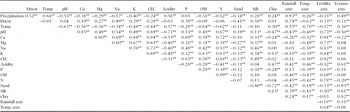
For each plot we obtained five climatic variables, interpolated from available data from 45 weather stations in the region, and 14 edaphic variables obtained from a composite soil sample from the first 30 cm of soil depth, from 20 locations in each plot. More details of soil analysis and climate interpolation can be found in Toledo (Reference TOLEDO2010). To summarize these often highly correlated environmental data we performed two Principal Component Analyses (PCAs). One PCA was done using five climatic variables; annual temperature, annual precipitation, the sum of precipitation from three driest months and the length of the dry period (< 100 mm of precipitation mo−1) and the drought period (<50 mm mo−1). A second PCA was done using 12 edaphic variables (CEC, Ca, K, M, Na, P, OM, N, acidity, sand, silt and clay). The first two axes resulting from these PCAs were used as the four main environmental axes in the analysis below. The first climatic axis (hereafter rainfall axis) explained 65% of the variation and correlated positively with the annual precipitation and negatively with the dry period. The second climatic axis (hereafter temperature axis) explained 29% and correlated positively with the mean annual temperature and negatively with the precipitation in the driest months. The first edaphic axis (hereafter soil fertility axis) explained 48% and correlated positively with soil fertility variables (CEC, Ca, Mg, Na, K, P, OM and N), and negatively with acidity. The second edaphic axis (hereafter soil texture axis) explained 20% and correlated positively with clay and silt, and negatively with sand content. The rainfall axis was weakly and negatively related to the soil fertility axis, but strongly and positively to the soil texture axis (Appendix 1). These results indicate that in high rainfall areas the soil were less fertile and had a higher silt and clay content. Although in general drier forests tended to have higher soil fertility than moister forests, some plots in moist areas had also soils with high fertility. These latter plots were all situated in the foothills of the Andes, which are from a younger geological origin, and hence more fertile (Toledo et al. Reference TOLEDO, POORTER, PEÑA-CLAROS, ALARCÓN, BALCÁZAR, CHUVIÑA, LEAÑO, LICONA, TER STEEGE and BONGERS2011a).
Forest data
Most plots were square (100 × 100 m) but 11 were rectangular (20 × 500 m). Each tree and palm ≥ 10 cm diameter at breast height (dbh; measured at 130 cm or higher when buttresses were present) was measured for its diameter, tagged and identified following standard protocols (Alder & Synnott Reference ALDER and SYNNOTT1992, Contreras et al. Reference CONTRERAS, LEAÑO, LICONA, DAUBER, GUNNAR, HAGER and CABA1999). The crown position of each individual was scored into one of five categories: (1) no direct light, (2) some side light, (3) some overhead light, (4) full overhead light and (5) emergent crown (Dawkins & Field Reference DAWKINS and FIELD1978). Each individual stem was scored into one of four categories of liana infestation: (0) without lianas, (1) lianas only on the trunk, (2) liana partially in trunk and crown, and (3) completely covered with lianas (Contreras et al. Reference CONTRERAS, LEAÑO, LICONA, DAUBER, GUNNAR, HAGER and CABA1999). In addition to these variables, the height of the tallest individual in the plot (hereafter heightmax) was measured with a clinometer for 90% of the plots.
Based on the field data we calculated 15 variables to describe forest structure. The vertical structure was described using four variables: the heightmax and the percentage of individuals in three forest layers (emergent, canopy and subcanopy). The emergent layer consists of all individuals with emergent crown, the canopy layer consists of all individuals with full and some overhead light, and the subcanopy layer consists of all individuals with either some or no side light. The horizontal structure was described using six variables: total basal area, tree basal area, palm basal area, median stem diameter (dbh50), the 99 percentile of the stem diameter (dbh99) and the slope of the size-class frequency distribution at the stand level (hereafter size-class distribution – SCD). This slope was calculated by regressing the (log-transformed) number of individuals per diameter class of 10 cm width to the average diameter of each size class. Finally, the density of life forms was described using five variables: the abundance of all individuals per plot (total density), the tree density, the palm density, the density of stems with liana infestation (hereafter ‘liana-density’) and the mean liana infestation (calculated by averaging the degree of liana infestation of all trees in the plot). Although we did not measure the abundance of lianas directly, we inferred it from the latter two variables.
Data analysis
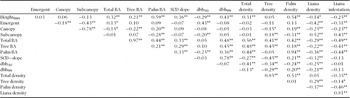
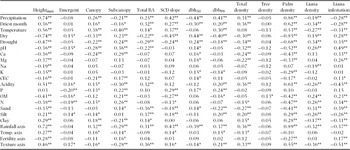
To investigate the effects of the environmental factors on forest structural variables we used a backward multiple regression, with the four main environmental axes as independent variables and each structural parameter as a dependent variable. Pearson correlations were used to evaluate how structural variables were associated amongst themselves (Appendix 2), and with environmental factors (Appendix 3). If necessary the data were logarithmic (log10)-, square root-, or arcsine- transformed to obtain normality. All statistical analyses and PCAs were performed with SPSS 15.0 for Windows (SPSS Inc.).
RESULTS
Variation in forest structure
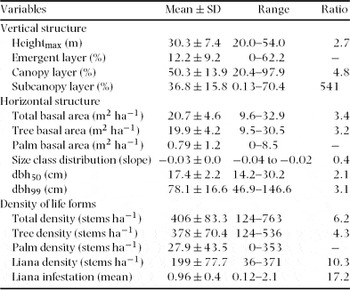
Forest structure varied considerably across the plots, with the largest variation in the subcanopy and emergent layers and in palm density (Table 1). In terms of vertical structure, the heightmax was on average 30 m (range = 20–54 m); on average 50% of the stems were in the canopy layer and only 12% in the emergent layer (range = 0%–62%). In terms of horizontal structure, the total basal area averaged 21 m2 ha−1 (range = 10–33 m2 ha−1), the dbh50 was 17 cm, and the dbh99 was 78 cm (range = 47–147 cm). Average total density was 406 stems ha−1 (range = 124–763 stems ha−1). Palms presented the largest variation in density among life forms (range = 0–353 stems ha−1) followed by lianas.
Mean (± SD) and ranges (minimum–maximum) of 15 structural variables (related to vertical structure, horizontal structure and density of life forms) from 220 1-ha permanent plots located in the lowlands of Bolivia. The ratio was calculated by dividing the maximum value by the minimum value, except for variables with zero values. Liana density refers to the number of trees infested with lianas, and is an indicator of liana abundance of the stand. Liana infestation indicates the average liana load of the trees.

Forest–environment relationships
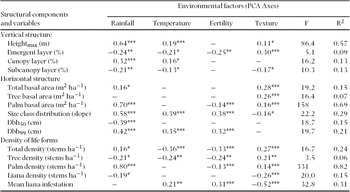
The backward multiple regression analysis showed that the rainfall axis was significantly related to 13 of the 15 forest structural variables studied, the soil texture axis to 12 of the variables and the temperature axis to nine variables (Table 2). To our surprise, the soil fertility axis was related to only eight forest structural variables. The variation explained by the backward regression models ranged from 6–82%. Palm density, palm basal area, heightmax and mean liana infestation were the forest structural variables best explained by the models (31–82%). Most of the forest structural variables were affected by a combination of both climatic and soil factors, tree basal area was only affected by soils and dbh50 was only affected by climate. Overall, climatic and edaphic factors had more positive effects than negative effects on the forest structural variables (Table 2).
Backward multiple regression of 15 structural variables on four environmental factors of 220 1-ha permanent plots located in lowland Bolivia. The standardized regression coefficient, F-value and coefficient of determination (R2) are provided. Significance levels are shown. * P < 0.05, ** P < 0.01, *** P < 0.001.

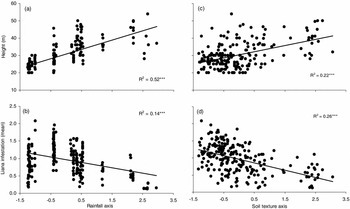
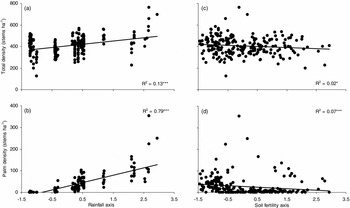
In Figures 1 and 2 we present bivariate relationships of selected forest structural variables with the rainfall and soil axes. Heightmax increased with rainfall and the silt content of the soils (Figure 1a, c). Liana infestation tended to decrease along the rainfall gradient and in plots with clay-silt soils (Figure 1b, d). Palm density increased significantly with rainfall, similar to total density (Figure 2a, b). While total and tree density were variable along the soil fertility gradient, the palm density was highest at intermediate level of soil fertility (Figure 2c, d).
Relationships of the PCA rainfall axis with heightmax (a) and liana infestation (b), and the PCA soil texture axis with heightmax (c) and liana infestation (d) of 220 1-ha plots located in lowland Bolivia. Regression lines, corresponding coefficient of determination (R2), and significance levels are shown. *** P < 0.001.

Relationships of the PCA rainfall axis with total density (a) and palm density (b), and the PCA soil fertility axes with total density (c) and palm density (d) of 220 1-ha plots located in lowland Bolivia. Regression lines, corresponding coefficient of determination (R2) and significance levels are shown. * P < 0.05, *** P < 0.001.

Annual temperature (from 24–26 °C) and altitude (100–480 m asl) were negatively correlated (Pearson r = –0.91, P < 0.001) and the variation of these variables among plots was small.
DISCUSSION
In this study we described how forest structure differed among Bolivian forests and we analysed how climatic and edaphic factors affect forest structure. Although all forest structural variables were significantly related to at least one environmental axis, the explained variation was generally low. Heightmax, total basal area, palm density and liana infestation responded more to this environmental variation, and our discussion will focus mostly on these forest structural variables.
Patterns in forest structure
In general, moister forests had taller stems, higher total basal area and palm density and lower liana abundance than drier forests. The maximum tree height in Bolivian lowland forests was 54 m; average maximum height in rain forests usually ranges between 45 and 55 m, although in some tropical rain forests individuals can reach over 60 m (Ashton & Hall Reference ASHTON and HALL1992, Richards Reference RICHARDS1996). Dry forests are smaller in stature and tend to have an even canopy (Murphy & Lugo Reference MURPHY and LUGO1986, Richards Reference RICHARDS1996, Swaine et al. Reference SWAINE, LIEBERMAN and HALL1990).
In our study the total basal area for individuals ≥ 10 cm dbh averaged 21 m2 ha−1 and ranged from 10 to 33 m2 ha−1 which is at the lower end of the range (20–70 m2 ha−1) found for tropical forests worldwide (de Gouvenain & Silander Reference DE GOUVENAIN and SILANDER2003, Losos et al. Reference LOSOS, ASHTON, BROKAW, BUNYAVEJCHEWIN, CONDIT, CHUYONG, CO, DATTARAJA, DAVIES, ESUFALI, EWANGO, FOSTER, GUNATILLEKE, GUNATILLEKE, HART, HERNANDEZ, HUBBELL, ITOH, JOHN, KANZAKI, KENFACK, KIRATIPRAYOON, LAFRANKIE, LEE, LIENGOLA, LAO, LOSOS, MAKANA, MANOKARAN, NAVARRETE, OHKUBO, PÉREZ, PONGPATTANANURAK, SAMPER, SRI-NGERNYUANG, SUKUMAR, SUN, SURESH, TAN, THOMAS, THOMPSON, VALLEJO, VILLA MUÑOZ, VALENCIA, YAMAKURA, ZIMMERMAN, Losos and Leigh2004). The variation of total basal area in tropical forests can be due to variation in stem density combined with variation in tree thickness. A high basal area can be the result of many slender stems or few thick stems (Bongers et al. Reference BONGERS, POPMA, MEAVE DEL CASTILLO and CARABIAS1988). In contrast, a low basal area could also result from disturbance by logging, wind and fire, directly affecting forest structure or indirectly through changing the floristic composition and consequently the forest structure (Spies Reference SPIES1998). Occurrence of cyclones can also temporarily increase tree density as shown in Africa and Madagascar (de Gouvenain & Silander Reference DE GOUVENAIN and SILANDER2003). In lowland Bolivia, we found several plots with lower tree density and basal area due to the massive abundance of some understorey herbs or shrubs (e.g. Phenakospermum guianense, Erythrochiton fallax, Metrodorea flavida and Pausandra trianae).
Palms are a striking feature of tropical forests, being very abundant and often even dominant, forming ‘oligarchic’ forests (Vormisto et al. Reference VORMISTO, SVENNING, HALL and BALSLEV2004). Some forests in lowland Bolivia had a relatively high palm density (48–353 palms ha−1) compared to other tropical forests: 103 palms ha−1 in Cocha Cashu, Peru (Gentry & Terborgh Reference GENTRY, TERBORGH and Gentry1990); 90–129 palms ha−1 in Bajo Calima, Colombia (Faber-Langendoen & Gentry Reference FABER-LANGENDOEN and GENTRY1991) and 11–115 palms ha−1 in La Selva, Costa Rica (Lieberman et al. Reference LIEBERMAN, LIEBERMAN, PERALTA and HARTSHORN1996). Higher palm density in Bolivia could be due to local dominance of palm-rich habitats such as flooded forests, where we found the highest palm densities.
Around 50% of all trees measured in our plots had some degree of liana infestation. Drier forests in Bolivia, as reported for other studies (Carse et al. Reference CARSE, FREDERICKSEN and LICONA2000, Pérez-Salicrup et al. Reference PÉREZ-SALICRUP, SORK and PUTZ2001, Uslar et al. Reference USLAR, MOSTACEDO and SALDIAS2004), had between 50% and 80% of their trees infested by lianas while moister forest had less than 50% (Licona-Vasquez et al. Reference LICONA-VASQUEZ, PEÑA-CLAROS and MOSTACEDO2007). Mascaro et al. (Reference MASCARO, SCHNITZER and CARSON2004) hypothesized that high palm abundance could negatively affect the regeneration, and consequently, the abundance of lianas in wet forests. Although we have found that in lowland Bolivia moister forests have lower liana density and higher palm density, lianas and palms respond independently to rainfall. Other components of forest structure, such as the amount of small-diameter stems and branches are important for liana support and success (Putz Reference PUTZ1984, Schnitzer & Bongers Reference SCHNITZER and BONGERS2002). Liana density tended to increase with the percentage of trees in the subcanopy layer and to decrease with increasing canopy height (Appendix 2). Similar results, more lianas in short trees and low canopies, were found in South Africa (Balfour & Bond Reference BALFOUR and BOND1993) and Panama (DeWalt et al. Reference DEWALT, SCHNITZER and DENSLOW2000). This result suggests that connected crowns of trees in lower canopies facilitate liana support and success.
Environmental effects on forest structure and trees
In the tropics, water availability is one of the most important environmental drivers of forest structure, function and dynamics (Malhi et al. Reference MALHI, PHILLIPS, LLOYD, BAKER, WRIGHT, ALMEIDA, ARROYO, FREDERIKSEN, GRACE, HIGUCHI, KILLEEN, LAURANCE, LEANO, LEWIS, MEIR, MONTEAGUDO, NEILL, NÚÑEZ VARGAS, PANFIL, PATIÑO, PITMAN, QUESADA, RUDAS-LL, SALOMAO, SALESKA, SILVA, SILVEIRA, SOMBROEK, VALENCIA, VÁSQUEZ MARTÍNEZ, VIEIRA and VINCETI2002, Murphy & Lugo Reference MURPHY and LUGO1986, Toledo et al. Reference TOLEDO, POORTER, PEÑA-CLAROS, ALARCÓN, BALCÁZAR, LEAÑO, LICONA, LLANQUE, VROOMANS, ZUIDEMA and BONGERS2011b). Water availability is determined by the amount and seasonal distribution of rainfall, and the water-retention capacity of soils. The importance of rainfall and water-retention capacity is underscored by the fact that they were the most important environmental determinants of forest structure in our study. The rainfall axis was significant in 87% of the cases, and the soil texture axis in 80%. Both environmental factors worked often in a similar direction, as indicated by the sign of the regression coefficient (Table 2). For example, forest height increased with rainfall and the water-holding capacity of the soils (e.g. clay and silt content). This confirms the hypothesis of Ashton & Hall (Reference ASHTON and HALL1992) that canopy height is mostly related to soil water supply. On the other hand, stem density, and consequently total basal area, was not related to water availability as we had hypothesized because higher resource availability should allow more stems to coexist. This lack of relationship was probably due to the fact that tree density and tree basal area were highly variable among both moist and dry forests.
Temperature and soil fertility factors had also the same direction for some structural variables. Both factors had positive effects on the size-class distribution, dbh99 and liana infestation; and negative effects on the emergent layer, total density and tree density. The temperature axis represents both the annual temperature as well as the precipitation of the three driest months. Whereas the annual temperature showed a stronger correlation with maximum height and the canopy and subcanopy strata, the precipitation of the three driest months showed a stronger correlation with total basal area and total density. Plots located in northern and southern Bolivia with higher annual temperature tended to have a higher percentage of trees in the canopy layer and a lower percentage of trees in the subcanopy layer. From the data available, we can state that higher temperature (and hence decreasing altitude) may increase tree stature. Plots located in western Bolivia with lower seasonality tended to have a higher total basal area and total stem density, the latter clearly being the result of a higher palm abundance.
Environmental effects on palms
The results for palm density supported our hypothesis that moister forests had more palms than drier forests, with the highest palm density being found in seasonally flooded forests. Although palms are widely distributed in the tropics and grow in a wide range of habitats, from upland and cleared forests to the slopes of mountains, some species tend to have a higher density in seasonally flooded forests (Kahn & Henderson Reference KAHN and HENDERSON1999, Velarde & Moraes Reference VELARDE and MORAES2008, Vormisto Reference VORMISTO2002). In lowland Bolivia, palm density peaked at an intermediate level of soil fertility. Similar results were found by Vormisto (Reference VORMISTO2002) in the Peruvian Amazonia, where the lowest palm density was found on the richest soils and the highest palm density at an intermediate level of fertility. In contrast, other studies reported higher palm density on richer soils (Gentry & Terborgh Reference GENTRY, TERBORGH and Gentry1990, Nebel et al. Reference NEBEL, KVIST, VANCLAY, CHRISTENSEN, FREITAS and RUIZ2001, Sesnie et al. Reference SESNIE, FINEGAN, GESSLER and RAMOS2009). In conclusion, palm density was found to be strongly determined by rainfall but still no clear pattern was found in relation to edaphic factors. This lack of a clear pattern suggests either that palms show a stronger relationship with soil properties at the species level (Clark et al. Reference CLARK, CLARK, SANDOVAL and CASTRO1995) than at the family level, or that other factor such as dispersal limitation are more important (Velarde & Moraes Reference VELARDE and MORAES2008).
Environmental effects on lianas
We hypothesized that lianas would have higher densities at low water availability due to their capacity for taking water from deep soil layers (Schnitzer Reference SCHNITZER2005). Liana density was indeed higher at low rainfall and on coarse soils with a low water-holding capacity. Although we did not measure liana abundance directly, our results are in line with those studies that show that lianas are more abundant in drier than in moister forests (DeWalt et al. Reference DEWALT, SCHNITZER, CHAVE, BONGERS, BURNHAM, CAI, CHUYONG, CLARK, EWANGO, GERWING, GORTAIRE, HART, IBARRA-MANRIQUEZ, ICKES, KENFACK, MACÍA, MAKANA, MARTÍNEZ-RAMOS, MASCARO, MOSES, MULLER-LANDAU, PARREN, PARTHASARATHY, PÉREZ-SALICRUP, PUTZ, ROMERO-SALTOS and THOMAS2010, Madeira et al. Reference MADEIRA, ESPÍRITO-SANTO, NETO, NUNES, AZOFEITA, FERNANDES and QUESADA2009, Parthasarathy et al. Reference PARTHASARATHY, MUTHURAMKUMAR and REDDY2004, Pérez-Salicrup et al. Reference PÉREZ-SALICRUP, SORK and PUTZ2001, Putz Reference PUTZ1984, Schnitzer Reference SCHNITZER2005, Swaine & Grace Reference SWAINE and GRACE2007). These results support the hypothesis that lianas have a growth advantage over trees in areas with a long dry season because of their deep and efficient root for taking water from deep soil layers and vascular systems (Schnitzer Reference SCHNITZER2005). A more simple explanation for high liana abundance in drier forests is that lianas are light demanding and take advantage of the higher light availability in the more open dry-forest canopy. A weak positive relationship between liana abundance and soil fertility was found in lowland Bolivia, with the highly fertile terra preta plots in Eastern Bolivia having one of the highest levels of liana infestation of trees (60–80%). Other studies also found that liana abundance increases slightly with soil fertility (Balfour & Bond Reference BALFOUR and BOND1993, Poulsen et al. Reference POULSEN, TUOMISTO and BALSLEV2006, Proctor et al. Reference PROCTOR, ANDERSON, CHAI and VALLACK1983, Putz & Chai Reference PUTZ and CHAI1987). Recently, phosphorus concentrations were found to be high in liana litter (Cai & Bongers Reference CAI and BONGERS2007), which suggests that lianas have the potential to enhance the availability of nutrients in areas where lianas are already abundant.
Concluding remarks
Rainfall and soil texture together determine plant water availability, and these were more important drivers of forest structure than soil fertility. Therefore, we consider that multiple, rather than single, environmental factors must be used to explain the forest structure in tropical forests. Compared with soil fertility (Clark & Clark Reference CLARK and CLARK2000, DeWalt & Chave Reference DEWALT and CHAVE2004, Nebel et al. Reference NEBEL, KVIST, VANCLAY, CHRISTENSEN, FREITAS and RUIZ2001, Paoli et al. Reference PAOLI, CURRAN and SLIK2008, White & Hood Reference WHITE and HOOD2004) modest attention has been given to soil texture as a driving factor (but see Jha & Singh Reference JHA and SINGH1990), although it is an important property that helps to determine the nutrient-supplying ability and the supply of water and air necessary for plant root activity (Brady Reference BRADY1990).
Our study supports earlier results indicating that forest structure is strongly influenced by climate (Clinebell et al. Reference CLINEBELL, PHILLIPS, GENTRY, STARK and ZUURING1995, Gentry Reference GENTRY1988, Murphy & Lugo Reference MURPHY and LUGO1986, ter Steege et al. Reference TER STEEGE, PITMAN, SABATIER, CASTELLANOS, VAN DER HOUT, DALY, SILVEIRA, PHILLIPS, VASQUEZ, VAN ANDEL, DUIVENVOORDEN, DE OLIVEIRA, EK, LILWAH, THOMAS, VAN ESSEN, BAIDER, MAAS, MORI, TERBORGH, VARGAS, MOGOLLÓN and MORAWETZ2003). Climatic conditions that determine the length of the growing season and intensity of rainfall may increase or decrease chemical and biological processes such as photosynthesis, respiration and soil nutrient availability (Saxe et al. Reference SAXE, CANNELL, JOHNSEN, RYAN and VOURLITIS2001). In these Bolivian forests climate is the strongest driver of forest structure (this paper), composition (Toledo et al. Reference TOLEDO, POORTER, PEÑA-CLAROS, ALARCÓN, BALCÁZAR, CHUVIÑA, LEAÑO, LICONA, TER STEEGE and BONGERS2011a) and dynamics (Toledo et al. Reference TOLEDO, POORTER, PEÑA-CLAROS, ALARCÓN, BALCÁZAR, LEAÑO, LICONA, LLANQUE, VROOMANS, ZUIDEMA and BONGERS2011b). As climate-change scenarios predict a decrease in rainfall and increase in dry-season length (IPCC 2007) we may expect potentially large changes in the structure and functioning of these and other tropical forests.
ACKNOWLEDGEMENTS
We are grateful to the field workers, researchers and forest managers of the different forestry companies, who have established and evaluated the permanent plots in La Paz (Ixiamas, San Pedro, AGROFOR), Pando (IMAPA, SAGUSA, CIMAGRO, MABET), Beni (Bolivia Mahogany, Fátima) and Santa Cruz (CIBAPA, Lago Rey, San Martín, CIMAL Guarayos, La Chonta, INPA, Velasco, San Miguel, San José and Sutó). We also thank the staff, researchers and technicians of the BOLFOR (I, II) and PANFOR projects, the Chimanes project, IBIF, FCBC, CFB, and Asociación PROMAB – UAB (RET and Verdum) who supported the plot establishment and monitoring, and provided logistical support. We also thank SENAMHI for the climate data. David Clark, and one anonymous reviewer gave valuable comments on a previous version of the manuscript. This study was supported by grants from the Netherlands Organization for the Advancement of Tropical Research-WOTRO (DC-Fellowship), the Russell E. Train Education for Nature – EFN/WWF, the International Foundation for Science-IFS and the Wageningen University and Research Centre (sandwich fellowship to MT).
Pearson correlations between climate variables, soil properties and environmental PCA axes. n = 220 * P ≤ 0.05, ** P ≤ 0.01. Driest = precipitation of the driest months, Temp = temperature, CEC = Cation Exchange Capacity, OM = organic matter.

Pearson correlations between forest structural variables. n = 220, * P ≤ 0.05, ** P ≤ 0.01. BA = basal area, SCD = size class distribution. dbh = diameter at breast height. See Table 1 for parameter details.

Pearson correlation coefficients of environmental variables and environmental axes with forest structural variables. n = 220, * P ≤ 0.05, ** P ≤ 0.01. dbh = diameter at breast height, SCD = Size−class distribution, BA = basal area, Temp. = temperature, CEC = Cation Exchange Capacity, OM = organic matter.