




No CrossRef data available.
Predisposing Factors and Situational Triggers: Exclusionary Reactions to Immigrant Minorities
Published online by Cambridge University Press: 27 February 2004
Abstract
This paper examines the bases of opposition to immigrant minorities in Western Europe, focusing on The Netherlands. The specific aim of this study is to test the validity of predictions derived from two theories—realistic conflict, which emphasizes considerations of economic well-being, and social identity, which emphasizes considerations of identity based on group membership. The larger aim of this study is to investigate the interplay of predisposing factors and situational triggers in evoking political responses. The analysis is based on a series of three experiments embedded in a public opinion survey carried out in The Netherlands (n=2007) in 1997–98. The experiments, combined with parallel individual-level measures, allow measurement of the comparative impact of both dispositionally based and situationally triggered threats to economic well-being and to national identity at work. The results show, first, that considerations of national identity dominate those of economic advantage in evoking exclusionary reactions to immigrant minorities and, second, that the effect of situational triggers is to mobilize support for exclusionary policies above and beyond the core constituency already predisposed to support them.
Information
- Type
- ARTICLES
- Information
- Copyright
- © 2004 by the American Political Science Association
Democratic politics in Western Europe faces a new challenge. In Austria, France, Germany, and Italy most dramatically, but throughout Western Europe more generally, the surge of immigration over the last decade has had major political repercussions. Politically, it has triggered intense debate about the nature of citizenship (Favell 1998), the rights of women (Okin 1999; Wikkan 2002), the claims—and limits—of multiculturalism (Barry 2001; Parekh 2000), even restrictions on the scope of free speech in order to promote group tolerance (Horton 1993; Modood 1993). Electorally, the traditional right has broadly benefited in a number of countries (e.g., Hitchcock 2002), and in some the extreme right has profited particularly, including the National Front in France, the National Alliance in Italy, and the Austrian Freedom Party in Austria (Mayer 2002; Sniderman et al. 2000; but see Kitschelt 1997).
The aim of this study is twofold. The first is to gauge the extent to which concerns over cultural and economic integration now drive reactions to immigrants and immigration in Western Europe. The second is to show how the dynamics of public responses to political issues follow from the interplay of two sets of factors, predisposing concerns and situational triggers. The specific way that these two factors operate in combination is a key to unexpected, large-scale electoral mobilization—in a word, to the flash potential of anti-immigrant politics.
THEORY AND HYPOTHESES
One of the oldest intuitions—it dates from at least Aristotle—is that conflict between groups is rooted in a clash of interests. Group interests can clash over a wide horizon of valued goods, including claims to social status and privileges (Blumer 1958, 4; Bobo and Hutchings 1996, 955). But on most realistic conflict interpretations, the core of group conflict is the clash of competing economic interests (Hardin 1995). In principle the calculus of economic advantage may operate at the individual or collective level, but in the theoretically best-developed interpretation of realistic conflict theory, people identify with a group because they have an individual interest in doing so (Hardin 1995, 48).
Social identity theory is now the principal theoretical alternative to realistic conflict theory (e.g., Brown 1995; Capozza and Brown 2000; and Huddy 2001).1
To be sure, there is a host of older theoretical approaches—for example, personality-based accounts of prejudice (e.g., Adorno et al. 1950) and social–structural accounts (e.g., Selznick and Steinberg 1969). We take account of other relevant factors below. For an excellent overview of a wide range of approaches, see Duckitt 1992.
Realistic conflict and social identity explanations need not be mutually exclusive. In all likelihood, concerns about both economic well-being and national identity underlie reactions to immigrant minorities in Western Europe, to some discernible extent. But the two theories point in different explanatory directions. Realistic conflict explanations concentrate on social–structural sources of group difference. They take the key explanatory mechanism to be economic competition. And they presume the driving motive is a desire to be materially better off. Social identity explanations concentrate on an array of group memberships. They take the key explanatory mechanism to be group categorization. And they presume the driving motive is a need for positive differentiation. Our understanding of the heart of the conflict over immigrant minorities, and what may be done to ease it, will differ depending how far strains over immigration turn on a conflict of material interests rather than a clash of cultural identities.
The Netherlands is the site of our study. There, but not only there, our hypothesis is that considerations of national identity dominate those of economic interest given current economic and political conditions. Two considerations are key.
First, the bearing of economic concerns on issues of immigrants and immigration is conditional on economic conditions: The worse the economic conditions, the greater the impact of economic concerns; the better the economic conditions, the lesser (Coenders and Scheepers 1998; Quillian 1995). Over the last decade, The Netherlands has been among the best off of the OECD countries, with GDP growing on the one side and government deficits declining on the other (Visser and Hemerijck 1997). Moreover, most Dutch recognize they have become better off and expect to become better off still.2
In our sample, for example, 85% believe that they and their family will be as well or better financially two years in the future and, similarly, that the economy will be as good or better two years in the future.
Second, the impact of concerns about national identity is conditional on the prominence of differences between groups. Specifically, concern over group identity varies as a function of perceptual distinctiveness, salience, and entatitvity.3
Brown (1995, 63); entativity is a term introduced by Campbell (1958), referring, roughly, to the perceived internal cohesiveness of a group.
In our sample, for example, immigrants are overwhelmingly perceived by the Dutch to live their lives together with much contact among one another, to have a solid group structure bound together though extended families and strong internal obligations, to share essentially the same values, and even to be well organized to protect their common interest. The percentage agreeing with each of these judgments about minorities, in our sample, is 91, 96, 80, and 77, respectively.
But how, exactly, do concerns about either economic well-being or cultural identity influence citizen responses to immigrant minorities and issues of immigration? Consider concerns about economic well-being, for the sake of illustration. They can manifest themselves in two different ways. People may have developed, for whatever reasons, an ongoing concern about their economic prospects that manifests itself in a generalized readiness to be concerned about being economically worse off. On the other hand, some aspect of people's immediate circumstances can trigger a concern about economic well-being. The critical question is, How do predisposing factors and situational triggers in combination shape reactions to ethnic minorities?
From a political point of view, two alternatives stand out.5
The literatures on predisposing factors and situational triggers correspond, broadly, to political and sociological studies through the medium of public opinion surveys and social psychological studies through the medium of laboratory experiments, respectively. For a review of both, see Duckitt, 1992.
Gauging the joint impact of predisposing factors and situational triggers requires a combination of randomized experiments and representative public opinion surveys. In this study we report results from a series of three experiments as part of a national survey of the adult population of The Netherlands, carried out from October 1997 through June 1998 by the CATI—Department of the Faculty of Social Sciences, Utrecht University (n=2007). The first, the Decoupling experiment, focuses on predispositions to perceive threats to economic well-being and cultural identity.6
We are very much in debt to the pioneering tripartite schema of Marcus et al. (1995), though our terms differ from theirs.
THE “DECOUPLING” EXPERIMENT
Our first objective is to gauge the comparative importance of threats to economic well-being and cultural identity in driving negative evaluations of immigrants. A threat to a group's identity and way of life inherently is a collective threat. In contrast, threats to economic interests may be perceived by individuals as threats to their own economic well-being or, alternatively, as threats to the economic well being of their group as a whole. At a more popular level, immigrants have become linked to problems of crime. Threats to safety may be perceived by individuals as threats to their own safety or, alternatively, as threats to the safety of individuals in the society as a whole. Accordingly, we assess three types of threats—to cultural identity, economic well-being, and safety—and assess the last two at two different levels—individual and collective.
But how should perception of a threat be assessed? Here is a representative indicator from the Bobo and Hutchings (1996) Index of Perceived Group Competition: “More good jobs for (group mentioned) means fewer good jobs for members of (other group mentioned).” Notice that the test indicator asks whether an object of value, good jobs in this instance, is at risk and whether a particular group is responsible for it being at risk. The test indicator is thus “double-barreled.” It simultaneously assesses how respondents feel about a possible threat and how they feel about a particular group identified as the source of the threat. But just so far as threat perception indicators tap both a judgment that feelings toward a group and a concern that a object of value is at risk, there is an obvious danger of tautology in explanations of group intolerance. People may see a particular group as threatening and therefore dislike it. But they may also say that it is threatening because they dislike it. And to the extent that the second alternative is right, it means that standard threat perception measures are measuring the very thing, dislike of a group, that they are meant to explain.
Hence the Decoupling experiment. This experiment has two conditions. Consistent with standard practice, the object at risk and the group allegedly putting it at risk are coupled in the first. So one half of the sample, randomly selected, is asked whether they agree strongly, agree somewhat, disagree somewhat, or disagree strongly with a series of five statements.
“I am afraid of increasing violence and vandalism in my neighborhood by ethnic minorities.”
“I am afraid that my economic prospects will get worse because of ethnic minorities.”
“I am afraid of increasing violence and vandalism in Dutch society by ethnic minorities.”
“These days, I am afraid that the Dutch culture is threatened by ethnic minorities.”
“I am afraid that the economic prospects of Dutch society will get worse because of minorities.”
In the second experimental condition, in contrast, the wording of the question is different in one respect: The reference to ethnic minorities is omitted. So the first question, for example, reads, “I am afraid of increasing violence and vandalism in my neighborhood.”
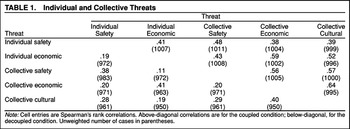
Just so far as respondents are reacting on the basis of how they feel about the group mentioned (rather than the threat mentioned), threat perception indicators referring to quite different threats should be highly correlated whatever is threatened. Table 1 presents the intercorrelations of threat perception indicators in the coupled condition, above the diagonal, and in the decoupled condition, below the diagonal.

As inspection of Table 1 shows, threat judgments are markedly more correlated with one another—whatever is threatened—in the coupled than in the decoupled condition. Thus the mean correlation between threats in the coupled condition is .49; in the decoupled condition, .29. When threat judgments are coupled with a reference to ethnic minorities, people who perceive themselves to be threatened in one way are markedly more likely to perceive themselves to be threatened in other ways—whatever those other ways are. In short, the double-barreled character of the standard threat perception measurement format blurs the distinctness of different types of threats.
Is there also a danger of tautological explanations of intergroup hostility? We measured hostility toward four ethnic minorities. Respondents are first asked about either Turks or Moroccans, then about either Surinamese or refugees and asylum seekers. Their feelings about each group are assessed using a measure of eight descriptive adjectives, six negative and two positive, validated in a series of previous studies of group hostility.7
The adjectives are honest, selfish, law-abiding, intrusive, slackers, violent, complainers, and inferior by nature. (See Appendix for complete wording.) For an account of the development and validation of this measure, see Sniderman et al. 2000, chap. 2.
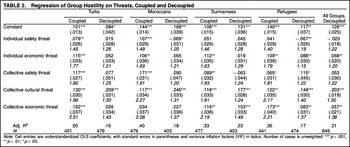
Table 2 summarizes the impact of different types of threat on hostility toward the four target groups when threat and group source of threat are coupled (first column for each group) and decoupled (second column). For each target group, we report a measure of multicollinearity associated with independent variables, their variance inflation factor (VIF)—in italics —and unstandardized OLS coefficients and their standard errors—in regular font.8
Here as throughout both dependent and independent variables are scored from 0 to 1 and the regression coefficients are unstandardized.

In contrast, when reference to what is threatened is decoupled from reference to ethnic minorities as the source of threat, the differential impact of different kinds of threats stands out. Most obviously, perceiving a threat to Dutch culture has by far the largest impact in provoking hostility toward minority groups. That is true for every group—Turks, Moroccans, Surinamese, and refugees and asylum seekers. In contrast, popular discussion of problems of crime notwithstanding,9
It is worth underscoring that these data were gathered before 9/11.
A presumption that concerns over economic well-being, particularly over personal economic well-being, are the driving motivational factor in political choice seems to some axiomatic. It is accordingly worth observing that, when asked whether their chances of getting what they want for things like housing, job promotions, and the like are any better or worse because of ethnic minorities in the country, only 14% responded worse, and more than half did not believe that their chances would be very much worse or that it would be unfair if they were.
Some oscillation in the size of coefficients across different target groups should be noted. Both egocentric and sociocentric safety threats are significant predictors for hostility to refugees, but the former is puzzlingly negative in sign, as it also is for Moroccans. Also, sociocentric economic threats are significant for Surinamese and for refugees and asylum seekers but not for Turks or Moroccans. For that matter, Table 2 also shows that economic threats matter less, or not at all, as a source of hostility to Turks and Moroccans but are a significant source of hostility to Surinamese and to refugees and asylum seekers. What might explain these differences between groups?
One possibility follows from a confound of order and religion effects. Respondents were first asked about either Turks or Moroccans, then about either Surinamese or refugees and asylum seekers. Respondents thus always were first asked about a Muslim group, and only then about a non-Muslim one. And because the first group is always Muslim, the (possible) impact of religion is entangled with the (possible) impact of order. Another possibility follows from the price in confidence levels exacted by assignment of subjects to multiple experimental conditions. The experimental variation of threat perception indicators into two forms, coupled and decoupled, cuts the sample size in half. In turn, the randomized assignment to one of a pair of minority groups cuts it in half again. Thus the effect of individual and collective economic threats on hostility to minorities, which is in the expected direction, may not reach conventional standards of statistical significance because of the limited number of observations. How can this pair of measurement problems—the slicing of the sample through assignment to multiple treatment conditions and the potential confounding of religion and question order—be dealt with?
By design our study included a second measure of hostility toward a group, namely, social distance.11
The social distance index consists of two questions: “To have [group name] as a neighbor seems to me very attractive, somewhat attractive, somewhat unattractive, very unattractive” and “To have a [group name] as a life partner seems to me very attractive, somewhat attractive, somewhat unattractive, very unattractive.”
We have only one half of the sample, even though every respondent was asked about every group, because one of every two respondents was asked the threat questions in the “contaminated” coupled condition.
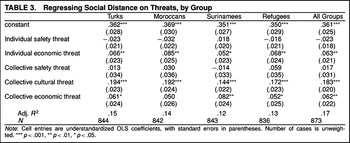
Table 3 replicates the analysis in Table 2, substituting the social distance measure of prejudice for the stereotype measure of prejudice. The results are clear and consistent. Perceived threats to safety, whether to the individual or to the groups as a whole, are not significant for any minority group. Perceived threats to economic well-being at both the personal and the national level are significant predictors of hostility for every minority group. And perceived threat to the Dutch culture is far and away the strongest predictor of hostility to minorities whether or not the minority is Muslim.

To this point, an explanatory account of intolerance toward immigrants centered on concerns about national economic well-being has been tested independently of other explanations of prejudice. To what extent do either of these concerns matter, it is necessary to ask, if the standard factors invoked in analyses of intolerance are taken into account?
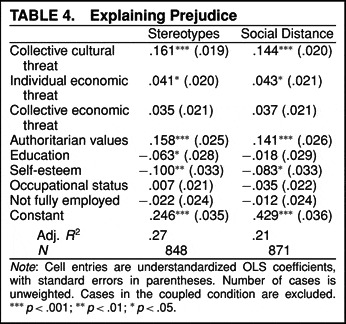
In Table 4 the analysis incorporates many of the larger family of sociodemographic and psychological factors established by previous research to be sources of intolerance—authoritarian values,13
See Appendix for question wording.
The occupational status takes into account labor force status and nature of job—dependent worker, self-employed, and managerial.

For all analyses, then, threats to cultural identity cut deeper than considerations of economic interest (once the problem of confounding is dealt with). But perhaps threats to economic interest matter especially for those who are not well off economically. To test this conjecture, both measures of prejudice, stereotype and social distance, were regressed on perceived threats, with perceived economic threat interacted successively with income, occupational status, and perceived economic well-being. Two sets of analyses were conducted. In one the observed values for the income and occupational status were used, ignoring missing data; in the other, the imputed values, to correct for missing analyses. The interaction effects were statistically insignificant in all cases.
There is another and more subtle problem to consider, however. Just because people say that they perceive another group to threaten their cultural identity, it does not follow that they actually fear for their cultural identity. They may say they do to mask their true motives. So they may say that their concern is to protect the well-being of the national culture and way of life when their concern, in truth, is to preserve their own economic well-being.
It is accordingly worth examining the larger matrix of considerations in which threats to culture and economic well-being are embedded. Just so far as the measure of perceived threat to cultural identity measures what it is intended to measure, than it should be tied more closely to other measures of the importance of national identity than to judgments of economic circumstances. Similarly, just so far as perceived threats to economic well-being measure what they are intended to measure, then they should be tied more closely to judgments of economic circumstances and prospects rather to evaluations of the importance of national identity.
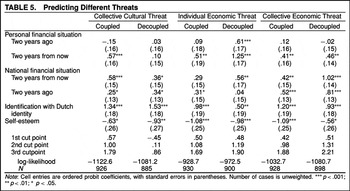
We have seen that the differential impact of different types of threat on hostility to ethnic minorities comes more clearly into view in the decoupled than in the coupled condition. A picture of the correlates of threat perception should also come more clearly into focus in the decoupled than in the coupled condition, if the “double-barreled” character of standard threat perception measures is indeed a problem. Table 5 accordingly reports ordered probit regressions of perceived threats to cultural identity and to economic well-being, first in the “coupled” condition, then in the “decoupled” condition.

In the coupled condition, indicators of threat to economic interests, whether personal and national, are entangled with considerations of identity. Conversely, threats to cultural identity are entangled with considerations of economic well-being. In the decoupled condition, in contrast, extraneous considerations tend to be trimmed. For both threats to cultural identity and to personal economic well being, then, there is a sharpening of discriminant validity when threat perception indicators are not double-barreled. We therefore concentrate on the correlates of threat perception in the “decoupled” condition.
Three principal results stand out. The first concerns a common basis for perceptions of threats. In a pioneering study, Marcus et al. (1995) hypothesized that one component of a readiness to perceive a specific threat is a generalized readiness to perceive threats. A generalized readiness to perceive threats and a lack of self-confidence and self-esteem go together (Sniderman 1975). Accordingly, we use an index of self-esteem derived from the California Psychological Inventory,15
For a description of procedures for item selection and validation of this self-esteem index, see Sniderman et al. 2000. A battery of studies has shown that the lower people's self-confidence and sense of self-worth, the more susceptible they are to feeling a diffuse sense of apprehension and threat (Sniderman 1975).
The second finding concerns the distinctness of different types of threats, notwithstanding this point of psychological commonality. To assess importance of national identity to individuals' personal identity, we use an index developed by Luhtanen and Crocker (1992). To canvass people's judgments of economic circumstances, we deploy questions about their personal and the national financial situation, both retrospectively and prospectively. (For question wording of all items, see Appendix.) Once a common reference to ethnic minorities is omitted, a readiness to perceive a threat to the national culture is primarily tied to the Luhtanen–Crocker measure of importance of national identity. Similarly, a readiness to perceive a threat to personal economic well-being is primarily tied to judgments of economic considerations, particularly to judgments that personal economic prospects look bleak over the next two years and that personal financial circumstances have deteriorated.
The third finding has to do with the intermediate position of perceptions of a threat to the national economy. On the one side, they are strongly tied to judgments of economic considerations. But on the other, they are substantially related to the importance of a national identity to a person's sense of personal identity. Perceived threats to the national economy thus have a strong symbolic component. We did not predict this result, but we believe that it makes intuitive sense. Threats to a country's way of life and to a country's economy share a common feature. Each focuses on the society as a whole, on a sense that “we” are vulnerable. And just so far as a perception of threats to the national economy has a whole involves an identification of an individual with the larger society, it is not surprising that the more important a sense of national identification is to individuals' sense of personal identity, the more likely they are to perceive a threat to the economic well-being of the nation. In contrast, the distinctness of threats to self-interest and cultural identity undercut the suggestion that individuals are claiming to perceive a threat to the national way of life to mask their concern about their individual (or national) economic well-being.
THE “FITTING-IN” EXPERIMENT
The results to this point speak to differences between individuals in the threats they perceive to economic well-being and cultural identity. A second and quite different issue also needs to be examined. To what extent does the same individual react differently when threats to cultural identity or economic well-being become salient?
The Dutch study was expressly designed to assess, in parallel, situational and dispositional threats to economic interest and national identity. The Fitting-In experiment accordingly manipulates the salience of threats to economic interests and to national identity by manipulating the characteristics of immigrants. Respondents are randomly assigned to one of four conditions. In the first and second, “a group of new immigrants that may come here” is characterized either as “highly educated and well suited for well-paying jobs” or as “not highly educated or well trained and only suited for unskilled jobs.” In the third and fourth conditions, immigrants are characterized either as people who “speak Dutch fluently and have a very good chance to fit in smoothly with the Dutch culture” or as people who “don't speak Dutch fluently and don't have a good chance to fit in smoothly with the Dutch culture.” All are asked the same test item: “Do you think it is a good idea or bad idea for these immigrants to be allowed to come here?” Four response options are presented: very good idea, somewhat good idea, somewhat bad idea, and extremely bad idea.
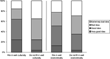
Which evokes the stronger reaction—the issue of economic integration or that of cultural integration? Figure 1 reports the distribution of responses as a function of immigrant characteristics. A poor fit either economically or culturally increases opposition to immigration. But whether or not immigrants are likely to fit in culturally matters far more than whether or not they will fit in economically. As Figure 1 shows, four of every five Dutch want to stiffen immigration requirements when immigrants do not speak Dutch fluently and do not have a good chance to fit in smoothly with Dutch culture, compared to two of five when they do. In contrast, two of every three Dutch do so when immigrants are not highly educated and well suited for well-paying jobs, compared to one of two when they are. Moreover, not fitting in culturally evokes significantly more opposition to immigration than not fitting in economically, while fitting in culturally promotes significantly more support for it than fitting in economically.16
The difference of response distributions between the two “not fitting” conditions is significant at p=.002 (χ2[3]=14.4); the difference between the two “fitting” conditions at p<.0001 (χ2[3]=26.6).

The pivotal question politically, however, is the impact of predisposing factors and situational triggers in combination. Suppose that public attention is drawn to the question of cultural conflict between established norms and those of new immigrants, say, by stories in the mass media or in the campaign of a national political figure. The salience of the issue of cultural identity can operate as a situational trigger. If the effect of this trigger is only (or primarily) to activate those already predisposed to respond negatively to immigrants, it will not alter the fundamental political landscape. But just so far as the effect of this situational trigger is to increase opposition from those not already predisposed to respond negatively to immigrants, the result is to enlarge the constituency throughout the society backing exclusionary reactions to immigrants.
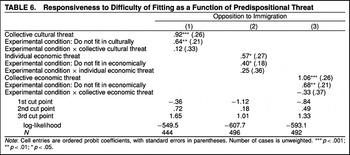
Table 6 assesses the specific way in which opposition to immigration is conditional both on a predisposition to perceive threats to cultural identity and economic interest and on the salience of threats to economic interests or cultural identity. Consider first the interplay of predisposing factors and situational triggers with respect to cultural identity. Column (1) in Table 6 presents an ordered probit regression of opposition to immigration on perceived cultural threat, the experimental treatment triggering the issue of cultural integration, and the interaction of the two. If triggering a concern about cultural integration has a galvanizing effect, then respondents more concerned about a threat to the national culture should be disproportionately more opposed to immigration of those who will have difficulty fitting in culturally, generating a significant interaction between cultural threat and experimental condition. In contrast, if triggering a concern about a cultural integration has a mobilizing effect, it should evoke proportionately as strong a reaction across-the-board. Table 6 shows that perceived threat increases opposition to immigration; so, too, does experimental triggering of the problem of cultural identity; but there is no interaction between them. In short, the results point to a mobilizing rather than a galvanizing effect.

The robustness of this result can be tested. Equivalent analyses of the joint effect of a disposition to perceive economic threats and a situational trigger of economic threats are provided for both individual economic well-being (column [2] in Table 6) and national economic well-being (column [3] in Table 6). The results parallel those for cultural identity. Triggering either type of economic concern evokes proportionately as strong a reaction from those who ordinarily are not at all concerned about them as from those who are most concerned about them. In short, the impact of situational triggers is neither confined to nor concentrated among the ranks of those expressly concerned about a threat to cultural identity. On the contrary, there consistently is an across-the-board mobilizing reaction.
THE “IDENTITY PRIMING” EXPERIMENT
The Fitting-In experiment turns on direct reference to characteristics of immigrants, desirable in one condition, frankly undesirable in the other. But of course there are constraints against direct public references to undesirable characteristics of immigrant minorities. Political aspirants who call attention to the problems of cultural or economic integration risk being labeled racist. They may do so anyway; indeed, have done so anyway. All the same, it is important to ask, Can opposition to immigration be mobilized in a way that is unambiguously legitimate?
In the Identity Priming experiment, respondents are randomly assigned to one of two experimental conditions. In one their identity as Dutch citizens is primed; in the other, their identity as individuals. In the national identification condition, the question begins with the introduction: “People belong to different types of groups. One of the most important and essential of these groups is the nation which you belong to. In your case, you belong to the Dutch nationality. Each nation is different.” In the personal identification condition, the question begins with the introduction: “People differ in many ways and each human being is unique. One person likes music, another likes to go for a walk, still another likes to go out. Everyone is different.” After the priming introduction, all respondents are asked, “Do you [as a Dutch person/personally] think that allowing new immigrants to enter The Netherlands should be made more difficult than it is now?” Responses take the form of a modified Likert scale, ranging from strongly disagree to strongly agree.
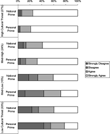
The crucial question for the politics of immigration is whether bringing people's sense of national (rather than personal) identity to the fore enlarges the constituency opposed to immigration above and beyond those already predisposed to oppose it out of a concern that the national way of life is threatened. Figure 2 therefore reports attitudes toward immigration conditional both on the type of prime (national or personal) and on the extent of perceived threat to the Dutch way of life.17
Given the findings on discriminant validity, the results reported are for the decoupled condition.

It is natural to suppose that identity politics matters for those for whom considerations of national identity matter—that is, matter consciously. And they do for a large number. In our study, on the order of one in every four strongly agree that the Dutch way of life is under threat; and support for making immigration more difficult is very nearly universal among them in both experimental conditions, as Figure 2 shows. There is thus a ceiling effect on the experimental treatment at one end of the continuum of concern about cultural threats. The striking aspect of the identity priming experiment results accordingly lies at the other end of the continuum. Here are respondents who are ordinarily not concerned at all about a threat to the Dutch way of life. But when they are primed to think in terms of their national rather than their personal identity, opposition to immigration increases significantly—significantly substantively, not just statistically. Among the third of the sample that reports the lowest cultural threat, 45% agree that immigration should be made more difficult in the personal prime condition, compared to 69% in the national prime condition. The findings of the Identity Priming experiment thus fit those of the Fitting-In experiment. Both show that situational triggers mobilize opposition broadly through the general public rather than just activating a core constituency already predisposed to oppose immigration.
CONCLUSIONS
What is driving contemporary reactions against immigration and immigrant minorities in Western European democracies? Concerns over economic and over cultural integration are the two most frequently given answers, although concerns over crime and safety are also cited. All three are plausible explanations and they are not mutually exclusive. But depending on whether one or the other is at the center of public concern, we shall have a different understanding of what is impelling opposition to immigrants and of what can be done to relieve it.
Realistic conflict is the most rigorously developed explanation of intergroup conflict. Concerns about economic well-being are indeed a source of opposition to immigrants and immigration, our results show. Moreover, the clash of economic interests matters at two distinct levels. Perceived threats to individual and to national economic interests evoke hostility to immigrants, in approximately equal measure.
This may seem a self-evident finding. Claims of an economic basis of political choice have achieved a near axiomatic status. But evidence in their support, for the public at large, is sparse (Sears and Funk 1990). This scarcity of supportive evidence, Sigelman, Greenberg, and Wald (n.d) have suggested, may be a measurement artifact. Standard measures of self-interest impute gains and losses on the basis of indirect indicators such as social class. A risk of slippage is obvious. So Sigelman and his colleagues show that self-interest, individually assessed, plays a larger role than usually observed in public opinion studies. We find the same. But the parallelism of findings based on economic interests self-assessed and economic costs experimentally manipulated provides a new basis for the hypothesis that calculations of economic advantage are a basis of reactions to immigrants and immigration.
A caveat is in order. Self-assessed economic threats are tied to factors having nothing to do with economic well-being; self-assessed threats to culture, to factors that have nothing to do with culture. Thus both are connected to low self-esteem and each is connected with the other. Even so, perceptions of economic threat are tied to economic considerations in the largest measure, and perceptions of threat to the national culture are tied to considerations of a national identity in the largest measure. And just so far as the two kinds of threat are distinct, it makes sense to ask to what extent the current anger and resentment against immigrant minorities in Western Europe spring from considerations of economic interest or national identity.
The answer to this question has some relevance to the current policy debate over multiculturalism. To the extent that the driving motive is concern over being economically worse off, opposition to immigrants is rooted ultimately in the economic logic of people's situations. And so far as that is true, it is possible to see how an extended period of economic progress can open up a path of conciliation. In contrast, to the extent that the driving motive is culture, the root problem is conflicting identities and values. And so far as that is true, there is no reason to believe that improvements in people's material circumstances will have an ameliorating effect. It accordingly is worth underlining that our results, both experimental and nonexperimental, show that concerns over national identity are more of a driving force than concerns over economic interest.
On a more general plane, it is self-evident that political responses are a product of both predisposing factors and situational characteristics. What is not self-evident—indeed, what was not possible to investigate until the introduction of randomized experimentation into public opinion surveys—is how the two sets of factors work in combination. Two alternatives stand out. A situational trigger may primarily galvanize those who already are broadly disposed to back a policy. Or it may mobilize support across-the-board in the public. Both the Fitting-In and the Identity Priming experiments throw light on the form of the relationship between intersecting characteristics of individuals and features of their situation. The results of both experiments indicate that situational triggers mobilize support beyond the core constituency already predisposed to oppose immigration.
This study is just a first step. It is necessary to begin specifying the conditions under which galvanizing or mobilizing effects are more likely to occur. Moreover, the design of any specific experiment is imperfect, and not only because all measurement is imperfect. There is always the issue of external validity.
Consider the Fitting-In experiment. In real life, individuals—and groups—have many attributes. In the Fitting-In experiment, immigrants are characterized only in terms of their economic skills or linguistic competence. It is natural to ask, then, whether variation in either economic skills or linguistic competence would have comparable effects in real life. Here is our best estimate, acknowledging a fringe of uncertainty. The point about relations between majority and minority groups is precisely that the image each holds of the other tends not to be individuated. In a word, the stripped-down characterization of immigrant minorities in the Fitting-In experiment corresponds to their stripped-down and stereotyped depiction in mass media and public discourse.
A deeper question of external validity centers on the implications for politics in the Identity Priming and the Fitting-In experiments. Both experiments show that the effect of situational triggers is additive, enlarging the circle of opposition to immigration above and beyond the core constituency already predisposed to oppose it. And both experiments, by showing that situational triggers make a contribution above and beyond that of predisposing factors, thus point to a mechanism for “flash” politics. How well does this fit the actual politics of The Netherlands?
For fully five decades, the conservative party, the VVD, was in the minority. In the early 1990s Frits Bolkenstein, a VVD figure, broke the elite consensus against public discussion of problems of the cultural integration of minorities. Warning “publicly against giving in too much to the cultural peculiarities of immigrants and argu[ing] that they should be expected to integrate much more into the Dutch way of life” (Thranhardt 2000, 172), he rode a wave of public popularity to the leadership of the VVD, and then to the shared leadership of the “Purple Coalition” with the Social Democrats, from 1994 to 2002. The meteoric rise of Pim Fortuyn is a still more dramatic example of the flash potential of anti-immigrant politics. In 2001, he burst into public prominence with attacks on Islam as “a backward culture” coupled with outright calls for reduction in immigration for both immigrants and asylum seekers. Polls predicted that he would lead one of the largest parties in government, possibly the largest: He was, partly for this reason, assassinated nine days before the national elections in 2002.18
Neither Bolkenstein nor Fortuyn could have amassed so much support, in so little time, in the usual quarters—among the more maladjusted, less educated, and more marginal. Combining randomized experimentation and representative sampling opens up an opportunity to achieve an understanding of sources and dynamics of the “flash” potential of anti-immigrant politics.Caution is called for, naturally. Our findings—and political examples—are drawn from the experience of one country only. How far they apply elsewhere is necessarily an open question. A distinction between generalizability and replicability may be useful here, however. Comparative research has shown that hostility to immigrants and opposition to immigration are tied to the same network of explanatory constructs across countries in Western Europe, including Germany, France, Belgium, and The Netherlands (Hagendoorn and Nekue 1999). We have been able to go beyond what has so far been established by taking advantage of randomized experiments. But for all the advantages of new experimental procedures, the disadvantage is precisely that they are new. So we would like to underline that the strongest point of our study ironically is the one most in need of further support.
A final implication of our results has to do with the possibly distinctive character of current strains over immigration in Western Europe. Part of the problem, quite possibly the largest, has to do with prejudice pure and simple. So far as this is so, the story is an old one, and the main characters in it—ignorance, parochialism, economic self-interest, dogmatically moralistic and judgmental outlooks, diffuse hostility—play depressingly familiar roles. But, increasingly, the strains over immigration in Western Europe are being cast in terms of a division between European majorities and Muslim minorities.
Our findings lend support to a hypothesis of culture conflict. A perception that Dutch culture is threatened is the dominant factor in generating a negative reaction to immigrant minorities. And the issue of cultural integration, when it becomes salient, evokes proportionately just as strong a reaction from those who are least concerned about a threat to Dutch culture as from those who are most concerned about one. This second finding goes substantially beyond the first—for it indicates that a readiness to respond on the issue of culture is not confined to those actively and consciously concerned about the issue. It instead extends throughout Dutch society.
It remains to be determined precisely what lies behind a concern with protection of a culture and way of life. But these findings raise a worrying possibility. Culture is a condensation of shared convictions as to what is right and should be valued and what is wrong and should be prohibited. Oversimplified and erroneous images of the “other” play a part in conflict between national majorities and Muslim minorities groups. But the divisions between them cannot be attributed solely to misperceptions and misunderstandings. There are points of genuine and deeply felt differences in values, for example, over the right of women to enter Western society as equals, without loss of honor to their families or risk of violence to themselves.19
Our findings of the centrality of the issue of cultural integration accordingly point to the possibility that the strains over immigration in Western European democracies are rooted in a genuine conflict of values, to an extent yet to be determined.APPENDIX: QUESTION WORDING
Threat Items
Individual Safety Threat: “Now I'm going to read you some other statements and this time I want to know whether you agree or disagree with each. Do you agree strongly, agree somewhat, disagree somewhat, or disagree strongly?” “I am afraid of increasing violence and vandalism in my neighborhood [by ethnic minorities].”
Individual Economic Threat: “I am afraid that my economic prospects will get worse [because of ethnic minorities].”
Collective Safety Threat: “I am afraid of increasing violence and vandalism in Dutch society [by ethnic minorities].”
Collective Cultural Threat: “These days, I am afraid that the Dutch culture is threatened [by ethnic minorities].”
Collective Economic Threat: “I am afraid that the economic prospects of Dutch society will get worse [because of minorities].”
Group Hostility (Eight-Item Additive Index)
“Now we will talk about some of the different groups present in our country. For each of the characteristics that I mention, can you tell me whether or not it applies to the majority of persons belonging to that group. Let's begin by talking about [minority group]. Do you agree or disagree that most of them are trustworthy? That they behave properly and act honestly? Do you agree strongly, agree somewhat, disagree somewhat, or disagree strongly with this description?”
“Do you agree or disagree that most of [minority group] are selfish? They think only about themselves, without concerning themselves very much about others.” (reversed)
“Do you agree or disagree that most of [minority group] are law-abiding? They behave like good citizens, observing the regulation and laws of the state.”
“Do you agree or disagree that most of [minority group] are intrusive? They press themselves on you in an annoying and insistent way.” (reversed)
“Do you agree or disagree that most of [minority group] are slackers? That they try to avoid working or in any case they avoid to do tiring heavy work.” (reversed)
“Do you agree or disagree that most of [minority group] are violent? They often use physical force or threaten to use it, in order to impose their will in their relations with others.” (reversed)
“Do you agree or disagree that most of [minority group] are complainers? That they try to make others feel sorry for them?” (reversed)
“Do you agree or disagree that most of [minority group] are by nature inferior to the Dutch people?” (reversed)
Social Distance (Eight-Item Additive Index: Two Items Repeated for Each of Four Groups)
“To have [group name] as neighbor seems to me very attractive, somewhat attractive, somewhat unattractive, very unattractive.”
“To have a [group name] as a life partner seems to me very attractive, somewhat attractive, somewhat unattractive, very unattractive.”
Economic Perceptions
“In general, do you think that you and your family are better off, worse off, or about the same financially compared with two years ago?”
“Looking ahead, do you think that two years from now you will be better off financially, worse off, or just about the same as now?”
“Looking ahead, do you expect that the economy will get better, get worse, or stay about the same in the next two years?”
“Now let's talk about the country as a whole. Would you say that most families in The Netherlands are better off, worse off, or about the same financially compared with two years ago?”
Identification with Dutch Identity (Four-Item Additive Index)
“Now I'm going to ask you about how you fell being Dutch. As I read each statement, please tell me if you agree strongly, agree somewhat, disagree somewhat, or disagree strongly with it? I often think of myself as Dutch.”
“I consider myself a typical Dutchman.”
“I'm proud that I'm Dutch.”
“If someone said something bad about Dutch people I feel almost as if they said something bad about me.”
Self-Esteem (Five-Item Additive Index)
“I'm going to make a few statements about people's mentality in general and yourself. Please tell me whether your think they are true or false. When in a group of people, I usually do what others want, rather than make suggestions.”
“I would have been more successful if people had given me a fair chance.”
“I certainly feel useless at times.”
“Teachers often expect too much work from their students.”
“I commonly wonder what hidden reason another person may have for doing something nice for me.”
Authoritarian Values (Three-Item Additive Index)
“Whenever a private or public employer finds it necessary to reduce the number of employees, the first to be let go should be women who have a husband who is working. Do you agree strongly, agree somewhat, disagree somewhat, or disagree strongly with this statement?”
“Here is the next statement: Only the elderly, children and handicapped should receive public assistance.”
“And how about: It is better to live in an orderly society in which the laws are vigorously enforced than to give people too much freedom.”
We are grateful for support from the National Science Foundation (Grants SR-9515006 and SES-510-50-805), the Dutch National Science Foundation, and the Dutch Ministry of Public Health, Welfare and Sports and a Ph.D. grant from the University of Utrecht.
References
Adorno Theodor,
Else Frenkel-Brunswick,
Daniel Levinson, and
R. Nevitt Stanford.
1950
The Authoritarian Personality.
New York:
Harper.
Barry Brian.
2001
Culture and Equality.
Cambridge, MA:
Harvard University Press.
Blumer Herbert.
1958
“Race Prejudice as a Sense of Group Position.”
Pacific Sociological Review
1
(1):
3–
7.Google Scholar
Bobo Lawrence, and
Vincent L. Hutchings.
1996
“Perceptions of Racial Group Competititon: Extending Blumer's Theory of Group Position to a Multiracial Social Context,”
American Sociological Review
61
(6):
951–72.Google Scholar
Brewer Marilyn B.
2001
“Ingroup Identification and Intergroup Conflict: When Does Ingroup Love Become Outgroup Hate?”
In Social Identity, Intergroup Conflict and Conflict Reduction,
ed. Richard D. Ashmore,
Lee Jussim, and
David Wilder.
New York:
Oxford University Press.
Brown R.
1995
Prejudice: Its Social Psychology.
Cambridge:
Blackwell.
Campbell Donald T.
1958
“Common Fate, Similarity, and Other Indices of the Status of Aggregates of Persons as Social Entities.”
Behavioral Science
3
(1):
14–
25.Google Scholar
Capozza Dora, and
Rupert Brown,
2000
Social Identity Processes: Trends in Theory and Research.
London:
Sage.
Coenders Marcel, and
Peer Scheepers.
1998
“Support for Ethnic Discrimination in The Netherlands, 1979–1993: Effects of Period, Cohort, and Individual Characteristics.”
European Sociological Review
14
(4):
405–22.Google Scholar
Duckitt John.
1992
The Social Psychology of Prejudice.
Praeger:
New York.
Favell Adrian.
1998
Philosophies of Integration: Immigration and the Idea of Citizenship in France and Britain.
New York:
St. Martins Press.
Hagendoorn L., and
Nekue S.
1999
Education and Racism.
Aldershot:
Ashgate.
Hagendoorn L.,
J. Veenman, and
W. Vollebergh, eds.
2003
Cultural and Social Integration of immigrants in The Netherlands.
Aldershot:
Ashgate.
Hardin Russell.
1995
One for All: The Logic of Group Conflict.
Princeton, NJ:
Princeton University Press.
Hitchcock William I.
2002
The Struggle for Europe.
New York:
Doubleday.
Horton John.
1993
“The Satanic Verses Controvery: A Brief Introduction,”
In Liberalism, Multitculturalism and Toleration,
ed. John Horton.
Houndmills:
Macmillan Press.
Huddy Leonie.
2001
“From Social to Political Identity: Implications for Political Psychology.”
Political Psychology
22
(1):
127–56.Google Scholar
Kitschelt Herbert.
1997
The Radical Right in Western Europe: A Comparative Analysis.
Ann Arbor:
University of Michigan Press.
Levy Jacob.
2000
The Multiculturalism of Fear.
New York:
Oxford University Press.
Luhtanen R.., and
J. Crocker.
1992
“A Collective Self-Esteem Scale: Self-Evaluation of One's Social Identity.”
Personality and Social Psychology Bulletin
18
(3):
302–18.Google Scholar
Marcus George E..,
John L. Sullivan,
Elizabeth Theiss-Morse, and
Sandra L. Wood,
1995
With Malice toward Some: How People Make Civil Liberties Judgments.
New York:
Cambridge University Press.
Mayer Nonna.
2002
Ces Français qui votent Le Pen.
Paris:
Flammarion.
Modood Tariz.
1993
“Muslims, Incitement to Hatred and the Law.”
In Liberalism, Multitculturalism and Toleration,
ed. John Horton.
Houndmills:
Macmillan Press.
Okin Susan Moller.
1999
Is Multiculturalism Bad for Women?
Princeton, NJ:
Princeton University Press.
Parekh Bhikhu,
2000
Rethinking Multiculturalism: Cultural Diversity and Political Theory.
Cambridge, MA:
Harvard University Press.
Quillian Lincoln.
1995
“Prejudice as a Response to Perceived Group Threat: Population Composition and Anti-Immigrant and Racial Prejudice in Europe.”
American Sociological Review
60
(4):
586–
612.Google Scholar
Sears David O.., and
Carolyn L. Funk.
1990
“Self-Interest in Americans' Political Opinions.”
In Beyond Self-Interest,
ed. Jane J. Mansbridge.
Chicago:
University of Chicago Press.
Selznick Gertrude, and
Stephen Steinberg.
1969
The Tenacity of Prejudice.
New York:
Harper.
Sigelman Lee,
Anna Greenberg, and
Kenneth Wald. N.d.
“Self-Interest and Race-Related Political Attitudes: A Reconsideration.”
Unpublished paper.
Sniderman Paul M.
1975
Personality and Democratic Politics.
Berkeley:
University of California Press.
Sniderman Paul M.,
Pierangelo Peri,
Rui de Figuerido, and
Thomas Piazza.
2000
The Outsider: Prejudice and Politics in Italy.
Princeton, NJ:
Princeton University Press.
Tajfel Henri.
1981
Human Groups and Social Categories: Studies in Social Psychology.
Cambridge:
Cambridge University Press.
Thranhardt Dietrich.
2000
“Conflict, Consensus, and Policy Outcomes: Immigration and Integration in Germany and The Netherlands.”
In Challenging Immigration and Ethnic Relations Politic,
ed. Ruud Koopmans and
Paul Statham.
Oxford:
Oxford University Press.
Visser Jelle, and
Anton Hemerijck.
1997
A Dutch Miracle: Job Growth, Welfare Reform and Corporatism in The Netherlands.
Amsterdam:
Amsterdam University Press.
Wikkan Unni.
2002
Generous Betrayal: The Politics of Culture in the New Europe.
Chicago, IL:
University of Chicago Press.
Individual and Collective Threats
Regression of Group Hostility on Threats, Coupled and Decoupled
Regressing Social Distance on Threats, by Group
Explaining Prejudice
Predicting Different Threats
Responsiveness to Difficulty of Fitting as a Function of Predispositional Threat
 You have
Access
- 820
- Cited by
Comments
No Comments have been published for this article.