

DISCUSSION POINTS
-
• Will beyond lithium-ion nonaqueous battery chemistries, such as lithium–air and lithium–sulfur, reach the calendar and cycle life requirements for EVs?
-
• Can traditionally low specific energy systems, such as flow batteries and aqueous batteries, improve sufficiently to be relevant for EVs?
Introduction
The widespread adoption of electrified vehicles can substantially reduce petroleum consumption and transportation-related greenhouse gas emissions. Petroleum is currently the dominate energy source for the world transportation sector, providing 94% of its primary energy. Reference Tran, Banister, Bishop and McCulloch1,2 Battery electric vehicles (EVs) and hydrogen fuel cell vehicles (FCVs) are the two options that can in principle enable a petroleum and emission-free transportation future if the electricity and hydrogen are generated by renewable energy. EVs have much higher round trip energy efficiencies than FCVs assuming hydrogen is generated by electrolysis of water. Even with today's U.S. electric power generation mix from fossil, nuclear, and renewable energy sources, battery EVs could cut greenhouse gas emissions by 25% as compared to gasoline-powered vehicles. Reference Elgowainy, Han, Poch, Wang, Vyas, Mahalik and Rousseau3 A Union of Concerned Scientists study showed that EVs would have lower greenhouse gas emissions than a 50-mpg Toyota Prius for 45% of Americans charged by today's grid. 4
Despite the benefits of increased energy security and decreased emissions, the adoption of EVs has been slow. In 2014, for example, the U.S. vehicle market had a sales volume of 16.4 million; the total for battery EVs was 63,416. 5 The slow adoption of these vehicles has been linked to concerns about cost, range, and safety. In a 2012 Consumer Report survey on battery EVs, Reference Bartlett6 range and safety concerns dominated the responses. Availability of fast charging is identified as another concern but can be viewed as an alternative expression of range anxiety. Reference Eberle and von Helmolt7 For these reasons, there were suggestions that battery powered EVs are more suitable for short distance, intercity commutes while hydrogen FCVs and EVs with on-board range extension mechanisms such as gasoline powered generators are better suited for long distance transportation. Reference Eberle and von Helmolt7 However, the gasoline powered range extension does not allow eventual transition to a completely emission-free solution. The most significant barrier for EV adoption is that they cost significantly more than gasoline-powered vehicles. According to analysis performed by Edmunds.com, the payback period for a typical 100 mile range EV can be more than 9 years even after discounting government subsidies. Reference Krebs8 The dominant cost driver for EVs is the energy storage system. Despite rapid progress made recently, EV-grade lithium-ion batteries still cost ∼410 $/kWh according to worldwide industry estimation in 2014 although industry leaders are close to 300 $/kWh. Reference Tran, Banister, Bishop and McCulloch1,Reference Howell9 Recent announcement from Tesla's planned Giga factory promises to drive down the battery cost by 30%. 10 Despite that promise, a further reduction of a factor 2 is needed to reach the 125 $/kWh target set by the United States Advanced Battery Consortium (USABC). 11
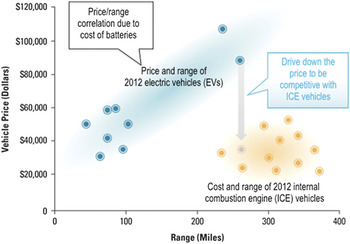
Due to the high cost of batteries, the price of an EV is strongly correlated with vehicle range (Fig. 1). EV manufacturers have managed to keep the price tag of the vehicles reasonable by using lower capacity battery packs, restricting the vehicle range to 100 mile. Unfortunately, the decrease in vehicle range leaves the consumer with range anxiety. Ideally, a range of around 300 miles is desirable, which is similar to that offered by conventional vehicles using internal combustion engines (ICEs). Tesla is currently the only automaker that manufactures a vehicle with a >250 mile range, although the vehicle price tag is significantly higher than a mainstream consumer vehicle.
2012 EV price as a function of range, compared to the price of vehicles with ICEs. The correlation between price and range is primarily due to the high cost of batteries. To reach near parity in cost and range with ICE vehicles, a factor of 3 in cost reduction is needed.

The need to reduce the cost of energy storage to produce an EV with similar price and range to conventional gasoline vehicles is well recognized. A recent study analyzed the cost drivers for energy storage, and advocated for research to further increase the specific energy to drive down system costs. Reference Wagner, Lakshmanan and Mathias12 Importantly, in addition to specific energy and cost, EV energy storage needs to meet stringent requirements in calendar and cycle life, abuse tolerance, temperature performance, among others. Any increase in specific energy should not be realized at the expense of these other performance metrics, in particular, in battery life.
In this report, we argue for a safety-centric approach where inherently safer energy storage systems are designed to assist vehicle crash management, which enables vehicle structural weight reduction. This multifunctional design enables using low-cost energy storage chemistries and architectures without weight penalties on the vehicle level even when they may have lower specific energies on the chemistry level. This report is organized as the following. We first analyze the cost drivers of EVs using the cost of each electric mile of driving range as the metric. This analysis helps to set the context for understanding the two types of research approaches for cost reduction. We then examine the first approach, which raises specific energy beyond current lithium-ion batteries to drive down costs and briefly review corresponding research approaches and challenges. Next, we propose a second approach, which concerns the development of inherently safer energy storage technologies and illustrate their system level benefits. Subsequently, the report briefly reviews the various classes of technologies that can enable this new design. Not intended to be comprehensive, these reviews help to illustrate critical research needs to fully realize a long-range, low-cost EV with inherently safe energy storage technologies.
Analysis of contributing factors for EV range and cost
Vehicle cost is a function of performance, size, and brand. To analyze the cost drivers for EVs, it is necessary to define a target vehicle size. The U.S. Department of Energy's EV Everywhere Initiative defines the target vehicle to be a mid-size sedan. Reference J. Ward13 We will base our analysis on this target vehicle.
The strong correlation between cost and range of EVs argues for the importance of a cost metric, the vehicle up front cost per electric mile of range:
 $${\rm{Cost}}\left( {{\$ \over {{\rm{mile}}}}} \right) = {{{\$ _{\rm{v}}}} \over R},$$
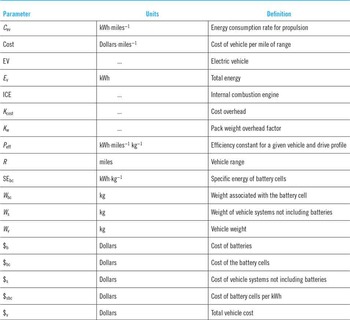
where $v is the vehicle cost and R is the range. For an explanation of symbols, see Table 1. Because $v is composed of the cost of batteries ($b) and the rest of vehicle systems ($s), the above equation becomes
 $${\rm{Cost}}\left( {{\$ \over {{\rm{mile}}}}} \right) = {{{\$ _{\rm{b}}} + {\$ _{\rm{s}}}} \over R}.$$
List of parameters and their units and definition.

State-of-the-art battery systems are composed of battery cells and overhead systems to perform thermal, electrical, and mechanical management functions hence
 $${\rm{Cost}}\left( {{\$ \over {{\rm{mile}}}}} \right) = {{{\$ _{{\rm{bc}}}}{K_{{\rm{cost}}}} + {\$ _{\rm{s}}}} \over R},$$
where $bc refers to the cost of the battery cells and K cost is the cost overhead when the cells are integrated into the pack. The range (R) of an EV is determined by the total energy (E v) it carries and the energy consumption rate (CE v) for propulsion
 $$R\left( {{\rm{mile}}} \right) = {{{E_{\rm{v}}}\left( {{\rm{kWh}}} \right)} \over {C{E_{\rm{v}}}\left( {{{{\rm{kWh}}} \over {{\rm{mile}}}}} \right)}}.$$
The energy consumption rate represents the overall propulsion efficiency of a vehicle and is a function of vehicle weight, aerodynamics, and driving profile. Among all the energy loss mechanisms, only aerodynamics is a function of vehicle esthetics while the rest are proportional to vehicle weight. Reference Verbrugge, Borroni-Bird, Ginley and Cahen14 The effect of vehicle weight on range generally dominates at low vehicle speeds, due to the small contribution of drag. The above equation can be approximated as
 $$R\left( {{\rm{mile}}} \right) = {{{E_{\rm{v}}}} \over {{W_{\rm{v}}}{P_{{\rm{eff}}}}}},$$
where P eff is a constant for a given vehicle and drive profile and W v is the vehicle weight. If we further deconvolute W v into the weight associated with the battery cell (W bc) with a pack weight overhead factor, K w, and other vehicle system weight (W s),
 $$R\left( {{\rm{mile}}} \right) = {{{E_{\rm{v}}}} \over {({W_{{\rm{bc}}}}{K_{\rm{w}}} + {W_{\rm{s}}}){P_{{\rm{eff}}}}}}.$$
Thus
 $${\rm{Cost}}\left( {{\$ \over {{\rm{mile}}}}} \right) = {{{\$ _{{\rm{bc}}}}{K_{{\rm{cost}}}} + {\$ _{\rm{s}}}} \over {{E_{\rm{v}}}}}\left( {{W_{{\rm{bc}}}}{K_{\rm{w}}} + {W_{\rm{s}}}} \right){P_{{\rm{eff}}}}.$$
Since
 $${W_{{\rm{bc}}}} = {{{E_{\rm{v}}}} \mathord{\left{\vphantom {{{E_{\rm{v}}}} {{\rm{S}}{{\rm{E}}_{{\rm{bc}}}}}}} \right\kern-\nulldelimiterspace} {{\rm{S}}{{\rm{E}}_{{\rm{bc}}}}}}\,{\rm{and}}\,{\$ _{{\rm{bc}}}} = {E_{\rm{v}}} \times {\$ _{{\rm{sbc}}}},$$
where SEbc is the specific energy of battery cells and $sbc is the cost of battery cells per kWh.
Then
 $${\rm{Cost}}\left( {{\$ \over {{\rm{mile}}}}} \right) = {{{E_{\rm{v}}}{\$ _{{\rm{sbc}}}}{K_{{\rm{cost}}}} + {\$ _{\rm{s}}}} \over {{E_{\rm{v}}}}}\left( {{{{E_{\rm{v}}}} \mathord{\left{\vphantom {{{E_{\rm{v}}}} {{\rm{S}}{{\rm{E}}_{{\rm{bc}}}}{K_{\rm{w}}} + {W_{\rm{s}}}}}} \right\kern-\nulldelimiterspace} {{\rm{S}}{{\rm{E}}_{{\rm{bc}}}}{K_{\rm{w}}} + {W_{\rm{s}}}}}} \right){P_{{\rm{eff}}}}.$$
Equation (8) shows that both battery cell specific energy (SEbc) and battery cell cost ($sbc) impact vehicle cost. However, their respective impact is heavily influenced by the respective ratios of battery weight and cost to those values of the whole vehicle.
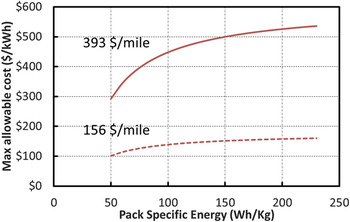
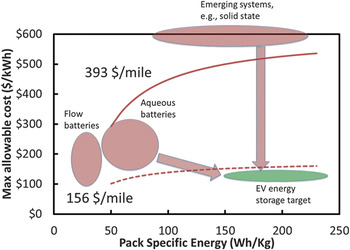
Based on a vehicle platform defined by a typical mid-size sedan, we performed a trade-off analysis between battery specific energy and cost for a given vehicle. The cost target is defined by the $/mile value. Figure 2 shows results from two different cost targets, 393 $/mile versus 156 $/mile. These two values are chosen based on an approximate state-of-the-art for EVs and a long-term goal for EVs to achieve mass adoption, respectively. Note that every combination of maximum allowable battery pack cost and battery pack energy density on the same curve will produce a vehicle with identical cost ($/mile). This relationship, however, is not linear. For example, the 393 $/mile curve shows that a specific energy less than 100 Wh/kg will require significantly lower costs, while increasing specific energy above 150 Wh/kg has a relatively small effect on allowable battery cost. When the battery specific energy is very low, its weight becomes a significant portion of the vehicle weight, which determines propulsion energy consumption. In other words, the battery is spending significant amounts of its stored energy to move itself and thus has a decreased system value. For the 156 $/mile scenario, the effect of higher specific energy on maximum allowable cost becomes even smaller. In fact, the effect is negligible above 150 Wh/kg. This limited impact on vehicle energy consumption with higher specific energy is due to the smaller contribution of battery weight on vehicle weight. An additional note regards the impact of weight at increased vehicle speed. The energy consumption rate at higher vehicle speeds is increasingly determined by aerodynamics. Consequently, our analysis represents the upper bound of importance on specific energy or battery weight has on vehicle range.
Maximum allowable battery pack cost as a function of battery pack specific energy for two cases of EV cost per mile of range.

Research approaches based on raising specific energy to reduce EV cost
The simple analysis outlined above provides effective guidelines for EV energy storage research. The most ideal solution, of course, is a battery cell of high specific energy (SEbc) and low cost ($sbc). Such an approach does assume the pack weight overhead factor, K w, does not increase. The leading candidate to fill this role is currently the lithium-ion battery, with further research effort aimed at increasing its specific energy. Reduction in battery cost is expected as long as the cost of materials and manufacturing does not out pace increases in specific energy.
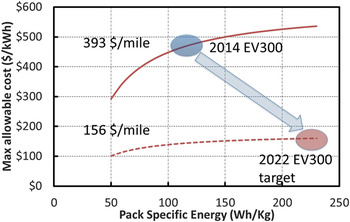
This simultaneous weight and cost reduction strategy dominates the current EV energy storage landscape and is the foundation of the long-term EV battery cost reduction roadmap (Fig. 3). Similar approaches are adopted by Japan's NEDO with a specific energy target of 250 Wh/kg by year 2020 as well as advocated by organizations in Europe. 15
The required cost and battery pack specific energy targets to realize the U.S. Department of Energy EV range and cost goals for 2022. Reference Howell9 EV300 refers to an EV with 300 mile of range.

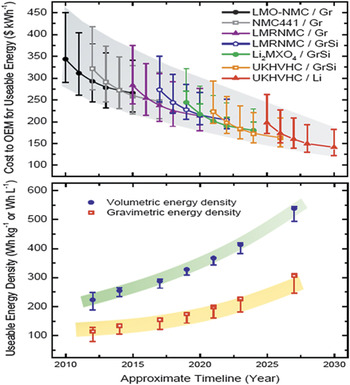
Figure 4 shows the projected decrease in battery cost and increase in specific and volumetric energy densities for lithium batteries with different cathode and anode chemistries. From 2012 to 2027, an estimated 150% increase in specific energy is responsible for the 50% reduction in cost.
Projections of battery energy density and cost in the following decades. In the cost plot, several cell chemistries are presented. LMO–NMC: a physical blend of Li1.1Mn1.9−x M x O4 with Li1+x (Ni1/3Mn1/3Co1/3)1−x O2; NMC441: (Li1+x (Ni4/9Mn4/9Co1/9)1−x O2); LMR–NMC: xLi2MnO3(1−x)LiMO2 with a capacity of 250 mA h/g @ 3.7 V; Li2MSiO4—M = Mn or Ni with an assumed capacity of 250 mA h/g @ 4.2 V; UKHVHC—unknown high-voltage, high-capacity cathode with an assumed capacity of 250 mA h/g @ 4.7 V; Gr: graphite; GrSi: graphite silicon composite with a capacity of 1000 mA h/g @ 0.4 V. Reference Howell9 Reprinted with permission: Kevin Gallagher, Argonne National Laboratory.

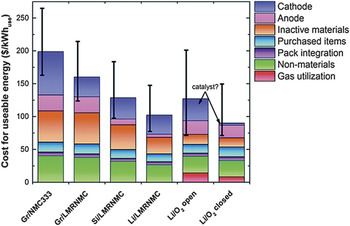
Figure 4 shows that none of the current cathode/anode pairs are expected to drive cost down to below 150 $/kWh. However, the USABC and the Department of Energy have set cost targets of 100–125 $/kWh. Reference Howell9 Consequently, cathode materials that cost even less and offer even higher specific energies are being pursued. Figure 5 shows the most optimistic projections of leading high specific energy systems (only Li–S battery is not included). As mentioned earlier, cells with increasing specific energies are still required to achieve the calendar and cycle life targets suitable for EV applications. Before we discuss the critical research needs to support the above projections of specific energy, it is worthwhile to briefly review the fundamental relationship between specific energy and cycle life.
Projected cost for different cell chemistries including cost breakdowns for different components. Note that the cost target for a USABC 45 kWh EV pack is 125 $/kWh. Reference Gallagher, Goebel, Greszler, Mathias, Oelerich, Eroglu and Srinivasan24 For explanations of abbreviations of battery materials, refer to Fig. 4. (Reproduced with permission).

Many mechanisms can be responsible for battery aging due to cycling or calendaring effects and several commercial lithium-ion batteries have been extensively tested and modeled. Reference Liu, Wang, Hicks-Garner, Sherman, Soukiazian, Verbrugge, Tataria, Musser and Finamore16–Reference Broussely, Herreyre, Biensan, Kasztejna, Nechev and Staniewicz23 Two factors are of fundamental importance. The first concerns the stability of the electrode/electrolyte interface. The negative electrode, lithiated graphite, has a chemical potential very close (0.1–0.2 V) to that of metal lithium. The organic electrolyte is not thermodynamically stable at this potential and is reduced on its surface forming a solid electrolyte interface (SEI) layer. This layer is electronically insulating but ionically conducting which enables highly reversible battery cycling. However, any perturbation to the integrity of this layer due to mechanical or thermal events will result in a repair of this layer and consumption of active charge. The second factor responsible for battery performance loss is mechanical in nature. During cycling, the electrode material, lithiated graphite, experiences a volume change of ∼10%, which may result in fracture of the SEI layer or even the particle. Reference Deshpande, Verbrugge, Cheng, Wang and Liu17 The coupling of the above two factors inevitably leads to capacity loss during electrochemical cycling. This mechanism has shown to be responsible for the capacity fade of leading commercial lithium-ion chemistries. Reference Liu, Wang, Hicks-Garner, Sherman, Soukiazian, Verbrugge, Tataria, Musser and Finamore16,Reference Wang, Purewal, Liu, Hicks-Garner, Soukazian, Sherman, Sorenson, Vu, Tataria and Verbrugge18 As we will discuss below, next generation electrode materials with higher capacities often involve much greater volume changes during operation which demand chemistry and materials innovations to realize a battery life that is competitive with that of lithium-ion batteries.
Alternative anodes
A high capacity anode such as silicon or lithium metal is required to realize the cost reduction as illustrated in Fig. 4. Both of them offer an order of magnitude higher charge storage capacities than graphite. The challenges associated with silicon are well documented. Silicon experiences a volume expansion of ∼300% during lithiation that may lead to particle disintegration. Reference McDowell, Lee, Nix and Cui25,Reference Szczech and Jin26 Even more challenging is the unstable interface between the lithiated silicon electrode and battery electrolyte. The large volume change creates mechanical instability at the interfacial layer. Any fracture will lead to fresh electrode surfaces that need to be passivated again which consumes charge and leads to rapid cyclable charge loss. Significant worldwide effort has been devoted to tackling these issues by using designed nanostructures to manage this mechanical failure mechanism. Reference McDowell, Lee, Nix and Cui25–Reference Xin, Qingliu, Juchuan, Xingcheng, Lott, Wenquan, Sheldon and Ji29 However, active lithium loss at the unstable interface remains a persistent challenge. The first demonstration of high capacity silicon anode will likely be in portable electronics where the sensitivity to specific energy is greater than cycle life. To impact EV applications, further progress is needed to scale up nanostructured materials, improve interfacial stability through electrolyte innovation, demonstrate performance in larger format cells, achieve longer cycle and calendar life, and finally, pass abuse tolerance tests.
The challenges associated with the use of lithium metal anodes are also very well known which include (i) the formation of lithium dendrites that can lead to shorting of the batteries as well as loss of active lithium due to electrode pulverization; and (ii) the low charge efficiency due to the high reactivity between metallic lithium and the organic electrolytes. A recent review offered a comprehensive account of the approaches attempting to address these challenges. Reference Xu, Wang, Ding, Chen, Nasybulin, Zhang and Zhang30 They can be categorized as (i) mechanical suppression; (ii) the use of electrolyte additives; and (iii) using single ion conductors. For mechanical suppression, a separator or solid electrolyte layer with high sheer modulus (∼10 Ga) is used to combat dendrite growth since lithium metal is a soft material with a Young's modulus of only 4.9 GPa. Reference Monroe and Newman31 For electrolyte additives, compounds such as CO2, Reference Aurbach, Zaban, Gofer, Ely, Weissman, Chusid and Abramson32,Reference Aurbach, Weissman, Zaban and Chusid33 HF, Reference Shiraishi, Kanamura and Takehara34 vinylene carbonate, and fluoroethylene carbonate, Reference Mogi, Inaba, Jeong, Iriyama, Abe and Ogumi35,Reference Stark, Ding and Kohl36 are reduced on the electrode surface to form an effective SEI. More recently, Cs+ was found to suppress dendrite growth and a “self-healing electrostatic shield” mechanism was proposed to explain the effect. Reference Ding, Xu, Graff, Zhang, Sushko, Chen, Shao, Engelhard, Nie, Xiao, Liu, Sushko, Liu and Zhang37 Finally, single ion conductors that effectively mitigate concentration gradients can significantly reduce dendrite growth. Reference Sadoway, Huang, Trapa, Soo, Bannerjee and Mayes38,Reference Bouchet, Maria, Meziane, Aboulaich, Lienafa, Bonnet, Phan, Bertin, Gigmes, Devaux, Denoyel and Armand39 The most noteworthy approach is the use of ceramic solid electrolytes. These electrolytes offer both mechanical strength and single ion conductivity. In fact, cycle life of over ten thousand charge/discharge cycles has been demonstrated in solid-state thin-film lithium batteries. Reference Bates, Dudney, Neudecker, Ueda and Evans40 However, using the same principle in a bulk form remains challenging and will be discussed in more detail later.
Alternative cathodes
With a lithium metal anode, Fig. 5 projects that a high capacity lithium transition metal oxide will enable a cost target of 100 $/kWh. If lithium metal is viable, then sulfur and oxygen would be even more desirable cathode materials. They offer 3–5x energy density with minimal cost attributed to the material. For these reasons, both systems are subjects of intensive research efforts. The sulfur cathode chemistry has progressed rapidly in recent years. Reference Barghamadi, Kapoor and Wen41–Reference Wang, Zeng, Zhou, Yin, Li, Cheng, Gentle and Lu44 The employment of nanostructured carbon scaffold to contain sulfur effectively addresses the insulating nature of the sulfur material and serves to confine the soluble polysulfide species and mitigate the well-known crossover mechanism that has plagued Li–S technology. Reference Ji and Nazar45,Reference Ji, Lee and Nazar46 As a result, cycling stability has been markedly improved. However, capacity loss due to sulfur redistribution persists. Reference Ji and Nazar45,Reference Wan, Pu and Ai47–Reference Zhang49 In addition, the crossover mechanism can in principle only be eliminated with the use of a solid-state separator. Finally, electrode performance is a strong function of electrode materials loading levels. Thicker electrodes, which are essential to higher cell specific energy, often lead to reductions in specific capacity, rate capability, and cycling stability. Reference Pope and Aksay50
The progress and challenges of lithium–air batteries have been reviewed recently. Reference Balaish, Kraytsberg and Ein-Eli51–Reference Christensen, Albertus, Sanchez-Carrera, Lohmann, Kozinsky, Liedtke, Ahmed and Kojic56 The oxygen cathode functions like a fuel cell electrode except that the discharge product is Li2O2, which is a solid and accumulates in the electrode. Challenges of lithium–air chemistry include: (i) the stability of the electrolyte in the presence of Li2O2; (ii) the reaction rate of Li2O2 formation and decomposition due to the involvement of oxygen catalysis; and (iii) the influence of contaminants from ambient air such as water and carbon dioxide. A recent analysis shows that Li–air cells offer limited advantages over advanced lithium-ion batteries due to these complexities. Reference Gallagher, Goebel, Greszler, Mathias, Oelerich, Eroglu and Srinivasan24 Breakthroughs in cathode catalysis and microstructural and system designs are needed to realize a lithium–air battery with the rate capability, cycle life, and energy efficiency sufficient for EV applications.
Other high specific energy nonaqueous systems
In addition to lithium-based systems, there has been recent effort in investigating cell chemistries based on other cations. Specifically, intercalation reactions involving multivalent cations such as Mg2+ have been a focus for the Joint Center for Energy Storage Research, a research hub supported by the U.S. Department of Energy. Reference Van Noorden57 Compared to lithium metal, magnesium metal electrode has a higher volumetric capacity and cycles reversibly without the formation of dendrite which stimulated intense research interest. However, the search for suitable electrolytes and high energy density cathode materials is still in its infancy. MgFeSiO4 was shown to deliver 300 mA h/g at 2.4 V, showing great promise in delivering competitive specific energy to lithium-ion batteries. Reference Orikasa, Masese, Koyama, Mori, Hattori, Yamamoto, Okado, Huang, Minato, Tassel, Kim, Kobayashi, Abe, Kageyama and Uchimoto58 Likewise, a high rate aluminum battery was reported recently. With an ionic liquid-based electrolyte, a cycle life of 7500 cycles was demonstrated but the low specific energy makes the concept more suitable for grid storage rather than EVs. Finally, the development of room temperature sodium-ion batteries has continued to progress, with most of the anode and cathode materials being analogs of lithium counterparts. Reference Lin, Gong, Lu, Wu, Wang, Guan, Angell, Chen, Yang, Hwang and Dai59 A cell chemistry that can deliver competitive specific energy and cycle life to lithium-ion has yet to emerge. Nevertheless, these recent advancements may stimulate increased interests in these under-explored chemistries which may eventually lead to higher specific energies.
Advanced pack designs and battery management systems
The approaches outlined above focus on developing long life, high specific energy battery chemistries to drive down cost and weight. In order for this to be effective, the K w factor in Eq. (8) needs to remain comparable to that for lithium-ion battery cells currently used. The K w factor, around 150% for lithium-ion batteries, represents the weight overhead on the system level that provides thermal, mechanical, and electrical protections for the battery cells. Reference Wagner, Lakshmanan and Mathias12 Lithium-ion batteries use high-energy redox couples operating with flammable organic carbonate electrolytes. As a result, the total combustible energy in a lithium-ion cell can be an order of magnitude greater than the electrochemical energy. Reference Harmon, Gopalakrishnan and Mikolajczak60 The thermal system is tasked to maintain temperature distribution in a very narrow range to minimize degradation of the cells. The electronic control system estimates the state of charge and health of the battery and provides safe shutdown functions. As the specific energy of cells increases, the K w factor will likely increase. The high specific energy demands better structural protection to avoid intrusion and deformation; consequently, additional guarding is required. In fact, it is a common practice to treat the battery pack as if it were a fuel tank. Reference Gabrielli61 Despite the conservative system designs, there have been several vehicle fire incidents that have raised safety concerns for consumers. These incidences illustrate the challenges of addressing abuse tolerances by relying on system protection. Reference Smith62 Advanced cell monitoring methods that can directly detect physical and chemical changes inside lithium-ion cells are being developed to assist with preventing these safety incidents and to improve utilization of battery capacities. Recently, a major initiative, the Advanced Management and Protection of Energy Storage Devices program, was launched by the Advanced Research Projects Agency for Energy (ARPA-E) of the U.S. Department of Energy to create a new generation of Battery Management System (BMS) sensing, controls, and power systems that can unlock greater performance, safety, and reliability from battery chemistries. 63
In summary, intensive research effort is underway to develop battery chemistries with specific energies far greater than those of lithium-ions. Candidates for both the cathode and the anode materials use reaction mechanisms beyond intercalation chemistry. The challenge of the coupled mechanical–chemical degradation mechanisms in these batteries is far greater than those encountered with lithium-ion batteries, which demands continued innovation in materials and systems design. The risk of achieving specific energy targets set in Fig. 3 while maintaining calendar and cycle life remains high. There is a great need to consider approaches other than driving up specific energies of nonaqueous batteries to improve the chance to reach the cost and range targets necessary to facilitate mass adoption of EVs.
Inherently safe design approach to EV cost and weight reduction
As shown by Eq. (8), the weight of the full vehicle is proportional to cost. The total vehicle weight, W v, can be described by:
 $${W_{\rm{v}}}{\rm{\ }} = {\rm{\ }}{K_{\rm{w}}}{{{E_{\rm{v}}}} \mathord{\left/ {\vphantom {{{E_{\rm{v}}}} {{\rm{S}}{{\rm{E}}_{{\rm{bc}}}}}}} \right. \kern-\nulldelimiterspace} {{\rm{S}}{{\rm{E}}_{{\rm{bc}}}}}} + {W_{\rm{s}}}.$$
Consequently, reduction in K w, W s, and increase in SEbc all serve to minimize total vehicle weight for a given E v. The approaches described thus far focused on the term SEbc. As an alternative approach, reduction in K w and W s will be just as effective in achieving the goal of increasing EV range.
As discussed above, the value of K w is determined by the need to provide thermal, mechanical, and electrical management to the battery cells. These are mainly determined by the cell chemistry, its performance sensitivity to temperature, and very importantly, its abuse tolerance.
Both thermodynamic and kinetic factors influence the abuse tolerance of an energy storage device. Thermodynamically, the total combustible energy contained in a battery pack far exceeds the electrochemical energy. Reference Harmon, Gopalakrishnan and Mikolajczak60 However, the more important aspect concerns the kinetic processes, which invariably lead to rapid temperature rise and thermal runaway. The triggers may include short circuiting due to mechanical impact or overcharge. Reference Nagasubramanian and Fenton64,Reference Roth, Doughty and Pile65 While overcharge can in principle be prevented by the battery management system, mechanical impact to the cells is prevented in leading EV designs by appropriate guarding.
To improve the abuse tolerance of the energy storage devices, three approaches can be taken:
-
(i) Reduce total combustible energy. The organic solvents used in lithium-ion batteries are highly combustible. Replacing them with solid-state ceramic materials or water will greatly reduce the possibility of a thermal runaway event.
-
(ii) Use an in situ arresting mechanism. Upon the occurrence of an internal short, large electric current passes through the short, this rapidly increases the local temperature. Because this is an electrochemical process, reducing the supply of ions and/or electrons can effectively reduce the short current. Inherent safety features could include temperature-induced local phase change or viscosity increase to decrease ion transport and a rapid increase in the resistance of cell components to decrease cell current.
-
(iii) Use a system level mechanism. If an EV battery pack is composed of a large number of cells, a thermal runaway of an individual cell rarely represents a safety hazard. However, if the thermal event propagates to neighboring cells, the entire system is then compromised. Consequently, any mechanism that can isolate individual incidents is highly desirable. Other system level solutions include the use of a fuel cell or flow cell rather than a battery. The rationale is that most of the electroactive species are physically separated in fuel storage containers rather than by a membrane.
If an energy storage system is designed with sufficient inherent safety, an additional opportunity to enhance vehicle system level performance becomes possible, i.e., increase EV range. The key is to merge the structures of the battery and the vehicle, or the terms E v/SEbc*K w and W s. If the battery can replace a part of W s, then the effective weight of the battery will be reduced as compared to a battery that serves no other function. So far, battery research has focused on the first term. The reduction of W s is handled separately by the introduction of lightweight materials, such as aluminum, magnesium, and carbon fiber composites to replace steel. Reference Kim and Wallington66 For a vehicle equipped with inherently safe energy storage systems, it is possible to use this type of energy storage to serve other functions on a vehicle, including its structural function. In other words, the energy storage system becomes multifunctional. Two general approaches can be used to explore multifunctionality:
-
(i) Energy storage devices that carry load. In this case, the devices can directly replace primary and secondary vehicle structures;
-
(ii) Energy storage devices that absorb mechanical impact. In this case, either materials or assemblies of devices can be engineered to absorb the impact energy during a vehicle crash. This energy absorbing device can potentially reduce the vehicle weight relative to the original vehicle structures designed for this purpose.
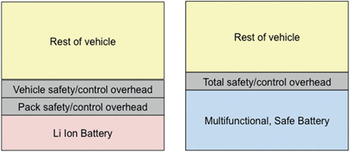
The benefit of multifunctionality can be significant. If half of a battery can be used as a structural member, then the effective weight of the battery is reduced by half or its effective specific energy is doubled. Consequently, a multifunctional battery may have a lower specific energy while still offering the same effective specific energy at the vehicle level. This important conclusion points to a new research space for EV energy storage research, i.e., to consider low-cost, inherently safer battery chemistries that have lower specific energy that can be integrated into the vehicle structure and/or assemblies. The schematics in Fig. 6 compare the weight distributions of a lithium-ion battery powered EV to one powered by an inherently safer, multifunctional battery. Note that the vehicle level specific energy is the same, thus they have the same range. However, because of the reduction in overhead and other parts of the vehicle due to the functions served by the battery, the cell level specific energy for the multifunctional battery can be lower.
A schematic comparison of the weight distribution of two EVs with the same vehicle level specific energy, or Wh/kg-vehicle. As compared to a lithium-ion battery, a multifunctional, inherently safer battery reduces system overhead as well as the rest of the vehicle weight since the battery serves part of the vehicle function. Despite the great difference in battery weight, the two vehicles have the same Wh/kg-vehicle and range.

Review and research needs in inherently safer battery chemistries and architectures
In this section, we briefly review battery chemistries and architectures that offer inherent safety advantages over lithium-ion batteries. We acknowledge that safety is often a poorly defined term. All the current commercial lithium-ion batteries are considered safe by passing all government issued safety regulations. We focus here on several classes of technologies that are expected to have inherent safety features due to the removal of one or more of the hazards in lithium-ion batteries. As shown in Fig. 7, these technologies offer a variety of starting points to arrive at the cost and specific energy targets, each raising unique research needs that will be discussed below.
Several class of technologies as potential candidates for EV storage. The cost and specific energy values are approximate. For emerging systems, specific energy values are projected based on laboratory cell data. Note that different candidate technologies require different development pathways to reach the target. However, multifunctional designs can always increase the effective specific energy for inherently robust energy storage solutions.

High energy density flow batteries
Flow batteries have enjoyed a recent renaissance due to their perceived advantages for grid storage. Reference Liu, Zhang, Yang, Lemmon, Imhoff, Graff, Li, Hu, Wang, Xiao, Xia, Viswanathan, Baskaran, Sprenkle, Li, Shao and Schwenzer67–Reference Dunn, Kamath and Tarascon72 In flow batteries, the anode and cathode active materials are usually dissolved in electrolyte solvents, which flow through the electrode surface where charge transfer takes place. An ion exchange membrane is needed to allow the passage of ions while preventing crossover of the electroactive species. For grid storage, the most important metrics are cost, cycle life, and round trip efficiency. Specific energy, on the other hand, is not as critical since most of the applications are not weight or volume constrained. As a result, most of the redox couples, such as the vanadium redox battery, have specific energies <25 Wh/kg. Reference Dunn, Kamath and Tarascon72 With the acceptance of having a lower cell voltage, aqueous electrolytes are often used due to their low cost relative to nonaqueous electrolytes.
Flow batteries can offer unique advantages for vehicle applications as well. For example, the battery can be electrically recharged or, alternatively, the catholyte and anolyte can be replaced at a fueling station, providing rapid charging which overcomes a major obstacle to EV adoption. While hydrogen fueling for FCVs can be fast, flow batteries can deliver much higher round trip efficiency assuming FCVs' hydrogen source is generated by electrolysis of water. In addition, the flow battery has the potential to tolerate degradation of the replaceable fluid, assuming purification is not prohibitively costly. However, for flow batteries to be suitable for EV applications, their specific energy has to be increased.
To increase specific energy, cell voltage or cell capacity needs to increase, either separately or together. For flow batteries, cell capacity is often limited by the solubility of the reactants. Consequently, it is important to search for flow systems with very high concentrations of active materials. Reference Dunn, Kamath and Tarascon72 Alternatively, a solid electrode can replace one of the solutions as in the well-known example of the zinc–bromine battery. Reference Liu, Zhang, Yang, Lemmon, Imhoff, Graff, Li, Hu, Wang, Xiao, Xia, Viswanathan, Baskaran, Sprenkle, Li, Shao and Schwenzer67,Reference Wang, Luo, Li, Wei, Li and Yang68 The zinc electrode functions as a traditional plating/dissolution electrode during battery cycling. However, reversible operation of the metal anode requires maintaining stability of the electrode dimension and preventing the formation of dendrites. Despite decades of research, a reversible metal electrode that can undergo thousands of cycles while maintaining dimensional stability remains elusive, although research continues to progress in this area. Reference Parker, Chervin, Nelson, Rolison and Long73
Another approach to improve energy density is to formulate the solid electrode material as particles suspended in an electrolyte. Recent work demonstrated that common lithium-ion battery materials could be formulated as a stable slurry with sufficient electrical conductivity to function as active materials. Reference Duduta, Ho, Wood, Limthongkul, Brunini, Carter and Chiang71 Compared to a traditional lithium-ion battery, a semisolid flow battery greatly reduces the number of steps for battery manufacturing, and system costs can be significantly reduced. Many challenges remain for semisolid flow batteries, including high parasitic pumping power loss due to friction, and the instability of the electrode/electrolyte interface due to the shear force. The last issue is particularly relevant for lithium-ion anode materials whose surface require the protection of the SEI. The SEI layer has to remain mechanically robust to survive the shear force during the flow of the particles. Research into material systems that are free of this issue is critically needed.
Aqueous batteries
The lack of flammable materials is a unique advantage for batteries using water-based electrolytes, if hydrogen gas evolution during operation is avoided. Until the invention of lithium-ion batteries, rechargeable aqueous batteries dominated the market. Despite their long history, only lead–acid, nickel–cadmium, nickel–metal hydride (Ni–MH), and silver–zinc have reached mass adoption. Reference Beck and Ruetschi74 For automotive applications, lead–acid batteries powered the early automobiles in the 1910s before ICEs were introduced. Amazingly, lead–acid batteries remained the power source of choice for General Motor's EV1 when it was introduced in the 1990s. Reference Brost75
Research in rechargeable aqueous batteries of high specific energy has stagnated in recent years. Reference Beck and Ruetschi74 This fact is largely driven by the success of lithium-ion batteries in the portable electronics market. With higher specific energy and longer cycle life than nickel–metal hydride, lithium-ion batteries have dominated recent research efforts in energy storage.
If aqueous batteries are to compete with lithium-ion batteries for EV applications, they need to demonstrate both higher specific energy and longer cycle life. Most aqueous batteries do not offer greater than 100 Wh/kg specific energy, Reference Beck and Ruetschi74 which is the lower bound as illustrated in Fig. 2. To increase specific energy, one approach is to expand the redox stability window of water so that redox couples with potentials higher than oxygen or lower than hydrogen evolution can be utilized. In fact, for the Ni–MH battery, the nickel oxyhydroxide electrode potential (0.49 V in 1 M of OH− solution) is very close to oxygen evolution as shown by nickel's Pourbaix diagram. Reference Beverskog and Puigdomenech76 As a result, the electrode is rarely fully charged before oxygen evolution takes place. Similarly, the metal hydride electrode operates very close to the hydrogen evolution potential. As a result, corrosion of metal hydride often limits battery life. If the electrolyte window can be widened, metal hydrides such as Mg2NiH4 may be used with a capacity of 2.5 times of state-of-the-art LaNi5H6, significantly increasing cell specific energy. Reference Cheng, Liang, Tao and Chen77 Consequently, research approaches for widening the aqueous electrolyte stability window through the suppression of water decomposition are critically needed. Alternatively, a double membrane configuration was proposed recently that promises operation of the anode and cathode reactions at vastly different pH values thus creating a zinc–cerium aqueous battery with a voltage of 3.08 V. Reference Gu, Gong, Yan and Yan78
The other issue that has plagued aqueous batteries is their poor cycle life. For example, lead–acid batteries degrade rapidly when cycled at full depth of discharge. This poor cycle life is rooted in its chemistry. The electrode reactions of lead–acid battery are not intercalation based and involve major changes in composition, microstructure, dissolution, and phase transformation. These changes make it difficult to maintain the dimensional stability of the electrode and lead to performance decay. Reference Ruetschi79 In contrast, aqueous lithium-ion batteries such as LiFePO4/Li5Ti2(PO4)3 have demonstrated exceptional cycle life due to the use of two intercalation electrode reactions; however, cell specific energy is low due to the limited capacity and low cell voltage. Reference Luo, Cui, He and Xia80 Searching for new redox reactions in aqueous electrolytes represents a major research opportunity. In particular, advancements in nanoengineering may enable better control of the complex battery reactions to offer long cycle life, such as with the lead–acid battery chemistry. As an example, nanoengineering approaches have been extensively used in lithium-ion battery research and have shown potential for enabling conversion and alloy type reactions. Reference Cheng, Liang, Tao and Chen77,Reference Trevey, Gross, Wang, Liu and Vajo81–Reference Li, Wang, Chen and Huang83
Batteries with built-in safety mechanisms
Lithium-ion batteries primarily rely on the battery management system to ensure their safety; however, there have been continuous attempts to improve the inherent safety of these batteries. The approaches include: (i) redox shuttle for over-charge protection. A compound soluble in the electrolyte is designed to be oxidized at potentials just beyond the upper limit of electrode charging potential. The oxidation product then migrates to the negative electrode surface where it is re-oxidized. This mechanism thus creates a chemical short inside the battery, while preventing unwanted irreversible reactions that may lead to battery safety incidents and cell failure. Reference Chen, Qin and Amine84 (ii) Mechanisms to cut off electronic or ionic flow at high temperatures or in the event of an internal short. Separators are designed to melt at elevated temperatures that drastically reduce the porosity of the separator and prevent further flowing of ions. Reference Roth, Doughty and Pile65 (iii) Addition of flame retardants to the electrolyte. Phosphorous or halogen-containing compounds have been extensively studied. Reference Nagasubramanian and Fenton64 However, the amount of fire retardant to be effective also tends to negatively impact battery performance, with reduction at the negative electrode being a leading cause.
The effectiveness of using any built-in mechanism depends on the relative rates between the on-set of the mechanism and that of thermal runaway. Consequently, detailed modeling and testing are necessary whenever a change is made to cell materials or formats. Finally, the majority of the research work has focused on mitigating thermal runaway or flammability. Developing inherent safety mechanism in response to mechanical abuse remains a less explored endeavor and represents a major research opportunity.
Batteries with essentially no combustible organic materials
All solid-state batteries have been a persistent research topic for the past two decades Reference Quartarone and Mustarelli85,Reference Takada86 and features prominently on the roadmap of Japan's NEDO. 15 A clear advantage is that these batteries are free of volatile, flammable organic solvents. Consequently, the total combustible energy is significantly lower than that of commercial lithium-ion batteries. Additional advantages of solid-state batteries include high energy density and long calendar and cycle life. For example, it is possible to use lithium metal as the negative electrode material, which greatly increases cell energy density. Reference Trevey, Gilsdorf, Stoldt, Lee and Liu87 It is also possible to use cathode materials such as FeS2 which normally does not cycle reversibly due to material dissolution into the nonaqueous electrolyte solution. Reference Yersak, Macpherson, Kim, Le, Kang, Son, Kim, Trevey, Oh, Stoldt and Lee88 The stable interface between electrode material and electrolyte results in few parasitic reactions in solid-state batteries and contribute to the long life of the battery. Comprehensive reviews of solid-state batteries have been published recently. Reference Quartarone and Mustarelli85,Reference Takada86 This article only discusses issues that are relevant to EV energy storage.
Early solid-state batteries used thin-film electrode and electrolyte layers. An example was the Li/LIPON/LiCoO2 cell developed at Oak Ridge National Laboratory. Reference Bates, Dudney, Neudecker, Ueda and Evans40,Reference Bates, Dudney, Lubben, Gruzalski, Kwak, Yu and Zuhr89 The electrolyte layer, LIPON, prepared by sputtering Li3PO4 in a nitrogen atmosphere, is a nitrogen-doped lithium phosphate, and has a conductivity of ∼10−6 S/cm. The low conductivity mandates the use of a very thin electrolyte layer to minimize the resistance. Despite the outstanding cycling stability of these batteries (>10,000 cycles demonstrated), the actual energy density of the device is very low since most of the battery is made of substrates and packaging materials.
Fabricating a bulk version of the solid-state battery has proven to be challenging. First, a solid-state ion conductor with much higher conductivity needs to be developed. For reference, common lithium-ion battery electrolytes have conductivities of ∼10−2 S/cm. Reference Xu90 There are several electrolytes, including La0.5Li0.5TiO3, Li3.25Ge0.25P0.75S4, Li7P3S11, and Li2S–SiS2–Li3PO4 with conductivities of >10−3 S/cm Reference Takada, Aotani and Kondo91–Reference Inaguma, Chen, Itoh, Nakamura, Uchida, Ikuta and Wakihara94 and a recent development of Li10GeP2S12 with a conductivity of >10−2 S/cm. Reference Kamaya, Homma, Yamakawa, Hirayama, Kanno, Yonemura, Kamiyama, Kato, Hama, Kawamoto and Mitsui95 Many of these phases use highly polarizable elements such as sulfur to enhance ionic conductivity. Unfortunately, the presence of these elements also gives rise to electronic conductivities as well as limited electrochemical stability window. One solution to this dilemma is to use electrochemical materials with very high capacities but with work potentials within the stability window. Recent work demonstrated that cathode materials such as TiS2, Reference Trevey, Stoldt and Lee96 FeS2, Reference Yersak, Macpherson, Kim, Le, Kang, Son, Kim, Trevey, Oh, Stoldt and Lee88 and a polymer composite made by the reaction between polyacrylonitrile and sulfur show stable cycling with a sulphide-based electrolyte. Reference Trevey, Gilsdorf, Stoldt, Lee and Liu87 It is thus important to develop the right electrolyte/electrode combination so that interfacial redox stability can be ensured.
An even greater challenge for bulk solid-state batteries is the large interfacial resistance. Ideally, the electrode is composed of a solid–solid composite of active materials and the electrolyte where (i) all the active materials are connected electrically, perhaps with the assistance of an electrically conducing additive; (ii) all the electrolyte materials are connected to ensure continuous ion conducting pathways; and (iii) the interface between the active material and the electrolyte is free of voids to provide a continuous electrochemical interface. The third requirement is particularly challenging, in contrast to batteries with liquid electrolytes where the liquid readily permeates into the pores of the electrodes and can manage volume change associated with the charge–discharge cycle. Current fabrication methods are not conducive to forming composites as described above. In general, powders of electroactive material, electrolyte, and conducting additives (most likely carbon black) are mixed thoroughly and pressed into a pellet. Residual porosity is usually unavoidable and there is no mechanism to ensure the formation of the ideal structure described above. Breakthroughs in materials processing are critically needed in this area.
Finally, all-solid-state batteries have to deal with the volume change and mechanical stress experienced during operation. Lithium-ion battery materials are known to experience varying degrees of volume change. For example, graphite expands by ∼13% when it is fully lithiated to a composition of LiC6 while LiCoO2 expands by ∼1.9% when it reaches a composition of Li0.5CoO2. Reference Koyama, Chin, Rhyner, Holman, Hall and Chiang97 These volume changes are minor compared to the materials of higher capacities. As mentioned previously, Si expands by ∼300% while S expands by 80% Reference Li, Zheng, Yang, Seh, Liu and Cui98 when it transforms into Li2S. In an all-solid-state battery, it is highly unlikely any appreciable amount of volume change is acceptable, to prevent crack formation that may lead to catastrophic failure. Consequently, the need for electrode materials with very small volume changes is of paramount importance for solid-state batteries.
Multifunctional energy storage systems
If energy storage chemistries and architecture can provide inherent safety, then multifunctional designs become possible. These energy storage devices could provide structural functions, including load transfer and energy absorption.
The concept of structural power dates back to the early 2000s, when various systems were evaluated under DARPA's Synthetic Multifunctional Materials Program. For example, prismatic cells were used as parts of the wing for an unmanned air vehicle, which achieved record flight time. Reference Christodoulou and Venables99 In this case, the battery served as both the power source and as part of the structure. To achieve this, the mechanical strength of the battery was increased by external reinforcement. An alternative approach is to make the battery itself truly structural by changing the material composition and structure of battery electrodes and separator. This approach is exemplified by the work of Snyder et al. Reference Snyder, Wetzel and Watson100 Both mechanical and electrochemical performance goals were considered in the battery design which dictated the material choices. For example, the polymeric electrolyte layer requires high ionic conductivity; however, the ionic conductivity of a polymeric material often correlates inversely with its mechanical strength. Nonetheless, this truly multifunctional approach represents a new paradigm in material design and engineering and holds great potential in realizing weight and volume savings on the system level. Research efforts in this area persist to this day. Reference Asp101–Reference Ekstedt, Wysocki and Asp103 For example, chopped carbon and glass fibers were used as fillers to the polymer matrix in both the electrode and electrolyte region. Reference Liu, Sherman and Jacobsen104 A battery that is load bearing with a tensile modulus of 3.1 GPa was fabricated, which achieved an energy density of 35 Wh/kg. Similarly, when highly elastic polymers are used to form the battery matrix, elastic batteries can be fabricated showing a reversible elastic strain of over 35%. More recently, carbon fiber composites have been used to construct an electrochemical capacitor and its integration as the roof of an automobile has been suggested. Reference MacKenzie105
If the targeted application is for automobiles, multifunctional design can be considered on multiple length scales. In addition to material and cell level solutions discussed above, pack and vehicle level opportunities are possible. For example, mechanical testing results of cylindrical lithium-ion battery cells show an energy absorption density of 0.27 J/g before cell failure. Reference Sahraei and Wierzbicki106 The cell can be viewed as a steel tube filled with packed powders immersed in liquids. Likewise, a water filled steel tube has been shown to absorb energy of nearly 4 J/g. Reference Chen, Surani, Kong, Punyamurtula and Qiao107 On the pack level, a recent design Reference Ginsberg108 builds battery cells into subunits, which are connected together using structural hinges. Upon mechanical impact, the battery pack can deform without sacrificing the mechanical integrity of the battery cell. The deformation absorbs part of the impact energy and contributes to vehicle occupant safety. In other words, the energy storage system, instead of being protected by additional vehicle structure, was able to participate in vehicle crash management and helped to protect vehicle occupant. Such additional functionality presents a powerful design opportunity that a vehicle equipped with an ICE does not have. The ability of the battery to absorb crash energy represents novel pathways to whole vehicle level optimization. A basic requirement for utilizing this mechanism is to ensure the inherent safety of the energy storage system.
Summary and Outlook
To drastically reduce the cost and improve the range of EVs, a safety-centric approach is proposed. The energy storage system can be considered as part of the vehicle mechanical structure to carry load and participate in vehicle crash energy management. The net result is a reduction in the total weight of the vehicle and an increase in range without the need to carry more energy onboard. This multifunctional design can also be viewed as a pathway to use energy storage chemistries that are inherently safer but with slightly lower specific energy than lithium-ion batteries as long as the total vehicle weight does not increase. This expansion of the choices of chemistries is critical in broadening our search for low-cost alternatives to lithium-ion batteries.
We conclude by pointing out the following research topics to enable such a safety-centric approach:
-
(1) High specific energy density aqueous batteries including advanced alkaline batteries, e.g., high-capacity metal hydrides with nickel oxide or air cathodes;
-
(2) Liquid-fueled flow batteries with high specific energies;
-
(3) All-solid-state batteries with (a) high conductivity electrolytes; (b) redox compatible electrode/electrolyte interfaces; (c) electrode materials with small to no volume change during operation; and (d) novel processing techniques that generate designed electrode/electrolyte composite structures;
-
(4) Multifunctional designs that seek synergy between mechanical and energy storage properties of materials, architectures, and system designs.
Acknowledgments
The authors thank Dr. Jacob Ward of the U.S. Department of Energy who provided the early framework for the EV battery cost analysis. Additionally the authors would like to thank Dr. Kevin Gallagher and the sponsorship of the U.S. Department of Energy's Office of Energy Efficiency and Renewable Energy (EERE) Vehicle Technologies Program (VTP) for their analysis and projections of future battery energy density and cost trends.