Arponen et al.’s paper is a timely discussion paper which raises basic issues about the relationship between environmental science and archaeology, and thus about the relationship between science and archaeology more broadly. My comments will therefore begin with a discussion of the nature of interdisciplinary research, as a background for re-evaluating the question of determinism in environmental research. Thus more recently we have seen a critical concern or even anxiety emerge over how to reconcile science-based and humanistic traditions of interpretation in a period of expanding importance of science-based knowledge in aDNA studies (Callaway Reference Callaway2018; Sørensen 2017; Kristiansen Reference Kristiansen2017). It raises the question of their relationship and of what provides good practice.
Archaeology and science: what relationship?
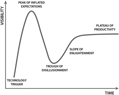
The relationship between archaeology and science has a long history, which allows us to extract certain historical regularities (Kristiansen Reference Kristiansen2014). The introduction of new science-based applications in archaeology is typically a two-phase process characterized by a ‘break-through’ phase of innovative basic research, which after 10 to 15 years is followed by a ‘consolidation phase’ of more widespread application (Martinon-Torres Reference Martinon-Torres, Armada, Mourillo-Barosso and Charlton2018, Figure 12.1). Between the two we sometimes find an intermediate phase of critical discussion and methodological refinements (Figure 1).
The so-called Gartner hype curve, here used to exemplify the process of new science innovations in archaeology (after Martinon-Torres Reference Martinon-Torres, Armada, Mourillo-Barosso and Charlton2018, Figure 12.1).

Breakthrough phase Groundbreaking basic research in a few leading research centres, publications in top-ranking science journals, redefinition of archaeological knowledge. Extensive research funding. Archaeological debates and theoretical reformulations to accommodate the new evidence. This is often followed by a phase of critique and re-evaluation, as in the case of the C14 calibration curve, which was then followed by a consolidation phase (or consensus phase) of more widespread application, lowering of prices, publication in more traditional archaeological journals in tandem with rapid accumulation of evidence that allows archaeological refinement of interpretations.
Right now strontium isotopic research is working hard to define more precise baselines, and what constitute proper baselines, being on its way into the consolidation phase (Frei and Frei Reference Frei and Frei2011). Ancient DNA research is still peaking in the first breakthrough phase, but we witness mounting critique not of its methodologies, but rather of the historical and theoretical implications of the results (Sørensen 2017; Kristiansen Reference Kristiansen2017). Archaeometallurgy is yet another example of an early breakthrough of chemical analyses, critique and a rather long decline, followed by new methods, such as lead isotopes, and new relevance (Martinon-Torres Reference Martinon-Torres, Armada, Mourillo-Barosso and Charlton2018).
Philosophy versus practice
The philosophical position outlined in the Arponen et al. paper, that natural sciences adhere to a specific law-bound system of causal explanation, cannot be, and in practice rarely is, assigned to social and historical explanations. Most science-based disciplines are careful not to transcend their methodological limits of inference. This is where interdisciplinary dialogue enters the scene, as historical forces of social and economic institutions adhere to a different logic. It is here, in the dialectic between environmental and social forces, that explanations are to be formulated. Thus, while environmental research can define ecological thresholds, it is only through the interaction between society and environment that economic constraints can be defined, as they depend upon economic needs and social motivations. In my experience, environmental researchers, especially pollen botanists, are always careful not to seek historical explanations for environmental changes that go beyond what they observe in the record. Evidently, with the new European Reveals database of absolute pollen diagrams, and its capacity to reconstruct vegetational patterns across Europe, we are in a much better position to enter a constructive phase of interpreting large-scale economic or environmental changes, in opposition to the constraints of traditional single-pollen diagrams (Roberts et al. Reference Roberts, Fyfe, Woodbridge, Gaillard, Davis, Kaplan, Marquer, Mazier, Nielsen, Sugita, Trondman and Leydet2018). As stated in the Arponen et al.’s paper, truly integrated research teams can produce truly holistic explanatory models of past changes, but always based on probabilities, and always subject to new interpretations in the face of upcoming new evidence.
Thus it is indeed true that there is a giant step from establishing a correlation between variables to providing a causal explanation of these correlations. And in most of the cases I know of where attempts are made at taking this giant step it is done either by an interdisciplinary research team or by archaeologists working with such teams. Some recent examples may illuminate such good practice when an interdisciplinary team of researchers contributes to a common theme, such as megadrought (Weiss Reference Weiss2017), ecology and population dynamics (Harper et al. Reference Harper, Diachenko, Rassamakin and Kennett2019), or the origin and circulation of metal (Radivojevic et al. Reference Radivojevic, Roberts, Pernicka, Stos-Gale, Martinon-Torres, Rehren, Bray, Brandherm, Ling, Mai, Vandkilde, Kristiansen, Shennan and Broodbank2018); or when a single researcher provides a synthesis based on solid interdisciplinary knowledge (Noble Reference Noble2017; Chapman Reference Chapman2018; Müller Reference Müller and Fernandez-Götz2016).
Who, then, is deterministic?
The answer is in the eye of the beholder. Scientists and archaeologists alike may hold to certain rules of basic environmental and human correlates within their respective fields, which some may call deterministic, but which are rarely applied to explain phenomena outside their area of relevance. Determinism arises only when attempts are made to apply explanations of data in one field to another field without due recognition of the methodological and interpretive practices of that discipline. And when you rely on monocausal explanations. It demands interdisciplinary research teams to account for multicausal historical or environmental transformations, and the application of a methodological and interpretive mix of quantitative and qualitative probabilities, whose outcome is therefore never deterministic, but whose success depends on an interdisciplinary familiarity of the team with both the data and the methods of each participating discipline. Given this definition, Arponen et al.’s paper seems to construct a problem that I find difficult to recognize in real academic practice, with minor exceptions of researchers who do not respect the limits of their knowledge. Most of their examples are indeed based on probabilistic interpretations, but where researchers place different weight on the dominant forces of change.
Interdisciplinary research thus demands that its practitioners embrace and understand the other contributing disciplines, which is mostly honoured. More often than not it is archaeologists who venture into attempts at synthesizing interpretations of complex science-based and archaeological evidence, which is fine as long as they are based on a proper knowledge of the disciplinary fields involved. And that goes also for scientists entering the explanatory field of archaeology. It is hard work but most contributions in the field are sound attempts at interdisciplinary probabilistic interpretation, and not deterministic in my definition.