Introduction
Despite their limited efficacy and association with significant harm in the elderly (Schneider et al., Reference Schneider, Dagerman and Insel2006; Hartikainen et al., Reference Hartikainen, Lönnroos and Louhivuori2007; Huybrechts et al., Reference Huybrechts2012a), nursing home residents are frequently prescribed psychotropic medicines to manage behavioral and sleep disturbances (Snowdon et al., Reference Snowdon, Galanos and Vaswani2011; Rattinger et al., Reference Rattinger2013). Many countries including the US and Australia have mandated or recommended nursing homes, also called long-term care or care homes, to implement measures to facilitate the appropriate use of such medicines (Hughes et al., Reference Hughes, Lapane, Watson and Davies2007). The Omnibus Budget Reconciliation Act (OBRA-1987) and Australian Pharmaceutical Advisory Council guidelines (APAC, 2002) are an example of these (APAC, 2002; Hughes et al., Reference Hughes, Lapane, Watson and Davies2007). However, reports continue to reveal psychotropic medicines are being prescribed for uses outside approved indications or for too long with infrequent review and attempts at cessation (Briesacher et al., Reference Briesacher2005; Simoni-Wastila et al., Reference Simoni-Wastila2014). The prevalence of psychotropic medicine use in nursing homes remains high. Forty seven percent (47%) of residents in Sydney nursing homes are prescribed a psychotropic medicine (Snowdon et al., Reference Snowdon, Galanos and Vaswani2011). It is not clear what percentage of these have no clear clinical indication or incorrect duration of treatment; however, studies suggest that at least 30% are likely to be inappropriately prescribed (Simoni-Wastila et al., Reference Simoni-Wastila2014). In some nursing homes within the US, the prescribing rate of antipsychotic medicines can be 24% whilst in others it is as high as 44% (Chen et al., Reference Chen, Briesacher, Field, Tjia, Lau and Gurwitz2010). The large discrepancy between the prescribing rates suggests that nursing home characteristics themselves influence use (Rochon et al., Reference Rochon2007; Huybrechts et al., Reference Huybrechts2012a).
Factors that contribute to this variation include regulatory and financial arrangements, as well as nursing home characteristics such as ownership type, bed capacity, staffing levels, and resident care needs (Kim and Whall, Reference Kim and Whall2006; Castle et al., Reference Castle, Hanlon and Handler2009; Zuidema et al., Reference Zuidema, de Jonghe, Verhey and Koopmans2011; Tjia et al., Reference Tjia, Gurwitz and Briesacher2012). However, these do not account for all the variation in prescribing (Chen et al., Reference Chen, Briesacher, Field, Tjia, Lau and Gurwitz2010; Huybrechts et al., Reference Huybrechts2012b). Residents are more likely to be prescribed an antipsychotic medicine if they enter into a nursing home with a high propensity for antipsychotic prescribing, irrespective of their clinical indication and after controlling for other factors (Rochon et al., Reference Rochon2007; Chen et al., Reference Chen, Briesacher, Field, Tjia, Lau and Gurwitz2010). Organizational culture is proposed as a key factor that explains these observed differences across nursing homes (Hughes et al., Reference Hughes, Lapane, Watson and Davies2007; Chen et al., Reference Chen, Briesacher, Field, Tjia, Lau and Gurwitz2010). Studies suggest that some nursing homes have cultures that normalize inappropriate prescribing as a solution to problems created by low staffing, high resident care needs, and nursing home structure (Hughes et al., Reference Hughes, Lapane, Watson and Davies2007; Chen et al., Reference Chen, Briesacher, Field, Tjia, Lau and Gurwitz2010). Culture has been found important particularly when general practitioners visit nursing homes, sometimes without direct contact with the resident, and decisions to prescribe are based on staff reports and interactions with nurses (Cody et al., Reference Cody, Beck and Svarstad2002).
Several studies have examined the link between organizational culture and nursing home quality of care using quantitative measures (Berlowitz et al., Reference Berlowitz2003; Scott-Cawiezell et al., Reference Scott-Cawiezell2005; van Beek and Gerritsen, Reference van Beek and Gerritsen2010). For example, nursing homes that emphasized participation among staff in quality improvement activities or innovation were related to improved dementia care and the prevention of pressure injuries (Berlowitz et al., Reference Berlowitz2003; van Beek and Gerritsen, Reference van Beek and Gerritsen2010). A limitation found across all studies is that they defined culture generally as values, beliefs, and norms of the nursing home without explaining what component was measured. Three related studies have measured the belief of nursing home staff about the use of psychotropic medicines for the management of behavioral and sleep disturbances (Svarstad et al., Reference Svarstad, Mount and Bigelow2001; Hughes et al., Reference Hughes2012; Peri et al., Reference Peri2015). However, the measure focused on knowledge of psychotropic medicines for the management of behavioral and sleep disturbances and did not capture organizational norms and practices surrounding the use psychotropic medicines. Also, two of the studies (Svarstad et al., Reference Svarstad, Mount and Bigelow2001; Hughes et al., Reference Hughes2012) only included nurses whilst one study included GPs and nurses (Peri et al., Reference Peri2015). Pharmacists and nursing assistants who are also involved in decisions regarding the use of psychotropic medicines in residents were not included.
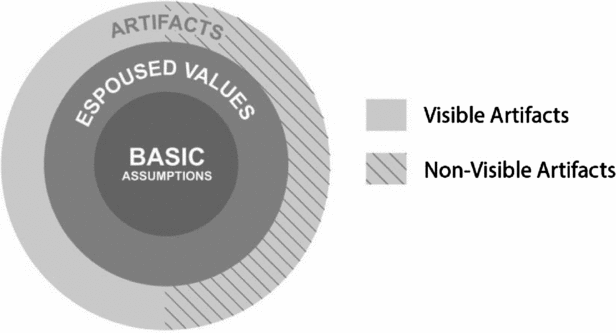
To date, no qualitative study has adopted a theoretical framework to explain nursing home organizational culture and the association with psychotropic prescribing from the perspective of both on-site and visiting staff members. According to Schein, culture has three layers (Schein, Reference Schein2010) (Figure 1). Artifacts are the outer layer of culture and explain “how” and “what” is taking place in an organization (Schein, Reference Schein1984). They may be visible or non-visible. Visible artifacts are components within the organization that are “seen, heard, and felt” such as structures, processes, and observed behaviors. On the other hand, the non-visible artifacts are the perceptions of members of the organization regarding the work environment and interactions with each other or with outsiders. Schein refers to these perceptions as the climate of the organization (Schein, Reference Schein, Ashkanasy and Peterson2000; Reference Schein2010). The middle and third layers are the espoused values and basic assumptions and explain “why” members behave the way they do at the layer of artifacts (Schein, Reference Schein2010).
Three layers of organizational culture.

This paper focuses on visible artifacts of culture because while they may appear to be consistent across organizations (Schein, Reference Schein2010), they can mean different things or may be adopted in different ways (Martin, Reference Martin2002). This study explored how visible artifacts in nursing homes influenced the prescribing and use of psychotropic medicines, and how these artifacts were operationalized across nursing homes, from the perspective of on-site and visiting staff.
Methods
A qualitative approach was used to uncover how visible artifacts were related to the use of psychotropic medicines in nursing homes. Semi-structured interviews were conducted with nursing home on-site and visiting staff involved with resident care. This study is part of a larger study exploring nursing home organizational culture related to the use of psychotropic medicines. Schein's theory was used to guide the overall study design and methods. The study was approved by The University of Sydney Human Research Ethics Committee (Protocol No: 15084).
Setting and participant sample
Purposive sampling was used to reflect diverse levels and types of care in nursing homes (low care, high care, combination of low/high care, or dementia specific) and ownership type (for profit and not-for-profit). Nursing homes were all located within the greater metropolitan area of Sydney. Low care nursing homes provide accommodation and low level nursing care. High care nursing homes offer care for people with greater frailty and who often need 24 hour nursing care in addition to low care needs (AIHW, 2012). The first author (MS) contacted representatives of the participating nursing homes via telephone and/or e-mail and approval was sought for the delivery of a study information package. Once organizational consent was obtained from the nursing home, an appointment was arranged with the nursing home manager to discuss recruitment strategies for on-site and visiting staff.
Both on-site staff (nursing home managers, licensed registered nurses, enrolled nurses and nursing assistants) and visiting staff (GPs, community pharmacists, accredited pharmacists, specialist medical practitioners, nurse practitioners, and clinical nurse consultant) were selected purposefully. Both groups were involved in resident care and interacted with one another to arrive at decisions regarding the use of psychotropic medicines. Whilst a small percentage of nursing home staff members were known to the first author, who has previously worked as a pharmacist in nursing homes, there is no formal relationship between the researcher and the participants interviewed. A minimum of three participants with differing professional roles within each nursing home was sought from the potential participant pool, allowing for maximum variation sampling. Participation was voluntary, and all participants provided written informed consent to participate in the study, including digital recording of the semi-structured interviews.
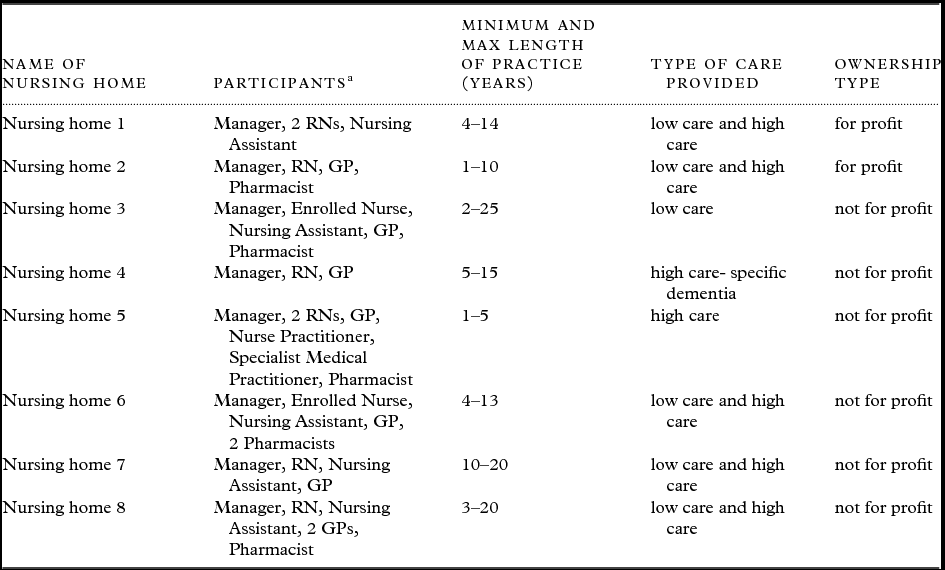
A total of 40 participants (23 on-site and 17 visiting staff) from eight participating nursing homes were interviewed by the first author (MS). The majority of the participating nursing homes were combined low/high care (n = 5) and not-for profit (n = 6) providers (Table 1). The median length of participants’ years of practice at research sites was 10 years (IQR 3–12). Fifteen nursing homes were contacted to participate in the study. Four nursing homes declined to participate due to time constraints. A further three failed to respond to the invitation to participate.
Characteristics of nursing home and participants

RN = registered nurses; GP = general practitioner.
aCNC – Clinical Nurse Consultant, visits nursing homes on referral.
Interviews were conducted between September 2012 and July 2013, until thematic saturation was reached. Most interviews (n = 34) were conducted at nursing homes, with the remaining conducted at the medical practitioners’ surgery (n = 3) and community pharmacy (n = 3). The median duration of the interviews was 50 minutes (IQR 40–60).
Data collection
In accordance with Schein's Theory on organizational culture, this paper focuses on visible artifacts which are the components within an organization that are “seen, heard, and felt” such as structures, processes, and observed behaviors (Schein, Reference Schein2010). In nursing homes visible artifacts include the visitation of healthcare professionals, staff handovers, meetings, medication rounds, and use of medication charts (Hughes et al., Reference Hughes, Lapane, Watson and Davies2007). Participants were asked to describe how these visible components operated in the nursing home. Also, participants were asked for their perspectives on the use of psychotropic medicines (i.e., antipsychotics, antidepressants, antidementia drugs, and sedatives/hypnotics) within the nursing home. The use of psychotropic medicines encompasses initiation, administration, monitoring, continuation, and cessation.
The interview guide was piloted for its appropriateness and relevance with members of one nursing home including the manager and two registered nurses. The interview guide was then modified slightly and further reviewed by members of the research team (TC and YJ) with experience in qualitative research. The pilot interviews were included in the main data as the changes made in the interview guide was minor.
The interviews were conducted by the first author (MS) a pharmacist who has worked in nursing homes and has been trained in qualitative research methods. Whilst it was useful to be familiar with the processes involving medication use in the nursing home, as a researcher the first author made conscious efforts not to accept potentially common assumptions at face value.
Field notes were taken at the time of the interview and further expanded notes were made soon after the visit as part of the data collection process. After each interview, the interviewer developed a summary report of the researcher's experiences of the interview and nursing home visit.
Data analysis
All interviews were transcribed verbatim and reviewed for accuracy by examining the transcripts multiple times while simultaneously listening to the recordings. The transcripts formed the data for thematic qualitative analysis. Thematic analysis is a foundational method and a flexible approach to gain rich insights into the purpose of our inquiry (Patton, Reference Patton2002). Transcripts were imported into a qualitative software program (Nvivo 10, QSR International) to assist in the management of data and were subsequently content analyzed. Transcripts were initially content coded for visible artifacts identifying specific cases, phrases, words, or sentences (Patton, Reference Patton2002). Coding was carried out by one researcher (MS) and refined by the research team (TC and YJ) using analyst triangulation (Patton, Reference Patton2002). The research team established links between visible components of the nursing home described by participants in the interview and the use of psychotropic medicines using the originally coded data. Those that were discussed at length and common to the majority of participants from the eight nursing homes were selected for further analysis. Coded data important to the area of interest was reviewed and compared among the research team and further sorted into themes. The research team met frequently to discuss emerging themes derived from the originally coded data to explain nursing homes adoption of the selected visible artifacts. Emerging themes were reviewed and refined to reconcile differences in interpretation. This process continued until no new themes emerged and all researchers agreed on final interpretation of the data. Reflexivity was facilitated by the use of field notes documented during data collection and further ensured as emerging concepts were identified and confirmed by on-going dialogues with the research team members throughout data collection and analysis.
Results
Three visible artifacts associated with the use of psychotropic medicines were identified. These were drugs and therapeutic committee meetings, pharmacist led medication management review, and formal and informal meetings with residents and their families. Our analysis demonstrated that these visible artifacts influenced the use of psychotropic medicines across all eight nursing homes and there were variations in the adoption of these visible artifacts across nursing homes. Some nursing homes utilized visible artifacts as procedures without the need for follow-up whilst others viewed them as a starting point for facilitating the appropriate use of psychotropic medicines. The following sections discuss each visible artifact in detail.
Visible artifact 1. Drugs and therapeutics committee meetings
Drugs and therapeutics committee meetings, also called Medication Advisory Committee (MAC) meetings in Australia, take place in nursing homes between on-site and visiting staff, with the goal of reviewing and evaluating medication management practices. Across the eight nursing homes, these meetings varied in their specific function and pattern of attendance of visiting staff. This influenced how concerns regarding the use of psychotropic medicines in nursing homes were raised and addressed.
Function of MAC meetings
MAC meetings in two nursing homes were utilized by managers to highlight the overuse of psychotropic medicines. This raised awareness of GPs to review the continued use of psychotropic medicines in residents. In the majority of cases, the discussion was driven by managers. For example,
It's really looking at key issues, people that are on sedatives, hypnotics. . . . we take these audits to the MAC meeting so the doctors can have a look at (them) [Nursing Home 5, Manager]
Everybody else raised the issue (at the MAC) of no ‘PRN’ [when required] psychotropic medications and to reduce the load of medications including psychotropics [Nursing Home 5, GP]
Participants from a number of nursing homes indicated that MAC meetings were also used as the platform to discuss the nursing homes’ collection of the three monthly incident reporting summaries such as falls and behaviors that were often associated with the use of psychotropic medicines.
We started to present the falls report in that forum. I found it was the best, because we had the [accredited] pharmacists there, who knew the meds and could look at that side. . .and then the [accredited] pharmacists would talk to the doctors, the RNs. That, to me, was the best process in falls related to medication [Nursing Home 7, Manager]
Further, MAC meetings were used for case conferencing of individual residents, which extended to both visiting and on-site staff and resulted in the review of the appropriateness of residents’ psychotropic medicines. On-site staff further reported that MAC meetings gave them the opportunity to raise their concerns with the GPs in attendance regarding the prescribing of psychotropic medicines compared to other communication media such as in writing.
There was a resident with this one behavior, the [accredited] pharmacist was able to say at the MAC ‘This antidepressant causes insomnia’. . .we could (then) work with a doctor (about this), it's been brilliant [Nursing Home 7, Manager]
In contrast, on-site staff at one nursing home reported that the content of the MAC meetings predominantly focused on operational matters such as pharmacy operation hours and pharmacy owing prescriptions, rather than clinical issues. This nursing home manager's attention to the use of psychotropic medicines centered on logistic issues pertaining to medication administration and not an assessment of the appropriateness of psychotropic medicines.
We discuss issues that might come up. . .if the pharmacy is closing down over Christmas time. . .if the pharmacy is having any problems with getting their scripts [Nursing Home 8, Manager]
Attendance at MAC meetings by visiting staff
Attendance of visiting staff at MAC meetings across the eight nursing homes varied. In all, but one nursing home, accredited pharmacists’ (visiting staff) participation in MAC meetings was considered important for guidance on the use of psychotropic medicines, given their extensive knowledge of pharmacotherapy.
We ensure that at our meetings we have the [accredited] pharmacists there and involve them in discussions on psychotropics [Nursing Home 5, Manager]
One nursing home did not include the accredited pharmacist at the MAC meeting as their role was ascribed to carrying out Residential Medication Management Reviews (RMMRs) and on-site staff education. In one nursing home visiting staff attendance at MAC meetings included the geriatrician who provided education and contributed to the discussion of the appropriate use of medicines including psychotropic medicines.
GPs are responsible for the vast majority of prescribing in nursing homes; however, most nursing homes indicated that it was difficult to organize GP attendance at MAC meetings. In a few cases where GPs attended, it was generally the same GP who routinely attended the MAC meetings. GP participants who opted not to attend routine MAC meetings explained that they were limited by time and other work commitments such as managing their own surgeries and several highlighted that they did not see the value in the MAC meeting, as only a small portion of the meeting related to their role. As a result, discussions on the appropriate use of psychotropic medicines were not conveyed to all GPs.
We go to MAC meetings because that's an opportunity to meet a couple of GPs. . . I'm meeting exactly the same GPs every time. The GPs who are interested come and those who do not; we're unable to catch them (to discuss issues about the use of psychotropic medicines). There are variations [Nursing Home 5, Geriatrician]
The absence of GPs at MAC meeting also hindered the opportunity for staff to communicate concerns regarding the prescribing of psychotropic medicines in residents. For example,
The MAC meeting in conjunction with the pharmacist, the manager, the doctor, care staff, (and) RNs discuss everything that we're really concerned about (with) the resident. In that scenario we can only deal with residents belonging to the GP (from NH 7) because there is no one else [Nursing Home 7, Nursing Assistant]
Visible artifact 2. Pharmacist led medication management reviews
A federally funded form of pharmacist led medication management review in Australian nursing homes is the RMMR. The RMMR is conducted by an accredited pharmacist who identifies actual and potential causes of medicine related problems and presents suggested solutions in a written report to the GP. Although it is a requirement for Australian nursing homes that every resident receives a RMMR as soon as possible after admission or on a clinical needs basis to current residents (APAC, 2002), we found variability in the way nursing homes utilized the specific recommendations from the RMMRs. In some cases, participants considered RMMR as either a logistical process for accreditation purposes where as in others it was used as a lever to implement changes in the use of psychotropic medicines such as the cessation of psychotropic medicines by the GP.
RMMR as a tool for change
On-site staff of several nursing homes reported that they initiated the process of the RMMR when they were concerned with the use of psychotropic medicines in residents who displayed deterioration in their condition, such as weight loss, increasing challenging behaviors, or experiencing adverse drug reactions. In a number of nursing homes, the RMMR report was given directly to the GP to highlight concerns regarding the use of psychotropic medicines. This action facilitated the uptake of RMMR report recommendations by the GP.
The [RMMR] report might say this resident is on a psychotropic, can't find any indications for use. . .I say [to the GP], ‘Well, what's happening about this, why are they on this? They've been on it since they came in, we don't know why. Do they still need to be on it?’ [Nursing Home 7, RN]
RMMR as a safety net
Both on-site staff and visiting staff from a number of nursing homes identified that RMMRs served as a “safety net” for prompting review of psychotropic medicines which had been prescribed for prolonged periods. This included anxiolytic and antipsychotic medicines, which may be overlooked by nursing home staff or GPs.
We need to monitor benzodiazepines, and the medication review [RMMR] helps that happens every 12 months. . . . if something is dropped off our radar, it's picked up at another level [Nursing Home 4, Manager]
GPs acknowledged that limited time hindered their ability to conduct thorough clinical review of the psychotropic medicines prescribed. For this reason RMMRs were relied on by several GPs to indicate the need for review and cessation of psychotropic medicines in residents. The GP from nursing home 4 stated:
Look, it [the RMMR] is a bit of a safety net. Particularly doctors like myself and others that I know who are doing this almost full-on, it's easy to miss something, like that lady who was on Risperidone and perhaps really quite unnecessarily [Nursing Home 4, GP]
RMMR as a box-ticking exercise
On-site staff of several nursing homes reported that the RMMR report received from the accredited pharmacist was filed in the GP communication book or residents’ medical records and no further action was taken. The review and action of recommendations in the RMMR was left to the discretion of the GP. Both on-site and visiting staff across nursing homes highlighted that the response to RMMR reports by GPs varied, with some who did not consider the RMMR report.
They [GPs] say, ‘Oh well, I'm the doctor and I'll do it when I'm ready.’. . . The [RMMR] report gets sent to the RNs. Then the RNs put it in their medical file. Some [GPs] tend to ignore the report or they look at it and they just say, ‘Okay, yeah.’ [Nursing Home 8, Nursing Assistant]
Visible artifact 3. Formal and informal meetings with residents and their families
Several nursing homes were identified to proactively engage with residents’ families in care decisions through the use of case conferencing, ad hoc meetings during family visits to the nursing home, and obtaining formal consent for the initiation of psychotropic medicines. The use of formal (case conferencing) and informal meetings with residents and their families to discuss the use of psychotropic medicines varied and had an influence on prescribing. There were also distinctions between nursing homes in how they responded to residents’ and families’ request for the initiation or continuation of psychotropic medicines.
Proactively engaging families and residents in decision making
Several nursing homes conducted case conference meetings with families when residents were first admitted to the nursing home. These meetings were used to discuss the resident's medication history including the appropriate use of psychotropic medicines. In some cases, this triggered the review of the use of psychotropic medicines and often resulted in their cessation by the GP.
I do go through medications with the families at that time [of the case conference]. . . if they're on any sedatives, hypnotics. Often, at that time, the families all come up and say, ‘I don't know they're on that,’ ‘That was ceased years ago,’ or ‘My mum doesn't need that anymore.’ That will then trigger a call to the doctor to say, ‘Look, can you review these because the families said they shouldn't be on (them) at all?’ [Nursing Home 5, Manager]
Other times, nursing home on-site and visiting staff found it important to explain the pros and cons of the use of psychotropic medicines to facilitate withdrawal.
Residents are so apprehensive about changing their medications ‘I've taken these for years, I don't want to change’ and so it's about patiently working with them over time, and convincing them that they may even feel better [Nursing Home 2, Manager]
While some of the on-site staff stated lack of interest from families regarding medications, others highlighted cases where families questioned the appropriateness of the residents’ medication when they visited the nursing home. For example, some families highlighted concerns to on-site staff regarding the sheer volume of medicines prescribed for the resident and reported side effects from psychotropic medicines, such as drowsiness and sedation. The concerns of families would be noted by on-site staff to request the GP to review psychotropic medicines.
There are some families that say, ‘you think it might be too much? Every time I come and visit, he's just sleeping or is just not into it’. We say to them ‘if you are really concerned, then we will get the doctor to review it again’ [Nursing Home 1, Nursing Assistant]
In addition, the majority of nursing homes reported that they gained consent from families prior to the commencement of antipsychotic medicines. For some nursing homes this included spending time with the resident's family to explain the rationale behind the need for commencing antipsychotic medicines. This approach was used to address any resistance from the families to commence psychotropic medicines due to the stigma attached to the use of these agents.
Giving in to resident and family requests
The majority of participants, both on-site and visiting staff were challenged by resistance from the residents’ families or the residents themselves when attempting to withdraw psychotropic medicines. For example, the resident or their family requested to have benzodiazepines reinstated after a trial withdrawal by the GP or have antidementia medicine continued when it was clear to GPs that the resident was not obtaining any benefit from treatment.
In advanced dementia it [antidementia medicines] has no role. They [residents’ family] want to keep giving it, to the last straw, whatever will help them. Some patients will understand, some family will understand, some of them will not take no for an answer [Nursing Home 8, GP]
Some nursing homes at times acquiesced to requests from residents or their families for the continuation or the initiation of psychotropic medicines even though they acknowledged risks of treatment outweighed any benefit.
One resident could not go without his sedative. It's a low dose and his Doctor (GP NH 7) just lets him have it and watches him all the time. He hasn't had any falls [Nursing Home 7, RN]
Discussion
Our qualitative study is the first to draw the link between visible artifacts of organizational culture and the use of psychotropic medicines. Using Schein's framework, we identified three key visible artifacts of organizational culture that influenced the use of psychotropic medicines in nursing home residents. They were: drugs and therapeutic committee meetings, pharmacist led medication management review, and formal and informal meetings with residents and their families. Even though these key visible artifacts take place in most nursing homes, our research showed not all use visible artifacts purposefully to facilitate the appropriate use of psychotropic medicines.
Drugs and therapeutic committee meetings is similar to MAC meetings in Australia (Hughes et al., Reference Hughes, Roughead and Kerse2008) which is recommend in the APAC guidelines to be established in nursing homes (APAC, 2002). Our study identified MAC meetings as an important artifact of organizational culture related to the use of psychotropic medicines in nursing homes. However, participants in our study reported significant variation in the operation of MAC meetings with respect to their function and attendance. This is largely dependent on whether managers decided to include discussions on the use of psychotropic medicines in the MAC meeting agenda and who they invited to participate (both on-site and visiting staff). Similarly, a number of studies highlight managerial support and creating connections among members is important for successful implementation of quality improvement programs (Kjos et al., Reference Kjos, Botten, Gjevjon and Romoren2010; Stein-Parbury et al., Reference Stein-Parbury, Chenoweth, Jeon, Brodaty, Haas and Norman2012). Although MAC meetings have been found an effective way to improve the quality of prescribing in nursing homes (Cheek et al., Reference Cheek, Gilbert, Ballantyne and Penhall2004), we found that this is facilitated when nursing homes managers coordinated multi-disciplinary attendance to evaluate psychotropic medicine use. In cases where this was not present, drugs and therapeutic committee meetings tended to focus on more procedural or logistic matters, such as the supply of medicines, rather than a discussion on the appropriate use of psychotropic medicines.
Pharmacists led medication management review, referred to as RMMR in Australia, was another important artifact that influenced the use of psychotropic medicines. The RMMR is also similar to drug regimen review in the US and the Clinical Medication Review (CMR) in the UK (Hughes and Lapane, Reference Hughes and Lapane2005; Zermansky et al., Reference Zermansky2006). Managers and on-site staff who adopted the RMMR as a lever of change to improve psychotropic treatment decisions reported that RMMR increased appropriate use of psychotropic medicines, typically a decrease in dose or cessation of psychotropic medicines. In contrast, other nursing homes considered RMMRs as a mandatory “box-ticking exercise” with recommendations for the review of psychotropic medicines were consistently overlooked or disregarded. In Australia and the US, pharmacists are required to give direct input to prevent inappropriate psychotropic prescribing; however, their uptake and implementation by the GP has found to be limited (Hughes and Lapane, Reference Hughes and Lapane2005; Nishtala et al., Reference Nishtala, McLachlan, Bell and Chen2011). General practitioners’ resistance to recommendations made in the RMMR and the absence of readiness to collaborate with pharmacists has been suggested to limit GP uptake (de Almeida Neto and Chen, Reference de Almeida Neto and Chen2008). Our findings demonstrated that the uptake of specific RMMR recommendations is not solely based on the GP response to the RMMR but by nursing home managers and on-site staff valuing the RMMR to facilitate changes to psychotropic prescribing. For the pharmacists led medication management review to improve the appropriateness of psychotropic medicines in nursing homes, appreciation and facilitation of this visible component by on-site staff is required.
The artifact of formal and informal meetings with residents and their families has important implications for the use of psychotropic medicines. In some cases, on-site staff and GPs reported resistance from residents or their families for the cessation of psychotropic medicines. However, rather than giving in to their request, some nursing homes considered it to be important to engage with residents and their families to explain the benefit and risk of psychotropic medicines. The idea of shared decision making to improve patient outcomes in primary care has been increasingly recognized (Légaré et al., Reference Légaré, Ratté, Gravel and Graham2008). Previous studies found nursing homes that involved families in decision making successfully led to the low use of feeding tubes and improved management of behavior in dementia (Foley et al., Reference Foley, Sudha, Sloane and Gold2003; Lopez et al., Reference Lopez, Amella, Strumpf, Teno and Mitchell2010). Likewise nursing home meetings with residents and their family for the purpose to discuss available evidence as well as the benefit and risk of psychotropic treatment will likely facilitate appropriate use of psychotropic medicines.
Most related research has isolated internal nursing home factors such as staff levels, bed capacity, and nursing home ownership as quantitative determinants of inappropriate psychotropic prescribing (Kim and Whall, Reference Kim and Whall2006; Castle et al., Reference Castle, Hanlon and Handler2009; Zuidema et al., Reference Zuidema, de Jonghe, Verhey and Koopmans2011; Tjia et al., Reference Tjia, Gurwitz and Briesacher2012). We demonstrated, using a qualitative method to explore the visible artifacts of organizational culture, that nursing home culture can also influence the use of psychotropic medicines. The study provided rich insight into the ways through which these artifacts are operationalized across nursing homes. The use of Schein's organizational cultural theory allowed the formulation of interview questions from which significant statements emerged. The discovery and exploration of the key artifacts were based on qualitative interviews. It is possible that other qualitative approaches such as observation could have further enhanced authenticity of the findings: that is to ensure the participants were not necessarily giving desired answers. However, we have used appropriate probing techniques to elicit examples of the participants’ views and attitudes.
Furthermore, a number of measures were used to enhance the credibility of our findings including the use of maximum variation sampling to obtain data from multiple sources, the use of in-depth interviews, the fact that identified themes were reviewed and refined by multiple researchers until consensus was reached, the achievement of data saturation and reflexivity through the review of field notes.
The findings of our study highlight that aspects of organizational culture need to be considered to reduce inappropriate use of psychotropic medicines. Data was collected in nursing homes in metropolitan Sydney as such transferability of the findings to other nursing homes in rural and remote areas may be limited.
Conclusion
We identified three visible artifacts of organizational culture related to the use of psychotropic medicines. They were: drugs and therapeutic committee meetings, pharmacist led medication management review, and formal and informal meetings with residents and their families. How they were operationalized across nursing homes played a significant role in reducing or preventing inappropriate use of psychotropic medicines. What triggers the particular adoption of specific practices by on-site and visiting staff appears to be a combination of complex social and professional interactions. Nursing homes that embraced the adoption of visible artifacts of organizational culture acknowledged that they could facilitate the appropriate use of psychotropic medicines, when compared to nursing homes who conducted practices as a “box-ticking exercise”. Investigating the visible artifacts of organizational culture provides a useful insight into practices which can improve the appropriate use of psychotropic medicines.
Conflicts of interest
None.
Description of authors’ role
MS assisted with the development of the research proposal, collected and analyzed the data, and writing of paper. RF assisted with the development of the research proposal and supervised data collection. YJ assisted with data analysis, writing, and editing of paper. TC designed the study, supervised data collection, assisted with data analysis, writing, and editing the paper.
Acknowledgments
The authors wish to acknowledge all those who participated in this study and the technical assistance of Husein Muhammad in the preparation of Figure 1.