Introduction
Papilio demoleus L. (Lepidoptera: Papilionidae) is one of the most serious pests of cultivated citrus fruits that are of high economic value in local and international markets (UNCTAD, 2006; FAOSTAT, 2010). Known variously as the citrus swallowtail, lime swallowtail or lime butterfly, the widely distributed species occurs in both the tropical and sub-tropical regions of the world, including Saudi Arabia (Badawi, Reference Badawi1981), Southern Asia (Corbet and Pendlebury, Reference Corbet and Pendlebury1992), the Middle East, India and the Indo-Pacific region (Vane-Wright and DeJong, Reference Vane-Wright and DeJong2003). Papilio demoleus has also been recorded in the Dominican Republic (Guerrero et al., Reference Guerrero, Veloz, Boyce and Farrell2004), Jamaica and Puerto Rico (Homziak and Homziak, Reference Homziak and Homziak2006).
Papilio demoleus attacks all species and varieties of citrus, including lime, orange and lemon (Lewis, Reference Lewis2009). Its larvae are voracious feeders, with older instars being the most damaging. The larvae prefer young foliage, and heavy infestation can lead to complete defoliation of orchards and nurseries (Atwal, Reference Atwal1976; Lewis, Reference Lewis2009).
Hand-picking of caterpillars and spraying with Endosulphan 35 EC are the two widely recommended methods of pest control. However, synthetic insecticides can be expensive and can cause damage to humans, other organisms and the environment.
Insect growth regulators (IGRs), which mimic or inhibit insect hormones to control pests, have a selective mode of action and are thought to be safer to non-target organisms and the environment than synthetic insecticides. IGRs interfere with the endocrine system of the target insect, disrupting normal development, metamorphosis and reproduction (Hoffmann and Lorenz, Reference Hoffmann and Lorenz1998).
Pyriproxyfen, 4-phenoxyphenyl (RS)-2-(2-pyridyloxy) propylether, is a photostable juvenile hormone analogue (JHA) with a broad spectrum of insect toxicity and short-lived residual effects (Dhadialla et al., Reference Dhadialla, Carlson and Le1998, Reference Dhadialla, Retnakaran, Smagghe, Gilbert, Kostas and Gill2005; Vythilingam et al., Reference Vythilingam, Luz, Hanni, Beng and Huat2005). The JHA has been applied successfully against several agricultural and household pests, including whiteflies, thrips, aphids, scale insects, mosquitoes, flies, ants, termites, cockroaches and fleas (Hirano et al., Reference Hirano, Hatakoshi, Kawada and Takimoto1998). However, the effect of JHAs on P. demoleus has not been fully explored.
We investigated the effects of pyriproxyfen on the development and metamorphosis of fourth and fifth instars and prepupae of P. demoleus, in laboratory assays.
Materials and methods
Insects
Eggs and young larvae of P. demoleus were collected from Citrus aurantifolia in fields with no history of pesticide use, and reared in the laboratory at 28 ± 2 °C, 75 ± 5% relative humidity and 12 h light–12 h dark photoperiod. Larvae were kept in glass troughs and provided with fresh Citrus aurantifolia leaves daily. Adults were maintained in ventilated cages and provided with a 10% honey solution for feeding and fresh Citrus aurantifolia twigs for oviposition.
Test product
Pyriproxyfen, 2-[1-methyl-2-(4-phenoxyphenoxy) ethoxy] pyridine (Vertanal®), purchased from Sigma-Aldrich Chemicals Private Limited, USA was diluted to known concentrations in acetone.
Experimental design
Twenty freshly moulted fourth and fifth instar (0–4 h old) larvae of P. demoleus were each treated with 1 μl of 7.5, 15, 30 and 60 μg/μl doses of pyriproxyfen on the dorsal surface of the last abdominal segment, using 10-μl Hamilton syringes. Controls were treated with the same amount of acetone. All the experiments were performed in triplicate.
Treated larvae were transferred to glass jars and provided with fresh citrus leaves. The jars were covered with muslin cloth. Larval mortality and deformities were recorded for 10–12 days or until the death of the insect, whichever was later, and any dead larvae and resulting abnormal individuals were collected, fixed in Bouin's solution and preserved in 70% ethyl alcohol for further microscopic study and photography.
For experiments with prepupae, freshly formed (0–4 h old) P. demoleus prepupae were treated with pyriproxyfen at 30, 60 and 90 μg/1 μl per prepupa on the dorsal surface of the prothorax, as described above. Controls were treated with acetone alone. The experiments were repeated twice. Observations were made for 10–12 days or until the emergence of adults in controls. Dead specimens were preserved in Bouin's solution for further microscopic study and photography.
Data analysis
Data on larval–larval and larval–pupal duration were analysed using one-way ANOVA. Pearson's correlation coefficient was used to examine the correlation between dose and deformities, using Biostat 2009 Professional 5.8.0 software.
Results
Effects on fourth instars
Topical administration of pyriproxyfen to freshly moulted fourth instars induced a delay in larval–larval ecdysis and subsequent larval–pupal ecdysis. It also reduced the frequency of pupation, increased mortality and ecdysial failure, and inhibited adult emergence.
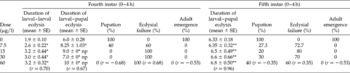
Larval–larval ecdysis was delayed significantly (f = 5.68; degree of freedom (df) = 4, 95; P = 0.0003; f crit. = 2.46) in a dose-dependent manner (r = 0.70; P ≤ 0.05) in all the treatments (Table 1). Larval–pupal ecdysis was also prolonged significantly (f = 13.9; df = 1, 26; P = 0.0009; f crit. = 4.22) (Table 1). At higher doses, the fifth larval stadium's duration was prolonged and pupation did not occur, and treated larvae died because of moult inhibition.
Effect of topically applied pyriproxyfen on fourth and fifth instar larvae of Papilio demoleus (N=20)

* significant at 0.001; ** non significant at 0.001; np = larvae did not pupate; r = correlation coefficient.
Only 40% pupation (r = − 0.68; P ≤ 0.05) was recorded at the lowest dose, and the emerging pupae were severely deformed. The pupae were open, with antennae and mouthparts lying outside of the chrysalis. The abdomens of these pupae had no signs of adult development, and they had the rudiments of larval prolegs on them. The pupae thus had larval, pupal and adult characteristics (Plate 1A).
Types of deformities resulting from topical administration of pyriproxyfen to fourth and fifth instars and prepupae of Papilio demoleus. A, open pupa with antennae, mouthparts outside and larval exuviae (fourth instar, 7.5 μg/l). B, wrinkled larva with double head capsule (fifth instar, 30 μg/l). C, pupal–adult intermediate with distorted wings and mouthparts (fourth instar, 7.5 μg/l). D, extremely shrunk and elongated larvae with rectal prolapse (fifth instar, 60 μg/l). E, extremely shrunk larva (fifth instar, 60 μg/l). F, melanized anterior half, pupal body with larval exuviae attached (90 μg/prepupa). G, defective pupae with larval exuviae and no pupal–adult differentiation (30 μg/prepupa). Bar = 1 mm; arrow shows double head capsule (A colour version of this figure is available online at http://journals.cambridge.org/jti)

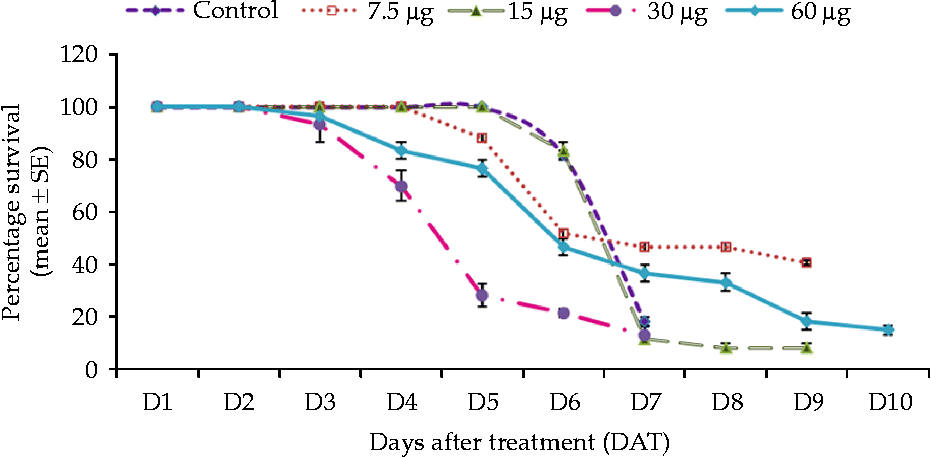
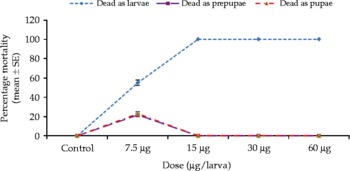
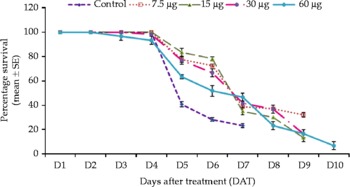
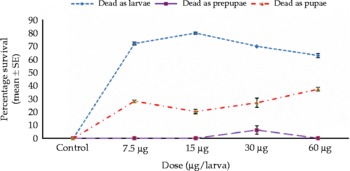
Larvae treated with the highest dose of pyriproxyfen (60 μg) had the longest larval duration (10 days after treatment (DAT)), followed by 9 and 7 DAT with 7.5-, 15- and 30-μg treatments, respectively (Fig. 1). These larvae showed severe morphological deformities and subsequently died, mainly due to ecdysial failure (Fig. 2).
Survival of fourth instar Papilio demoleus following treatment with pyriproxyfen (A colour version of this figure is available online at http://journals.cambridge.org/jti)
Percentage mortality at various developmental stages of fourth instars of Papilio demoleus after treatment with pyriproxyfen (A colour version of this figure is available online at http://journals.cambridge.org/jti)

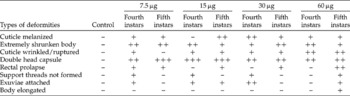
Table 2 summarizes the types of deformities observed following treatment. The most prominent effect was the formation of a double-head capsule (DHC) (Plate 1B), with the older head capsule attached to the newly formed one. In some cases, the new head capsule was not properly chitinized, was white or light coloured and the mouthparts were soft and non-functional. This effect was observed at all doses. Apart from the formation of DHCs, extremely reduced body size and rectal prolapse (Plate 1D and E) were also observed (Table 2).
Types of deformities observed as a result of pyriproxyfen treatment on fourth and fifth instars of Papilio demoleus

Effect: (–) none; (+) mild; (++) moderate; (+++) severe.
There was complete inhibition of adult emergence (r = − 0.53; P ≤ 0.05) in the pupae formed at the lowest dose of 7.5 μg, and all of them died as pharate adults.
Effects on fifth instars
Pyriproxyfen treatments in fifth instars caused a non-significant (f = 0.69; df = 4, 39; f crit. = 2.61) delay in the duration of larval–pupal ecdysis compared with control groups (Table 1).
Pupation was reduced sharply at all the doses applied; only 40% pupation was recorded at the 60-μg treatment, compared with 100% in control groups. Pupation appeared to be independent of dose, as was the percentage of pupae formed (r = − 0.35; P ≤ 0.05) (Table 1).
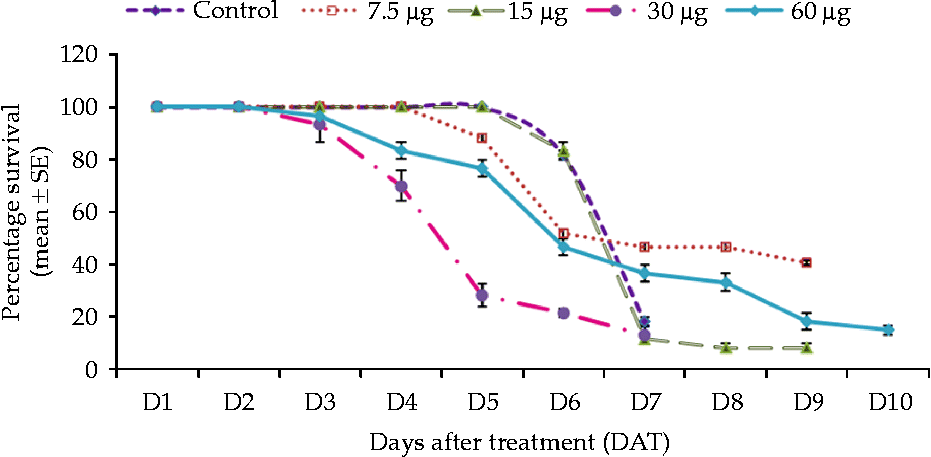
The larvae that did not undergo pupation survived up to day 10 in the 60-μg treatment, followed by day 9 in the 7.5-, 15- and 30-μg treatments, respectively (Fig. 3). The majority of the treated insects died as larvae due to ecdysial failure at all doses (r = 0.35; P ≤ 0.05) (Fig. 4). Deformities similar to those found in the treated fourth instars were also observed in the treated fifth instars (Table 2). A total inhibition of adult emergence (r = − 0.53; P ≤ 0.05) at all doses was also observed and all the treated insects died without completing normal pupal–adult development. The wings and antennae were formed partially in a few specimens, but the abdomen was pupal in all cases.
Survival of fifth instar Papilio demoleus following treatment with pyriproxyfen (A colour version of this figure is available online at http://journals.cambridge.org/jti)

Percentage mortality during various developmental stages of fifth instar larvae of Papilio demoleus treated with pyriproxyfen (A colour version of this figure is available online at http://journals.cambridge.org/jti)

Effects on pupation
When freshly formed prepupae were treated with different doses of pyriproxyfen, they were able to pupate. However, larval exuviae remained attached to the abdominal portion of the pupae, and the development of head, antennae, wings and legs was adversely affected, in a dose-dependent manner (data not shown). The thoraxes of the majority of pupae formed showed varying degrees of melanization (Plate 1F and G). Abdominal development was most severely affected at all doses; all of the pupal abdomens showed no signs of adult development. There was complete inhibition of adult emergence at all doses.
Discussion
In normal development, at the end of each larval instar, the ecdysteroid level elevates and initiates the larval or pupal moult by cessation of feeding and expression of genes appropriate for the next stage of development. The presence of juvenile hormone (JH) at this time expresses the genes for the larval characters, repressing those for the pupal or adult characters (Adams, Reference Adams2003). Edwards et al. (Reference Edwards, Braun and Wyatt1993) suggested that unlike natural JH, pyriproxyfen resists enzymatic degradation and persists in the insect's system longer.
The observed delay in larval–larval and larval–pupal ecdysis and the prolongation of the duration of treated fourth and fifth instars suggest that topical application of pyriproxyfen inhibits the release of the moulting hormone ecdysone, or its activity. High levels of the JHA in larval tissues cause the larva's cells to continue in that stage (Hirano et al., Reference Hirano, Hatakoshi, Kawada and Takimoto1998), thus disrupting normal development.
Similar results of delay in development and metamorphosis as a result of JHA treatment have been observed in Blatella germanica (L.) (Reid et al., Reference Reid, Brock and Bennett1994), cat fleas (Meola et al., Reference Meola, Ready and Meola2000; Rust, Reference Rust2005), Chrysoperla rufilabris (Chen and Liu, Reference Chen and Liu2002), and Aedes aegypti (Braga et al., Reference Braga, Mello, Peixoto and Valle2005; Harburguer et al., Reference Harburguer, Seccacini, Masuh, Audino, Zerba and Licastro2009).
Ecdysial failure was observed as a prominent result of pyriproxyfen application, indicating that the JHA disrupts the secretion or activity of ecdysone (Frederik Nijhout, Reference Frederik Nijhout1998). It has been found that 20-hydroxyecdysone application in the honeybee, Apis mellifera, inhibits cuticular melanization. The effect of pyriproxyfen appears to be the opposite; it caused an enhancement of melanization, probably by suppressing ecdysteroid levels (Zufelato et al., Reference Zufelato, Bitondi, Simões and Hartfelder2000). The increased melanization of P. demoleus larval cuticle seen in our present study could be due to the suppression of ecdysteroid release/synthesis.
According to Hangartner and Masner (Reference Hangartner and Masner1973) and Kimura (Reference Kimura1973a, Reference Kimurab), ecdysone not only controls the synthesis of new cuticle, but also other phenomena associated with moulting; its deficiency adversely affects the enzyme chitinase, which causes the digestion of endocuticle, causing the old cuticle not to shed completely. Sláma (Reference Sláma, Sláma, Romanuk and Sorm1974) suggested that the abnormal biometrical proportions of different parts of treated larvae caused ecdysial failure. In the present study, ecdysial failure was more severe when fourth instars were treated, compared with fifth instars.
A suppression of feeding which led to death before completion of larval–pupal transformation was observed, similar to previous studies in Spodoptera litura (Sundermurthy, Reference Sundermurthy1977) and Nephantis serinopa (Sundermurthy, Reference Sundermurthy1980). The author suggested that JHA interfered with the digestive system of the treated insects and induced anti-feeding activity (Sundermurthy, Reference Sundermurthy1977, Reference Sundermurthy1980).
The production of larval–pupal and pupal–adult intermediates, and abnormal pupation as a consequence of application of JHA pyriproxyfen could be attributed to high endogenous level of the JHA, which mimicked natural JH's action of suppressing pupation (Eto, Reference Eto, Hang and Hoffman1990). This led to abnormal or incomplete pupation, and the development of mosaics (Koçak and Kilinçer, Reference Koçak and Kilinçer1997).
Several authors have reported morphogenetic abnormalities, including production of intermediates with varying degrees of larval/pupal/adult characteristics as a result of JH/JHA treatments in species such as B. germanica (Reid et al., Reference Reid, Brock and Bennett1994) and Aphis glycines (Richardson and Lagos, Reference Richardson and Lagos2007).
Pyriproxyfen treatment of fourth and fifth instars of P. demoleus completely inhibited adult emergence, indicating that it interferes with cellular differentiation and curtails the development of the pupa (Ellsworth et al., Reference Ellsworth, Diehl, Kirk, Henneberry and Silvertooth1997). Several researchers have observed similar results in various species, including Polypedilum nubifer (Trayler et al., Reference Trayler, Pinder and Davis1994), Culex quinquefaciatus (Chavasse et al., Reference Chavasse, Lines, Ichimori, Majala, Minjas and Marijani1995), Aedes togoi (Lee, Reference Lee2001), Anopheles culicifacies and Anopheles subpictus (Yapabandara and Curtis, Reference Yapabandara and Curtis2004), A. aegypti (Sihuincha et al., Reference Sihuincha, Zamora-Perea, Orellana-Rios, Stancil, López-Sifuentes, Vidal-Oré and Devine2005; Harburguer et al., Reference Harburguer, Seccacini, Masuh, Audino, Zerba and Licastro2009), Musca domestica (Sulaiman et al., Reference Sulaiman, Mustafa and Jeffery2008), and Culex pipiens (Michaelakis et al., Reference Michaelakis, Porichi and Koliopoulos2009).
Pyriproxyfen application to P. demoleus prepupae had significant inhibitory effects on normal pupation; all the treated prepupae transformed into abnormal pupae, which were unable to eclose into normal adults. This corroborates the observations of Koçak and Kilinçer (Reference Koçak and Kilinçer1997). The treated pupae developed into pharate adults with varying degrees of deformities, such as open, deformed or small pupae with organogenesis blocked at different levels. It has been suggested that pyriproxyfen interferes with the expression of genes responsible for cell differentiation and stops the imaginal development during the pupal stage (Ellsworth et al., Reference Ellsworth, Diehl, Kirk, Henneberry and Silvertooth1997). Kono et al. (Reference Kono, Omata-Iwabuchi and Takahashi1997) studied the effects of pyriproxyfen on pupae of Culex pipens molestus and found similar effects. Zufelato et al. (Reference Zufelato, Bitondi, Simões and Hartfelder2000) found that topical application of pyriproxyfen led to a delay in the pupal ecdysteroid peak by 4 days, and the subsequent precocious melanization of pupae of A. mellifera. Pupal death and consequent brood reduction was also induced by the JHAs fenoxycarb and pyriproxyfen in Pheidole megacephala (Reimer et al., Reference Reimer, Glancey and Beardsley1991).
Overall, our study is consistent with previous studies in other insects, and we conclude that pyriproxyfen is a promising JHA for the control of the citrus pest P. demoleus. Further larger studies, including field trials, are recommended.
Acknowledgements
The financial assistance provided by the University Grants Commission in the form of a Research Scholarship for Meritorious Students in Science to the corresponding author is gratefully acknowledged. We express our sincere thanks and gratitude to the learned reviewers and editors of IJT for constructive criticisms and valuable suggestions which helped to bring the manuscript to its present form.